Location :
Orlando, FL, USA
Location :
Orlando, FL, USA +1 (407) 714-1616
 info@biz4group.com

















Imagine a digital system that doesn’t wait for instructions but instead, understands your business goals, learns from real-time feedback, and takes independent actions to get the job done.
Read More

AI crypto wallet app development has become more complex as wallet products move beyond storing assets and processing transactions. Teams building wallet products in 2026 need to make early decisions around multi-chain support, AI capabilities, security architecture, compliance requirements, and backend infrastructure because these choices directly influence cost, scalability, and long-term maintenance.
Fintech founders, startup teams, CTOs, product leaders, and technical decision-makers evaluating wallet products face a different set of challenges depending on their goals. Some are validating an MVP. Some are preparing for fundraising discussions. Others are planning consumer products, enterprise platforms, or large-scale digital asset ecosystems.
Building an AI crypto wallet requires decisions across architecture, feature prioritization, infrastructure, security, compliance, and deployment planning. Questions around custodial models, blockchain integration, development cost, and scalability often appear long before the first sprint starts.
The technical complexity increases as more capabilities are added. Multi-currency support changes infrastructure requirements. AI-powered transaction monitoring affects backend design. Portfolio analytics, fraud detection, predictive insights, and personalized asset management introduce additional requirements around processing pipelines, monitoring systems, and machine learning workflows. Some companies are also exploring automation workflows used to build crypto AI agent systems for more intelligent financial operations.
Whether you are building internally, evaluating vendors, or working with an AI development company, having clarity around these decisions early helps reduce technical debt, avoid unnecessary infrastructure spending, and create wallet products that can scale with growing user and transaction volumes.
AI crypto wallet app development means building cryptocurrency wallet applications that combine blockchain technology with artificial intelligence features for asset management, security, automation, and financial insights. Many founders entering this space ask questions like: "I want to make an AI crypto wallet application for 2026 with multi-currency support and enhanced user experience, where do I start?" The answer usually starts with understanding that modern wallet products involve much more than wallet creation and blockchain connectivity.
Traditional wallet apps mainly focus on storing, sending, and receiving digital assets. AI-powered wallet products go further by analyzing transactions, monitoring risks, generating insights, and helping users manage assets more efficiently.
Building these products requires decisions around wallet architecture, blockchain integration, AI systems, security, compliance, and scalability from the beginning.
Traditional wallet apps mainly focus on storage and transactions. AI crypto wallet apps add intelligence layers that help users understand activity, detect risks, and automate certain actions.
Traditional Crypto Wallet Apps |
AI Crypto Wallet Apps |
|---|---|
Store, send, and receive digital assets |
Support AI-driven asset management |
Show transaction history |
Analyze transactions in real time |
Basic security checks |
Fraud detection and anomaly detection |
Limited personalization |
Personalized portfolio insights |
Manual decisions |
Predictive alerts and automation |
Blockchain-focused systems |
Blockchain systems combined with AI systems |
Adding AI changes how crypto wallet software is designed because transaction data, analytics pipelines, and machine learning systems become part of the product itself. This often creates additional planning requirements when companies integrate AI into an app that already depends on blockchain infrastructure and real-time financial data.
AI-powered wallet products generally fall into two groups. Some help users make decisions through analysis and recommendations. Others perform actions automatically after receiving permissions.
AI-Enhanced Crypto Wallet Apps |
Agentic AI Crypto Wallet Apps |
|---|---|
Generate insights and recommendations |
Execute actions using predefined permissions |
Focus on monitoring and analysis |
Focus on automation and execution |
Require user approval for actions |
Can perform actions automatically |
Common for managing portfolio & alerts |
Common for automated financial workflows |
Lower operational complexity |
Higher security and governance requirements |
Many companies start with AI-enhanced capabilities before expanding toward autonomous workflows, automated financial operations, and broader AI automation services as products mature. This transition usually increases requirements around permissions, monitoring, risk controls, and operational governance.
AI crypto wallet app development helps solve several challenges that appear as wallet products become larger and more complex.
As wallet products grow, users need more than storage and transaction functionality. They need systems that help manage assets, identify risks, and make faster decisions across increasingly complex crypto ecosystems.
AI crypto wallet architecture decides how wallets store assets, manage private keys, connect with blockchain networks, process AI features, and handle compliance requirements. These decisions affect development cost, scalability, security requirements, and how the product operates after launch.
Most cryptocurrency wallet applications use either custodial or non-custodial architecture. The main difference comes down to who controls private keys and who is responsible for managing assets.
Custodial AI Crypto Wallet Apps |
Non-Custodial AI Crypto Wallet Apps |
|---|---|
Platform controls private keys |
Users control private keys |
Easier account recovery |
Users manage wallet recovery |
Higher compliance responsibility |
Lower operational responsibility |
Easier onboarding for new users |
Greater user ownership and control |
More centralized systems |
More decentralized systems |
Platform responsible for asset protection |
Users share responsibility for asset protection |
Many teams ask: "we are developing a crypto wallet app with AI features and want to understand best practices for building scalable and secure architecture." In most cases, custody decisions come first because they influence infrastructure, compliance requirements, user experience, and operational complexity.
Multi-Party Computation (MPC) divides cryptographic operations across multiple systems instead of keeping private keys in a single location. This reduces single points of failure and is becoming common in products focused on developing secure AI crypto wallet for multiple currencies, enterprise wallet platforms, and digital asset products handling large transaction volumes. MPC is also frequently used alongside AI-powered transaction monitoring and fraud detection systems.
Smart contract wallets move wallet logic into programmable smart contracts instead of depending only on private keys. This makes it easier to support features such as automated permissions, social recovery, spending limits, subscription payments, and more flexible authentication methods. Teams building wallet products with automation, personalized asset management, or advanced workflows often explore account abstraction earlier in development.
Architecture choices directly influence infrastructure requirements, compliance obligations, and long-term operating costs. Custodial systems usually require more monitoring systems, operational controls, and compliance workflows. Non-custodial systems reduce platform responsibility but place more responsibility on users.
Adding AI features increases complexity further because transaction analysis, fraud detection, portfolio insights, and machine learning workflows require additional infrastructure and processing systems. Companies building larger platforms, enterprise AI solutions, or products through an AI product development company often evaluate these trade-offs before development begins.
Architecture decisions affect wallet functionality, compliance scope, infrastructure complexity, and future scaling requirements. Choosing the right model early usually makes development faster and reduces expensive changes later.
The right feature set depends on the wallet's target users, business goals, and long-term roadmap. Most AI crypto wallet apps combine core wallet functionality, AI-driven intelligence, blockchain capabilities, and enterprise controls. The challenge is identifying which features are essential for launch and which can be introduced as the product grows.
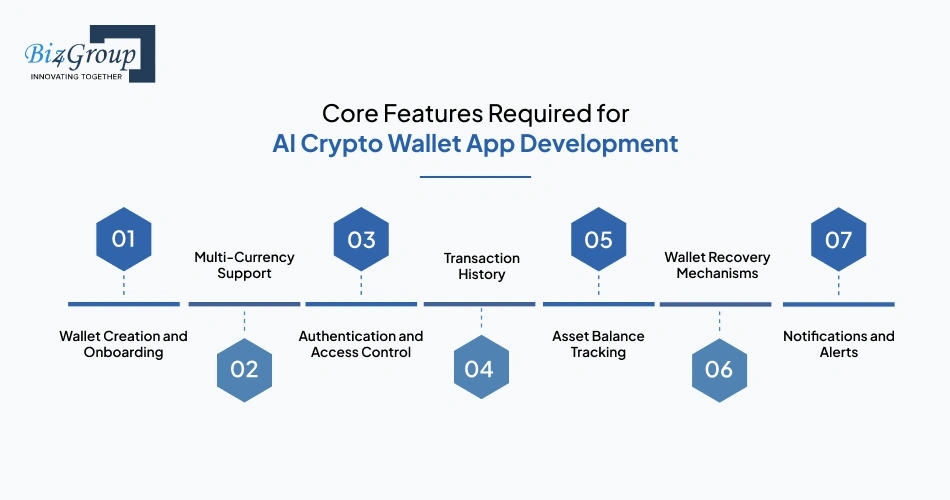
Every cryptocurrency wallet application needs a foundation of features that allow users to manage digital assets securely and interact with blockchain networks.
Core Feature |
Purpose |
|---|---|
Wallet Creation and Onboarding |
Allows users to create and access wallets |
Multi-Currency Support |
Manages multiple cryptocurrencies from one interface |
Authentication and Access Control |
Protects accounts and wallet access |
Transaction History |
Tracks incoming and outgoing transactions |
Asset Balance Tracking |
Displays real-time asset holdings |
Wallet Recovery Mechanisms |
Supports account recovery and backup |
Notifications and Alerts |
Keeps users informed about account activity |
These features form the foundation of any digital asset wallet. Before adding advanced AI capabilities, blockchain integrations, or enterprise controls, the core user experience and security layers should be stable and reliable.
For teams thinking, we are a fintech startup and want to develop an AI crypto wallet app with multi-currency support, AI-driven portfolio insights, and transaction monitoring, the AI layer becomes one of the biggest product differentiators. These features help users understand wallet activity, identify risks, and make more informed financial decisions.
Key AI features include:
Similarly, requirements that come of out queries like 'I want to build an AI crypto wallet app with predictive transaction intelligence and fraud prevention features' typically require transaction analytics, behavioral analysis, anomaly detection, and ongoing AI model development to process blockchain activity in real time.
These capabilities move a cryptocurrency wallet application beyond storage and transactions by providing intelligence that helps users manage assets more effectively.
Blockchain features determine how users interact with assets, networks, and decentralized applications beyond basic wallet operations.
Key blockchain features include:
As blockchain ecosystems continue to expand, many teams prioritize multi-chain wallet support early to avoid rebuilding infrastructure when new blockchain networks need to be added later.
These features increase wallet utility and allow users to participate in a broader range of Web3 activities from a single platform.
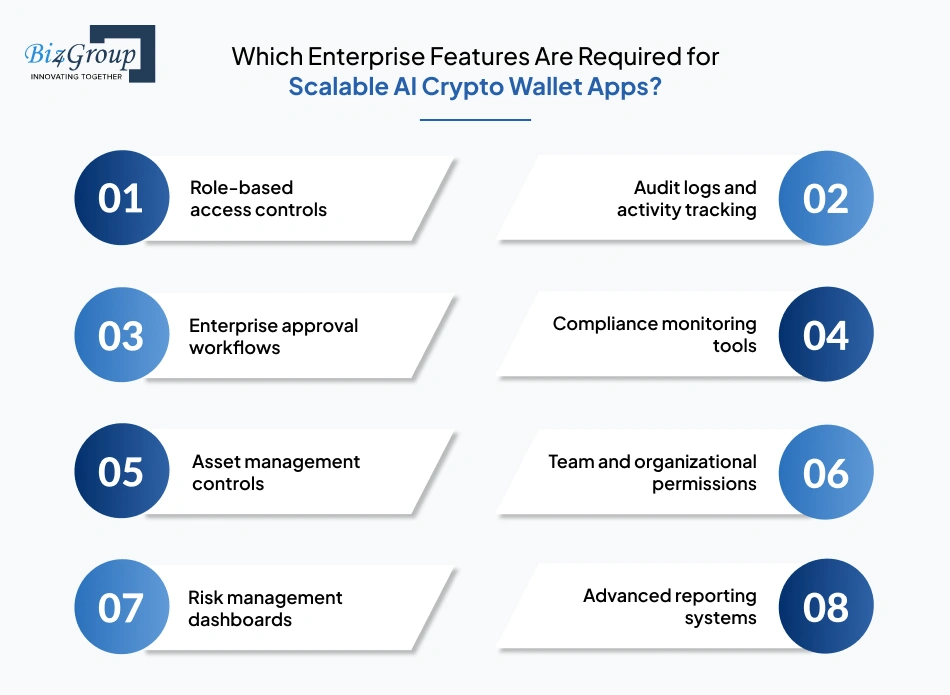
Enterprise wallet products often require additional controls, visibility, and governance capabilities that go beyond the needs of consumer-facing applications.
Key enterprise features include:
Organizations building enterprise crypto wallet solutions often combine these capabilities with AI consulting services to support compliance, governance, operational visibility, and large-scale asset management requirements.
These features become increasingly important as transaction volumes, user counts, and organizational complexity grow.
Product planning often begins with goals such as I want to develop an AI crypto wallet app for my fintech startup with secure multi-currency management and portfolio analytics. In these situations, launching with the right feature set is usually more important than launching with the largest feature set.
AI Crypto Wallet MVP Features |
Later-Stage Features |
|---|---|
Wallet creation and onboarding |
Advanced fraud detection |
Multi-currency support |
Cross-chain asset transfers |
Authentication and recovery systems |
Staking and token swapping |
Transaction history |
Smart contract wallet capabilities |
Asset balance tracking |
Enterprise access controls |
Basic portfolio analytics |
Advanced predictive analytics |
Transaction monitoring |
Agentic automation workflows |
Notifications and alerts |
Institutional asset management tools |
A successful MVP focuses on secure asset management, usability, and a limited set of AI-powered capabilities that provide immediate value. Advanced blockchain functionality, enterprise controls, and automation features can be introduced after validating demand and product-market fit.
Feature selection directly affects development cost, infrastructure requirements, security complexity, and scalability. Most successful AI crypto wallet platforms start with strong core functionality, introduce AI capabilities that solve clear user problems, and expand into advanced blockchain and enterprise features as adoption grows.
Develop AI crypto wallet app solutions with the right architecture, blockchain integrations, and AI capabilities from day one.
Start Building Your AI Crypto WalletThe tech stack behind an AI crypto wallet app must support blockchain connectivity, AI processing, security, scalability, and real-time transaction handling. For teams thinking I am planning to create an AI-powered crypto wallet platform and need guidance on development cost, blockchain integration, and AI features, the architecture usually consists of six layers: frontend, backend, blockchain infrastructure, AI systems, security infrastructure, and operational tooling.
The frontend handles wallet interactions, asset visibility, transaction workflows, and AI-powered insights.
Layer |
Common Technologies |
|---|---|
Mobile Development |
React Native, Flutter |
Web Development |
React.js, Next.js |
State Management |
Redux, Zustand |
Wallet Connectivity |
WalletConnect, Web3Modal |
UI Components |
Material UI, Tailwind CSS |
React Native is commonly used for cross-platform mobile wallet applications, while ReactJS development and NextJS development are frequently chosen for web dashboards, admin portals, and browser-based wallet interfaces.
The backend manages wallet operations, blockchain communication, transaction processing, user management, and business logic.
A typical backend stack includes:
This layer becomes increasingly important when building AI-powered transaction monitoring, portfolio analytics, and blockchain wallet development workflows.
Multi-chain support allows users to manage assets across different blockchain ecosystems from a single wallet interface. Common blockchain integrations include:
Supporting multiple chains early can simplify future expansion and improve user adoption for products targeting broader crypto ecosystems.
AI systems process transaction data, detect anomalies, generate portfolio insights, and support personalized recommendations.
AI Function |
Infrastructure Components |
|---|---|
Transaction Analysis |
Machine learning models |
Fraud Detection |
Behavioral analytics systems |
Portfolio Insights |
Analytics engines |
Risk Scoring |
Predictive models |
User Recommendations |
Personalization systems |
AI workloads such as transaction analysis, fraud detection, portfolio insights, and predictive modeling are commonly built using Python development because of its mature machine learning ecosystem and extensive framework support.
Companies investing in AI integration services often use these systems to support AI-powered transaction monitoring, machine learning fraud detection in crypto, and AI portfolio management crypto capabilities.
Security should be built into every layer of the wallet platform. Key components include:
Security architecture directly affects regulatory compliance, asset protection, and user trust.
Operational infrastructure helps maintain uptime, performance, and system visibility after launch.
Infrastructure Area |
Common Tools |
|---|---|
Containerization |
Docker |
Orchestration |
Kubernetes |
Cloud Hosting |
AWS, Azure, Google Cloud |
Monitoring |
Prometheus, Grafana |
Logging |
ELK Stack |
CI/CD |
GitHub Actions, GitLab CI/CD, Jenkins |
Teams that hire AI developers for crypto wallet projects often include DevOps planning early because AI systems, blockchain integrations, and transaction processing services require continuous monitoring and maintenance.
Create AI crypto wallet application experiences with multi-currency support, portfolio insights, and secure asset management.
Discuss Your Wallet RequirementsBuilding a secure AI crypto wallet app requires protection across private keys, smart contracts, AI systems, APIs, user authentication, and blockchain infrastructure. Security should be planned from the architecture stage because fixing weaknesses after launch is often more expensive and difficult.
Private keys control access to digital assets, making them one of the most important parts of any cryptocurrency wallet application. Keys should never be stored in plain text or exposed through application code. Most modern wallet products use Multi-Party Computation (MPC), hardware security modules (HSMs), encrypted storage, or secure enclaves to reduce the risk of unauthorized access and asset theft.
When we are planning to create an AI crypto wallet app for our users and want to ensure compliance, security, and predictive analytics features, the AI layer introduces additional risks that traditional wallet apps do not face. These risks can include manipulated AI models, prompt injection attacks, poisoned training data, unauthorized access to analytics systems, and inaccurate predictions. AI-powered transaction monitoring and fraud detection systems should be reviewed regularly to ensure they continue producing reliable results.
Smart contracts are commonly used for staking, token swaps, account abstraction, and automated wallet functions. A flaw in a smart contract can expose user funds or disrupt wallet operations. Automated testing, code reviews, formal verification, and independent security audits help identify vulnerabilities before deployment.
Threat modeling is the process of identifying how attackers could target a wallet platform before it goes live. This includes evaluating risks across authentication systems, private key management, blockchain integrations, APIs, AI systems, and backend services. Many teams working with a custom software development company include threat modeling during architecture planning to identify potential attack paths early.
Most blockchain networks currently use cryptographic standards that remain secure against today's computing capabilities. However, advances in quantum computing could eventually challenge some of these methods. While most wallet products do not need quantum-resistant cryptography today, teams building long-term digital asset platforms should monitor developments in this area and evaluate future adoption when needed.
Secure AI crypto wallet development requires protecting assets, transactions, user identities, smart contracts, and AI systems at the same time. As wallet platforms introduce more automation, analytics, and features powered by generative AI, security requirements extend beyond blockchain infrastructure and into the AI systems that support the user experience.
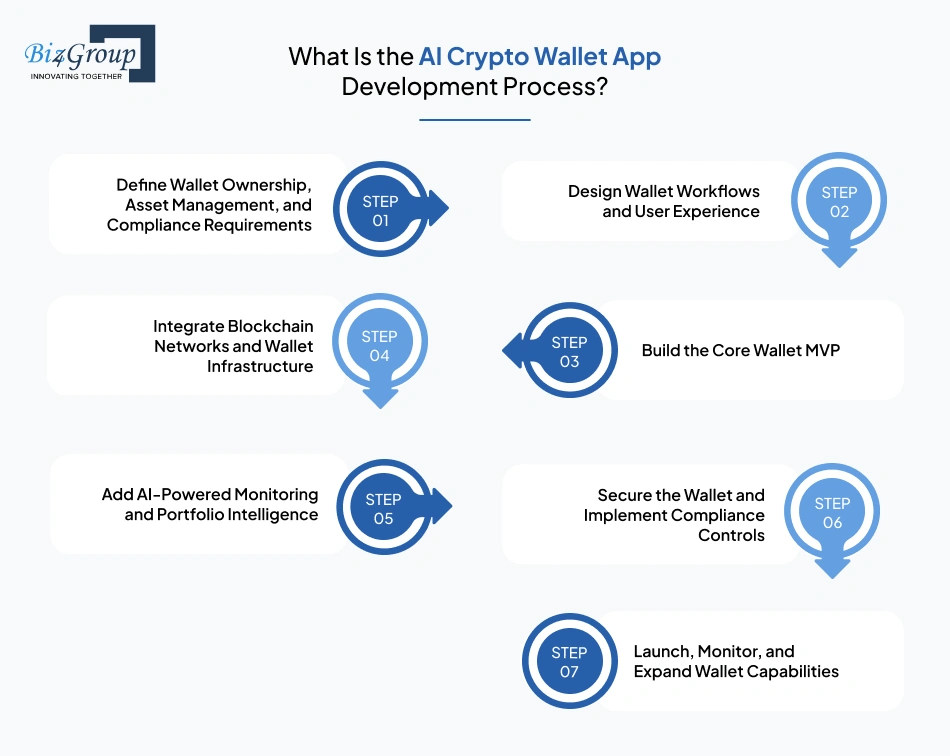
AI crypto wallet app development requires more than connecting a wallet to blockchain networks and adding AI features later. Teams need to make decisions around asset custody, blockchain infrastructure, AI capabilities, compliance requirements, and security architecture before development begins. A structured process helps reduce rework, control costs, and create a wallet platform that can scale as user adoption grows.
The first step is deciding how users will own and manage assets within the platform. This includes selecting a custodial, non-custodial, or MPC-based architecture, identifying supported cryptocurrencies, and understanding the compliance obligations attached to each model.
Key activities include:
These decisions influence the architecture, security model, feature roadmap, and overall development cost.
Wallet products succeed when users can manage assets easily and securely. Before development begins, teams should define how users will create wallets, recover accounts, view assets, approve transactions, and interact with AI-powered insights.
Key activities include:
Strong UI/UX development is especially important because users regularly interact with transactions, balances, portfolio insights, and security controls.
Also read: Top UI/UX design companies in USA
Most businesses should avoid launching with every planned feature. Many startups use MVP development services to validate user demand and product-market fit before investing in advanced blockchain or AI functionality.
A practical AI crypto wallet MVP typically includes:
Launching with a focused feature set makes it easier to collect user feedback and prioritize future development.
Also read: 12+ MVP Development Companies in USA to Launch Your Startup in 2026
Once the MVP foundation is established, the next step is connecting the wallet to blockchain ecosystems and supporting asset management across multiple networks.
Key activities include:
This stage forms the foundation for Web3 wallet development, DeFi integrations, and multi-chain wallet support.
This is where the wallet begins to differentiate itself from traditional cryptocurrency wallet applications. AI systems should work directly with wallet activity and blockchain data to generate useful insights and improve decision-making.
Key activities include:
The objective is to help users understand risks, monitor assets, and make informed decisions without adding unnecessary complexity to the wallet experience.
Security and compliance should be validated before launch because both directly affect user trust and operational risk.
Key activities include:
At this stage, teams should verify that security controls protect both blockchain infrastructure and AI-powered systems.
Also Read: 15+ Software Testing Companies in USA in 2026
After launch, the focus shifts from development to optimization. Monitoring real-world usage helps identify performance issues, security concerns, and opportunities for future growth.
Key activities include:
As adoption grows, the wallet can evolve from a basic digital asset wallet into a more advanced platform for portfolio management, automation, and intelligent asset monitoring.
Businesses that build AI-powered crypto wallet platform solutions can improve engagement through personalized insights, monitoring, and automation.
Explore AI Wallet DevelopmentOne of the first decisions in AI crypto wallet app development is whether to build the wallet infrastructure yourself or use existing wallet providers and blockchain services. This decision affects development cost, launch timelines, customization options, security controls, and how much of the platform you manage internally.
Most AI crypto wallet projects follow one of three approaches.
Approach |
Description |
|---|---|
Existing Wallet Infrastructure |
Uses third-party wallet SDKs, APIs, custody services, and blockchain providers |
Hybrid Infrastructure |
Combines third-party services with custom-built wallet components |
Custom Infrastructure |
Builds wallet systems, blockchain integrations, and security layers from scratch |
Each option offers a different balance of speed, flexibility, and long-term control.
Using existing wallet infrastructure allows businesses to launch faster because many core wallet functions are already available through third-party providers.
Advantages:
Limitations:
For many startups building a cryptocurrency wallet application, existing solutions provide enough functionality to validate the product before investing in custom development.
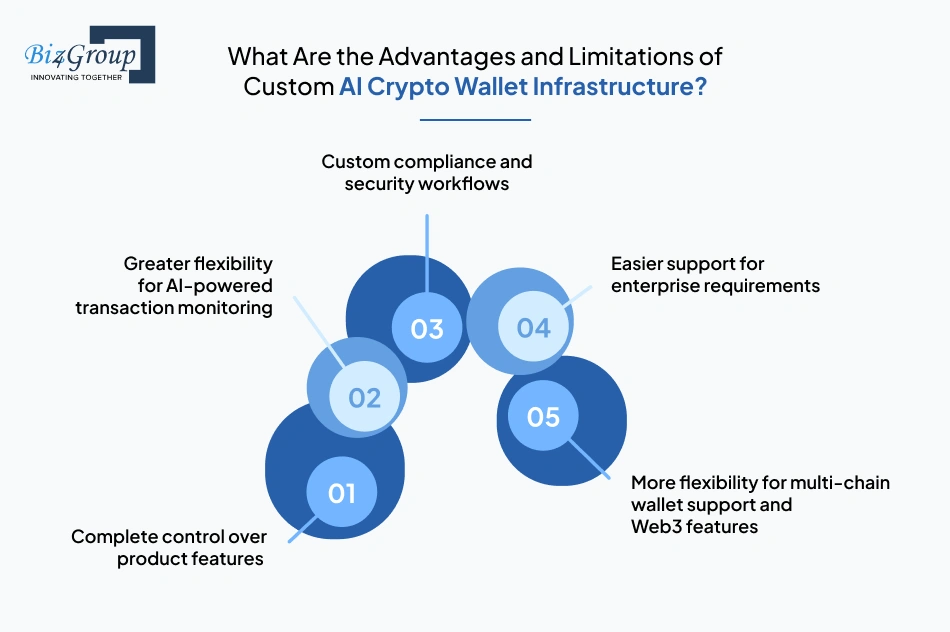
Custom infrastructure gives businesses full ownership of wallet functionality, blockchain integrations, AI systems, and security architecture.
Advantages:
Limitations:
This approach is often chosen when the wallet itself is a core part of the business rather than a supporting feature.
The best option depends on business goals, budget, and how much customization the product requires.
If You Want To... |
Recommended Approach |
|---|---|
Launch quickly |
Existing wallet infrastructure |
Validate an MVP with limited investment |
Existing wallet infrastructure |
Add AI capabilities to an existing wallet product |
Hybrid infrastructure |
Build a unique wallet experience |
Hybrid or custom infrastructure |
Support enterprise workflows and advanced controls |
Custom infrastructure |
Create proprietary AI and blockchain capabilities |
Custom infrastructure |
Businesses focused on rapid launch often start with existing solutions and move toward custom development as the product grows. Companies building highly specialized wallet platforms may choose custom infrastructure earlier, especially when advanced AI features, unique security controls, or proprietary asset management workflows are part of the roadmap.
Teams evaluating custom wallet infrastructure often work with a software development company in Florida to assess architecture requirements, security considerations, and long-term maintenance needs before committing to a build strategy.
Lessons learned from business app development using AI can also help when planning AI-powered transaction monitoring, portfolio analytics, and other intelligence features that rely on scalable data and machine learning systems.
The right choice comes down to balancing speed, cost, customization, and long-term product goals. A solution that works for an MVP may not be the right fit for an enterprise crypto wallet platform handling large transaction volumes and complex operational requirements.
Develop AI crypto wallet platform with blockchain integration, scalable architecture, and secure backend systems.
Talk to Our AI ExpertsCompliance requirements affect how users sign up, how transactions are reviewed, how assets are managed, and what controls need to be built into the wallet. The exact requirements depend on whether the wallet is custodial or non-custodial, which services it offers, and how it handles user transactions and identity verification.
Compliance requirements can vary significantly depending on who controls the private keys and who is responsible for managing user assets.
Compliance Area |
Custodial AI Crypto Wallet Apps |
Non-Custodial AI Crypto Wallet Apps |
|---|---|---|
Private Key Control |
Platform controls keys |
User controls keys |
Regulatory Requirements |
Higher |
Lower |
KYC Requirements |
Often required |
Depends on functionality |
AML Monitoring |
Commonly required |
Depends on business model |
User Asset Responsibility |
Platform |
User |
Compliance Infrastructure |
More extensive |
Typically less extensive |
Custodial wallets usually face more compliance requirements because the platform is responsible for holding and managing user assets. Non-custodial wallets generally face fewer requirements, although services such as staking, swapping, and fiat on-ramps can increase compliance responsibilities.
Know Your Customer (KYC) and Anti-Money Laundering (AML) requirements help verify user identities and identify suspicious financial activity. These requirements are usually handled through identity verification, sanctions checks, transaction reviews, and risk assessment systems.
AI-powered transaction monitoring can help identify unusual activity, flag high-risk transactions, and support fraud detection efforts. Automated monitoring also makes it easier to review larger transaction volumes without relying entirely on manual checks.
The Financial Crimes Enforcement Network (FinCEN) oversees certain digital asset activities in the United States. Whether an AI crypto wallet product falls under FinCEN requirements often depends on its custody model, transaction handling processes, and the services it provides.
Custodial wallet providers may need to determine whether they fall under money services business (MSB) rules and whether registration, reporting, and transaction review requirements apply. These requirements can directly affect onboarding processes, reporting systems, and compliance controls built into the platform.
Many AI crypto wallet platforms eventually expand beyond the US market, which introduces additional compliance requirements. Different countries may have their own rules for crypto transactions, user privacy, identity verification, and financial reporting.
Expansion into markets such as the European Union may introduce requirements related to MiCA, GDPR, and local digital asset regulations. Businesses planning international growth should evaluate these requirements early to avoid making major changes after launch.
Similar compliance planning approaches are often used by the top AI development companies in Florida when building AI-powered financial platforms that operate across multiple regions.
Compliance requirements affect wallet features, user onboarding, transaction reviews, reporting systems, and day-to-day operations. Addressing these requirements early helps reduce regulatory risk and creates a stronger foundation for scaling an AI crypto wallet platform over time.
Principles used in AI assistant app design can also improve how compliance alerts, risk notifications, and verification requests are presented to users, making these processes easier to understand and complete.
Planning to develop AI crypto wallet app solutions? Validate costs, infrastructure, security needs, and feature scope before building.
Get Your Project Estimate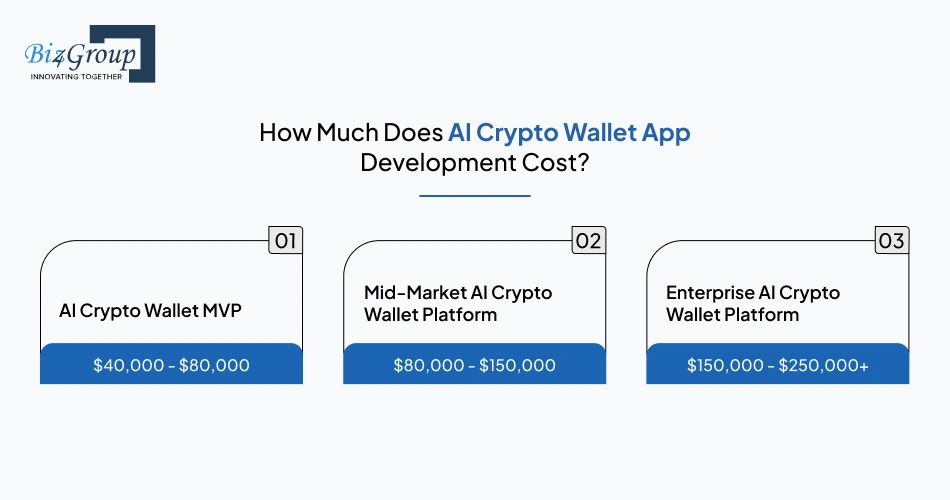
AI crypto wallet app development usually costs between $40,000 and $250,000+, depending on the wallet architecture, AI features, blockchain integrations, security controls, compliance requirements, and overall product complexity. These numbers should be treated as ballpark estimates because every project has different technical and business requirements.
Project Type |
Estimated Cost Range |
Typical Scope |
|---|---|---|
AI Crypto Wallet MVP |
$40,000 - $80,000 |
Core wallet features, multi-currency support, transaction monitoring |
Mid-Market AI Crypto Wallet Platform |
$80,000 - $150,000 |
Multi-chain support, AI insights, staking, stronger security |
Enterprise AI Crypto Wallet Platform |
$150,000 - $250,000+ |
Custom infrastructure, enterprise controls, compliance systems |
Costs increase as you add custom blockchain integrations, AI capabilities, security controls, compliance features, and enterprise-grade functionality.
AI crypto wallet development costs come from several areas, including infrastructure, blockchain integrations, AI systems, security, and compliance.
Component |
Typical Share of Total Budget |
|---|---|
Infrastructure and Backend Systems |
20% - 25% |
Blockchain Integration |
20% - 25% |
AI Systems and Analytics |
15% - 25% |
Security Architecture |
15% - 20% |
Compliance and Regulatory Features |
10% - 15% |
UI/UX and Frontend Development |
10% - 15% |
For teams saying "we are evaluating development partners for AI crypto wallet apps and need cost estimates and tech stack guidance," cost estimates become much clearer once you know which blockchains, AI features, security controls, and compliance requirements the wallet needs.
The largest budget increases usually come from custom blockchain integrations, fraud detection systems, portfolio analytics, MPC implementation, and enterprise compliance features.
Development is only part of the budget. Running a crypto wallet platform also creates ongoing costs after launch. Common hidden costs include:
These costs should be included in long-term planning because they continue throughout the life of the product.
Development costs can vary significantly depending on whether the product is built by an internal team or an external development partner.
Development Approach |
Cost Impact |
Key Considerations |
|---|---|---|
In-House Development |
Higher |
Greater control, higher hiring costs, longer team-building timeline |
Outsourced Development |
Lower to Moderate |
Faster execution, access to blockchain and AI expertise |
Hybrid Model |
Moderate |
Internal ownership combined with external technical support |
Many startups outsource development because hiring blockchain engineers, AI specialists, security experts, and DevOps professionals internally can take significant time and budget.
Some organizations that started as an AI chatbot development company have expanded their expertise into blockchain platforms, financial software, and AI-powered product development.
A hybrid model is often a practical middle ground for businesses that want to keep product ownership in-house while accelerating delivery with external specialists.
Overall, there is no fixed price for AI crypto wallet app development. The final budget depends on the wallet architecture, supported blockchains, AI capabilities, security model, compliance requirements, and feature set.
Concepts used in AI chatbot integration projects can also influence how wallet platforms deliver transaction alerts, portfolio insights, and user notifications, especially when AI-generated recommendations become part of the user experience.
Before building an AI crypto wallet app, a few important decisions need to be made. These decisions affect development cost, timelines, features, security requirements, and long-term scalability. Defining them early helps create a clearer roadmap and reduces the risk of major changes during development.
Start by defining who will use the wallet and what value the product should deliver.
Decision Area |
Questions to Answer |
|---|---|
Target Users |
Retail investors, enterprises, institutions, or Web3 users? |
Primary Use Case |
Asset management, DeFi access, payments, trading, or portfolio tracking? |
Revenue Model |
Subscription, transaction fees, premium features, or enterprise licensing? |
Geographic Markets |
US only or international expansion planned? |
AI Capabilities |
Monitoring, fraud detection, portfolio insights, or predictive analytics? |
A wallet focused on AI-powered monitoring and portfolio insights will require different features and infrastructure than a wallet designed mainly for storing digital assets.
A few technical decisions have a major impact on development effort and cost.
When businesses say I want to find a vendor to build an AI-powered crypto wallet app with blockchain integration and multi-currency support, these decisions should be made early because they directly affect project estimates and development timelines.
Security and compliance requirements should be identified early because they affect wallet architecture, user onboarding, and transaction handling. Common planning areas include:
Businesses often begin their vendor search with requirements such as we are looking for companies that develop AI crypto wallet apps with secure architecture and compliance in USA or I need a company that can develop an AI crypto wallet app with AI-driven insights and secure backend. Defining these requirements early helps avoid costly architecture changes later.
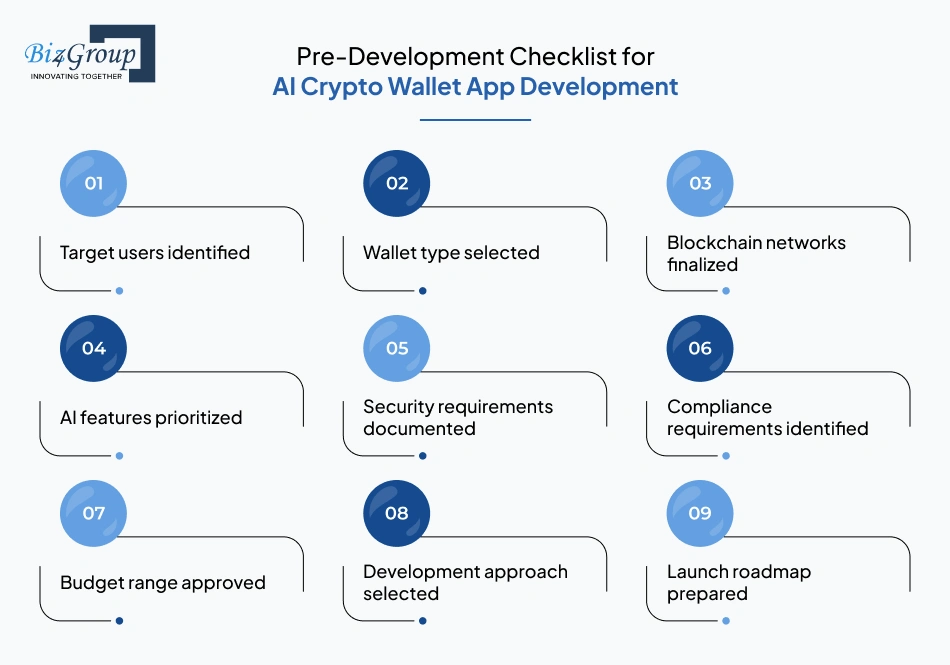
Before engaging a development team, make sure the following decisions have been documented:
Checklist Item |
Status |
|---|---|
Target users identified |
☐ |
Wallet type selected |
☐ |
Blockchain networks finalized |
☐ |
AI features prioritized |
☐ |
Security requirements documented |
☐ |
Compliance requirements identified |
☐ |
Budget range approved |
☐ |
Development approach selected |
☐ |
Launch roadmap prepared |
☐ |
Completing this checklist before speaking with vendors can help speed up planning and improve estimate accuracy.
Build AI-powered crypto wallet platform solutions with multi-chain support, fraud detection, and AI-driven portfolio analytics.
Start Your Development Journey TodayBuilding an AI crypto wallet requires expertise in blockchain development, AI systems, security, compliance, and scalable backend architecture.
Whether we are evaluating vendors to build an AI-powered crypto wallet app with real-time monitoring, fraud detection, and personalized insights or we want end-to-end AI crypto wallet app development services for fintech startups and enterprises, Biz4Group LLC supports the entire development lifecycle, from product planning and architecture design to development, deployment, and ongoing support.
Biz4Group LLC has experience building blockchain applications, AI-powered platforms, fintech products, and enterprise software solutions.
The team has also worked on related domains like AI crypto trading bot development, providing practical experience with blockchain data, AI-driven decision systems, transaction analytics, and secure financial applications.
This experience helps businesses build secure crypto wallet platforms that support AI-driven insights, transaction monitoring, and long-term scalability.
Experience developing products with capabilities similar to an AI conversation app also helps create intuitive user experiences around portfolio insights, alerts, recommendations, and other AI-powered wallet features.
Building an AI crypto wallet app involves far more than connecting to a blockchain and adding an AI layer. Decisions around custody models, multi-chain support, AI capabilities, security architecture, compliance requirements, and infrastructure all influence the final product, development timeline, and budget.
For most businesses, the challenge is not choosing whether to use AI. The challenge is deciding where AI should create value inside the wallet. Transaction monitoring, fraud detection, portfolio insights, and risk analysis are often more impactful than adding AI features simply because they sound innovative.
The same principle applies to development. A well-scoped MVP with the right architecture usually creates more long-term value than a feature-heavy product built without clear priorities.
If you're planning to build AI software in the Web3 space, start by defining the problem the wallet needs to solve, then work backward into the technology, compliance requirements, and development roadmap. The blockchain and AI stacks can be changed over time. Poor planning decisions are much harder to fix.
Working with an experienced AI app development company can help shorten that learning curve and turn early product assumptions into a practical development plan.
Have an AI Crypto Wallet Idea but Unsure Where to Start? Schedule a strategy call!
AI crypto wallet app development typically costs between $40,000 and $250,000+, depending on the wallet architecture, supported blockchain networks, AI features, security requirements, compliance scope, and level of customization. An MVP usually falls at the lower end of the range, while enterprise platforms with advanced AI capabilities and custom infrastructure require larger investments.
Yes. AI features such as transaction monitoring, portfolio analytics, fraud detection, and personalized insights can be implemented in non-custodial wallets where users retain control of their private keys. The AI layer analyzes wallet activity and blockchain data without taking custody of user assets.
Most new wallet products begin with major blockchain ecosystems such as Bitcoin, Ethereum, Solana, and Polygon. The ideal selection depends on the target audience, supported use cases, transaction volume expectations, and whether the product requires multi-chain wallet support from launch.
AI crypto wallets analyze transaction history, asset allocations, wallet activity, market behavior, and risk patterns to generate portfolio insights. Depending on the implementation, AI models can identify trends, detect unusual activity, highlight concentration risks, and provide personalized asset management recommendations.
Yes. AI crypto wallet apps can integrate with decentralized finance (DeFi) protocols to support activities such as staking, token swaps, liquidity participation, lending, and borrowing. These integrations often require smart contract connectivity, multi-chain infrastructure, and additional security controls.
AI models should be monitored and updated regularly as transaction patterns, user behavior, fraud techniques, and blockchain ecosystems evolve. The update frequency depends on the complexity of the AI features, the amount of transaction data available, and the accuracy requirements of the platform.
One of the most common mistakes is trying to launch with too many features at once. Businesses often achieve better results by starting with a focused wallet MVP, validating user demand, and then expanding into advanced capabilities such as AI-powered transaction monitoring, portfolio intelligence, staking, swapping, and multi-chain support.

with Biz4Group today!
Our website require some cookies to function properly. Read our privacy policy to know more.