 Location :
Orlando, FL, USA
 +1 (407) 714-1616
 info@biz4group.com


 AI Summary Powered by Biz4AI
- An AI IVR for property management answers resident calls, sorts maintenance from emergencies, answers rent questions and hands off to people with the details already captured.
- The most useful first flows are maintenance requests, rent and payment questions, and after-hours coverage.
- Emergencies (fire, gas, flooding) need a hard rule: send callers to 911 or your on-call line, never to a queue.
- It earns its keep only when it writes work orders and notes back into your property management software.
- In one 2026 survey of 1,500 renters, 84% expected a reply from their property manager within 24 hours.
AI IVR for property management works best when it does three jobs: answer the calls that follow a pattern (maintenance, rent, office hours), keep real emergencies out of any queue, and write every request into your property management software so nothing lives only in a voicemail.
Residents call when something is leaking, locked or late, and they rarely call at a convenient time. This blog covers that resident side; whereas the wider picture sits in our guide to real estate IVR system development.
Which property management calls can an AI IVR handle?
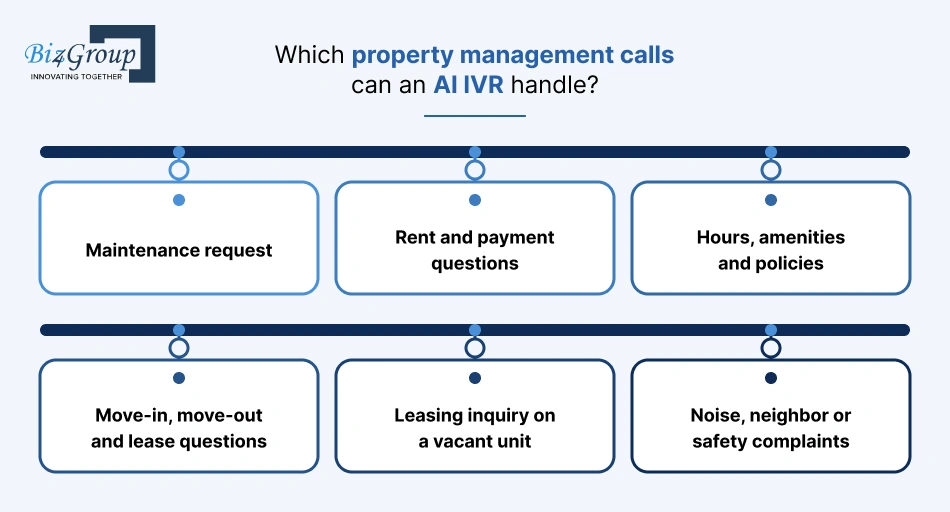
The repetitive ones: maintenance requests, rent and payment questions, office hours and policy questions, move-in and move-out logistics, and inquiries on vacant units. The calls that need judgment or empathy, such as complaints and disputes, go to a person.
|
Call type |
What the IVR does |
Hands to a person when |
|---|---|---|
|
Maintenance request |
Checks for an emergency, captures unit, issue and access, creates the work order |
The caller reports danger or asks for a person |
|
Rent and payment questions |
Gives balance and due date, sends a secure payment link by text |
A dispute, a payment plan or a late-fee waiver comes up |
|
Hours, amenities and policies |
Answers from your approved policy text |
The question isn't in the approved text |
|
Move-in, move-out and lease questions |
Gives checklists and dates, books walkthroughs |
Terms need interpreting or an exception |
|
Leasing inquiry on a vacant unit |
Answers basic questions, books a tour |
The prospect wants to negotiate |
|
Noise, neighbor or safety complaints |
Takes a short message and a callback time |
Always; this is a person's call |
The leasing row follows the same pattern as the calls described in IVR use cases for lead qualification and appointment scheduling, so that page is the one to read for how those calls are scripted.
How should a maintenance call flow work?
Check for danger first, then capture the details in a fixed order, then create the work order and confirm by text. Putting the emergency check before everything else is what keeps a burst pipe from waiting behind a squeaky door.
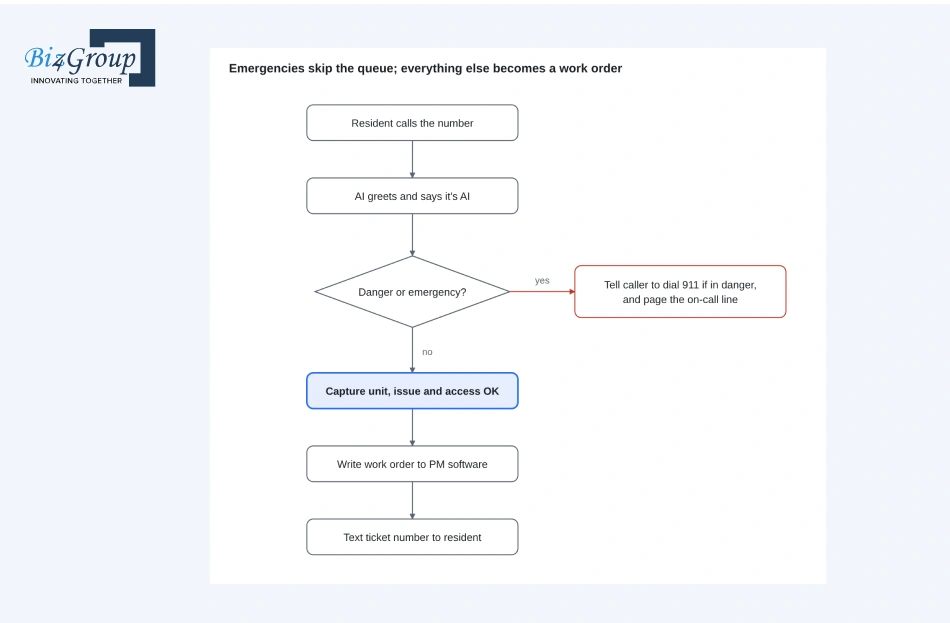
What the IVR should capture before it creates the work order:
- Unit number and the caller's name
- Issue category (plumbing, heating and cooling, appliance, electrical, lock or access, other)
- Severity in plain terms (still working, partly working, not working, water or smoke involved)
- Permission for staff to enter if the resident is out, plus pets
- The best time and number for the technician to reach them
- An optional photo, sent by replying to the confirmation text
If the caller says "agent" at any point, the call should move to a person with a short summary attached, so they don't have to repeat themselves.
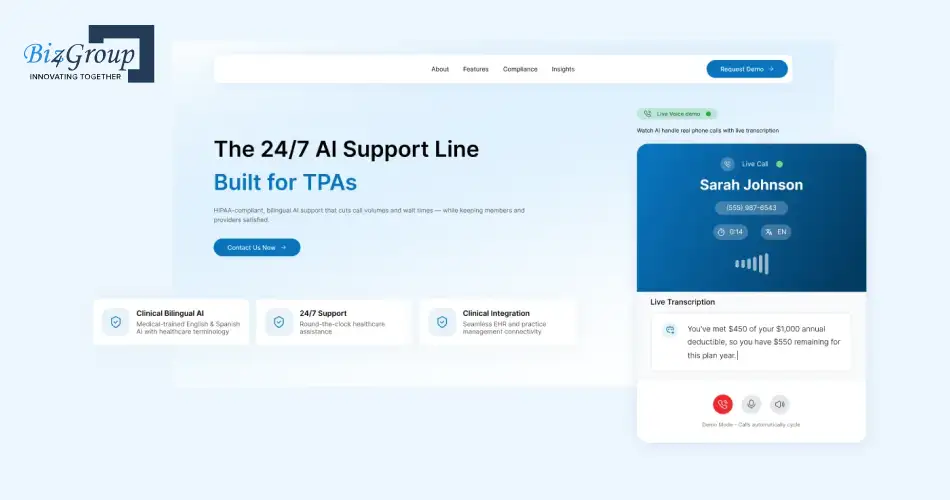
Handing off with a summary isn't theoretical. Biz4Group built the same pattern into an AI-driven IVR and support platform for a healthcare third-party administrator: a voice-only IVR that answers calls around the clock, handles eligibility and claim-status questions, and passes unresolved calls to a person with a summary, in English and Spanish. The industry is different, and the call-handling pattern is the same.
Want this call flow running on your properties?
Biz4Group builds the triage, emergency routing and work-order write-back around your property management software.
Build my maintenance IVRWhat should the IVR say about rent and payments?
Balances, due dates and a secure way to pay, but never a request to read out card numbers. Callers can ask "how much do I owe?" and get an answer from your accounting system, then get a text with a payment link to your resident portal.
Keeping card numbers off the line matters because they can end up in call recordings. The PCI Security Standards Council has published guidance on protecting cardholder data in audio recordings, a good reason to route payments through a hosted payment page or your portal instead of the voice channel.
If you want the IVR to place rent reminders in an AI voice, consent rules apply to outbound calls. They're covered in our guide for call recording and AI disclosure rules for real estate IVR.
Why do phone responsiveness and maintenance matter to renewals?
Because renters tie both to whether they stay. In a 2026 survey of 1,500 US renters run by a property management software vendor, the people satisfied with maintenance were far more likely to plan to renew, and the same held for communication.
|
Finding |
Figure |
|---|---|
|
Renters who expect a reply from their property manager within 24 hours |
84% |
|
Renters who expect a reply the same day or faster |
61% |
|
Renters satisfied with maintenance who plan to renew (vs others) |
57% more likely |
|
Renters satisfied with communication who plan to renew (vs others) |
58% more likely |
|
Renters planning to move between mid-2026 and mid-2027 |
28%, up from 18% in 2025 |
Those numbers come from the vendor's own 2026 renters' report, so read them as a signal rather than a guarantee. The takeaway for your phone line is simple: an answer in the first minute, with a ticket number, beats a callback tomorrow.
How should an AI IVR handle after-hours calls and emergencies?
With one hard rule: anything involving danger goes to 911 and your on-call line, never into a queue, and everything else gets acknowledged and scheduled. The IVR shouldn't try to judge whether a leak is "serious enough" on its own; the script should name the situations that trigger the emergency path.
|
Situation |
What the IVR does |
|---|---|
|
Fire, smoke, gas smell, someone hurt |
Tells the caller to hang up and dial 911, and pages on-call at the same time |
|
Active flooding, sparking, no heat in dangerous cold |
Pages the on-call technician and confirms the callback number |
|
Lockout |
Follows your policy: on-call locksmith, or a callback at opening time |
|
Routine request (dripping tap, slow drain, noisy fan) |
Creates the work order, texts the ticket number and sets a time expectation for the next business day |
|
Complaint or sensitive issue |
Takes a short message and promises a callback |
Your lease, local rules and your insurer decide what counts as an emergency, so have them review the list before it goes live. Many properties also serve residents in more than one language, and the same flow can run in each, as described in why a multilingual IVR matters for US real estate.
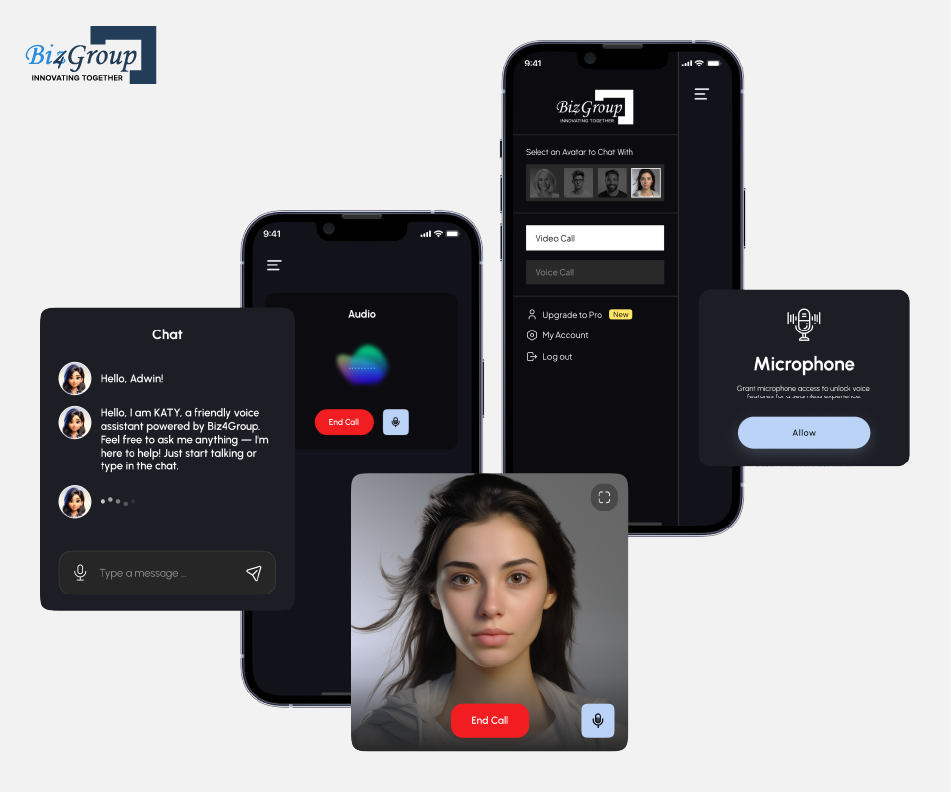
A flow like this lives or dies on how natural the spoken replies sound, especially at 2 a.m. Real-time speech recognition and responses are the same ingredients behind Biz4Group's AI Wizard, an avatar companion app that takes voice calls and chats.
How does an AI IVR connect to your property management software?
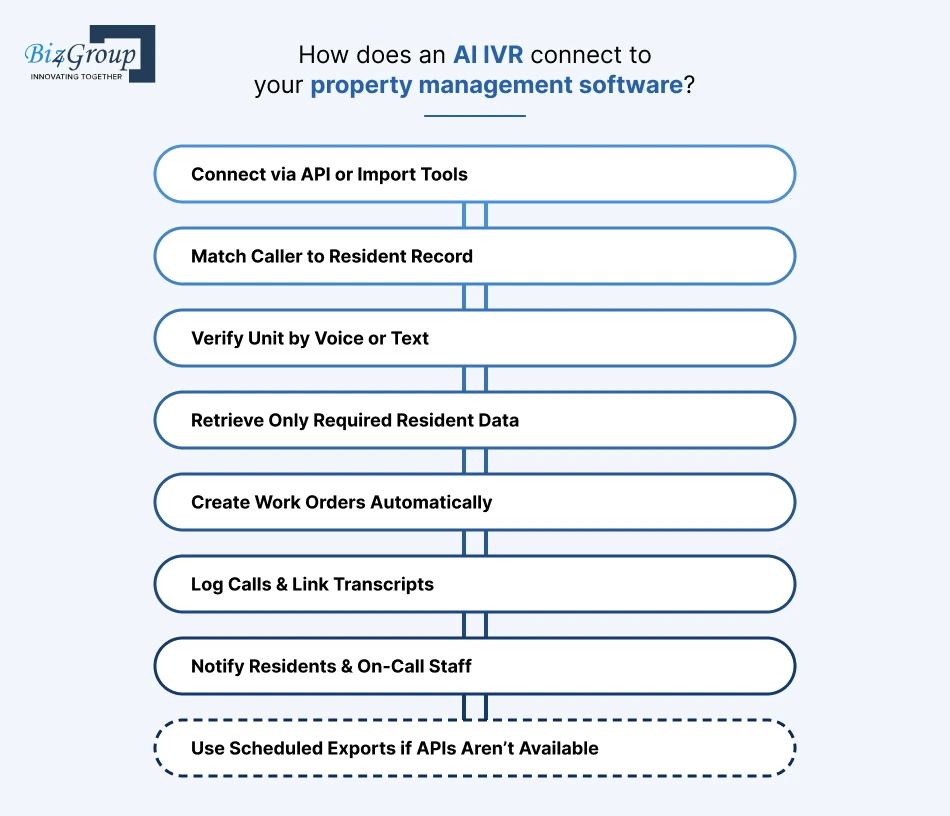
Through the platform's API or import tools: the IVR reads who is calling and which unit they live in, then writes the work order and a call note back. If your software doesn't offer an API, scheduled exports or an email-to-ticket address can do the same job with more delay.
- Match the caller to a resident record by phone number, and confirm the unit by voice or text.
- Read only what the call needs: unit, lease status, balance and due date.
- Write the work order with category, severity and access permission.
- Log a short call note and a link to the transcript.
- Notify the resident by text and the on-call staff by their usual channel.
Software that bundles resident, accounting and maintenance records makes this easier, and AI property management system development shows how those platforms are built.
Leads that come in by phone flow into a CRM instead, a different integration that's covered in a piece on connecting an AI IVR to real estate CRM platforms.
Using a Platform that's hard to connect?
Our team checks your platform's API and import options and plans the integration for you.
Check my integrationHow do you roll it out without upsetting residents?
Start small: one property or one call type, ideally after hours first, and read the transcripts weekly. Residents forgive a slow bot faster than a wrong answer, so widen the scope only when the answers hold up.
- After-hours only. The easiest win, since the alternative is voicemail.
- Maintenance during business hours. Add it once triage and work orders are accurate.
- Rent and policy questions. Connect accounting data and approved policy text.
- Everything else. Add move-in and leasing flows last.
Track calls answered, work orders created, handoffs to people and resident feedback. Whether to rent the phone layer or build your own is a separate decision, weighed in custom AI IVR vs off-the-shelf.
So, what happens when the pipe bursts at 2 a.m.?
The IVR picks up, asks the one question that matters (is anyone in danger?), then either sends the caller to 911 and your on-call line or opens a work order before the caller has finished sighing. Your team wakes up to tickets instead of voicemails.
Want an AI IVR built around your properties, your software and your after-hours rules?
Set an appointment with the AI experts at Biz4Group LLC today!
FAQs
1. Can the IVR approve repairs or spending?
It shouldn't. Let it capture and route, and keep approvals with your staff. If you want it to schedule routine work automatically, set a clear dollar threshold and a list of approved vendors first.
2. What if a caller can't be matched to a unit?
Fall back to name and address, or text a verification code to the number on file. If it still can't match, create a ticket flagged "unverified" so staff can confirm it before anyone is dispatched.
3. How does it deal with an upset resident?
By not arguing. Set the flow to move to a person as soon as the caller says they're frustrated, repeats themselves or asks for a manager, and pass along a summary so the resident doesn't have to start over.
4. How do you make sure staff act on after-hours tickets?
Send a morning digest of overnight requests sorted by severity, and track how long each one waits. Without that habit, the IVR just creates a tidy backlog.
5. Can it take calls from property owners too?
Yes, as a separate call type. Owners ask about statements, vacancies and repair approvals, so route those to their account manager with the owner's property list already pulled up.
