 Location :
Orlando, FL, USA
 +1 (407) 714-1616
 info@biz4group.com


 AI Summary Powered by Biz4AI
- Custom AI avatar development cost typically falls between $10,000 and $150,000+, with product scope deciding where a project lands within that range.
- Beyond the build, an AI avatar development budget needs room for hidden costs like data retraining, API licensing, and compliance audits that rarely show up in the first quote.
- Team structure, whether in-house, nearshore, offshore, or agency-led, shifts the final cost within the same range rather than adding to it.
- Starting with an MVP-first build lowers the cost to build AI avatar significantly, letting businesses test core features before scaling further.
- Real-world projects like Truman and AI Wizard show how cost optimization strategies work in practice, cutting costs while still delivering measurable business results.
- Biz4Group brings hands-on experience building AI avatars like Truman and AI Wizard, structuring projects around milestones and existing AI models to keep development cost predictable.
I am planning to create a custom AI avatar for my business but unsure how much investment it will actually require. If this is what you are thinking, you are not alone. Many businesses today are exploring AI avatars but want a clear understanding of the actual cost before getting started.
How much does it really cost to build a custom AI avatar, and is it worth the investment in a rapidly growing market? As companies and individuals move toward more immersive and personalized digital experiences, understanding AI avatar development cost becomes an important part of planning.
The cost of developing an AI avatar typically ranges between $8,000 and $150,000 or more. This depends on factors such as design complexity, features like voice and facial expressions, level of interactivity, and whether the solution is built in-house or through an external development partner. While the investment may vary, it directly reflects the level of customization and performance required.
Market trends also highlight why businesses are paying attention to this space. The global AI avatar market is projected to grow from USD 0.80 billion in 2025 to USD 5.93 billion by 2032, driven by advancements in natural language processing, computer vision, and generative AI across industries like healthcare, education, entertainment, and customer service.
For businesses evaluating the development cost of an AI avatar, an important decision is whether to outsource or build in-house. Outsourcing can help reduce initial costs and speed up deployment, while in-house development offers greater control but requires a higher investment.
Whether you are a startup aiming to engage customers, a company looking to automate support, or an individual exploring a digital presence, the cost to build an AI avatar for business should be seen as a strategic investment. This guide explores all the cost factors, development stages, and considerations to help you decide if and how you should enter this rapidly expanding market.
AI Avatar Development Cost Estimator – Get a Quick Quote For your AI Avatar
When planning your project, it is important to have a clear idea of the AI avatar development cost before you begin. While exact figures depend on complexity, you can get a quick estimate using a simple formula:
AI Avatar Development Cost = (Features × Development Hours) × Hourly Rate + Integration & Maintenance Costs
This formula provides a reliable way to estimate the cost to create AI avatar, since it considers all the major factors that drive pricing:
- Features: Advanced elements such as voice interaction, facial animation, or multilingual capabilities.
- Development Hours: The total time required for coding, testing, and deployment.
- Hourly Rate: The average cost per hour of the development team, which varies by location and expertise.
- Integration & Maintenance Costs: Ongoing support, updates, and system compatibility.
Example Calculation
Suppose a company wants to calculate the development pricing of AI avatar for a customer-facing solution with voice interaction, facial animation, and multilingual support.
- Features required: 3 major modules
- Development hours: 500 hours
- Hourly rate: $40/hour
- Integration & maintenance: $4,000
Cost = (3 × 500) × $40 + $4,000
Total Cost = $60,000 + $4,000 =
$64,000
This illustrates how the cost of developing AI avatar scales with complexity. A simple chatbot avatar might fall in the $8,000–$10,000 range, while advanced avatars with rich interactivity may reach $50,000+.
For organizations considering the cost to build an AI avatar for business, this estimator gives a quick and realistic view to align budgets and expectations.
Also Read: How to Build an AI App: A Step-by-Step Guide
Start Your AI Avatar Journey Today
Turn your vision into reality with a custom AI avatar built for your business needs.
Get a Free Cost Estimate TodayHow Much Does a Custom AI Avatar Cost Based on Scope?
Project scope decides which range your final number falls into, and the real answer to how much does a custom ai avatar cost usually starts with this one decision, not the smaller details.
|
Scope Tier |
Cost Range |
What's Typically Included |
|---|---|---|
|
Basic AI Avatar |
$10,000 – $35,000 |
MVP builds, one use case, a smaller AI footprint |
|
Moderate Level Custom AI Avatar |
$35,000 – $85,000 |
Multiple features, one deployment channel, moderate integrations |
|
Advanced Level Custom AI Avatar |
$85,000 – $150,000+ |
Multi-use-case, enterprise-wide deployment, deep integrations and compliance needs |
These three tiers set the outer boundaries every cost factor in this guide operates inside, so your final number always traces back to scope first, features second.
What Factors Affect AI Avatar Development Cost?
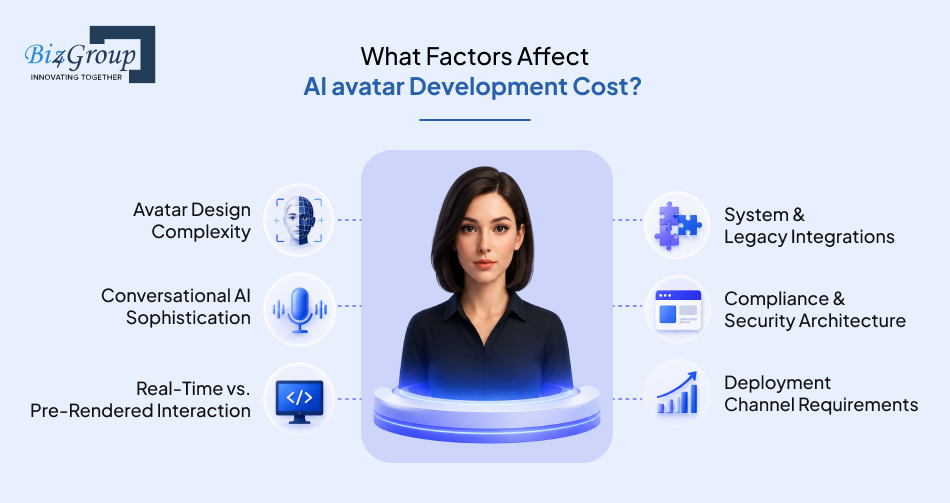
Six factors decide how much an AI avatar actually costs, and each one moves your final number in a different direction, so understanding them upfront makes budgeting far less of a guessing game.
1. Avatar Design Complexity
An avatar's look decides a big part of the price tag. Basic character designs need less time to build, while lifelike faces, natural expressions and smooth body movement take far more design and testing work.
The cost to build a realistic AI avatar sits close to the top of this range, while a simple animated version stays near the bottom.
- Basic 2D avatars: Simple character with limited expressions, cost between $2,500 and $8,000
- Moderate 3D avatars: Better animation and body movement, cost between $8,000 and $18,000
- Hyper-realistic avatars: Lifelike skin, natural expressions and advanced gestures, cost between $18,000 and $35,000
2. Conversational AI Sophistication
How smart your avatar sounds costs just as much as how it looks, sometimes more. Real conversations, memory of past chats and support for multiple languages need custom AI models trained specifically on your business data.
A basic version that uses ready-made language tools keeps AI avatar development pricing low for simple use cases, but it will sound noticeably less natural.
- Pre-trained models: Ready-made conversation ability with limited customization, cost between $2,500 and $9,000
- Custom-trained AI models: Trained on business data for accurate, natural responses, cost between $9,000 and $20,000
- Domain-specific models: Built for one industry with deep personalization, cost between $20,000 and $35,000
This is the build cost only. Retraining the model after launch comes with a separate, ongoing cost.
3. Real-Time vs. Pre-Rendered Interaction
How fast your avatar needs to reply changes the cost by a wide margin. An avatar that plays back a pre-made video answer is cheaper to build than one that replies instantly during a live conversation.
Live replies need extra computing power running in the background at all times, and that is a cost many businesses do not expect.
- Pre-rendered responses: Video-style replies prepared in advance, cost between $1,800 and $6,000
- Near real-time responses: Short delay before the avatar replies, cost between $6,000 and $14,000
- Full real-time interaction: Instant replies during live conversation, cost between $14,000 and $25,000
4. System & Legacy Integrations
Connecting your avatar to the tools your business already runs on is where cost can quietly climb. Integration with e-commerce platforms, booking systems or a CRM takes noticeably more work than a simple chat widget.
Older internal systems that were never built to connect with anything new take even longer to link, and AI avatar integration cost usually climbs the most right here, not at the design stage.
- Single integration: One connected tool such as a chat widget, cost between $1,800 and $6,000
- Multiple modern integrations: CRM, booking or e-commerce connections, cost between $6,000 and $14,000
- Legacy system integration: Older internal tools with no ready-made connection, cost between $14,000 and $25,000
This figure covers the work of building the connection. What you pay each month to keep using the connected service comes later, in a separate part of the budget.
Also Read: Artificial Intelligence in CRM
5. Compliance & Security Architecture
Certain industries cannot treat data protection as optional. AI for healthcare in particular carries strict requirements around patient data, and finance or education businesses face similar rules of their own.
Built-in encryption and secure data handling need to be part of the system from day one, not added after launch.
- Basic data protection: Standard encryption and secure storage, cost between $1,000 and $4,000
- Industry-standard compliance: Data protection rules such as GDPR, cost between $4,000 and $10,000
- Regulated industry compliance: Healthcare or finance-grade rules such as HIPAA, cost between $10,000 and $18,000
This is the one-time cost of building compliance into the system. Regular audits and legal reviews after launch come with a separate, ongoing cost.
Also Read: HIPAA-Compliant AI Healthcare Software Development
6. Deployment Channel Requirements
Where your avatar lives changes what you pay. A single website deployment is the simplest and cheapest option. App integration usually needs its own testing cycle, since a mobile screen behaves differently from a browser window, and every extra place your avatar needs to work adds its own build and testing time on top.
- Single channel: Website deployment only, cost between $800 and $3,000
- Two to three channels: Website and mobile app together, cost between $3,000 and $8,000
- Multi-channel deployment: Website, app, kiosk or VR combined, cost between $8,000 and $15,000
|
Cost Factor |
Overall Cost Impact |
|---|---|
|
Avatar Design Complexity |
$2,500 – $35,000 |
|
Conversational AI Sophistication |
$2,500 – $35,000 |
|
Real-Time vs. Pre-Rendered Interaction |
$1,800 – $25,000 |
|
System & Legacy Integrations |
$1,800 – $25,000 |
|
Compliance & Security Architecture |
$1,000 – $18,000 |
|
Deployment Channel Requirements |
$800 – $15,000 |
This is the real breakdown behind custom AI avatar development cost, not a single flat number pulled out of thin air. Ask what is included in AI avatar development pricing before signing anything, because a quote that skips even one of these points is a quote you cannot fully trust.
What Are the Hidden Costs of AI Avatar Development?
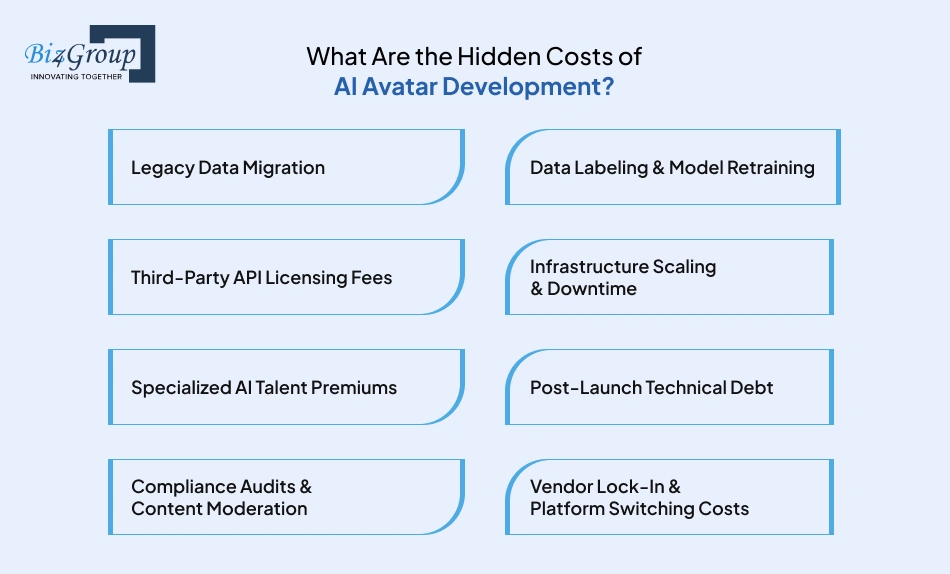
Hidden costs surface after the contract is signed, not before, covering everything a vendor's quote leaves out once your avatar moves from development into daily, real-world use across your business.
1. Legacy Data Migration
Old customer records, product catalogs and past chat logs rarely sit in a format the new system can read right away. Someone has to clean, structure and move all of it before the avatar goes live, and this step alone can quietly raise AI avatar implementation cost before development even starts.
Hidden cost: $1,000 – $15,000, one-time
2. Data Labeling & Model Retraining
An AI model never really finishes learning. New questions, new product lines and new customer behaviour mean it needs fresh, cleaned data on a regular basis to stay sharp. This ongoing work is where AI avatar maintenance and support cost usually comes from, not from anything broken.
Hidden cost: $500 – $20,000 annually
3. Third-Party API Licensing Fees
Every voice engine, translation tool or AI service plugged into your avatar runs on its own billing model. Some charge per message, some charge per minute, and most only get expensive once real usage kicks in.
Hidden cost: $50 – $1,500 monthly
Also Read: A Guide to API Development
4. Infrastructure Scaling & Downtime
More users talking to your AI avatar at once means more computing power working behind the scenes to keep replies quick. When capacity runs short, replies slow down or the avatar goes offline entirely, and this is usually where AI avatar deployment cost quietly grows month over month, long after launch.
Hidden cost: $50 – $2,000 monthly
5. Specialized AI Talent Premiums
Not every developer can build or fine-tune an AI model, and the ones who can charge accordingly. Most initial quotes are priced against general software rates, not the specialised rates AI engineers actually command.
Hidden cost: 15–35% above standard development rates
6. Post-Launch Technical Debt
Bugs that slipped through testing tend to surface once real users start talking to the AI avatar in ways nobody predicted. Fixing them after launch takes real development hours that were never part of the original quote.
Hidden cost: $500 – $15,000
7. Compliance Audits & Content Moderation
Passing a compliance check once does not mean the work is done. Regulated industries need regular audits, legal reviews, and someone keeping an eye on what the avatar actually says to customers day to day. For larger businesses, this is exactly where AI avatar implementation cost for enterprises keeps climbing well after the system goes live.
Hidden cost: $1,000 – $20,000 annually
9. Vendor Lock-In & Platform Switching Costs
Switching platforms later sounds simple until you try doing it. Your data, your trained model and your AI model integrations were all built around one vendor's system, and untangling that takes real time and real money.
Hidden cost: $1,000 – $30,000, one-time, when switching
|
Hidden Cost |
Timing |
Cost Impact |
|---|---|---|
|
Legacy Data Migration |
One-time |
$1,000 – $15,000 |
|
Data Labeling & Model Retraining |
Recurring (annual) |
$500 – $20,000/year |
|
Third-Party API Licensing Fees |
Recurring (monthly) |
$50 – $1,500/month |
|
Infrastructure Scaling & Downtime |
Recurring (monthly) |
$50 – $2,000/month |
|
Specialized AI Talent Premiums |
Recurring (rate-based) |
15–35% above standard rates |
|
Post-Launch Technical Debt |
One-time |
$500 – $15,000 |
|
Scope Creep Costs |
One-time (contingent) |
$500 – $25,000 |
|
Compliance Audits & Content Moderation |
Recurring (annual) |
$1,000 – $20,000/year |
|
Vendor Lock-In & Platform Switching Costs |
One-time (contingent, if switching) |
$1,000 – $30,000 |
These costs stay invisible on day one and reshape your budget well before year one ends. Planning for them now beats discovering them halfway through the project.
How Can You Reduce AI Avatar Development Costs?
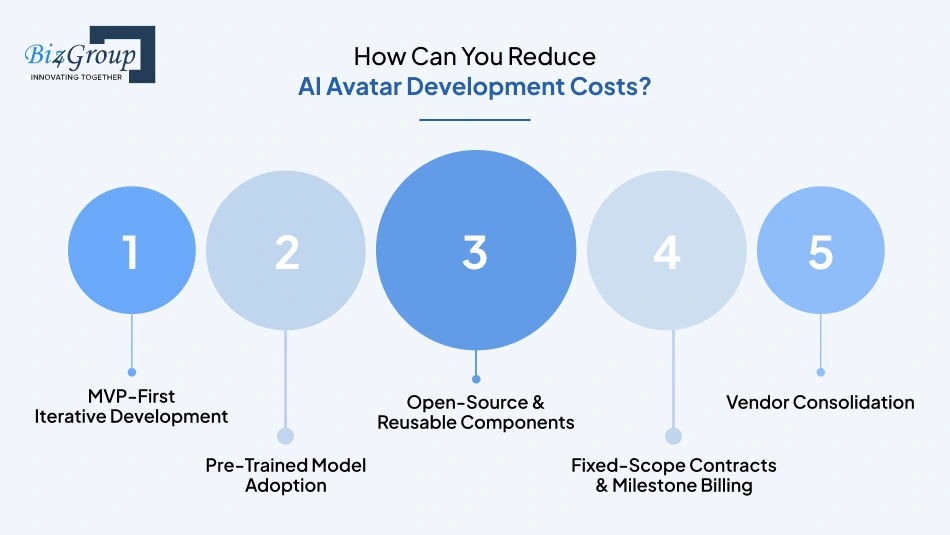
Practical, process-level changes bring your final number down without cutting corners on what your AI avatar delivers, and each one works regardless of which budget tier you started planning around.
1. MVP-First Iterative Development
Building every feature before launch multiplies cost fast, and most of it goes toward features nobody uses in the first few months anyway. This is exactly the strategy behind affordable ai avatar services for startups, where every dollar needs to justify itself before more gets committed.
- Launch with core conversation flows only, add advanced features after usage data comes in
- MVP development services validate the concept before committing to a full build
- Test avatar performance with real users before investing in full personalization.
This approach typically saves businesses between $1,500 and $30,000, depending on how much scope gets trimmed from the initial build.
Also Read: Top MVP Development Companies in USA
2. Pre-Trained Model Adoption
Training an AI model from scratch takes months and a large budget most projects don't have. Fine-tuning an existing foundation model gets you most of the same capability in a fraction of the time and cost.
- Fine-tune existing language models instead of building custom architecture
- Reserve custom training for highly specialised, industry-specific conversations only
- Reuse existing voice and language models rather than building new ones from zero
Adopting a pre-trained model over a fully custom one usually saves between $1,500 to $15,000 across the build.
3. Open-Source & Reusable Components
Not every piece of your avatar needs to be built new. Open-source libraries and pre-built design components cover a large share of standard functionality, and reusing them cuts both build time and UI/UX design cost significantly. Only the pieces unique to your brand need to be designed from scratch.
- Use open-source natural language processing libraries instead of proprietary alternatives
- Apply existing animation rigs and templates rather than building new ones per project
- Save custom design work for brand-specific visual elements only
Reusing open-source and pre-built components typically brings enterprise AI avatar pricing down by $1,000 to $10,000.
Also Read: Top UI/UX Design Companies in USA
4. Fixed-Scope Contracts & Milestone Billing
Open-ended hourly billing leaves room for costs to grow quietly as small requests pile up. Locking the scope early and paying against clear milestones keeps the budget predictable from start to finish, which matters even more for affordable ai avatar generators for small businesses working with a fixed budget.
- Define deliverables and acceptance criteria before development begins
- Tie payments to completed milestones rather than hours logged
- Route new requests through a formal change process instead of informal additions
A fixed-scope contract usually prevents $1,000 to $25,000 in AI avatar development budget that would otherwise show up as scope creep.
5. Vendor Consolidation
Working with several separate vendors for design, AI and integration adds coordination overhead on top of the actual development work. Bringing more of the build under one vendor reduces the back-and-forth and the extra cost that comes with it.
- Combine design, development and integration under a single provider where possible
- Reduce the number of handoffs between teams to avoid duplicated work
- Negotiate bundled pricing across services instead of paying each vendor separately
Consolidating vendors typically saves businesses $500 to $10,000 in coordination and integration overhead.
These moves work together to protect your AI avatar development budget without limiting what the final product can actually deliver for your business over time.
Optimize Your AI Avatar Development Cost
Discover cost-effective strategies with Biz4Group to maximize value without overspending.
Get a Custom QuoteReal World Examples Where Cost was Optimized for AI Avatar Development
Spanning healthcare and wellness to companionship, two project real world implementation answer cost to build ai avatar with real numbers, showing exactly where the spend went down without cutting what the AI avatar delivers.
1. Truman: Wellness Avatar Built Around Existing AI Models
Truman is a wellness avatar built for Dr. Truman Berst, offering personalized health guidance alongside an in-app supplement store. The project used GPT-4 and GPT-3.5 Turbo rather than a fully custom-trained model, keeping AI development inside a predictable range while still supporting natural health conversations.
Integration with e-commerce platforms let users shop for supplements inside the same experience, so the avatar and the store shared one integration budget instead of two.
- A generative AI chatbot handled both health guidance and product recommendations in one system
- Membership plans added recurring engagement without a separate feature build
- Health history tracking reused the same data layer already built for consultations

This combination helped the business cut operational costs by 20 percent after launch, without adding a second AI system to maintain. The complete breakdown of this build is available in the Truman project overview.
2. AI Wizard: Companion Avatar Built on Pre-Trained Tools
AI Wizard is a companion avatar offering voice and video conversations, developed using existing AI engines instead of building animation and speech technology from scratch. D-ID's avatar engine handled the facial animation and lip sync, which kept design cost out of the build entirely.
Seamless conversational support using ChatGPT and Whisper AI covered the natural language and voice recognition side, so neither piece needed custom training from zero. Incremental learning updates let the model improve gradually instead of requiring a full retrain each time new data came in, keeping ongoing maintenance closer to the lower end of that range.
- Built to work across iOS, Android and web from a single React Native codebase instead of three separate builds
- Connected with Reddit, Discord and Facebook, adding reach without new integration work for each platform
- Users can customise their own avatar without extra design work on the development side

Using existing AI engines instead of building each piece from scratch kept the project close to the lower end of what a real-time, multi-platform avatar usually costs. Full project details for this build are documented on the AI Wizard portfolio page.
Both projects prove the same point: reusing proven AI tools and integrations brings real costs down without shrinking what the finished avatar can deliver for the business.
How Does Team Structure Affect Your Development Cost?
Team structure does not add a new cost on top of your development budget. It changes where inside your existing range the final number lands, with one clear exception worth watching closely.
1. In-House Development
Building with an in-house team gives you direct control over every decision, from how the avatar sounds to how quickly changes get made. Finding an affordable ai avatar developer in USA gets harder at this level, since local specialised talent commands premium rates.
- Direct, same timezone communication throughout the project
- Full ownership of code, design assets and trained models
- Faster feedback loops during testing and revisions
In-house teams typically place a project in the upper 60 to 100 percent of whichever budget tier it falls into.
2. Nearshore Development
Nearshore teams sit in a similar time zone, which keeps daily communication close to real-time without the higher price tag of a fully in-house team. For businesses working across US or European hours, this often becomes the middle ground between control and cost.
- Overlapping working hours make live collaboration easier
- Cultural and language alignment reduces miscommunication
- Rates sit meaningfully below in-house without losing responsiveness
Nearshore development typically brings the AI avatar platform cost 15 to 25 percent below in-house pricing, within the same tier.
Also Read: Nearshore Software Development
3. Offshore Development
Offshore teams offer the lowest development rates available, which is why they show up often in enterprise AI avatar pricing conversations where budgets need to stretch across large-scale rollouts. Time zone gaps and less overlap in working hours are the trade-off.
- Significantly lower hourly rates than in-house or nearshore options
- Requires stronger documentation and asynchronous communication practices
- Works best for well-defined, clearly scoped projects
Offshore development typically brings the same AI avatar solution pricing 25 to 40 percent below in-house pricing, within the same tier.
Also Read: Offshore Software Development in 2026
4. Outsourced or Agency Model
An agency brings a managed, ready-to-go team without the overhead of hiring directly, which is part of why AI avatar development cost for enterprises often gets structured this way. Agencies typically charge a margin on top of raw development rates, in exchange for project management and quality oversight already built in.
That blended structure is exactly what Biz4Group LLC applies to AI avatar builds, pairing onshore oversight with nearshore development. As an AI avatar development company in USA, this approach keeps quality consistent while managing cost.
Here what it brings to the table:
- Hands-on delivery experience includes projects such as Truman and AI Wizard
- Core features prioritised first, expanded later based on real usage
- Cost tied to completed milestones, not hours logged
- One point of contact managing the entire build
- Built-in quality checks and project management included
- Faster team assembly than hiring in-house from scratch
Agency-led development typically brings the same project in 10 to 20 percent below in-house pricing, within the same tier.
Also Read: Top 40 Software Development Outsourcing Companies 2026
5. Expedited Delivery Timelines
Compressing a timeline is the one exception to everything above. Rushing a build usually means running design, development and testing in parallel instead of in sequence, and that takes more people working at once, not just faster people.
- Parallel workstreams replace the usual sequential build process
- Overtime and additional developers get added to hit the deadline
- Applies on top of whichever team model is chosen
Expedited delivery typically adds 15 to 25 percent on top of the base cost, regardless of which team model is used.
Here is the same Moderate-tier project priced three different ways, all inside the same $35,000 to $85,000 band.
|
Team Model |
Project Cost |
|---|---|
|
In-house team |
$75,000 |
|
Nearshore team |
$58,000 |
|
Offshore team |
$48,000 |
The scope stayed identical across all three. Only the regional cost of labor changed, and the total never left the range already set for that tier.
Team structure decides where your project sits within the budget you already planned, not a new number added beside it. The right model depends on priorities, not price alone.
Conclusion
From above it is cleared that AI avatars are shaping the future of digital interaction by blending intelligence, personalization, and user-friendly design. They are not just tools but strategic assets that can transform how businesses connect with customers, train employees, and deliver seamless services. Success in AI avatar projects comes from aligning features with business goals, planning carefully, and choosing the right development partner.
Real-world case studies highlight how AI avatars are already driving innovation across healthcare, training, and customer engagement. Companies that adopt this technology today are not only improving efficiency but also gaining a competitive edge in their industries.
Take the next step toward innovation — Book an appointment with Biz4Group today!
FAQ
1. What factors have the biggest impact on the cost of AI avatar development?
Key factors include design complexity, AI model sophistication, personalization features, system integrations, and ongoing maintenance. Each adds to the overall development cost.
2. Does choosing 2D vs. 3D design affect the budget of AI avatar development?
Yes. A simple 2D avatar is more affordable, while 3D or hyper-realistic avatars require advanced modeling and rendering, which increases costs significantly.
3. How does integration with business systems influence the cost of creating an AI avatar?
Basic website or app integration is relatively low-cost, but connecting with CRMs, ERPs, or compliance-heavy systems can raise development expenses considerably.
4. Can outsourcing reduce the pricing of AI avatar development?
Outsourcing to cost-effective markets can lower development rates by 25–40% compared to in-house teams in high-cost regions, making it a smart option for budget control.
5. Are there hidden costs businesses should plan for in AI avatar projects?
Yes. Common hidden costs include licensing fees, cloud hosting, data preparation, security compliance, and continuous retraining of AI models.
6. How can an MVP approach help optimize the building cost of AI avatar?
By launching a minimum viable product with core features first, businesses save money upfront and invest in advanced features only after validating user demand.
