 Location :
Orlando, FL, USA
 +1 (407) 714-1616
 info@biz4group.com


 AI Summary Powered by Biz4AI
- Recording consent follows the stricter state on the call, so a nationwide IVR is safest with an up-front notice on every call.
- Federal law needs one party's consent; about a dozen states want everyone's. California adds lawsuits that reach AI vendors.
- Telling callers they're talking to AI is required in a few states and wise in all of them. Calls your system places with an AI voice also fall under the TCPA.
- Decide who records, who keeps it, and for how long before you sign with any vendor.
- A wording kit and an attorney checklist are included.
Real estate IVR call recording and AI disclosure rules come down to three questions: who has to agree to the recording, what callers must be told about the AI on the line, and who keeps the recording afterward. Your buyers, tenants and sellers call from every state, so the safest build answers all three the same way on every call. This page is the rulebook for that, part of the wider series on AI IVR for real estate.
Which laws apply when an AI IVR records or answers a call?
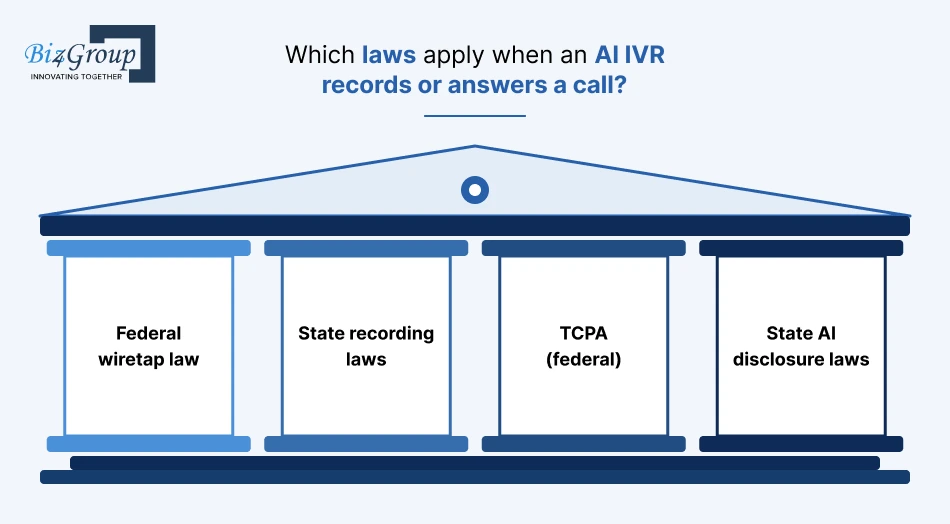
Four layers, and the strictest one that touches the call usually sets your standard: federal wiretap law, state recording laws, the federal rules on calls your system places with an AI voice, and a growing set of state AI disclosure laws.
|
Layer |
What it governs |
The short version |
|---|---|---|
|
Federal wiretap law |
Recording phone calls |
Allowed when one party consents, unless the recording is made to commit a crime or a wrong |
|
State recording laws |
Recording calls in each state |
Some follow the federal one-party rule, about a dozen want everyone's consent |
|
TCPA (federal) |
Calls your system places with an artificial or AI voice |
Consent rules apply to AI voices |
|
State AI disclosure laws |
Telling people they're dealing with AI |
A few states require it in certain situations; more are being added |
The federal layer is the easy one: the statute lets a person intercept a call when they are a party to it or when one party has given prior consent, with an exception for interception made to commit a criminal or tortious act, as the text of 18 U.S.C. § 2511 lays out.
Do you need everyone's consent to record IVR calls?
In about a dozen states, yes. Federal law needs one party's consent, and your business counts as a party, but states with all-party rules want the caller to agree too. Since an IVR can't reliably tell where a caller is sitting, an up-front notice on every call is the practical fix.
|
Aspect |
One-party consent |
All-party consent |
|---|---|---|
|
Who must agree |
Your business is enough |
You and the caller |
|
What the IVR does |
Can record, though a notice is still good practice |
Must tell the caller before recording and let them continue or opt out |
|
Where it applies |
Federal baseline and most states |
A group of states led by California, Florida, Illinois, Pennsylvania and Washington |
A press-freedom nonprofit's state-by-state recording guide lists these as all-party states: California, Delaware, Florida, Illinois, Maryland, Massachusetts, Michigan (in part), Montana, New Hampshire, Pennsylvania and Washington. It also flags the wrinkles that matter for an IVR:
- Some states split the rules by type of conversation, so phone calls can be treated differently from in-person talk (Connecticut and Nevada, for example, are stricter for phone calls).
- A couple of states apply the all-party rule only in particularly private places.
- For a call that crosses state lines, the safe assumption is that the stricter state's law applies, and courts differ on which location counts.
- Warning callers and letting them continue is generally treated as consent, though getting a clear yes is still recommended.
That last point is why the notice belongs in the first few seconds of the call, before the IVR asks for a name, address or property detail. A relocating buyer in Florida calling a Texas brokerage is the case your notice has to survive.
Can an AI vendor's recording tool get you sued in California?
It can raise the risk, and that risk is shared between you and whoever runs the AI on your calls. California's privacy statute makes it unlawful to record confidential communications without all parties' consent, and it carries a private right to sue for statutory damages of $5,000 per violation, according to a privacy nonprofit's overview.
The newer wrinkle is about who counts as the listener. In Ambriz v. Google (N.D. Cal., February 2025), the court let claims go forward against a vendor of AI contact-center software, applying a "capability" test: a provider can draw scrutiny when its technology is able to use call data for its own benefit, even if it never did. Law-firm commentary on the ruling stresses that it came at the early motion stage and that the law on whether actual use is required is unsettled, as a law-firm summary explains.
What that means in practice: before launch, find out who can touch the audio and transcripts, whether any of it can be used to improve the vendor's own models, and say so in the notice. That question looks different depending on whether you rent a platform or own the stack, which the custom vs off-the-shelf comparison walks through.
Want these rules built into your IVR from the first call?
Biz4Group builds the notice, consent capture and human handoff into your AI IVR, ready for your attorney's review.
Build my compliant IVRDo you have to tell callers they're talking to AI?
Not everywhere, and not always, but it is the safer default and it's required in some situations. The laws are patchy, so most teams settle on one honest line at the start of every call.
What the sources describe today:
- California's bot law covers bots used in a commercial transaction with intent to mislead about their artificial identity, per a law-firm roundup of chatbot disclosure laws. The intent element makes it narrower than it sounds, and nothing stops you from disclosing anyway.
- Utah's AI law requires businesses using generative AI with consumers to disclose when someone asks, and to disclose up front in certain regulated occupations, with administrative fines of up to $2,500 per violation, according to a law-firm analysis of the statute.
- More states keep adding rules. One 2026 summary counts 19 states passing chatbot or AI-companion bills out of 146 introduced across the 2025 and 2026 sessions, most aimed at other kinds of bots.
Two habits cover most of the gap: open the call with a plain statement that the caller is speaking with an automated AI assistant, and answer truthfully if anyone asks whether they're talking to a person. If your IVR handles callers in more than one language, the notice has to be given in that language too, which is part of the thinking behind multilingual AI IVR for real estate.
What do the numbers say about lawsuits and caller expectations?
Two trends pull in the same direction: phone-consent lawsuits keep coming, and most callers say they want to be told when AI is involved. A clear human option makes them noticeably more comfortable.
|
Number |
What it measures |
Source type |
|---|---|---|
|
84% |
US consumers who want to know when they're interacting with AI (1,000 surveyed) |
|
|
About 3 in 4 |
Consumers who want to know when content is AI-generated |
Analyst research cited in a trade-press report |
|
4 in 5 |
Consumers willing to use AI customer service when a path to a live rep exists (3,000 surveyed) |
Vendor study, June 2026, same report |
|
55% vs about 25% |
Trust in AI service with a clear human option vs without one |
Same vendor study |
|
41%, rising to 53% |
Customers less likely to use a company that uses AI for service, and when there's no human option |
Same vendor study |
The survey figures come from vendor-run studies, so read them as a direction, not a precise measure. The direction is consistent, though: say it's AI, and keep a human one word away. For an IVR, the "agent" option isn't just a courtesy line in the script. It's the part callers say matters most.
Does the TCPA cover AI voice calls your system places?
Yes. The FCC rules that AI-generated voices count as "artificial" under the TCPA, so calls your system places with an AI voice need the called person's prior express consent unless an exemption applies. The ruling clarified existing rules rather than writing new ones, per the FCC announcement.
The rule is about calls placed to people. A caller who dials your IVR to ask about a listing isn't receiving a call from you, so the consent question lives on the outbound side: callbacks, appointment reminders, rent notices and follow-ups to web leads. Marketing-style calls bring extra expectations on top, including a way to opt out.
The cleanest setup is boring and effective: capture consent at the moment someone fills in a form or texts a number, store it with a timestamp, and let the dialer check it before every call. That connects directly to how AI lead qualification by phone is wired, since the first outbound call is where most teams get into trouble.
Do fair housing rules reach your IVR scripts?
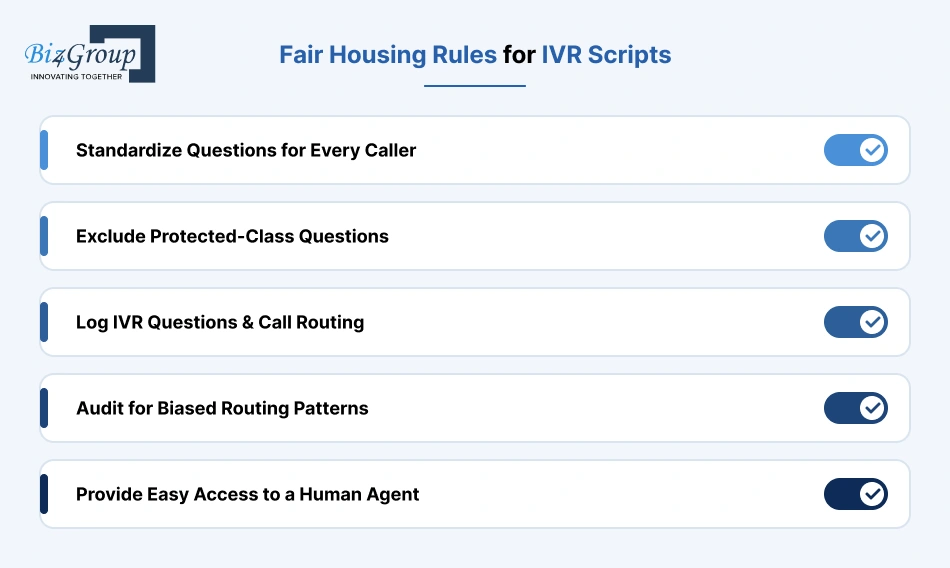
They do wherever the IVR screens, steers or advertises. HUD said in 2024 that the Fair Housing Act applies to AI used in tenant screening and in advertising through online platforms, and that housing providers and screening companies share responsibility for the outcome.
For an IVR, that translates into a few habits:
- Ask every caller the same qualifying questions in the same order.
- Keep questions about family, disability, religion, national origin, race, color or sex out of the script.
- Log what the IVR asked and how it routed each call, so patterns are visible.
- Give callers an easy path to a person.
Tenant lines carry their own mix of maintenance, payment and leasing calls, which is covered in AI IVR for property management.
How long should you keep recordings and transcripts?
Only as long as you have a reason, and the reason should be written down before launch. The sources reviewed for this page don't offer one retention rule to quote for real estate calls, so the job is to set a schedule you can explain.
|
What you keep |
Why you'd keep it |
Decision to make |
|---|---|---|
|
Call audio |
Training, disputes, quality checks |
How long, and who can listen |
|
Transcript |
Search, summaries, coaching |
Whether it lives longer than the audio |
|
Summary or note in the CRM |
Follow-up and service history |
Which fields are allowed to hold personal details |
|
Consent and notice log |
Proof the caller was told |
Usually kept longer than the audio itself |
|
Caller details from the IVR (name, number, address) |
Routing and follow-up |
Deletion on request and after inactivity |
Two extra questions belong on your attorney's list: whether your state's real estate commission treats call recordings tied to a transaction as records you must keep, and how a legal hold pauses deletion. Where summaries flow into your CRM, CRM integration for an AI IVR decides which fields get written and who can see them.
What should the call actually say?
Short, plain and early. Put the notice in the first few seconds, say it in words a caller would use, and always offer a person. Here's starting wording to hand your attorney, not final text:
|
Moment |
Starting wording |
Notes |
|---|---|---|
|
Opening notice |
"Thanks for calling [Brokerage]. You're speaking with an automated AI assistant, and this call may be recorded and transcribed so we can help you better. Say 'continue' to go ahead, or 'agent' to talk to a person." |
|
|
Before any personal question |
"Are you a real person?" "I'm an AI assistant. I can keep helping, or connect you with a team member." |
Answer honestly every time |
|
Caller declines recording |
"No problem. I'll connect you to a team member." |
Only if your policy offers an unrecorded path |
|
Outbound call opening |
"This is an automated assistant calling for [Brokerage] about the property you asked about on [date]. This call may be recorded. Say 'stop' and we won't call again." |
Only after stored consent |
|
Handoff |
"I'm passing you to [team]. They'll see a summary of what we covered." |
Mention the summary so nothing surprises the caller |
What should you bring to your attorney before launch?
Your call map, your vendor's data terms and the exact wording above, because those three turn a vague legal review into a short one. Use this list as the agenda:
- Which states do your callers call from, and are all-party states among them?
- Where does the recording notice play, and how does a caller say yes or opt out?
- Who can access audio and transcripts, and can the vendor use them to improve its models?
- What does the AI disclosure say, and in which languages?
- For outbound AI calls, where is consent stored and how is it checked before dialing?
- What is the retention schedule for audio, transcripts, notes and consent logs?
- Have the screening and qualifying questions been checked against fair housing rules?
- What is the process when a caller asks for their data to be deleted?
Ready to launch an AI IVR with the rules built in?
Bring your call types and states, and Biz4Group will design, build and launch it.
Talk to Biz4GroupSo, what does a compliant call sound like?
Like a polite receptionist who admits what it is: an AI that may be recording, ready to hand you to a human whenever you ask. Say that in the first seconds, store the proof, and delete on schedule, and you've covered the parts you control. Skip it, and every call is a small bet against damages like California's $5,000 per violation.
Want an AI IVR built with these rules in from day one? Reach out to Biz4Group LLC and the team will take it from here.
FAQs
1. Can a caller refuse recording and still use the IVR?
They can if you build that path. Many teams route a caller who declines to a person or to a version of the flow that doesn't record. It's a policy choice, so decide it before launch and make the opt-out as easy as the opt-in.
2. Do AI voicemails and call-back messages count?
Generally they're treated as calls made with an artificial voice, so the TCPA consent questions above apply to them too. Because voicemail drops have their own wrinkles, ask your attorney to review that flow separately.
3. Do transcripts need the same consent as audio?
Treat them the same. Transcripts capture the content of the call, and the California lawsuits against AI call-analysis vendors were about software reading and processing calls, not only storing audio. Your notice should cover recording and transcription.
4. If a vendor handles the recording, are you covered?
Not automatically. Responsibility depends on your contract and on the law involved; HUD, for instance, has said housing providers and screening companies share responsibility for AI in screening. Get the vendor's data-use terms in writing and have your attorney review who is responsible for what.
5. How often should you revisit these rules?
Before you launch in a new state, whenever your vendor changes its data terms, and on a set schedule after that. State AI and privacy laws are being added every session, so a policy that was fine at launch can drift out of date.
