Location :
Orlando, FL, USA
Location :
Orlando, FL, USA +1 (407) 714-1616
 info@biz4group.com


















Imagine a digital system that doesn’t wait for instructions but instead, understands your business goals, learns from real-time feedback, and takes independent actions to get the job done.
Read More
Kalix QC is an innovative platform that uses computer vision to bring consistency to cannabis quality and pricing. It turns visual inspection into reliable scores and real-world price ranges, helping growers and buyers make decisions they can actually trust.
Working with Biz4Group has been one of the best decisions I’ve made for my business. They took a complex vision and turned it into a fully functional AI platform that we’re using today. What impressed me most was their ability to understand the business behind the technology.
If you’re looking for a development team that can handle sophisticated software projects while treating your business like a true partner, I highly recommend Biz4Group.

Founder, Kalix QC
The cannabis industry has long relied on visual inspection and individual expertise to determine product quality and pricing. While experienced growers and buyers can assess a product by sight, these evaluations often vary from person to person, leading to inconsistent grading and wide price differences for similar products.
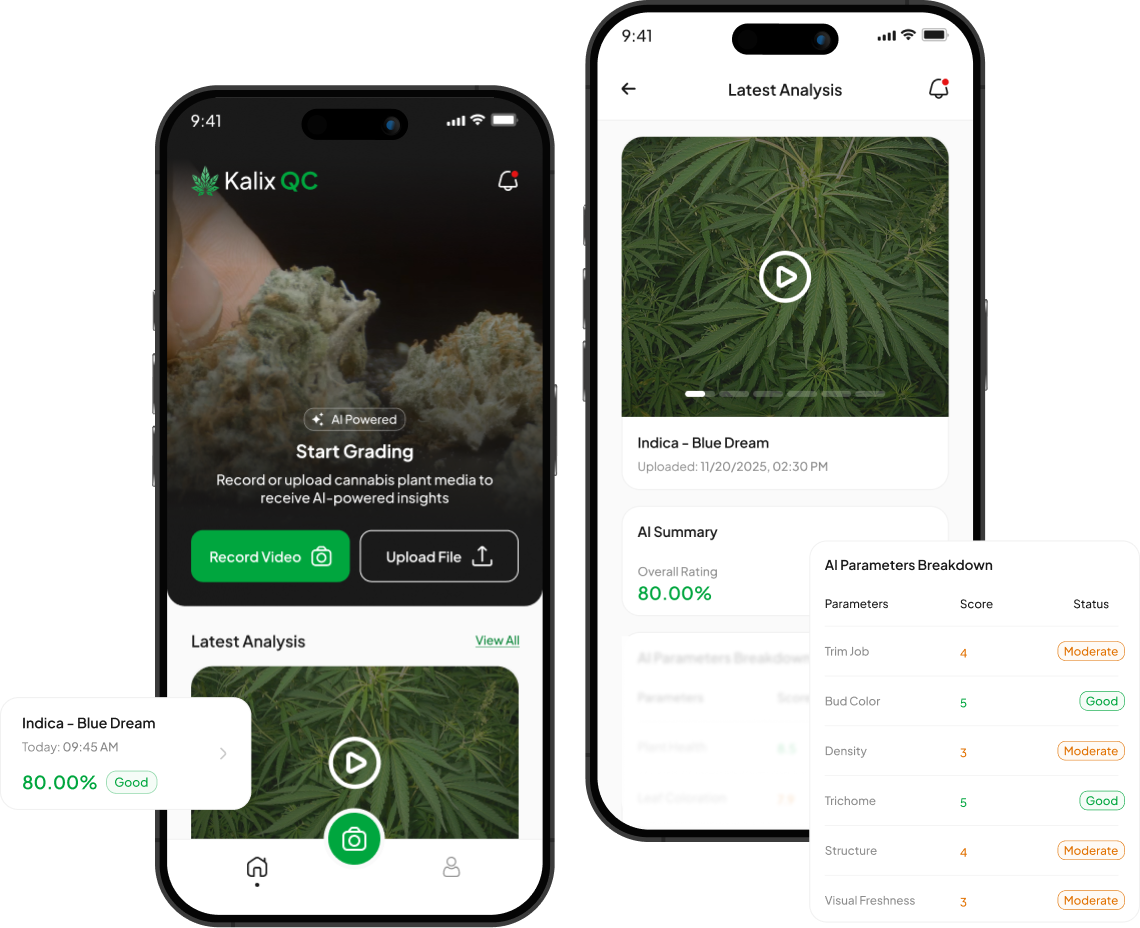
Kalix QC was developed to bring structure and consistency to this process. Using computer vision, the platform evaluates cannabis flower across seven quality parameters and translates those observations into a clear, standardized score along with a corresponding Kalix Price Range (KPR). This gives both growers and buyers a shared reference point, making evaluations more transparent and decisions more grounded.
By creating a consistent way to evaluate both quality and pricing, Kalix QC brings a level of clarity the industry has been missing. It helps growers position their products with confidence and allows buyers to validate what they’re paying for, making every interaction more informed, balanced, and easier to navigate.

Kalix QC uses computer vision to evaluate cannabis flower from images or video captures. Instead of relying on manual inspection alone, the platform examines visible characteristics and surface details to deliver an unbiased assessment. This allows users to review product quality quickly without depending entirely on individual judgment.
Kalix QC assesses each product across seven key attributes, like size, color, structure, density, trichomes, trim quality, and visual freshness. Each aspect is reviewed separately, giving users a more complete understanding of quality rather than a single, generalized opinion.


All evaluation inputs are combined into a single Kalix Score expressed as a percentage. This makes it easy to understand overall quality in a blink while still reflecting the details behind the evaluation. The score helps create alignment between growers, buyers, and quality teams during discussions.
Based on the evaluated quality, Kalix QC generates a Kalix Price Range (KPR) that reflects realistic pricing expectations. Instead of fixed numbers, the range adjusts according to product characteristics and current market behavior, helping users approach pricing with greater clarity.


Kalix QC is designed for real-world use, allowing users to capture, analyze, and review results directly from their mobile devices. Whether on-site at a grow facility or during a transaction, users can access quality scores and pricing insights without interrupting their workflow.
 Computer vision-based quality evaluation
Seven-factor visual grading system
Unified percentage-based Kalix Score
Intelligent Kalix Price Range generation
Image and video analysis support
Mobile-first capture and results display
Consistent quality assessment process
Quick grading and price insights
Built for growers and buyers
Secure evaluation history tracking
Developing Kalix QC involved tackling key challenges that influenced both accuracy and real-world usability.
Challenges
Maintaining consistent evaluation accuracy across different samples and conditions was critical. Variations in product appearance, capture quality, and environmental factors made it challenging to ensure dependable results every time.
SOLUTIONS
We refined the evaluation process by continuously improving how visual inputs are interpreted and scored. By aligning outputs with real-world expectations and testing across diverse samples, the platform delivers results users can rely on in practical scenarios.
Challenges
Cannabis quality evaluation has traditionally depended on human observation, which can vary based on experience, perspective, and even context. The same product can be judged differently by different people, making it difficult to establish a consistent standard for grading and pricing.
SOLUTIONS
Biz4Group approached this by translating visual cues into measurable signals using computer vision. By defining clear evaluation parameters and applying them uniformly across all inputs, the platform delivers consistent results while still aligning closely with how industry experts assess quality.
Challenges
Differences in lighting, camera quality, and capture angles can significantly impact how a product appears in images or videos. These inconsistencies made it challenging to maintain reliable evaluations across different devices and environments.
SOLUTIONS
To address this, we designed a guided capture approach within the app that helps standardize how inputs are recorded. This reduced variability at the source and improved the reliability of visual analysis without adding complexity for the user.
Challenges
There is no widely accepted method to connect cannabis quality directly to pricing. Market rates often fluctuate, and similar products can be priced very differently, making it difficult for users to determine fair value.
SOLUTIONS
Biz4Group introduced a structured approach that connects evaluated quality with a dynamic price range. By aligning quality scores with current market behavior, the platform provides users with a practical pricing reference they can use during negotiations.
Challenges
Processing visual inputs and generating results in a reasonable time frame required careful handling of compute resources, especially as multiple evaluations occur simultaneously.
SOLUTIONS
We optimized the processing flow to balance performance and accuracy, ensuring that users receive results within a practical timeframe while maintaining the quality of analysis expected from the platform.
Served as the core backend language, handling data processing, model integration, and overall system logic required for image-based evaluation.
Used to build and run deep learning models, enabling efficient processing of visual data and supporting GPU-accelerated performance.
Implemented for object detection and segmentation, allowing the system to accurately identify and isolate cannabis buds within images and video frames.
Applied for scoring and evaluation logic, helping translate visual analysis into structured quality scores.
Used for image processing tasks such as feature extraction and visual analysis, forming a key part of the computer vision pipeline.
Supported image handling and preprocessing, ensuring consistent input quality for reliable evaluation.
Enabled numerical computations required for data processing, analysis, and scoring calculations.

Sanjeev Verma has been actively conceptualizing and creating software solutions for the past 20 years in the IT domain. He has worked on technical leadership positions with Marriott Vacations, Disney, MasterCard, Statefarm, and Oracle. He has been a key player in developing, implementing, and monitoring Digital Solutions ranging from IoT solutions & products, Mobile and Web Development, and Digital Marketing to Full Stack Development and CMS solutions.
We build systems that bring clarity to complex, experience-driven decisions.
Our website require some cookies to function properly. Read our privacy policy to know more.