 Location :
Orlando, FL, USA
Location :
Orlando, FL, USA +1 (407) 714-1616
 info@biz4group.com

 AI Summary Powered by Biz4AI
- Use conversational AI and semantic search to help buyers find homes based on budget, location, lifestyle, and preferences.
- Apply AI-powered recommendations to suggest relevant properties using buyer preferences, search history, saved listings, and interactions.
- Start with core AI features such as conversational search, listing summaries, personalized recommendations, and AI-assisted lead qualification.
- Integrate licensed MLS/IDX data to maintain accurate property listings and support reliable AI search.
- Expect development costs of $20,000 to $300,000, with basic platforms taking around 30 to 60 days and advanced platforms taking 60 to 120 days or longer.
- Work with Biz4Group for AI product development, from product planning and architecture to custom AI solutions and AI consulting services.
Most residential marketplaces look the same: a search bar, a map, and a wall of listings. Buyers scroll for a few minutes, see homes they can't afford or don't want, and quietly leave for the next app.
That's why custom AI residential property marketplace development really comes down to buyer experience. Anyone can list properties. What sets a marketplace apart is how fast it helps a buyer land on the right five homes, and how confident they feel doing it.
In this guide, we'll go through the features that actually change that experience: AI property recommendations, conversational search, virtual tours, and financial-readiness checks. Then we'll look at build vs. buy, what it costs, and how to tell if the experience is working.
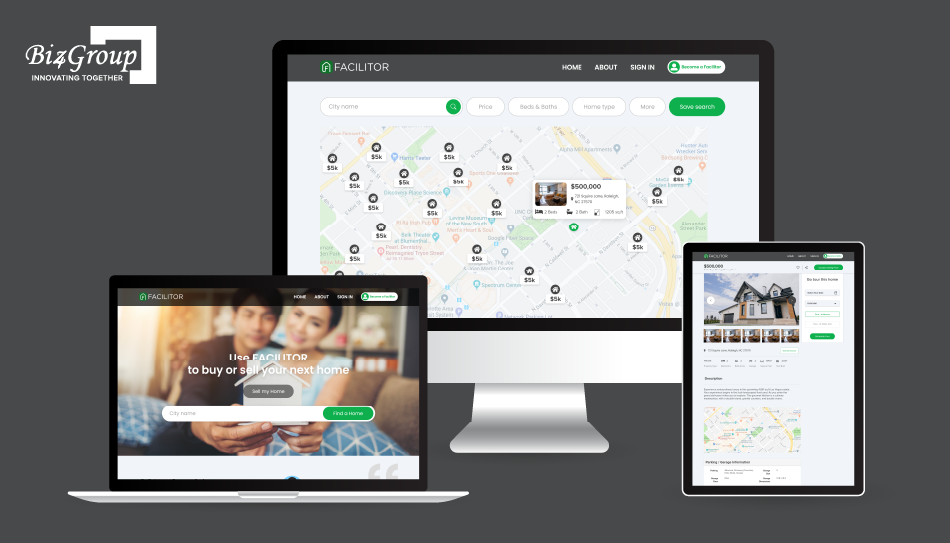
Facilitor is a good example of this. It's a home-buying platform that matches properties to budget and location, then uses buyer financial verification to decide which homes a buyer sees at all. We built it at Biz4Group, as part of our AI product development services, and it's the clearest lesson we have on why affordability belongs inside the recommendation, not after it.
So if you're planning a marketplace and wondering what to build first, let's start with what buyers actually notice.
Why Does AI Search Matter for a New Residential Property Marketplace?
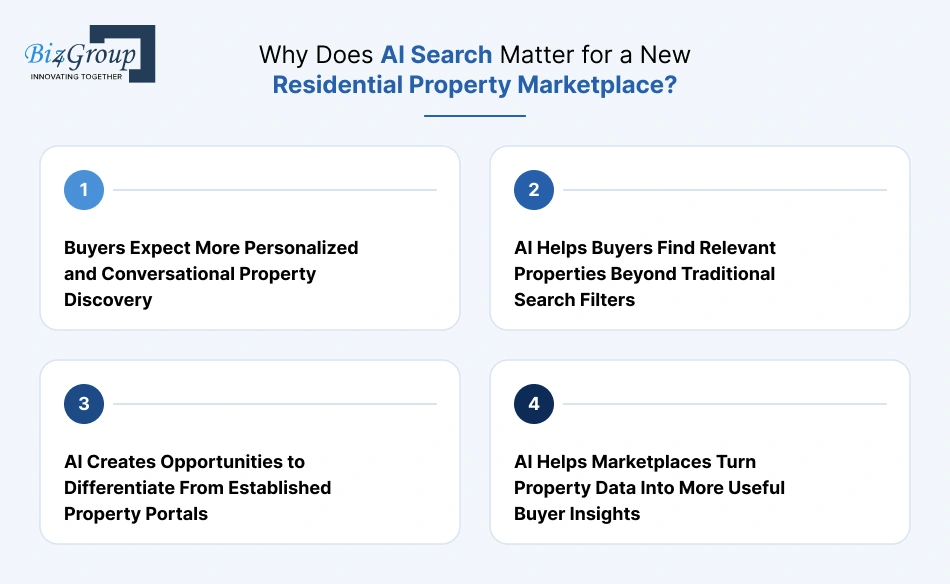
AI search helps buyers find homes that actually fit what they're looking for, even when they can't describe their needs through standard search filters. It understands everyday requests, picks up on buyer preferences, and suggests relevant properties. For a new marketplace, this is a way to offer something more useful than another portal filled with property listings.
Buyers Expect More Personalized and Conversational Property Discovery
Think about how people actually look for homes. They don't always start with an exact budget, bedroom count, or location. They might say they want a quiet neighborhood, a short commute, a garden, and enough space to work from home.
Standard property filters can't always handle these requirements together. Buyers end up changing filters, trying different searches, and going through listings that don't quite fit.
With AI-powered conversational search, they can simply describe what they want and refine the results through a conversation.
For example, a buyer might ask, "Can you find me a two-bedroom home under $500,000, close to public transport, with space for a home office?" The marketplace can turn that request into search criteria and find matching properties using its available listing and location data.
AI Helps Buyers Find Relevant Properties Beyond Traditional Search Filters
Here's where AI search gets interesting. A buyer might search for a three-bedroom home but overlook a two-bedroom property with a separate study that could serve the same purpose.
Traditional filters may leave that property out. AI can understand the context of the search and suggest alternatives that could still work.
It can do this through:
- Semantic search: Understands what buyers mean, rather than looking only for matching words.
- Intent recognition: Picks up on priorities such as commute time, affordability, or outdoor space.
- Personalized recommendations: Suggests properties based on searches, saved listings, and feedback.
- Context-aware results: Finds relevant alternatives when an exact match isn't available.
Of course, AI shouldn't ignore important requirements. If a buyer sets a firm budget, the system shouldn't keep recommending homes they can't afford. The idea is to help buyers discover more relevant options, not overwhelm them with unsuitable ones.
AI Creates Opportunities to Differentiate From Established Property Portals
A new marketplace probably won't have the listing volume or brand recognition of established portals right away. So, trying to compete on the same terms may not make much sense.
Instead, it can focus on giving a particular group of buyers a better experience.
For example, a marketplace built for people relocating to a new city could help them explore homes alongside commute options, nearby amenities, and neighborhood information. A platform for first-time buyers could make property comparisons easier and explain listing details in simpler terms.
A few ways to stand out include:
- Offering search experiences designed around a specific buyer group or region.
- Helping buyers understand properties and neighborhoods, not just browse listings.
- Making it easier to compare homes and build a shortlist.
- Connecting buyers with agents who already understand their requirements.
The real opportunity is to solve a buyer problem that larger portals may not be addressing well.
AI Helps Marketplaces Turn Property Data Into More Useful Buyer Insights
Every search, saved listing, and piece of buyer feedback can tell the marketplace something about what a person wants. AI can use these signals to make future property suggestions more relevant.
For example, if someone keeps saving homes with balconies but skips properties far from public transport, the marketplace can use that activity to refine its recommendations.
|
Information available |
What it can tell the marketplace |
|---|---|
|
Search queries and filters |
What the buyer is actively looking for |
|
Saved and skipped listings |
Which property features attract or discourage interest |
|
Property and location details |
Which other homes or areas may be relevant |
|
Buyer feedback |
Whether recommendations are actually useful |
One thing to keep in mind: browsing behavior doesn't always tell the whole story. A buyer might save a property just to compare prices, not because they intend to purchase it. So, AI recommendations should remain flexible and let buyers update their preferences.
That's what makes AI residential property marketplace development useful: not simply collecting more data, but using the right information to help buyers find and compare homes with less effort.
How Can a New Real Estate Marketplace Differentiate From Zillow and Redfin Using AI?
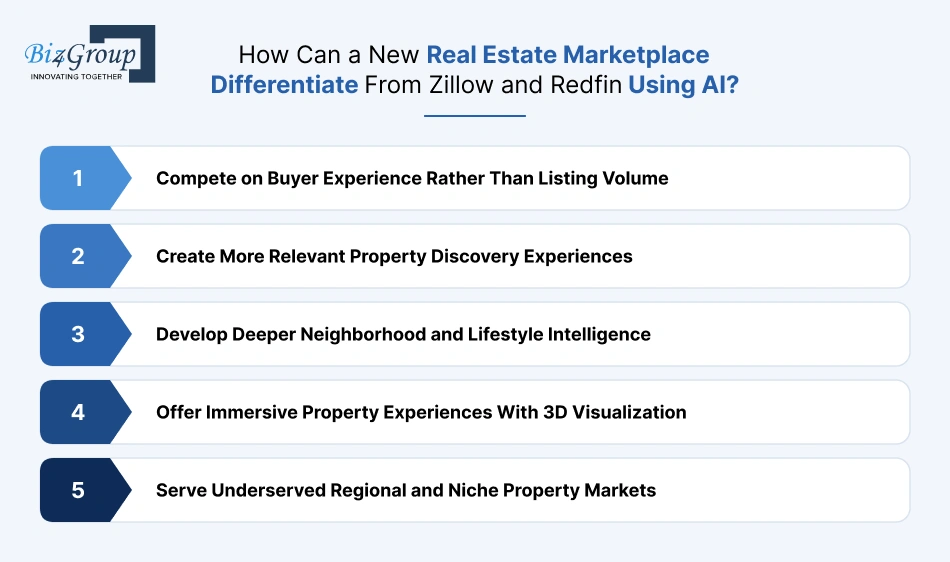
A new real estate marketplace can stand out from Zillow and Redfin by using AI to make property discovery more personal, neighborhood research more useful, and property viewing more interactive. It can also focus on specific buyer groups or regional markets instead of trying to compete on listing volume alone. The idea is to give buyers something they can't get from a basic property search experience.
Compete on Buyer Experience Rather Than Listing Volume
You don't need thousands of listings to give buyers a useful experience. You need to help them make sense of the listings you have.
Here's a question a new marketplace owner might ask:
"I am building a new real estate marketplace and I know we cannot compete with Zillow or Realtor.com on listing volume alone, so I want to know how AI can help us win on buyer experience instead."
AI can help your marketplace deliver more relevant property matches, personalized recommendations, neighborhood insights, and conversational search. Focus on a specific buyer group or regional market, then build features around the problems those buyers face.
Think about it. Would a buyer rather scroll through 200 homes that loosely match their filters, or see 15 properties that fit their budget, preferred location, and lifestyle?
AI can help make the second experience possible. It can rank listings based on buyer preferences, explain why certain homes appear in the results, and make it easier to compare shortlisted properties.
For a new marketplace, this means focusing on the quality of property discovery instead of trying to match the listing volume of established portals.
Create More Relevant Property Discovery Experiences
Buyers don't always know exactly what to search for. Someone might say, "I need a comfortable home near my office, but I don't want to spend too much on commuting." That's quite different from simply selecting a location and setting a price filter.
An AI-powered marketplace can understand this request, ask follow-up questions, and narrow down properties based on the buyer's priorities.
It can also learn from the homes buyers save, skip, or revisit. Over time, these signals can help improve recommendations. Just make sure buyers can correct their preferences, because saving a property doesn't always mean they want something similar.
Develop Deeper Neighborhood and Lifestyle Intelligence
Here's something worth remembering: people aren't just buying a house. They're choosing where they'll spend their everyday lives.
A buyer with children may care about nearby schools and parks. Someone working in the city may be more interested in commute times and public transport. A remote worker might prioritize quieter surroundings and access to everyday amenities.
An AI marketplace can bring together property information, maps, transport data, and local amenities to help buyers explore these factors. It can also explain why a particular neighborhood might fit their stated preferences.
Of course, these suggestions should be based on reliable location data. AI shouldn't make up claims about an area's safety, schools, or lifestyle.
Offer Immersive Property Experiences With 3D Visualization
Sometimes, a few listing photos just aren't enough. Buyers want to understand the layout, get a feel for the space, and imagine how they might use it.
This is where 3D tours and AI-powered visualization can help. A marketplace could let buyers:
- Walk through rooms using interactive 3D tours.
- Explore layouts through digital floor plans.
- See how an empty room might look with AI-generated furniture and staging.
- Understand room dimensions and how spaces connect.
For example: a buyer looking at an unfurnished apartment could use virtual staging to picture how a living room might look with furniture. But there's one important rule: digitally staged images must be clearly labelled. Buyers should never mistake an AI-generated visual for the property's actual condition.
Serve Underserved Regional and Niche Property Markets
Now, here's another way to approach the market: don't try to build a portal for everyone.
A new marketplace could focus on a specific region, buyer type, or property category where existing search experiences leave users with unanswered questions.
For example:
- Regional property markets: Help buyers search using local property terminology and neighborhood information.
- Luxury homes: Offer detailed visual tours and recommendations based on specific property and lifestyle preferences.
- First-time buyers: Make it easier to compare homes, understand listing details, and narrow down choices.
- Relocation buyers: Bring property discovery together with commute details and neighborhood information.
- Specialized housing: Support searches based on particular property types or accessibility requirements.
The idea is simple: understand one group of buyers really well, build an experience around what they need, and use AI to make that experience more helpful. That's a much clearer way for a new marketplace to stand out than simply adding another AI chatbot to its website.
Which AI Features Should a Residential Property Marketplace Build First?
Start with features that make it easier for buyers to find and understand properties. For most new marketplaces, that means conversational search, relevant recommendations, and AI-assisted listing discovery before moving on to more data-intensive features such as predictive pricing. You don't need to build everything at launch. Get the core experience right first, then add more advanced capabilities as your marketplace grows.
Core AI Features for an Initial Marketplace Launch
Think about what buyers need when they first visit your platform. They want to find suitable homes without going through endless filters, understand the listings, and narrow down their choices. These are good features to start with:
- AI-powered property search: Let buyers describe what they want in everyday language while keeping familiar filters for budget, location, and property type.
- Personalized property recommendations: Suggest homes using declared preferences, saved listings, and search activity.
- AI-generated listing summaries: Help buyers understand key property details without having to read lengthy descriptions.
- Conversational buyer assistance: Answer questions about listings and help buyers refine their searches.
- AI-assisted lead qualification: Collect basic requirements, such as budget, preferred location, and buying timeframe, before connecting buyers with agents.
This isn't just an experimental direction for the industry.
- Redfin introduced Conversational Search in November 2025, allowing buyers to describe what they want and refine their search through follow-up conversations.
- Realtor.com has also introduced natural-language property search, using AI to interpret listing requirements and image analysis to identify features such as property styles and amenities.
These examples show how conversational discovery can work as part of an actual property search experience, rather than as a chatbot sitting separately on the website.
For your own marketplace, the starting point could be much simpler: let buyers describe their requirements, translate those into searchable criteria, and return relevant listings. You can add more sophisticated conversation and personalization as the product develops.
Advanced Capabilities for Marketplace Differentiation
Once the basic search experience is working well, you can introduce features that help buyers explore properties in more detail.
Some possibilities include:
- Lifestyle-based property matching: Recommend homes based on commute preferences, nearby amenities, and other lifestyle requirements.
- AI-powered property comparisons: Help buyers compare shortlisted homes across price, size, features, and location.
- 3D tours and AI virtual staging: Let buyers explore property layouts and visualize how furnished spaces might look.
- Neighborhood intelligence: Combine location, transport, and amenity data to help buyers understand the areas around shortlisted properties.
- Image-based property search: Help buyers find homes with visual features similar to a reference image.
There are already examples of these experiences in the US market. Zillow's 3D Home combines virtual tours with interactive floor plans. The company has described using computer vision and machine learning to generate floor plans and estimate room dimensions from captured property imagery. Its more recent improvements also use AI image processing to enhance tour quality while preserving the actual appearance of the home.
For a custom marketplace, you don't necessarily need to build the underlying imaging technology yourself. You can integrate suitable 3D tour tools or develop your own property visualization features around the needs of your target market.
Features to Introduce After Building a Sufficient Data Foundation
Some AI features need more than a collection of property listings. They rely on reliable historical records, consistent property information, and enough relevant data to produce useful results.
|
Feature |
What it needs before it becomes useful |
|---|---|
|
Predictive property pricing |
Reliable historical transaction data and local market coverage |
|
Property value estimation |
Property attributes, comparable sales, and local valuation data |
|
Buyer demand forecasting |
Consistent search, enquiry, and transaction signals over time |
|
Advanced recommendation models |
Sufficient buyer interactions and feedback |
|
Automated investment insights |
Reliable rental, price, vacancy, and local market data |
|
For example, a new marketplace may not have enough buyer activity to train or validate a sophisticated recommendation model. It can begin with declared preferences and simpler ranking methods, then improve its recommendations as more users interact with the platform. |
The same goes for property valuations. An AI-generated estimate should not be presented as a reliable market value unless it has been tested against suitable local data. Buyers need to understand what the estimate represents and where its limitations lie. |
Prioritize Features by Buyer Value, Data Readiness, and Complexity
So, how do you decide what belongs in the first release? Look at three things: whether the feature solves a real buyer problem, whether you have the data to support it, and how much effort it takes to build and maintain.
|
Development stage |
Features to consider |
Why |
|---|---|---|
|
Initial launch |
Conversational search, listing summaries, basic recommendations |
Addresses everyday property discovery needs |
|
Next release |
Neighborhood intelligence, property comparisons, 3D experiences |
Adds depth once location data and property media are available |
|
Later stage |
Predictive pricing, demand forecasting, advanced recommendations |
Requires stronger historical data and ongoing validation |
Don't choose a feature just because a major portal has introduced it. Look at what makes sense for your audience and market. A regional marketplace, for example, might get more value from accurate neighborhood information than from an advanced image-search system.
Start with a few useful capabilities, see how buyers respond, and build from there. That's how you create a custom AI property marketplace that feels genuinely helpful instead of simply looking feature-rich.
How to Build a Custom AI Residential Property Marketplace
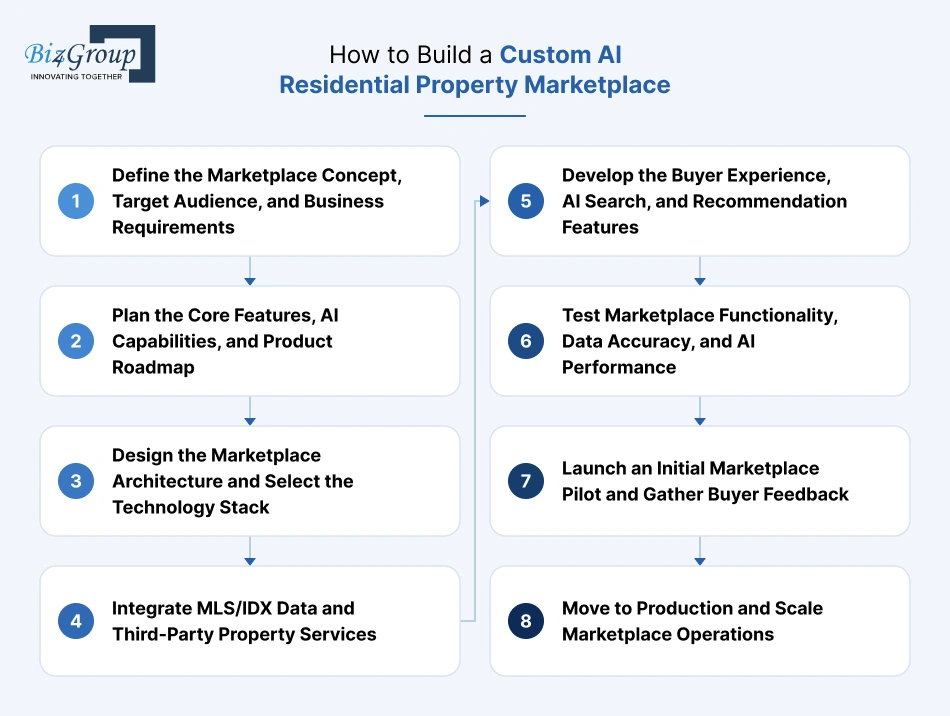
Building a custom AI residential property marketplace involves more than adding a chatbot to a property portal. You need to define who the marketplace serves, organize reliable property data, build a simple buyer experience, and add AI features that help people find and compare homes. The development process should bring these parts together in stages, so you can test the idea with real buyers before investing in a larger platform.
Define the Marketplace Concept, Target Audience, and Business Requirements
Start by deciding who the marketplace is for and what problem it will solve. A platform for first-time homebuyers will need a different experience from one focused on luxury properties, rental-to-buy options, relocation, or a specific regional market.
Be clear about the audience, property types, geographic coverage, and business model. Also consider who will manage listings, verify property information, respond to buyer enquiries, and maintain relationships with agents or brokers.
These decisions will shape the platform's features and data requirements. For example, a marketplace for people moving to a new city may need detailed neighborhood information and commute comparisons. A platform focused on new residential developments may need floor plans, construction updates, and virtual property tours.
Plan the Core Features, AI Capabilities, and Product Roadmap
Once the marketplace concept is clear, decide which features buyers need at launch and which can come later. Trying to build every possible AI capability at once can increase development time and make the product harder to test.
A practical roadmap could look like this:
|
Development stage |
Features to consider |
|---|---|
|
Initial marketplace launch |
Property listings, standard filters, AI-assisted search, saved properties, buyer accounts, and enquiry forms |
|
Next development stage |
Personalized recommendations, conversational search, property comparisons, and neighborhood insights |
|
Later expansion |
Advanced image search, AI-generated staging, predictive analytics, and more detailed lifestyle matching |
The exact order will depend on your audience and available property data. A feature should not be added just because it uses AI. It should solve a buyer problem or make the marketplace easier to use.
Design the Marketplace Architecture and Select the Technology Stack
The architecture should support property listings, search, user accounts, third-party integrations, and AI services without making the platform difficult to update as it grows. Your technology choices will depend on the expected traffic, data sources, product features, and development team's experience.
A typical technology stack may include:
- Frontend: React or Next.js can be used to build the web interface, with React Native or Flutter for mobile apps. NextJS development can help deliver fast-loading property pages that are easier for search engines to index.
- Backend: Node.js or Python can handle marketplace operations, APIs, and data processing. NodeJS development is useful for API-driven features and real-time interactions, while python development is often used for AI integrations, recommendation systems, and machine learning workflows.
- Database: PostgreSQL can store user accounts, property records, saved searches, and other marketplace data.
- Search infrastructure: Elasticsearch or OpenSearch can support property filters and keyword search, while a vector database can help retrieve listings based on the meaning of a buyer's query.
- AI services: Existing language models, embedding models, and recommendation tools can power conversational search and personalized property suggestions.
- Cloud infrastructure: AWS, Azure, or Google Cloud can host the application and support its ongoing operation.
You may also work with a UI/UX design company to design the buyer journey, search experience, listing pages, and mobile interface. The important thing is to choose technologies that fit the product requirements, rather than adding tools that the marketplace does not need yet.
Integrate MLS/IDX Data and Third-Party Property Services
Property data is one of the most important parts of the marketplace. You need a reliable way to collect listing details, prices, property features, images, availability, and location information.
For a US-focused marketplace, this may involve MLS or IDX integrations. The available access method and permitted use depend on the relevant MLS rules, agreements, and data providers. Make sure the required rights cover how the data will be displayed, stored, processed, and used by AI features.
You may also need third-party services for maps, geocoding, property images, mortgage calculations, school information, or local amenities. Before integrating them, check their data coverage, update frequency, licensing terms, and API limits.
Property records from different sources may use different formats or field names. Standardizing these records helps the marketplace provide consistent filters, comparisons, and AI search results.
Develop the Buyer Experience, AI Search, and Recommendation Features
The buyer experience should guide the AI development, not the other way around. Think about how someone will search for a home, review matching properties, compare options, save listings, and contact an agent.
For example, a buyer might enter: "Find a three-bedroom home under $600,000 with a garden, within 30 minutes of my workplace." The search system can identify the property requirements, convert them into structured filters, and retrieve matching listings. It can then use semantic search to find relevant results when a buyer describes preferences that do not fit neatly into standard filters.
Recommendations can also become more useful over time. The marketplace can use information such as saved properties, search history, viewed listings, and stated preferences to adjust the results. Buyers should be able to update or remove preferences when their plans change.
You do not necessarily need to train AI models from scratch. An initial version can use existing language models, structured property data, search tools, and recommendation logic. More specialized models or fine-tuning may make sense later, once the marketplace has enough suitable data and a clear reason to develop them.
Test Marketplace Functionality, Data Accuracy, and AI Performance
Before inviting buyers to use the platform, test the complete property search journey. Check whether listings load correctly, filters return accurate results, saved properties remain available, and enquiry forms reach the right people.
AI features need their own testing. A conversational search system should understand different ways of describing the same requirement, respect important constraints such as price and location, and avoid inventing property details. Recommendations should also be checked for relevance and variety.
Pay particular attention to property data. Incorrect prices, outdated availability, duplicate listings, or missing details can undermine buyer trust, even if the AI search experience works well.
You should also test mobile usability, page speed, security, access permissions, and how the platform handles unexpected errors.
Launch an Initial Marketplace Pilot and Gather Buyer Feedback
Start with a defined market, property category, or group of buyers rather than opening the platform everywhere at once. A focused pilot gives you a chance to see how people actually use the marketplace and where they run into problems.
You can use MVP development services to build and test an initial version with the features needed to validate the idea. During the pilot, track what buyers search for, which properties they save, whether recommendations are useful, and how often searches lead to enquiries.
Ask users where the experience falls short. They may want better location filters, more accurate property details, clearer comparisons, or an easier way to contact agents. Use this feedback to decide what to improve before expanding the platform.
Move to Production and Scale Marketplace Operations
Once the pilot shows that the marketplace works for its intended audience, prepare for a broader production launch. This involves improving infrastructure capacity, strengthening security, setting up monitoring, and making sure property data continues to update reliably.
You will also need processes for handling listing errors, buyer enquiries, agent access, customer support, and AI performance reviews. As the marketplace expands into new regions, check whether additional MLS/IDX agreements, data providers, or local services are required.
Scaling should be based on actual usage and business needs. You may need to improve search infrastructure, adjust recommendation systems, add new data sources, or introduce advanced AI features as the platform grows. Building in stages helps you make those decisions using buyer feedback and marketplace data rather than assumptions.
Planning to Build a Smarter Property Marketplace?
If you're looking to make property discovery easier with conversational search, personalized recommendations, or AI-powered buyer experiences, Biz4Group can help you plan and develop a custom AI product around your business goals.
Let's Build Your MarketplaceWhat Does the Technical Architecture of an AI Property Marketplace Include?
An AI property marketplace has five main layers that work together to manage listings, connect data sources, power AI features, and support users. Here's what each one does.
Property Data and Media Management Layer
This layer stores property details such as price, location, features, and listing status, along with photos, floor plans, and 3D tours. Keeping this information organized and updated helps buyers get accurate listing details.
Integration Layer for MLS/IDX Feeds and Third-Party Services
This layer connects the marketplace to MLS/IDX feeds, mapping tools, mortgage calculators, and other property services. It brings their data into the platform and keeps records updated, while respecting each provider's usage rules.
AI Layer for Language Models, Semantic Search, and Recommendations
This layer powers conversational search and personalized recommendations. It helps buyers find properties based on everyday requests and preferences, using verified listing information rather than making assumptions.
Application Layer for Buyers, Agents, and Marketplace Administrators
This is the part users interact with. Buyers search and save properties, agents manage enquiries, and administrators oversee listings, users, and platform activity. Each group gets tools suited to its role.
Supporting Infrastructure for Security, Data Quality, and Monitoring
This layer keeps the marketplace secure and reliable. It covers access controls, data protection, backups, listing checks, and system monitoring. It also helps teams track AI accuracy and search performance.
|
Architecture layer |
Main responsibility |
|---|---|
|
Property Data and Media Management |
Stores listing details, photos, floor plans, and 3D tours. |
|
MLS/IDX and Third-Party Integrations |
Connects external data sources and keeps property records updated. |
|
AI Layer |
Powers conversational search, semantic retrieval, and personalized recommendations. |
|
Application Layer |
Provides tools for buyers, agents, and marketplace administrators. |
|
Supporting Infrastructure |
Handles security, data quality, backups, and performance monitoring. |
How Should a New Marketplace Integrate MLS/IDX Data Into Its AI Platform?
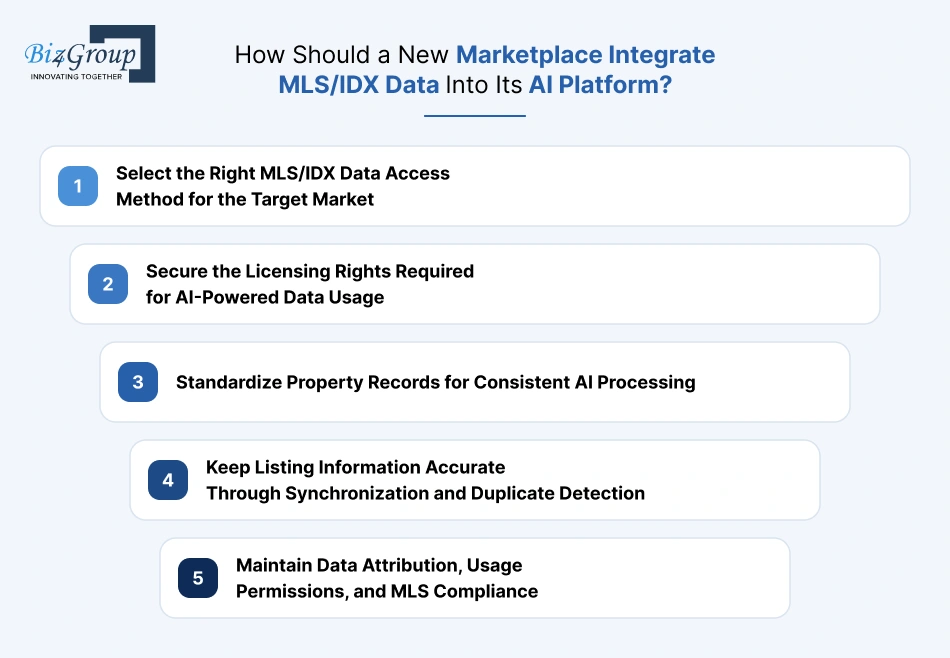
To integrate MLS/IDX data into an AI property marketplace, choose an approved data access method, confirm the rights needed for AI use, and keep listing records accurate and consistent. These steps help AI search and recommendations work with reliable property information.
Select the Right MLS/IDX Data Access Method for the Target Market
Check how the local MLS provides listing data. Some support the RESO Web API, while others have different access requirements. Choose a method that supports your marketplace's update needs and search experience.
Secure the Licensing Rights Required for AI-Powered Data Usage
Permission to display listings does not automatically cover every AI use. Check whether your MLS agreement allows data storage, semantic search, recommendations, analysis, or model training. Confirm these rights before building AI features around the data.
Planning to use listing data to power AI recommendations or train a model? Check those permissions before development, not after the feature is built.
Standardize Property Records for Consistent AI Processing
MLS feeds may use different formats and field names. Standardize details such as price, property type, bedrooms, and amenities so the AI can interpret them consistently. The RESO Data Dictionary can help with common field names and definitions.
Keep Listing Information Accurate Through Synchronization and Duplicate Detection
Set up regular updates to capture price changes, listing-status updates, and withdrawn properties. Also, check for duplicates when data comes from multiple sources so buyers don't see the same property more than once.
What happens if a buyer saves a property that has already gone off the market? Outdated records can quickly damage trust, so listing updates need to be reliable.
Maintain Data Attribution, Usage Permissions, and MLS Compliance
Track where each listing comes from and follow the provider's rules for displaying property details and images. The marketplace should also handle listing removals and permission changes correctly.
How Does Conversational AI Improve Property Search?
Conversational AI lets buyers search for homes by describing what they need in everyday language. They can ask for properties, adjust their preferences, and ask questions without repeatedly changing filters. This makes property discovery easier and more flexible.
A common question is:
"We have a regional property portal with basic filter search, and I keep seeing bigger platforms move to conversational AI search, so I want to understand what it would take to build something similar for our marketplace."
Start by connecting a language model to your property search system. It should understand natural-language queries, convert buyer requirements into structured filters, and retrieve matching listings. Add follow-up questions and semantic search to help buyers refine results.
Converts Natural-Language Buyer Intent Into Structured Property Queries
A buyer might enter:
"I'm looking for a two-bedroom apartment under $400,000, close to public transport, with a balcony."
The AI identifies the requirements and turns them into searchable criteria:
- Property type: Apartment
- Bedrooms: 2
- Maximum budget: $400,000
- Location preference: Near public transport
- Preferred feature: Balcony
The buyer simply describes what they want. The system handles the translation into search filters.
Combines Semantic Retrieval With Traditional Search Filters
Traditional filters work well for exact requirements such as price, location, and bedrooms. Semantic search helps interpret preferences that are harder to express through fixed options.
For example, a search for "a home with enough space to work remotely" could retrieve listings mentioning a study, spare room, or suitable workspace.
Combining both approaches helps buyers discover relevant properties while keeping important requirements such as budget and location intact.
Grounds AI Responses in Verified Property Information
What if a buyer asks whether a property has parking, but the listing doesn't mention it?
The AI should say the information isn't available rather than guess. To make this possible, the system should retrieve answers from verified listing records and approved data sources.
This is important because a confident but incorrect answer can mislead someone making a major purchase decision.
Supports Follow-Up Questions and Context-Aware Search Refinement
Buyers often change their minds as they explore properties. Conversational AI should let them refine a search without starting again.
A typical conversation might look like this:
|
Buyer request |
How the search changes |
|---|---|
|
Find apartments under $400,000. |
Sets the property type and budget. |
|
Only show those with parking. |
Adds a parking requirement. |
|
Include nearby neighborhoods too. |
Expands the location range. |
|
Show me the ones with balconies. |
Adds another property preference. |
The AI carries relevant search context forward, so buyers don't have to repeat their requirements.
Prevents Unsupported Claims and Inaccurate Search Results
Conversational AI needs clear limits. It should:
- Never invent property features, prices, or availability.
- Respect fixed requirements such as maximum budget.
- Distinguish verified details from missing information.
- Make it easy to check the original listing.
The goal isn't to make the AI answer every question. It's to help buyers find relevant homes without giving them information the marketplace cannot verify.
How Does AI Personalize Property Recommendations?
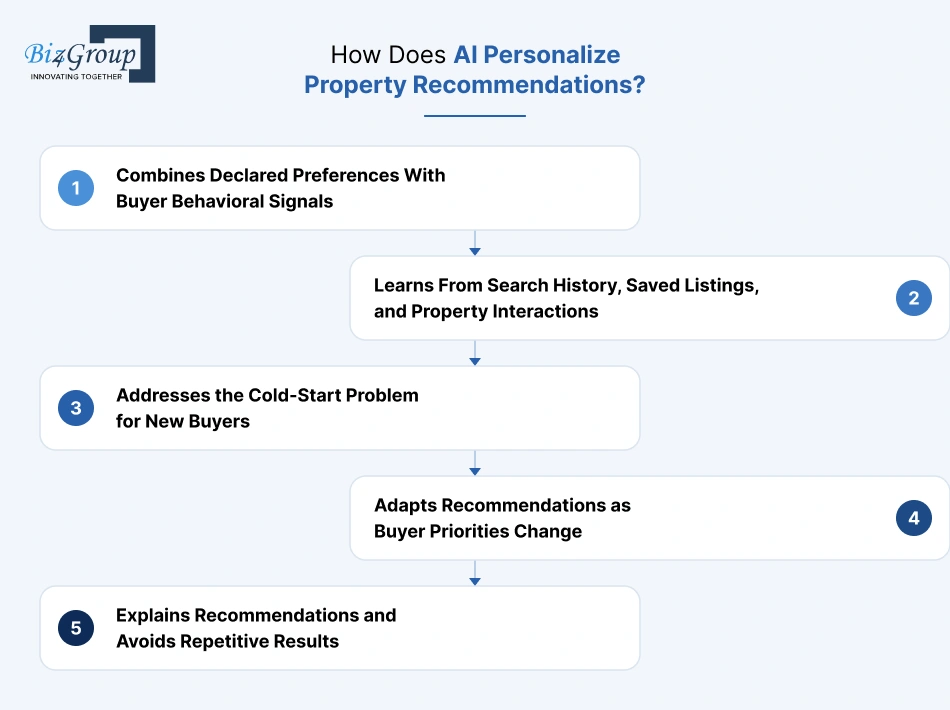
AI personalizes property recommendations by looking at what buyers say they want and how they interact with listings. It uses these details to suggest homes that better match their needs, rather than showing everyone the same popular properties. As buyers explore more homes and update their preferences, the recommendations can change with them.
Combines Declared Preferences With Buyer Behavioral Signals
Buyers don't always tell you everything they're looking for. Someone might say they need a two-bedroom apartment in a particular area, but their browsing activity may show a preference for balconies, larger kitchens, or properties with parking.
AI can bring these signals together:
- What buyers tell you: Budget, location, property type, size, and must-have features.
- What their activity shows: Properties they save, revisit, compare, or skip.
The important part is not to treat every click as a firm preference. Viewing a property doesn't necessarily mean a buyer wants something similar.
Learns From Search History, Saved Listings, and Property Interactions
Imagine a buyer keeps saving homes with gardens but rarely interacts with apartments that lack outdoor space. The recommendation system can pick up on this pattern and give more attention to properties with gardens.
It can learn from repeated searches, saved listings, comparisons, and other meaningful interactions. Over time, these signals help make suggestions more relevant without asking buyers to fill out long preference forms.
Here's a question that captures this requirement:
"I want our platform to actually learn what a buyer is looking for over time instead of making them refill the same filters every visit, so I need to know how to build a personalization engine into our marketplace."
Build a recommendation engine using declared preferences, search history, saved listings, and meaningful property interactions. Start with preference-based recommendations, then refine them as more buyer activity becomes available. Let buyers update their preferences whenever their requirements change.
Addresses the Cold-Start Problem for New Buyers
What happens when someone signs up but hasn't searched for a property yet? The marketplace has very little information to personalize recommendations.
This is called the cold-start problem. A simple way to handle it is to ask new buyers a few useful questions about their budget, preferred locations, property type, and essential features. The platform can use these answers to suggest an initial set of homes.
It can then learn from their activity as they start exploring listings.
Adapts Recommendations as Buyer Priorities Change
A buyer's requirements can change during the property search. They may start with a two-bedroom apartment and later decide they need an extra room for a home office.
The recommendation system should reflect these changes instead of continuing to show properties based on old preferences. Buyers should also have an easy way to update their requirements when the AI gets them wrong.
Explains Recommendations and Avoids Repetitive Results
Wouldn't buyers find recommendations more useful if they knew why a property was suggested?
Instead of simply displaying a list of homes, the marketplace can add short explanations:
- Within your preferred budget.
- Matches your interest in outdoor space.
- Similar to properties you've saved.
- Located near your preferred area.
It should also avoid repeatedly showing the same types of listings. Mixing familiar matches with new, relevant options gives buyers more to explore without losing sight of what they want.
Struggling to Make Your Property Portal Stand Out?
Biz4Group can help you bring useful AI capabilities into your marketplace, from intelligent property matching to neighborhood insights and conversational search.
Explore our AI Product Development ServicesHow Can 3D Tours and AI-Generated Staging Improve Property Discovery?
3D tours and AI-generated staging help buyers get a better feel for a home before visiting it. Instead of relying only on photos, they can look around rooms, understand the layout, and picture how an empty space might look with furniture. Here's what each feature brings to the experience:
|
Feature |
What buyers can do with it |
|---|---|
|
Interactive 3D Tours |
Walk through rooms virtually, look around, and get a better sense of how different spaces connect. |
|
Digital Twins |
Explore a digital version of the property, with details such as room layouts and dimensions where available. |
|
AI-Enhanced Virtual Tours |
Get guided walkthroughs, room descriptions, and answers to questions based on available property information. |
|
AI-Generated Staging |
See how an empty living room, bedroom, or other space might look with furniture and decor. |
|
Visual Disclosures |
Tell the difference between actual property photos and images that have been digitally staged or edited. |
Help Buyers Picture the Space Without Misleading Them
Think about someone viewing a home from another city. They may like the photos but still wonder whether the living room is spacious enough or how the bedrooms connect. A 3D tour can help answer some of those questions before they arrange a visit.
AI staging can also help buyers imagine how an unfurnished room could look. But there's an important distinction: staged furniture is only a visual example, not part of the actual property.
Keep original photos available, label edited images clearly, and don't let AI change permanent features such as walls, windows, or room dimensions. Buyers should be able to picture the possibilities without getting the wrong idea about the home.
How Does Neighborhood and Lifestyle-Fit Scoring Improve Property Matching?
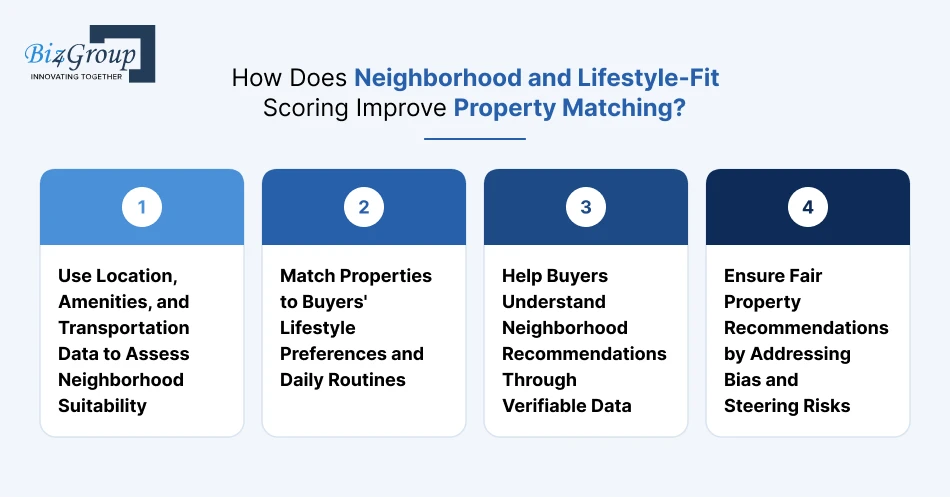
Neighborhood and lifestyle-fit scoring helps buyers compare homes based on more than price, size, and property type. It considers nearby amenities, transport links, commute times, and personal preferences to show how well a location might fit their daily routine.
Use Location, Amenities, and Transportation Data to Assess Neighborhood Suitability
The marketplace can combine location data with information about nearby facilities to give buyers a clearer picture of an area. This may include:
- Distance to public transport and major roads.
- Nearby parks, shops, and healthcare facilities.
- Estimated travel times to selected destinations.
- Walking and cycling access.
This helps buyers understand what's around a property before arranging a visit.
Match Properties to Buyers' Lifestyle Preferences and Daily Routines
Different buyers look for different things in a neighborhood. Someone working remotely may prefer nearby cafes and parks, while a daily commuter may care more about public transport.
Buyers should be able to share their priorities so the system can match locations accordingly.
What matters most to someone choosing a neighborhood: a short commute, nearby amenities, or access to outdoor spaces? Letting buyers set these preferences makes recommendations more relevant.
Help Buyers Understand Neighborhood Recommendations Through Verifiable Data
A lifestyle-fit score means little if buyers don't know how it was calculated. The marketplace should explain the reasons behind a recommendation, such as:
- Close to the buyer's preferred transit stop.
- Parks within the selected distance.
- Estimated commute within the buyer's preferred travel time.
Use reliable, current data and make missing information clear rather than filling gaps with assumptions.
Ensure Fair Property Recommendations by Addressing Bias and Steering Risks
AI should help buyers explore neighborhoods based on their own preferences, not assumptions about the people who live there. To reduce bias and steering risks:
- Check recommendation data for unfair patterns.
- Avoid using variables that indirectly reflect protected characteristics.
- Let buyers control their own location preferences.
- Regularly review which properties and neighborhoods the system recommends.
The goal is to help buyers explore their options, not decide which neighborhoods they should live in.
How Can AI and Real Estate Agents Work Together in a Property Marketplace?
AI can take care of some of the early work in a property search, but it shouldn't replace real estate agents. It can help buyers find suitable homes, answer basic questions, and organize enquiries. Agents can then step in when buyers need local knowledge, advice, or help moving forward with a property.
Let AI Handle Initial Buyer Qualification and Routine Property Discovery Tasks
When someone visits a property marketplace, they may not know exactly what they're looking for yet. AI can ask a few simple questions about their budget, preferred location, property type, and must-have features.
It can use those answers to suggest homes and handle basic questions about listings. This gives buyers a place to start without having to speak to an agent straight away. Agents also spend less time sorting through enquiries that aren't a good fit.
Connect Buyers With Real Estate Agents When Human Assistance Is Needed
Some questions need a real person. A buyer might want to arrange a viewing, understand the local market, discuss an offer, or get help with the next steps.
The marketplace should make it easy to move from AI assistance to an agent. Buyers shouldn't have to repeat their search requirements every time they switch from one to the other.
Give Agents Buyer Preferences and Search Context for More Relevant Follow-Ups
An agent can have a much more useful first conversation when they already know what a buyer wants. Instead of starting with the usual questions, they can see details such as:
- The buyer's preferred areas and budget.
- Property types and features they're looking for.
- Homes they've saved or shortlisted.
- Questions they've asked during their search.
Wouldn't it be easier to help a buyer if you already knew what mattered to them? Sharing this context helps agents follow up with relevant properties and advice rather than sending listings at random.
Improve Lead Management Through AI-Powered Routing and CRM Integration
Not every enquiry should go to the same agent. AI can help direct leads based on the property location, buyer's requirements, and agent availability or area of expertise.
With CRM integration, the marketplace can also keep track of conversations, follow-ups, and lead status. This makes it easier for agents to see who needs a response and for marketplace teams to spot enquiries that might otherwise be missed.
Should You Build, Buy, or Partner to Develop an AI Property Marketplace?
There are three main ways to get an AI property marketplace off the ground: build it yourself, start with an existing platform, or bring in a development partner. You can also combine these approaches. The right choice depends on your budget, technical team, and how much you want to customize the buyer experience.
|
Approach |
What it means |
When it makes sense |
|---|---|---|
|
Build from scratch |
Create your own marketplace, including its search, AI features, and user experience. |
When you want full control and have specific features that existing platforms can't provide. |
|
Buy a white-label platform |
Start with a ready-made property marketplace and add your branding. |
When you want to launch with standard features without building everything yourself. |
|
Work with a development partner |
Bring in an external team to build the marketplace or handle specialist work. |
When you need technical expertise that your in-house team doesn't have. |
|
Use a hybrid approach |
Combine existing tools with custom-built features. |
When you want to save development time but still make key parts of the marketplace your own. |
What if you want to launch quickly but still offer something different? A hybrid approach may be worth considering. You could use existing tools for standard marketplace functions and build your own AI search, recommendations, or neighborhood features.
Whichever route you choose, make sure you understand what you can customize, who owns the data and AI models, and what support you'll get as the marketplace grows.
What is the Cost of AI Residential Property Marketplace Development and the Factors that Affect it?
Building an AI residential property marketplace can cost anywhere from $20,000 to $300,000 USD. The difference comes down to what you want the platform to do. A marketplace with basic property search and a few AI features needs less work than one with advanced recommendations, multiple MLS/IDX integrations, and 3D property experiences.
Here's how the budget can vary by project size:
|
Development level |
Estimated cost |
What you can build |
|---|---|---|
|
MVP |
$20,000–$60,000 |
A working marketplace with property listings, buyer accounts, search filters, basic AI search, and an admin panel. |
|
Mid-Level |
$60,000–$150,000 |
A more feature-rich platform with MLS/IDX integration, conversational search, personalized recommendations, maps, and agent tools. |
|
Enterprise |
$150,000–$300,000 |
A highly customized marketplace with advanced AI, multiple data integrations, neighborhood insights, 3D tours, AI staging, and support for larger user volumes. |
What Factors Affect the Development Cost?
So, why can two property marketplaces have such different budgets? A few things make a real difference:
- MLS/IDX integration: Connecting multiple listing sources, handling different data formats, and keeping listings updated can add to the cost. Licensing fees may be separate.
- AI features: Basic AI search is different from building personalized recommendations or custom AI models. More advanced features usually need more development and testing.
- 3D tours and AI staging: These features involve additional tools, property media, and sometimes third-party services.
- Custom integrations: Connections to CRM systems, maps, mortgage tools, and other services add to the project scope.
- Ongoing expenses: Hosting, AI usage, data subscriptions, maintenance, and support need their own budget after launch.
These figures are broad estimates, not fixed prices. The actual cost depends on the features you choose, the complexity of the integrations, and the team building the platform. It's also worth keeping your initial development budget separate from the cost of running the marketplace.
How Long Does It Take to Develop and Launch an AI Property Marketplace?
With AI coding tools and ready-made AI services, a basic property marketplace can be developed in 30 to 60 days. A more advanced platform with custom AI features, multiple data integrations, and 3D experiences may take 60 to 120 days or more. Here's a rough idea of how the work can be divided.
Discovery, Requirements, and Technical Architecture
2 to 5 days
Decide who the marketplace is for, what buyers should be able to do, and which features are needed for launch. AI tools can help prepare wireframes, user flows, and the initial technical plan.
Core Marketplace Development and MLS/IDX Integration
10 to 20 days
Build the main parts of the marketplace, including property listings, buyer accounts, search filters, and the admin panel. Connect the MLS/IDX data feeds needed for the launch market. Data access and provider approvals can affect the timeline.
AI Implementation, Testing, and Focused Market Pilot
7 to 20 days
Add features such as conversational search, AI listing summaries, and basic recommendations. Test them with actual property listings and let a small group of buyers try the marketplace before a wider launch.
Production Go-Live and Multi-Market Expansion
5 to 15 days
Fix issues found during the pilot, check listing accuracy, and prepare the platform for public use. Expanding to other markets takes additional time because each location may have different listing data sources and requirements.
These are indicative estimates for a focused project. Some tasks can happen at the same time, and complex integrations or delayed data access can extend the timeline.
Have an AI Property Marketplace Idea?
Whether you're starting with an MVP or upgrading an existing portal, Biz4Group can help you shape the product, choose the right AI features, and build a marketplace that meets your buyers' needs.
Talk to Our AI ExpertsHow Can a New Property Marketplace Improve Its Visibility in AI Answer Engines?
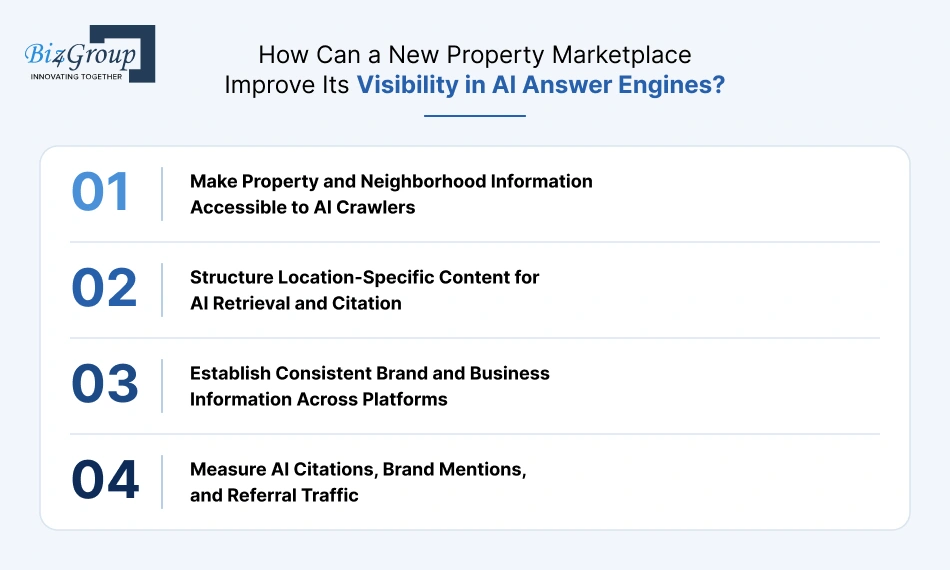
A new property marketplace can improve its visibility in AI answer engines by making its property information easy to access, its local content easy to understand, and its brand details consistent across the web. This gives AI systems clearer information to find, understand, and potentially cite.
Make Property and Neighborhood Information Accessible to AI Crawlers
Make sure important property pages and neighborhood guides can be accessed by search engine and AI crawlers. Avoid hiding key details behind login screens or relying entirely on JavaScript to display listing information. Keep pages crawlable and provide clear, useful descriptions.
Structure Location-Specific Content for AI Retrieval and Citation
Create useful pages for the areas you serve. Include details about local amenities, transport links, property types, and market information, using clear headings and structured data where relevant.
For example, a guide to two-bedroom apartments in a particular neighborhood gives both buyers and AI systems more specific information than a generic city page.
Establish Consistent Brand and Business Information Across Platforms
Keep your marketplace name, website, business details, and service areas consistent across directories, social profiles, business listings, and industry websites. Make it easy to understand who operates the platform and which property markets it covers.
Measure AI Citations, Brand Mentions, and Referral Traffic
Track when your marketplace is mentioned or cited in AI-generated answers, along with visits coming from AI platforms. Also monitor branded searches and organic traffic to see whether visibility is improving.
Are AI answer engines actually mentioning your marketplace? Check this regularly across relevant property searches, and use what you find to improve pages that are missing useful information.
How Should Marketplace Teams Measure AI Buyer Experience Performance?
To see whether AI is helping buyers, marketplace teams need to look at how people search, which properties they explore, and whether they eventually contact an agent. A few simple metrics can show what's working and where the experience needs attention.
|
What to measure |
Metrics to track |
What they tell you |
|---|---|---|
|
Search and Recommendations |
Relevant results, saved listings, recommendation clicks, and search refinements. |
Are buyers finding homes that match what they're looking for? |
|
Buyer Engagement and Retention |
Repeat visits, property views, saved homes, and return searches. |
Are buyers finding enough value to keep exploring the marketplace? |
|
Leads and Agent Conversions |
Enquiries, viewing requests, qualified leads, and agent follow-ups. |
Are property searches turning into genuine conversations with agents? |
|
AI Feature Performance |
Search success, engagement, and conversions before and after a feature launch. |
Is the new AI feature making the intended difference? |
|
AI Costs and Business Results |
API usage, hosting costs, cost per qualified lead, and conversion rates. |
Are the results worth the cost of running these AI features? |
Keep Checking What's Working
Review these numbers regularly. For example, if buyers use AI search often but rarely save or enquire about the suggested homes, the recommendations may need attention. Small controlled tests can also help you understand whether a change to search or recommendations is actually improving the experience.
Ready to Build a Property Marketplace Buyers Actually Love?
Building a property marketplace today? Give buyers a reason to choose yours. AI residential property marketplace development can help create smarter property searches, more relevant recommendations, and a smoother journey from browsing to booking a viewing. The trick is to start with real buyer needs, reliable property data, and AI features that solve everyday search frustrations. After all, nobody enjoys scrolling through hundreds of listings to find one home that feels right!
At Biz4Group, we bring experience in AI product development, helping businesses turn ideas into useful, market-ready AI products. Need help deciding which AI features belong in your marketplace? Our team can guide you through product planning, architecture, and AI consulting services.
Have a property marketplace idea in mind? Connect with the AI experts at Biz4Group to discuss your vision and explore what it would take to bring it to life. Let's build a property search experience buyers will actually enjoy!
Frequently Asked Questions
1. How much does it cost to build an AI-powered real estate marketplace like Zillow?
Building an AI-powered property marketplace can cost around $20,000 to $300,000 USD, depending on its features, data integrations, AI capabilities, and customization. A basic MVP costs less than an enterprise platform with advanced recommendations, 3D tours, and multiple MLS/IDX integrations.
2. Can I build a real estate marketplace using AI without developing my own AI model?
Yes. You can use existing AI models, APIs, and services for conversational search, listing summaries, and property recommendations. Custom model development may be needed later if your marketplace requires specialized behavior or has enough data to support it.
3. How do I integrate MLS/IDX listings into a custom property marketplace?
You need approved access to an MLS or IDX data feed, the required licensing permissions, and an integration that maps listing information into your marketplace database. You should also check whether your data agreement permits AI-powered search, analysis, or model training.
4. Which AI features should I include in a real estate marketplace MVP?
Start with features that help buyers discover properties:
- Natural-language property search.
- AI-generated listing summaries based on verified data.
- Basic personalized recommendations.
- Conversational buyer assistance.
- Buyer enquiry and lead management.
5. How can AI match homebuyers with properties beyond price and location filters?
AI can interpret preferences such as a home office, natural light, nearby parks, or a shorter commute. It can combine these preferences with property details and location data to suggest relevant listings.
6. Can AI recommend neighborhoods based on a buyer's lifestyle?
Yes. AI can use verified information about amenities, transport, commute times, and nearby facilities to compare neighborhoods against buyer preferences. Recommendations should explain the data behind each match and avoid assumptions about residents or communities.
7. How long does it take to develop an AI real estate marketplace?
A focused MVP may take around 30 to 60 days, while a more advanced marketplace may take 60 to 120 days or more. Actual timelines depend on feature complexity, data access, integrations, and testing.
8. Should I build a custom AI property marketplace or use a white-label platform?
A white-label platform can help you launch with standard marketplace features. Custom development gives you more control over AI search, recommendations, data integrations, and the buyer experience. A hybrid approach can combine existing tools with custom-built features.
9. How can a new property portal compete with Zillow and Redfin?
A new marketplace can focus on a specific region or buyer segment and offer useful features such as conversational search, lifestyle-based property matching, neighborhood insights, and personalized recommendations. Its focus should be on solving discovery problems for its target audience.
10. How can I make my real estate marketplace visible in ChatGPT and other AI answer engines?
Make property and neighborhood pages accessible to crawlers, publish structured location-specific information, use relevant schema markup, and maintain consistent business details across platforms. Track AI citations, brand mentions, and referral traffic to measure visibility.
11. What data is needed to train AI models for a property marketplace?
It depends on the feature. Property listings, descriptions, images, location details, buyer search activity, saved properties, and preference data can support different AI capabilities. You need appropriate usage rights, data quality checks, and privacy safeguards before using this information for model training.
