 Location :
Orlando, FL, USA
 +1 (407) 714-1616
 info@biz4group.com

 AI Summary Powered by Biz4AI
-
Estimated cost of personal chef booking website development ranges from $45,000 to $150,000+, depending on feature complexity and team location.
-
Core features include user/chef profiles, booking engine, payments, reviews, admin panel, and at least one AI-powered functionality.
-
Recommended tech stack includes React or Flutter, Node.js or Django, TensorFlow or OpenAI, and cloud platforms like AWS or GCP.
-
The development timeline for a well-scoped MVP is typically 16 to 24 weeks (4 to 6 months).
-
Key strategies to reduce AI private chef booking platform development cost include prioritizing core features, using cross-platform tools, starting with off-the-shelf AI, and avoiding overengineering.
(From a cost-first lens, for startup founders and decision-makers)
There’s a bit of a myth floating around in the startup ecosystem.
The myth goes like this:
“If you’re building anything with AI in it — especially something as niche as a Private Chef Booking Platform — prepare to sell your house, your car, and maybe one kidney.”
Let’s clarify that real quick.
Yes, it’s going to cost money. But no, it doesn’t have to wreck your budget.
The average cost to develop AI private chef booking website ranges from $45,000 to $150,000+ — depending on:
- The complexity of the AI features you want from day one
- Whether you're building for web, mobile, or both
- How polished your UX needs to be
- Where your development team is located (hint: Bay Area devs ≠ budget-friendly)
- And how disciplined you are with scope creep
And no, this isn't a wild guess. These are real-world AI-powered private chef web portal development estimate, on actual projects.
Start with what you need to build first.
Then figure out what those pieces will cost.
Then stack them together and make your MVP (Minimum Viable Platform) make business sense. Here’s an interesting guide for you on how to build custom MVP for AI private chef booking website.
This blog is built to help you do exactly that. We're breaking it all down:
- What features go into an AI chef platform (and what each one costs)
- What kind of tech stack makes sense (with actual numbers)
- What your dev timeline and team should look like (so you’re not overhiring)
- How to optimize your budget without cutting corners on quality
Let’s get into it.
Core Features and Functionality with Cost Estimates for AI Private Chef Booking Website Development
Here’s a little secret no one talks about during those flashy pitch deck presentations:
Every single feature on your app burns cash.
Some a little. Some a lot. Some for absolutely no reason.
So, before you start dreaming of multi-level filtering, dynamic chef matching, and custom calorie tracking integrations, here’s what you really need to know:
- Which features matter for your MVP
- How much each one will realistically cost to build personal chef booking website
We’ve broken it down into four core areas:
- User-side features
- Chef-side features
- Admin dashboard
- AI-powered smarts
Let’s talk numbers:
User-Side Features (aka What Your Customers Will Use)
|
Feature |
What It Does |
Cost Estimate |
|
User Registration & Profile Setup |
Let's users create accounts, input dietary preferences, payment info |
$2,000 – $4,000 |
|
Search & Filter Engine |
Filter chefs by cuisine, location, availability, budget |
$3,000 – $5,000 |
|
Booking System |
Schedule a chef by selecting date, time, number of guests |
$4,000 – $6,000 |
|
Secure Payments Integration |
Stripe or PayPal for payments and invoicing |
$2,500 – $4,000 |
|
Ratings & Reviews |
Leave feedback for chefs after the experience |
$2,000 – $3,500 |
Optional but nice-to-have:
- Saved favorites, group bookings, allergy alerts
(Add another $2,000 – $4,000 depending on complexity)
Chef-Side Features (the tools for the service providers)
|
Feature |
What It Does |
Cost Estimate |
|
Chef Profile Setup |
Upload bio, specialties, pricing, availability |
$2,000 – $4,000 |
|
Calendar Management |
Block dates, set available hours, sync with Google Calendar |
$2,500 – $4,000 |
|
Booking Dashboard |
View upcoming bookings, manage services, update pricing |
$3,000 – $5,000 |
Admin Panel (aka Your Control Room)
|
Feature |
What It Does |
Cost Estimate |
|
User & Chef Management |
View/edit accounts, handle disputes, deactivate users |
$3,000 – $5,000 |
|
CMS for Static Pages |
Manage FAQs, Terms, About Us, blog posts, etc. |
$2,000 – $3,500 |
|
Dispute Resolution Module |
Handle issues, refunds, user complaints |
$2,000 – $4,000 |
Pro Tip:
Don’t skimp on the admin panel. It saves you hundreds of hours down the road in managing chaos.
AI-Powered Features (where the magic happens)
|
Feature |
What It Does |
Cost Estimate |
|
Recommendation Engine |
Suggests chefs based on past bookings, preferences |
$5,000 – $12,000 |
|
Menu Personalization |
AI-curated meal suggestions based on dietary data |
$4,000 – $8,000 |
|
AI Chatbot Assistant |
Handles onboarding, FAQs, booking help via NLP |
$3,000 – $6,000 |
These AI features aren’t just for show. They seriously improve conversion rates and customer retention — and that means long-term ROI.
Here’s a supporting guide for you on
Total Estimated Feature Cost:
$45,000 – $90,000
(Depending on which features you prioritize in the MVP)
Rule of thumb: Don’t build your 5-year roadmap on day one. Build for the next 6–12 months. Let the platform grow with your audience.
Speaking of MVP, you can explore our curated list on MVP development companies in USA.
Build Smart. Launch Fast. Scale Confidently.
Partner with Biz4Group to bring your AI chef platform to life — on time and on budget.
Book a Free Consultation CallTechnology Stack with Cost Breakdown for AI-based Chef Reservation System
Look — you can’t build an AI-based chef reservation platform on vibes.
You need tech. And not just “cool” tech — the right tech.
One that’s scalable, secure, and won’t require a full rebuild every time your traffic spikes on a weekend because some influencer booked a vegan chef for a pool party.
So, here’s a no-nonsense tech stack for your AI private chef platform — with real reasons why, and what each part will cost to set up (roughly).
Recommended Stack (with Cost Breakdown)
|
Component |
Technology |
Why This Works |
Estimated Cost |
|
Frontend (Web & Mobile) |
React.js / Next.js / Flutter |
Fast, responsive, works for web + mobile. Flutter saves time on mobile dev. |
$5,000 – $10,000 |
|
Backend Framework |
Node.js (with Express) or Django (Python) |
Scalable, secure, developer-friendly. Great for integrating with AI modules. |
$6,000 – $12,000 |
|
AI/ML Integration |
TensorFlow / PyTorch / OpenAI API |
Builds smart recommendations, NLP bots, personalized menus. OpenAI APIs save time if you don’t need full custom models. |
$10,000 – $20,000 |
|
Database |
PostgreSQL / MongoDB |
PostgreSQL for relational data (users/bookings). MongoDB for flexibility (chef profiles, preferences). |
$2,000 – $4,000 |
|
Cloud Infrastructure |
AWS / Google Cloud / Azure |
Hosting, scaling, AI model deployment, load balancing. Also, offers free credits for startups. |
$3,000 – $6,000 |
|
DevOps & CI/CD |
Docker, Kubernetes, GitHub Actions |
For continuous integration, scalable deployment, automated testing |
$2,000 – $5,000 |
|
APIs & 3rd Party Services |
Stripe (payments), Twilio (SMS), Google Maps (location), Nutritionix/OpenAI (diet data) |
Don’t reinvent the wheel. Use solid APIs to speed up dev and improve user experience. |
$2,000 – $5,000 |
|
Admin Panel Tools |
Custom CMS / Open-source dashboard (e.g., Strapi) |
For managing chefs, users, bookings, refunds. Easy to customize and extend later. |
$3,000 – $6,000 |
Quick Tips for Tech Cost Control
- Don’t overbuild your backend. Keep it clean, modular, and extensible.
- Use serverless functions (like AWS Lambda) for isolated tasks to save cloud costs.
- Start with off-the-shelf AI APIs and gradually move to custom ML models if/when needed.
- Stick with cross-platform tools like Flutter unless you really need native mobile apps.
Total Estimated Tech Stack Setup Cost:
$33,000 – $68,000
(Depending on your choices for AI integration, cloud, and whether you go native or cross-platform)
Tech stack is where a lot of founders either overspend or underbuild. You want to do neither. You want smart, stable, future-proof — not over-engineered.
Speaking of integrating AI, here is what Biz4Group offers in terms of AI integration services.
Time & Team: Development Timeline and Team Composition
Let’s talk about the thing that makes founders sweat the most:
Timelines.
Team size.
Burn rate.
If you’re planning to launch a lean, focused version of your AI private chef booking platform (read: MVP), here’s a breakdown of how long it will take, and who you’ll need to get there.
Estimated Development Timeline (MVP Build) to build AI Private Chef Booking Platform
|
Phase |
What Happens Here |
Estimated Duration |
|
Discovery & Planning |
Requirements gathering, user flow mapping, technical architecture |
2–3 weeks |
|
UI/UX Design |
Wireframes, mockups, clickable prototypes |
2–4 weeks |
|
Frontend + Backend Development |
Core user + chef flows, booking engine, admin panel |
10–14 weeks |
|
AI Feature Development |
Recommendation engine, menu personalization, chatbot |
4–6 weeks (can run in parallel) |
|
QA & Testing |
Functional, performance, security testing across devices |
2–3 weeks |
|
Launch & Post-launch Fixes |
Go live, monitor, fix bugs, polish rough edges |
1–2 weeks |
Total time: ~16 to 24 weeks
(aka 4 to 6 months for a well-built MVP that doesn’t cut corners)
Having mentioned UI/UX design, it's worth getting familiar with UI/UX design cost as well.
Core Team Roles You’ll Need
|
Role |
Why You Need Them |
|
Project Manager |
Keeps the timeline from becoming a suggestion |
|
UI/UX Designer |
Designs intuitive flows that convert, not confuse |
|
Frontend Developer |
Builds what users interact with (React/Flutter etc.) |
|
Backend Developer |
Handles the logic, database, APIs, and business rules |
|
AI/ML Engineer |
Builds and trains your recommendation engine & personalization modules |
|
QA Tester |
Makes sure everything actually works, on all devices |
|
DevOps Engineer |
Deploys your platform without turning your server into toast |
|
Business Analyst (optional but useful) |
Aligns tech with business goals, keeps feature creep in check |
If you’re working with an agency or outsourced team, you won’t need to hire each role individually — but you should still know who’s doing what.
“Can’t I just hire two devs and get this done?”
Technically? Sure.
Realistically? Not if you want to launch on time and without 127 bugs.
If you want:
- Stable tech
- Good UX
- Built-in AI that actually works
- And a scalable backend that doesn’t need to be rewritten in six months
You’ll need the full squad — at least for the first build.
Your AI Chef Platform, Done Right.
Work with developers who’ve done it before — and know how to do it better.
Start Your Project TodayBudget Breakdown Summary of AI Private Chef Platform Development
If you don’t know the budget needed to launch a chef booking platform with AI, you can’t plan it also.
And you definitely can’t go to investors, co-founders, or internal stakeholders with a vague, “I think it’ll be somewhere between $10K and... I don’t know... $200K?”
Nope.
You need a realistic, line-by-line budget view of where your money’s going — based on the features, stack, and team we’ve already talked about.
So here it is:
MVP Budget Breakdown (Based on Real-World Estimates)
|
Area |
What It Covers |
Estimated Cost Range (USD) |
|
UI/UX Design |
Wireframes, clickable prototypes, responsive layouts |
$5,000 – $12,000 |
|
Frontend + Backend Development |
Booking flows, dashboards, scheduling engine, core logic |
$20,000 – $60,000 |
|
AI/ML Feature Development |
Chef recommendations, menu personalization, chatbot |
$10,000 – $35,000 |
|
Admin Panel |
User/chef management, CMS, dispute tools |
$5,000 – $15,000 |
|
QA & Testing |
Manual and automated testing across devices |
$3,000 – $8,000 |
|
Cloud Infrastructure & DevOps |
AWS/GCP setup, staging environments, CI/CD pipelines |
$2,000 – $8,000 |
|
3rd-party Integrations |
Stripe (payments), Twilio (SMS), Google Maps, OpenAI APIs |
$3,000 – $12,000 |
Total Estimated Cost (for MVP):
$45,000 – $150,000+
Yes, it’s a wide range. And here’s why:
- If you go with a fully remote, offshore team in India or Eastern Europe, stick to basic AI, and keep scope tight → you're closer to $45K–$75K.
- If you go cross-platform (web + mobile), use custom-trained AI models, and partner with a US-based team → you're looking at $120K–$150K+.
Things That Can Inflate the Budget (if you’re not careful):
- Building both Android & iOS natively instead of using Flutter
- Adding AI features that aren’t really needed in the MVP
- Hiring freelancers without project management (hello, scope creep)
- Designing 30 screens when your MVP only needs 10
- Delaying decisions (time = dev hours = money)
Founder Tip:
Don’t try to build a “perfect” platform.
Build a revenue-ready, testable version that your first 1,000 users will love. Then use that momentum (and feedback) to improve.
Moreover, when it comes to strategizing on AI private chef booking website development, here’s you can explore what our AI consultants team in Biz4Group has to offer.
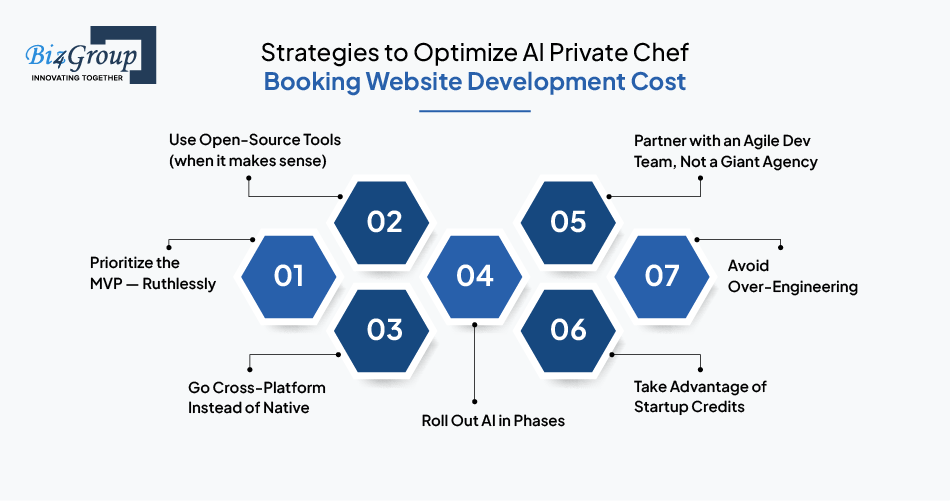
Strategies to Optimize AI Private Chef Booking Website Development Cost
Let’s call it what it is:
You’re not just trying to build a platform.
You’re trying to build it without maxing out your credit line or begging VCs for more money at the prototype stage.
Here’s how you keep your chef booking dream alive — without blowing up your budget.
1. Prioritize the MVP — Ruthlessly
Don’t build the 5-year roadmap. Build the 6-month launch version.
- You don’t need VR kitchen tours.
- You don’t need real-time nutritional analytics (yet).
- You do need chef profiles, booking, and payments — with maybe one cool AI feature to start.
This one decision alone can cut your cost to develop AI private chef booking website, by 30–50%.
2. Use Open-Source Tools (when it makes sense)
Why pay to build from scratch when the internet already made it for you?
- Open-source CMS (like Strapi or Keystone)
- React UI libraries (like Chakra UI or Material UI)
- AI frameworks (like Hugging Face models or LangChain for chatbots)
Less dev time = fewer billed hours = more money saved.
3. Go Cross-Platform Instead of Native
Unless your users are super picky about app experience, you don’t need separate Android and iOS codebases.
Use Flutter or React Native and launch once — not twice.
Founders who do this typically save 30–40% on mobile app costs.
4. Roll Out AI in Phases
You don’t need to solve every personalization problem with machine learning from day one.
Start with:
- Simple chef matching based on filters
- AI-assisted menu suggestions using APIs
Leave the heavy lifting (custom-trained models, deep personalization) for Phase 2.
5. Partner with an Agile Dev Team, Not a Giant Agency
Large agencies have impressive portfolios and hefty price tags.
What you really need?
A lean, skilled, senior-led team that:
- Works in sprints
- Shares detailed estimates
- Isn’t afraid to say, “You don’t need that feature yet.”
(We’ll talk more about Biz4Group in a minute — and why they tick all those boxes.)
6. Take Advantage of Startup Credits
AWS, Google Cloud, Notion, HubSpot — they all want your startup to succeed (so you’ll pay them later).
Sign up for their startup programs and get:
- $2,000–$100,000 in cloud credits
- Free tools
- Priority support
That’s real money off your build and hosting costs.
7. Avoid Over-Engineering
This one’s big. And common.
Don’t create the world’s most flexible booking logic if 90% of your users just want Friday night dinner at 7 PM.
Build for the common case.
Add edge-case features only if users ask for them later.
Bottom line: You don’t need to cut corners — you just need to cut clutter.
Smart founders build lean, test fast, and scale what works.
Not everything shiny needs to be in v1. The goal is launch and learn, not launch and lose control of your budget.
AI Meets Hospitality — Let’s Build the Future.
Create next-gen chef booking experiences with a team that delivers results.
Schedule a Call NowHow Biz4Group is the Right Partner for Building Your AI Private Chef Booking Website in Budget?
Let’s be real. Anyone can say they build AI-powered marketplaces.
But not everyone can actually show you a live, functional, beautifully executed chef booking platform.
Biz4Group, an AI development company can.
Because we already did it.
Case in Point: Book Private Chef — Built by Biz4Group
We helped bring to life Book Private Chef, a sleek, AI-enhanced web portal connecting clients with private chefs across the U.S. It’s a platform built for personalized experiences — and it nails every detail:
- Smart chef profiles with filters for cuisine, budget, and dietary needs
- Real-time booking engine and availability calendar
- Secure payment gateway and client review system
- Admin dashboard for end-to-end control
- Scalable backend to support growth and future feature rollouts
And yes — it looks stunning.
It functions smoothly.
And it was delivered on time, within budget, and with full-stack excellence.
Now here’s why you should seriously consider partnering with Biz4Group for any web development services:
1. We’ve Done This Before — Successfully
Platforms like Book Private Chef aren’t just concepts for us — they’re battle-tested builds. We know what works (and what doesn’t), and we bring that knowledge straight into your project from Day One.
2. In-House AI Experts Who Build Smart, Not Just Flashy
From chef matching algorithms to chatbot assistants and menu personalization, our team doesn’t just “plug in AI.” We tailor intelligent systems that serve actual user needs — and scale with you.
Speaking of chatbot assistants above, here is a complimentary guide for you on how to integrate chatbot in website.
3. Full-Service, Full-Stack
Whether you're launching just web, just mobile, or both — we’ve got you covered:
- UI/UX Design
- Frontend & Backend Development
- AI/ML Model Integration
- DevOps + Hosting + QA
- Post-launch support & future iterations
All under one roof. No outsourcing puzzles. No dropped balls.
4. Transparent, Agile Development Process
You get:
- Clear cost breakdowns
- Sprint-based development
- Weekly check-ins
- Roadmaps you can actually understand
No black-box surprises. No bloated invoices. Just clean, professional execution.
5. Flexible Engagement Models
Whether you're bootstrapping an MVP or scaling into Series A territory, we adapt:
- Fixed-cost projects for MVPs
- Time & material for ongoing builds
- Dedicated resources if you want to build long-term with us
6. Clients Trust Us — and Come Back for More
With 700+ successful projects and over 300 happy clients, we’ve built platforms that work, scale, and evolve — not just look good for a demo.
If you're serious about building a smart, scalable, AI-powered chef booking platform — and you actually want it delivered on budget — Biz4Group is the move.
We’re not guessing how to build this. We’ve already done it.
Wrapping Up!
Let’s recap.
You’re not just building a booking site.
You’re creating a smart, AI-powered experience that connects people with private chefs — personalized, seamless, and scalable.
And now, you know exactly what that takes:
- The features that matter — and what they cost
- A tech stack that’s modern, stable, and startup-friendly
- A realistic timeline and the team to deliver it
- A budget range you can actually work with (without selling a kidney)
- Real strategies to trim cost without cutting corners
- And a tech partner who’s already done it — and nailed it
So, here’s the big question:
Are you ready to build it — the right way, from Day One?
If the answer is yes, then let’s not waste time.
Built for Founders. Backed by Experience.
Built for Founders. Backed by Experience.
Turn your vision into a scalable AI chef booking platform — without blowing your runway.
Talk to Our Startup ExpertsFAQ
1. How much does it cost to build an AI chef booking website?
The cost to develop AI private chef booking website typically ranges from $45,000 to $150,000+, depending on complexity.
2. How long does it take to build a chef booking platform with AI features?
A well-scoped MVP can be built in 16 to 24 weeks (4 to 6 months).
This includes:
- Planning & design
- Development of user/chef flows
- AI integration (e.g., recommendations or chatbots)
- Testing and launch
Timelines may vary based on feature depth and how prepared you are with requirements.
3. What are the must-have features in an AI-based chef booking platform?
At a minimum, you should include:
- User & chef profiles
- Smart search and filtering
- Booking & calendar management
- Payment processing
- Reviews and ratings
AI features like personalized chef recommendations and menu suggestions give your platform an edge and improve user retention.
4. Can I start with a basic version and add AI later?
Absolutely — and it’s often the smarter approach. Start with essential booking functionality, then gradually integrate AI tools (e.g., behavior-based suggestions or NLP chatbots) based on user demand. This keeps your MVP lean and helps manage budget efficiently.
5. Do I need a separate app for users and chefs?
Not necessarily. A well-designed app (or web portal) can handle both roles with separate login flows and dashboards. However, for advanced platforms or heavy traffic, separating user and chef experiences into distinct apps may offer better performance and usability.
