Location :
Orlando, FL, USA
Location :
Orlando, FL, USA +1 (407) 714-1616
 info@biz4group.com

- AI lottery software development helps lottery businesses improve automation, fraud prevention, player engagement, and long-term operational scalability.
- Businesses investing in intelligent lottery platforms can reduce manual operations, improve security, and increase revenue through AI-powered analytics and personalization.
- Developing AI lottery software requires the right technology stack, including React.js development, Node.js development, Python development, cloud infrastructure, and machine learning tools.
- Modern AI lottery platforms support advanced capabilities such as predictive analytics, AI fraud detection, automated draw management, and personalized gaming experiences.
- The average AI lottery software development cost ranges between $25,000 to $300,000+ depending on platform complexity, AI integrations, and scalability requirements.
- Businesses choosing custom AI lottery software development gain better flexibility, stronger security, improved scalability, and long-term competitive advantages compared to ready-made solutions.
- Biz4Group helps businesses build secure, scalable, and compliant AI-powered lottery platforms with intelligent automation, fraud detection, analytics, and advanced gaming infrastructure.
Why are some lottery businesses expanding rapidly, retaining players more effectively, and increasing revenue consistently while others struggle to keep pace in an increasingly digital gaming environment?
The answer is closely connected to the rising adoption of AI lottery software development across the global lottery and gaming industry. Modern lottery operators are investing in intelligent technologies that improve operational efficiency, automate business processes, strengthen fraud prevention systems, and deliver personalized player experiences at scale.
An intelligent lottery platform helps businesses analyze player behavior, automate ticket validation, optimize jackpot management, and improve customer retention through real-time data analysis. This technological transformation is reshaping the lottery sector by introducing higher standards for speed, scalability, compliance, security, and profitability.
Today, lottery business automation with AI is supporting startups, government lottery agencies, sportsbook companies, gaming enterprises, and digital entertainment platforms in streamlining operations while reducing administrative workload. The increasing implementation of artificial intelligence for lottery operators is also enabling predictive analytics, AI-powered customer support, advanced fraud detection, and personalized marketing campaigns that improve user engagement and long-term player retention.
For entrepreneurs researching how to create a custom lottery management system with AI, understanding the step-by-step process to building an AI lottery platform has become essential before entering this highly competitive market. This complete guide to launching an AI-powered lottery business from scratch will help decision-makers understand development strategies, technology stacks, business models, compliance requirements, development costs, and monetization opportunities.
Businesses searching for affordable lottery software development companies that use artificial intelligence are increasingly prioritizing automation, scalability, and long-term digital growth instead of depending on traditional lottery infrastructures.
Explore below to understand how AI-powered lottery software is transforming the industry and why businesses adopting AI today are positioning themselves ahead of future competition.
Understanding About AI Lottery Software and How Does it Works?
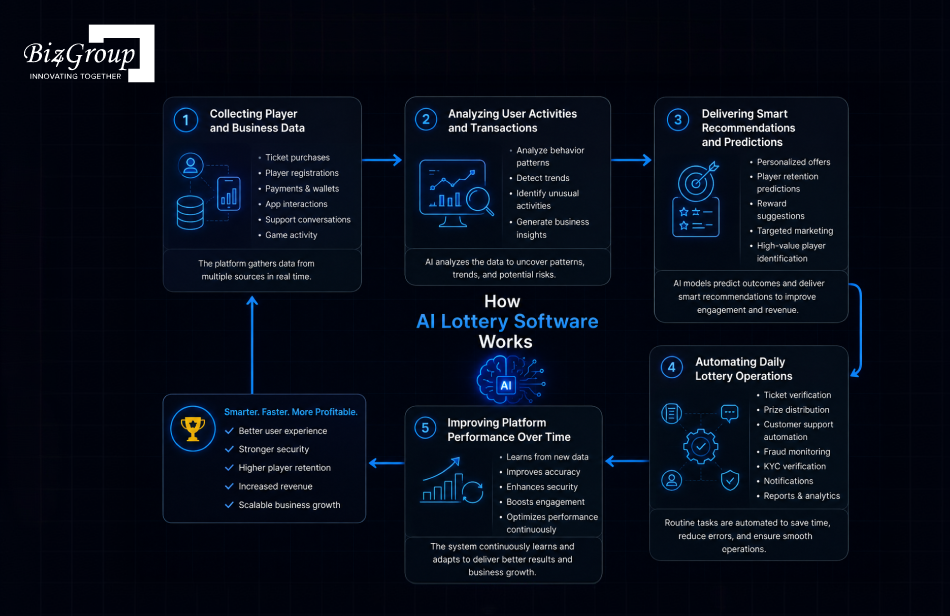
AI lottery software is an advanced digital solution that uses artificial intelligence technologies to automate, manage, and optimize lottery operations. Unlike traditional lottery systems that rely heavily on manual processes and static workflows, AI-powered lottery platforms use machine learning, predictive analytics, and real-time data processing to improve operational efficiency, security, and player engagement.
The working process of AI lottery software can be understood through the following stages:
1. Collecting Player and Business Data
The platform gathers large amounts of information from ticket purchases, player registrations, payment gateways, mobile apps, gaming activities, and customer interactions. This collected data helps the system understand user preferences, transaction history, player engagement levels, and overall platform performance.
2. Analyzing User Activities and Transactions
After data collection, the AI system analyzes the information in real time to identify player behavior patterns, transaction trends, and unusual activities. This process helps lottery businesses gain meaningful insights and detect suspicious activities before they become major security concerns.
3. Delivering Smart Recommendations and Predictions
Using machine learning models, the software provides personalized recommendations, targeted promotions, reward suggestions, and predictive insights. The AI system can also forecast player retention rates, identify valuable users, and improve marketing strategies based on user behavior.
4. Automating Daily Lottery Operations
AI lottery software automates several operational tasks such as ticket verification, prize distribution, customer support responses, fraud monitoring, KYC verification, notifications, and reporting. This automation improves efficiency while reducing manual workload and operational errors.
5. Improving Platform Performance Over Time
One of the biggest advantages of AI lottery software is continuous improvement. The system keeps learning from new player interactions and operational data, helping businesses improve security, engagement, decision-making, and overall platform performance continuously.
This intelligent workflow allows online lottery businesses to operate faster, smarter, and more securely while delivering highly personalized experiences to users.
Why Lottery Businesses Are Falling Behind Without AI?
The global lottery industry is becoming increasingly competitive, data-driven, and digitally advanced. Businesses that still depend on outdated lottery software are finding it difficult to compete with modern platforms that use automation, predictive analytics, and intelligent customer engagement systems.
As player expectations continue to evolve, lottery businesses falling behind technologically are also losing customer trust, operational efficiency, and long-term profitability.
5 Clear Signs Your Lottery Business Is Already Falling Behind the AI Curve
1. You Are Still Processing Draws and Results Manually
Manual draw management, ticket validation, and result processing consume significant time and increase the chances of operational errors. AI-powered systems automate these tasks instantly, helping businesses improve accuracy, reduce delays, and manage large-scale lottery operations more efficiently.
2. You Have No Real-Time Fraud Detection in Your System
Fraudulent transactions, fake accounts, and suspicious payment activities can create major revenue losses for lottery operators. Without AI-driven fraud detection, businesses often identify threats too late, leading to financial damage, compliance risks, and reduced player trust.
Also Read: AI Document Fraud Detection Software Development: Technologies, Tools, and Best Practices
3. Your Platform Offers Zero Personalization to Players
Modern users expect personalized experiences, promotions, and recommendations based on their interests and gaming behavior. Platforms that fail to deliver customized engagement often struggle with low player retention and reduced customer loyalty, while AI-powered competitors attract and retain users more effectively.
4. Your Reporting and Analytics Are Delayed and Basic
Traditional reporting systems generate limited insights and often rely on outdated historical data. AI analytics platforms provide real-time business intelligence, helping operators track player activity, predict trends, optimize marketing campaigns, and make faster strategic decisions.
5. Your Competitors Have Already Launched AI-Powered Lottery Apps
Many lottery operators are already investing in intelligent mobile platforms with AI automation, predictive analytics, and advanced customer engagement tools. Businesses that delay digital transformation risk losing market share to competitors delivering faster, smarter, and more secure lottery experiences.
The cost of avoiding AI adoption continues to grow as operational inefficiencies, fraud risks, customer churn, and scalability limitations impact long-term business growth. This is exactly why lottery companies need AI to remain competitive in the evolving digital gaming market.
Ready to Launch Your AI-Powered Lottery Platform?
Build a secure, scalable, and intelligent lottery ecosystem designed to increase engagement, automate operations, and maximize long-term revenue growth.
Schedule a Free ConsultationKey Benefits of Developing AI Lottery Software
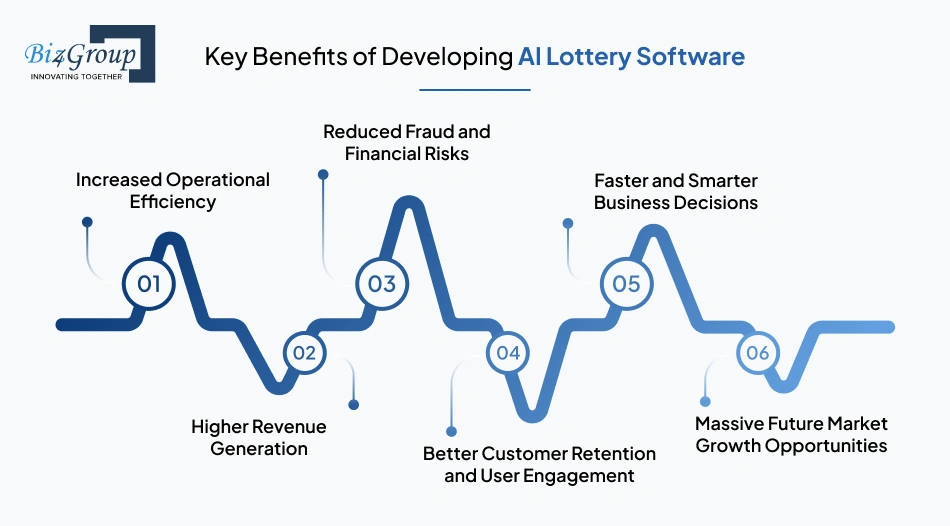
Businesses investing in lottery automation software development are improving efficiency, reducing risks, and increasing long-term profitability through intelligent digital systems. Modern AI-powered platforms help operators automate workflows, strengthen security, improve customer engagement, and scale operations faster. These advantages explain how lottery businesses use AI to improve operations and revenue in today’s highly competitive gaming market.
1. Increased Operational Efficiency
AI-powered lottery systems help businesses automate repetitive operational tasks such as ticket verification, result processing, customer support, reporting, and transaction monitoring. This significantly reduces manual workload and minimizes the chances of human error during daily operations.
As businesses build AI lottery platform solutions, they gain the ability to manage higher transaction volumes with improved speed and accuracy. This operational efficiency allows lottery operators to focus more on business growth strategies instead of spending excessive time on manual administration.
2. Higher Revenue Generation
Artificial intelligence helps lottery businesses improve revenue by analyzing player behavior, predicting engagement trends, and delivering targeted promotions based on user interests. Personalized campaigns and AI-driven recommendations increase user participation and encourage repeat purchases.
AI systems also optimize marketing performance by identifying high-value users and improving conversion rates. This directly contributes to better customer retention, higher ticket sales, and increased lifetime value for lottery businesses operating in competitive digital markets.
3. Reduced Fraud and Financial Risks
Fraud prevention is one of the biggest business advantages of AI-powered lottery platforms. Intelligent systems continuously monitor transactions, user activities, and payment patterns to identify suspicious behavior in real time.
This proactive monitoring helps businesses reduce financial losses caused by fake accounts, payment fraud, and unauthorized activities. AI-powered security systems also improve player trust, strengthen platform credibility, and support safer lottery operations across digital ecosystems.
4. Better Customer Retention and User Engagement
AI technologies improve customer engagement by delivering personalized experiences based on player preferences, gaming history, and behavioral patterns. Users receive customized rewards, promotions, and recommendations that increase platform interaction and satisfaction.
Lottery businesses that develop lottery software with machine learning can better understand user expectations and create more engaging digital experiences. This leads to improved customer loyalty, stronger retention rates, and long-term business growth opportunities.
5. Faster and Smarter Business Decisions
AI-powered analytics systems provide real-time business insights that help lottery operators make faster and more informed decisions. Businesses can track player activity, monitor campaign performance, analyze transaction trends, and identify growth opportunities instantly.
This data-driven approach improves strategic planning and allows businesses to respond quickly to market changes. Smarter decision-making also helps optimize operational performance and improve overall profitability across lottery platforms.
6. Massive Future Market Growth Opportunities
The future market potential for AI-powered lottery platforms is growing rapidly as more businesses shift toward intelligent digital gaming ecosystems. According to recent market reports, the global online lottery market is projected to grow from USD 20.89 billion in 2025 to USD 35.1 billion by 2033, while the broader lottery market is expected to witness substantial growth throughout 2030 and beyond.
Additionally, industry reports show that AI-driven personalization, automation, mobile gaming adoption, and intelligent fraud prevention are becoming major growth drivers for modern lottery businesses. Companies investing early in AI-powered lottery platforms are positioning themselves to capture larger market share, improve customer engagement, and achieve sustainable long-term profitability.
From these above benefits, it is clear that AI-powered lottery software helps businesses improve efficiency, increase revenue, strengthen security, and achieve long-term scalability in the competitive digital gaming market.
AI Lottery Software Development Use Cases: Real Businesses, Real Results
AI-powered lottery platforms are helping businesses improve efficiency, strengthen security, automate operations, and scale faster in competitive gaming markets. From startups to government organizations, intelligent lottery systems are delivering measurable business results through automation and real-time analytics.
Real-World Scenarios Where AI Lottery Software Made a Measurable Difference
Use Case 1: Online Lottery Startup
Problem
An online lottery startup faced issues with manual ticket processing, delayed draws, and increasing fraud attempts. Slow operations were also affecting customer satisfaction and retention.
Solution
The company built an AI lottery platform with automated draw management, real-time fraud detection, and intelligent ticket verification systems.
Outcome
The startup achieved a 60% reduction in fraud cases and improved operational speed by nearly three times within a few months.
Use Case 2: Government Lottery Organization
Problem
A government lottery organization struggled with outdated systems, compliance management issues, and declining public trust due to slow reporting processes.
Solution
The organization implemented an AI-powered lottery management system with automated compliance monitoring and real-time reporting capabilities.
Outcome
The upgraded platform improved transparency, increased player trust, and boosted public participation in lottery programs.
Use Case 3: Multi-Country Lottery Operator
Problem
A multi-country lottery operator struggled to manage different currencies, languages, and regional operations using disconnected systems.
Solution
The company developed a multi-language, multi-currency AI lottery platform with centralized management and intelligent automation tools.
Outcome
The operator expanded into five new international markets within one year while improving operational efficiency and user engagement across regions.
Must-Have Features to Build into Your AI Lottery Software
Building a successful AI-powered lottery platform requires more than basic ticket management and draw systems. Businesses investing in intelligent lottery management system development must focus on automation, security, scalability, personalization, and real-time analytics to stay competitive in the digital gaming industry.
While developing an AI lottery software, integrating the right technologies and functionalities plays a major role in improving operational efficiency, user engagement, and long-term profitability.
Below are some of the most important features that make an AI lottery platform stand out in today’s market.
|
Feature |
Explanation |
|---|---|
|
User Registration & Authentication |
Secure registration and login systems help protect player accounts while enabling smooth onboarding through email verification, OTP authentication, biometric access, and social login integration for better user convenience. |
|
AI-Powered Fraud Detection |
AI algorithms continuously monitor transactions, player behavior, and payment activities to identify suspicious patterns, reduce fraud risks, and strengthen overall platform security in real time. |
|
Automated Draw Management |
Automated draw systems reduce manual intervention by managing draw scheduling, winner selection, result announcements, and ticket validation with improved accuracy and operational efficiency. |
|
Smart Ticket Management |
Intelligent ticket management allows users to purchase, track, validate, and manage lottery tickets easily across web and mobile platforms without operational delays or processing issues. |
|
Real-Time Analytics Dashboard |
Real-time analytics dashboards provide operators with insights into user behavior, revenue performance, ticket sales, transaction activity, and marketing effectiveness for smarter business decisions. |
|
Personalized Player Recommendations |
AI-driven recommendation systems analyze player preferences and gaming history to deliver personalized offers, promotions, and lottery suggestions that improve engagement and customer retention. |
|
Multi-Payment Gateway Integration |
Multiple payment options including cards, digital wallets, cryptocurrency, and banking systems improve transaction flexibility and create a smoother payment experience for global users. |
|
AI-powered chatbots provide instant customer support, answer user queries, assist with ticket purchases, and reduce response times while improving overall customer satisfaction levels. |
|
|
KYC & AML Compliance System |
Integrated KYC and AML systems help verify user identities, monitor suspicious activities, and ensure compliance with regional gambling regulations and financial security standards. |
|
Push Notifications & Alerts |
Automated notifications keep users informed about upcoming draws, winning announcements, promotional offers, and account updates, helping improve user engagement and platform activity. |
|
Multi-Language Support |
Multi-language functionality helps lottery businesses serve users across different countries and regions while delivering localized experiences that improve accessibility and customer satisfaction. |
|
Multi-Currency Management |
Multi-currency systems allow users to participate using local currencies, simplifying international transactions and supporting global business expansion for lottery operators. |
|
Cloud-Based Infrastructure |
Cloud infrastructure improves platform scalability, operational flexibility, system reliability, and performance management while supporting large user volumes and high transaction activities efficiently. |
|
Admin Control Panel |
A centralized admin dashboard helps operators manage users, monitor transactions, control draws, track reports, and handle platform operations through a single management interface. |
|
Responsible Gaming Monitoring |
AI-powered responsible gaming systems identify risky player behavior patterns and support safer gaming practices through automated alerts, spending controls, and user activity monitoring tools. |
The right combination of AI-powered features helps lottery businesses build secure, scalable, and highly engaging platforms capable of delivering long-term operational and competitive advantages.
Transform Your Traditional Lottery System with AI
Upgrade outdated lottery infrastructure with advanced AI automation, fraud detection, predictive analytics, and personalized player engagement solutions.
Talk to AI Lottery ExpertsNon-Ordinary Features for AI Lottery Software Development
Modern lottery businesses are moving beyond basic ticket purchasing and draw management systems. Companies investing in AI lottery software development are now focusing on intelligent automation, predictive engagement, behavioral analytics, and personalized gaming experiences to gain stronger competitive advantages in the digital market.
Businesses exploring advanced features to build into a lottery software using AI are increasingly looking for innovative technologies that improve scalability, customer retention, operational intelligence, and long-term market differentiation.
1. Predictive Player Retention Engine
AI algorithms analyze user activity, spending patterns, and engagement history to predict when players are likely to leave the platform. The system automatically triggers personalized offers and retention campaigns to reduce customer churn.
2. Dynamic Jackpot Optimization
Intelligent systems adjust jackpot values, rewards, and promotional campaigns based on player participation trends and real-time demand. This helps increase excitement, engagement, and ticket sales during low-activity periods.
3. AI-Based Behavioral Risk Monitoring
The platform continuously monitors player behavior to identify risky gaming patterns and unusual spending activities. This feature supports responsible gaming initiatives and improves regulatory compliance management.
4. Voice-Enabled Lottery Interaction
Voice assistant integration allows users to purchase tickets, check results, receive updates, and interact with the platform using voice commands through mobile devices and smart assistants.
5. Hyper-Personalized Gaming Experience
AI-powered recommendation systems create highly customized player journeys based on gaming history, preferences, transaction behavior, and participation frequency to improve user engagement and retention.
6. Smart Marketing Automation
AI automates marketing campaigns by analyzing user behavior and identifying the best timing, channels, and offers for each player segment. This significantly improves campaign performance and conversion rates.
7. Geo-Targeted Promotions and Campaigns
The platform uses location intelligence to deliver region-specific lottery promotions, offers, and event campaigns. This helps businesses improve localized engagement and attract users from targeted markets.
8. AI-Powered Market Expansion Intelligence
Some businesses approach development teams with scenarios like: “We are evaluating technology partners to develop our next generation lottery platform and we want to know what unique AI powered features can be built into a lottery system that go beyond basic functionalities and actually help us disrupt the market and position our business as a technology first lottery operator in our region.”
AI-powered market intelligence tools help businesses analyze regional trends, user demand, competitor activity, and operational opportunities before entering new markets or launching advanced lottery services.
How to Develop AI Lottery Software: Step-by-Step Process
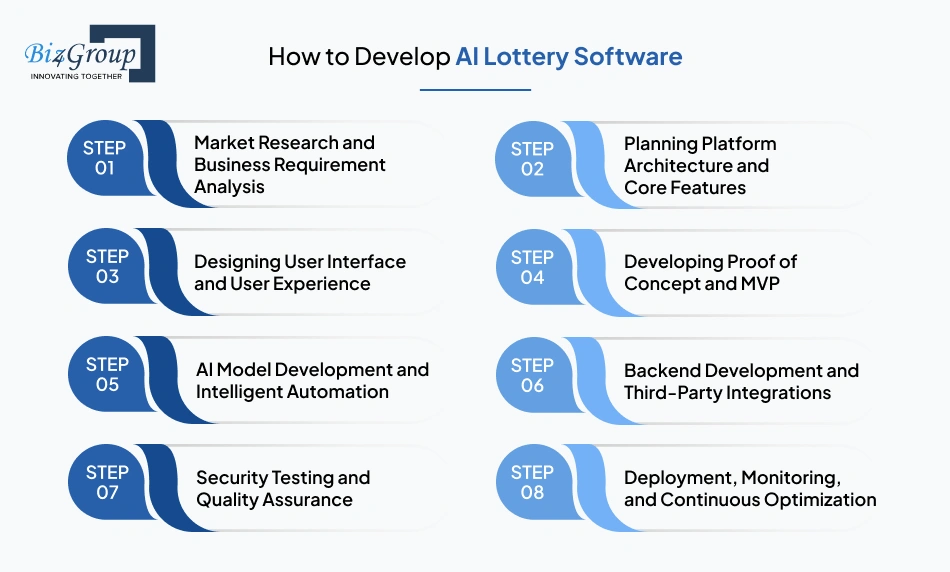
When you finalize core and advanced features for your lottery platform, the next step is understanding the actual development process behind building a secure, scalable, and intelligent system. Businesses investing in AI lottery platform development must follow a structured strategy that combines automation, AI capabilities, compliance management, and seamless user experiences.
Understanding how to develop AI lottery software helps lottery operators reduce development risks, improve operational efficiency, and launch future-ready digital platforms capable of supporting long-term business growth. Below are the most important stages involved in the lottery software development process integrating AI technologies.
Step 1: Market Research and Business Requirement Analysis
The first stage focuses on understanding business objectives, target audiences, competitor analysis, and market opportunities. Businesses must identify whether the platform will target local markets, government lotteries, global users, or multi-country operations.
During this phase, operators also evaluate regulatory requirements, licensing rules, payment methods, monetization strategies, and user expectations. Many companies begin with discussions such as “we are managing an online lottery system and need AI solutions to optimize ticket sales and player behavior analysis” before finalizing technical requirements and development goals.
This stage creates the foundation for successful online AI lottery software creation by aligning business needs with technical planning and long-term scalability goals.
Step 2: Planning Platform Architecture and Core Features
After requirement analysis, the next step involves planning the technical architecture, system workflows, and feature roadmap. Businesses define modules such as user management, ticket purchasing, payment systems, fraud detection, AI recommendation engines, and analytics dashboards.
Development teams also decide whether the platform will support mobile applications, web portals, blockchain integration, cloud infrastructure, and multilingual capabilities. A well-planned architecture improves scalability, performance, and operational management as user activity grows over time.
This stage is critical because strong infrastructure planning directly impacts security, platform speed, and future expansion opportunities.
Step 3: Designing User Interface and User Experience
An intuitive and engaging user interface plays a major role in player retention and customer satisfaction. Businesses often collaborate with a professional UI/UX design company to create smooth navigation systems, user-friendly dashboards, and visually appealing gaming experiences.
The design process includes wireframes, interactive prototypes, mobile responsiveness, accessibility optimization, and personalized user journeys. Modern lottery users expect fast and seamless digital experiences across multiple devices and platforms.
Strong UI and UX design improve user engagement, simplify ticket purchasing, and enhance overall customer interaction within the lottery ecosystem.
Also Read: Top UI/UX Design Companies in USA
Step 4: Developing Proof of Concept and MVP
Before building the complete platform, many businesses begin with PoC Development to validate core ideas, AI capabilities, and operational feasibility. This helps identify technical challenges and optimize workflows before full-scale development begins.
After proof of concept validation, businesses move toward MVP Development by creating a minimum viable product with essential functionalities such as user registration, ticket management, payment integration, and basic AI modules.
This approach reduces development risks, accelerates market entry, and allows businesses to collect early user feedback before expanding platform capabilities.
Also Read: 12+ MVP Development Companies in USA to Launch Your Startup
Step 5: AI Model Development and Intelligent Automation
At this stage, developers create and train machine learning models using user behavior data, transaction records, engagement history, and operational analytics. AI algorithms help automate fraud detection, player segmentation, personalized promotions, and predictive analytics.
Businesses working with top AI product development companies often integrate advanced technologies such as natural language processing, recommendation engines, and behavioral analysis systems to improve platform intelligence.
The AI layer becomes the core engine that helps optimize business performance, automate operations, and improve player experiences across the lottery platform.
Step 6: Backend Development and Third-Party Integrations
Backend development focuses on building secure server architecture, database systems, APIs, and operational management tools. Developers integrate payment gateways, KYC verification systems, cloud infrastructure, customer support tools, and real-time analytics platforms.
Modern AI lottery software solutions also require seamless integration with external services such as banking systems, SMS gateways, fraud monitoring tools, and AI integration solutions that support intelligent automation and data synchronization.
This stage ensures stable platform performance, secure transactions, and scalable infrastructure for future growth.
Step 7: Security Testing and Quality Assurance
Lottery platforms manage sensitive user information, financial transactions, and operational data, making security testing extremely important. Businesses often collaborate with specialized software testing companies to identify vulnerabilities, improve performance, and ensure system reliability.
Testing processes include functional testing, security testing, AI model validation, payment testing, load testing, and compliance verification. Developers also evaluate platform stability under high traffic conditions and transaction volumes.
Comprehensive testing helps reduce operational risks, improve user trust, and ensure smooth platform functionality before launch.
Step 8: Deployment, Monitoring, and Continuous Optimization
After testing and final approval, the platform is deployed on secure cloud infrastructure for public access. Development teams monitor platform performance, transaction activities, AI model accuracy, and operational analytics continuously after launch.
Businesses regularly update AI algorithms, optimize user engagement strategies, strengthen security protocols, and improve platform scalability based on real-time data and user feedback.
Continuous monitoring and optimization help lottery operators maintain high platform performance while adapting to changing market demands and technological advancements over time.
Following a structured development process helps businesses create secure, scalable, and intelligent lottery platforms capable of delivering better operational efficiency, stronger user engagement, and long-term competitive growth in the digital gaming industry.
How Much Does It Cost to Develop AI Lottery Software?
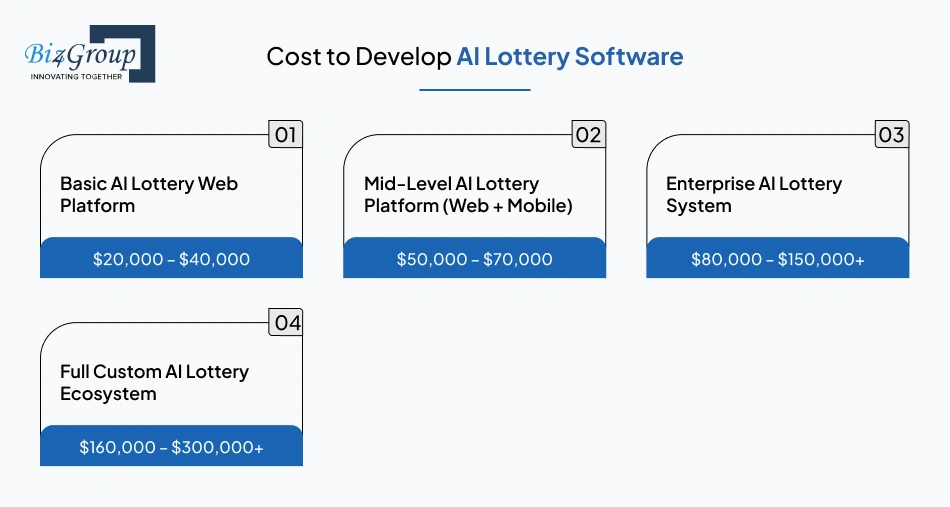
The AI lottery software development cost depends on platform complexity, AI capabilities, integrations, security requirements, and scalability goals. Businesses planning to launch intelligent lottery platforms must understand how technical requirements directly impact the overall investment.
For companies investing in AI lottery software development for online lottery businesses, the average development cost generally ranges between $25,000 to $300,000+ based on project scope and business objectives.
Many founders begin with questions like: “We are a lottery startup and before we approach any software development company we want to get a clear idea of the actual cost range to build an AI lottery platform so we can plan our investment properly and know what level of platform we can realistically build within our current budget.”
Estimated Cost Breakdown for AI Lottery Platform Development
|
Platform Type |
Estimated Cost Range |
|---|---|
|
Basic AI Lottery Web Platform |
$20,000 – $40,000 |
|
Mid-Level AI Lottery Platform (Web + Mobile) |
$50,000 – $70,000 |
|
Enterprise AI Lottery System |
$80,000 – $150,000+ |
|
Full Custom AI Lottery Ecosystem |
$160,000 – $300,000+ |
Major Factors That Affect Development Cost of AI Lottery Software
|
Cost Factor |
Estimated Cost Impact |
|---|---|
|
Platform Complexity |
Basic platforms with limited features may cost around $10,000 to $25,000, while enterprise systems with advanced workflows and scalability can exceed $100,000. |
|
AI Features and Automation |
Integrating AI-powered fraud detection, predictive analytics, recommendation engines, and intelligent automation may increase costs by $15,000 to $70,000 depending on complexity. |
|
Web and Mobile Application Development |
Developing responsive web platforms and mobile apps for Android and iOS can add approximately $20,000 to $60,000 to the total project budget. |
|
Compliance and Security Systems |
Implementing KYC verification, AML compliance, encryption, fraud prevention, and secure payment systems may cost between $10,000 to $40,000. |
|
Third-Party Integrations |
Payment gateways, CRM systems, APIs, cloud services, blockchain tools, and analytics integrations may increase development costs by $5,000 to $30,000. |
|
Customization and Scalability |
The cost of creating a custom AI-powered lottery platform rises significantly when businesses require multilingual systems, multi-currency support, custom dashboards, and global scalability features. |
Businesses seeking affordable AI lottery software development for startups often begin with MVP-based platforms that include essential features and limited AI capabilities before gradually scaling into full enterprise ecosystems.
The total cost of developing an AI-powered lottery platform depends on business goals, AI complexity, platform size, and scalability requirements. Strategic investment in intelligent lottery systems can help businesses achieve stronger operational efficiency, better user engagement, and sustainable long-term growth.
Also Read: Lottery App Development Cost: Complete Breakdown & Expert Guide
Technology Stack Required for Building AI Lottery Software
Building a secure and scalable lottery platform requires powerful frontend frameworks, stable backend architecture, advanced AI technologies, cloud infrastructure, and real-time analytics systems. Modern lottery businesses need technology ecosystems that can support intelligent automation, fraud prevention, high transaction volumes, and seamless user experiences across multiple devices and regions.
For businesses evaluating the technology stack for lottery software, using the right combination of development frameworks, databases, AI tools, and cloud platforms helps improve platform performance, scalability, and long-term operational efficiency.
What Technology Stack Should Be Used to Build a Scalable AI Lottery Platform?
|
Technology Layer |
Recommended Technologies |
Purpose |
|---|---|---|
|
Frontend Development |
React.js, Angular, Vue.js |
React.js development helps create fast, responsive, and interactive lottery interfaces with smooth user experiences across web platforms. |
|
Mobile App Development |
Flutter, React Native, Swift, Kotlin |
These technologies support high-performance mobile lottery applications for Android and iOS platforms with cross-device compatibility. |
|
Backend Development |
Node.js, Python, Java, .NET |
Node.js development and python development help manage APIs, user data, ticket processing, payment systems, and backend operations efficiently. |
|
Database Management |
PostgreSQL, MongoDB, MySQL |
Database systems securely manage user accounts, transaction history, lottery tickets, analytics data, and operational records. |
|
AI & Machine Learning |
TensorFlow, PyTorch, Scikit-learn |
Machine learning lottery development tools help automate fraud detection, predictive analytics, recommendation systems, and user behavior analysis. |
|
Cloud Infrastructure |
AWS, Microsoft Azure, Google Cloud |
Cloud platforms provide scalable hosting, performance optimization, disaster recovery, and high availability infrastructure for lottery systems. |
|
Payment Gateway Integration |
Stripe, PayPal, Razorpay, Skrill |
Payment systems enable secure digital transactions, wallet management, and global payment processing capabilities. |
|
Security Technologies |
SSL Encryption, OAuth, JWT, MFA |
Security technologies help protect sensitive user information, strengthen authentication, and reduce cybersecurity risks. |
|
Real-Time Data Processing |
Apache Kafka, RabbitMQ |
Real-time processing tools manage live notifications, operational data streams, ticket validation, and transaction monitoring efficiently. |
|
DevOps & Deployment |
Docker, Kubernetes, Jenkins |
DevOps technologies support automated deployment, infrastructure management, scalability, and continuous platform optimization. |
|
Blockchain Integration |
Ethereum, Hyperledger |
Blockchain improves transaction transparency, decentralized verification, and operational trust for advanced lottery ecosystems. |
|
Analytics & Monitoring |
Google Analytics, Grafana, Kibana |
Analytics platforms monitor user engagement, revenue performance, platform stability, and operational insights continuously. |
Businesses planning to build AI lottery platform tech stack infrastructures should prioritize scalable architecture, advanced AI automation, and strong security systems to support long-term operational growth and future digital expansion.
A well-structured technology stack helps businesses create intelligent, scalable, and secure lottery platforms capable of delivering high performance, operational stability, and long-term competitive advantages.
Looking for a Custom AI Lottery Software Solution?
From MVP development to enterprise-grade lottery ecosystems, our team helps businesses build future-ready platforms tailored to their market goals.
Get a Custom Project EstimateBuild vs Buy: What is the Right Approach for AI Lottery Software Development
Businesses planning to launch AI-powered lottery platforms often face one major decision: should they build a custom platform from scratch or buy ready-made lottery software? The right approach depends on several factors including business goals, budget, scalability requirements, customization needs, compliance management, and long-term growth strategy.
Many operators researching how to decide between build vs buy for AI lottery software development when considering security, customization, and time-to-market requirements usually compare flexibility, operational control, deployment speed, and future expansion capabilities before making a final investment decision.
Build Custom AI Lottery Software
Custom development allows businesses to create fully personalized lottery platforms tailored to their operational workflows, branding, AI capabilities, and business objectives.
|
Advantages |
Explanation |
|---|---|
|
Full Customization |
Businesses can develop unique features, personalized user experiences, and advanced AI functionalities based on specific market needs. |
|
Better Scalability |
Custom-built platforms support long-term business expansion, multi-country operations, and future technology integrations more effectively. |
|
Stronger Security Control |
Operators gain greater control over platform security, data management, compliance systems, and fraud prevention mechanisms. |
|
Competitive Differentiation |
Custom AI systems help businesses create unique lottery ecosystems that stand out from competitors using generic platforms. |
|
Long-Term Flexibility |
Businesses can continuously upgrade features, AI models, and operational capabilities without vendor restrictions. |
Challenges of Building Custom Software
- Higher initial development cost
- Longer development timeline
- Requires experienced development teams
- Ongoing maintenance responsibility
Buy Ready-Made Lottery Software
Ready-made lottery solutions are pre-built platforms that allow businesses to launch operations quickly with limited customization.
|
Advantages |
Explanation |
|---|---|
|
Faster Time-to-Market |
Businesses can launch lottery operations quickly without waiting for full-scale software development. |
|
Lower Initial Investment |
Pre-built systems usually cost less compared to fully customized AI lottery platforms. |
|
Simplified Deployment |
Vendors typically manage setup, infrastructure, and technical support during deployment. |
|
Suitable for Small Startups |
Businesses with limited budgets can test market opportunities before investing in enterprise systems. |
Challenges of Buying Ready-Made Software
- Limited customization capabilities
- Restricted AI feature flexibility
- Vendor dependency for updates and support
- Scalability limitations for growing businesses
- Shared architecture may create operational restrictions
Which Approach is Better?
Businesses seeking long-term scalability, advanced automation, personalized user experiences, and stronger market differentiation often prefer custom AI lottery software development. On the other hand, startups with limited budgets and urgent launch timelines may initially choose ready-made solutions to enter the market faster.
The final decision should depend on business size, technical requirements, AI integration goals, operational control needs, and future expansion strategies.
Both build and buy approaches offer unique advantages, but businesses focused on long-term innovation, scalability, and intelligent automation often achieve greater flexibility and competitive value through custom AI lottery software development.
Also Read: How To Build AI Software: A Comprehensive Guide for Founders
How to Monetize AI Lottery Software to Earn Profits?
Building an AI-powered lottery platform is not only about automation and player engagement. It is also about creating multiple revenue streams that support long-term profitability and business scalability. Businesses investing in AI lottery management software development can generate revenue through ticket sales, subscriptions, advertising, partnerships, premium services, and intelligent user engagement strategies.
Companies planning to develop digital lottery software development with AI are increasingly focusing on sustainable monetization models that improve player retention while maximizing operational revenue opportunities.
1. Ticket Sales and Transaction Revenue
Ticket sales remain the primary revenue source for lottery businesses. AI systems help increase ticket purchases by delivering personalized recommendations, targeted promotions, and predictive engagement campaigns based on player behavior.
Intelligent automation also improves user experiences during ticket purchases, resulting in higher participation rates and better conversion performance.
Additionally, businesses can generate revenue through:
- Daily and weekly lottery draws
- Multi-jackpot ticket sales
- Digital scratch card purchases
- International lottery participation fees
2. Subscription-Based Membership Plans
Lottery platforms can introduce premium membership plans that offer exclusive rewards, early access to jackpots, bonus entries, and personalized gaming experiences. Subscription models help businesses generate recurring monthly or yearly revenue.
AI-driven analytics also help identify high-value users who are more likely to purchase premium memberships and loyalty programs.
Additionally, subscription plans may include:
- VIP lottery memberships
- Priority customer support
- Exclusive promotional offers
- Premium loyalty rewards
3. In-App Advertising and Brand Partnerships
AI-powered lottery applications can generate additional revenue through strategic advertising placements and sponsored campaigns. Businesses can partner with gaming brands, financial companies, or entertainment platforms for targeted advertisements.
AI algorithms improve advertising performance by displaying personalized ads based on user interests, location, and engagement patterns.
Additional monetization opportunities include:
- Sponsored lottery campaigns
- Partner brand promotions
- Video advertising placements
- Event sponsorship integrations
4. Affiliate and Referral Programs
Referral systems encourage users to invite new players in exchange for bonuses, discounts, or rewards. Affiliate partnerships with gaming companies and payment providers can also create additional revenue channels.
AI systems help optimize referral campaigns by identifying the most active users and tracking conversion performance more accurately.
Additional affiliate revenue sources include:
- User referral commissions
- Partner gaming platform promotions
- Payment gateway partnerships
- Cross-platform affiliate collaborations
5. Premium AI Features and VIP Services
Businesses creating a custom AI lottery system can offer advanced features such as predictive gaming insights, VIP memberships, priority support, personalized recommendations, and exclusive jackpot participation as premium paid services.
These value-added offerings improve customer engagement while increasing average revenue per user.
Additional premium services may include:
- AI-based gaming insights
- Personalized jackpot alerts
- VIP player dashboards
- Premium analytics access
6. Cross-Selling Digital Gaming Services
Lottery businesses can increase profitability by integrating additional gaming services such as scratch cards, sports betting, fantasy gaming, or casino modules within the same ecosystem.
Companies looking to modernize lottery business with AI often use cross-selling strategies to maximize user engagement and diversify revenue streams across multiple gaming categories.
Additional cross-selling opportunities include:
- Fantasy sports integration
- Casino gaming modules
- Online betting services
- Gamified reward systems
7. Data-Driven Marketing Optimization
AI analytics platforms help businesses optimize promotional campaigns, identify high-converting user segments, and improve customer acquisition strategies. This reduces marketing waste while increasing overall return on investment.
Businesses planning to upgrade legacy lottery software to AI often achieve stronger monetization performance through intelligent user targeting and automated engagement systems.
Additional marketing monetization strategies include:
- Personalized promotional campaigns
- Geo-targeted marketing offers
- Automated re-engagement campaigns
- AI-driven loyalty programs
A well-planned AI lottery platform can generate multiple scalable revenue streams while improving player retention, operational efficiency, and long-term business profitability.
How to Choose the Right AI Lottery Software Development Company?
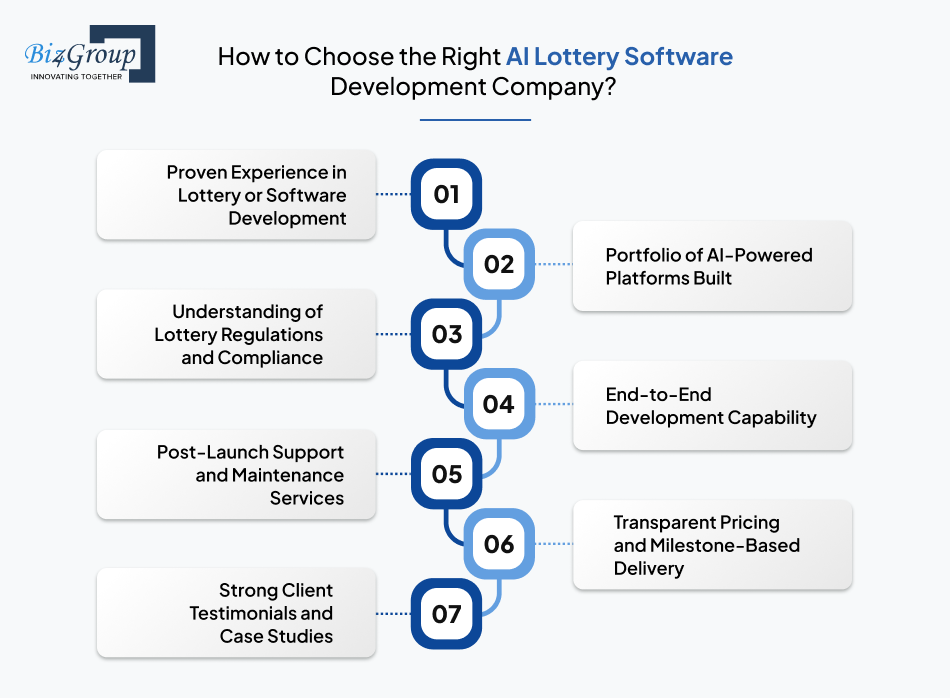
Finding the right technology partner plays a major role in the success of any lottery platform. Businesses planning to make AI lottery software must evaluate technical expertise, industry knowledge, AI capabilities, compliance experience, and long-term support services before finalizing a development company.
Many operators begin their search with requirements like: “we are running a lottery system and looking for experienced AI lottery software development companies that can ensure compliance, automation, and advanced fraud detection.” This highlights the importance of choosing a reliable development partner capable of delivering scalable and secure AI-powered lottery solutions.
1. Proven Experience in Lottery or Software Development
A company with strong experience in lottery platforms and gaming software development understands operational workflows, security requirements, payment systems, and user engagement strategies more effectively.
Businesses planning the development of AI lottery software should prioritize teams with industry-specific expertise instead of general software providers with limited gaming knowledge.
2. Portfolio of AI-Powered Platforms Built
Reviewing previous projects helps businesses evaluate the company’s technical capabilities, UI quality, AI implementation expertise, and scalability experience. A strong portfolio demonstrates practical experience in building intelligent digital platforms.
When choosing lottery software developer partners, businesses should look for successful case studies involving AI automation, analytics systems, fraud detection, and large-scale gaming ecosystems.
3. Understanding of Lottery Regulations and Compliance
Lottery businesses operate under strict legal and regulatory frameworks. Development companies must understand KYC verification, AML regulations, regional gambling laws, payment security standards, and responsible gaming requirements.
Compliance expertise reduces operational risks and helps businesses avoid legal complications during platform deployment and expansion.
4. End-to-End Development Capability
The best AI lottery software development company should provide complete development services including business analysis, UI/UX design, frontend and backend development, AI integration, testing, deployment, and post-launch optimization.
End-to-end development support ensures smooth project execution and better communication throughout the platform development lifecycle.
5. Post-Launch Support and Maintenance Services
Launching the platform is only the beginning of long-term operational management. Businesses need ongoing technical support, performance monitoring, AI model development & optimization, security updates, and infrastructure maintenance after deployment.
Reliable post-launch support helps businesses maintain operational stability and improve platform performance continuously.
6. Transparent Pricing and Milestone-Based Delivery
Professional development companies provide clear pricing structures, detailed project timelines, and milestone-based delivery models. Transparency helps businesses manage budgets, track project progress, and avoid unexpected development costs.
This is especially important for startups and enterprises creating an AI lottery software platform with long-term scalability goals.
7. Strong Client Testimonials and Case Studies
Client reviews, testimonials, and success stories provide valuable insights into a company’s communication quality, technical expertise, project management process, and delivery standards.
Businesses looking to hire AI lottery software development company partners should evaluate real client feedback before making final decisions.
The right AI lottery software development partner can help businesses build secure, scalable, and future-ready lottery platforms while ensuring compliance, operational efficiency, and long-term digital growth.
Build the Next Generation AI Lottery Platform
Partner with experienced AI and gaming technology specialists to create high-performance lottery software built for scalability, security, and compliance.
Book Your Strategy CallHow Biz4Group Build Compliant AI Lottery Software in USA?
Businesses planning to launch intelligent lottery platforms often ask questions like: “we are evaluating vendors for lottery software development with AI capabilities, who should we choose?” The answer usually depends on a company’s experience in AI technologies, gaming infrastructure, compliance management, security implementation, and scalable platform development.
Biz4Group is an experienced AI development company that helps businesses build secure, scalable, and intelligent digital gaming ecosystems for the United States market. The company specializes in AI-powered automation, predictive analytics, fraud prevention systems, cloud infrastructure, and user-centric gaming experiences.
Our team focuses on building secure AI lottery platform with fraud detection and analytics capabilities that help operators improve operational efficiency, strengthen security, automate workflows, and enhance player engagement. Their development approach combines intelligent automation, scalable architecture, real-time monitoring systems, and compliance-focused infrastructure for long-term business growth.
The company also has experience developing intelligent lottery software with automation and AI tools that support personalized user engagement, AI-powered recommendations, payment integrations, KYC systems, and operational analytics. Businesses looking to create scalable AI-powered lottery gaming platform solutions can benefit from their expertise in frontend development, backend systems, AI integration, and cloud-based deployment.
Projects Delivered:
1. AI-Powered Social Casino Platform – Stackr
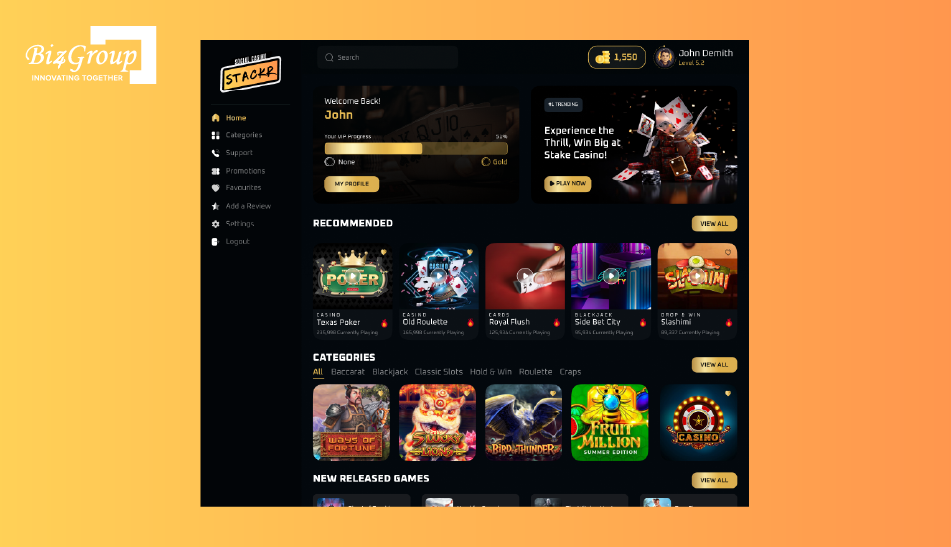
Biz4Group developed an advanced AI-powered social casino platform with engaging gaming experiences, intelligent user interaction systems, and scalable infrastructure management.
2. JuicySlots iGaming Platform

The company also developed JuicySlots, an advanced iGaming aggregation platform that integrates multiple casino games, user engagement systems, payment management, and scalable operational infrastructure.
Businesses searching for lottery platform development services, AI-powered gaming infrastructure, and custom lottery software solutions often prioritize companies with proven AI expertise, compliance knowledge, and scalable technology capabilities. Biz4Group combines all these capabilities to help lottery operators build future-ready digital lottery ecosystems for competitive gaming markets.
With strong expertise in AI automation, gaming technologies, fraud prevention, and scalable software infrastructure, Biz4Group helps businesses launch secure and intelligent lottery platforms designed for long-term growth and operational success.
Wrapping Up
AI-powered lottery software is helping modern lottery businesses improve operational efficiency, strengthen fraud prevention, increase player engagement, and scale digital operations more effectively. Features such as intelligent automation, predictive analytics, personalized gaming experiences, and real-time monitoring are creating new growth opportunities for lottery operators across global markets.
Businesses still depending on traditional systems often face challenges related to scalability, security, customer retention, and operational management. Adopting AI-driven lottery technologies helps companies deliver faster, safer, and more engaging user experiences while meeting changing market expectations and compliance requirements.
As digital competition continues increasing within the gaming industry, businesses investing in AI-powered lottery platforms today are positioning themselves for stronger long-term growth and market leadership.
Ready to build your AI-powered lottery platform? Schedule a call with our experts today and explore how intelligent lottery software can support your business growth goals.
FAQs
1. What is AI lottery software development?
AI lottery software development is the process of building intelligent lottery platforms using technologies such as artificial intelligence, machine learning, predictive analytics, and automation tools. These systems help automate lottery operations, improve fraud detection, personalize user experiences, optimize ticket sales, and enhance overall platform efficiency.
2. How long does it take to build an AI lottery platform?
The development timeline depends on platform complexity, AI capabilities, integrations, and customization requirements.
- Basic MVP AI lottery platform: 2 to 4 weeks
- Mid-level AI lottery platform: 6 to 12 weeks
- Enterprise AI lottery ecosystem: 14 to 18 weeks
Factors such as mobile app development, compliance systems, AI automation, and third-party integrations can also affect the total development timeline.
3. How much does AI lottery software development cost?
The average cost of AI lottery software development generally ranges between $25,000 to $300,000+ depending on platform features, AI integrations, scalability, security requirements, and customization needs.
4. Can AI be integrated into an existing lottery system?
Yes, AI technologies can be integrated into existing lottery platforms without rebuilding the entire infrastructure. Businesses can add AI-powered fraud detection, predictive analytics, automated customer support, recommendation systems, player behavior analysis, and intelligent reporting tools to modernize their current lottery operations.
5. Which company is best for AI lottery software development?
The best AI lottery software development company is one that has proven experience in AI technologies, gaming platforms, security systems, compliance management, cloud infrastructure, and scalable software development. Businesses should evaluate portfolios, technical expertise, client reviews, and post-launch support services before selecting a development partner.
6. Is AI lottery software legal and compliant with regulations?
Yes, AI lottery software can be fully legal and compliant when developed according to regional gambling laws, KYC regulations, AML policies, data privacy standards, and responsible gaming requirements. Compliance implementation depends on the target country, licensing authority, and operational structure of the platform.
7. Can a startup afford to build an AI lottery platform?
Yes, startups can begin with MVP-based AI lottery platforms that include essential features and limited AI functionalities. Many businesses start with smaller investments and gradually scale the platform as user growth and revenue increase. This approach helps startups reduce initial development costs while entering the market faster.