 Location :
Orlando, FL, USA
Location :
Orlando, FL, USA +1 (407) 714-1616
 info@biz4group.com

- AI adoption statistics in 2026 reflect organizations moving carefully from pilots to systems that teams rely on every day.
- AI adoption statistics by industry 2026 reveal that sectors with repeatable workflows and measurable outcomes are pulling ahead faster than others.
- At the enterprise level, scale remains the hard part - Enterprise AI adoption statistics 2026 highlight how many initiatives stall between proof of concept and full production.
- Smaller teams move differently. SMBs experiment early and often, but scaling remains slower due to budget, data, and execution limits.
- Generative AI has increased visibility, not shortcuts. Interest is high, but production usage remains deliberate and tightly governed.
- The real signal across the blog is simple. Maturity now matters more than intent, and adoption only counts when it shows up in real workflows.
In the US market right now, AI is no longer a future bet. It shows up in board decks, hiring plans, budget approvals, and quiet internal experiments that never make press releases. What separates confident decisions from expensive guesses is not hype but AI adoption statistics. Leaders are no longer asking whether AI matters. They are putting in sharper queries in LLM engines like ChatGPT and Grok, like:
- AI adoption statistics latest data
- how many companies use AI today
- AI adoption trends by industry
- global AI adoption rates 2026
- AI adoption stats for business leaders
The market data is starting to answer those questions with clarity:
- Recent global surveys show that nearly 78 percent of organizations have already adopted AI in at least one business function, a clear signal that adoption is now mainstream rather than experimental
- Looking ahead, projections indicate that over 80 percent of large enterprises are expected to use AI at scale in 2026, driven by analytics, automation, and decision support systems.
These numbers matter because they reveal momentum, especially when reviewing enterprise AI adoption statistics 2026 across competitive markets.
In many US companies, the pressure is subtle but constant. Boards want clarity, teams want direction, and competitors are clearly moving faster. AI decisions are now tied to hiring plans, operational efficiency, and long-term valuation. This is where adoption data becomes a planning tool, not a talking point, especially for leaders evaluating internal capabilities or a custom software development company to support long-term execution.
The real value, however, comes from understanding how adoption differs beneath the surface. Patterns shift when you compare large organizations to leaner teams, and when you examine small business AI adoption statistics 2026 alongside enterprise benchmarks. For leaders shaping roadmaps or working with AI consulting services, these insights turn AI adoption from a trend into a strategic advantage.
Global AI Adoption Statistics and Market Momentum
Across the US market, AI has quietly settled into everyday business reality. It shows up in planning discussions, internal tooling, analytics stacks, and workflow decisions that rarely make headlines. What matters to leaders now is not whether AI exists in the market, but how widely it is being used and how quickly expectations are shifting. The numbers offer a clear view of that momentum.
Here is what current global adoption data shows:
- AI-powered sales are projected to reach a staggering $1.3 trillion by 2032.
- AI is expected to grow at a 43% CAGR through 2032.
- The AI training market is all set to hit a valuation of around $470 billion by 2032.
- 38% of Americans are in support of AI and its capabilities.
- 51% of American adults have used AI at least once to look up something.
Taken together, these figures point to a market that is actively normalizing AI usage. For US business leaders, this creates a different kind of pressure. Peers are moving, teams are experimenting on their own, and competitors are learning faster with each iteration. Decisions around tooling, data readiness, and partners often intersect with conversations about enterprise AI solutions, even when AI is not the headline topic in the room.
This broader momentum is why following AI adoption statistics closely has become part of strategic awareness. The data helps leaders understand how widespread AI usage really is, how quickly expectations are evolving, and what “keeping pace” looks like - as adoption continues to deepen across global markets.
Why Understanding AI Adoption Statistics is Critical for Business Leaders?
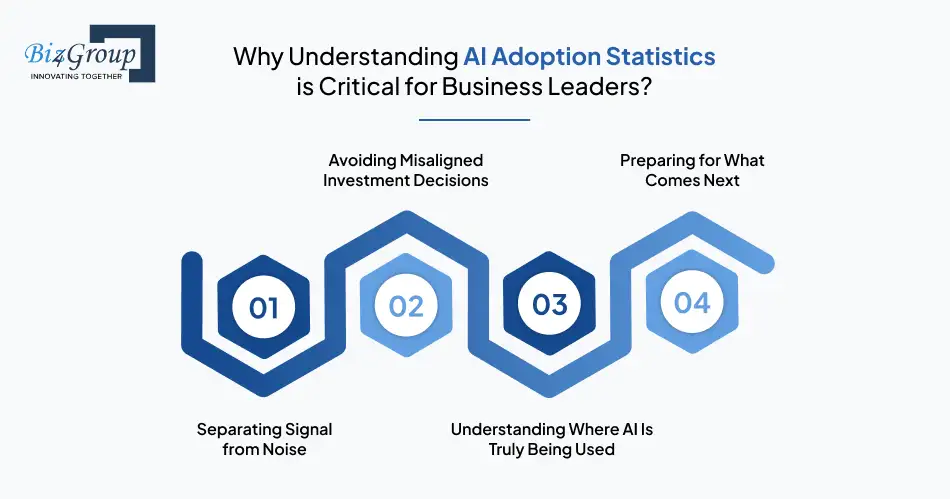
In US boardrooms today, decisions around AI are no longer abstract. AI adoption statistics help leaders move from instinct to clarity by grounding strategy in what the market is actually doing. That shift brings a few realities worth examining closely.
1. Separating Signal from Noise
AI conversations are loud, but adoption data brings focus. Enterprise AI adoption statistics show how uneven progress really is across organizations, which helps leaders benchmark responsibly. This context matters when budgets, priorities, and expectations are being set, especially in discussions tied to AI automation services.
2. Avoiding Misaligned Investment Decisions
Adoption data highlights where spending aligns with maturity and where it does not. Leaders can see which capabilities are gaining traction and which remain niche, helping avoid overcommitting to trends that lack operational depth.
3. Understanding Where AI Is Truly Being Used
Not every AI headline reflects real usage. Reviewing generative AI adoption statistics helps leaders see where experimentation has translated into daily workflows and where it has stalled. This clarity becomes essential before greenlighting initiatives or deciding whether to hire AI developers.
4. Preparing for What Comes Next
Tracking generative AI adoption statistics 2026 gives leaders early insight into how expectations are shifting across markets. This perspective supports smarter planning around talent, tooling, and timelines as AI adoption continues to evolve.
In practice, adoption data is not about chasing trends or copying competitors. It gives business leaders a grounded way to weigh risk, timing, and readiness, and to make decisions that reflect reality rather than assumption.
Reading the Numbers Is Easy. Acting on Them Is Not.
AI adoption statistics show momentum everywhere, but execution paths vary widely across businesses.
Build AI SoftwareWhy AI Adoption Rate Statistics Vary Across Organizations?
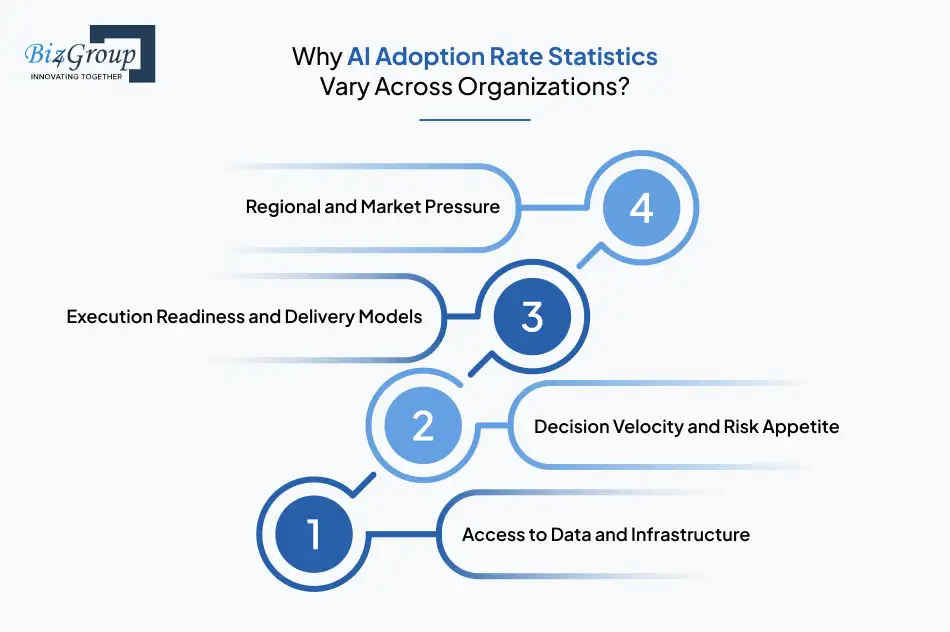
On paper, AI adoption can look uniform, but the reality inside companies is very different. AI adoption statistics highlight wide gaps that are shaped by structure, readiness, and decision-making style. Understanding why these gaps exist makes the data far more useful.
1. Access to Data and Infrastructure
Organizations start from very different technical baselines. Some already have clean data pipelines and cloud systems, while others are still consolidating basic tools. This directly impacts AI adoption rate statistics, especially when execution depends on internal systems rather than intent alone.
- Example: A company with centralized data and modern analytics tools can move from idea to pilot quickly. Another organization may spend months just preparing data before AI work even begins.
2. Decision Velocity and Risk Appetite
Larger organizations often move cautiously, while smaller teams act faster but with tighter constraints. This difference is visible in SMB AI adoption statistics, where experimentation happens early but scaling takes longer. These patterns influence how adoption unfolds across markets.
- Example: A lean team might test AI in customer support within weeks. A larger firm may require approvals across legal, security, and operations before any deployment starts.
3. Execution Readiness and Delivery Models
Adoption accelerates when teams can move from concept to deployment. Organizations with prior experience in AI model development often progress faster because internal teams understand scope, timelines, and tradeoffs before committing resources.
- Example: Teams that have shipped AI features before can estimate effort realistically. Others struggle to translate ideas into working systems without repeated trial and error.
4. Regional and Market Pressure
Geography and competition also shape adoption pace. Global ai adoption statistics 2026 reflect uneven momentum driven by regulation, customer expectations, and industry maturity. In some cases, organizations partner with an AI app development company to keep pace with faster-moving competitors.
- Example: Companies in highly competitive markets feel pressure to adopt AI sooner. Those in regulated or slower-moving sectors often take a more cautious approach.
|
Factor Influencing Adoption |
Impact on Adoption Rates |
Common Outcome |
|---|---|---|
|
Data readiness |
High variance |
Slower adoption, no reliable data |
|
Decision-making structure |
Medium variance |
Longer approval cycles |
|
Execution capability |
High variance |
Fast progress, experienced teams |
|
Market and regional forces |
Medium variance |
Uneven adoption across regions |
These differences explain why adoption metrics rarely tell a single story. For leaders comparing progress across peers or regions, reviewing AI adoption statistics SMEs worldwide alongside broader benchmarks offers clearer context into why adoption speeds vary so widely.
AI Adoption Statistics by Company Size in 2026
Company size plays a quiet but decisive role in how AI shows up inside organizations. AI adoption statistics reveal different priorities, constraints, and execution patterns depending on scale, which sets the stage for how adoption unfolds across enterprises and smaller businesses.
Enterprise AI Adoption Statistics in 2026
Large organizations approach AI with ambition, structure, and caution at the same time. Their adoption patterns reflect scale, governance, and long planning cycles, which shape how AI becomes operational.
1. Strategic Integration Over Experimentation
Enterprises tend to invest in AI as part of long-term strategy rather than short experiments. AI adoption in enterprise statistics show initiatives tied closely to core systems, data platforms, and decision workflows, often in collaboration with an AI development company for large-scale execution.
2. Depth of Use Matters More Than Presence
Adoption is increasingly measured by how deeply AI is embedded across functions. Many large organizations now report multiple AI use cases in production, aligning with broader artificial intelligence Statistics that track enterprise maturity across regions.
3. Governance Shapes Adoption Speed
Legal, security, and compliance teams play a central role in enterprise AI rollouts. The current state of enterprise AI reflects careful sequencing, where approvals and risk management influence how quickly AI initiatives scale.
The adoption story changes noticeably when shifting away from large organizations. Smaller teams operate with different constraints, timelines, and expectations, which alters how adoption unfolds at this end of the market.
Adoption Looks Different at Every Scale
Enterprise AI adoption statistics reveal one set of challenges, while SMBs face another. Knowing where you fit changes how you move forward.
Talk to an AI Product Development CompanySmall Business and SME AI Adoption Statistics
For smaller organizations, AI adoption is shaped by speed, practicality, and immediate business impact. Decisions are often faster, but resource limits introduce their own tradeoffs.
1. Use Case Driven Adoption
Small businesses typically adopt AI through specific, high-impact use cases rather than broad platforms. Many lean on external support, especially AI integration services, to move quickly without building complex systems internally.
2. Industry Influence on Adoption Choices
SME adoption patterns often mirror their industry peers. Decisions are shaped by customer expectations and competitive pressure, particularly when tracking AI adoption by industry 2026 across sectors.
3. Scaling Depends on Clear Returns
While experimentation happens early, scaling AI across teams depends on measurable outcomes. Budget sensitivity means expansion follows proven value, not long-term transformation roadmaps.
|
Company Size |
Adoption Focus |
Common AI Characteristics |
|---|---|---|
|
Large Enterprises |
Strategic and cross-functional |
Strong governance, multiple production use cases |
|
Mid-sized Firms |
Selective and growth-driven |
Focused deployment tied to revenue or efficiency |
|
Small Businesses |
Tactical and fast-moving |
Narrow use cases, faster experimentation |
Viewed together, these patterns explain why adoption data can feel fragmented without context. Comparing enterprises and smaller organizations through enterprise generative AI adoption statistics helps leaders understand not just who is adopting AI, but how company size shapes the adoption journey.
AI Adoption by Industry 2026: Use Cases
AI adoption does not spread evenly across the economy. AI adoption statistics show that industries with clear data flows, repeatable processes, and measurable outcomes move faster than others. Looking at industry-specific use cases helps explain where adoption is already mature and where it is still evolving.
1. AI Adoption Use Cases in Finance
Finance continues to lead AI adoption because of transaction scale, regulatory requirements, and the need for real-time decision making. When viewed through AI usage growth statistics, financial services consistently rank among the earliest and deepest adopters.
1.1 Fraud Detection and Transaction Monitoring
Financial institutions rely on AI to analyze transaction behavior continuously and identify anomalies as they occur. Wealth management AI solutions reduce manual review effort while improving response times across high-volume payment environments.
- 72 percent of financial institutions globally use AI for fraud detection and risk management.
1.2 Algorithmic and Quantitative Trading
AI-driven models process market signals and pricing movements faster than manual strategies, enabling firms to execute decisions at scale. This capability has become standard across modern trading desks.
- Nearly 90% of global trading volume is operated through AI-based algorithmic trading systems.
1.3 Customer Service Automation
Banks deploy AI assistants to manage high volumes of routine customer interactions efficiently. Many accelerate rollout by working with an AI chatbot development company to meet scale and compliance requirements.
- Around 60 percent of financial institutions leverage AI-powered chat or voice systems for customer support.
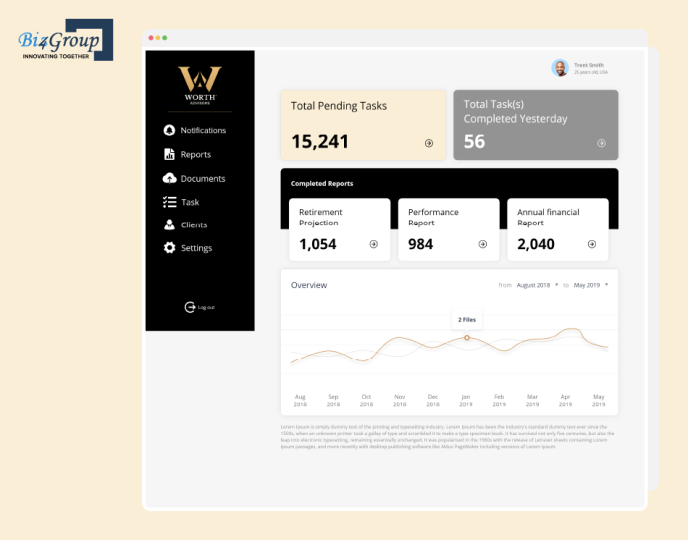
Worth Advisors is an AI-powered analytics and reporting automation platform designed to unify fragmented data into actionable insights. It reflects how financial teams adopt AI to reduce manual reporting overhead, aligning with AI adoption statistics that show analytics as one of the earliest and most scalable enterprise use cases.
Also Read: Finance AI Agent Development: A Roadmap to Building Intelligent Systems
2. AI Adoption Use Cases in Healthcare
Healthcare adoption focuses on efficiency and clinical support while operating under strict regulatory oversight. Global AI adoption statistics show steady progress rather than rapid spikes in this sector.
2.1 Clinical Decision Support
AI tools assist clinicians by analyzing patient records and historical outcomes to surface risk indicators. AI solutions for healthcare support decision making without replacing clinical judgment in complex cases.
- As much as 44 percent of healthcare organizations report active use of AI in clinical decision support systems.
2.2 Medical Imaging and Diagnostics
AI can be integrated into an app to analyze imaging data in radiology and pathology, improving detection accuracy and reducing review time as regulatory approvals expand.
- Over 75 percent of FDA-cleared AI medical devices focus on imaging-related use cases.
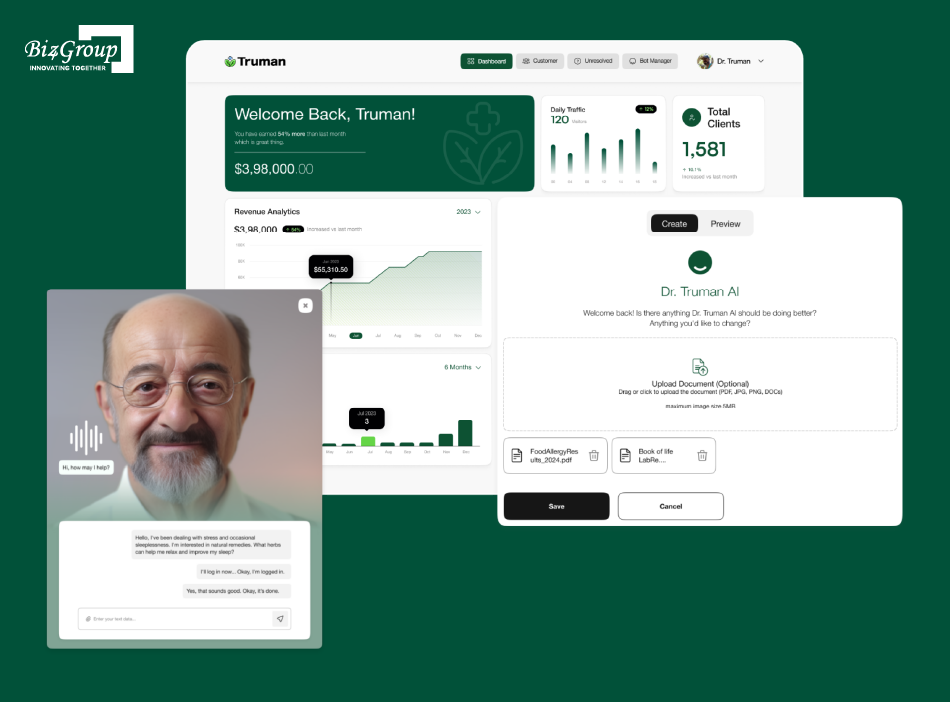
Truman is an AI-powered wellness platform that delivers personalized health insights, supplement recommendations, and ongoing engagement through data-driven interactions. Its adoption highlights how AI is increasingly embedded into consumer health experiences, aligning closely with broader healthcare AI adoption statistics that emphasize personalization at scale.
Also Read: How to Build Agentic AI in Healthcare: The Future of Intelligent Care
Generative AI Is Everywhere. Production Use Is Not.
Generative AI adoption statistics highlight interest, but real value comes from systems that teams actually use.
Build AI Software3. AI Adoption Use Cases in Real Estate
Real estate adoption centers on pricing accuracy, demand forecasting, and digital engagement as buying journeys become more data-driven. This raises questions around how many companies use AI in 2026 within property platforms and broker networks.
3.1 Property Valuation and Market Forecasting
AI models analyze historical sales data, location attributes, and demand signals to generate more accurate valuations and respond faster to market shifts.
- More than 70 percent of large platforms use real estate AI software.
3.2 Customer Engagement and Lead Qualification
Many platforms integrate AI into apps to handle buyer inquiries, qualify leads, and guide early-stage decisions more efficiently.
- 25% increase in customer engagement or lead scoring noticed by real estate firms using AI.
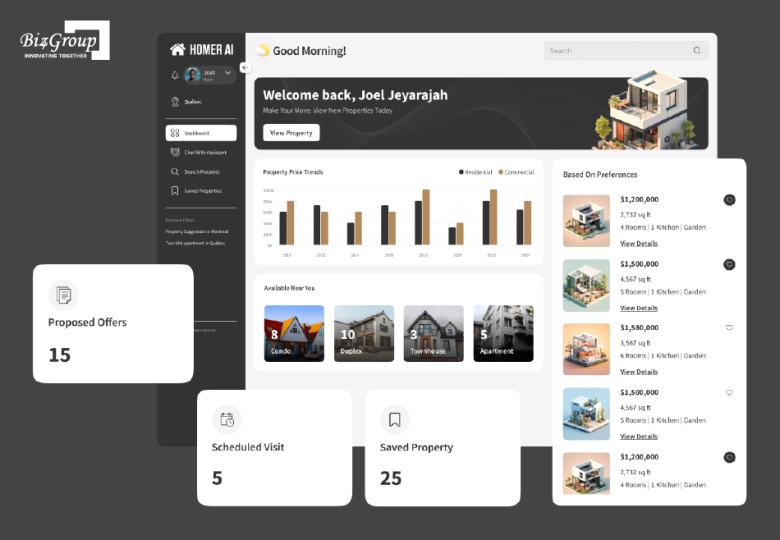
Homer AI is a conversational property management platform developed by Biz4Group, that connects buyers, sellers, and property data within a single AI-driven interface. It mirrors how AI adoption in real estate is shifting from back-office automation to customer-facing systems, a pattern consistently reflected in real estate AI adoption statistics.
Also Read: A Guide to Real Estate AI Predictive Analytics Software Development
4. AI Adoption Use Cases in Education
Education adoption emphasizes personalization and operational efficiency as institutions respond to digital-first learning expectations and resource constraints. This makes adoption data useful when assessing what percentage of businesses use AI-powered edtech software across education providers and platforms.
4.1 Personalized Learning Systems
AI adapts content and pacing based on individual learner behavior and performance, improving engagement without increasing instructional workload.
- According to Claned, 47 percent of EdTech providers will actively use AI-driven personalization models.
4.2 Administrative and Student Support Automation
Institutions use AI to support scheduling, grading assistance, and student services, reducing administrative burden while improving response times.
- According to a report by HEPI (Higher Education Policy Institute) Generative AI went mainstream fast: the share of students using tools like ChatGPT for assessments rose from 53% to 88%.
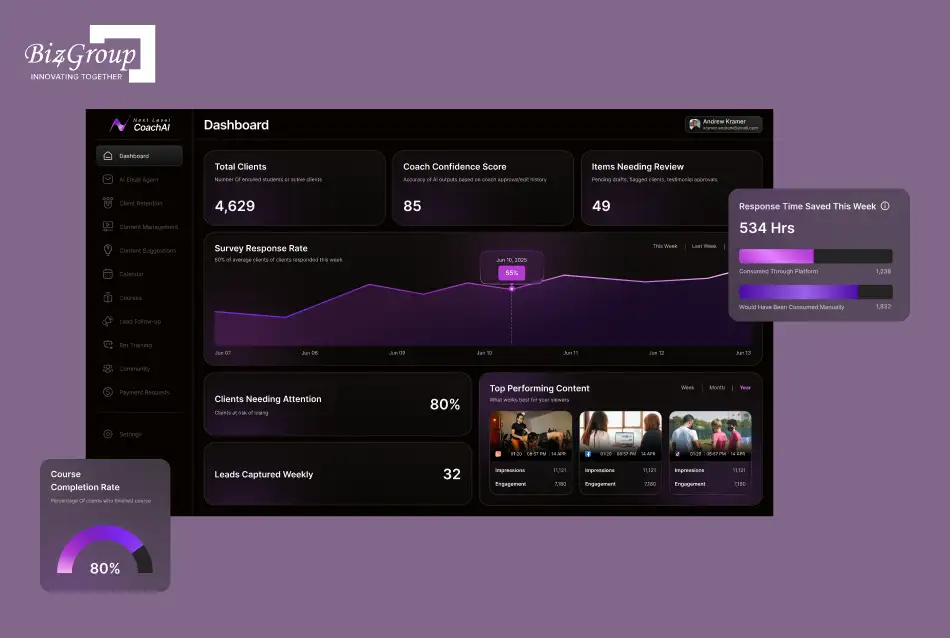
Coach AI is an intelligent platform built for coaches and educators to streamline workflows, manage client interactions, and scale engagement. Its usage illustrates how AI adoption in professional services is driven by efficiency gains, reinforcing trends seen in AI adoption statistics across education and knowledge-based industries.
Also Read: Thinking About Building an eLearning Platform? Here’s How to Start
Seeing How Other Industries Use AI Sparks Better Decisions
AI adoption statistics by industry 2026 show what works in practice, not just in theory.
Explore AI Use Cases5. AI Adoption Use Cases in eCommerce
Adoption of AI-powered eCommerce solutions is closely tied to personalization, logistics, and forecasting accuracy. This sector offers some of the clearest AI use cases across industries with statistics tied directly to revenue outcomes.
5.1. Personalized Recommendations
AI-driven recommendation engines tailor product suggestions based on browsing and purchase behavior, directly influencing conversion rates.
- In eCommerce, AI is no longer a differentiator - with 97% planning implementation and 78% of organizations already using AI, it’s become table stakes.
5.2. Demand Forecasting and Inventory Planning
AI improves forecasting accuracy across channels, helping retailers reduce stockouts and excess inventory.
- According to IJRASET, AI has materially improved demand forecasting, enabling e-commerce firms to achieve over 90% accuracy.
Also Read: AI eCommerce Agent Development Explained: Automation for Modern Retail
6. AI Adoption Use Cases in Insurance
Insurance automation software adoption focuses on efficiency and risk evaluation as firms modernize legacy processes. These patterns contribute to broader AI adoption trends for enterprises across regulated industries.
6.1 Claims Processing Automation
AI systems analyze documents and images to speed up claims review and settlement, reducing manual workload and turnaround time.
- 61 percent of insurers use AI in claims processing or document analysis.
6.2 Risk Modeling and Underwriting
AI enhances underwriting decisions by identifying patterns across large datasets that are difficult to assess manually.
- Insurers using AI report up to 30 percent improvement in risk assessment accuracy.
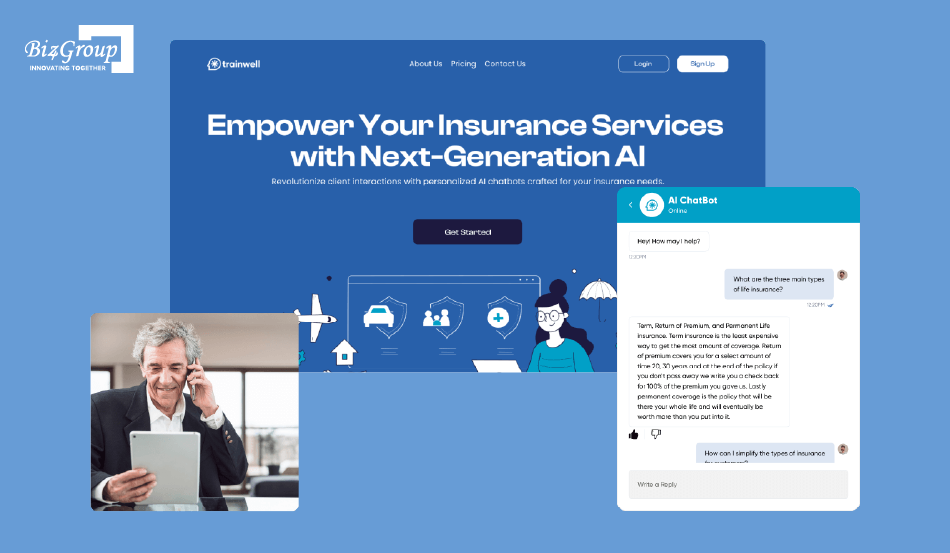
Insurance AI is an AI-driven training and support platform designed by Biz4Group for insurance agents, helping them access policy knowledge, compliance guidance, and scenario-based assistance in real time. It reflects how AI adoption in insurance is moving beyond pilots into everyday enablement, where adoption statistics start translating into operational usage.
Also Read: A Guide to AI Insurance App Development: Insights by Biz4Group
7. AI Adoption Use Cases in Staffing and HR
HR adoption emphasizes efficiency and consistency across hiring and workforce planning. Data increasingly highlights which industries are adopting staffing software solutions the fastest as talent markets tighten.
7.1 Resume Screening and Candidate Matching
AI automates early-stage screening and candidate matching, reducing manual effort and time to hire.
- Ethical AI now ranks high in HR, with 67% of leaders prioritizing fairness and transparency via AI-based screening or matching tools.
7.2 Workforce Analytics and Retention Planning
AI supports workforce planning by analyzing engagement and attrition risk to inform leadership decisions.
- With AI-driven workforce analytics, organizations see a 40% efficiency gain alongside fewer delays and stronger team output.
Also Read: A Guide to AI HR Agent Development: Features, Steps and Challenges
8. AI Adoption Use Cases in Hospitality
Hospitality adoption focuses on service consistency and revenue optimization in a competitive environment. This sector reflects broader AI adoption statistics by industry 2026 across customer-facing businesses.
8.1 Guest Interaction Automation
Hotels deploy AI assistants to handle bookings and inquiries using AI chatbot integration, improving response times during peak demand periods.
- Over 50 percent of large hotel chains use AI chat systems for guest communication.
8.2 Dynamic Pricing and Revenue Management
AI adjusts pricing based on demand and occupancy trends, helping maximize revenue while remaining competitive.
- AI-driven pricing tools improve revenue per available room by up to 10 percent.
Across sectors, adoption is driven by measurable outcomes rather than experimentation alone. For leaders tracking AI adoption trends for enterprises, industry-level differences provide far clearer signals than surface-level averages.
Also Read: AI-based Hospitality Software Development - The Complete Guide
AI Implementation Statistics and Maturity Levels Across Organizations
Headline adoption numbers only tell part of the story. AI adoption statistics become meaningful when paired with implementation data that shows how many initiatives actually reach production, how consistently they are used, and how deeply they are embedded across organizations.
Adoption vs Implementation Reality
Reported adoption often outpaces real deployment. While many organizations claim AI usage, far fewer operate AI systems at scale, a gap clearly reflected in enterprise AI adoption statistics when pilots are compared with production environments.
- AI is everywhere, yet 74% of companies struggle to move from pilots to real, scalable impact, as per a report by BCG.
|
Dimension |
Adoption Claims |
Implementation Reality |
|---|---|---|
|
Dimension |
Adoption Claims |
Implementation Reality |
|
Initiative count |
Multiple pilots |
Few scaled deployments |
|
Usage frequency |
Occasional |
Embedded in workflows |
|
Accountability |
Innovation teams |
Business owners |
|
Measurement |
Project progress |
Operational outcomes |
At this stage, teams often experiment with limited interfaces such as an AI conversation app, without integrating AI into core systems.
Maturity Stages of AI Usage
AI maturity reflects how reliably organizations depend on AI outputs for real decisions. Data tied to generative AI adoption statistics shows that most companies remain in early or transitional stages rather than full operational maturity.
According to reports by Bain & Company on generative AI readiness found that while 95% of US companies reported using generative AI by late 2024, the average number of use cases in production only doubled over the year, highlighting that many firms still have just a handful of production deployments.
- Early maturity focuses on controlled experiments and proof-of-concept builds.
- Intermediate maturity introduces AI into select workflows with limited scope.
- Advanced maturity uses AI outputs for recurring operational decisions.
- High maturity aligns AI with governance, data strategy, and accountability.
As maturity increases, usability becomes a priority, pushing teams to partner with an experienced UI/UX design company for AI-driven tools.
Enterprise vs SMB Implementation Depth
Implementation depth varies sharply by company size. This contrast becomes clearer when comparing enterprise AI adoption statistics 2026 with small business AI adoption statistics 2026, particularly around scale, governance, and time to value.
- According to an analysis by OECD, Large enterprises are nearly twice as likely as SMBs to report AI systems running at enterprise scale.
|
Implementation Area |
Enterprises |
SMBs |
|---|---|---|
|
Deployment scope |
Organization-wide |
Team or function-specific |
|
Tooling approach |
Custom platforms |
Packaged solutions |
|
Governance |
Formal review models |
Lightweight oversight |
|
Time to value |
Longer cycles |
Faster initial rollout |
SMBs often prioritize speed and validation through MVP software development, while enterprises focus on resilience and long-term scalability.
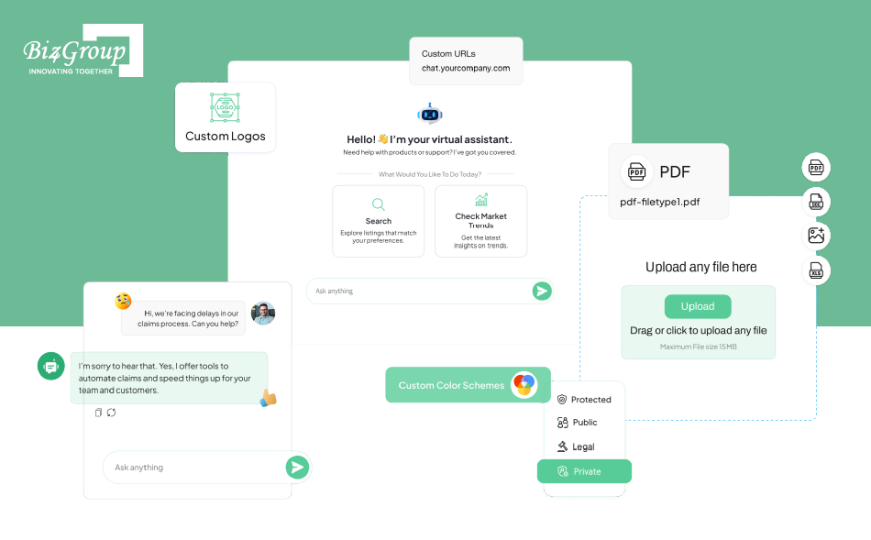
Biz4Group’s custom enterprise AI agent was built to automate internal queries across departments such as HR, legal, and operations. It demonstrates how organizations move from AI adoption intent to implementation maturity, where enterprise AI adoption statistics begin reflecting structured, production-grade deployments rather than isolated experiments.
Across regions, these patterns remain consistent. Global AI adoption statistics 2026 show that while intent is high everywhere, maturity progresses unevenly. When viewed alongside AI adoption statistics SMEs worldwide, the data explains why implementation depth, not adoption claims, is the real differentiator in AI readiness.
Adoption Claims Do Not Equal Maturity
AI adoption rate statistics often hide the gap between pilots and production systems. Closing that gap takes deliberate execution.
Work With an AI Product Development CompanyBarriers Slowing AI Adoption Across Industries
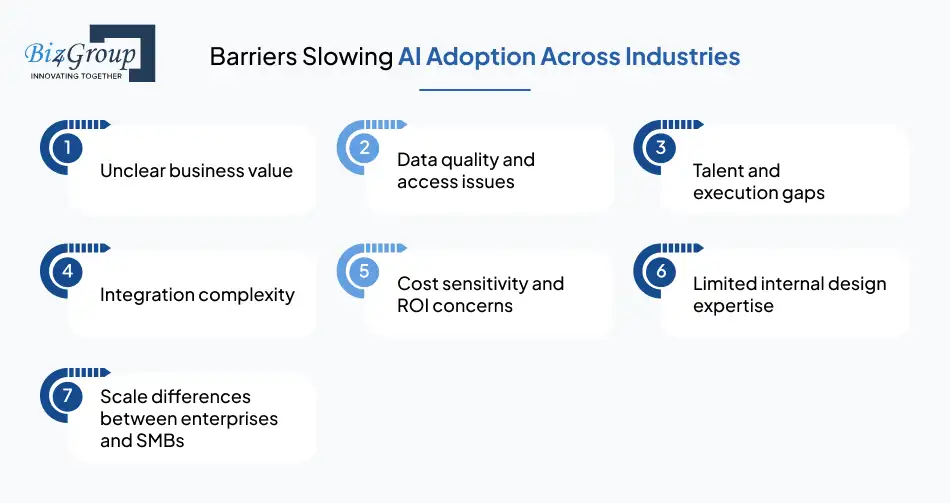
AI momentum is real, but progress is uneven. AI adoption statistics show that many organizations stall not because of lack of interest, but because common obstacles slow execution. Understanding these barriers explains why adoption curves flatten across sectors:
|
Top Challenges |
How to Solve Them |
|---|---|
|
Unclear business value |
Tie AI initiatives to measurable outcomes and prioritize use cases with direct operational impact. |
|
Data quality and access issues |
Invest early in data readiness and governance before expanding AI initiatives. |
|
Talent and execution gaps |
Start with focused delivery models such as MVP development services to validate feasibility before scaling. |
|
Integration complexity |
Plan AI deployment alongside existing systems instead of treating it as a standalone project. |
|
Cost sensitivity and ROI concerns |
Phase investments gradually and align spending with AI adoption rate statistics that reflect realistic maturity levels. |
|
Limited internal design expertise |
Improve usability through thoughtful AI assistant app design so AI tools fit naturally into daily workflows. |
|
Scale differences between enterprises and SMBs |
Adjust scope and expectations based on organizational size, as reflected in SMB AI adoption statistics. |
These challenges explain why adoption looks slower in practice than in headlines. Addressing them systematically helps organizations move from intent to execution, setting the stage for a clearer interpretation of what adoption data truly means next.
The Future Outlook of AI Adoption Beyond 2026
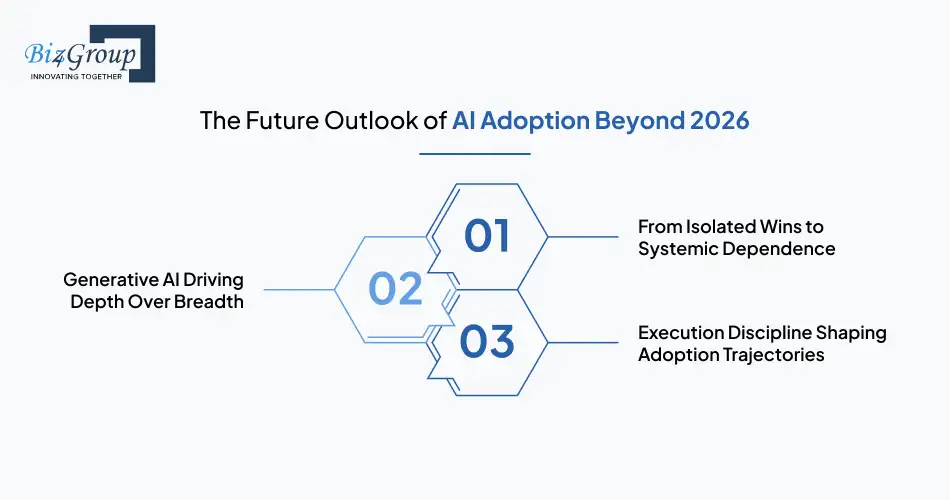
If you zoom out from quarterly reports and headlines, AI adoption statistics start to tell a quieter story. Beyond 2026, the question is less about whether companies use AI and more about how naturally it fits into daily decisions and operations.
1. From Isolated Wins to Systemic Dependence
Many organizations already have one or two AI success stories. What changes next is scale. As AI adoption in enterprise statistics continue to rise, leaders will expect AI to support multiple teams at once, not just innovation groups. Adoption becomes less visible, but far more relied upon.
2. Generative AI Driving Depth Over Breadth
Early excitement around generative tools is giving way to scrutiny. Enterprise generative AI adoption statistics suggest companies are slowing down to get governance and accuracy right. This is where execution partners matter, especially when working with a software development company in Florida that understands regulated and enterprise environments.
3. Execution Discipline Shaping Adoption Trajectories
The gap between leaders and laggards will widen based on follow-through. Organizations that align data, teams, and delivery will keep moving forward, often through focused business app development using AI rather than scattered tools. Adoption will reflect consistency of use, not experimentation volume.
As this shift plays out, broader artificial intelligence Statistics become less about forecasts and more about patterns leaders recognize in their own organizations. That recognition is usually what prompts the next set of questions, long before any formal strategy refresh happens.
The Data Is Clear. The Next Move Is Yours.
AI adoption statistics are only useful when they inform what you build next and how you scale it.
Build AI SoftwareFinal Words
AI adoption is no longer a question of curiosity or ambition. The data shows where organizations are moving, where they stall, and why outcomes differ even when intent looks similar. When you step back and connect the dots, AI adoption statistics stop being abstract numbers and start reading like a map.
A map of readiness, execution discipline, and real-world usage. For leaders deciding when and how to move next, the signal is clear. Adoption rewards clarity, not speed. And the companies that treat AI as a system, not a side project, are the ones shaping what comes after 2026.
Seeing the Numbers but Unsure Where to Start? Bridge the gap between AI intent and real-world deployment. Connect with our seasoned AI strategists.
FAQs about AI Adoption Stats 2026
1. How reliable are AI adoption statistics when making business decisions?
AI adoption numbers are most reliable when viewed as directional signals rather than exact benchmarks. Trends matter more than absolute values, especially when comparing peer behavior, timelines, and maturity patterns across global AI adoption statistics.
2. How fast is AI adoption actually growing year over year?
Growth is steady rather than explosive in most sectors. AI usage growth statistics show consistent increases driven by operational use cases, not experimentation alone, which is why adoption appears slower but more durable than early forecasts suggested.
3. Are small businesses really adopting AI at the same pace as large enterprises?
Adoption intent is similar, but execution depth differs. SMB AI adoption statistics indicate faster experimentation cycles, while scaling and long-term usage tend to lag due to budget, talent, and infrastructure constraints.
4. Is generative AI inflating overall AI adoption numbers?
Generative tools have increased visibility, but they have not fundamentally distorted adoption data. Generative AI adoption statistics show that while interest surged quickly, production usage still follows traditional implementation timelines.
5. Which industries are expected to lead AI adoption over the next few years?
Industries with repeatable workflows and measurable outcomes are moving fastest. Data tracking which industries are adopting AI the fastest consistently points to finance, retail, healthcare support functions, and professional services.
6. What is the most common mistake companies make when interpreting AI adoption data?
Many assume adoption equals maturity. AI adoption rate statistics often reflect pilots and limited deployments, not enterprise-wide usage, which leads to overestimating readiness and underplanning for execution challenges.
