 Location :
Orlando, FL, USA
Location :
Orlando, FL, USA +1 (407) 714-1616
 info@biz4group.com

 AI Summary Powered by Biz4AI
- AI analyzes vehicle photos to detect visible dents, scratches, cracks, and other damage.
- Comparing before-and-after inspection images helps identify new damage and reduce rental return disputes.
- Development costs typically range from $25,000 to $200,000+, depending on AI capabilities, training data, integrations, and platform scale.
- Insurers, rental companies, fleet operators, and dealerships can use AI for damage assessments, repair estimates, and vehicle condition tracking.
- Businesses exploring a development partner can work with Biz4Group to build AI vehicle damage detection platforms tailored to their inspection workflows, damage classification, repair assessments, and integration requirements.
"That scratch was already there," says the renter. Your only proof is a dim photo of a wet bumper, and it settles nothing either way. Disputes like this are rarely about the money. They're about whether the customer believes you.
J.D. Power's 2025 U.S. Auto Claims Satisfaction Study ranks trust and fairness of settlement as the top two of eight satisfaction dimensions, ahead of time to settle. Damage assessment is where both get tested, because that's where "your word against theirs" begins.
AI vehicle damage detection targets that problem: computer vision finds and classifies damage in photos or video, then estimates repair cost. Analysts value the 2025 market at $1.4 billion (Verified Market Research), rising to $4.74 billion by 2033, to $2.2 billion (Acumen Research and Consulting, which includes inspection hardware), rising to $13.47 billion by 2035.
Where teams get burned is the jump from demo to daily use. A model that works on clean sample photos then meets your real photos, your existing systems, and your staff. We saw this while building Insurance AI, a GPT-powered assistant that started because a client kept answering the same agent questions on Zoom. It has nothing to do with dented bumpers, but four lessons carried over:
- Messy input. Agents asked the same thing in many different ways. Damage photos are just as messy: light, angle, weather, camera. That dim, wet bumper is the normal case, not the edge case.
- Easy fit. We delivered it as a script that drops into the client's existing site. Damage reports need to flow into claims and fleet systems the same way, and that handoff is where AI automation removes double entry.
- Feedback. Users rate answers, and admins use the ratings to retrain the model. Adjuster corrections can do the same for damage detection.
- Simple admin. Non-technical admins upload documents and edit answers themselves. A damage detection platform needs that too.
Let's dive into how to build an AI vehicle damage detection platform that holds up outside the demo: how it works, where it fails, and what it costs.
How Does an AI Vehicle Damage Detection System Work?
An AI vehicle damage detection system uses vehicle photos to spot and classify visible damage, such as scratches, dents, and cracks.
How does it work? It combines computer vision and object detection to locate damage, then uses vehicle details and repair pricing data to estimate costs and generate a damage report. For insurers, rental companies, dealerships, and fleet operators, this means faster inspections, more consistent assessments, and fewer disputes over vehicle damage.
The process starts with image capture and ends with a structured damage report. Here’s how each stage works.
Step 1: Image Capture and Preprocessing
Customers, adjusters, or staff capture vehicle photos through a mobile app or inspection kiosk. The system checks image quality and may adjust brightness, resize images, or correct minor distortions before analysis.
Preprocessing helps standardize photos taken in different conditions, but it cannot recover details hidden by glare, blur, dirt, or poor camera angles. If an image is unsuitable, the system should request another photo rather than risk an unreliable assessment.
Computer Vision for Vehicle Damage Detection
Computer vision helps the AI interpret vehicle images by identifying vehicle parts, separating the vehicle from its background, and locating visible signs of damage. This is where computer vision development supports vehicle damage detection.
Depending on the task, the system may use different techniques to:
- Identify vehicle parts, such as bumpers, doors, and windshields.
- Detect visible damage, including scratches, dents, cracks, chipped paint, and broken components.
- Segment damaged areas at the pixel level when a more precise outline is needed.
Each technique serves a different purpose. Results depend on image quality, training data, and performance under real inspection conditions.
For insurers, rental companies, dealerships, and fleet operators, computer vision turns vehicle photos into structured evidence for damage assessment.
YOLO Object Detection for Car Damage
After image preprocessing, an object detection model can identify the location and type of suspected damage. YOLO (You Only Look Once) is one option for this task. It analyzes an image in a single model pass, making it useful for time-sensitive workflows such as rental check-ins and insurance inspections.
A YOLO-based vehicle damage detection model can identify visible issues such as:
- Scratches
- Dents
- Cracks
- Broken headlights
- Bumper damage
- Windshield damage
- Missing or detached vehicle parts
The model marks each suspected defect with a bounding box and a confidence score. The box shows where damage may be present, while the score indicates how strongly the model supports its prediction. Neither confirms the damage’s depth, severity, or repair cost on its own.
Models such as YOLOv8 and YOLO11 may suit cloud-based systems, mobile inspection workflows, or edge devices used at dealerships and inspection kiosks. The right model depends on:
- Detection performance on real inspection photos
- Processing speed and computing resources
- Deployment requirements
- The quality and variety of available training data
Testing against real-world images is essential before deployment.
By combining computer vision with YOLO object detection, businesses can build a vehicle damage detection platform that identifies visible defects and supports consistent inspection workflows across insurance, rental, fleet, and automotive operations.
Step 2: Damage Detection and Classification
The AI model analyzes vehicle images to detect and classify visible damage, such as scratches, dents, and cracks. Through AI model development, teams can train and evaluate models using labelled vehicle images that represent different:
- Damage types and vehicle parts
- Lighting conditions and camera angles
- Vehicle makes, models, and colors
- Inspection environments and image qualities
Model performance depends on the quality and variety of these images and how accurately they are labeled. Metrics such as precision and recall help measure how often the model correctly identifies damage and how much relevant damage it misses.
Teams can set confidence thresholds to route uncertain predictions to an adjuster or inspector for review. This reduces reliance on potentially incorrect classifications without assuming every AI prediction is correct.
Step 3: Severity and Repair Cost Estimation
Detecting damage and estimating repair costs are separate tasks. A photo may show a scratch or dent without revealing its depth, hidden structural damage, or the full extent of the repair required.
A cost estimation workflow can combine detected damage with:
- Vehicle-part information
- Damage severity categories
- Local labor rates and parts prices
- Repair methods and insurer-specific rules
This information helps generate an indicative repair estimate.
For example, a surface scratch may require paintwork, while a dented panel may need repair or replacement. The final cost depends on the vehicle, damage extent, repair method, and local pricing. Estimates should be flagged for review when photos do not provide enough evidence for a reliable assessment.
Step 4: Report Generation and Integration
After analysis, the system generates a digital report containing details such as:
- Original vehicle photos
- Detected damage locations and classifications
- Model confidence scores
- Repair cost estimates, where available
- Flags for cases requiring human review
The platform can connect with insurance claims platforms, fleet management systems, and rental workflows to reduce duplicate data entry and make inspection records easier to access. Available integrations depend on the connected systems and the data they support.
Reports should retain the original photos and flag uncertain results so teams can verify the evidence behind each assessment.
AI Vehicle Damage Detection Workflow at a Glance
|
Stage |
What happens |
|---|---|
|
Image capture |
Collects vehicle photos and checks image quality |
|
Computer vision |
Identifies vehicle parts and prepares images for analysis |
|
Damage detection |
Locates and classifies visible defects |
|
Severity and cost estimation |
Combines damage findings with repair rules and pricing data to estimate costs |
|
Report generation and integration |
Creates a structured report and shares relevant data with connected systems |
This workflow helps businesses standardize inspections, reduce manual effort, and process damage reports faster. Human review remains important when image quality is poor, damage is ambiguous, or an estimate needs further verification.
Next, let’s look at the business benefits of AI vehicle damage detection.
Also Read: How Are Startups Using AI As a Service (AIaaS) To Scale Smarter and Faster?
Why Invest in an AI Vehicle Damage Detection System?
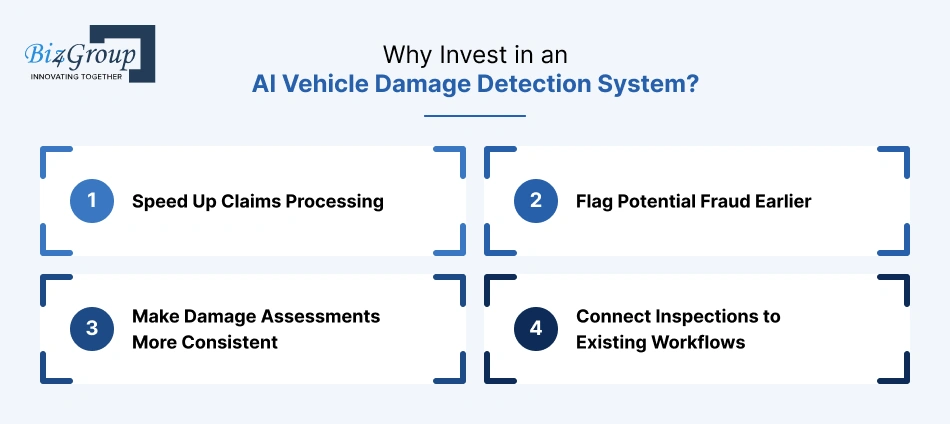
Manual vehicle inspections can slow claims, trigger disputes, and leave room for fraud. For insurers, rental companies, and fleet operators, an AI vehicle damage detection system can help streamline inspections, flag suspicious damage patterns, and make assessments more consistent.
Here’s where businesses can gain the most value.
1. Speed Up Claims Processing
AI-assisted inspections can reduce the time spent reviewing vehicle photos and documenting visible damage. Instead of manually checking every image, teams can focus on reviewing flagged cases and resolving exceptions.
- Faster assessments: Process damage photos more quickly.
- Fewer backlogs: Help claims teams manage high inspection volumes.
- Better customer experience: Give customers updates sooner and reduce unnecessary waiting.
The actual time saved depends on image quality, workflow design, and how much of the claims process is automated.
2. Flag Potential Fraud Earlier
False or inflated damage claims can drive up costs. AI can help flag suspicious patterns, inconsistencies, or potentially reused images for further investigation.
- Spot anomalies: Identify damage reports or images that warrant a closer look.
- Support investigators: Give claims teams additional evidence to review.
- Focus resources: Prioritize cases that need human investigation.
AI flags are not proof of fraud. Human reviewers still need to verify the evidence before a claim is challenged or rejected.
3. Make Damage Assessments More Consistent
Different inspectors may describe the same scratch or dent differently. A properly trained AI model applies consistent detection criteria across inspections, helping teams reduce variation in their assessments.
This can support:
- More standardized damage reports
- Fewer avoidable disputes over visible damage
- Clearer documentation for customers and internal teams
- More consistent review processes across locations
Consistency still depends on model performance, photo quality, and clear assessment rules. Uncertain cases should go to a human reviewer rather than receive an automatic decision.
4. Connect Inspections to Existing Workflows
Damage detection delivers more value when its results flow into the systems teams already use. Through AI integration services, businesses can connect inspection workflows with claims platforms, fleet management systems, and repair networks where supported.
This can help teams:
- Transfer inspection results without repeated manual entry
- Keep damage photos and reports organized
- Trigger follow-up tasks based on inspection outcomes
- Share relevant information across connected systems
For businesses managing large vehicle volumes, these connections can reduce administrative work and make inspection processes easier to scale.
The bigger opportunity goes beyond automating photo reviews. It’s about helping teams resolve claims faster, investigate suspicious cases more effectively, and manage inspections with greater consistency. Next, let’s explore how AI vehicle damage detection is used across insurance, rental, and fleet operations.
Also Read: Why 75% of Enterprises Are Investing in AI-Powered Solutions?
What Types of AI Vehicle Damage Detection Systems Are Available?
The right type of AI vehicle damage detection system depends on how your business inspects vehicles, processes claims, and manages data. A rental company checking cars between bookings has different needs from an insurer handling thousands of claims or a fleet operator inspecting vehicles across multiple locations.
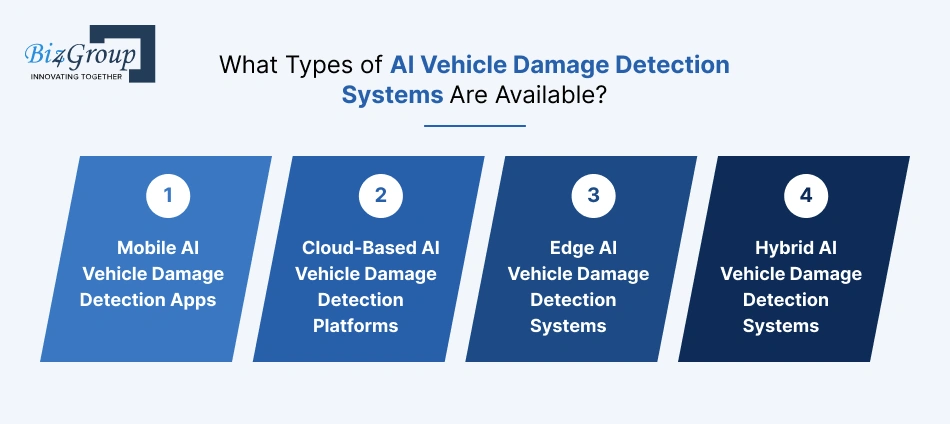
Four common deployment approaches are mobile apps, cloud-based platforms, edge AI systems, and hybrid systems. Each offers different trade-offs in accessibility, processing speed, infrastructure, and control.
1. Mobile AI Vehicle Damage Detection Apps
Mobile apps let drivers, renters, and adjusters capture vehicle photos using a smartphone. They’re easy to roll out and can guide users through the inspection process without requiring dedicated scanning equipment.
They work well for:
- Rental vehicle check-ins and check-outs
- Self-service damage reporting
- Inspections by drivers and field adjusters
- Small and distributed fleets
Example: Ravin AI offers vehicle inspection technology designed to make inspections accessible through mobile devices, including browser-based workflows.
For businesses exploring AI vehicle damage detection system development, a mobile-first approach can be a practical starting point. However, inspection quality still depends on photo guidance, lighting, camera angles, and whether users capture all required views.
2. Cloud-Based AI Vehicle Damage Detection Platforms
Cloud-based platforms send inspection images to remote servers for processing. Teams can access results centrally, making this approach useful for businesses handling large volumes of inspections across different locations.
Key advantages include:
- Scalability: Add processing capacity as inspection volumes grow.
- Centralized management: Maintain common assessment workflows across locations.
- Simpler model updates: Deploy model improvements centrally.
- System connectivity: Connect inspection results with claims and fleet platforms.
Example: Tractable provides AI-powered vehicle damage assessment technology for insurance workflows.
Cloud-based AI vehicle damage detection can suit insurers and large rental or fleet businesses. The main trade-offs are internet dependency, cloud processing costs, response times, and the need to handle vehicle images securely.
3. Edge AI Vehicle Damage Detection Systems
Edge AI systems process images on or near the inspection site rather than sending every image to a remote cloud service. They can support quick feedback at dealerships, inspection hubs, and fleet depots, including environments with limited connectivity.
They’re useful when businesses need:
- Rapid inspection results on-site
- Less dependence on continuous internet access
- Local processing of inspection data
- Automated checks at fixed inspection points
Example: UVeye uses AI-powered vehicle inspection systems to scan vehicles for issues, including exterior and underbody damage.
Edge deployment can reduce reliance on cloud connectivity, but it may require dedicated hardware, local computing capacity, and on-site maintenance. Processing speed and detection performance depend on the system’s configuration and the inspection conditions.
4. Hybrid AI Vehicle Damage Detection Systems
Hybrid systems combine edge processing with cloud-based capabilities. For example, a depot could perform an initial inspection locally, then send images and results to the cloud for centralized reporting, deeper analysis, or review across multiple locations.
This approach can help enterprises balance:
- Speed: Process selected inspection tasks locally.
- Central oversight: Consolidate reports across locations.
- Flexibility: Assign different tasks to edge devices and cloud services.
- Data control: Define where images are processed, stored, and transferred.
Businesses may use enterprise AI solutions to support the integrations and workflows needed for more complex deployments.
Example: Truepic Onsite Inspections focuses on capturing trusted visual evidence for remote inspections. Confirm its current deployment capabilities and fit for vehicle damage detection before presenting it as a direct example of a hybrid damage detection platform.
Hybrid systems offer flexibility, but they also introduce more architectural complexity. Teams need to decide which tasks run locally, which run in the cloud, how data is synchronized, and how model updates are managed.
The best fit comes down to your inspection volume, connectivity, infrastructure, and reporting needs. Mobile apps prioritize convenient capture, cloud platforms support centralized processing, edge systems bring processing closer to the vehicle, and hybrid deployments combine these approaches.
Next, let’s look at how insurers, rental companies, fleet operators, and dealerships use AI vehicle damage detection in practice.
Where Is AI Vehicle Damage Detection Used in the Real World?
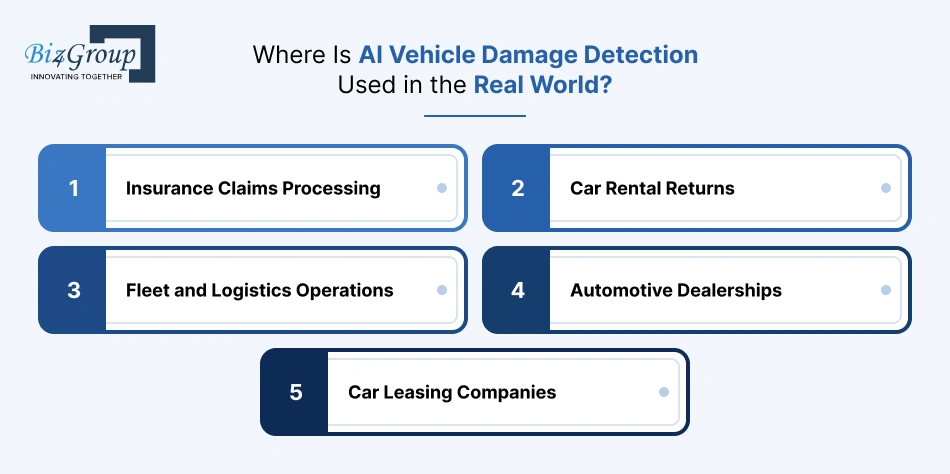
AI vehicle damage detection helps businesses inspect vehicles, document visible damage, and make more consistent decisions. Its practical value depends on the workflow: insurers need faster claims assessments, rental companies need clear return records, and fleet operators need to track vehicle condition across locations.
Here’s how businesses can apply the technology in five common scenarios. The right approach also depends on how businesses pick the best AI Model for their use case.
1. Insurance Claims Processing
Insurers can use AI vehicle inspection systems to analyze claim photos, identify visible damage, and support preliminary repair estimates. This helps claims teams process routine cases faster while focusing their attention on complex or uncertain assessments.
For example, an insurer could connect the inspection workflow with an Insurance AI platform to organize claim evidence and support assessment workflows.
Key benefits include:
- Faster initial damage assessments
- More consistent claim documentation
- Early flags for potentially suspicious claims
- Less manual effort for adjusters
AI can support fraud reviews, but its findings need verification before a claim is challenged or rejected.
2. Car Rental Returns
Rental companies can use AI vehicle damage detection to compare vehicle condition at check-out and return. Guided photo capture and timestamped inspection records help teams establish when visible damage was documented.
This can help businesses:
- Reduce disputes over pre-existing scratches and dents
- Document vehicle condition at each handoff
- Identify damage that needs further inspection
- Keep return and repair workflows moving
For example, Ravin AI offers mobile and automated inspection options that help rental and fleet businesses capture vehicle condition and review damage reports.
The system still needs clear photo coverage and reliable inspection records. Poor images or damage hidden from view can lead to missed findings.
3. Fleet and Logistics Operations
For fleet managers, an unavailable vehicle can disrupt schedules and increase operating costs. AI-assisted inspections help teams document damage during routine checks, vehicle handoffs, and return-to-depot processes.
Businesses can use inspection results to:
- Track new damage across vehicles and locations
- Prioritize repairs and follow-up inspections
- Maintain vehicle condition histories
- Coordinate maintenance and reduce avoidable delays
For fleets operating across multiple depots, centralized inspection records make it easier to review vehicle condition over time. AI can flag visible damage, while maintenance teams determine the required repairs and whether a vehicle is safe to operate.
4. Automotive Dealerships
Dealerships can use automated vehicle inspections when accepting trade-ins, assessing inventory, or checking vehicles before and after servicing. Consistent photo evidence helps staff explain a vehicle’s condition and identify issues that may affect appraisal or reconditioning.
Common applications include:
- Documenting scratches, dents, and exterior defects
- Supporting trade-in and used-vehicle assessments
- Identifying issues that need repair before resale
- Sharing visual evidence with customers
For example, UVeye offers AI-powered vehicle inspection systems that assess areas such as the exterior, tires, and underbody. The inspection setup determines which vehicle areas can be checked.
More consistent evidence can support fairer appraisals and clearer customer conversations, although final pricing still depends on the vehicle’s overall condition and market value.
5. Car Leasing Companies
Leasing companies need to assess vehicle condition when contracts end. AI vehicle damage detection can help document visible damage and support wear-and-tear reviews, giving both the provider and customer clearer evidence during vehicle return.
It can help teams:
- Record vehicle condition at lease-end
- Flag damage that may require closer review
- Compare return images with earlier inspection records
- Support repair estimates and end-of-lease assessments
For example, a photo record may help distinguish a newly documented dent from damage recorded during an earlier inspection. The system cannot establish when damage occurred unless suitable earlier evidence is available.
AI-supported inspections can make lease returns more transparent, but charges should follow the lease terms and the provider’s review process.
Across these use cases, AI vehicle damage detection is most useful when it fits into existing inspection and decision-making workflows. Businesses exploring a custom solution can hire AI developers to build around their industry requirements, data sources, and integration needs.
Next, let’s look at the business advantages that can make this technology a worthwhile investment.
What Business Benefits Does AI Vehicle Damage Detection Deliver?
The value of AI vehicle damage detection system development is best measured through operational data, not promises of instant savings. Tracking performance before and after deployment helps businesses determine whether the system improves productivity, controls costs, and supports better decisions.
1. Measure Claims Processing Efficiency
Track how AI affects the time and effort required to assess claims. Useful metrics include:
- Average time from claim submission to assessment
- Claims processed per adjuster
- Percentage of cases requiring manual review
- Rework caused by missed or incorrectly classified damage
Results vary by workflow and automation level, so establish a baseline before rollout.
2. Evaluate Fraud Detection Performance
AI can flag suspicious images or damage patterns for investigation, but a flag does not confirm fraud. Measure whether the system helps investigators prioritize cases accurately.
Track:
- Confirmed fraud cases identified
- False-positive rate
- Investigation time per case
- Financial impact of verified fraud findings
Also Read: AI Insurance Fraud Detection.
3. Track Customer Experience
Assess whether clearer inspection records and more transparent decisions improve the customer journey. Monitor customer satisfaction scores, NPS, complaint rates, and time to resolve disputes. These measures help identify where the inspection process needs improvement; better scores are not guaranteed by automation alone.
4. Calculate the Cost of Each Inspection
Higher inspection volume does not automatically translate into lower operating costs. Compare the cost per inspection before and after deployment, including:
- Staff time and manual review
- Cloud processing or edge hardware
- System integration and maintenance
- Model monitoring and ongoing improvements
Businesses planning to build AI system capabilities should include these ongoing expenses in their ROI calculations.
5. Use Inspection Data to Improve Decisions
Structured inspection records can reveal patterns that support longer-term planning. Depending on data quality and available integrations, businesses can analyze:
- Repair costs by vehicle type or location
- Frequently damaged parts
- Differences between estimated and final repair costs
- Recurring inspection issues across operations
These insights can inform repair budgets, maintenance planning, and supplier negotiations. Their value depends on complete records and consistent damage classification.
The bottom line: Establish baseline metrics, monitor results after launch, and compare actual performance against the cost of running the system. This gives decision-makers a more reliable basis for assessing the return on AI vehicle damage detection.
Next, let’s look at the essential features of an AI vehicle damage detection system.
What Features Must an AI Vehicle Damage Detection Platform Have?
A production-ready AI vehicle damage detection platform needs more than a model that identifies dents and scratches. It must capture usable images, produce reviewable assessments, fit existing workflows, and handle vehicle and customer data responsibly.
The following features form a practical starting point. Which ones you prioritize will depend on whether the platform supports insurance claims, rental inspections, fleet operations, or dealership assessments.
|
Feature |
What It Includes |
Business Value |
|---|---|---|
|
Guided Image Capture |
Image uploads, angle guidance, and checks for blur, glare, and poor lighting. |
Reduces unusable images and repeat inspections. |
|
AI Damage Detection |
Detection and classification of dents, scratches, cracks, and affected vehicle parts. |
Provides consistent initial assessments. |
|
Severity and Cost Estimation |
Damage severity categories and repair estimates based on vehicle details, parts, and regional labor rates. |
Supports repair planning and claims decisions. |
|
Human Review |
Manual corrections, escalation rules, and review of uncertain results. |
Helps catch errors in complex cases. |
|
System Integrations |
APIs and connections to claims platforms, fleet systems, dealer CRMs, and repair workflows. |
Reduces duplicate data entry. |
|
Workflow and Access Controls |
Role-based permissions, approval steps, and configurable business rules. |
Aligns the platform with internal processes. |
|
Cloud or Edge Deployment |
Cloud processing or edge deployment based on connectivity, latency, and data requirements. |
Fits different inspection environments. |
|
Data Security |
Encryption, access controls, data retention policies, and appropriate compliance measures. |
Protects vehicle images and customer records. |
|
User-Friendly Interface |
Mobile-friendly screens, clear instructions, and multilingual support where needed. |
Makes inspections easier to complete correctly. |
|
Analytics and Monitoring |
Inspection reports, model accuracy, false detections, and manual-review rates. |
Helps teams identify performance and quality issues. |
When planning an AI vehicle damage detection platform, prioritize features based on the inspection workflow, integration needs, and cost of incorrect assessments. Validate detection performance on real-world images before expanding to advanced capabilities such as predictive maintenance and workflow automation.
Which Advanced Features Set a Damage Assessment Platform Apart?
Advanced features can extend a vehicle damage assessment platform beyond inspection into forecasting, richer damage context, and model improvement. Their value depends on the business problem and the quality of available data.
|
Advanced Feature |
How It Works |
Best-Fit Use Case |
|---|---|---|
|
Predictive Repair Analytics |
Uses historical inspection and repair data to estimate repair timelines, costs, and workload. |
Helps insurers, fleets, and dealerships plan repair capacity. |
|
IoT and Telematics Data |
Combines impact alerts, vehicle telemetry, and inspection images to add context to a reported damage event. |
Supports fleet incident reviews and claims investigations. Telematics alone cannot confirm visible damage. |
|
AR-Assisted Damage Visualization |
Overlays repair guidance or reference visuals on a live camera view or vehicle image. |
Helps technicians explain damage and communicate repair options. |
|
Generative AI for Synthetic Training Data |
Creates simulated damage images to supplement training datasets, particularly for rare damage types. |
Helps model teams address gaps in available training data. Synthetic images must be validated against real-world examples. |
|
Blockchain-Based Inspection Records |
Records verification data or inspection-record references on a shared ledger. |
May help multiple parties verify whether records have changed, where shared recordkeeping is a genuine requirement. It does not guarantee that the original inspection data is accurate. |
Predictive analytics can estimate repair costs and timelines from historical data. Telematics can add context to damage reports by linking vehicle impact alerts with inspection records. AR can guide technicians through damage visualization, while generative AI can create synthetic damage images to supplement training datasets. Blockchain may help verify whether shared inspection records have been altered, but it cannot guarantee their accuracy.
How Do You Build an AI Vehicle Damage Detection Platform, Step by Step?
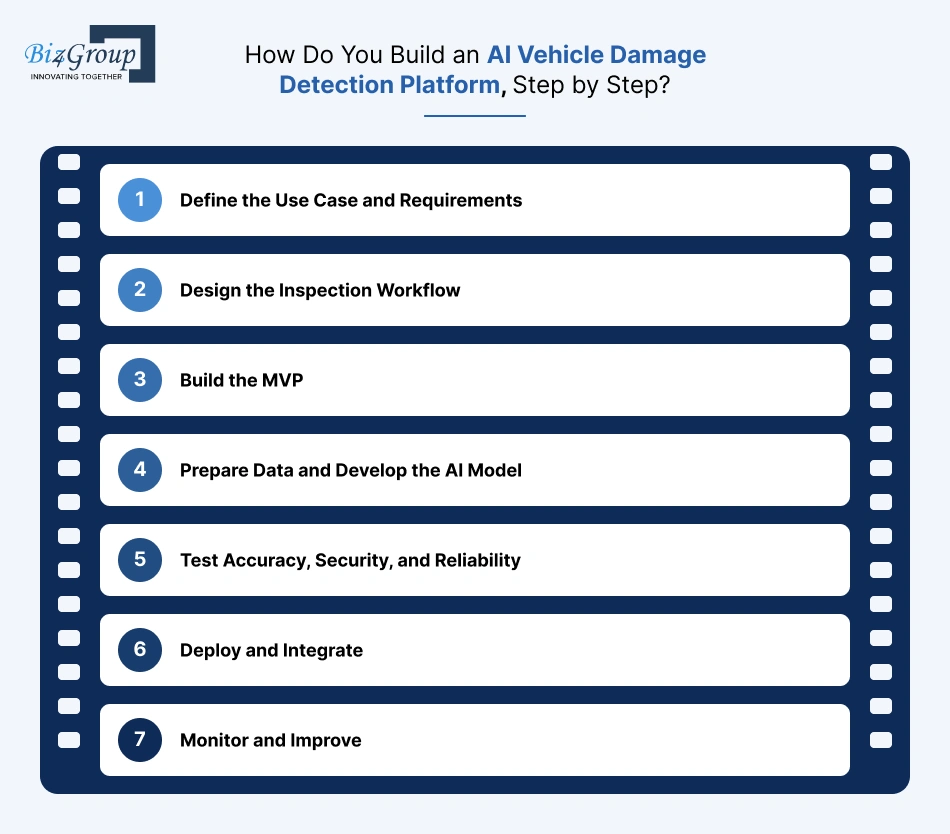
Building an AI vehicle damage detection platform starts with a defined business problem, suitable training data, and a clear plan for validating results. For a car rental company, the goal might be to compare vehicle condition at pickup and return, identify possible new damage, and give staff evidence to review disputes.
1. Define the Use Case and Requirements
Identify the first workflow the platform must support and establish how success will be measured.
- Map the current inspection process and its main failure points.
- Define users, required data, and integration needs.
- Set measurable targets, such as inspection time, manual-review rate, and disputed damage cases.
- Identify applicable privacy and data-retention requirements.
For rental inspections, decide how pickup and return records will be matched to the same vehicle and rental agreement.
2. Design the Inspection Workflow
Map the user journey before development begins.
- Create prototypes for staff and customer inspections.
- Define how users capture photos, review detected damage, and submit reports.
- Test the workflow with representative users.
- Account for poor connectivity and failed uploads where relevant.
The design should make it easy to capture comparable evidence at pickup and return.
3. Build the MVP
Start with the smallest version that can test the core business assumption.
For a rental company, the MVP could include:
- Vehicle and rental identification.
- Pickup and return photo capture.
- Automated image-quality checks.
- Damage detection and comparison between inspection records.
- A reviewable report showing possible new damage.
Defer advanced analytics and other optional capabilities until the core workflow has been validated.
4. Prepare Data and Develop the AI Model
Model performance depends on the quality and variety of training data. Collect representative vehicle images covering different damage types, vehicle surfaces, lighting conditions, and camera angles.
- Label damage locations and categories consistently.
- Separate training, validation, and test datasets.
- Evaluate detection performance on unseen images and difficult cases.
- Test whether the model distinguishes new damage from damage already recorded.
- Use reviewer corrections to identify data gaps and guide future improvements.
For rental inspections, reliable before-and-after comparisons are particularly important. A scratch detected at return is not necessarily new if it was present at pickup.
5. Test Accuracy, Security, and Reliability
Test the complete workflow before using it for operational decisions.
- Measure precision, recall, and missed-damage rates.
- Test glare, shadows, dirt, wet surfaces, and incomplete photo sets.
- Check performance across vehicle types and inspection environments.
- Test access permissions, data protection, and expected traffic loads.
- Confirm that uncertain results can be referred for human review.
AI evaluation should continue after launch, not stop when development is complete. The NIST AI Risk Management Framework provides guidance for managing AI risks throughout development and use.
6. Deploy and Integrate
Release the platform into a controlled environment before expanding to more locations.
- Connect inspection records to the relevant rental, claims, or fleet systems.
- Configure monitoring, backups, and error alerts.
- Train staff on reviewing results and handling exceptions.
- Pilot the platform with a limited group of users and vehicles.
Use pilot results to identify workflow failures and unexpected operating costs before a wider rollout.
7. Monitor and Improve
After launch, compare actual performance with the baseline established during discovery.
Track:
- Inspection completion time.
- Percentage of inspections requiring manual review.
- Missed and incorrectly identified damage.
- Disputed assessments and their resolution.
- Cost per completed inspection.
Use these findings to prioritize model updates and workflow changes. Retrain models when new, representative data justifies it, and validate each update before release.
The development process should follow a clear sequence: define the use case, prepare the data, build and test the MVP, pilot it, and improve it using real operating results.
What Tech Stack Works Best for an AI Vehicle Damage Detection System?
The right tech stack combines image processing, machine learning, data storage, and application infrastructure. The best choices depend on model accuracy requirements, expected inspection volume, deployment environment, and whether the team is building its own AI models or using third-party APIs.
Many tech experts ask, “I am a developer at an insurtech startup, and we want to build our own AI vehicle damage detection system instead of relying on third-party APIs. I need to understand the full development process, from collecting training data to deploying a model that can detect dents, scratches, and structural damage from regular phone photos. What tech stack should we be using?”
Here are the main technology layers to consider:
|
Layer |
Recommended Technologies |
Purpose |
|---|---|---|
|
Frontend |
React, Next.js |
Builds inspection portals, image review screens, and assessment dashboards. |
|
Backend |
Python with FastAPI or Django; Node.js where needed |
Handles business logic, image uploads, authentication, and communication between services. |
|
AI and Computer Vision |
PyTorch, TensorFlow, OpenCV; YOLO models for object detection |
Supports damage localization, image preprocessing, and model training. Segmentation models may help outline irregular damage areas. |
|
Data Annotation |
CVAT, Label Studio, Supervisely |
Labels dents, scratches, cracks, vehicle parts, and other target categories for training and evaluation. |
|
Database and Image Storage |
PostgreSQL, S3-compatible object storage |
Stores inspection records, vehicle metadata, model outputs, and image files without placing large images directly in the main database. |
|
Model Serving and Optimization |
ONNX Runtime, NVIDIA TensorRT, cloud inference endpoints |
Runs trained models in production and helps balance inference speed, hardware costs, and accuracy. |
|
Cloud Infrastructure |
AWS, Microsoft Azure, Google Cloud |
Provides compute, storage, networking, and scaling for model training and production workloads. |
|
APIs and Integration |
REST APIs; gRPC where low-latency service communication is needed |
Connects the model service to claims platforms, rental applications, and fleet systems. |
|
Mobile Development |
React Native, Flutter, or native iOS and Android development |
Supports photo capture, inspection workflows, and uploads from phones used by customers or field staff. |
|
Deployment and MLOps |
Docker, CI/CD pipelines, model versioning; Kubernetes when justified |
Standardizes deployment and helps teams roll out model updates and scale services. |
|
Security and Testing |
OAuth 2.0/OIDC, TLS, encryption at rest, automated API and load testing |
Protects inspection data and checks application reliability under expected workloads. |
|
Monitoring |
Prometheus, Grafana, OpenTelemetry |
Tracks service health, inference latency, failures, and resource usage. Model quality should be evaluated separately using labeled inspection data. |
Which AI Framework Should You Choose?
Think of PyTorch as your go-to for building custom computer vision models, TensorFlow as a solid alternative if your team already uses it, and OpenCV as your image-prep toolkit for tasks like resizing and cropping.
For detecting and outlining damage, YOLO26 is worth exploring, with deployment options including ONNX and TensorRT. Test it on real vehicle damage photos before choosing a model, and check its license for commercial use.
One catch: phone photos can reveal visible dents and scratches, but hidden structural damage needs other inspection methods. Start with a lean tech stack, then scale up when your workload demands it.
Which KPIs Show Whether AI Vehicle Damage Detection Is Working?
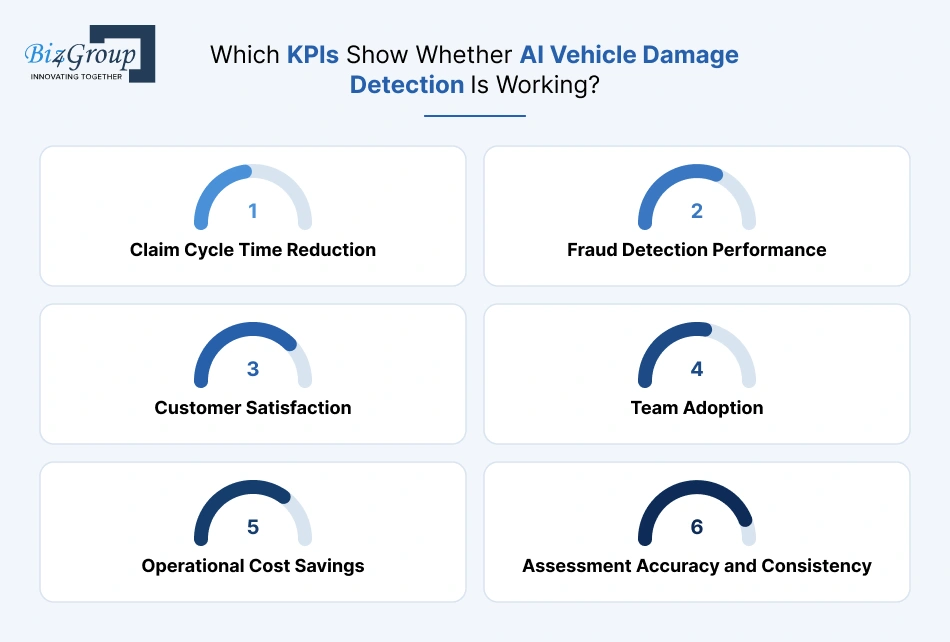
Track these KPIs to measure whether your AI vehicle damage detection platform improves efficiency, controls costs, and delivers consistent assessments.
1. Claim Cycle Time Reduction
- Median time from inspection to claim decision or settlement.
- Average time required to complete a damage assessment.
- Change in cycle time before and after implementation.
2. Fraud Detection Performance
- Precision: How many flagged cases are confirmed as suspicious?
- Recall: How many known fraudulent cases does the system detect?
- False-positive rate: How often does it incorrectly flag legitimate claims?
A damage mismatch may indicate a potential issue, but it does not prove fraud.
3. Customer Satisfaction
- Customer satisfaction score (CSAT).
- Damage-related dispute rates.
- Complaints about inspection results.
Clear, consistent reports can help customers understand damage assessments. Businesses can also explore customer service AI chatbots to support customer communication.
4. Team Adoption
- Percentage of eligible inspections completed using the platform.
- Active usage across adjusters, rental agents, and fleet operators.
- Frequency of users overriding AI-generated results.
Low adoption may indicate workflow friction, training gaps, or a lack of trust in the results. AI-powered business app development should account for these factors during rollout planning.
5. Operational Cost Savings
- Cost per inspection and claim processed.
- Staff time spent on manual inspections.
- Dispute resolution and claim-handling costs.
- Vehicle turnaround time for rental businesses.
- Total savings compared with implementation and ongoing operating costs.
Use these figures to calculate return on investment (ROI).
6. Assessment Accuracy and Consistency
- Precision and recall: How reliably the platform detects visible damage.
- Classification accuracy: How correctly it categorizes damage types.
- Consistency: How often comparable images produce consistent results.
- Performance by condition: Results across vehicle types, lighting, and image quality.
Establish a baseline before launch and track these KPIs regularly. The results will show where the platform is delivering value and whether it is meeting business targets.
How Much Does It Cost to Build an AI Vehicle Damage Detection Platform?
Building an AI vehicle damage detection platform typically costs $25,000 to $200,000+. The spread comes from scope, not guesswork. We estimate by hours × blended rate, using a rate of $35-$50 per hour. Hours depend on how many damage types, user roles, integrations, and fraud checks you need.
|
Tier |
Example scope |
Estimated cost |
|---|---|---|
|
MVP |
One use case (e.g., rental check-in/out), guided photo capture, scratch/dent/crack detection on a fine-tuned model, basic severity bands, PDF/JSON report |
$25K-$60K (~700-1,200 hrs) |
|
Mid-level |
Multiple damage classes, part-level severity, repair-cost estimation, duplicate/metadata fraud checks, cross-platform app, admin dashboard, 2 integrations |
$60K-$120K (~1,700-2,400 hrs) |
|
Enterprise |
Multi-tenant platform, video capture, advanced fraud detection, 4+ integrations, multilingual support, audit logs, retraining pipeline, load testing, compliance review |
$120K-$200K+ (~3,400-5,400+ hrs) |
What Moves the Price?
- Data and annotation setup: 120-600 hours, depending on the number of damage classes, image volume, and labeling type.
- Model development: 200-900 hours. Detection alone is cheaper than segmentation, part identification, and severity scoring.
- Severity and repair-cost estimation: 60-200 hours, depending on whether it uses simple rules or part-level pricing data.
- Fraud and image-integrity checks: 100-300 hours (roughly $3.5K-$15K at the rates above).
- Each additional integration (claims system, fleet dashboard, rental management tool): roughly 70-100 hours, or $2.5K-$5K.
- Compliance and security: photos can contain license plates, faces, and location metadata, so privacy controls and audit logs add effort in the mid and enterprise tiers.
What Hidden Costs to Consider During AI Vehicle Damage Detection Platform Development?
Building the platform is just the beginning, with ongoing costs needed to keep it accurate, secure, and reliable as inspection volumes grow.
1. AI Model Updates and Retraining
- Adapting to new vehicle models, paint finishes, and damage types.
- Updating models for changing camera devices and inspection conditions.
- Testing new versions before deployment.
2. Damage Dataset Collection and Annotation
- Collecting images of dents, scratches, cracks, chipped paint, and other visible damage.
- Labeling images across vehicle types, camera angles, and lighting conditions.
- Expanding datasets to address underrepresented damage types and difficult cases.
3. Image Storage and AI Processing
- Cloud storage for high-resolution inspection images.
- GPU or other compute resources for image analysis.
- Backup, data retrieval, and storage management as inspection volumes increase.
4. Integration and API Maintenance
- Connecting with claims platforms, rental management systems, fleet tools, repair platforms, and dealership CRMs.
- Maintaining APIs and updating integrations when connected systems change.
- Testing data flows and resolving integration issues.
5. Detection Accuracy Monitoring
- Tracking missed damage and false detections.
- Evaluating model performance across vehicle types and image conditions.
- Updating models when monitoring reveals performance gaps.
6. Data Security and Compliance
- Protecting license plates, customer details, and location data.
- Maintaining encryption, access controls, and data retention policies.
- Budgeting for security testing, audits, and applicable privacy requirements, including GDPR or CCPA where relevant.
Include these recurring expenses in your total cost estimate, not just the initial build budget. The next step is to explore monetization models that can help turn an AI vehicle damage detection platform into a revenue-generating business.
Also Read: How Much Does It Really Take to Build Smart Solutions?
How Can You Monetize an AI Vehicle Damage Detection App?
AI vehicle damage detection platforms can generate revenue through recurring subscriptions, per-inspection fees, enterprise licensing, and paid integrations. The right model depends on inspection volume, customer type, deployment requirements, and the value delivered.
Current vehicle inspection providers already offer per-inspection pricing, volume-based plans, and enterprise contracts with custom integrations or private deployment.
Here are six monetization models to consider:
|
Monetization Model |
How It Works |
Business Value |
|---|---|---|
|
Subscription Plans |
Charge rental companies, dealerships, insurers, or fleets a recurring fee based on features, usage limits, or business size. |
Generates predictable recurring revenue. |
|
Pay-Per-Inspection |
Charge customers for each completed vehicle assessment, with volume discounts for high inspection volumes. |
Offers flexible pricing and connects revenue to usage. |
|
Enterprise Licensing |
Offer annual or quarterly contracts with custom integrations, dedicated support, service-level agreements, and private deployment options. |
Supports larger contracts and long-term business relationships. |
|
API Access and Integration |
Charge businesses to integrate damage detection into existing claims, rental, fleet, or dealership systems. Pricing can depend on API usage or committed volumes. |
Reaches customers who want to add damage detection to their existing platforms. |
|
White-Label Licensing |
Let automotive businesses offer the platform under their own brand through licensing agreements. |
Expands market reach through established business partners. |
|
Premium Analytics and Workflow Features |
Charge extra for fleet-wide damage trends, inspection comparisons, customized reports, repair-cost estimates, and advanced dashboards. |
Creates opportunities to upsell customers who need deeper operational insights. |
What About Data and AI Assistant Add-Ons?
- Damage analytics: Offer aggregated damage trend reports where the data is sufficiently anonymized and its use is authorized by contract. Data that can still identify individuals may remain subject to privacy laws.
- AI-powered customer assistance: Offer automated inspection guidance, report explanations, and customer support as optional features. For example, an AI conversation app can help customers navigate inspection results and related service requests.
Choose a pricing model that matches customer needs and the cost of delivering each assessment. A subscription can suit predictable usage, while per-inspection pricing may work better for fluctuating volumes. Enterprise licensing and paid add-ons can increase revenue as customers need deeper integrations or more advanced capabilities.
Also Read: Building Smart Applications with AI as a Service APIs
What Are the Risks of a Poorly Built Damage Detection System?
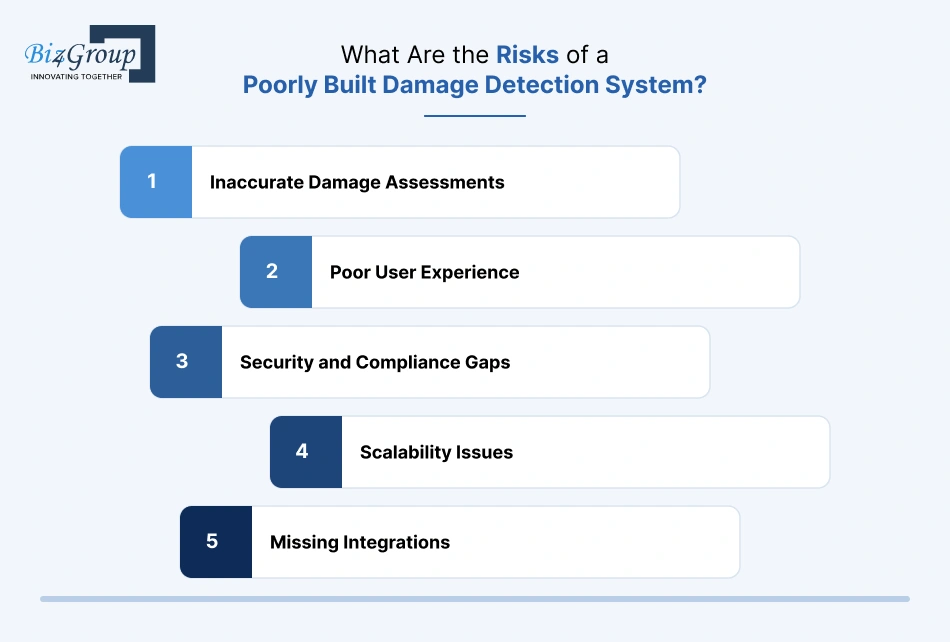
A poorly built AI vehicle damage detection platform can lead to inaccurate assessments, low adoption, security risks, and operational delays. Key risks include:
|
Risk |
Business Impact |
How to Reduce It |
|---|---|---|
|
Inaccurate Damage Assessments |
Missed damage or incorrect repair estimates can trigger claim disputes, rental charge disagreements, and customer complaints. |
Test against verified inspection data and track false positives and missed damage. |
|
Poor User Experience |
Complicated workflows can discourage staff and customers from using the platform. |
Simplify photo capture, reporting, and assessment workflows. |
|
Security and Compliance Gaps |
Poor data protection can expose customer information and create legal or regulatory risks. |
Implement access controls, encryption, retention policies, and applicable compliance measures. |
|
Scalability Issues |
Traffic spikes during severe weather or peak rental periods can cause slowdowns and downtime. |
Load-test the platform and plan computing capacity around expected demand. |
|
Missing Integrations |
Disconnected claims, fleet, and rental systems can create duplicate work and limit adoption. |
Plan API integrations and validate data flows early. See our AI chatbot development guide for related integration considerations. |
Address these risks during planning, development, and testing to reduce operational disruption and protect your investment. Next, let’s examine the key challenges of building an AI vehicle damage detection platform and how to address them.
What Challenges Come Up When Developing AI Vehicle Damage Detection?
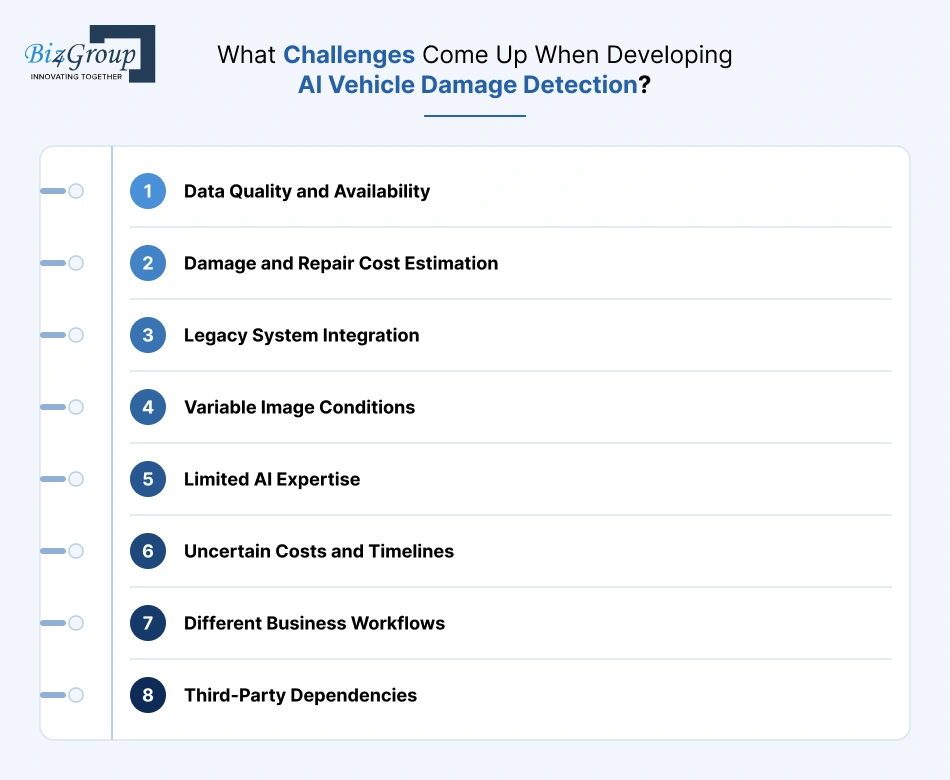
Building an AI vehicle damage detection platform in-house presents challenges around data, detection accuracy, system integration, and cost.
For insurers considering an in-house alternative to vendors like Tractable or Inspektlabs, the key challenges include:
|
Challenge |
Why It Occurs |
How to Solve It |
|---|---|---|
|
Data Quality and Availability |
Existing images may be poorly labeled or lack diverse damage examples. |
Audit available data, standardize labels, and fill gaps with representative images. |
|
Damage and Repair Cost Estimation |
Images may miss hidden damage, while repair costs vary by parts, labor, and location. |
Validate estimates against repair records and relevant parts and labor data. |
|
Legacy System Integration |
Claims platforms may have outdated interfaces or incompatible data formats. |
Map data flows early and develop suitable API connections or adapters. |
|
Variable Image Conditions |
Lighting, glare, dirt, and camera angles can affect detection. |
Test across real-world conditions and define image quality requirements. |
|
Limited AI Expertise |
Computer vision development requires specialized skills and ongoing model maintenance. |
Assess internal capabilities and plan for specialist hires or external partners. |
|
Uncertain Costs and Timelines |
Data preparation, integration, and testing requirements may be unclear initially. |
Run a feasibility study and proof of concept before full development. |
|
Different Business Workflows |
Insurers, rental companies, and fleets have different inspection and reporting requirements. |
Define the target workflow and required features before development. |
|
Third-Party Dependencies |
External models and services may introduce licensing restrictions, usage costs, or vendor lock-in. |
Review licensing, pricing, data portability, and alternatives before choosing providers. |
Assessing these challenges early helps determine the feasibility and cost of in-house development. Next, let’s look at the compliance and privacy requirements.
How Do You Keep AI Vehicle Damage Detection Compliant and Private?
AI vehicle damage detection platforms may process inspection photos, license plates, customer details, and claim records. Protecting this data requires privacy controls, clear AI governance, and compliance measures tailored to the markets where the platform operates.
|
Compliance Area |
Implementation Approach |
Risk if Ignored |
|---|---|---|
|
Data Protection Laws |
Identify applicable laws, such as GDPR and CCPA/CPRA. Establish a lawful basis for processing, document data flows, and assess whether a Data Protection Impact Assessment (DPIA) is required. |
Regulatory penalties, legal disputes, and market restrictions. |
|
Customer Privacy |
Collect only necessary data, encrypt it in transit and at rest, set retention limits, and provide required privacy notices and consent options. |
Data exposure, complaints, and loss of customer trust. |
|
AI Governance and Accountability |
Assign clear ownership for AI risks, document model limitations and intended use, and maintain records of model versions, decisions, and access. Use the NIST AI Risk Management Framework as a practical reference. |
Weak oversight, inconsistent decisions, and difficulty demonstrating accountability. |
|
Accuracy and Fairness |
Evaluate detection performance across vehicle types, damage categories, lighting conditions, and image quality. Document known limitations and investigate systematic errors. |
Unreliable assessments, disputes, and unfair outcomes. |
|
Security and Incident Response |
Apply role-based access controls, secure data transfers, maintain audit logs, and establish procedures for investigating and reporting breaches where required. |
Unauthorized access, operational disruption, and potential liability. |
|
Third-Party and Cloud Providers |
Review vendor security practices, data-processing agreements, subcontractors, and restrictions on using inspection images to train external models. |
Loss of data control, contractual disputes, and exposure through suppliers. |
|
Cross-Border Data Transfers |
Map where images and claim records are stored or accessed. Apply required transfer safeguards and regional storage measures where applicable. |
Transfer restrictions, compliance gaps, and delays entering new markets. |
Build these controls into the platform from planning through deployment and ongoing operation. Requirements vary by jurisdiction and business use, so obtain qualified legal advice before launch. The NIST AI Risk Management Framework provides guidance for governing, assessing, and managing AI risks.
For insurance, rental, and fleet businesses, strong governance helps protect customer data while supporting accountable, reliable assessments. Next, let’s explore the emerging trends shaping AI vehicle damage detection.
What Are the Latest Trends in AI Vehicle Damage Detection?
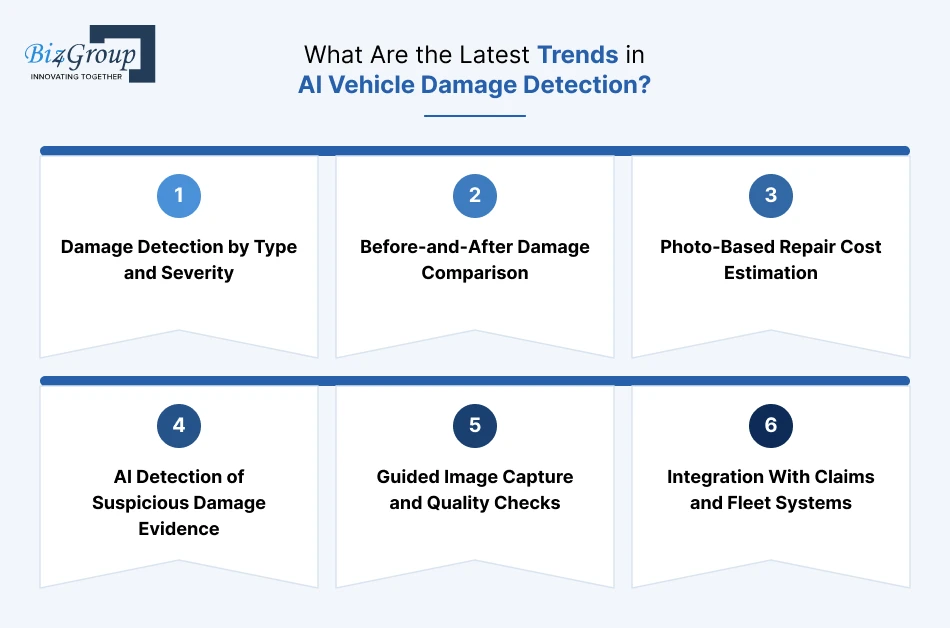
AI vehicle damage detection is advancing through more specialized capabilities for identifying damage, comparing vehicle condition, and supporting repair assessments. Key trends include:
1. Damage Detection by Type and Severity
AI models are becoming more specialized in identifying visible damage such as dents, scratches, cracks, broken lights, and chipped paint. Classifying damage by type and severity helps insurers, rental companies, and fleets standardize initial assessments.
2. Before-and-After Damage Comparison
AI can compare vehicle images captured at different times to identify newly visible damage. This is particularly useful for rental pickup and return inspections, fleet handovers, and insurance claims involving previous damage.
3. Photo-Based Repair Cost Estimation
Damage detection platforms are combining image analysis with vehicle details, parts pricing, labor rates, and repair data to estimate potential repair costs. Estimates still depend on local pricing and may not capture hidden damage that requires further inspection.
4. AI Detection of Suspicious Damage Evidence
Image analysis is being used to flag potentially manipulated photos, inconsistent damage records, and discrepancies between submitted images and claim details. These signals can help prioritize suspicious claims, but they do not independently prove fraud.
5. Guided Image Capture and Quality Checks
Platforms are using guided photo capture to help users submit clear images from suitable angles. Automated checks can flag blur, poor lighting, incomplete vehicle coverage, or images that need to be retaken before assessment.
6. Integration With Claims and Fleet Systems
Damage detection is increasingly being connected to claims management, rental inspection records, fleet maintenance, and repair estimation workflows. This lets businesses use detection results within existing operations rather than managing separate assessment tools.
These trends focus on the core capabilities of AI vehicle damage detection: identifying visible damage, comparing vehicle condition, estimating repair costs, and connecting results to business workflows.
Also Read: Top 25 AI Consulting Companies in USA
Stay Ahead of the Curve
Lead your industry with AI vehicle damage detection system that’s future-ready and customer-first.
Partner With Biz4Group NowShould You Build, Buy, or Partner for AI Vehicle Damage Detection?
The right approach depends on your budget, timeline, internal AI expertise, and integration needs. Insurers, rental companies, and fleet operators can build a custom platform, buy an existing solution, or partner with a development team to create a tailored solution.
|
Approach |
Best For |
Key Consideration |
|---|---|---|
|
Build In-House |
Businesses with experienced AI teams, unique requirements, and long-term control needs. |
Requires investment in data, model development, infrastructure, and ongoing maintenance. |
|
Buy an Existing Solution |
Businesses that need established damage detection capabilities quickly. |
Customization, integration options, pricing, and vendor dependency may limit flexibility. |
|
Partner With a Development Company |
Businesses that need tailored capabilities without building the entire technical team internally. |
Choose a partner with relevant AI expertise, integration experience, and a clear delivery plan. |
Why Partner With Biz4Group for AI Vehicle Damage Detection?
A scratch on a rental car shouldn’t turn into a week of back-and-forth. And a dent shouldn’t leave your claims team guessing.
That’s where a purpose-built AI vehicle damage detection platform can help. Biz4Group, an AI app development company, can help you plan a solution around the real challenges insurers, rental companies, and fleet operators face.
Here’s what your platform could include:
- Spot damage faster: Identify visible dents, scratches, cracks, and other damage from vehicle images.
- Compare inspections: Check pickup and return photos to help identify newly visible damage.
- Make repair estimates more useful: Combine detected damage with vehicle details, parts pricing, and labor data to support cost estimates.
- Fit into your workflow: Connect inspection results with claims, rental operations, fleet management, or repair systems.
Our AI-driven chatbot project showcases our work on AI-powered applications. For your vehicle damage detection platform, the features, integrations, and model requirements would be shaped around your data, workflows, and business goals.
Ready to put damage assessments in gear? Talk to Biz4Group about building a platform tailored to your business.
Final Takeaway
AI vehicle damage detection can help insurers, rental companies, and fleet operators document visible damage, compare inspection photos, and support repair cost estimates. The real value comes from turning image analysis into consistent assessments that fit existing business workflows.
As Andy Wood, Lead Solutions Engineer at CCC Intelligent Solutions, explains in CCC’s article on AI-powered estimating:
“AI can build line-level estimates from qualified vehicle damage photos in seconds – all according to your own unique rules and thresholds.”
For businesses developing these capabilities, the priority is to combine reliable image analysis with relevant repair data, practical integrations, and clear performance targets.
Biz4Group can help you define the platform requirements, AI capabilities, and integration strategy around your business needs. Explore our AI consulting services to discuss your project.
Discuss Your Project with Biz4Group
FAQs
1. Can AI distinguish new vehicle damage from pre-existing damage?
Yes. An AI vehicle damage detection platform can compare pickup and return photos to identify potential changes in vehicle condition. Consistent image capture and human review help confirm whether the damage is new.
2. How does AI vehicle damage detection handle poor-quality photos?
AI vehicle inspection platforms can check for blur, glare, poor lighting, and incomplete coverage before analysis. If an image is unsuitable, the system can request a clearer photo or send the inspection for manual review.
3. Can AI estimate vehicle repair costs from photos?
AI vehicle damage assessment can identify visible damage and affected parts, while repair estimates use severity assessments, regional parts prices, labor rates, and pricing rules. Hidden damage may still require a physical inspection.
4. What data is needed to train an AI car damage detection model?
Training requires labeled vehicle images covering scratches, dents, cracks, different vehicle parts, and varied lighting and camera angles. A diverse dataset with damaged and undamaged examples helps improve detection reliability.
5. How do you measure AI vehicle damage detection accuracy?
Use precision, recall, and mean average precision (mAP) to evaluate object detection, alongside severity-classification agreement where applicable. Test the model on real-world images and compare its results with assessments by qualified inspectors.
6. Should a business build a custom AI vehicle inspection platform or use an existing API?
An existing vehicle damage detection API can help businesses launch faster, while custom platform development offers greater control over workflows, integrations, and model behavior. Compare costs, performance on your own images, and long-term requirements before deciding.
7. Can AI detect fake or reused vehicle inspection photos?
AI-powered photo integrity checks can flag duplicate images, possible manipulation, and suspicious inspection patterns. These signals support fraud investigation but should not be treated as conclusive proof without further verification.
8. How many photos are needed for AI vehicle damage assessment?
The number depends on the vehicle and inspection workflow. A typical process captures all four sides, with additional close-up photos of visible damage to support more detailed assessment.
9. How much does it cost to develop an AI vehicle damage detection platform?
The cost to develop an AI vehicle damage detection platform typically ranges from $25,000 to $200,000+, depending on features, AI model complexity, data requirements, integrations, and deployment scale. A detailed scope assessment helps estimate the development budget and ongoing maintenance costs.
10. How can Biz4Group help with AI vehicle damage detection platform development?
Biz4Group can help businesses plan and develop a custom AI vehicle damage detection platform, from defining core features and image-processing workflows to planning integrations and deployment. Discuss your business requirements, available training data, and budget to determine the right development approach.
