Location :
Orlando, FL, USA
Location :
Orlando, FL, USA +1 (407) 714-1616
 info@biz4group.com


















Imagine a digital system that doesn’t wait for instructions but instead, understands your business goals, learns from real-time feedback, and takes independent actions to get the job done.
Read More
 AI Summary Powered by Biz4AI
Ever opened three or four "Character AI alternatives" lists, only to realize they all recommend the same platforms without explaining which one is actually right for you?
That's the challenge today. There are plenty of AI character platforms to choose from, but finding one that matches the way you use AI is a different story. A platform that's excellent for long-form roleplay may not be the best fit for creative writing, while one that shines as an AI companion may fall short if privacy or customization is your priority. The rapid pace of innovation in generative AI app development has also given users more choices than ever, making it even harder to separate genuinely useful platforms from those that simply check the usual feature boxes.
You might be asking yourself:
Character AI itself remains one of the largest AI character platforms. According to Similarweb, it attracts hundreds of millions of monthly visits, while Sacra estimates it has around 20 million monthly active users, highlighting the growing demand for AI-powered character conversations and the expanding ecosystem of competing platforms.
Whether you're comparing platforms for personal use or curious about how a generative AI development company approaches AI companions, storytelling, and conversational experiences, understanding what sets these platforms apart has never been more important.
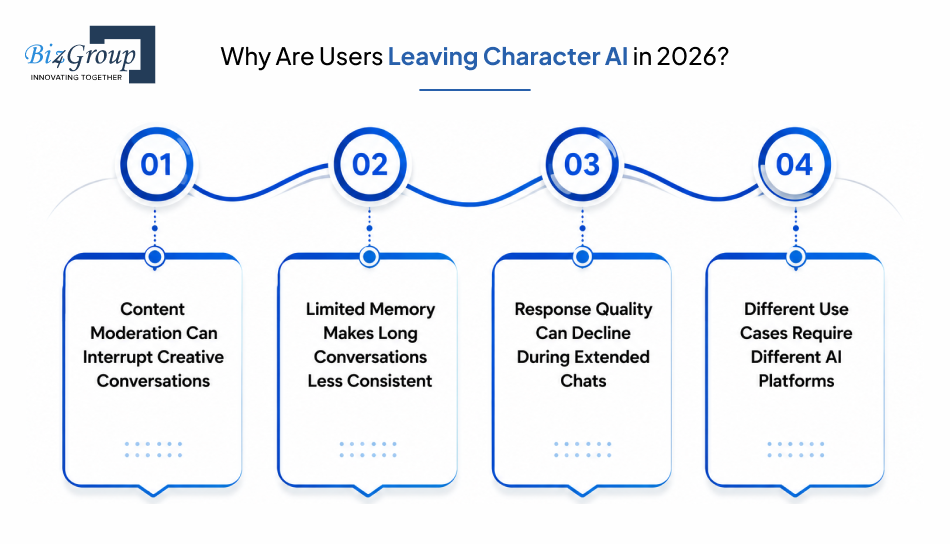
Character AI remains one of the most popular AI character platforms, but it's no longer the default choice for everyone. As the market has matured, users have become more selective about memory, response quality, creative flexibility, and the overall chat experience. That's why more people are searching for alternatives to Character AI and comparing them based on their specific needs instead of simply choosing the biggest platform.
While there's no single reason behind the shift, the four factors below consistently influence why users start exploring other AI roleplay platforms.
One of the most common frustrations comes from conversations ending or changing direction unexpectedly because of platform moderation. A user recently summed it up perfectly:
"i have been using Character AI for roleplay for over a year but the filters have gotten so bad that it keeps cutting off my stories mid-scene for no real reason, i want to find an alternative that has the same kind of character creation and chat experience but without the constant interruptions, what are the actual best alternatives in 2026 that people are using for long-form creative roleplay without constantly hitting a wall"
The answer depends on your priorities, but several Character AI alternatives for roleplay provide more flexible storytelling experiences while still maintaining their own moderation policies. Instead of looking for the least restrictive platform, focus on one whose approach aligns with the kind of stories you want to create. This balance is becoming increasingly important across generative AI platforms as developers work to support creativity while maintaining responsible AI use.
Many users enjoy building ongoing stories or relationships with AI characters, but that becomes difficult when important details are forgotten over time. While newer platforms are introducing better long-term memory and character consistency, memory still varies widely between services. If you're comparing Character AI alternatives with better memory, it's worth paying attention to how each platform handles long conversations rather than relying on feature lists alone.
Conversation quality is another reason users start looking elsewhere. One writer described the challenge this way:
"i am a writer who has been using Character AI to develop characters and test dialogue but i want something with better underlying AI quality that can actually write well and stay in character consistently over long conversations, what are the Character AI alternatives in 2026 that use the best AI models and actually produce high quality creative output rather than repetitive generic responses"
For writers, roleplayers, and game designers, the best platforms aren't necessarily the ones with the most features. They're the ones that maintain believable dialogue, stronger character consistency, and higher-quality writing across longer sessions. These are often the qualities that separate average AI chat experiences from genuinely useful creative tools.
Not everyone uses Character AI for the same reason. Some users want immersive roleplay, others need an AI writing partner, while many are looking for companionship or greater privacy. That's why the best Character AI alternatives 2026 aren't defined by a single winner.
The right platform depends on what you want to accomplish, making it far more useful to compare platforms by use case than by popularity alone. This is the same principle organizations follow when they build AI software for different audiences, where success depends on solving a specific problem rather than trying to serve every possible use case.
|
Reason Users Switch |
Why It Matters |
What to Look For Instead |
|---|---|---|
|
Content moderation |
Can interrupt roleplay or creative storytelling |
A platform whose moderation approach matches your intended use |
|
Limited memory |
Characters may lose context during long conversations |
Better long-term memory and stronger character consistency |
|
Response quality |
Dialogue can become repetitive or less engaging |
Higher-quality AI models and more consistent conversations |
|
Different goals |
One platform rarely fits every user |
Choose based on your primary use case, not overall popularity |
As AI character platforms continue to evolve, users have more choice than ever before. Rather than asking which platform is objectively the best, the better question is which one best matches the way you want to use AI. That's the approach we'll use throughout the rest of this comparison.
The right Character AI alternative is the one that best matches your primary use case and performs well in the areas that matter most to you, such as memory, conversation quality, customization, pricing, and privacy. Instead of choosing the platform with the longest feature list or the biggest community, start by identifying what you want from the experience, then compare platforms against those specific requirements.
A common mistake is choosing a platform because it's popular rather than because it's built for your needs. Many AI chatbot alternatives to Character AI excel in one area while being average in another.
Use the table below as a starting point.
|
If You Primarily Want To... |
Prioritize Platforms That Offer... |
|---|---|
|
Long-form roleplay |
Better memory, consistent characters, flexible storytelling |
|
Creative writing |
High-quality writing, world-building tools, strong dialogue generation |
|
AI companionship |
Persistent memory, natural conversations, voice features |
|
Casual conversations |
Fast responses, simple interface, generous free plan |
|
Privacy and control |
Self-hosting, local AI models, open-source support |
For example, if your goal is writing a novel, choosing a platform designed for AI companionship may leave you disappointed. Likewise, if you simply want casual conversations, you probably don't need the complexity of a self-hosted setup.
This same principle applies beyond consumer AI. Organizations investing in AI consulting services often begin by identifying a specific business objective before evaluating technologies, because the right solution depends on the problem you're trying to solve.
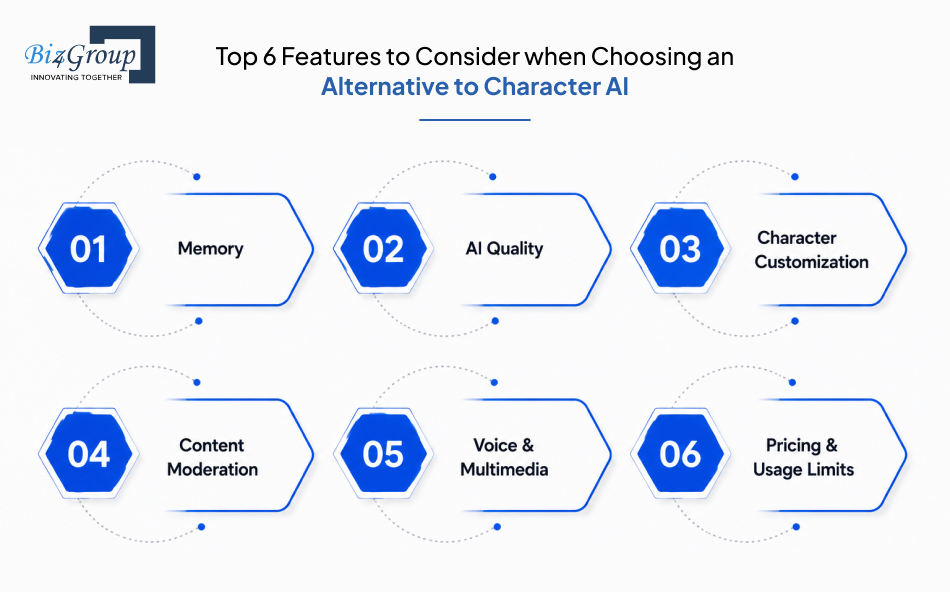
Once you've identified your primary use case, compare platforms using the factors that have the biggest impact on everyday use instead of focusing on long feature lists.
|
Feature |
Why It Matters |
|---|---|
|
Memory |
Determines how well the AI remembers previous conversations, character details, and ongoing storylines. |
|
AI Quality |
Influences response quality, creativity, reasoning, and how consistently characters stay in role. |
|
Character Customization |
Lets you define personalities, backstories, writing style, and conversation behavior. |
|
Content Moderation |
Affects what types of conversations the platform supports and how often interactions may be interrupted. |
|
Voice & Multimedia |
Useful if you prefer spoken conversations, image generation, or richer interactions. |
|
Pricing & Usage Limits |
Free plans vary widely in message limits, available features, and access to advanced AI models. |
The AI market is also evolving rapidly. According to Grand View Research, the global generative AI market is projected to grow to around 1260 billion USD by 2034, which explains why new AI character platforms and features continue to emerge at a rapid pace.

So a useful question to ask yourself is: Which feature would frustrate me the most if it didn't work well? If the answer is memory, prioritize Character AI alternatives with better memory. If it's storytelling, focus on Character AI alternatives for creative writing. If you mainly chat on your phone, mobile experience and voice support may matter more than advanced customization.
Whether you're comparing consumer AI platforms or evaluating technologies to integrate AI into an app, the same principle applies: define your goal first, then choose the platform whose strengths align with that goal instead of assuming one solution is the best for everyone.
The top Character AI alternatives in 2026 include Janitor AI, NovelAI, DreamGen, Kindroid, Replika, Poe, and SillyTavern, each catering to a different type of user. While Janitor AI and DreamGen are popular for immersive roleplay, NovelAI is better suited for creative writing, Kindroid and Replika focus on AI companionship, and SillyTavern appeals to users who want complete control through self-hosting. The remaining platforms fill other niches, from multi-model AI access to community-created characters and local AI setups.
Overview: Janitor AI is a character-first chat platform with a large community library of user-created bots. Unlike Character AI, it supports external AI models, allowing users to connect services like GPT or Claude for better writing quality and longer conversations. It also offers both filtered and less restrictive chat modes.
Key Strengths: 32,000+ community characters, external AI model support, persona system, flexible chat modes, custom bots
Best For: Character roleplay, users who want model flexibility, community-created AI characters
Overview: NovelAI is a writing platform before it's a chatbot. Instead of focusing on casual conversations, it gives writers tools like Lorebooks, Memory, Author's Notes, genre presets, and fine-tuned story models to keep characters, locations, and plot details consistent across long stories. It also includes anime-style AI image generation.
Key Strengths: Lorebooks, story-focused AI models, Author's Notes, Memory system, AI image generation
Best For: Novelists, fan fiction, world-building, long-form storytelling
Overview: DreamGen sits somewhere between an AI chatbot and an interactive fiction engine. Rather than simply chatting with a character, you can build structured scenarios, define characters, locations, and lore, then steer the story as it unfolds without completely breaking the narrative flow. It also supports AI-generated scene images.
Key Strengths: Scenario editor, narrative steering, story worlds, character management, AI image generation
Best For: Interactive fiction, collaborative storytelling, writers who want more control over story direction
Overview: Kindroid is designed around long-term AI companionship rather than standalone chats. It uses multiple memory layers, including backstories, persistent memories, and searchable journal entries, helping characters remember people, events, and preferences across future conversations. It also supports voice calls and group chats.
Key Strengths: Journal memory, persistent memory, voice calls, group chats, customizable AI companions
Best For: AI companionship, long-term conversations, users who want consistent memory across chats
Overview: Replika is built for long-term AI companionship rather than character roleplay. It remembers personal details, supports voice and AR interactions, offers relationship modes such as Friend and Mentor, and is designed to make conversations feel more personal over time.
Key Strengths: Long-term memory, voice calls, 3D avatars, AR experiences, relationship modes, emotional conversations
Best For: AI companionship, daily conversations, emotional support
Overview: Chai takes a community-first approach by giving users instant access to thousands of AI characters created by other users. Instead of spending time building your own bot, you can explore different personalities, conversation styles, and roleplay scenarios directly from the app.
Key Strengths: Large community bot library, mobile-first experience, quick character discovery, easy onboarding
Best For: Casual roleplay, discovering community-created characters, mobile users
Overview: Poe isn't a dedicated roleplay platform. Instead, it brings together leading AI models like GPT, Claude, Gemini, and others in one place, while also letting users create and share custom bots. If you want to compare different models before committing to one platform, Poe makes that easy.
Key Strengths: Multiple AI models, custom bot creation, model comparison, single subscription for multiple models
Best For: Trying different AI models, productivity, custom AI assistants
Overview: SillyTavern isn't an AI model or chatbot. It's an open-source frontend that connects to local or cloud-hosted language models, giving you complete control over prompts, character cards, lorebooks, extensions, and conversation settings. It's one of the most customizable AI roleplay tools available.
Key Strengths: Lorebooks, character cards, extension ecosystem, local AI support, prompt customization, API compatibility
Best For: Self-hosting, advanced roleplay, privacy-focused users, AI power users
Overview: Pygmalion AI isn't a complete chat platform. It's an open-source language model project built specifically for chat and roleplay, giving developers and hobbyists the freedom to run, fine-tune, or integrate the model with frontends like SillyTavern.
Key Strengths: Open-source LLM, self-hosting, community-driven development, roleplay optimization, frontend compatibility
Best For: Open-source enthusiasts, developers, self-hosted roleplay, AI experimentation
Overview: Moemate goes beyond text chat by combining customizable AI characters with voice conversations, voice cloning, image generation, web search, screen perception, and animated avatars. It's closer to an AI studio than a traditional roleplay platform.
Key Strengths: Voice cloning, animated avatars, image generation, multimodal AI, custom characters, web search
Best For: Interactive AI companions, creators, multimodal conversations, avatar-based experiences
Overview: Backyard AI focuses on private AI conversations by letting you chat with characters using either local or cloud-hosted models. Unlike many self-hosted tools, it simplifies model management through desktop and mobile apps while still offering advanced controls for experienced users.
Key Strengths: Local AI models, voice chats, desktop application, cloud model support, advanced model controls, privacy
Best For: Private AI chats, local AI, users moving beyond browser-based platforms
Overview: Sakura AI is a character chat platform centered around user-created AI personalities. It lets users create their own characters, customize personalities and behavior, explore a large community library, and use the same platform for roleplay, productivity, or everyday conversations.
Key Strengths: User-generated characters, personality customization, community library, AI assistant features, cross-platform apps
Best For: Character roleplay, custom AI personalities, casual conversations, users who enjoy community-created bots
The right Character AI alternative depends on what you want to do with it. If your goal is roleplay, you won't necessarily choose the same platform as someone writing a novel or looking for an AI companion. Rather than picking the most popular option, start with your primary use case and choose the platform that performs best in that area.
|
If You Want... |
Recommended Platform(s) |
Why They're a Good Fit |
|---|---|---|
|
Long-form roleplay |
Janitor AI, DreamGen |
Better support for immersive scenarios, character customization, and longer story-driven conversations |
|
Fiction writing & world-building |
NovelAI |
Built specifically for storytelling with tools like Lorebooks and writing-focused AI models |
|
AI companionship |
Kindroid, Replika |
Designed for ongoing relationships, personalized interactions, and stronger long-term memory |
|
A free Character AI alternative |
Chai, Poe |
Easy to get started with free access and a wide range of AI chat experiences |
|
Privacy & self-hosting |
SillyTavern, Backyard AI, Pygmalion AI |
Greater control over AI models, conversation data, and local deployment |
|
Voice conversations |
Kindroid, Replika, Moemate |
Native voice features that make conversations feel more natural |
|
Beginners |
Replika, Chai, Sakura AI |
Simple setup, intuitive interface, and minimal learning curve |
Ultimately, there's no one-size-fits-all Character AI alternative. The best choice depends on how you use AI most often. Once you've narrowed your options to two or three platforms, try using the same prompt or scenario on each one. Comparing their responses side by side is often the quickest way to find the platform that feels right for your workflow.
Turn your AI product idea into a custom platform built around the features your users actually want, from memory and roleplay to voice and personalization.
Talk to Our AI Product Team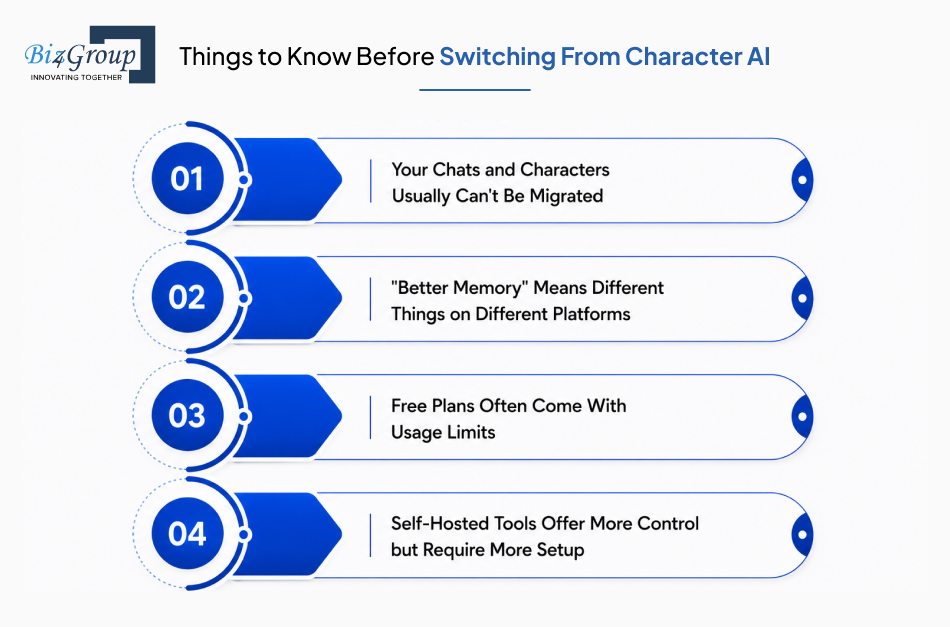
Switching to a new AI platform is usually straightforward, but there are a few things you should know before making the move. Most Character AI alternatives differ in how they handle memory, pricing, data, and setup, so understanding these differences upfront can save you time and help you choose a platform that matches your expectations.
If you're hoping to move your existing Character AI chats or custom characters to another platform, the answer is usually no. Most AI roleplay platforms use different character formats, memory systems, and conversation architectures, which means you'll likely need to recreate your characters and start new conversations. If you've invested a lot of time in building detailed personas, it's worth saving your prompts or character descriptions before switching.
Many platforms advertise better memory, but that doesn't always mean the same thing. Some remember key facts about you across multiple chats, while others simply keep track of longer conversations within a single session. If you're specifically looking for Character AI alternatives with better memory, check whether the platform supports persistent memory, profile memory, or long-context conversations instead of relying on marketing claims. This is also an important consideration in AI model development, where memory design directly affects how consistently an AI responds over time.
A free plan is a great way to test a platform, but it rarely gives you the full experience. Depending on the service, you may encounter daily message limits, slower response times, restricted access to advanced AI models, or limited memory features. If you're comparing free Character AI alternatives, take a few minutes to review what's included before assuming every free tier offers the same value.
A common question from users is:
"i have been reading about SillyTavern and local AI models as an alternative to Character AI for roleplay but i have no idea how hard it is to set up or whether my computer can run it, is it actually worth the effort compared to just using a web-based platform and what are the realistic pros and cons for someone who is not super technical but wants more control and privacy over their AI roleplay sessions"
The short answer is that self-hosting is worth considering if privacy, customization, and model choice are your top priorities. Tools like SillyTavern give you far more control than a typical AI conversation app, but they also require extra setup, compatible hardware, and a willingness to learn the basics of running AI models.
If you simply want to start chatting immediately, a cloud-based platform will usually be the easier choice. The same trade-off exists in enterprise AI solutions, where greater control often comes with greater operational responsibility.
Before switching, spend a little time understanding what each platform actually offers instead of focusing only on feature lists. A few minutes of research can save you from choosing a platform that looks impressive on paper but doesn't fit the way you want to use AI. Whether you're evaluating consumer platforms or planning to hire AI developers for a custom solution, matching the tool to the intended use case almost always leads to better results.
Whether you're building an AI companion, storytelling platform, or conversational assistant, create a solution designed around your own vision instead of copying what's already available.
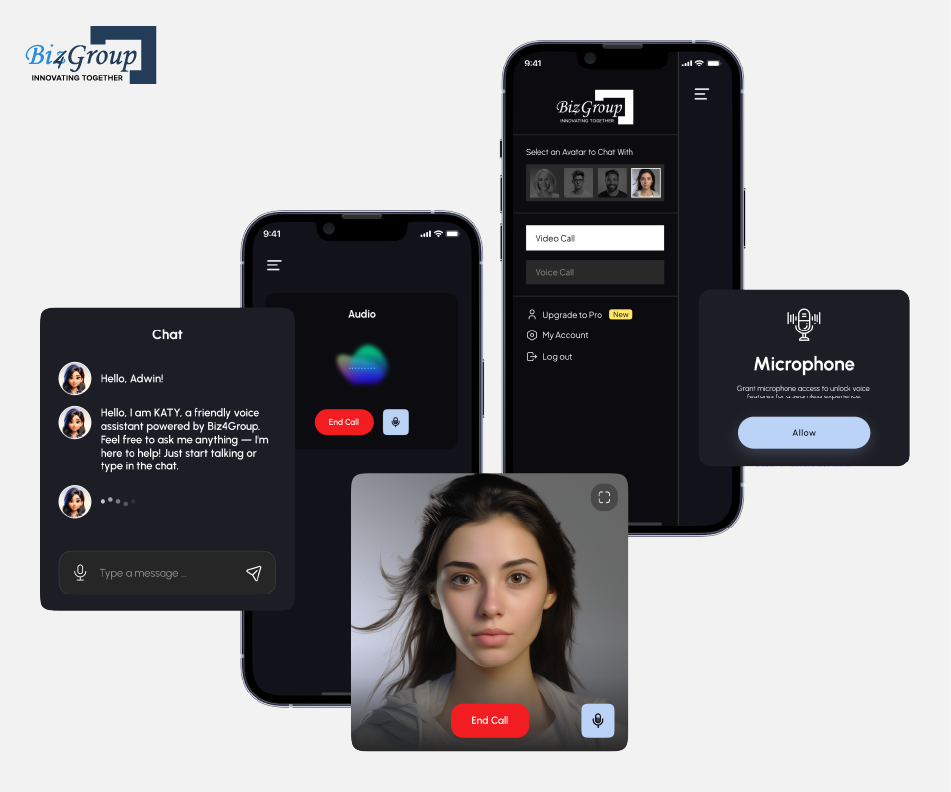
Build Your AI PlatformEvaluating AI character platforms requires understanding how conversational AI is designed, from memory management and character consistency to voice interactions and personalization. At Biz4Group LLC, we've worked on real-world conversational AI products, including AI Wizard, an avatar-based AI companion that supports voice and video conversations, avatar customization, and AI-powered interactions. That hands-on experience gives us practical insight into the technologies behind modern AI companion and roleplay platforms, allowing us to evaluate them beyond feature lists.
What if the "best" Character AI alternative isn't the one everyone recommends, but the one that fits the way you actually use AI? Before committing to a platform, ask yourself two simple questions: What do I use AI for most often? and Which feature would frustrate me the most if it didn't work well? The answers will usually narrow your options faster than any feature comparison.
The AI character space is evolving quickly, and the platforms on this list reflect how diverse AI experiences have become. Biz4Group offers a wide range of generative AI and product development services, and has seen this evolution firsthand, from conversational AI and intelligent assistants to custom roleplay and companion experiences. That practical understanding reinforces one simple takeaway: choose the platform that solves your problem, not the one with the longest feature list.
There isn't a single best option for everyone. Janitor AI is a strong choice for customizable roleplay, NovelAI stands out for creative writing, Kindroid and Replika are better suited for AI companionship, while SillyTavern is ideal for users who want a self-hosted setup with maximum control.
For long-term memory, Kindroid is one of the strongest options because it uses persistent memory and journal features to remember conversations over time. NovelAI also performs well for storytelling through its Memory and Lorebook systems, while DreamGen is designed to maintain narrative consistency across longer scenarios.
Yes. Chai and Poe offer free plans that let you explore AI conversations without an upfront subscription. Some platforms also provide free tiers with limited messages or features, making them useful for testing before deciding whether a paid plan is worthwhile.
NovelAI is the strongest option for creative writing because it's built specifically for long-form storytelling, character development, and world-building. DreamGen is another good choice if you prefer interactive stories with branching narratives and multiple characters.
If you're looking for an AI companion that remembers personal details and supports ongoing conversations, Kindroid and Replika are the leading options. Both focus on relationship continuity, with features like persistent memory and voice conversations.
Yes. SillyTavern is one of the most popular self-hosted options because it works with both local and cloud-based AI models. Backyard AI offers a simpler way to run local models, while Pygmalion AI is a good choice for users who want an open-source language model for character-based conversations.
Most major platforms, including Replika, Kindroid, Chai, Poe, Moemate, and Sakura AI, offer mobile apps or mobile-friendly web experiences. Self-hosted tools like SillyTavern are generally better suited for desktop use, although they can also be accessed from mobile devices with the right setup.
Platforms with stronger content moderation and clearly defined community guidelines, such as Replika and Poe, are generally more suitable for younger users than platforms designed for unrestricted roleplay. Parents should still review each platform's age requirements, privacy policy, and safety features before allowing younger users to create an account.

Our website require some cookies to function properly. Read our privacy policy to know more.