Location :
Orlando, FL, USA
Location :
Orlando, FL, USA +1 (407) 714-1616
 info@biz4group.com


















Imagine a digital system that doesn’t wait for instructions but instead, understands your business goals, learns from real-time feedback, and takes independent actions to get the job done.
Read More

Look around. So many companies now are racing to build smart software that feels like it can think, write, talk, and create. Business leaders are betting big on generative AI app development because this technology can transform routine work into strategic growth opportunities.
According to recent reports, 72% of organizations now use generative AI in at least one part of their business operations, and that number is growing fast as teams move from experimentation to actual workflows.
Smart companies report measurable gains in productivity and customer satisfaction with generative AI application development. In fact, companies that invest in generative AI are seeing strong returns, with every $1 spent on generative AI delivering approximately $3.7 back in value.
So, yes. The promise that you can develop generative AI application for businesses that drives revenue, delight users, and unlocks new capabilities is very real. Yet many leaders are unsure when the time is right or how to approach building and scaling these systems thoughtfully.
This guide will help break that down for you. You will learn how to build generative AI powered app that fits your strategy, your customers, and your long-term vision.
Let's begin with the basics.
Before deciding whether to invest, most leaders want clarity. What exactly are they building, and how is it different from what already exists?
Generative AI app development refers to creating software applications that can produce original outputs such as text, images, video, audio, or structured responses based on user input and context.
These applications learn patterns from large datasets and use that understanding to generate new content or actions that feel natural and relevant.
Traditional software works on predefined logic. Generative AI applications work on learned patterns. That shift changes how apps behave and how businesses use them.
Here is a generative AI apps vs traditional AI app solutions table to make that clear.
|
Aspect |
Traditional AI Apps |
Generative AI Apps |
|---|---|---|
|
Core function |
Classify or predict |
Create and generate |
|
Output |
Fixed and rule based |
Dynamic and context aware |
|
Learning approach |
Narrow datasets |
Large and diverse datasets |
|
User interaction |
Limited responses |
Conversational and adaptive |
This difference explains why generative AI in application development has unlocked use cases that were not practical before.
Even though the experience feels simple to users, several components work together behind the scenes.
When businesses develop generative AI application for businesses, the goal is to create systems that adapt, scale, and deliver measurable value.
Generative AI app development allows companies to move from static tools to adaptive systems. These apps respond to users, personalize experiences, and automate complex workflows.
Leaders often ask this question... Why now? Why build generative AI applications today? The short answer is simple. Competitive pressure. Market demand. And measurable business impact.
In many ways the technology has matured. The cost to start is lower. The potential benefit is higher.
Generative AI adoption is rising fast. According to Bloomberg, the Gen AI market will surpass $1.3 trillion globally by 2032. And 92% of Fortune 500 firms have adopted the technology, including major brands like Coca-Cola, Walmart, Apple, and Amazon.
This is not hype. It is a reflection of real business demand.
Generative AI app development can help in multiple ways. Here are the most common pain points leaders solve by investing now:
Generative AI apps bring these capabilities to life. They create content. They automate workflows. They support decision making. They surface insights from data.
Business technology adoption has shifted. In the past, companies built automation first. Today they build AI automation.
Smart automation opens new opportunities:
These are no longer optional. They shape customer expectations. They shape operational efficiency. They shape revenue outcomes.
Businesses that automate knowledge and content workflows report up to 40% faster execution cycles.
Build Smart with Biz4Group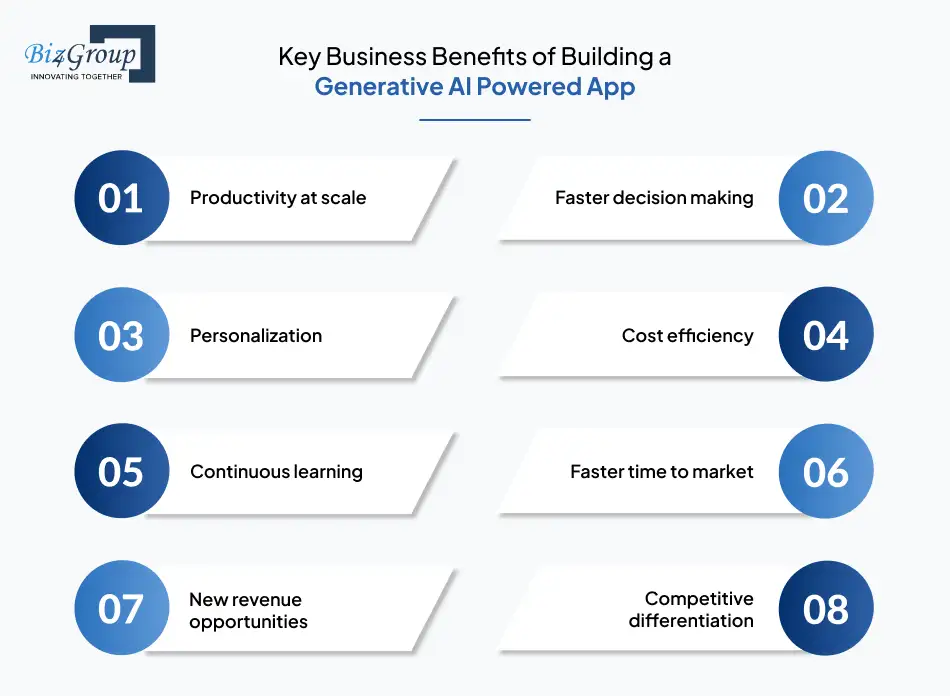
Every business investment comes down to outcomes. Leaders want to know what improves, what scales, and what drives returns. Building a generative AI powered app delivers value across operations, customer experience, and long-term growth when done with a clear strategy.
|
Business Benefit |
What It Delivers |
Why It Matters to Decision Makers |
|---|---|---|
|
Productivity at scale |
Automates content creation, research, summaries, and responses |
Teams spend less time on repetitive work and more time on high impact initiatives |
|
Faster decision making |
Converts large volumes of data into clear insights and recommendations |
Leaders gain timely information without waiting on manual analysis |
|
Personalization |
Tailors content, responses, and experiences to individual users |
Improves engagement, retention, and customer satisfaction |
|
Cost efficiency |
Reduces operational overhead through automation and smart workflows |
Lowers long term costs while supporting growth |
|
Continuous learning |
Applications improve over time through usage and feedback |
Business systems become smarter without constant reengineering |
|
Faster time to market |
Accelerates development of intelligent features and services |
Companies respond quickly to market shifts and customer needs |
|
New revenue opportunities |
Enables AI powered products, subscriptions, and premium features |
Opens additional income streams beyond core offerings |
|
Competitive differentiation |
Delivers experiences that feel intuitive and adaptive |
Helps brands stand out in crowded digital markets |
When organizations invest in generative AI app development, these benefits compound over time. Early gains often show up in productivity and efficiency. Long-term value appears through innovation, differentiation, and scalable growth.
Once leaders understand the benefits, the next question follows naturally. What can generative AI actually do inside a real business environment? The answer goes far beyond chatbots or writing tools. Modern generative AI applications handle complex tasks that once required large teams.
Generative AI can produce text, images, video, and audio based on simple prompts or structured inputs.
A well known example is ChatGPT, which companies use to draft emails, blogs, and internal documentation.
On the creative side, Midjourney helps brands produce visual concepts in minutes instead of days.
Generative AI enables applications to hold natural, contextual conversations with users.
A strong example is Duolingo Max, which uses generative AI to simulate real conversations for language learners. Many businesses also rely on conversational systems similar to a generative AI chatbot to improve customer support and engagement.
Generative AI applications can scan large volumes of documents and data to extract insights.
Notion AI is a familiar example, helping teams summarize meeting notes and project updates instantly.
Beyond single interactions, generative AI can:
Companies exploring advanced automation often deploy generative AI agents to handle multi step workflows like lead qualification or report generation.
Generative AI helps teams ideate faster by generating concepts, drafts, and alternatives.
Examples include:
Together, these capabilities show why businesses are investing in generative AI app development. The technology adapts to different roles, industries, and goals.
Teams using AI assisted workflows cut repetitive tasks by 30%-50%, freeing time for high impact work.
Book a Strategy Call Today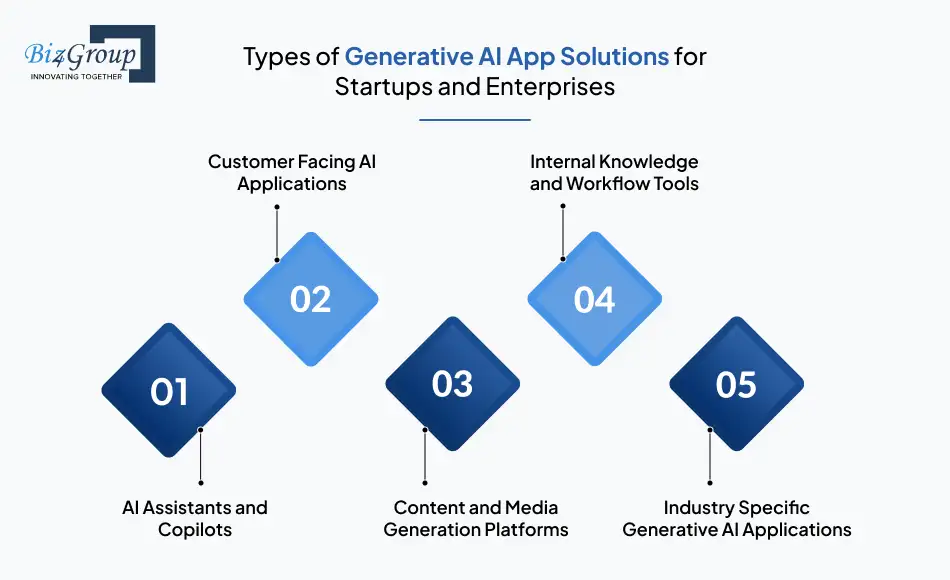
Once businesses understand what generative AI can do, the next step is choosing the right type of application. Not every company needs the same solution. The format, scope, and complexity depend on business goals, users, and scale.
Below are the most common types of generative AI app solutions businesses build today, explained in simple terms.
These applications work alongside users to improve productivity. A well-designed AI assistant can support content creation, document summarization, and knowledge retrieval, while an AI copilot helps teams with guided decision making, research, and workflow support.
These apps interact directly with customers across web, mobile, or voice platforms. They help businesses answer questions in real-time, guide users through purchases or onboarding, and offer personalized recommendations.
These platforms focus on creating and managing creative assets. Typical capabilities include text-to-image generation, text-to-video creation, and content customization and reuse.
These applications support employees behind the scenes. They are built to search internal documents and data, summarize reports and policies, and automate routine operational workflows.
Some businesses choose tailored solutions built for a specific domain. Examples include healthcare documentation tools, financial analysis assistants, and education and training platforms.
Choosing the right type of generative AI app solution sets the foundation for success. In the next section, we will explore how these applications are used across industries.
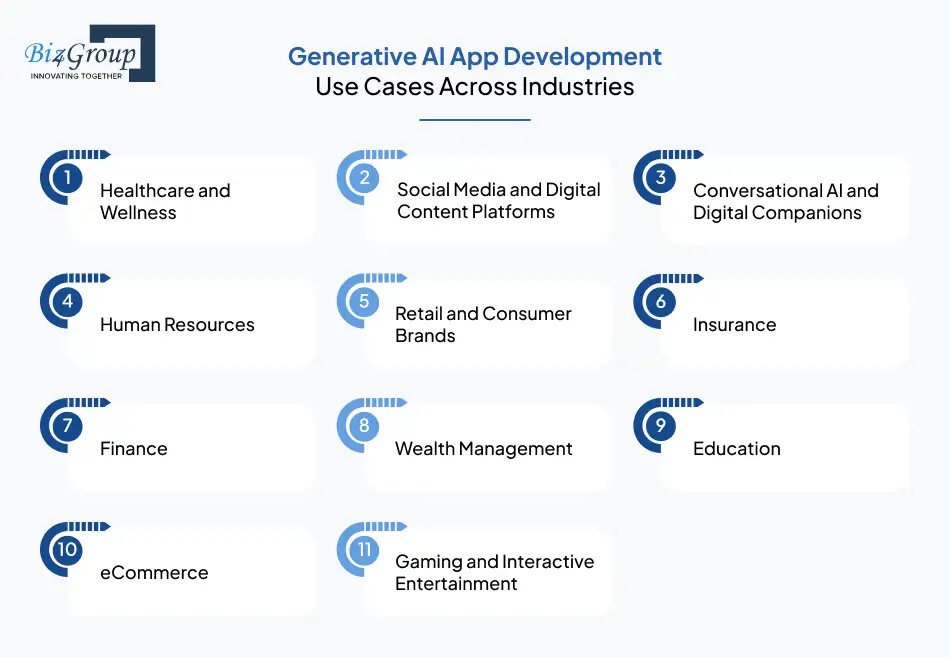
Generative AI app development is now shaping how industries operate, serve customers, and scale innovation. While the core technology remains similar, the business outcomes vary by domain.
Healthcare organizations use generative AI to improve engagement, personalize wellness journeys, and assist users with timely guidance. These applications focus on empathy, accuracy, and user trust.
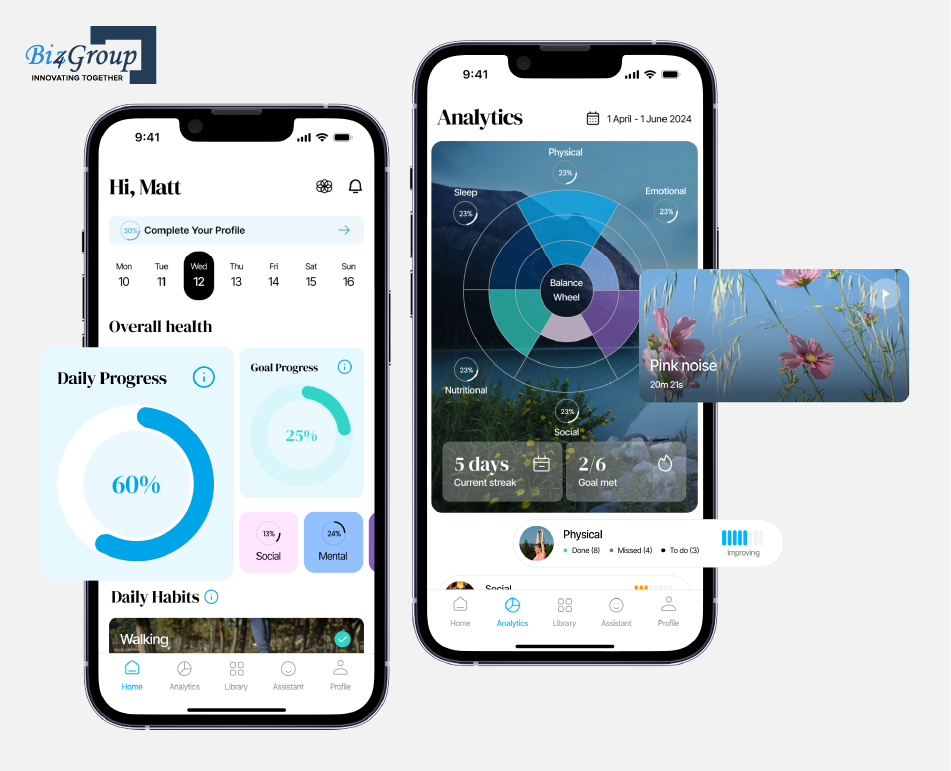
Biz4Group partnered on Quantum Fit, an AI-powered mobile app focused on holistic personal development across physical, mental, and lifestyle dimensions.
The solution demonstrates how to build AI-powered generative application experiences that adapt to individual user goals over time.
Digital platforms rely on generative AI to help users create content faster while maintaining originality. These solutions improve creator engagement and platform stickiness.
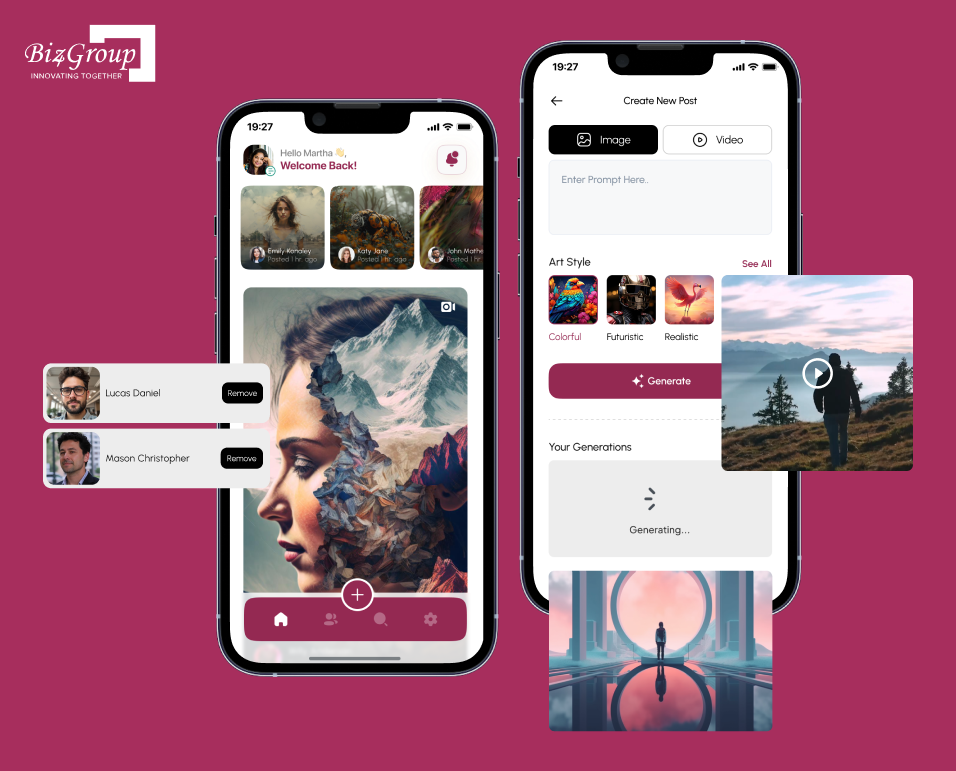
Biz4Group delivered an AI-powered social media application that enables users to generate images and videos using advanced AI models.
This platform reflects real world expertise in generative AI in application development for creative ecosystems.
Conversational AI apps focus on human-like interaction through voice, video, and chat. These experiences are designed to feel responsive, contextual, and emotionally aware.
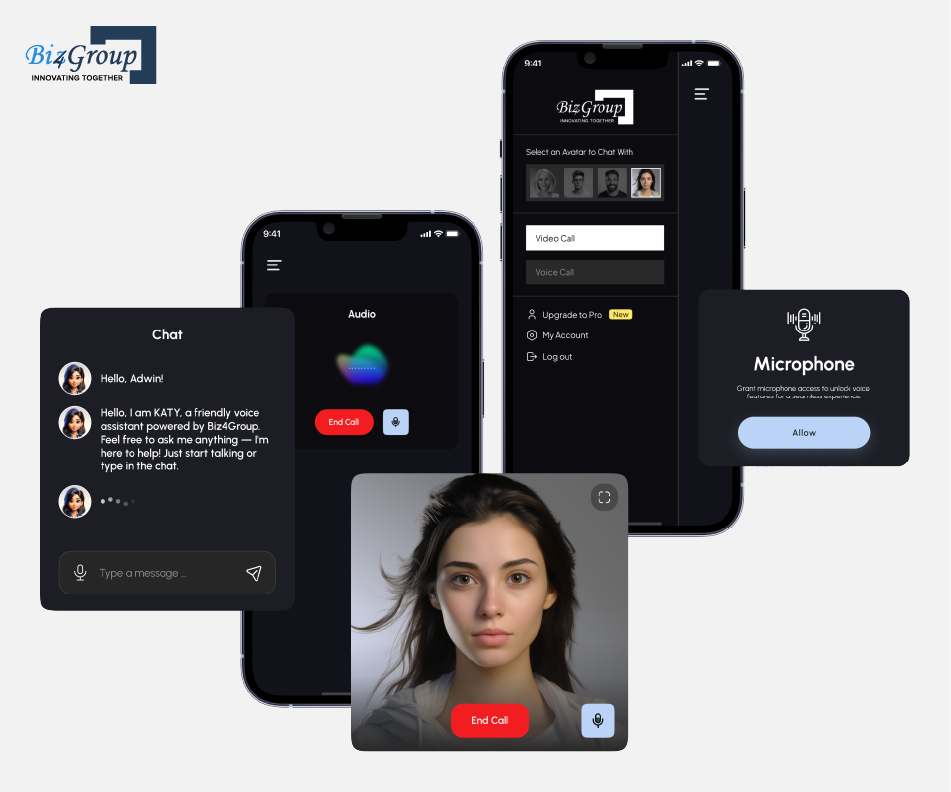
With expertise in AI avatar development solutions, Biz4Group built an avatar-based AI companion that communicates through voice and video in real time.
This project demonstrates enterprise generative AI app development with a strong focus on user experience and cost efficiency.
Organizations are increasingly building generative AI apps to modernize hiring, onboarding, and internal communication. Through generative AI in HR, businesses deploy intelligent applications that screen candidates, personalize onboarding journeys, and support employees with real-time guidance. These generative AI app solutions reduce manual workload while improving consistency and engagement across the employee lifecycle.
Retailers rely on generative AI app development to create personalized shopping experiences across digital touchpoints. By applying generative AI in retail, brands build applications that generate product content, tailor recommendations, and support customer interactions at scale. These apps help maintain brand consistency while responding dynamically to consumer behavior.
Insurance providers use generative AI app development to simplify complex workflows and improve communication. Through generative AI in insurance, businesses build applications that summarize claims, explain policy details, and assist customers with timely responses. These generative AI apps reduce processing time while supporting compliance-driven environments.
Financial institutions invest in generative AI app development to enhance reporting, analysis, and customer interactions. With generative AI in finance, firms create applications that generate insights from large datasets, assist internal teams, and respond to client queries efficiently. Accuracy, transparency, and control remain central to these AI-driven financial applications.
Wealth management firms adopt generative AI app development to deliver personalized insights and client communication tools. By using generative AI in wealth management, businesses build applications that generate portfolio summaries, performance explanations, and advisory content. These apps help advisors scale services without losing personalization.
Educational institutions use generative AI app development to support adaptive learning and content creation. Through generative AI in education, organizations create applications that personalize lessons, provide tutoring support, and generate assessments. These tools enhance learner engagement while supporting educators with intelligent assistance.
eCommerce companies leverage generative AI app development to improve product discovery and customer experience. With generative AI in eCommerce, businesses build applications that generate product descriptions, automate support responses, and deliver personalized recommendations. These apps directly impact conversion rates and customer satisfaction.
Studios explore generative AI app development to push creative boundaries in interactive experiences. By applying generative AI in gaming, developers build applications that create dynamic characters, adaptive narratives, and evolving game worlds. These generative AI apps make gameplay more immersive and responsive to player actions.
These industry examples show how generative AI app development adapts to different business needs while following the same strategic principles.
Clear use cases. Scalable design. Controlled costs.
Also read: Top 12 generative AI use cases
From wellness to content platforms, businesses are turning use cases into products. The next success story could be yours.
Get in Touch with Biz4GroupA generative AI application can look impressive on the surface and still fail in real business environments. The difference lies in the features built beneath the interface. The right features ensure the application performs reliably, scales smoothly, and earns user trust over time.
The table below highlights the essential features businesses should prioritize during custom generative AI app development.
|
Feature |
What It Is |
What It Does |
|---|---|---|
|
Context awareness |
Ability to understand user intent and history |
Delivers relevant and consistent responses across interactions |
|
Personalization engine |
AI driven user preference modeling |
Tailors content, recommendations, and workflows for each user |
|
Token and cost management |
Controls how and when AI models are invoked |
Prevents unnecessary usage and reduces operational costs |
|
Data security controls |
Encryption and access management layers |
Protects sensitive business and user data |
|
Feedback and learning loop |
Mechanism to capture user feedback |
Improves accuracy and relevance over time |
|
Scalable architecture |
Modular backend and cloud infrastructure |
Supports growth without performance degradation |
|
Human oversight |
Review and moderation capabilities |
Reduces errors and maintains output quality |
|
Integration readiness |
APIs and connectors to existing systems |
Enables seamless workflow automation |
|
Compliance readiness |
Support for regulatory requirements |
Helps meet industry and regional standards |
|
Performance monitoring |
Usage and response tracking |
Identifies issues and optimization opportunities |
These features form the foundation of generative AI app solutions for startups and enterprises alike. They help businesses move from experimentation to dependable production systems.
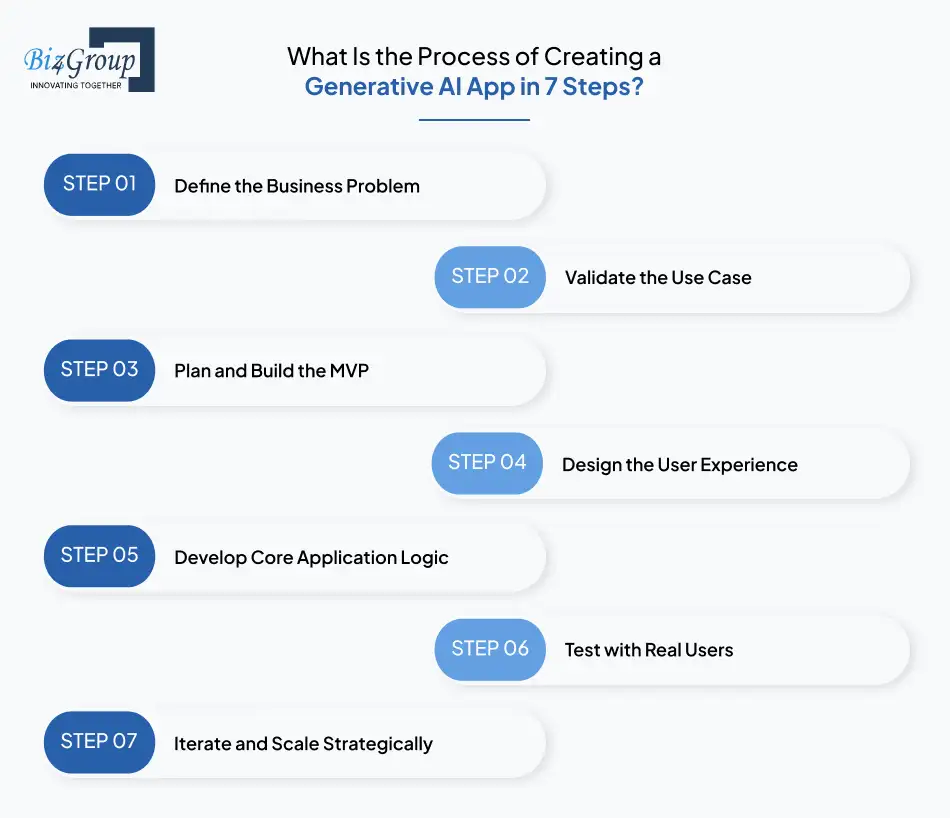
Building a successful generative AI application requires more than a good idea. It demands clarity, planning, and disciplined execution. Below is a practical seven step process businesses follow to move from concept to production.
Every successful generative AI app begins with a clear problem statement.
This step focuses on:
A well-defined problem prevents wasted investment later.
Not every problem benefits from generative AI. During validation, teams:
This step protects against building technology without purpose.
The MVP proves value before full-scale investment. Key goals of developing an MVP include:
Also read: Top 12+ MVP development companies in USA
A bespoke UI/UX design company helps in shaping how users interact with generative AI.
This stage involves:
Also read: Top 15 UI/UX design companies in USA
Once all that is clear, teams move into development.
This phase focuses on:
The emphasis remains on reliability and relevance.
Testing goes beyond functionality. It helps teams:
Feedback from this step informs meaningful improvements.
After validation, the application evolves. Teams:
This step ensures long-term value and scalability.
This process shows how businesses can develop generative AI app for businesses in a structured and outcome focused way.
Next, we will explore the tech stack for building an app integrating generative AI, and how strategic technology choices support performance and growth.
Projects with a defined MVP roadmap reduce rework by up to 35% compared to unplanned builds.
Get Your Functional MVP in 3 WeeksTechnology decisions shape the success or failure of generative AI app development. The right tech stack supports scalability, performance, and long-term flexibility, while poor choices lead to cost overruns and technical debt.
Below is a high-level view of the core components businesses rely on when building an app integrating generative AI. The focus stays on strategy, not tools.
|
Layer |
Purpose |
Tools and Frameworks |
|---|---|---|
|
Frontend |
User interaction and experience |
React, Ionic, Angular, React Native |
|
Backend |
Business logic and orchestration |
Node.js, Python, FastAPI |
|
AI Models |
Content and response generation |
OpenAI GPT models, Google Vertex AI, Anthropic Claude |
|
Data Layer |
Storage and retrieval |
PostgreSQL, MongoDB, Redis |
|
Cloud Infrastructure |
Scalability and reliability |
AWS, Google Cloud, Azure |
|
APIs and Integrations |
Workflow connectivity |
REST APIs, GraphQL, third party services |
|
Monitoring and Analytics |
Performance and usage tracking |
Cloud monitoring tools, custom dashboards |
This structure supports both generative AI app solutions for startups and enterprises, allowing teams to start small and scale responsibly.
When businesses develop generative AI app with security and compliance considerations, governance becomes as important as functionality. These safeguards protect users, data, and brand reputation.
Key areas leaders should prioritize include:
These practices help businesses build secure and compliant generative AI app solutions that earn trust from users and regulators alike.
With the right technology foundation in place, the next step is understanding cost. Up next, we will break down the generative AI app development cost estimate from MVP to full scale deployment, including hidden factors leaders often overlook.
Cost is one of the first questions business leaders ask when planning generative AI app development. On average, a generative AI application can cost anywhere between $20,000-$250,000+, depending on scope, complexity, scale, and long-term requirements.
Some teams start lean with a focused MVP. Others invest in advanced or enterprise AI solutions from the beginning. Understanding how costs evolve across stages helps businesses plan realistically and avoid surprises.
Below is how investment typically grows as applications mature.
|
Stage |
Scope Overview |
Typical Investment Range |
|---|---|---|
|
MVP |
Core use case, limited features, early validation |
$20,000-$50,000 |
|
Advanced Level |
Multiple use cases, AI integration services, optimization |
$60,000-$150,000 |
|
Enterprise Level |
Large scale deployment, governance, performance |
$180,000-$250,000+ |
These ranges apply across generative AI app solutions for startups and enterprises, with variation based on business goals.
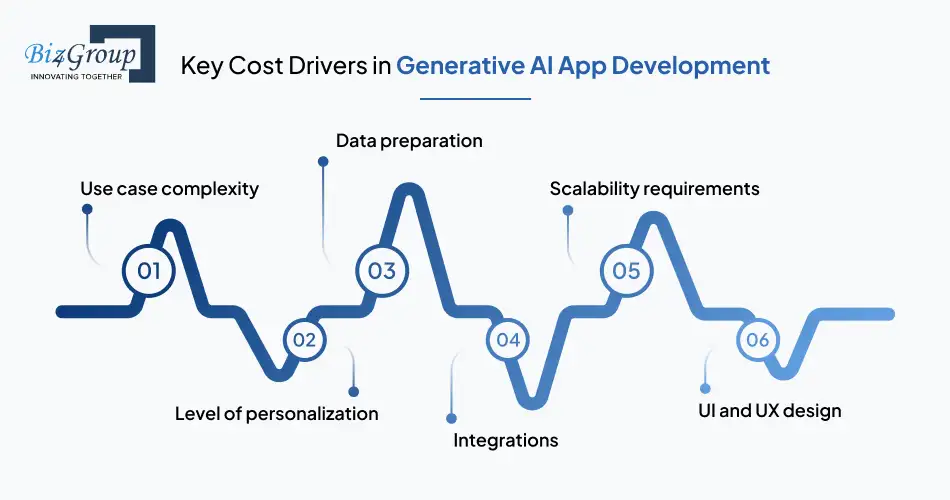
Every generative AI app development cost estimate depends on a few core drivers. Understanding these early helps leaders make informed tradeoffs.
|
Cost Driver |
What Influences It |
Estimated Cost Impact |
|---|---|---|
|
Use case complexity |
Single task vs multi workflow automation |
$5,000-$40,000 |
|
Level of personalization |
Generic responses vs user specific context |
$8,000-$30,000 |
|
Data preparation |
Cleaning, structuring, and enrichment |
$4,000-$25,000 |
|
Integrations |
CRM, ERP, internal systems |
$6,000-$35,000 |
|
Scalability requirements |
User volume and performance needs |
$10,000-$50,000 |
|
UI and UX design |
Simple interface vs polished experience |
$5,000-$20,000 |
These drivers shape both initial and lasting costs in custom generative AI app development.
Even well-planned projects can face unexpected expenses. These costs often appear after launch and affect ROI if not anticipated.
Accounting for these early leads to more accurate generative AI app development cost estimates.
Cost control does not mean sacrificing quality. Smart planning helps businesses build AI-powered generative application solutions efficiently.
These approaches help organizations develop scalable generative AI app platforms without runaway expenses.
Generative AI app development costs vary widely, but clarity brings control. Businesses that plan for scope and scale avoid unpleasant surprises and protect ROI from day one. A realistic budget sets the foundation, but the next decision often matters even more.
Should you build a custom solution, buy an existing one, or combine both?
Unplanned AI usage can increase monthly spend by 25%-60% without usage controls in place.
Get a Custom Cost EstimateOnce the budget is clear, leaders face a strategic crossroads. Build a custom solution from the ground up or buy an off-the-shelf product. Each path has advantages, tradeoffs, and lasting implications for generative AI app development.
|
Decision Area |
Build |
Buy |
|---|---|---|
|
Customization |
Full control over features, workflows, and logic |
Limited to vendor defined capabilities |
|
Time to market |
Longer initial timeline due to development |
Faster deployment with ready-made tools |
|
Cost structure |
Higher upfront cost, lower dependency |
Lower upfront cost, ongoing licensing fees |
|
Scalability |
Designed specifically for business growth |
Restricted by vendor architecture |
|
Data ownership |
Full ownership and control of data |
Data stored or processed by third parties |
|
Integration |
Seamless fit with internal systems and workflows |
Often limited or costly integrations |
|
Competitive advantage |
Unique product differentiation |
Similar experience as competitors |
|
Compliance control |
Easier to align with internal policies |
Dependent on vendor compliance standards |
Build when your product or workflow is core to your business and needs flexibility, deep integration, and control.
Buy when speed matters more than customization and the use case is well served by existing platforms.
Go hybrid when you want to validate quickly using tools, then evolve into custom solutions.
Up next, we will explore the challenges, risks, common mistakes, and best practices businesses face during generative AI app development, and how to avoid costly missteps.
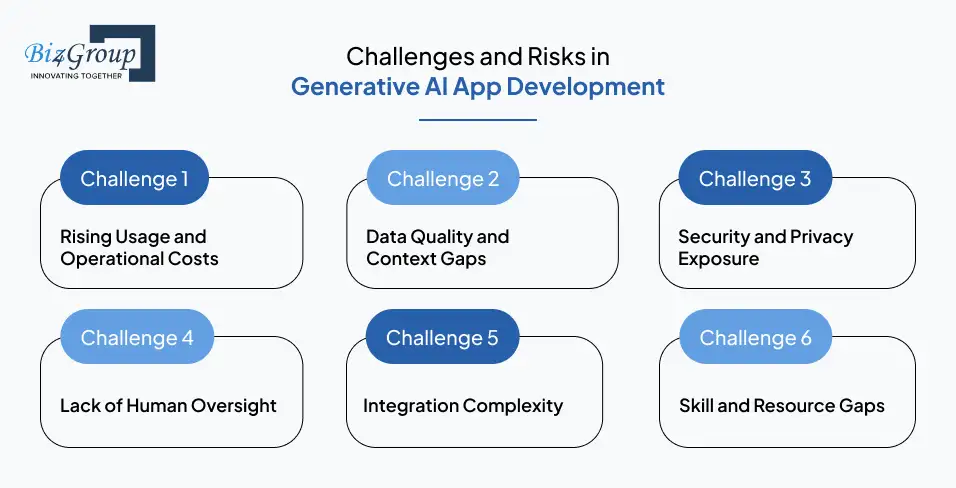
Generative AI app development offers powerful opportunities, but it also introduces new challenges that many businesses underestimate. Understanding these risks early helps teams avoid costly missteps and build reliable applications that deliver real value.
Below are the most common challenges, paired with practical solutions businesses can apply.
Uncontrolled model usage can inflate costs as adoption grows.
Solutions
Generative AI outputs depend heavily on the quality of input data.
Solutions
Handling sensitive information introduces compliance and trust risks.
Solutions
Fully automated systems can produce inaccurate or misleading outputs.
Solutions
Generative AI apps often need to work with existing systems.
Solutions
Many organizations lack in-house expertise to execute effectively.
Solutions
By addressing these challenges head on, businesses can build AI powered generative application solutions that are reliable, secure, and adaptable.
But who can help you build such solutions?
Clear governance and oversight can reduce AI related errors by over 45% in production systems.
Talk to Biz4Group's ExpertsBiz4Group LLC is a USA-based software development company known for building intelligent, scalable, and business focused digital solutions. Over the years, we have helped organizations across industries design and deliver high impact applications by combining strategic thinking with deep execution expertise.
What sets Biz4Group apart is our ability to connect business strategy with advanced AI capabilities. As a seasoned AI development company, we do not approach projects as isolated builds. We design intelligent systems that fit seamlessly into existing workflows while supporting future expansion.
We bring hands-on experience with generative AI development across conversational platforms, personalization engines, content automation tools, and AI driven applications. Our work reflects a clear understanding of how to deploy generative AI responsibly while meeting performance, privacy, and usability expectations.
Businesses choose Biz4Group because we listen first. We invest time in understanding goals, constraints, and success metrics before recommending solutions. This approach helps avoid wasted effort and leads to products that perform in real conditions.
So, if you’re ready to build a powerful generative AI application, we are ready to help you build a reliable one.
Generative AI app development has become a practical path for businesses looking to improve efficiency, enhance user experiences, and unlock new digital capabilities. What started as experimental technology is now powering real products across industries, from content platforms and wellness apps to enterprise tools and customer facing solutions.
Businesses that approach generative AI with a clear strategy see stronger results. They focus on solving real problems, validate ideas early, and evolve their applications based on usage and feedback. When planned well, generative AI applications support smarter workflows, faster execution, and more engaging digital experiences without unnecessary complexity.
This is where the right development partner makes a difference. Biz4Group LLC helps businesses across the USA design and deliver generative AI solutions that align with real business goals. Our experience across AI powered products, enterprise platforms, and custom software development allows us to guide organizations from concept to execution with confidence.
Have an idea worth building?
Let’s turn it into a generative AI application that delivers value from day one. Connect with Biz4Group and start building smarter, faster, and with purpose.
A focused MVP can take 6-10 weeks, depending on scope. However, Biz4Group can deliver a functional MVP in 2-3 weeks by using reusable components that reduce development time and cost.
Yes. Generative AI apps are commonly designed to integrate with CRMs, ERPs, content systems, and internal tools. Proper integration planning ensures AI outputs fit naturally into existing workflows.
Control is maintained through prompt design, response filtering, human review processes, and usage boundaries. These measures help ensure outputs align with business standards and expectations.
Updates depend on usage patterns, business needs, and performance goals. Some applications require regular tuning, while others function effectively with periodic adjustments.
Many generative AI models support multilingual capabilities. With proper configuration, businesses can deliver consistent experiences across regions and markets.
Businesses should assess experience, delivery approach, communication style, and understanding of business goals. A strong partner helps shape strategy, not just write code.

with Biz4Group today!
Our website require some cookies to function properly. Read our privacy policy to know more.