Location :
Orlando, FL, USA
 +1 (407) 714-1616
 info@biz4group.com


 AI Summary Powered by Biz4AI
- Most claim denials in medical billing start before billing, with missing documentation, coding errors, eligibility gaps, and authorization problems, and a denial differs from a rejection because the payer reviewed the claim and refused to pay all or part of it.
- The main types of denials in medical billing are soft denials fixed with a corrected claim, hard denials that need a formal appeal, and final denials where deadlines have passed, and each belongs to a front-end, mid-cycle, or back-end owner.
- A short list of codes, including CARC 16, 18, 4, 11, 22, 27, 29, 50, 97, and 197, shows up most often in medical billing denials, so read the group code, CARC, and RARC together before you correct, appeal, or write off.
- AI reduces denials in medical billing by scoring claims for risk before submission, drafting first-pass codes, rechecking eligibility, and drafting appeals for a person to approve, while payer-side AI denials in medical billing now face 2026 state laws that mostly govern insurers, not providers.
- For claim denial prevention with AI, fix messy data and broken processes first, sign a BAA before sharing PHI, keep a named person approving every consequential step, and pilot one payer and one denial category for 90 days, which is how Biz4Group built Bill Matters.
Picture a claim that went out three weeks ago.
Today, the remittance lands in your queue with a CO-27 on it. The patient’s coverage ended before the date of service.
Does that sound familiar?
A 30-second eligibility check at check-in would have caught it. Instead, someone on your team is now hunting for active coverage, calling the patient, and watching the filing deadline.
That is what denials in medical billing look like on an ordinary week. Nothing dramatic happens. The work is repetitive, it runs against a clock, and most of it feels like it should never have happened.
So, what are denials in medical billing, exactly?
A denial happens when a payer processes your claim and refuses to pay all or part of it, and the reason comes back as a code on the remittance. A rejection never gets that far. If you have ever wondered what is the difference between a claim denial and a rejection, the next section answers it side by side.
Is it getting better? For most teams, no.
Experian Health surveyed 210 revenue cycle leaders in January and February 2026. Only 32% said their denial rates were falling. Another 42% saw little change, and 25% saw their rates keep rising.
That leaves about two in three teams where medical billing denials held flat or climbed. Most of those leaders still rated their own prevention work as effective.
Why are claim denials increasing in 2026, even for teams doing the basics right?
Part of the answer sits on the payer side. Three-quarters of physicians say denials have climbed over the past five years, and six in 10 told the AMA’s 2026 prior authorization survey they worry AI is driving the increase.
That is why AI denials in medical billing now means two things. Payers use automated review to approve, downcode, or deny claims and prior authorizations. Providers use AI to prevent, prioritize, and appeal those denials.
We cover both in this guide, including the common AI denials in medical billing you are most likely to see: automated medical necessity denials, downcoding, and prior authorization denials. Payers now review and deny claims faster than most practices can appeal them by hand.
We see this problem from both sides.
When we launched Bill Matters, our CEO, Sanjeev Verma, explained what pushed us to build it. Billing teams know a denied claim is often worth fighting, but “nobody has the hours to fight all of them.” So, they pick a few and let the rest go.
Bill Matters reads the denial, the claim, and the supporting documents, finds the evidence that is missing, and drafts the appeal. A person reviews and signs off on every appeal before it reaches a payer.
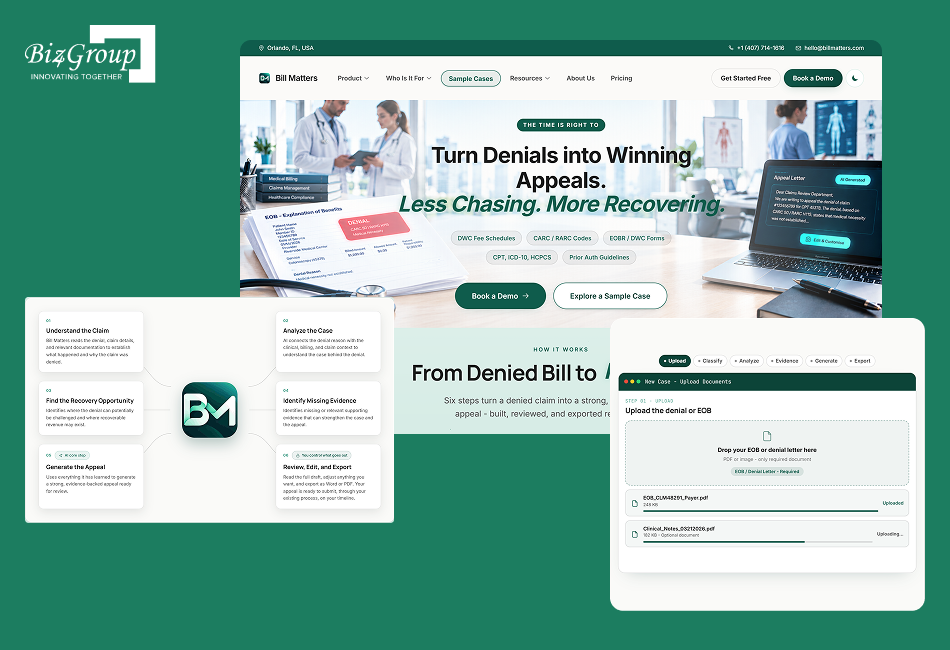
We hear how it feels when the queue grows faster than your team can clear it, and we know it does not have to stay that way. Here is what we will break down, step by step:
- A clear definition of a denial, plus the causes behind most of them.
- The types of denials in medical billing and the codes you will see most often.
- How to reduce claim denials in medical billing with claim denial prevention steps that start before a claim leaves your system.
- How does AI reduce claim denials, where it falls short, and how to answer payer AI.
- What to ask before you buy an AI denial management tool, and what slows adoption down.
This guide is written for RCM directors, billing managers, and practice administrators in the United States. Each section ends with something you can act on this week.
First, a quick check on terms. Mixing up a denial and a rejection sends the fix to the wrong team.
What Are Denials in Medical Billing, and What Causes Most Claim Denials?
If you work in a denial queue, you probably guess the cause before you finish reading the code. Most of the time, you are right.
This section gives you the vocabulary to confirm that guess quickly. It also gives you a cause map to stop the same denials in medical billing from coming back next month.
What is a Denial in Medical Billing?
A denial is a payer’s decision, made after it processes your claim, to refuse payment for all or part of the services billed. The reason comes back on the remittance advice or EOB as standard codes. Some denials can be corrected and resubmitted. Others need formal appeal.
That is the short answer to what is a denial in medical billing. The longer answer has a twist: a denial can hit a single service line while the rest of the claim pays. A claim can look paid and still carry a denial inside it.
That is one reason medical billing denials slip past teams that only watch claim-level status.
What is the Difference Between a Claim Denial and a Rejection?
A rejection stops a claim before the payer adjudicates it. A denial comes after adjudication. Here is how they compare in daily work:
|
Aspects |
Rejection |
Denial |
|---|---|---|
|
When it happens |
Before the payer adjudicates the claim |
After the payer adjudicates the claim |
|
Who flags it |
Clearinghouse or payer front-end edit |
Payer adjudication system or reviewer |
|
What it means |
The claim never entered review |
The payer reviewed it and declined payment |
|
Where you see it |
Clearinghouse or payer front-end report, such as a 277CA |
835 remittance or EOB with CARC and RARC codes |
|
Usual fix |
Correct the error and resubmit |
Correct and resubmit, appeal, or write off |
Why does this matter beyond vocabulary? Because a rejection can quietly use up your filing window.
Under Medicare rules, a claim returned or rejected as unprocessable is not considered filed. It has to be corrected and resubmitted, and the 12-month limit from the date of service keeps running. Commercial payers set their own limits in your contract, and many are shorter, so check each one.
Our advice is to track rejections and denials on separate reports. A rising rejection count points to data entry or your scrubber. A rising denial count points to payer rules, authorization, coding, or documentation.
How Do You Read a Denial on a Remittance Advice?
Every adjustment on a remittance can carry three codes, and you need all three to read it correctly. For any claim-level or line-level adjustment, Medicare’s electronic remittance advice can report a group code, a claim adjustment reason code (CARC), and a remittance advice remark code (RARC).
- Group code: says who carries the financial responsibility for the unpaid amount.
- CARC: gives the overall reason for the adjustment.
- RARC: adds more specific detail, such as which document is missing.
Two group codes decide most of your money outcomes.
- What does CO mean in medical billing? It stands for contractual obligation, and it assigns the unpaid amount to you, the provider.
- What does PR mean on an EOB? It stands for patient responsibility, and it assigns the amount to the patient. For Medicare, a beneficiary can be billed only when the group code is PR. The other two group codes on X12’s list are OA (other adjustment) and PI (payer-initiated reduction).
Mix up CO and PR and you either bill a patient for something you agreed to write off, or you write off money the patient owes. Read the group code before you decide whether to correct, appeal, or bill the patient.
The codes themselves live in X12’s official CARC list, which you can search by number. The lists change during the year, so check the current version instead of an old printed cheat sheet.
One more thing the codes will not tell you is whether a person or an automated system made the decision. A CARC describes the reason, not the reviewer. That matters more every year as AI denials in medical billing grow, and we cover how to spot and answer them in the AI section.
Bill Matters starts the same way you do. It reads the EOB and the denial code to find the real reason, then names the exact document still missing, such as an operative note, an itemized statement, or a signed authorization.
What Causes Most Claim Denials in Medical Billing?
Most AI medical billing denials were set in motion days or weeks before the claim went out.
In Experian Health’s January and February 2026 survey, revenue cycle leaders named missing or incomplete documentation (53%), coding errors (45%), and duplicate claims (39%) as the most preventable causes of claim denials in medical billing. Eligibility and coverage errors, non-covered services, missing or expired authorizations, and untimely filing each landed between 30% and 35%. Half of the leaders also put front-end accuracy among their top three ways to cut denials.
Notice how few of those causes start in the billing office. Here is who usually owns each one:
|
Cause |
Who usually owns it |
Where it starts |
First fix |
|---|---|---|---|
|
Missing or incomplete documentation |
Providers, CDI, coding |
The note does not show why the service was needed |
Documentation prompts at the point of care, plus a pre-bill check for required documents |
|
Coding errors |
Coding team |
A missing modifier, or a diagnosis that does not support the procedure |
Payer-specific edits and coder review of exceptions |
|
Duplicate claims |
Billing team |
A resubmission sent while the first claim is still pending |
Check claim status before any resubmission |
|
Eligibility and coverage errors |
Front desk, patient access |
Coverage changed after scheduling |
Recheck at scheduling and again on the day of service |
|
Non-covered services |
Front desk, billing |
The plan excludes the service |
Benefit check and patient notice before the visit |
|
Authorization problems |
Scheduling, authorization team |
A missing, expired, or mismatched authorization number |
Look up payer rules before the visit and tie the number to the claim line |
|
Untimely filing |
Billing manager |
A claim sat in a rejection queue |
Filing deadline alerts by payer |
A single denial often has more than one cause. Take a CO-50 medical necessity denial. The diagnosis was vague at scheduling, the order was missing, and the note never says why the test was needed. Three teams touched that claim before billing did.
The most useful first cut of your denial data is by owner, not by code. It tells you which team to call. Claim denial prevention starts when every denial has a named owner.
What Can You Do This Week to Start Claim Denial Prevention?
You do not need new software to begin. You need your last 90 days of remittances and an hour.
- Pull 90 days of 835 remittances: Include every line-level denial, not only claim-level ones.
- Sort by group code, CARC, and RARC together: A CARC alone can hide whether the money is yours or the patients.
- Assign each top code to the team that could have prevented it: Use the table above as your starting map.
- Split rejections and denials into two reports: Set a filing deadline alert for any claim sitting in a rejection queue.
Then bring the owner report to your next team meeting. Showing the front desk its own top denial code does more than any memo.
Once you can read a denial and trace it to its owner, the next question is which type you are looking at. That decides whether you correct, appeal, or write off.
What Are the Types of Denials in Medical Billing?
The main types of denials in medical billing are soft denials, which you fix with a correction, hard denials, which need formal appeal, and final denials, where no path to payment is left. By root cause, they fall into front-end, mid-cycle, and back-end denials.
Ask five billers for the types of denials and you will get five different lists. Some sort by code. Some sort by department. Some sort by whether the claim can still be saved.
All of them are right, and none is complete alone. We use three lenses in this section: whether you can recover the claim, who owns the cause, and who or what made the decision. Start with recoverability, because it decides what you do next.
1. Which Denials Can You Recover: Soft, Hard, or Final?
Some denials need a quick correction. Others need a written argument. A few are over before you open the remittance.
1.1 What Is a Soft Denial in Medical Billing?
It is a temporary denial you can fix without a formal appeal. The payer wants a correction or a missing piece of information, then it reprocesses the claim.
Typical examples are a missing modifier, a subscriber ID that does not match, or a records request.
Send a replacement claim (frequency code 7), not a new original claim. A second original claim can trigger a duplicate denial (CO-18) and put you back where you started.
1.2 What Is a Hard Denial in Medical Billing?
It is a payer determination that stands unless you challenge it, usually through a formal appeal with documentation. Medical necessity (CO-50), a bundling dispute (CO-97), and a missing authorization the payer will not grant retroactively are common examples.
Some guides tell you to write off every hard denial. We disagree. What is the difference between a hard denial and a soft denial comes down to effort, not to whether the money is gone.
The same code can be soft or hard. A CO-197 for a missing authorization is soft if the payer accepts a retroactive authorization and hard if it does not. Read the remark code and the payer’s policy before you label it.
1.3 What Is a Final Denial?
A final denial is one where the path to payment has closed. The filing limit passed with no proof of timely submission. The appeal deadline passed. Or you have used every appeal level.
Write these off and record the root cause. The write-off is a loss. The root cause is what keeps the next one from happening.
Many final denials are hard denials that aged out. That is why heading 4.1 below starts with deadlines.
2. Which Denial Types Does Each Team Own?
Recoverability tells you what to do. Root cause tells you who should have prevented it. Group denials by where in the revenue cycle they begin.
2.1 Front-End Denials: Registration, Eligibility, and Authorization
These start at scheduling and check-in, before any code is chosen.
- Typical codes: CO-27 (coverage ended before the service), CO-22 (another payer may be responsible), CO-197 (authorization absent).
- Usual owner: front desk, patient access, scheduling.
- Best prevention: recheck eligibility at scheduling and again on the day of service and look up payer authorization rules before the visit.
2.2 Mid-Cycle Denials: Coding, Documentation, and Medical Necessity
These start when the visit is documented and coded.
- Typical codes: CO-4 (modifier problem), CO-11 (diagnosis does not fit the procedure), CO-97 (service bundled into another), CO-50 (medical necessity).
- Usual owner: coding team, providers, clinical documentation staff.
- Best prevention: payer-specific coding edits, coder review of exceptions, and documentation prompts at the point of care.
2.3 Back-End Denials: Claim Data, Duplicates, and Timely Filing
These start after the claim is built.
- Typical codes: CO-16 (claim lacks information), CO-18 (duplicate), CO-29 (filing limit expired).
- Usual owner: billing team and billing manager.
- Best prevention: scrubber edits, a claim status check before every resubmission, and filing deadline alerts by payer.
You will also see denials labeled clinical, technical, and administrative. Those labels overlap loosely with ours. Clinical denials mostly sit in the mid-cycle group, because they turn on documentation and medical necessity. Technical denials map to claim data and coding edits. Administrative denials cover eligibility, authorization, and filing deadlines.
Pick one labeling system and keep it. Mixed labels make trends impossible to read.
3. Who Made the Decision: A Person or an Algorithm?
The third lens is newer. Payers use automated review in claim edits, prior authorization, and utilization review, so some denials come from a person and some from software.
The remittance will not say which. You can ask two questions of any denial letter. Does it name a reviewer? Does it cite the chart, or only the codes?
We cover common AI denials in medical billing, and what 2026 state laws now require of insurers, in the AI section. For now, add a “reviewer named” column to your denial log so you have a baseline when you need it.
4. How Do You Decide Whether to Correct, Appeal, or Write Off a Denial?
You decide by checking three things in order: the deadline, the denial type, and the cost of the fight.
4.1 Check the Deadline First
Appeal windows close faster than most teams expect. In Original Medicare, you have 120 days from receipt of the initial determination to request the first-level appeal, called a redetermination. You then have 180 days after that decision to request the next level, a reconsideration.
Commercial plans set their own windows. Put the date on your calendar the day the denial lands.
4.2 Match the Denial to an Action
Here is how to tell a hard denial from a soft denial, and what to do next:
|
What you see |
Likely type |
Action |
|---|---|---|
|
Missing field, modifier, or ID (CO-16, CO-4) |
Soft |
Send a replacement claim |
|
Payer asks for records |
Soft |
Send the documents before the stated deadline |
|
Medical necessity (CO-50) with chart support |
Hard |
Appeal with notes and the payer policy |
|
Authorization absent (CO-197) |
Soft or hard |
Request retroactive authorization if allowed, otherwise appeal |
|
Duplicate (CO-18) with no earlier payment |
Soft |
Check claim status, then send a replacement claim |
|
Filing limit (CO-29) with proof of on-time submission |
Hard |
Appeal with clearinghouse acceptance proof |
|
Filing and appeal deadlines both missed |
Final |
Write off and log the root cause |
4.3 Weigh the Cost of the Fight
Not every denial is worth a full appeal. In a survey, denied claims went through an average of three rounds of review, and each round took 45 to 60 days.
So, rank by dollars and odds of success, not by age alone. A high-value denial with clear chart support goes first. A low-value denial with weak support may cost more to fight than it returns.
5. What Can You Do This Week to Sort Your Denials?
You can finish this in an afternoon.
- Label every open denial soft, hard, or final, using the table in heading 4.2.
- Calendar the appeal deadline for each hard denial.
- Tag each denial front-end, mid-cycle, or back-end.
- Pull your ten highest-dollar hard denials and check whether the chart supports an appeal.
That triage is what we built Bill Matters to do. It reads the denial, checks whether the claim is worth pursuing, flags the evidence that is missing, and drafts the appeal for your team to review and approve.
With your denials sorted by type, the next step is knowing the codes behind the most common ones. That is where we go next.
What Are the Most Common Denials in Medical Billing, and What Do Their Codes Mean?
The most common medical billing denials trace back to ten claim adjustment reason codes (CARCs): 16, 18, 4, 11, 22, 27, 29, 50, 97, and 197. They cover missing data, duplicates, coding conflicts, coverage problems, late filing, medical necessity, bundling, and missing authorization. X12 defines every code, and your payer adds remark codes (RARCs) with the detail.
Which of those ten account for most of your dollars? For many teams, the answer is not the code they complain about most.
1. How Common Are Medical Billing Denials Right Now?
Hospitals and physicians saw an initial denial rate of 11.65% in 2025 through November, up from 11.41% in 2024, according to Kodiak Solutions data reported by HFMA. Initial denials tied to prior authorization and precertification rose to 1.56% of claims from 1.46%.
By our math, authorization accounts for about 13% of those initial denials. It is a growing slice, but most denials still start somewhere else.
An initial denial rate is simple to calculate: denied claims divided by claims submitted, tracked monthly. Will your number match the national one? Probably not exactly, and that is fine. Track yours against your own history, by payer.
2. What Are the Most Common Denial Codes in Medical Billing?
Here are the ten we see most, with the first move for each:
|
CARC |
What it means |
Usual cause |
First action |
Best prevented by |
|---|---|---|---|---|
|
16 |
Claim lacks information or has a billing error |
Missing subscriber ID, NPI, diagnosis, or required field |
Read the RARC, fix the field, send a replacement claim |
Front-end data checks and scrubber edits |
|
18 |
Exact duplicate claim or service |
Resubmitting while the first claim is pending |
Check claim status. If the first claim paid, post it and close the duplicate |
A status check before any resubmission |
|
4 |
Modifier missing or inconsistent with the procedure |
Missing 25, 59, or laterality modifier |
Add the modifier and send a replacement claim |
Coder education and an edit library |
|
11 |
Diagnosis inconsistent with the procedure |
The ICD-10 code does not support the CPT code |
Check linkage against the chart, correct, resubmit |
Coder review and payer-specific edits |
|
22 |
Care may be covered by another payer |
Wrong payer order or outdated coordination of benefits |
Update COB and bill the right payer first |
Coverage discovery at registration |
|
27 |
Expenses incurred after coverage ended |
Coverage lapsed before the service date |
Find active coverage and rebill |
Eligibility checks at scheduling and on the day of service |
|
29 |
Filing time limit expired |
Late claim or no proof of on-time submission |
Appeal with clearinghouse acceptance proof |
Filing deadline alerts by payer |
|
50 |
Not deemed medically necessary |
Diagnosis or notes do not support the service |
Appeal with chart notes and the payer policy |
Documentation at the point of care |
|
97 |
Payment included in the allowance for another service |
Unbundling or a payer bundling edit |
Check NCCI edits and modifier use, then appeal if the services are separate |
NCCI edit checks before submission |
|
197 |
Precertification or authorization absent |
Service performed without authorization |
Request retroactive authorization if the payer allows it, otherwise appeal |
Authorization rules checked at scheduling |
We list the CARC number only, on purpose. The group code in front of it (CO, PR, or OA) comes from the payer, and it decides who owns the balance. Check it on every remit. The wording follows X12’s official list.
3. Which Codes Need a Closer Look?
Four codes cause more confusion than the rest, because they hide something or mean less than they appear to.
3.1 What Does CO-50 Mean, and Why Is It Easy to Miss?
The payer decided the service was not medically necessary. It is one of the hardest codes to reverse without clear chart support.
It is also easy to miss. A Stanford Health Care leader told HFMA that many commercial medical necessity denials do not arrive labeled that way.
So read beyond the CARC. Scan the remark code and the denial letter for policy language. Then check whether the order, the diagnosis, and the note tell the same story.
3.2 What Does CO-197 Mean as Authorization Rules Tighten?
Precertification or authorization was absent when the claim processed.
Authorization pressure is growing. In MGMA’s 2026 Regulatory Burden Report, 90% of practices said their prior authorization burden grew over the past 12 months. Three of the report’s top five administrative burdens tie to Medicare Advantage: prior authorization, denials, and automatic downcoding.
If you had an authorization and still got denied, look for a different code. CARC 284, for example, says the number may be valid but does not apply to the billed services. Tie each authorization number to the exact CPT code, units, provider, and dates on the claim line.
3.3 Why Does CARC 18 Show Up with Different Group Codes?
X12 says to use CARC 18, the duplicate code, with group code OA, except where state workers’ compensation rules require CO. So, a duplicate can appear as OA-18 on one remit and CO-18 on another.
Read the group code instead of assuming it. Then check claim status before you resubmit anything. If the first claim paid, post that payment and close the duplicate.
3.4 Is CO-45 a Denial?
Usually not. CARC 45 means the charge exceeds the fee schedule or contracted amount, and CMS processing rules pair it with the CO or PR group code.
On most remits, it is the routine contractual write-down, not a rejection of the claim. Count it separately, or it inflates your medical billing denials report.
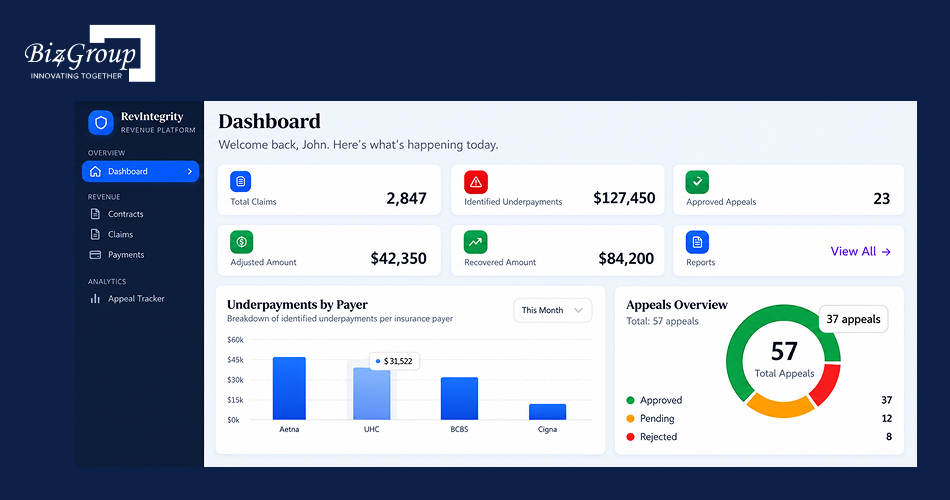
Use it as a check instead. If the adjustment is larger than your contract allows, you may have an underpayment. That is the check we built RevIntegrity to run for hospital billing teams: it compares paid amounts against contracted CPT rates and flags the gaps.
4. What Can You Do This Week with This Code List?
You need your remittance data and about an hour.
- Export 90 days of denials by CARC and group code, with dollar amounts.
- Rank your top five codes by dollars, not by count.
- Write a one-line first action for each, using the table in heading 2.
- Pull CO-45 contractual adjustments out of your denial rate and review them as an underpayment check.
- Assign each top code to the owner from the causes table in the earlier section.
When Bill Matters reads a denial, it maps the denial reason to the documents needed to overturn it, so your staff can see what is attached and what is still missing.
Codes tell you what happened. Next, we look at how AI is changing both sides of this fight, starting with how it can flag these codes before a claim goes out.
How Does AI Reduce Denials in Medical Billing? 6 Trends to Watch in 2026
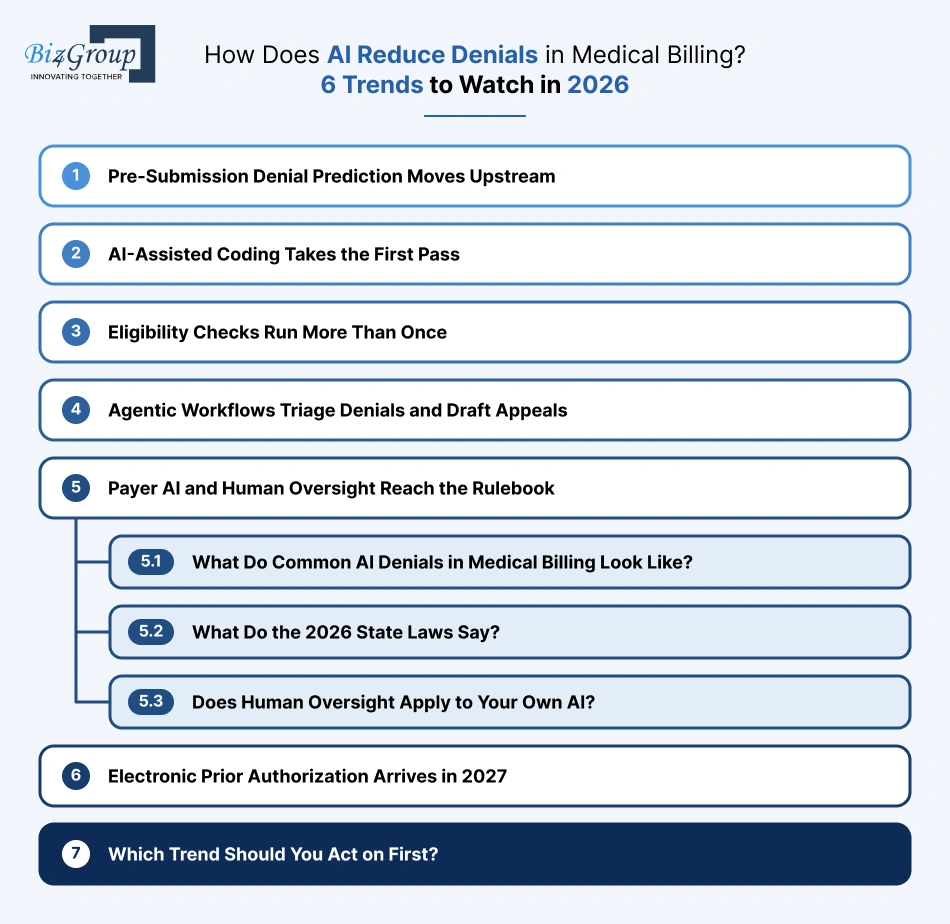
It scores claims for risk before submission, drafts first-pass codes, rechecks coverage, speeds authorization steps, triages denials and drafts appeals for a person to approve, and helps you respond when a payer’s own AI issues the denial. Six trends matter most in 2026.
Does that match where your team needs help? Experian Health asked 210 revenue cycle leaders where automation would help most. Front-end registration and verification came first (49%), coding validation and documentation support second (45%), and automated authorization checks third (43%). AI-driven denial prediction and prevention was named by 35%.
We build this kind of software, so we will also tell you where the promise runs ahead of the evidence.
1. Pre-Submission Denial Prediction Moves Upstream
Can AI predict claim denials? In part, yes. A prediction model reads each claim against your own history: payer, plan, CPT and ICD-10 pairing, modifiers, provider, authorization status, and eligibility date. It returns a risk score and a plain reason, such as “MRI billed, no authorization on file for this payer.”
The model does not predict every payer decision. It points your team at the claims that deserve a second look. That is claim denial prevention at its most practical.
Two tests separate useful tools from decorative ones. First, ask for precision and recall on the highest-risk claims, not one overall accuracy number. When most claims pay, a model that flags nothing still looks accurate. Second, ask how the tool learns about payer rule changes, because a model trained on history cannot know a rule that changed last week.
2. AI-Assisted Coding Takes the First Pass
Natural language processing reads the encounter note and proposes ICD-10, CPT, and HCPCS codes, with the supporting text highlighted. Coders then spend their time on exceptions, complex encounters, and anything the model scores with low confidence.
Groups are moving here first. In an October 2026 MGMA poll, 63% of 214 respondents said their organizations are moving toward more automation this year, and coding topped the list of tasks they are automating.
Treat suggested codes as drafts, and log who accepted each change.
3. Eligibility Checks Run More Than Once
Coverage changes between scheduling and the visit more often than most front desks assume. A single check at intake is not enough.
Re-verify at scheduling, at pre-registration, and on the day of service. The check itself is a standard transaction. AI adds value on top of it: it decides which patients to recheck first and flags changes between touchpoints, such as a new payer or a changed subscriber ID.
4. Agentic Workflows Triage Denials and Draft Appeals
What is agentic AI in revenue cycle management? McKinsey describes it as AI that can make decisions and run multi-step processes on its own, unlike generative AI, which mostly advises. Its analysis says AI enablement could cut the cost to collect by 30 to 60 percent. That is a projection, not a measured result.
McKinsey also points health systems to the back end of the revenue cycle first, because the work there is mostly administrative and carries less risk. Denials and appeals fit that description.
Watch how you add tools. Seema Verma, the former CMS Administrator, warned at MGMA’s 2026 conference against bolting on one AI tool for billing and another for coding with no plan for how they share data.
Our design rule for Bill Matters is simple. The AI does the sorting and the first draft, and a person approves every appeal before it reaches a payer. It reads the denial, checks whether the claim is worth pursuing, flags missing evidence, and drafts the appeal.
5. Payer AI and Human Oversight Reach the Rulebook
The new laws mostly govern insurers, not you. They still change how you appeal, so it pays to read them closely.
5.1 What Do Common AI Denials in Medical Billing Look Like?
Payers use automated review in claim edits, prior authorization, and utilization review. HFMA reported in January 2026 that initial denials sometimes arrive within seconds of submission.
These are the common AI denials in medical billing to watch for:
- Automated medical necessity denials (CO-50) that match diagnosis to procedure codes without reading the chart.
- Downcoding of evaluation and management levels.
- Prior authorization denials that arrive faster than your team can review them.
The warning signs are a decision within hours, rationale that echoes your codes instead of the chart, and no named clinician.
5.2 What Do the 2026 State Laws Say?
Holland & Knight tracked six insurer-focused laws signed between March 4 and May 5, 2026, which is about nine weeks by our count. The common thread is that insurers may use AI to assist but cannot rely on it as the sole basis for denying care. Physicians Practice counts at least seven states this year.
A few examples:
- Washington (SB 5395, effective June 11, 2026): only licensed professionals may deny prior authorization requests on medical necessity grounds.
- Alabama (SB 63, effective October 1, 2026): AI-assisted prior authorization decisions must reflect the patient’s own medical history, and insurers certify annually to the state.
- Indiana (HB 1271, effective July 1, 2026): insurers may not use AI as the sole basis for downcoding a claim.
- Illinois (SB 3114): a ban on automated downcoding without human review starts January 1, 2028.
- Georgia and Utah: both take effect January 1, 2027.
Check plan type first. These laws do not reach self-insured employer plans governed by ERISA, and Medicare Advantage plans generally sit outside state insurance law.
5.3 Does Human Oversight Apply to Your Own AI?
In Indiana, yes. HB 1271 also bars providers from using AI to submit claims without review by the provider or a billing professional.
Whether or not your state has a rule, adopt one as policy. A named person reviews AI-drafted claims and appeals, and the system logs who approved what.
6. Electronic Prior Authorization Arrives in 2027
Prior authorization is where payer rules, your EHR, and AI meet. The CMS prior authorization rule (CMS-0057-F) covers payers, not practices.
Starting in 2026, covered payers (other than qualified health plan issuers on the federal exchanges) must send decisions within 72 hours for expedited requests and seven calendar days for standard ones. They must also give a specific reason for any denied request and publicly report prior authorization metrics each year. The rule excludes drugs. Their prior authorization APIs are generally due by January 1, 2027.
Your EHR and billing vendors are the ones who connect to those APIs. MGMA suggests asking them this quarter which payers’ APIs will connect, when, and at what cost. A denial reason that arrives as structured data can be matched to the right claim and routed without anyone reading a PDF. That is where AI earns its keep here.
7. Which Trend Should You Act on First?
Match the trend to your biggest denial category:
- Registration and eligibility denials: start with trends 1 and 3.
- Coding and documentation denials: start with trend 2.
- A growing appeal backlog: start with trend 4.
- Payer AI denials: start with trend 5, and log “reviewer named” on every denial.
Turning Denials Into Recoverable Revenue?
Identify denial risks, uncover missing evidence, prepare stronger appeals, and track recovery with AI-powered claim intelligence.
Try Bill MattersWhat to Look For in an AI Denial Management Tool
A reliable AI denial management tool should combine measurable accuracy, explainability, human review, integration, compliance, and reporting with clear operational controls.
So if you’re asking, “I am comparing AI-powered claim management solutions for our healthcare business, but I do not know how to evaluate their accuracy, denial prediction capabilities, compliance measures, ease of integration, and human review processes.”
Focus on whether the platform performs consistently across real claims, fits existing infrastructure, and maintains accountable decision pathways. Have a look:
1. Accuracy
Evaluate how consistently the system identifies relevant denial patterns and produces reliable outputs. For AI claim denial prediction, look for measurable performance across claim types, payers, and real operating conditions rather than broad accuracy claims.
2. Explainability
AI outputs should be understandable to the people reviewing them. The system should show the reasoning, relevant claim information, and supporting factors behind a recommendation so users can assess the result without treating the model as a black box.
3. Human Review
Human review should be built into the workflow, with clear points for intervention, approval, escalation, and exception handling. The technology should support professional judgment rather than create a process where questionable outputs move forward unchecked.
4. Integration
Assess whether the tool can work with your existing claims, billing, documentation, and revenue cycle environment. Strong AI solutions for health insurance claim denials should fit established systems and workflows instead of creating another operational silo.
5. Compliance
Review how the technology handles sensitive healthcare information, access controls, auditability, and required oversight. For AI-powered medical billing denial prevention, compliance cannot sit outside the workflow; it needs to be considered alongside how the system processes and influences claim decisions.
6. Reporting
Reporting should provide actionable visibility into denial activity, system performance, workflow outcomes, and areas requiring attention. Look for reporting that helps RCM leaders measure operational impact and identify where the technology is actually improving denial-management performance.
With these six criteria in place, evaluating AI denials in medical billing becomes far more practical. The right solution should strengthen health insurance claim management without compromising accuracy, control, or visibility.
How to Get Started with AI for Denial Management
Start with a focused use case, confirm data readiness, connect existing systems, establish oversight, then pilot the workflow against measurable operational outcomes.
For chief revenue cycle officers and RCM directors asking, “We want to adopt AI for our medical billing operations, but our existing systems are disconnected. I need to understand which integrations, data sources, security controls, and implementation steps are required.”
The path below answers how to implement AI for medical billing denial management:
1. Start With a Defined Denial-Management Use Case
Choose a specific operational problem with measurable outcomes rather than introducing AI across the entire revenue cycle at once. A focused scope makes performance easier to assess.
2. Map Data Sources and System Dependencies
Identify where claims, documentation, payer information, and related revenue-cycle data reside. Then determine how disconnected systems will exchange the information required for the intended workflow.
3. Establish Human Oversight Before Deployment
Define review points for AI-influenced decisions, assign responsibility for exceptions, and keep qualified professionals involved wherever claim decisions require judgment or accountability.
4. Pilot Against Measurable Outcomes
Run a controlled pilot and compare results with the existing process. Track how AI reduces denials in medical billing alongside operational efficiency, rather than treating adoption itself as success.
5. Scale Only After Value Is Demonstrated
Expand after the pilot shows reliable performance and measurable value. The same approach can then extend across additional revenue-cycle functions or higher claim volumes. The research brief emphasizes that adoption is currently outpacing proven ROI, making measurement essential.
What Are the Biggest Challenges of Adopting AI for Denial Management, and How Do You Solve Them?
The biggest challenges of adopting AI for denial management are messy data, systems that do not connect, automating a broken process, pilots that never prove return, accuracy that drops on complex claims, staff who do not trust the output, privacy questions about PHI, and oversight that lags behind use. Each one has a fix you can start this quarter.
Why do AI denial management projects fail? Rarely because of the model. On our healthcare AI projects, the places that stall are EHR access, data quality, and adoption by the people who use the tool.
The table below pairs each challenge with what it looks like in daily work and a fix. Which ones sound like your last technology rollout?
1. Which Challenges Should You Plan for Before You Start?
|
Challenge |
What It Looks Like |
How to Fix It |
|---|---|---|
|
Messy or Scattered Data |
Claims, remits, eligibility responses, and authorization records sit in different systems with different formats. The tool sees only part of each claim. |
Start with data you already control: 837 claims, 835 remittances, eligibility responses, and authorization records. Add clinical documents in a second phase. Audit 90 days first: how many denials carry a CARC, a RARC, a payer, and an authorization number? |
|
Systems That Do Not Connect |
Staff re-key data between a practice management system, a clearinghouse, and a payer portal, and no API is available. |
Use clearinghouse files and scheduled exports as a bridge. Check what your EHR already offers before buying a standalone tool. MGMA’s IT chief told Medical Economics to look at built-in EHR AI features first and to start in revenue cycle, for example by running remittance files through a HIPAA-compliant AI tool to find denial root causes. |
|
Automating a Broken Process |
The same mistakes, now faster. A weak registration step still produces bad claims, only in higher volume. |
Map the workflow, fix the broken step, then automate it. A revenue cycle leader at Harvard Medical Faculty Physicians told Becker’s that automating a flawed process repeats the same mistake faster across thousands of claims. Start with one payer and one denial category. |
|
Pilots That Never Prove Return |
The pilot launches, staff use it, and nobody can say whether denials fell. |
Record a baseline first. Experian suggests tracking first-pass claim acceptance rate, denial rates by root cause, eligibility and authorization denials, and rework volumes. Run 90 days on one payer and one category, then compare. |
|
Accuracy That Drops on Complex Claims |
The tool works on simple encounters and misses on high-dollar or multi-service claims. Vendor accuracy figures describe the vendor’s data, not yours. |
Ask for a retrospective test on 6 to 12 months of your own remittances. Test complex and high dollar claims separately. Ask for precision and recall on the highest risk claims and set a review trigger for when a payer changes policy. |
|
Staff Who Do Not Trust the Output |
Staff override every flag or stop opening the queue. In MGMA’s October 2026 poll, the 11% of groups moving toward more manual work cited payer complexity, tool gaps, and staffing problems. |
Put your denial team lead in the pilot. Show the reason behind every flag. Measure time saved and share the number. Block training time on the calendar, because short-staffed teams have no spare hours to learn a new tool. |
|
Privacy and PHI Questions |
Nobody can say where patient data goes, who sees it, or whether the vendor trains models on it. |
Sign a business associate agreement before any PHI is shared. HHS says a cloud vendor that creates, receives, maintains, or transmits ePHI for you is a business associate, even if the data is encrypted and the vendor holds no key. Require role-based access, encryption, an audit trail, and a written answer on model training. We built Bill Matters this way. |
|
Oversight That Lags Behind Use |
AI drafts claims, appeals, or write-offs and no one owns the approval. |
Decide which actions need a person: appeal submission, code changes, and write-offs. Log every approval with a name and a time. Sample-review outputs monthly. Some states, such as Indiana, already require review of AI-submitted claims, as covered in heading 5.3 of the AI trends section. |
2. Are You Ready to Pilot AI for Denial Management?
How do you implement AI for denial management without stalling? Answer five questions honestly:
- Can you export 90 days of 835 remittances with CARC, RARC, and group codes?
- Do you know your initial denial rate and your top five codes by dollars?
- Can you name the person who approves AI output?
- Will your vendor sign a business associate agreement before seeing PHI?
- Have you picked one payer and one denial category for a 90-day pilot?
If you answered no to two or more, fix those first. They are cheaper than any software, and they decide whether claim denial prevention tools work at all. If you answered yes to all five, you are ready to compare tools.
Not sure where you stand? We can review your remittance data with you and tell you honestly whether AI is the right first move or whether a front-desk process change would pay back sooner.
Ready to Take Denial Management Upstream?
Use AI to spot claim risks earlier, reduce avoidable rework, and give your RCM team better control over the claims process.
Explore AI Denial ManagementWhy Choose Biz4Group to Build or Buy AI for Denial Management?
Choose Biz4Group if you want a team that has built and launched its own AI denial management product, signs a business associate agreement before touching PHI, and keeps a person in charge of every consequential decision. You can check each claim below.
How do you choose an AI denial management vendor? Ask who built it, how they protect your data, and what you can verify without talking to their sales team. Here are our answers.
Who Is Behind This Guide, and What Have We Built?
We are an AI development company in Orlando, Florida, founded in 2003. We have delivered more than 1,000 technology projects, including more than 100 in healthcare AI.
This guide comes from Dave Caplis, our Technical Director. He has more than 20 years in technology and leads the architecture and delivery of our HIPAA-safeguarded AI platforms, including our work on AI-driven denial management.
We also build for the problems in this guide:
- Bill Matters launched in September 2026. It reads the denial, the claim, and the supporting documents, flags missing evidence, and drafts the appeal for your team.
- RevIntegrity checks paid claims against contracted rates for hospital billing teams, so underpayments do not hide inside medical billing denials data.
How Do We Protect Your Data and Keep a Person in Charge?
- We sign a business associate agreement before any PHI is shared.
- Data is encrypted at rest and in transit, access is role-based, and every action is logged.
- Case data is never used to train models for anyone else.
- A person reviews and approves every appeal before it reaches a payer. Bill Matters does not submit appeals on its own.
We also do not claim a HIPAA certification. No government body certifies software as HIPAA compliant, and we would rather say so than sell you a badge. Our healthcare stack includes X12/EDI, the format behind the remittances discussed earlier, along with HL7 and FHIR.
What Can You Check Yourself?
- Reviews: we hold a 4.9 out of 5 rating on Clutch across 28 reviews and 4.8 out of 5 on Upwork across more than 120 reviews.
- Client feedback: a senior manager at Adobe wrote that we executed well and communicated clearly on a project with many stakeholders.
- Our work in public: our healthcare library covers medical billing platforms, claim scrubbers, prior authorization, HIPAA penalties, and AI governance. Read it before you talk to us.
Two Ways to Work with Us
If you run a practice or billing company with a denial backlog, Bill Matters is the fastest way to see how AI handles your own denials. If you are a health system, billing company, or health-tech team with unusual data or a product to own, our team builds custom AI denial management software.
We will also tell you when AI is the wrong first move. If a few registration errors cause most of your denials in medical billing, a front-desk fix will pay back sooner. Book a call and we will look at your remittance data with you.
Wrapping Up!
Denials in medical billing are less random than they feel. Most trace back to a few codes, a few owners, and a few steps that happen long before a claim reaches the payer. Three ideas from this guide are worth keeping.
- Read the whole remittance, then sort by owner. The group code, CARC, and RARC together tell you who owns the balance and who could have prevented the denial. That is where claim denial prevention starts.
- Do not write off every hard denial. Sort each denial into soft, hard, or final, and calendar the appeal deadline the day it lands.
- Use AI where it is strongest, with a person in charge. It works best before submission and during appeals. It works only when someone named approves anything consequential. Payer AI and the new state laws change how you appeal, so check the plan type first.
The teams we talk to rarely lack effort. They lack the hours to fight every denial. That is the gap AI should close, and it is also why we build our own tools to draft and rank, not to submit on their own.
Here is a start you can finish this week. Export 90 days of remittances, rank your top five codes by dollars, and assign each one an owner. Then pick one payer and one denial category for a 90-day pilot and record your baseline first.
AI is not the first fix for every team. If a few front-end errors cause most of your medical billing denials, fix those first. It costs less and pays back sooner. We will say so if your data points that way.
FAQ
1. What Are Denials in Medical Billing, and How Are They Different from Rejections?
Denials in medical billing happen when a payer processes a claim and refuses to pay all or part of it. The reason appears on the remittance as codes. A rejection is different. It is returned before the payer reviews it, usually for a data error, so you correct it and resubmit. A denial may need a correction, an appeal, or a write-off.
2. What Are the Types of Denials in Medical Billing?
The main types of denials in medical billing are soft denials, which a correction fixes, hard denials, which need a formal appeal, and final denials, where deadlines have closed the path to payment. By root cause, they fall into front-end denials (registration, eligibility, authorization), mid-cycle denials (coding, documentation, medical necessity), and back-end denials (claim data, duplicates, filing deadlines).
3. What Are the Most Common Reasons for Claim Denials in Medical Billing?
The most common reasons for claim denials in medical billing are missing or incomplete documentation, coding errors, duplicate claims, eligibility and coverage problems, non-covered services, authorization gaps, and missed filing deadlines. On remittances, CARCs 16, 18, 4, 11, 22, 27, 29, 50, 97, and 197 are the codes we see most. Most of these start before the claim reaches your billing team.
4. How Do You Reduce Denials in Medical Billing?
Start at the front end. Recheck eligibility at scheduling and on the day of service, look up authorization rules before the visit, and fix documentation and coding at the point of care. That is claim denial prevention in practice.
Then measure it. HFMA’s Claim Integrity Task Force tracks the initial denial rate as a percentage of claim volume and of claim dollars. Benchmarks quoted online vary and often use different definitions, so compare yourself with your own history and payer mix first. Give every denial a named owner and review your top five codes monthly, because medical billing denials repeat until someone owns the cause.
5. Can Denied Claims Be Appealed, and How Long Do You Have?
Yes. Many soft denials only need a corrected claim, and hard denials can go to appeal. Read the reason on the remittance, decide whether to correct or appeal, gather the chart notes and payer policy, and file before the deadline.
In Original Medicare, you have 120 days from receipt of the initial determination to request the first-level appeal. Commercial plans set their own windows, so calendar the date the denial arrives. Tools like Bill Matters can draft the appeal from the denial and your documents, and your team reviews and approves it.
6. How Does AI Reduce Denials in Medical Billing, and Does It Replace Your Staff?
How does AI reduce denials in medical billing? It scores claims for denial risk before submission, suggests codes for a coder to review, rechecks eligibility, flags missing authorizations, ranks denials by recovery odds, and drafts appeals.
It does not replace your staff. A named person should approve consequential steps, and any vendor that handles PHI should sign a business associate agreement first. Bill Matters follows that rule: the AI drafts, and your team approves.
7. What Are AI Denials in Medical Billing, and Are They Legal?
AI denials in medical billing are denials where a payer’s automated system made or shaped the decision. The common AI denials in medical billing include automated medical necessity denials, downcoding, and fast prior authorization denials.
Several states enacted laws in 2026 that stop insurers from using AI as the sole basis to deny care. These laws generally do not reach self-insured employer plans, and Medicare Advantage plans generally sit outside state insurance law. Check the plan type first, then ask who reviewed the denial and whether AI was used.