 Location :
Orlando, FL, USA
Location :
Orlando, FL, USA +1 (407) 714-1616
 info@biz4group.com

 Key Takeaways
- Connect the data: Link BIM, IoT, BMS, PMS, and maintenance data into one reliable digital twin.
- Put AI to work: Use equipment data for predictive maintenance, energy analysis, and building performance insights.
- Start small: Build an MVP for one property, measure results, then expand across the portfolio.
- Plan the investment: Digital twin development cost for real estate ranges from $10,000 to $450,000 based on scope and integrations.
- Choose with evidence: Compare integrations, security, CRE expertise, and pilots. Biz4Group's AI and real estate development experience offers relevant work to evaluate alongside other vendors.
A digital twin becomes useful when it starts answering questions your property team already deals with every day: Which HVAC unit is showing abnormal behavior? Which building is using more energy than expected? Which assets need attention before they cause downtime?
Digital twin technology for commercial real estate connects BIM, IoT sensors, building management systems, and property data to help answer those questions from one connected view. A sensor reading tied to the correct HVAC asset, floor, equipment history, and maintenance record gives AI much more context than an isolated data point.
That context supports predictive maintenance, building performance analysis, energy monitoring, and portfolio-level comparisons.
This is also where many digital twin projects become more complex than expected. A BIM model needs the right asset information. IoT data needs consistent identifiers and reliable timestamps. BMS and maintenance systems need working integrations.
The twin needs a data model that keeps those sources connected as the building changes. These technical choices directly influence the digital twin development cost for real estate and the time required to reach a reliable working system.
Biz4Group LLC, a U.S.-based AI consulting service provider, works on AI systems where the quality of the underlying data and integrations directly affects the usefulness of the AI layer. For a real estate digital twin, that means paying attention to BIM-to-asset mapping, IoT data flows, building-system integrations, predictive maintenance logic, and the workflows that turn an AI signal into an operational action.
Can the Digital Twin Pull Live Data from IoT Sensors, BIM Models, and Building Management Systems Automatically?
Yes. A properly designed commercial real estate digital twin pulls data from IoT sensors, BIM models, and building management systems through APIs, data connectors, and other integration methods. The key is giving each data source a clear role and mapping its information to the right building, floor, room, asset, or equipment.
BIM Provides Building and Asset Data
A BIM model provides the digital building structure. It contains information such as spaces, floors, equipment locations, building components, and asset relationships.
For a digital twin, BIM data provides the context around live readings. A temperature reading becomes more useful when the system knows which room it belongs to, which HVAC unit serves that space, and where that equipment sits within the building.
Here at this time, digital twin with BIM integration for real estate moves beyond a standalone 3D model. The model becomes part of the data structure used to understand the physical property.
IoT Sensors Provide Live Building Data
IoT sensors supply the changing conditions inside a building. Depending on the property and use case, those readings include temperature, humidity, occupancy, energy consumption, equipment vibration, pressure, air quality, and other operating signals.
The twin receives these readings through gateways, IoT platforms, APIs, or other supported connectors. Each reading needs a reliable link to the relevant asset or location. Without that mapping, the system has data without enough context to support useful analysis.
- For example, a vibration reading from an air-handling unit becomes useful when the twin links it to that unit's location, equipment type, maintenance history, and other operating data.
BMS Provides Operational Data
A building management system provides another layer of information. BMS platforms typically collect and manage data from systems such as HVAC, lighting, alarms, and other building controls.
Connecting the BMS gives the twin access to operational conditions that change throughout the day. The twin then has a broader view of how building systems are operating rather than relying on individual sensor readings.
The exact data available depends on the BMS, connected equipment, communication protocols, and configuration of the building.
APIs Automate Data Exchange
APIs provide a common way for software systems to exchange data. In a CRE digital twin, they often connect the twin platform with IoT platforms, BMS software, property systems, maintenance tools, and other applications.
A typical data flow looks like this:
Sensor or BMS → IoT/BMS platform → Integration layer → Digital twin → AI and analytics → Property workflow
The integration layer also handles tasks such as authentication, data formatting, timestamps, asset mapping, and error handling. These details matter when data arrives from several systems with different formats and update intervals.
Connected Data Creates a Unified Twin
The digital twin becomes useful when these separate data sources refer to the same physical assets and locations. BIM supplies the building context, IoT supplies live conditions, and BMS supplies operational data.
- A property manager, for example, could select an HVAC unit in the twin and see its location, current readings, operating status, and relevant maintenance information in one place. That same connected data then feeds use cases such as digital twin technology for facility management, predictive maintenance, energy monitoring, and building performance analysis.
The connection also needs to work in both directions when the use case requires it. Some digital twins focus on monitoring and analysis, while more advanced systems connect insights to maintenance platforms or building controls.
How Does AI Use Digital Twin Data to Predict Equipment Failures Before They Cause Downtime?
AI model development for predictive maintenance starts with comparing live equipment data against historical operating patterns to spot signs of a developing fault.
In an AI digital twin for predictive maintenance in real estate, this helps facilities teams identify unusual behavior early, inspect the right equipment, and schedule maintenance before a failure causes downtime.
Equipment History Improves AI Predictions
Past maintenance records give AI a reference for how an asset has behaved over time. The model uses repair history, operating hours, previous faults, and component changes to understand the equipment's normal pattern.
- Practical example: An HVAC unit with repeated bearing repairs gets a different risk profile from a similar unit with a stable maintenance history.
Sensor Patterns Reveal Equipment Problems
Facilities and portfolio managers often ask:
"We manage a portfolio of office buildings and our maintenance costs keep going up because we only find equipment problems after they have already caused downtime, so can you explain how digital twin technology with AI could help us predict these issues before they happen, and which providers are known for this."
AI compares current temperature, vibration, pressure, power, and runtime patterns against historical equipment behavior. When those patterns indicate a developing fault, the digital twin flags the asset and feeds the signal into the maintenance workflow before failure occurs.
- Practical example: Rising vibration combined with higher motor current in a chiller points to a developing issue more clearly than either reading alone.
AI Identifies Potential Failure Signals
The model compares current readings with expected operating behavior and historical patterns. It then flags unusual conditions linked to possible equipment problems.
- Practical example: A pump shows increasing power consumption while its flow rate drops across several cycles, triggering an inspection alert.
Predictions Trigger Maintenance Workflows
A prediction becomes useful when it reaches the maintenance process. The digital twin sends the alert and relevant asset information to a CMMS, maintenance platform, or internal work-order system.
- Practical example: An HVAC alert creates a work order with the asset location, recent readings, and alert history for the technician.
Data Quality Affects Prediction Accuracy
Poor data affects the quality of AI predictions. Missing readings, incorrect asset mapping, sensor errors, and incomplete maintenance records all reduce the reliability of the model.
- Practical example: If a vibration sensor stops reporting, the system needs to mark the data as missing instead of treating the equipment as stable.
The result is a maintenance process based on equipment condition and operating data rather than a fixed schedule alone.
Can the Digital Twin Update in Real Time as Building Conditions, Occupancy, or Systems Change?
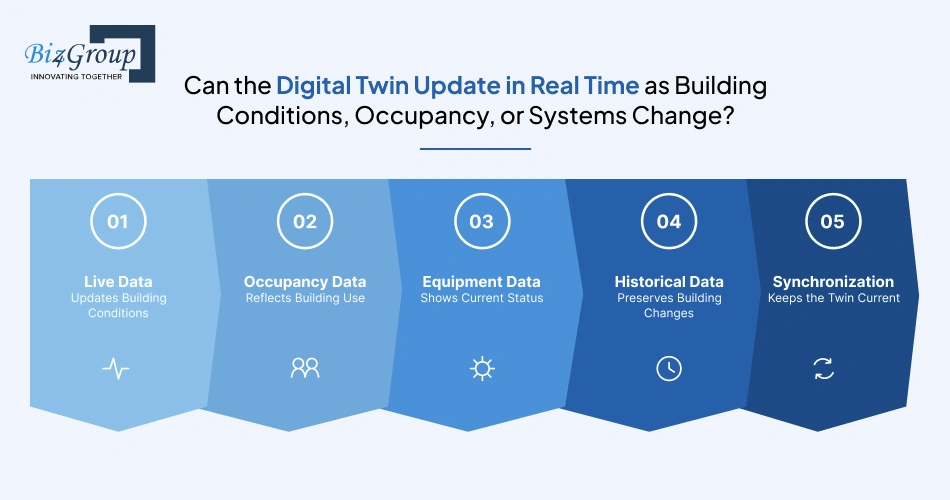
Yes. A connected digital twin platform for property managers updates when new data arrives from IoT sensors, BMS platforms, occupancy systems, and other building sources. The refresh rate depends on the system and the use case. A maintenance alert needs faster updates than a monthly energy report.
Live Data Updates Building Conditions
Sensor feeds update values such as temperature, humidity, energy use, and equipment status. The twin maps each reading to the right space or asset. A chiller's temperature readings update every minute, giving the facilities team a current view of its operating condition.
Occupancy Data Reflects Building Use
Occupancy feeds show how spaces are being used. The twin connects that information with relevant HVAC, lighting, and energy data. A conference area with higher-than-usual occupancy shows increased cooling demand during the same period.
Equipment Data Shows Current Status
BMS and IoT integrations send equipment states, alarms, and operating readings into the twin. This keeps asset information tied to current conditions. When an air-handling unit enters an alarm state, the twin records the event against that specific asset and location.
Historical Data Preserves Building Changes
The twin keeps previous readings alongside current data. Teams use that history to compare performance and investigate recurring issues. A facilities manager reviews several months of AHU readings and finds pressure changes before previous maintenance events.
Synchronization Keeps the Twin Current
The system needs reliable timestamps, asset IDs, and data mappings to keep updates accurate. If a source stops reporting, the twin needs to mark the data as stale rather than treat an old reading as current. If a temperature sensor stops sending data at 2:14 PM, the twin shows the last valid reading and its timestamp.
For real time IoT data integration for buildings, the key is matching the refresh rate to the use case and keeping every data point tied to the correct building asset.
How Does the System Flag Energy Inefficiencies or ESG Compliance Gaps Across a Property Portfolio?
A digital twin compares energy, equipment, occupancy, and sustainability data across properties to spot unusual performance and potential compliance gaps. Instead of reviewing every building manually, property teams get a clearer view of which assets or properties need attention.
Energy Data Reveals Unusual Consumption
The digital twin technology for commercial real estate tracks electricity, gas, heating, cooling, and other energy data against expected usage. A sudden increase, unusual pattern, or gap between similar properties signals a closer review.
|
Signal |
What the System Flags |
|---|---|
|
Higher electricity use |
Possible equipment or operational inefficiency |
|
Increased HVAC consumption |
Cooling or heating performance issue |
|
Unusual overnight usage |
Equipment running outside expected schedules |
|
Energy spike after occupancy drops |
Possible controls or equipment problem |
Building Comparisons Highlight Poor Performance
Portfolio-level comparisons make inefficient properties easier to identify. The system compares buildings using metrics such as energy use per square foot, operating hours, occupancy, and equipment performance.
For example, two buildings with similar size and occupancy levels show very different cooling consumption. The digital twin highlights the higher-consuming property for further investigation.
Performance Metrics Track Efficiency
A digital twin solution for commercial property portfolios gives managers a consistent way to track performance across buildings. Useful metrics include energy intensity, equipment runtime, peak demand, water consumption, and emissions data.
These metrics also help teams track whether efficiency projects produce measurable results after implementation.
Sustainability Data Supports ESG Reporting
The twin brings operational data into one system so teams spend less time collecting information from separate building systems. Energy consumption, emissions, equipment performance, and other sustainability metrics stay connected to the properties and assets that produced them.
This creates a more traceable data set for internal ESG reporting and performance reviews.
Alerts Highlight Potential Compliance Gaps
Rules and thresholds help the system flag data that needs attention, such as missing sustainability measurements, abnormal consumption, or performance outside an internal target.
The alert does not replace a compliance review. It gives the property team a specific building, asset, or metric to investigate instead of searching through portfolio data manually.
For CRE teams, the practical value is prioritization. The digital twin highlights the buildings and performance areas that need attention first, giving managers a clearer starting point for energy, maintenance, and ESG actions.
Ready to Turn Your Building Data into Something Useful?
Connect BIM, BMS, IoT, and AI around one CRE use case worth solving.
Build Your Digital Twin MVPWhat Happens When Sensor Data Is Incomplete, Delayed, or Conflicting Across Connected Building Systems?
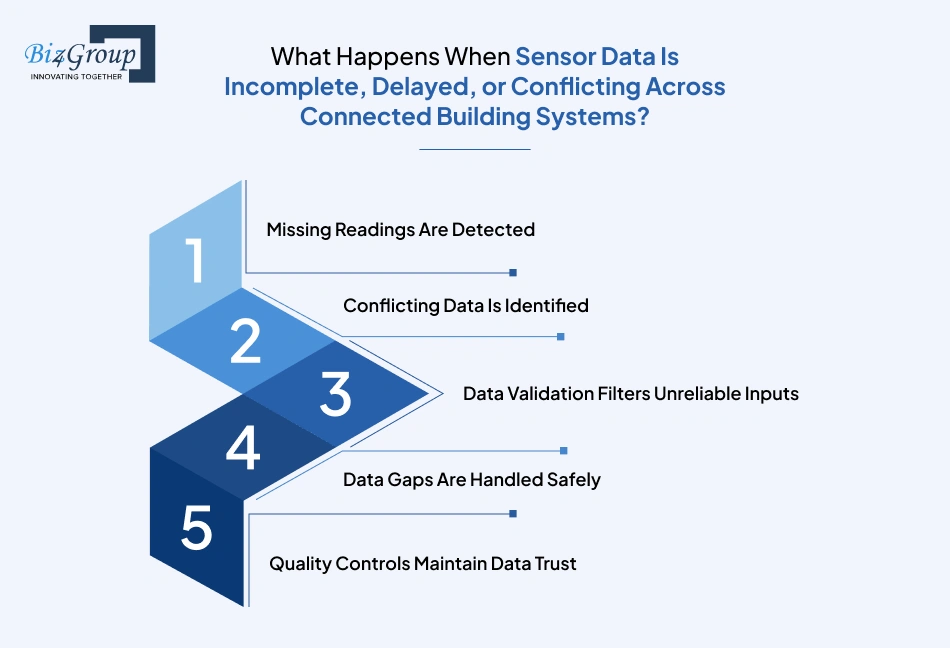
A commercial building rarely produces perfectly synchronized data. An HVAC sensor might report every 30 seconds, the BMS every few minutes, and the PMS only when a work order changes. A reliable digital twin architecture for commercial real estate accounts for these differences before data reaches equipment analytics, maintenance alerts, or AI models.
Missing Readings Are Detected
Problem: A rooftop AHU stops sending supply-air temperature readings while its BMS status continues to show "running."
System response: If the sensor is configured for 30-second intervals, six consecutive missing readings create a missing-data event. The AHU remains marked as operational, while its temperature measurement is marked unavailable.
Operational impact: A digital twin with IoT integration for commercial buildings does not interpret missing temperature readings as stable conditions. The maintenance queue instead shows the AHU ID, affected sensor, last valid reading, and time since the last update.
Conflicting Data Is Identified
Problem: The BMS reports that Chiller-02 is running, while its electrical meter shows zero power consumption and the chiller controller reports an inactive state.
System response: The three records are matched using the chiller ID and timestamps. Because the operating states disagree, the conflicting readings are flagged for reconciliation instead of being combined into one operating status.
Operational impact: The discrepancy points the engineering team toward the BMS integration, power meter, or controller connection before it affects the property asset performance monitoring system.
Data Validation Filters Unreliable Inputs
Problem: A supply-air temperature sensor assigned to an AHU suddenly reports 180°F, or a meter begins sending kW values as watts after an integration change.
System response: Incoming values are checked against configured operating ranges, measurement units, timestamps, and asset mappings. The 180°F reading is flagged as abnormal, while a unit mismatch is caught before the value enters energy calculations.
Operational impact: The abnormal or incorrectly formatted reading stays out of equipment diagnostics and energy reports until the underlying data issue is resolved.
Data Gaps Are Handled Safely
Problem: A network outage creates a 45-minute gap in electricity-meter readings for a commercial property.
System response: The missing interval is recorded between the last valid timestamp and the first reading received after the connection returns. The 45-minute period remains identified as missing instead of being counted as zero consumption.
Operational impact: Real time IoT data integration for buildings does not produce an artificial consumption drop in monthly energy analysis simply because a meter connection was unavailable.
Quality Controls Maintain Data Trust
Problem: An AHU repeatedly loses sensor connectivity after network maintenance, creating missing readings several times each month.
System response: Each event is linked to the same AHU and sensor ID, with the failure timestamp, outage duration, and affected data stream recorded. Repeated failures then form a traceable pattern in the integration history.
Operational impact: The recurring issue points to a specific sensor or connection that needs correction rather than generating separate unexplained data gaps.
For digital twin system development for CRE, these data controls belong inside the integration layer. In a digital twin system integration with PMS and IoT platforms, correctly mapped assets, timestamps, units, and sensor status give maintenance predictions, energy calculations, and portfolio reporting a reliable data foundation.
How Can Property Owners Measure ROI Through Maintenance Cost Reduction, Downtime Prevention, and Energy Savings?
Property owners measure digital twin ROI by comparing measurable operating improvements against implementation and ongoing costs. The main inputs are maintenance spending, equipment downtime, energy consumption, avoided failures, and the cost of running the digital twin across the property or portfolio.
Maintenance Costs Establish the Baseline
Start with maintenance spending before the digital twin goes live. Separate preventive maintenance, reactive repairs, emergency callouts, replacement parts, and contractor costs.
For example, if three years of work orders show repeated failures from the same type of HVAC equipment, that history provides a baseline for measuring whether condition-based maintenance reduces repair frequency or emergency service costs.
Downtime Data Shows Avoided Losses
Downtime needs an asset-level measure. Track how often critical equipment fails, how long each failure lasts, and what the interruption costs the property.
A failed chiller serving a leased office floor has a different financial impact from a failed exhaust fan in a low-occupancy service area. Linking equipment alerts to work orders and downtime records makes those differences visible.
Energy Data Measures Efficiency Gains
Compare energy consumption before and after implementation while accounting for factors such as occupancy, operating hours, weather, and major equipment changes.
A portfolio manager might compare monthly kWh per square foot for similar buildings and then investigate whether lower consumption follows HVAC scheduling changes, equipment repairs, or control-system adjustments.
Property Results Show Business Value
The ROI calculation becomes more useful when results are tied to individual properties, assets, and interventions.
|
ROI Measure |
What to Track |
|---|---|
|
Maintenance savings |
Repair, labor, parts, and emergency service costs |
|
Downtime reduction |
Failure frequency, outage duration, and affected operations |
|
Energy savings |
kWh, energy cost, and energy intensity |
|
Asset life |
Replacement timing and equipment operating life |
|
Operational efficiency |
Technician response time and work-order resolution |
This gives owners a practical way to compare results across properties instead of relying on a single portfolio-wide percentage.
Total ROI Includes Ongoing Costs
A common question from CRE leadership teams is:
"I am trying to convince my leadership team to invest in digital twin technology for our commercial properties but I do not have solid numbers to back it up, so can you break down the realistic ROI and cost range for a mid sized CRE company, along with a few case studies I could reference."
For a mid-sized CRE firm, development costs can range from roughly $10,000 to $450,000 depending on scope, integrations, AI, and portfolio size. Measure ROI through avoided repairs, reduced downtime, energy savings, and ongoing platform costs rather than a generic percentage.
A simple calculation is:
Digital Twin ROI = (Annual Quantifiable Benefits − Annual Digital Twin Costs) ÷ Annual Digital Twin Costs × 100
For digital twin ROI for commercial real estate portfolios, owners get a clearer picture when each benefit is tied to a documented baseline and a measurable operational change rather than an assumed saving.
How Do You Develop a Digital Twin for a Commercial Building or Portfolio?
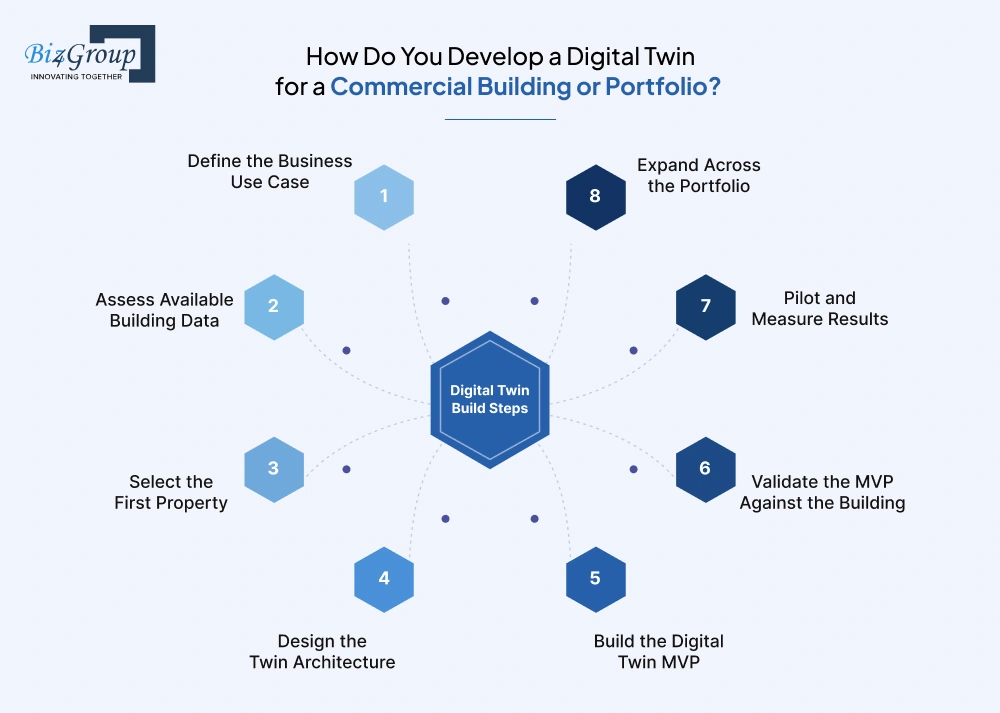
Build the digital twin in stages: define the business outcome, assess the available property data, select a pilot building, design the architecture, build an MVP, validate it against the building, and then expand the proven setup across the portfolio.
Define the Business Use Case
Choose the first operational problem the digital twin needs to address, such as reducing HVAC failures, identifying energy waste, improving asset visibility, or comparing building performance.
Deliverable: A defined use case, baseline metric, target outcome, and list of users who will act on the results.
Assess Available Building Data
Inventory BIM models, BMS feeds, IoT sensors, PMS records, CMMS or work orders, equipment schedules, floor plans, and historical maintenance records. Check asset IDs, timestamps, units, equipment locations, and data frequency across each source.
Deliverable: A data inventory showing each source, its quality, update frequency, owner, and integration method.
Select the First Property
Prioritize a property with a clear use case, accessible building data, reliable equipment records, and enough historical information to measure change. Define which floors, equipment, sensors, and workflows belong in the first release.
Deliverable: A scoped pilot property with selected assets, connected data sources, users, and measurable success criteria.
Design the Twin Architecture
Map the relationships between BIM, IoT, BMS, PMS, CMMS, APIs, databases, analytics, and AI services. Establish a common asset structure so the same chiller, AHU, meter, floor, or room keeps a consistent identity across connected systems.
Deliverable: A digital twin architecture for commercial real estate covering the data model, integrations, APIs, storage, analytics, security, and user access.
Build the Digital Twin MVP
Connect the selected data sources, create the asset hierarchy, map the required equipment, and implement the specific workflow chosen for the MVP. For a predictive maintenance MVP, that might include HVAC sensor data, equipment history, anomaly detection, and maintenance alerts.
Avoid building portfolio-wide dashboards, advanced AI models, or integrations that the first use case does not need.
Deliverable: A working MVP that connects real property data to one clearly defined operational workflow.
Validate the MVP Against the Building
Check whether asset IDs match physical equipment, sensor readings arrive correctly, BIM locations correspond to actual spaces, BMS states reflect equipment operation, and generated alerts match real conditions.
For example, if the MVP identifies AHU-04 as running, its BMS status, sensor readings, equipment location, and maintenance records should support that state.
Deliverable: A validated MVP with verified data mappings, functioning integrations, and documented issues requiring correction.
Pilot and Measure Results
Measure the outcome selected at the start, such as equipment failures, energy intensity, maintenance response time, technician workload, or data-quality improvements.
Document which integrations, workflows, and data structures worked as expected and which required changes.
Deliverable: A pilot result showing whether the MVP achieved its target and what needs to change before wider deployment.
Expand Across the Portfolio
Reuse the validated data model, integration patterns, APIs, workflows, and deployment process for additional properties. Adapt building-specific elements such as equipment types, BMS configurations, sensor layouts, and property-management workflows.
Deliverable: A repeatable foundation to develop a digital twin platform for multi property portfolios without rebuilding the entire solution for every building.
AI in real estate development works best when the digital twin starts with a defined property use case, followed by data assessment, architecture design, integration, validation, and a controlled rollout.
How Much Does Digital Twin Development Cost for Commercial Real Estate?
Digital twin development for commercial real estate typically falls between $10,000 and $450,000, depending on the number of properties, data sources, integrations, AI capabilities, and operational workflows involved.
Twin Complexity Drives the Starting Cost
The first cost question is what the twin actually needs to represent and do.
|
Project Scope |
Typical Cost Range |
|---|---|
|
Basic building asset visualization and data model |
$10,000 to $40,000 |
|
Connected single-building digital twin |
$40,000 to $100,000 |
|
AI-enabled twin with predictive analytics |
$100,000 to $200,000 |
|
Multi-property digital twin platform |
$200,000 to $350,000 |
|
Enterprise portfolio platform with advanced AI and integrations |
$350,000 to $450,000+ |
These are planning ranges rather than fixed quotes. The actual digital twin development cost for real estate depends on the existing building data and the integrations required.
Portfolio Platforms Add Integration Costs
How much does it cost to develop a digital twin for a commercial real estate portfolio?
A portfolio platform introduces another layer of work. Each property can have different BMS vendors, sensor protocols, asset naming conventions, PMS configurations, and data structures.
The development cost increases when the platform needs standardized asset models, multi-property dashboards, role-based access, property-level comparisons, centralized analytics, and integrations across many buildings.
BIM, IoT, AI, and Cloud Affect Costs
Technology components add cost based on how deeply they are integrated.
- BIM: Model preparation, asset extraction, and BIM-to-asset mapping
- IoT: Sensor connectivity, gateways, protocols, data ingestion, and monitoring
- BMS: Integration with equipment states, alarms, schedules, and control data
- AI: Anomaly detection, predictive maintenance, forecasting, and model development
- Cloud: Data storage, processing, APIs, monitoring, security, and ongoing infrastructure
A project that only visualizes building assets has a very different scope from an AI powered digital twin development service that analyzes live equipment data and triggers maintenance workflows.
How Should CRE Firms Start a Digital Twin Project?
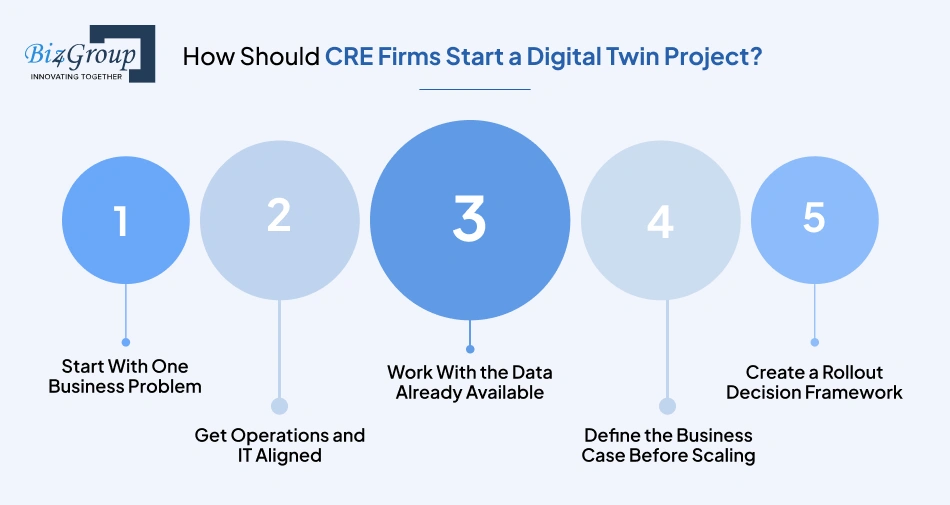
Start by deciding whether the project solves a business problem worth funding, whether the organization has the data and people to support it, and what evidence will justify further investment.
A common question among smaller CRE teams is whether digital twins make financial sense without a large technology budget.
"I am running a commercial real estate business and I keep losing potential tenants because they cannot get a real feel for the property without visiting in person, so can you suggest companies that offer digital twin technology for commercial buildings and tell me if it is actually worth the investment for a firm my size."
For a smaller CRE firm, start with focused property visualization and asset information rather than a full portfolio platform. The investment makes more sense when it supports leasing, remote property evaluation, or tenant engagement with a measurable business outcome.
Start With One Business Problem
Ask: What recurring property problem has a measurable cost or operational impact?
Look for issues such as:
- Unexpected HVAC failures
- High energy consumption
- Slow maintenance response
- Poor visibility into asset condition
- Excessive manual property reporting
Decision: Choose one problem where a measurable improvement is possible.
Get Operations and IT Aligned
Ask: Who owns the building data, who operates the assets, and who will act on the digital twin's output?
Confirm ownership across:
- Facilities and engineering
- Property management
- IT and cybersecurity
- Asset management
- Data or analytics teams
Decision: Assign clear ownership for data access, system integration, operational decisions, and project results.
Work With the Data Already Available
Ask: What information already exists that supports the selected use case?
Review BIM models, BMS records, IoT feeds, PMS data, CMMS records, energy bills, equipment schedules, and maintenance histories.
Decision: Use existing data where it is reliable. Add sensors or integrations only where a specific information gap prevents the use case from working.
Define the Business Case Before Scaling
Ask: What financial or operational improvement justifies the investment?
For example:
|
Business Problem |
Baseline to Measure |
|---|---|
|
HVAC failures |
Emergency repairs and downtime |
|
Energy waste |
Energy cost and intensity |
|
Manual inspections |
Staff hours |
|
Slow maintenance |
Response and resolution time |
|
Poor asset visibility |
Time spent finding equipment information |
Decision: Establish a baseline before implementation so the project has something concrete to measure against.
Create a Rollout Decision Framework
Ask: What results justify moving from the initial project to additional properties?
Set thresholds around:
- Financial savings
- Downtime reduction
- Energy performance
- Data reliability
- User adoption
- Workflow improvements
Decision: Expand when the evidence supports the business case. If the results fall short, adjust the use case, data sources, or workflow before committing additional properties.
This approach keeps the digital twin implementation roadmap for CRE focused on business decisions rather than technology for its own sake. The development section explains how to build the twin; this section determines whether, where, and when the organization should invest further.
How Should You Choose a Digital Twin Platform or Development Company for CRE?
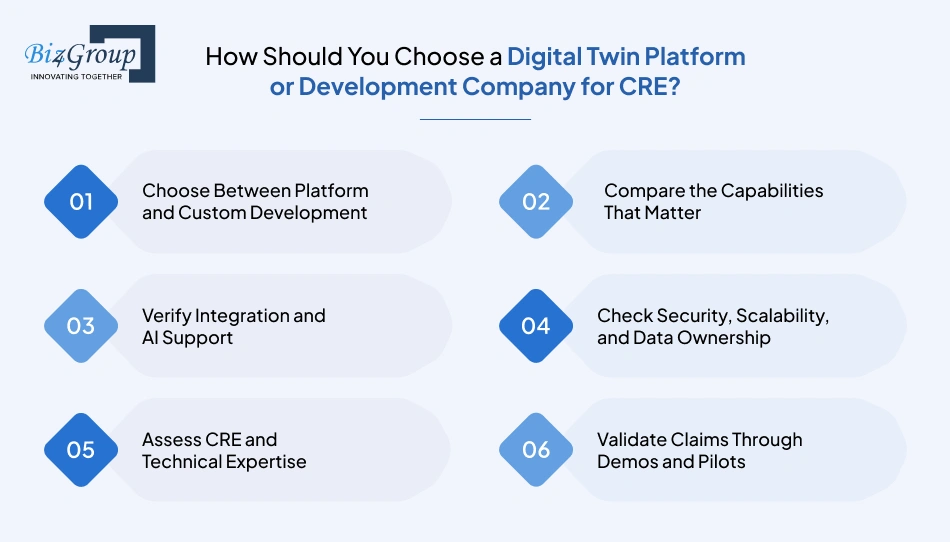
The right choice depends on what the CRE firm already has, what it needs to build, and how deeply the digital twin needs to connect with property systems. Evaluate the vendor offering AI integration services against AI capabilities, security, scalability, CRE workflows, and its ability to prove those capabilities through an actual demo or pilot.
Choose Between Platform and Custom Development
Start by deciding whether an existing platform covers the required workflow or whether the project needs custom development.
An off-the-shelf platform makes more sense when the required features, integrations, and data model already match the portfolio.
Custom development becomes more relevant when the project involves business app development using AI, specific BIM-to-asset mapping, proprietary workflows, or integrations with existing PMS, BMS, CMMS, and IoT systems.
For a custom project, ask whether the vendor if they provide MVP development services and technical proof-of-concept work before committing to the complete platform. If the project needs substantial customization, compare the option to hire AI developers directly with working through a development partner.
Compare the Capabilities That Matter
Real estate investors and property teams often ask:
"I am struggling to get international investors and buyers to commit to our commercial properties because they cannot fly in for every walkthrough, so can you suggest how digital twin technology could solve this and recommend a few leading companies that specialize in this for commercial real estate."
A digital twin can provide remote access to building layouts, spaces, assets, and relevant property information, reducing reliance on physical walkthroughs during initial evaluation. Check the provider's 3D/BIM capabilities, remote visualization, property-data integration, and investor-facing workflows.
|
Capability |
What to Check |
|---|---|
|
Asset modeling |
BIM, floor plans, equipment hierarchy, asset relationships |
|
Live data |
IoT, BMS, meters, occupancy, equipment telemetry |
|
Analytics |
Energy, asset performance, anomalies, portfolio comparisons |
|
AI |
Predictive maintenance, forecasting, anomaly detection |
|
Workflows |
Alerts, work orders, maintenance actions, reporting |
|
Portfolio support |
Multiple properties, roles, permissions, property-level views |
For digital twin features for commercial property management, the important question is whether each capability connects to an actual property workflow.
Verify Integration and AI Support
Ask the vendor to demonstrate how they integrate AI into an app, starting with a real building data point and showing how it becomes an analysis, prediction, or operational action.
A useful demo starts with an IoT or BMS reading, maps it to the correct asset, stores its historical context, and shows how an AI model or rule turns that information into an operational output.
This is particularly important for digital twin system integration with PMS and IoT platforms. Biz4Group's published AI development work describes integration with existing applications, platforms, business systems, APIs, data environments, and AI services, along with MVP and PoC development for testing technical assumptions.
Check Security, Scalability, and Data Ownership
Ask specific questions before signing a development agreement:
- Who owns the custom code, data model, and trained models?
- Where is property and tenant data stored?
- Which third-party AI or cloud services receive the data?
- How are users, properties, and equipment permissions separated?
- What happens when another property is added?
- Who maintains integrations when a BMS or PMS changes?
- What support continues after launch?
These questions matter more than broad claims about being "enterprise-ready."
Assess CRE and Technical Expertise
Look for evidence that the vendor understands both real estate workflows and the underlying technology. A company that has built AI property platforms still needs to demonstrate that it understands your specific CRE environment, especially when the project involves physical assets, building systems, maintenance data, and portfolio operations.
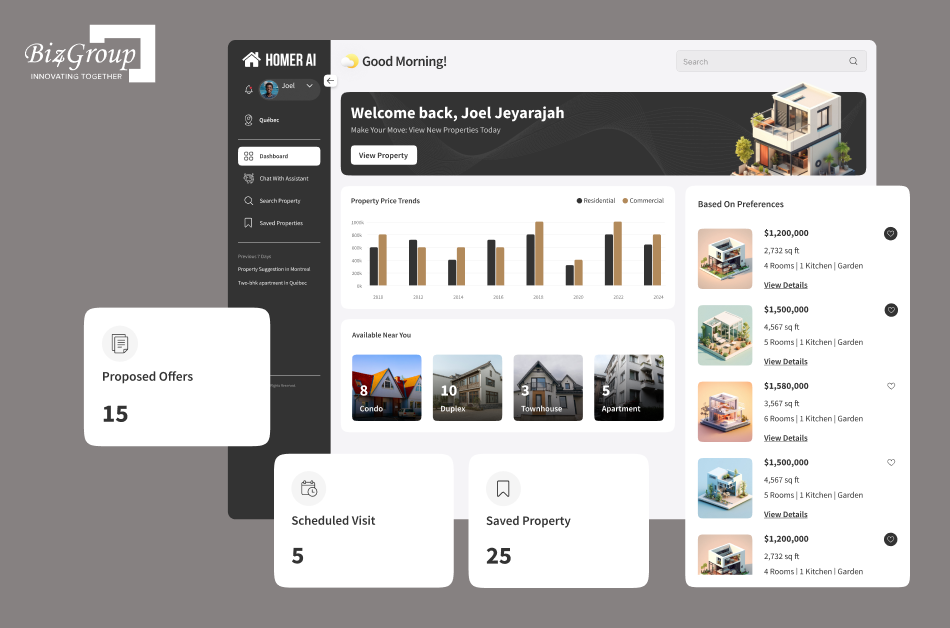
Biz4Group's Homer AI project combined conversational AI with property preferences, property plans, APIs, scheduled visits, and 3D property rendering. The project used FastAPI to retrieve property-plan information and Three.js to render 3D models, providing relevant experience with connecting property information to an interactive digital representation.
Validate Claims Through Demos and Pilots
A vendor presentation tells you what the product is supposed to do. A focused demo shows how it actually works.
For a CRE digital twin, ask the vendor to demonstrate one complete workflow:
Building data → Asset mapping → Live update → Analysis or AI → Alert → Maintenance or operational action
Then test the workflow with representative property data through a PoC or MVP. Check data accuracy, response time, asset mapping, user permissions, AI output, and integration behavior.
This approach also aligns with Biz4Group's published AI development process, which describes PoCs for testing specific technical questions and MVPs for validating essential functionality, integrations, data, and user interaction before larger implementation.
The strongest vendor decision comes from evidence you can test: working integrations, relevant CRE experience, clear ownership terms, measurable technical performance, and a pilot that reflects the way your properties actually operate.
Still Wondering Where Your Digital Twin Should Start?
Find the right use case, data sources, integrations, and rollout path before you overbuild.
Plan Your CRE Digital TwinWrapping Up!
Digital twin technology for commercial real estate starts making sense when the data answers a real property question. Is that chiller actually behaving differently? Why did energy use jump in Building 7? Which asset needs attention before it fails? Getting useful answers means connecting BIM, IoT, BMS, maintenance history, and AI to the workflow that follows. A 3D model alone won't do the job. What matters is whether the connected data leads to a decision someone can act on.
Biz4Group brings relevant E-E-A-T from providing AI development services around commercial real estate workflows, data integrations, and operational use cases. Its development approach covers discovery, architecture, MVP development, integration, testing, and deployment. That fits the practical path discussed here: prove the workflow first, measure the result, then scale. Whether you're evaluating or planning your first property, then contact Biz4Group.
FAQs
1. How long does digital twin implementation take?
A focused digital twin MVP for one commercial building often takes a few months, while a full portfolio deployment takes longer because each property adds data mapping, system integrations, testing, and rollout work. The timeline depends heavily on BIM readiness, BMS and IoT connectivity, historical data quality, and the number of workflows included.
2. What is the difference between a BIM model and a digital twin?
BIM provides the building's physical and asset information, while a digital twin connects that information with live operational data. With building lifecycle digital replica development, the model stays connected to information from IoT sensors, BMS platforms, maintenance systems, and other building sources throughout the property's operational lifecycle.
3. Does digital twin require IoT sensors?
No. A digital twin can start with existing BIM, BMS, PMS, CMMS, energy, and equipment data. IoT sensors become useful when existing systems do not provide the measurements required for a specific use case. Real time IoT data integration for buildings becomes especially valuable for equipment condition monitoring, occupancy analysis, and energy management.
4. Can a digital twin work with existing BMS and PMS systems?
Yes. APIs and integration layers connect the digital twin with existing BMS, PMS, IoT, and maintenance systems. Consistent asset identification remains important because each reading needs to connect to the correct property, floor, room, equipment, or asset. This creates a smart building operations and analytics platform from data that previously sat across separate systems.
5. Can digital twins be used across multiple commercial properties?
Yes. A portfolio-level twin uses a common data structure while allowing each property to retain its own equipment, systems, schedules, and configurations. This supports property asset performance monitoring system capabilities across buildings and makes it easier to compare energy use, equipment condition, maintenance activity, and other performance measures.
6. How does AI improve a commercial real estate digital twin?
AI analyzes patterns across equipment readings, maintenance history, occupancy, energy consumption, and other property data. Applications include anomaly detection, predictive maintenance, forecasting, and AI powered building performance simulation, giving property teams a way to test operating conditions and identify potential performance issues.
7. What data does a digital twin need to support predictive maintenance?
Predictive maintenance works best with equipment specifications, sensor readings, operating history, maintenance records, failure history, and runtime data. These inputs support a predictive maintenance workflow automation process where an equipment anomaly can move from detection to inspection, work-order creation, and follow-up.
8. What should a CRE team measure after launching a digital twin?
Track metrics connected to the original business case, including emergency repair costs, equipment downtime, energy intensity, maintenance response time, asset failures, and technician workload. Over time, AI powered building performance simulation and portfolio analytics can also help compare operating scenarios and identify opportunities for efficiency improvements.
