Location :
Orlando, FL, USA
 +1 (407) 714-1616
 info@biz4group.com


 AI Powered Summary by Biz4AI
- AI agents in healthcare fail on siloed data because they cannot reliably access, reconcile, or interpret records scattered across systems.
- Working a claim requires connected coverage, clinical, authorization, claim, financial, and denial context for the specific case.
- Healthcare data fragmentation hurts most in denial work, where interpreting the denial and finding evidence become separate cross-system investigations.
- Healthcare data integration can make fragmented data usable without replacing core systems, when paired with normalization, task-specific retrieval, and governance.
- When context is missing or conflicting, a reliable agent flags the gap, asks for evidence, or escalates instead of guessing.
- Bill Matters by Biz4Group supports denial intelligence, evidence identification, and appeal preparation, with a person reviewing every appeal before submission.
A denial comes back with CARC 197, which means authorization, precertification, or notification was absent. Your AI agent reads the remittance and recommends a corrected claim. But the authorization was approved weeks ago, under a slightly different member ID, in a utilization management portal the agent cannot reach.
Your AI agent may not be failing because the model is weak. It may be failing because the information it needs is scattered across the claims workflow.
That is the common pattern with AI agents in healthcare. The organization often has the data. The agent still cannot use it for the task in front of it. The authorization, clinical notes, claim history, and payment posting each sit in a different system, with different formats and access rules. Possessing data is not the same as making it usable.
This article follows the failure from cause to fix. It covers why agents break on fragmented data, what context a claim requires, where fragmentation hurts RCM workflows, how to make the data usable, how an agent should behave when context is still incomplete, and how to judge readiness.
Why Do AI Agents Fail When Healthcare Data Is Siloed?
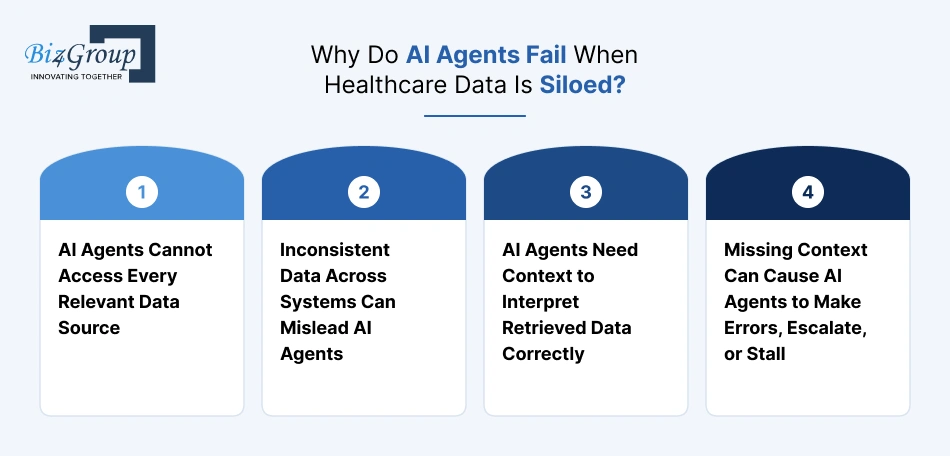
They fail because a silo limits what the agent can retrieve, reconcile, and interpret. Healthcare data silos leave the agent with partial records, and partial records lead to unreliable reasoning. The chain looks like this:
Fragmented data → incomplete or inconsistent context → unreliable agent reasoning → workflow exceptions → human intervention
Model quality still matters. But a capable model cannot compensate for missing, inaccessible, inconsistent, or poorly contextualized workflow data. Five ideas are easy to blur together here: availability, accessibility, consistency, context, and actionability.
Below we have separated them down for you:
1. AI Agents Cannot Access Every Relevant Data Source
Data availability means the information exists somewhere in the organization. Data accessibility means the AI agent can retrieve it when the task requires it. Siloed healthcare systems can create a gap between the two.
An authorization approval, for example, may exist in a payer or utilization management portal that staff can access. The agent may not be able to retrieve it if the portal has no usable interface, requires an individual login, or operates outside the systems available to the agent.
The same issue can occur with:
- Scanned clinical or billing documents stored outside connected systems
- Notes recorded in legacy applications
- Payer information available only through external portals
- Supporting documentation stored in separate repositories
This creates a partial view of the case. The agent can process the information it can retrieve, but it may not know that a relevant record exists elsewhere. Its response can therefore appear complete while omitting information that materially affects the task.
2. Inconsistent Data Across Systems Can Mislead AI Agents
Siloed systems can also contain different versions of the same information. The problem is not simply that data is stored separately. The agent must determine whether records from different systems refer to the same patient, claim, payer, or transaction.
Examples include:
- A member ID appears with a prefix in the payer system but without it in registration.
- A patient's name or date of birth differs slightly between the EHR and billing system.
- One system shows a claim as closed while another shows it as open.
- The same payer appears under different naming conventions across systems.
These discrepancies can interfere with record matching and claim interpretation. An agent may associate records that belong to different patients, treat one patient's records as separate cases, or interpret conflicting claim statuses as a single state.
The result can be a confident response built on data that does not consistently describe the same underlying case.
3. AI Agents Need Context to Interpret Retrieved Data Correctly
Even when an agent can retrieve the relevant records, siloed data can leave those records disconnected from the information that gives them meaning.
Consider a payment amount in a remittance record. The amount alone does not tell the agent whether the payment is correct or what should happen next. It needs to establish:
- Which claim and claim line the payment belongs to
- Whether the payment came from the primary or secondary payer
- Which adjustment codes explain the difference between billed and paid amounts
- Whether the remaining balance represents patient responsibility or a contractual adjustment
Without these relationships, each individual record may be accurate while the overall picture remains incomplete.
This is the critical distinction: access to a record is not the same as access to the context required to interpret that record correctly.
4. Missing Context Can Cause AI Agents to Make Errors, Escalate, or Stall
When the agent cannot establish a complete and reliable view of the case, its ability to complete the task breaks down. The resulting failure generally takes one of three forms:
- Incomplete analysis: The agent reaches a conclusion using only the information available to it, which can produce an unsupported or incorrect recommendation.
- Escalation: The agent cannot establish enough evidence to proceed and sends the case to a human reviewer.
- Failure to complete: The agent cannot resolve the missing relationships or information and returns an incomplete result or stops the workflow.
For example, an agent reviewing a denied claim may retrieve the denial reason but lack access to the related authorization record or supporting documentation. It has information about the denial, but not enough connected evidence to determine the full case.
That is why siloed healthcare data creates a fundamental limitation for AI agents: the agent may be able to read individual records without being able to establish the complete, reliable picture required to make a decision or complete the task.
What Data Does an AI Agent Need to Work a Healthcare Insurance Claim?
AI agents for healthcare claims need six connected kinds of context, plus supporting evidence that ties them to the case. The table is the inventory. It describes what the agent needs, not how the systems get connected.
|
Context |
Examples |
Why the agent needs it |
|---|---|---|
|
Coverage |
Eligibility, plan, coverage order |
Establish who is covered and under which benefit |
|
Clinical |
Documentation, diagnosis and procedure context |
Understand the service that was delivered |
|
Authorization |
Approval status, dates, approved services |
Confirm whether required approval existed |
|
Claim |
Claim lines, billing history |
Understand what was submitted |
|
Payer |
Adjudication result, payer and contract information |
Understand what the payer did and on what terms |
|
Financial |
EOB, ERA, payment posting |
Understand the financial outcome |
|
Denial |
Denial reason, history, prior actions, evidence |
Determine the next workflow step |
Read together, these form a chain: claim, payer, provider, clinical, financial, denial, and recovery context. AI claims processing only works when the agent can follow that chain for a single case.
1. Identity, Eligibility and Coverage Context
Everything starts with knowing who the patient is and what coverage applied on the date of service. That means patient and member identity, payer, plan, and coverage order.
Eligibility data answers whether coverage was active. It does not always answer which benefit applied or whether another payer was primary. The agent needs both, plus the payer and contract terms that govern how the claim should have been adjudicated. A wrong identity match at this first step contaminates every later step.
2. Clinical and Authorization Context
Clinical context tells the agent what happened. Authorization context tells it what was approved before it happened.
For claims work, the agent rarely needs the whole chart. It needs the documentation that supports the billed service and the diagnosis and procedure context where payer policy depends on it. It also needs the authorization record: status, dates, and approved services. Much of this sits in clinical systems and payer portals that billing teams reach in different ways.
3. Claim and Financial Context
Claim context shows what was submitted: the claim lines, codes, dates, and billing history. Financial context shows what the payer did about it: the EOB or ERA, the remittance, and the payment posted.
The agent has to read the two together. A payment makes sense only against the line it answers. Payment reconciliation between submission and remittance is where many errors surface.
4. Denial and Recovery Context
This is the context that decides the next step. It includes the denial reason, how the payer has handled similar claims, prior actions on the account, earlier appeals or recovery attempts, and the supporting evidence available.
Without recovery history, an agent may repeat an action that already failed. Without evidence, it can describe the problem but cannot support a fix.
Where Do Data Silos Break the Healthcare Claims and RCM Workflow?
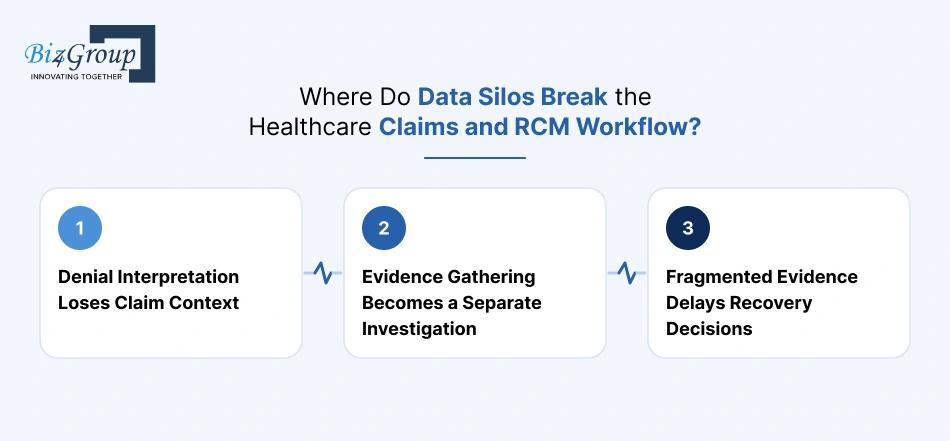
The technical problem becomes operational when a real denial arrives. The workflow typically breaks at three points: understanding the denial, finding the evidence, and deciding how to recover the payment.
1. Denial Interpretation Loses Claim Context
A denial signal usually arrives on the remittance as a code pair, such as a CARC with a RARC. These codes explain what the payer says happened. They do not provide the complete claim history needed to understand the case.
The team may need to pull information from several places:
- The PM system for claim and billing details
- The payment posting system for remittance information
- The EHR or document repository for clinical context
- The payer portal for authorization or coverage details
The denial is visible, but the information needed to interpret it sits across multiple systems. Staff must reconcile those records before determining what actually happened.
When Biz4Group built Bill Matters, it addressed this gap through denial intelligence. The capability reads the EOB and denial code, then connects the denial reason with the relevant claim context. This gives the team a case-level view instead of requiring them to interpret the denial code in isolation.
2. Evidence Gathering Becomes a Separate Investigation
Once the denial is understood, the next question is whether the available evidence supports a recovery action.
A medical necessity denial, for example, may require:
- Clinical documentation
- The submitted claim
- Authorization records
- Billing history
- Payer information
- Previous correspondence
That evidence may be spread across an EHR, billing system, payer portal, document repository, and email. Staff must locate, compare, and connect the supporting records before deciding whether the case can move forward.
Bill Matters' AI evidence intelligence maps the denial reason to the documentation needed to support recovery. It identifies available and missing evidence while keeping that evidence connected to the case for human review.
3. Fragmented Evidence Delays Recovery Decisions
Once the denial context and supporting evidence are available, the team must determine the appropriate recovery path. Depending on the case, that may mean correcting the claim, submitting additional information, resubmitting, or filing an appeal.
When the required information is fragmented, staff must reconcile records before determining the next step. That slows resolution and can become more costly when payer-specific appeal windows are involved.
This is where healthcare claims automation becomes more difficult, particularly in AI denial management. Clean claims can often follow predictable workflows with structured data. Denials require the system to connect information across multiple sources before it can determine the appropriate action. When those connections are missing, the workflow falls back to manual investigation and rework.
The operational impact is longer denial-to-decision time, more workflow exceptions, and more staff effort spent investigating cases instead of recovering revenue.
Stop Making Denials a Data Hunt
Connect the information your teams need before fragmented data slows down revenue recovery
Explore Smarter RCM WorkflowsHow Can Healthcare Organizations Make Fragmented Data Usable Without Replacing Core Systems?
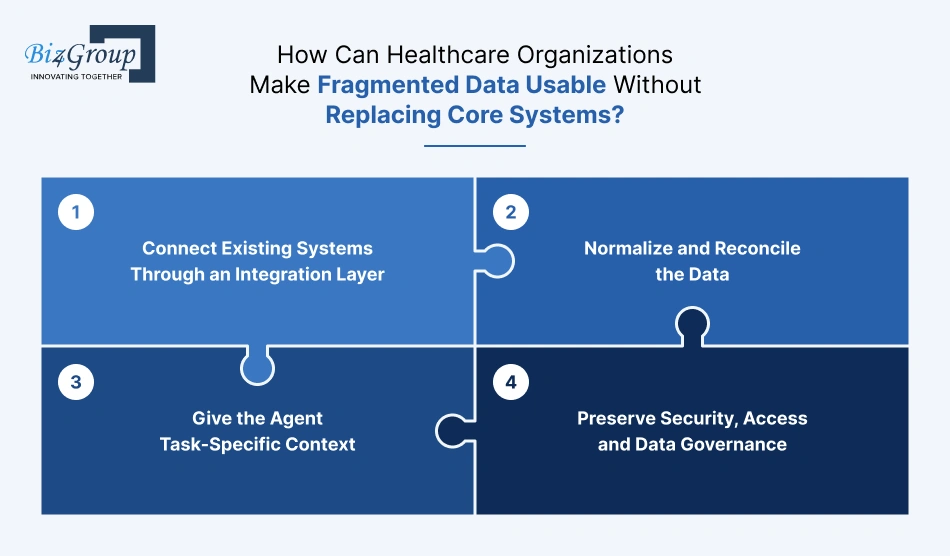
Most organizations do not need to replace their EHR or PMS to make fragmented data usable. They can connect existing systems, normalize the data, retrieve task-specific context, and govern access.
Interest in AI in healthcare revenue cycle management is growing. A 2025 HFMA and AKASA Pulse survey of 519 hospital and health-system finance and revenue cycle leaders found that 80% were exploring, piloting, or implementing generative AI for revenue cycle management.
The same survey identified integration with existing systems as a major hurdle. The survey was commissioned by AKASA and covered hospitals and health systems only.
These four jobs should remain separate:
- Integration moves information between systems.
- Normalization makes data consistent.
- Context retrieval selects what the agent needs for a task.
- Governance controls access and accountability.
1. Connect Existing Systems Through an Integration Layer
An integration layer connects source systems with the AI agent using the interfaces they already support, including APIs, integration engines, HL7 messages, and EDI transactions such as 837 claims, 835 remittances, and 270/271 eligibility exchanges.
FHIR can also support healthcare interoperability. HL7 defines FHIR as a standard for healthcare data formats and an API for exchanging health information. However, FHIR moves structured information; it does not resolve conflicting records or determine which data an agent needs.
CMS-0057-F is also pushing payer interoperability forward. Impacted payers must implement Patient Access, Provider Access, Payer-to-Payer, and Prior Authorization FHIR APIs by January 1, 2027. Operational provisions began January 1, 2026, with drug prior authorizations excluded.
For payer provider data integration, this creates useful infrastructure for specific payer data flows. It does not connect every internal system or evidence source. Organizations still need their own health insurance data integration and claims data integration across the systems their workflows depend on.
2. Normalize and Reconcile the Data
Integration makes data available. Normalization makes equivalent information consistent across systems.
This includes:
- Mapping different data formats and code sets
- Standardizing dates and status values
- Cleaning payer names and identifiers
- Matching the same patient or member across systems
Two controls matter most:
- Identity matching: Use defined rules to link records and flag uncertain matches rather than forcing them.
- Reconciliation: Apply clear precedence rules when systems disagree and record which source takes priority.
This is the core of RCM data integration: ensuring the agent works from consistent records rather than conflicting versions of the same case.
3. Give the Agent Task-Specific Context
Once data is connected and reconciled, the agent still needs the right information for the task. More data does not mean better reasoning. Irrelevant records can obscure the facts that matter.
For a denial task, retrieval might include:
- The claim line under review
- The matching remittance
- The relevant authorization
- Documents tied to the denial reason
The agent does not need the entire patient record or account history. Retrieval should also identify the source of each item so the result can be verified.
The goal is simple: give the agent the information required for the task, not everything available in the enterprise.
4. Preserve Security, Access and Data Governance
Connecting more systems also increases access to protected health information. The agent therefore needs defined permissions, authentication, monitoring, and ownership.
Under HIPAA, the minimum necessary standard generally limits PHI use to what a specific purpose requires, while the Security Rule requires safeguards for electronic PHI, including access control, audit controls, authentication, integrity, and transmission security.
In practice, treat the agent as a user with a defined role:
- Give it its own authenticated identity and role-based access.
- Limit each task to the data it requires.
- Log what it accesses and produces.
- Maintain ownership of data definitions, lineage, and retention.
These controls make AI use traceable without requiring organizations to replace the systems that already hold their healthcare data.
What Should an AI Agent Do When the Data Is Missing, Conflicting, or Incomplete?
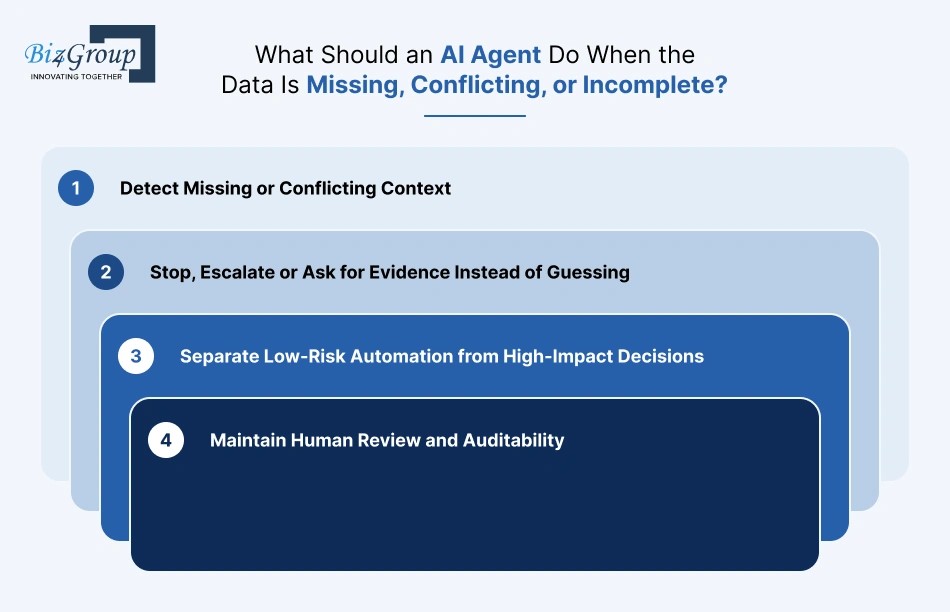
It should stop guessing. Connected systems still leave gaps, so AI agents in healthcare need defined behavior for incomplete context: detect the gap, say what is missing, ask for evidence or escalate, and leave consequential decisions to a person.
1. Detect Missing or Conflicting Context
A reliable agent checks its context before it reasons. That means:
- Comparing what it retrieved against the required context for the task.
- Recognizing when two records disagree instead of picking one silently.
- Flagging its uncertainty in plain terms.
- Tying each conclusion to a source, it actually retrieved.
The last point matters most. An answer with no source should be treated as unsupported.
2. Stop, Escalate or Ask for Evidence Instead of Guessing
When the check fails, the agent has three acceptable moves. It can request the missing item, route the case to a person with the gap described, or stop. It should never invent evidence, fill in a missing authorization number, or assume a document exists.
Consider a denial where the clinical note supporting the service cannot be found. The right output is not a confident appeal. It is a short list of what is missing and where the agent looked.
Once the gaps are known, Bill Matters' AI Appeal Builder drafts a citation-backed appeal from the available evidence. A person reviews and signs off on every appeal before it reaches a payer, so consequential action stays under human control.
3. Separate Low-Risk Automation from High-Impact Decisions
Not every task carries the same risk. Match the control to the consequence.
|
Task tier |
Examples |
Suggested control |
|---|---|---|
|
Lower risk |
Classification, summarization, retrieval, flagging |
Automate with monitoring and sampling |
|
Moderate |
Recommending a next action, drafting a document |
Automate the draft and require human review |
|
Higher impact |
Submitting an appeal, writing off a balance, billing the patient, anything touching coverage or liability |
Keep under human decision with a full audit trail |
This is a governance choice, not a statement of what the law requires. Legal requirements for human review vary by program, payer, and jurisdiction. Confirm the rules that apply before automating decisions that affect coverage or patient liability.
4. Maintain Human Review and Auditability
Human oversight only works if it is designed in. Define who reviews which output, what the reviewer sees, and what authority the agent has.
A useful audit trail records the sources retrieved, the conclusion reached, the gaps flagged, and the person who approved the action. Monitor it over time. A rise in escalations often points to a new data problem or a payer change before anyone reports it.
AI governance for agents comes down to clear boundaries, recorded decisions, and a person accountable for consequential action.
How Do You Know Whether Your Healthcare Data Is Ready for AI Agents?
AI-ready healthcare data is data an agent can access, trust, and act on for a specific workflow. Six questions test that. A no on any of them is a signal to narrow the workflow before you scale AI agents further.
1. Can the Agent Access Every Required Source?
List the context the workflow needs. Then confirm the agent can retrieve each item with permission.
- Does every required source have an interface the agent can use?
- Are any key documents available only to a person?
- Does the agent know when a source fails to respond?
2. Is the Data Consistent Across Systems?
Test with real cases. Take a sample of recent claims and compare identity, dates, and status across systems.
- What share of records match without manual correction?
- Are the rules for resolving conflicts written down?
3. Can the Organization Identify Missing Context?
Check whether gaps are detectable. For each task, can the workflow tell when a required item is absent, and does it say so? If missing items surface only when a person complains, the answer is no.
4. Are Permissions, Escalation and Human Review Defined?
Confirm the agent has a scoped role, a defined escalation path, a named reviewer for high-impact actions, and an audit trail. If any of these is undecided, the workflow is not ready for production.
5. Can You Measure Agent Performance and Business Outcomes?
Set the measures before launch, not after.
|
Measure |
What it tells you |
|---|---|
|
Accuracy |
Whether outputs are correct against a reviewed sample |
|
Exception rate |
How often the agent cannot complete the task |
|
Human intervention rate |
How much human work remains per case |
|
Workflow completion |
Whether cases finish end to end |
|
Turnaround time |
Whether resolution is actually faster |
|
Financial impact |
Whether recovery or cost outcomes change |
6. Is the First Workflow Narrow Enough to Control?
Do not automate every process at once. Choose one workflow where the required data is identifiable, outcomes are measurable, failure modes can be monitored, escalation is defined, and human review is available. A single denial category for a single payer is a reasonable starting unit.
Expand only after the exception rate and intervention rate hold steady. That is how AI claims automation scales because it was earned, and it tells you which sources your data integration effort should reach first.
Reliable AI agents in healthcare depend on more than model quality. The agent needs accessible, consistent, relevant context, plus clear boundaries for what it can do when that context is incomplete. Healthcare data integration gives the agent a fair chance to work a claim. Workflow design and human review decide whether it works safely. Start with one bounded workflow and measure it. If denials and evidence gathering are where your agents stall, book a Bill Matters product demo to see that workflow in action.
FAQs
1. What is a data silo in healthcare?
A data silo is information held in one system or department that other systems and teams cannot easily access or combine with their own. In claims work, a typical silo is authorization data in a portal, clinical notes in an EHR, and payment data in a billing system.
2. Are healthcare data silos the same as interoperability problems?
Not exactly. Interoperability is the ability of systems to exchange and use data. A silo can persist even where exchange is technically possible, because of access rules, ownership, conflicting definitions, or because no connection was ever built.
3. Can AI agents work with legacy healthcare systems?
Yes, often through existing interfaces such as HL7 messages, EDI files, batch exports, or an integration engine. Expect limits. Older systems may expose fewer fields or update less often, which affects what the agent can do reliably.
4. Do healthcare organizations need a data warehouse before deploying AI agents?
Not necessarily. A warehouse, data lake, or data fabric can help when you need consolidated analytics. Many agent workflows instead need task-specific retrieval from the source systems. Decide by workflow, not by default.
5. What healthcare systems should be connected for AI claims processing?
Start with the systems behind the workflow: the EHR or EMR, the practice management or billing system, the clearinghouse, payer remittance and portal data, authorization records, and the document repository. Add others only when a specific task needs them.
6. Can AI automate denial management when claims data is fragmented?
Partly. Lower-risk tasks such as classifying denials, summarizing remittances, and flagging missing items can work with limited connections. End-to-end denial work needs connected context, and consequential actions still need human review.
7. What happens when an AI agent does not have enough information to process a claim?
A well-designed agent flags the gap, states what is missing, and routes the case to a person or requests the evidence. A poorly controlled one may guess. That difference is designed in. It is not automatic.
8. How can healthcare organizations make their data AI-ready?
Start small. Pick one workflow, list the context it needs, fix identity matching for those sources, connect them, and set the escalation rules. Measure the results, then extend to the next workflow.