 Location :
Orlando, FL, USA
Location :
Orlando, FL, USA +1 (407) 714-1616
 info@biz4group.com

 AI Summary Powered by Biz4AI
- Global AI spending is projected to reach $3.49 trillion by 2027, with AI infrastructure accounting for more than 45% of total spending.
- 88% of organizations now use AI in at least one business function, with adoption particularly strong across technology, financial services, manufacturing, and healthcare.
- 86% of enterprises plan to increase their AI budgets, yet only 39% report measurable EBIT impact, with most reporting an impact of less than 5%.
- Agentic AI spending is projected to grow from $206.5 billion in 2026 to $376.3 billion in 2027, making it one of the fastest-growing areas of AI investment.
- Enterprises are shifting from AI experimentation toward scalable implementations that combine AI models, data, infrastructure, security, and governance to deliver measurable business value.
Disclaimer: AI statistics and forecasts vary by source, methodology, and reporting period. Figures in this report are presented with their original context and should not be treated as directly comparable unless stated otherwise.
Worldwide AI spending is set to reach $2.59 trillion in 2026, a 47% increase from the previous year, according to Gartner's 2026 forecast. That pace of investment raises an obvious question: is the money keeping up with the results? Gartner separately estimates in 2026 forecast report that more than 40% of agentic AI projects could be canceled by 2027 due to unclear business value, rising costs, and governance gaps.
This report brings together the AI development statistics enterprises need to understand where the market is heading in 2027. It looks at how much organizations are investing in AI, how quickly adoption is growing across generative AI, agentic AI, and traditional AI, which industries are leading the way, where AI is delivering measurable ROI, and what the future of AI development looks like beyond 2026.
Before we get into the numbers, there is one important note on methodology: AI research firms measure the market differently. Gartner's spending figures cover the broader AI market, including infrastructure, software, and services. IDC's AI infrastructure data focuses on a narrower hardware segment, while Stanford's AI Index tracks corporate and private investment flows rather than total market spending. These figures aren't directly interchangeable, so throughout this report, we've clearly identified the source and context behind each statistic.
At Biz4Group, we work with organizations building AI-powered products and enterprise AI solutions, and the data reflects something we see in practice: the companies getting the most value from AI aren't necessarily the ones spending the most. They're the ones investing in the foundation around the technology, including data, infrastructure, talent, and governance, rather than treating the AI model as the entire solution.
How Is the AI Market Growing, and Where Are Investments Going?
The AI market growth statistics show where the industry is gaining momentum, while artificial intelligence investment trends reveal where enterprises and investors are putting their money.
Here, we explore statistics across the major types and segments of AI to understand what is shaping AI development in 2027.
Global AI Spending
- Worldwide AI spending is forecast to grow from $1.76 trillion in 2025 to $2.59 trillion in 2026, a 47% increase, and to $3.49 trillion in 2027. (Gartner)
- AI infrastructure will account for more than 45% of total AI spending in 2026, driven by AI-optimized servers, cloud infrastructure, and network fabric. (Gartner)
- AI software spending is projected to rise from $283 billion in 2025 to $452 billion in 2026, a 60% increase. (Gartner)
- AI cybersecurity spending is forecast to jump from $25.9 billion in 2025 to $51.3 billion in 2026, and to roughly $86 billion in 2027, a 231% increase over two years. (Gartner)
- Enterprise AI spending is projected to reach $632 billion by 2028. (IDC, via BusinessWire)
- Global AI infrastructure spending reached $89.7 billion in Q1 2026, up 33% year over year, and IDC has raised its full-year 2026 forecast to $497 billion.
Enterprise Budget Plans
- 86% of enterprises plan to increase their AI budgets in 2026, and only about 2% expect to reduce spending. (NVIDIA, State of AI 2026)
- 48% of North American organizations plan AI budget increases of 10% or more. (NVIDIA)
- The median enterprise AI budget grew 22% year over year. (McKinsey, Global AI Survey)
- 42% of CFOs plan to increase AI spending by at least 30% over the next two years. (Bain & Company)
- AI budgets have grown from 0.8% of revenue in 2025 to 1.7% in 2026. (BCG, AI Radar 2026)
- 94% of organizations remain committed to continued AI investment even where ROI has been delayed. (BCG)
- 35% of organizations expect to spend more than $10 million on AI in 2026. (NVIDIA)
Where Is the Money Going?
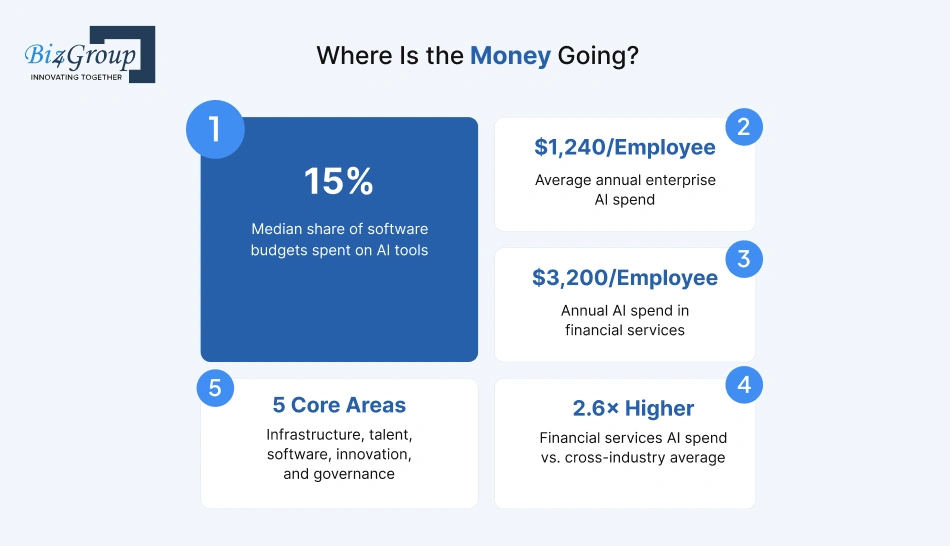
- The median business allocates about 15% of its software budget to AI tools.
- Enterprise AI spending averages $1,240 per employee annually at organizations with 500 or more employees. Financial services firms spend about $3,200 per employee, roughly 2.6 times the cross-industry average.
- Budgets concentrate in five areas: AI infrastructure (GPUs, servers, cloud), AI talent (engineers, MLOps, governance specialists), AI software and platforms (copilots, workflow automation), research and innovation, and security and governance.
Corporate and Private AI Investment
- Global corporate AI investment reached $581.7 billion in 2025, up 130% year over year. (Stanford AI Index 2026)
- Private AI investment totaled $344.7 billion in 2025, up 127.5%, with nearly half flowing into generative AI. (Stanford AI Index 2026)
- US private AI investment reached $285.9 billion in 2025, 23 times China's $12.4 billion. (Stanford AI Index 2026)
- Enterprise generative AI spending tripled from $11.5 billion in 2024 to $37 billion in 2025. (Menlo Ventures, State of Generative AI in the Enterprise)
The pattern across every one of these numbers is the same: AI investment has shifted from experimental budgets to infrastructure-scale, board-level spending. The next question is how that investment is translating into actual use across the enterprise.
Wondering if your AI budget is actually keeping pace, or just keeping you busy?
See how your investment compares with the latest enterprise AI benchmarks.
Talk to Our AI Strategy TeamWhat Do the Latest Statistics Reveal About Different Types of AI?
Enterprise AI is not just one category anymore. Investment, adoption, and risk now vary sharply by the type of AI in question, from broad enterprise adoption down to agentic systems that are still finding their footing. Here's how each one breaks down.
1. Enterprise AI Adoption
Adoption of AI in at least one business function is close to universal. The open question for most organizations is no longer whether to use AI, but how deeply it's embedded.
- 88% of organizations used AI in at least one business function in 2025, up from 78% in 2024 and 55% in 2023. (McKinsey, State of AI)
- A separate 2026 enterprise survey puts adoption at 91%.
- 80% of Fortune 500 companies now use AI agents. (Microsoft)
- Adoption leaders share three traits: large volumes of high-quality data, repeatable business processes, and clearly measurable ROI.
- Adoption rate alone is a weak signal of maturity. A single chatbot deployment counts the same as an enterprise-wide rollout. Business functions using AI, production deployments versus pilots, and measurable business outcomes are better benchmarks.
2. Generative AI Adoption
- 70% of organizations use generative AI in at least one business function. (Stanford AI Index 2026)
- 15% of organizations report significant, measurable GenAI ROI already, with 38% expecting it within a year. (Deloitte, State of AI in the Enterprise)
- 26% of organizations are exploring autonomous agent development to a large or very large extent. (Deloitte)
- Adoption by business function: content creation (71%), software development (58%), customer interaction (54%), with operations and analytics both growing.
- 14% of employees use generative AI daily at work, and daily users report meaningfully better outcomes than infrequent users: 92% report increased productivity, 58% report greater job security, and 52% report salary increases. (PwC, Global Workforce Hopes and Fears Survey 2025)
- Worldwide generative AI spending was forecast to reach $644 billion in 2025, up 76.4% year over year. (Gartner)
- 84% of developers now use AI coding tools, and GitHub Copilot is deployed at 90% of Fortune 100 technology companies. (GitHub)
- Consumer-level generative AI adoption varies sharply by geography: 73% of India's surveyed population reports GenAI use, compared with 45% in the US and 29% in the UK. Adoption also skews generational, with 70% of Gen Z reporting GenAI use. (Salesforce)
- 84% of sales professionals using or planning to use GenAI report increased sales, and 51% of marketers are using or planning to use it. (Salesforce)
- 99% of businesses say responsible generative AI measures are necessary, and 71% of IT leaders cite security threats as a barrier to adoption. (Salesforce)
Most enterprises aren't replacing traditional AI with generative AI. They're running both side by side: predictive AI for fraud detection or recommendations, generative AI for drafting, summarizing, and assisting employees.
3. Agentic AI
- Spending on AI agents is forecast to grow from $206.5 billion to $376.3 billion.
- 17% of organizations currently have AI agents in production, and more than 60% expect to deploy them within the next two years.
- Gartner forecasts that 33% of enterprise software applications will incorporate agentic AI by 2028, up from less than 1% in 2024, and that AI agents will autonomously make 15% of day-to-day work decisions by 2028, up from 0% in 2024.
- 50% of companies already using generative AI are expected to launch agentic AI pilots or proofs of concept by 2027, up from 25% in 2025. (Deloitte)
- Only 21% of surveyed organizations report mature agentic AI governance. (Deloitte, 2026 Agentic AI Survey)
- More than 40% of agentic AI projects are expected to be canceled before reaching production, due to unclear business value, rising costs, and governance gaps. (Gartner)
Agentic AI is both the fastest-growing category of AI investment and the one carrying the highest execution risk. The gap between agent pilots and agents running unattended in production is still wide.
4. AI Infrastructure
- Combined 2026 capital expenditure from Amazon, Alphabet, Microsoft, and Meta is estimated at $695 billion to $720 billion.
- Microsoft's Q3 FY2026 capital expenditure alone was $31.9 billion. (Microsoft Investor Relations)
- Global data center systems spending is projected to reach $787.99 billion in 2026, up 55.8%. (Gartner)
- Active AI-dedicated data center capacity stands at 11.5 GW today and is projected to reach 43.6 GW by 2031.
- Regional AI infrastructure spending in Q1 2026: the United States led with $67.9 billion (75.7% of the global total), followed by China ($7.8 billion, 8.7%), APeJC ($5.8 billion, up 62% year over year), and Western Europe ($5.1 billion). The Middle East and Africa posted the fastest growth, up 233% year over year to $1.1 billion. (IDC, Q1 2026 AI Infrastructure Tracker)
5. AI ROI and Business Outcomes
- About 95% of generative AI pilots deliver little or no measurable P&L impact, while about 5% achieve rapid revenue acceleration. (MIT NANDA, The GenAI Divide: State of AI in Business 2025)
- The average return is $3.70 for every $1 invested in generative AI.
- 56% of CEOs report neither revenue growth nor cost reduction from their AI investments, while 12% report both. (PwC, 29th Annual Global CEO Survey 2026)
- 25% of planned AI spending is expected to be deferred into 2027, and fewer than a third of decision-makers can tie AI value directly to financial growth. (Forrester, 2026 Technology & Security Predictions)
- Organizations that redesign work processes around AI are twice as likely to exceed their revenue goals. (Gartner)
- The workflows where AI produces measurable value first tend to be high-frequency ones: customer support, software development, document processing, internal knowledge management, and back-office finance operations.
7. AI Adoption Barriers
- Top barriers to enterprise AI adoption: data quality and availability (52%), lack of internal AI expertise (49%), regulatory and legal concerns (31%), and resistance to change (30%). (PEX Report 2025/26)
- 67% of organizations have experienced a security breach linked to an unapproved AI tool. (WRITER, Enterprise AI Adoption Survey 2026)
- Only 28% of executives say they trust AI for decision-making. (Alteryx, 2026 Executive Insights on AI)
Most of these barriers are organizational rather than technical. Two companies can deploy the same foundation model and get very different results depending on data quality, governance, and change management.
How Is AI Adoption Evolving Across Industries?
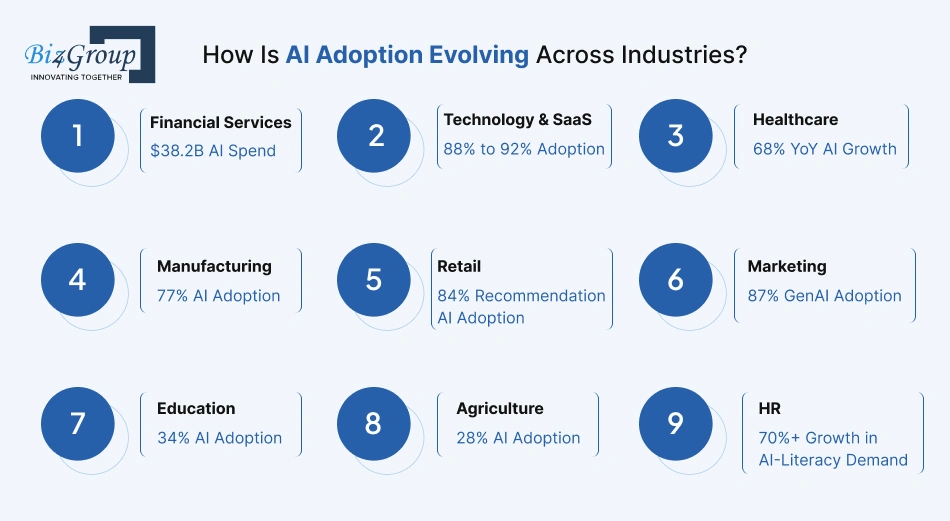
Investment and adoption both vary widely by sector. Financial services and technology lead on spending, healthcare is growing fastest, and education and agriculture are still catching up. Here's what the data shows, industry by industry.
1. Financial Services
- AI spending in financial services reached $38.2 billion in 2026, the highest of any industry tracked. (Presenc AI)
- Adoption sits between 79% and 84% overall, and reaches 89% for fraud detection specifically.
- Financial services organizations spend about $3,200 per employee annually on AI, roughly 2.6 times the cross-industry average.
- Primary use cases: fraud detection, risk analysis, and regulatory compliance.
2. Technology and SaaS
- Technology sector AI spending reached $34.6 billion in 2026, and the sector allocates the highest share of any industry's IT budget to AI, at 18.2%. (Presenc AI)
- Adoption sits between 88% and 92%, the highest of any industry, driven by digital-native infrastructure that supports faster deployment.
- Primary use cases: AI coding assistants, copilots, analytics, and customer support.
3. Healthcare
- Healthcare AI spending reached $28.4 billion in 2026 and is growing faster than any other industry, up 68% year over year. (Presenc AI)
- Adoption is 62% overall, with 63% of physicians and 80% of hospitals using AI in at least one function.
- Adoption is driven largely by workforce shortages and rising clinical workloads.
- Primary use cases: clinical documentation, medical diagnostics, and medical imaging.
4. Manufacturing
- 77% of manufacturers use AI, primarily to improve efficiency, quality control, and predictive maintenance.
- Primary use cases: predictive maintenance and automated quality inspection.
5. Retail and E-commerce
- 53% of retailers use AI for demand forecasting and personalization, while adoption for recommendation engines specifically reaches 84%.
- Adoption is driven by competitive pressure and the need to improve customer experience.
- Primary use cases: personalization, inventory forecasting, and dynamic pricing.
6. Marketing
- 72% to 84% of marketing teams use AI in at least one function, and 87% use generative AI specifically.
- Marketers expect generative AI to save 5 hours of work per week, and 71% expect it to eliminate routine busywork.
- Primary use cases: content generation and campaign optimization.
7. Education
- 34% of educational institutions use AI, held back primarily by budget constraints and regulatory considerations.
- Primary use cases: personalized learning and AI tutoring.
8. Agriculture
- 28% of agricultural operations use AI, the lowest adoption rate of any major industry, reflecting lower digital maturity and limited infrastructure investment.
- Primary use cases: precision farming and crop monitoring.
9. Human Resources
- AI engineering hiring grew more than 25% year over year in 2025, and AI engineering roles now make up nearly 7% of technical job postings. (LinkedIn Economic Graph, AI Labor Market Update)
- Job postings requiring AI literacy grew more than 70% year over year. (LinkedIn Economic Graph)
- More than 1 in 3 young workers globally are in occupations with medium-to-high exposure to AI-driven task change. (World Economic Forum, AI and the Future of Entry-Level Work 2026)
- US software developer employment for ages 22 to 25 fell nearly 20% from 2024. (Stanford AI Index 2026)
- 85% of employers say workforce upskilling is a priority and 70% expect to provide upskilling opportunities, but only 7% of AI expenditure currently goes toward people and workforce issues, versus 93% toward technology infrastructure. (World Economic Forum, Future of Jobs 2025)
- 63% of employers cite skills gaps as a major barrier to AI transformation, and 59% of workers are expected to need reskilling or upskilling by 2030. (World Economic Forum)
Hiring alone isn't closing the AI talent gap fast enough. Most organizations now combine external AI specialists with internal upskilling rather than relying on hiring alone.
Across every industry, the pattern holds. Adoption is highest where data is abundant, processes are repeatable, and ROI is easy to measure. Regulation, legacy infrastructure, and lower digital maturity slow adoption elsewhere, but that reflects longer implementation timelines, not lower long-term potential.
How Does AI Adoption and Investment Vary Across Global Markets?
- The United States holds the largest share of global AI talent and led global private AI investment at $285.9 billion in 2025, 23 times China's total. (Stanford AI Index 2026)
- US generative AI investment alone exceeded the combined total of China and Europe in 2025. (Stanford AI Index 2026)
- Consumer-level generative AI adoption varies sharply by country: 73% of India's surveyed population reports GenAI use, compared with 45% in the US and 29% in the UK. (Salesforce)
- 61% of desk workers globally are using or planning to use generative AI, and 75% say they want to use it to automate work tasks and communications. (Salesforce)
What Makes Some AI Programs More Successful Than Others?
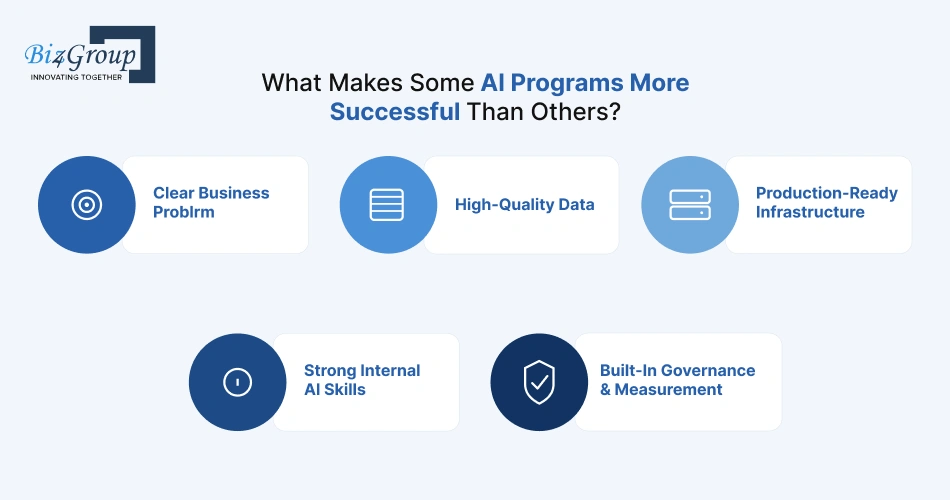
Across every section above, one pattern repeats: the organizations getting the most value from AI aren't the biggest spenders. They're the ones treating AI as a business initiative first and a technology choice second.
The data points to five factors that need to move together:
- A clear business problem, defined before any model is chosen
- High-quality, well-governed data
- Infrastructure built for production workloads, not just pilots
- Internal AI capability, built through a mix of hiring and continuous upskilling
- Governance and continuous measurement, built in from the start rather than added after deployment
Improving all five together is what separates the roughly 5% of organizations extracting real value from generative AI, per MIT NANDA's research, from the 95% still stuck in pilot mode. A stronger model can't compensate for poor data. A larger budget can't compensate for low employee adoption. And even a successful pilot will struggle to scale without governance and integration built around it.
What's Next: AI Development Beyond 2026
- Gartner projects that agentic AI will be embedded in 33% of enterprise software by 2028, up from less than 1% in 2024, and that AI agents will autonomously make 15% of day-to-day work decisions by the same year.
Five Trends Shaping the Next Phase of Enterprise AI
- AI agents are automating multi-step workflows across departments.
- Multimodal AI is bringing text, images, audio, and enterprise data into unified applications.
- Industry-specific models are improving cost efficiency, performance, and data privacy.
- AI governance is becoming a standard enterprise requirement.
- Embedded AI is moving from standalone tools into core enterprise software.
Leading analysts, including Gartner, IDC, McKinsey, and the Stanford AI Index, consistently project continued growth in enterprise AI adoption, infrastructure investment, and AI-enabled business applications through the rest of the decade.
The biggest opportunity ahead isn't predicting which model wins next. It's building an organization that can adapt as the technology keeps changing: one with reliable data, scalable infrastructure, AI-literate teams, and governance built to hold up as adoption scales.
Frequently Asked Questions
1. How can businesses use these AI statistics to plan technology investments?
Businesses can use this data to benchmark enterprise spending, adoption rates, hiring trends, and infrastructure investment against broader market trends. That helps prioritize high-impact use cases, allocate budgets more effectively, and build AI strategies based on measurable outcomes rather than market hype.
2. What's the difference between enterprise AI adoption and generative AI adoption?
Enterprise AI adoption measures how widely organizations use AI across business functions overall. Generative AI adoption focuses specifically on the use of large language models and foundation models for tasks like content creation, software development, customer support, and knowledge management. Most organizations now use both together.
3. Which AI technologies are likely to create the biggest business opportunities next?
AI agents, multimodal AI, industry-specific foundation models, intelligent automation, and AI-powered enterprise software are the areas analysts expect to reshape software development, customer service, operations, and decision-making over the next few years.
4. How do these investment trends affect business competitiveness?
Current investment trends show organizations spending more on infrastructure, cloud platforms, governance, and skilled talent, not just AI models. Businesses that invest strategically across these areas are generally better positioned to scale AI and adapt to changing market conditions.
5. What are the biggest risks in scaling enterprise AI adoption?
The most common challenges are poor data quality, legacy systems, security and compliance requirements, skills shortages, and unclear ROI measurement. Scaling successfully depends on strong governance and high-quality data, not on the technology alone.
6. What AI skills are most valuable for developers right now?
Employers are increasingly seeking developers with expertise in retrieval-augmented generation (RAG), LLMOps, MLOps, AI application architecture, cloud infrastructure, AI security, observability, and API integration.
7. Should organizations build custom AI solutions or buy existing platforms?
It depends on the objective. Many organizations start with commercial AI platforms to move quickly, then customize or fine-tune models for proprietary workflows as adoption matures. A hybrid approach usually offers the best balance of speed, flexibility, and long-term scalability.
8. What should CTOs prioritize when planning AI investments?
CTOs should start with the business problem, not the technology. The strongest AI strategies prioritize high-quality data, scalable infrastructure, governance, security, employee adoption, and measurable outcomes, in that order.
