Location :
Orlando, FL, USA
Location :
Orlando, FL, USA +1 (407) 714-1616
 info@biz4group.com


















Imagine a digital system that doesn’t wait for instructions but instead, understands your business goals, learns from real-time feedback, and takes independent actions to get the job done.
Read More

 How Can You Optimize the Cost of AI Vacation Rental App Development?
How Can an AI Vacation Rental App Generate ROI for Your Business?
How Can You Optimize the Cost of AI Vacation Rental App Development?
How Can an AI Vacation Rental App Generate ROI for Your Business?
"We're managing 150 vacation rental properties across multiple cities. Pricing updates are manual, guest inquiries never stop, and occupancy fluctuates every season. Should we invest in AI vacation rental app development to automate operations and increase revenue?"
Yes. Investing in AI vacation rental app development can significantly improve operational efficiency and revenue performance by managing multiple properties across multiple cities.
AI vacation rental management software development can automate time-consuming tasks like dynamic pricing, bookings, guest communication and more, by reducing response times while freeing staff for higher-value tasks.
The global vacation rental market is expected to reach $101.37 billion in 2026 and grow to $138.74 billion by 2035, it is driven by rising demand for short-term rentals and digital booking experiences. Simultaneously, artificial intelligence is rapidly becoming a competitive necessity. The global AI in hospitality market is projected to grow from $0.23 billion in 2025 to $0.37 billion in 2026. the numbers is reflecting how hotels, rental operators, and travel platforms are investing in AI automation services to improve efficiency and guest experiences.
The reason for this change is simple - traditional vacation rental platforms are lacking optimization necessary for today's time. As property portfolios grow, these limitations become even more expensive.
This is where AI vacation rental app development creates a significant advantage. Instead of relying on manual processes, businesses can use AI to optimize vacation rental operations to enhance guest experience, which will result in higher revenue, lower operational overhead, and better scalability. Let's understand what AI vacation rental management software development actually is.
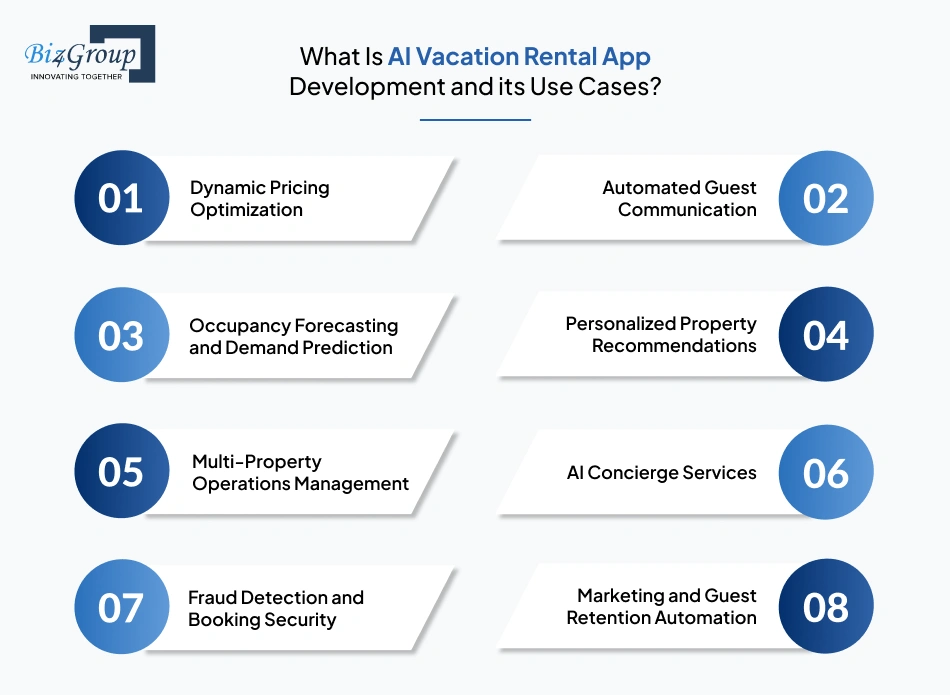
An AI vacation rental app is a digital platform that helps property owners, rental operators, and hospitality businesses manage, market, and optimize vacation rentals using artificial intelligence. It combines traditional vacation rental functionalities such as property listings, bookings, payments, and guest management with intelligent systems that can analyze data, automate decisions, and improve operational efficiency.
Unlike traditional vacation rental software that mainly helps users manage listings, bookings, and calendars, an AI-powered platform actively analyzes business and market data to support decision-making and automate operations.
Here are some use cases of how AI helps in a vacation rental platform:
It helps vacation rental businesses in maximizing revenue by automatically adjusting property rates based on real-time market conditions.
How AI helps:
Example:
A property management company operating 150 rentals notices that a major music festival has been announced in one of its cities. The AI system detects the expected surge in demand and automatically increases rates for nearby properties, to help the business capture additional revenue without manual intervention.
AI-powered assistants in AI vacation rental app can manage guest interactions throughout the booking journey, making their journey seamless.
How AI helps:
Example:
If a guest arrives late at night, asks how to access the property. Instead of waiting for a support representative, the AI assistant instantly shares access codes, parking instructions, Wi-Fi details, and check-in guidelines.
AI helps businesses anticipate future demand by first looking at occupancy patterns like how many properties are booked, how availability changes, and when demand goes up or down to helps make proactive decisions around pricing and inventory.
How AI helps:
Example:
The platform predicts a drop in occupancy during the upcoming month. Property managers launch targeted promotions and adjust pricing ahead of time, to help reduce vacancies and maintain revenue.
AI improves the booking experience by matching travelers with the most relevant listings.
How AI helps:
Example:
A family that frequently books beachfront villas is shown similar family-friendly vacation homes with pools and larger living spaces, increasing the likelihood of a booking.
AI simplifies the management of multi, large property portfolios from a centralized platform.
How AI helps:
Example:
A vacation rental company managing properties across several cities receives an alert that certain listings are generating lower occupancy than comparable properties. The system recommends pricing adjustments and listing optimizations.
AI enhances guest experiences with vacation rental app development with AI features by providing personalized assistance before, during, and after a stay.
How AI helps:
Example:
A guest interested in outdoor adventures receives recommendations for nearby hiking trails, guided tours, and local experiences directly through the vacation rental app.
AI helps protect vacation rental platforms from fraudulent activities and financial risks by detecting unusual booking behavior, payment patterns, and user activity in real time before any damage occurs.
How AI helps:
Example:
A user attempts multiple bookings using different accounts but the same payment information. The AI system identifies the unusual behavior and flags the reservation for verification before processing.
AI helps businesses build stronger guest relationships by delivering personalized communication, anticipating guest needs, providing instant support, and sending timely follow-ups that improve satisfaction and encourage repeat bookings.
How AI helps:
Example:
A guest who previously booked a ski chalet receives personalized winter vacation offers the following season, encouraging repeat bookings and increasing customer lifetime value.
It's important to compare it with the traditional vacation rental platforms to understand the true impact of AI, as many businesses are still using it today. Let's explore how AI booking and rental app development is different from the traditional way.
See what AI-powered platforms can really unlock.
Connect With UsEveryone wants the AI magic, but guests don't book a property because of a brilliant machine learning model. They book because the search works, payments are secure, and reservations are seamless. That's why core features come first.
When you develop AI vacation rental app solutions, these core features serve as the backbone of the platform. They ensure smooth booking management, secure transactions, efficient property administration, and an engaging user experience. Whether you're planning to build AI vacation rental platform capabilities for a startup, expand an existing rental business, or are a travel tech company exploring AI vacation rental app development to compete with Airbnb-like platforms using smart automation features, these foundational capabilities should be considered essential before introducing advanced AI functionality.
Core Feature |
Purpose |
Business Value |
|---|---|---|
User Registration & Profile Management |
Enables guests, hosts, and administrators to create and manage accounts. |
Supports personalized experiences and secure access. |
Property Listing Management |
Allows hosts to create, update, and manage rental listings. |
Maintains an organized property inventory. |
Advanced Property Search & Filters |
Helps travelers find suitable properties based on preferences and requirements. |
Improves booking conversions and user satisfaction. |
Booking & Reservation Management |
Handles reservations, confirmations, modifications, and cancellations. |
Streamlines booking operations. |
Availability & Calendar Management |
Displays real-time property availability and booking schedules. |
Prevents booking conflicts and scheduling issues. |
Secure Payment Processing |
Supports online payments, deposits, refunds, and transaction tracking. |
Ensures safe and seamless transactions. |
Conversational AI & Booking Assistant |
Enables natural-language search, AI-powered booking assistance, guest support, multilingual communication, and voice interactions throughout the customer journey. |
Reduces support workload while improving user experience. |
Ratings & Reviews System |
Allows guests to share feedback and rate their stay experiences. |
Builds trust and platform credibility. |
Push Notifications & Alerts |
Sends updates regarding bookings, payments, check-ins, and promotions. |
Improves user engagement and communication. |
Property Management Dashboard |
Provides property managers with visibility into bookings, occupancy, and performance. |
Simplifies operational management. |
Multi-Property Management |
Enables management of multiple rental units from a centralized interface. |
Supports business scalability. |
Reporting & Analytics |
Tracks bookings, revenue, occupancy rates, and business performance metrics. |
Supports informed decision-making. |
Multi-Language & Multi-Currency Support |
Accommodates users from different regions and countries. |
Expands global market reach. |
Once these features are in place, businesses can move toward more advanced functionality that truly differentiate a modern AI vacation rental solution for hospitality from traditional rental platforms. Furthermore, we are exploring the advanced features of the AI vacation rental solution for hospitality.
Think of core features as the foundation of a vacation rental platform. Advanced AI features are the secret weapon that helps it outperform competitors, delight guests, and generate more revenue without adding more work.
These advanced capabilities are separate from a standard booking platform from a truly intelligent AI vacation rental solution for hospitality.
Advanced AI System |
What It Does |
Business Impact |
|---|---|---|
Revenue Intelligence Engine |
Combines dynamic pricing, occupancy forecasting, demand prediction, competitor monitoring, seasonality analysis, and revenue optimization into a single AI-driven decision system. |
Maximizes occupancy, ADR, and overall rental revenue. |
Guest Experience & Personalization Engine |
Delivers personalized property recommendations, travel suggestions, concierge services, targeted offers, and upsell opportunities based on guest behavior and preferences. |
Improves booking conversions, guest satisfaction, and repeat bookings. |
Property Intelligence System |
Uses computer vision, image analysis, damage detection, amenity verification, listing optimization, and predictive maintenance to manage property quality and performance. |
Improves property condition, listing accuracy, and operational efficiency. |
Operations Automation Engine |
Automates housekeeping scheduling, maintenance workflows, check-ins, checkouts, calendar synchronization, task management, and operational coordination. |
Reduces manual effort and streamlines day-to-day operations. |
Trust, Fraud & Risk Intelligence |
Monitors user behavior, payment activity, booking patterns, guest screening signals, and identity verification processes to detect fraud and reduce platform risks. |
Protects revenue, reduces chargebacks, and improves platform trust. |
Portfolio & Market Intelligence Platform |
Analyzes performance across properties, locations, markets, and customer segments while identifying growth opportunities and expansion potential. |
Supports data-driven scaling and strategic decision-making. |
Document & Compliance Intelligence |
Automates processing of rental agreements, invoices, identity documents, tax records, compliance requirements, and regulatory workflows. |
Reduces administrative overhead and compliance risks. |
Predictive Business Intelligence |
Identifies future operational risks, demand fluctuations, customer behavior trends, and growth opportunities through advanced analytics and AI-driven decision support. |
Improves planning accuracy and business performance. |
Generative AI Content & Marketing Engine |
Creates listing descriptions, marketing campaigns, guest communications, SEO content, multilingual content, and personalized promotional materials. |
Reduces content creation costs and improves marketing effectiveness. |
These features are rapidly becoming the differentiators that drive growth in modern AI booking and rental app development projects.
Now let's learn about the tech stack needed for creating an AI vacation rental app that is suitable for you.
Let's build AI capabilities that actually move the needle.
Connect With UsThe smartest AI feature in the world won't deliver results, if the technology supporting it can't scale. That's why businesses that are planning AI vacation rental app development must carefully choose the technologies that power everything from bookings and payments to forecasting and automation.
If you're planning to develop AI vacation rental app solutions, the following technology stack provides the foundation for a scalable, secure, and intelligent platform.
Technology Layer |
Recommended Technologies |
Purpose in AI Vacation Rental App Development |
|---|---|---|
Web Frontend Development |
React.js, Next.js, Angular, Vue.js |
Delivers responsive web experiences for guests, hosts, property managers, and administrators while ensuring smooth property browsing and booking journeys using React.js development and Next.js development |
Flutter, React Native, Swift, Kotlin |
Enables travelers and property owners to manage bookings, properties, payments, and communications from mobile devices. |
|
Backend Development |
Node.js, Python, Java Spring Boot, .NET |
For developing and managing the core backend architecture that supports bookings, pricing, payments, user accounts, and operational processes, businesses can work with a Node.js development company and Python development company. |
API Management |
REST APIs, GraphQL |
Connects platform modules, mobile apps, AI services, and third-party providers into a unified ecosystem. |
Database Management |
PostgreSQL, MySQL, MongoDB |
Stores and manages critical business data such as user profiles, property listings, reservations, transactions, and operational records. |
Cache Layer |
Redis, Memcached |
Improves application performance by reducing response times during high-traffic booking periods. |
Search & Discovery Engine |
Elasticsearch, OpenSearch |
Helps travelers quickly find relevant properties using filters, location data, amenities, pricing, and availability. |
AI Models & LLMs |
OpenAI GPT, Claude, Gemini, Llama |
Power intelligent guest communication, content generation, recommendation engines, and conversational booking experiences. |
Machine Learning Frameworks |
TensorFlow, PyTorch, Scikit-learn |
Enable dynamic pricing, demand forecasting, occupancy prediction, fraud detection, and personalization capabilities. |
AI Agent Frameworks |
LangGraph, LangChain, CrewAI, AutoGen |
Support autonomous AI agents that can manage bookings, answer guest inquiries, recommend properties, and automate operational tasks. |
Vector Database |
Pinecone, Weaviate, Qdrant |
Stores contextual data that helps AI deliver personalized recommendations, semantic search, and more relevant guest interactions. |
RAG Infrastructure |
LlamaIndex, LangChain |
Allows AI systems to retrieve real-time property, booking, and business information before generating responses. |
Cloud Infrastructure |
AWS, Microsoft Azure, Google Cloud Platform |
Provides scalable infrastructure capable of supporting growing user bases, property inventories, and AI workloads. |
Object Storage |
Amazon S3, Azure Blob Storage, Google Cloud Storage |
Securely stores property photos, videos, floor plans, guest documents, and other digital assets. |
CDN & Content Delivery |
Cloudflare, Amazon CloudFront |
Accelerates content delivery worldwide, improving page load speeds and user experiences across different regions. |
Real-Time Communication |
WebSockets, Socket.IO |
Enables instant messaging, live booking updates, and real-time guest-host interactions. |
Notification Services |
Firebase Cloud Messaging, Twilio, SendGrid |
Delivers booking confirmations, payment alerts, reminders, promotional offers, and operational notifications. |
Payment Processing |
Stripe, PayPal, Adyen, Braintree |
Facilitates secure payments, deposits, refunds, subscription charges, and transaction management. |
Authentication & Access Control |
Auth0, Firebase Auth, OAuth 2.0, JWT |
Protects user accounts, controls platform access, and safeguards sensitive customer information. |
OTA Integrations |
Airbnb API, Vrbo API, Booking.com API, Expedia API |
Synchronizes listings, availability, reservations, and pricing across multiple booking channels automatically. |
AI Property Management System (PMS) Integrations |
Guesty, Hostaway, Hostfully |
AI property management software connects operational workflows, housekeeping, reservations, and property management activities. |
Smart Property Integrations |
August, Yale, Schlage Smart Locks, IoT Devices |
Supports automated guest access, remote property monitoring, and smart rental operations. |
Maps & Geolocation Services |
Google Maps, Mapbox |
Helps travelers discover property locations, nearby attractions, transportation options, and local points of interest. |
CRM & Marketing Automation |
HubSpot, Salesforce, Mailchimp, Klaviyo |
Enables customer engagement, retention campaigns, personalized promotions, and lead nurturing efforts. |
Data Warehousing |
Snowflake, Amazon Redshift, BigQuery |
Consolidates operational and business data for reporting, forecasting, and executive decision-making. |
Data Pipelines |
Apache Airflow, Fivetran |
Automates the collection and movement of data needed for analytics, reporting, and AI model training. |
Event Streaming |
Apache Kafka |
Processes real-time booking events, pricing updates, user activities, and operational data streams. |
Analytics & Business Intelligence |
Tableau, Looker, Mixpanel, Amplitude |
Provides visibility into occupancy rates, revenue performance, guest behavior, and platform growth metrics. |
DevOps & CI/CD |
Docker, Kubernetes, GitHub Actions, GitLab CI/CD, Jenkins |
Accelerates software delivery while supporting scalability, reliability, and continuous platform improvements. |
Monitoring & Observability |
Datadog, Grafana, Prometheus, ELK Stack, New Relic |
Identifies performance bottlenecks, outages, and operational issues before they impact users. |
Security & Compliance Tools |
AWS KMS, Vault, Cloud Security Services |
Protects sensitive guest data, secures payment information, and helps maintain regulatory compliance standards. |
This technology stack enables businesses to create AI vacation rental booking and management app with smart features to support everything and ensures the platform remains scalable as bookings, properties, and user demand continue to grow.
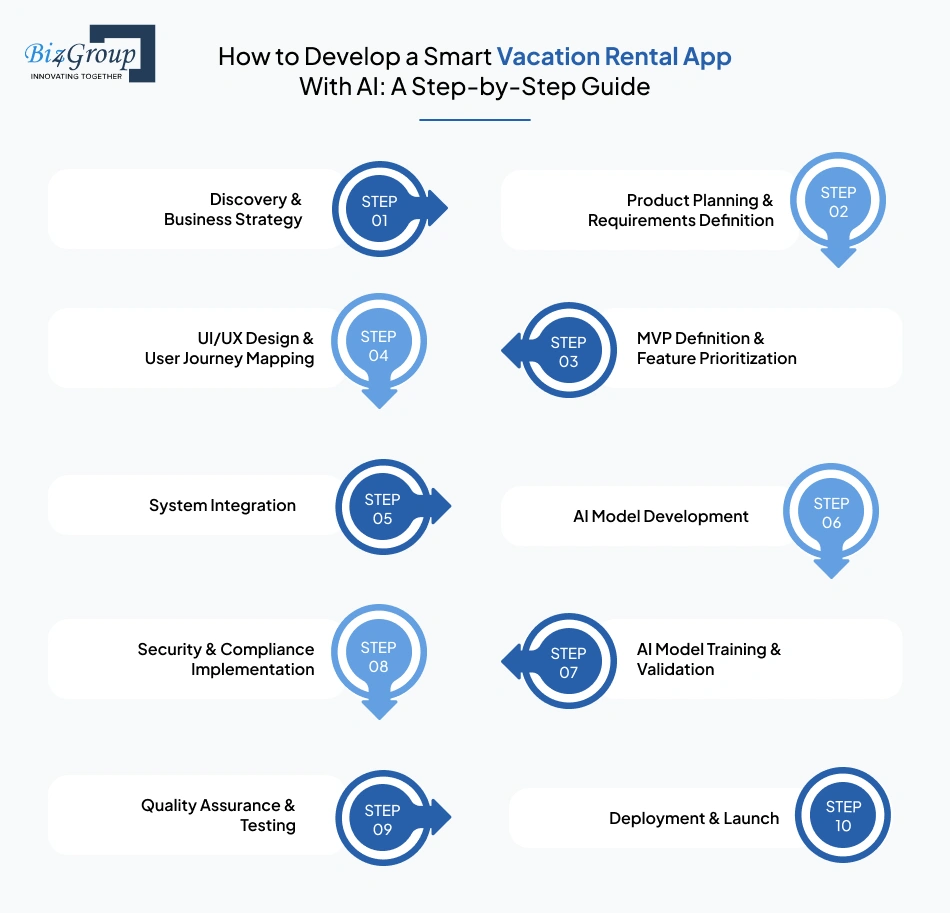
Building an AI vacation rental app isn't just about launching another booking platform. It's about creating a system that can intelligently manage and support business growth without adding operational complexity.
If you've ever thought, "I want to create an AI-powered vacation rental platform but need guidance on features, development steps, and cost," you're not alone. Many projects struggle not because of technology limitations, but because they lack a clear development roadmap from the beginning.
Step 1: Discovery & Business Strategy
The discovery phase lays the strategic foundation for the entire project. It helps businesses validate their idea, identify market opportunities, define success metrics, and ensure that the platform aligns with both user needs and business objectives before development begins.
What happens in this step?
This step leads to a clear product vision, business strategy, and development roadmap aligned with measurable business goals.
Once the business strategy is finalized, the next step is to convert high-level objectives into detailed product requirements. This phase establishes exactly what the platform should do, how users will interact with it, and what technical requirements must be met to support business goals.
What happens in this step?
With this step, you will have a detailed product requirements document (PRD) that serves as the blueprint for design and development.
Rather than building every feature at once, businesses should focus on launching a Minimum Viable Product (MVP) that delivers immediate value while reducing development costs and time-to-market. This phase identifies the essential features required for launch.
What happens in this step?
With MVP, you will end up with a focused MVP roadmap that accelerates launch, reduces risk, and provides a foundation for future platform expansion.
Also Read: 12+ MVP Development Companies in USA to Launch Your Startup in 2026
The design phase focuses on creating intuitive experiences for guests, hosts, property managers, and administrators. The goal is to design a UI/UX that ensure users can complete tasks efficiently while enjoying a seamless experience across web and mobile platforms.
What happens in this step?
With this, you will have a user-friendly interfaces that improve engagement, conversions, and customer satisfaction.
Also Read: Top 15 UI/UX Design Companies in USA (2026 Edition)
For an AI vacation rental platform to function effectively, it must work seamlessly with API development, tools and systems that power daily operations. This phase focuses on integrating third-party services, booking channels, payment providers, and property management solutions into a unified ecosystem.
What happens in this step?
By the end of this step, you will have a connected platform that automates workflows, reduces manual effort, and ensures real-time data consistency across systems.
This is where the platform's intelligence is built. AI model development can automate decision-making, generate insights, and improve operational efficiency across the vacation rental lifecycle.
What happens in this step?
With that, you will have a custom AI capability that helps in automating operations, improving guest experiences, and maximizing revenue.
Developing AI models is only the beginning. These models must be trained using relevant data and validated to ensure their predictions, recommendations, and automation capabilities are accurate and reliable.
What happens in this step?
With AI model training you will have a production-ready AI model capable of delivering consistent and accurate results.
Vacation rental platforms handle sensitive guest information, payment data, and property access details. This phase ensures the platform meets security standards and regulatory requirements while protecting business and customer data.
What happens in this step?
By the end of the phase you will have a secure, compliant platform that protects user data and minimizes operational risks.
Before launch, every feature, integration, workflow, and AI capability must be tested to ensure the platform performs reliably under real-world conditions.
What happens in this step?
This will result in a stable, reliable, and production-ready platform with reduced risk of post-launch issues.
Also Read: 15+ Software Testing Companies in USA in 2026
This phase moves the platform from development environments into production, making it available to real users and property managers.
What happens in this step?
With that you will have a live AI-powered vacation rental platform ready for market adoption.
Launching the platform is only the beginning. To maintain performance, security, and AI accuracy, the platform must be continuously monitored, updated, and optimized as business needs and market conditions evolve.
What happens in this step?
A secure, scalable, and continuously improving platform that delivers long-term business value and ROI. Now it's time to explore the cost of AI property rental app development services in 2026.
Turn your AI vacation rental vision into reality.
Connect With Us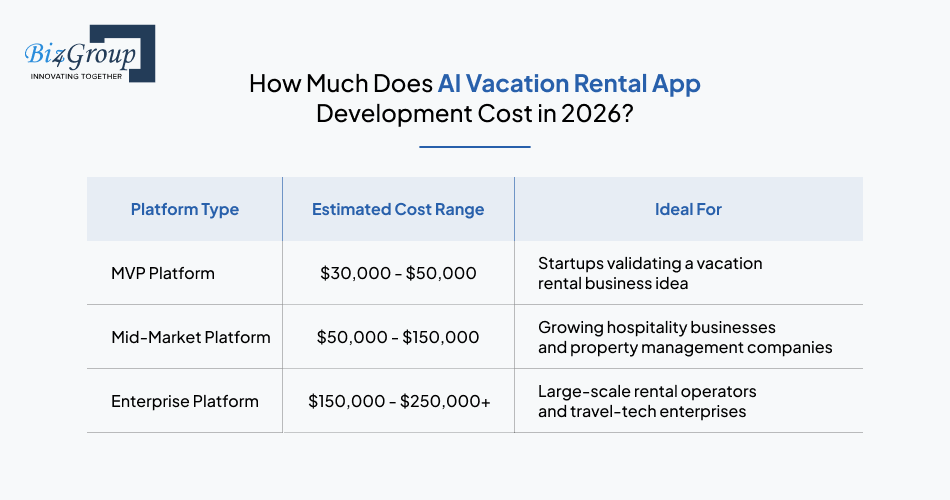
The cost of AI vacation rental app development can range from $30,000 to $250,000+. It depends on the platform's scope, AI complexity, number of integrations, supported platforms, and scalability requirements. Here is a brief idea of cost of AI vacation rental management software development.
Platform Type |
Estimated Cost Range |
Ideal For |
|---|---|---|
MVP Platform |
$30,000 - $50,000 |
Startups validating a vacation rental business idea |
Mid-Market Platform |
$50,000 - $150,000 |
Growing hospitality businesses and property management companies |
Enterprise Platform |
$150,000 - $250,000+ |
Large-scale rental operators and travel-tech enterprises |
What Factors Have the Biggest Impact on Development Cost of AI Vacation Rental App?
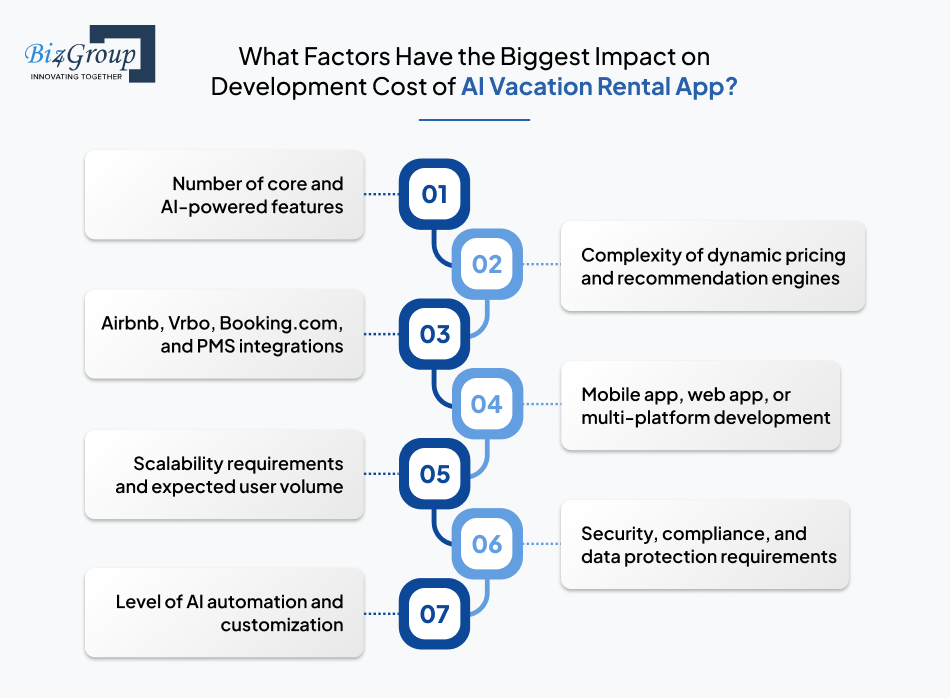
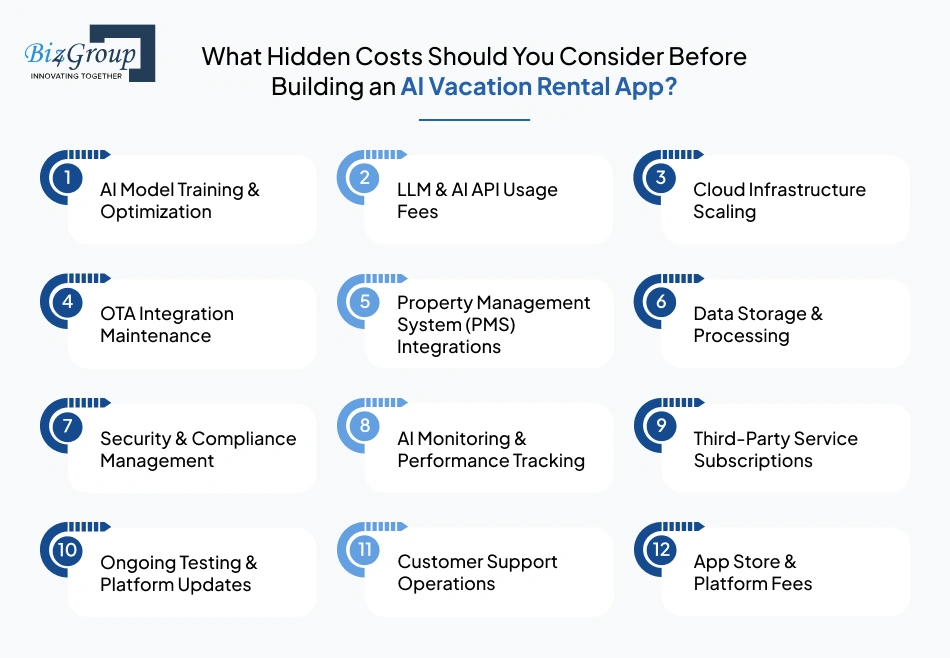
The upfront development budget is only the starting point. To accurately estimate the total cost of ownership, businesses must also consider the hidden expenses associated with maintaining and scaling AI-powered platforms. Let's have a look at the hidden cost of building AI vacation rental platform.
The biggest budgeting mistake businesses make during AI vacation rental app development is assuming that the quoted development cost represents the total investment, that is required to launch and scale the platform. But in contrast, expenses remain hidden during the early planning stages and only become visible as the platform grows, integrates with additional systems, and supports increasing operational complexity. Here is the list of hidden costs that later affect the budget of the development of AI Vacation Rental App.
Hidden Cost Category |
Why It Matters |
|---|---|
AI Model Training & Optimization |
AI models require continuous retraining and fine-tuning to maintain accuracy as user behavior and market conditions change. |
LLM & AI API Usage Fees |
AI-powered guest assistants, recommendation engines, and content generation features often incur ongoing usage-based charges. |
Cloud Infrastructure Scaling |
As bookings, users, and property listings grow, hosting, storage, and computing costs increase accordingly. |
OTA Integration Maintenance |
APIs from Airbnb, Vrbo, Booking.com, and other platforms frequently change and require ongoing maintenance. |
Property Management System (PMS) Integrations |
Supporting third-party PMS platforms may involve recurring licensing, customization, and maintenance expenses. |
Data Storage & Processing |
Growing volumes of booking data, guest interactions, images, videos, and analytics require additional storage and processing resources. |
Security & Compliance Management |
Maintaining GDPR, PCI DSS, encryption standards, and security monitoring involves recurring operational costs. |
AI Monitoring & Performance Tracking |
AI systems require monitoring tools to measure model accuracy, detect failures, and optimize performance. |
Third-Party Service Subscriptions |
CRM tools, communication platforms, analytics solutions, payment gateways, and marketing software often operate on subscription models. |
Ongoing Testing & Platform Updates |
Continuous testing, bug fixes, feature enhancements, and operating system updates are necessary to keep the platform stable. |
Customer Support Operations |
Even with AI automation, human support teams are often needed to handle complex guest and host issues. |
App Store & Platform Fees |
Publishing, maintaining, and processing transactions through mobile app stores may generate recurring fees. |
Understanding hidden costs early helps businesses create more accurate budgets, avoid unexpected expenses, and build a sustainable growth strategy for their platform. Now, let's explore the cost optimization while building an AI vacation rental app.
Plan smarter before development begins.
Connect With UsBuilding a feature-rich vacation rental platform does not mean you need to overspend. The most successful companies focus on strategic investments. They launch with essential capabilities first, then later expand based on market demand. If you're planning to develop AI vacation rental app solutions, the following strategies can help control costs without compromising quality or scalability.
Launch with essential features such as property listings, booking management, payments, and a few high-impact AI capabilities. This reduces initial investment and helps validate product-market fit faster.
Focus on dynamic pricing, AI guest communication, and personalized recommendations before investing in advanced capabilities such as predictive maintenance or portfolio optimization.
Leverage existing AI services and foundation models significantly reduces the time and cost required to build custom AI systems from scratch.
Frameworks like Flutter and React Native allow businesses to build both iOS and Android applications using a single codebase that reduces development effort.
Cloud platforms provide scalable resources without requiring large upfront investments in servers, storage, or maintenance.
Instead of building payment processing, maps, messaging, and authentication systems internally, integrate reliable third-party solutions to accelerate development.
Design the platform in independent modules makes it easier to add features, scale operations, and update components without major redevelopment costs.
Automated quality assurance and deployment pipelines reduce manual effort, shorten release cycles, and lower long-term maintenance costs.
Roll out advanced AI functionality gradually based on business needs, user adoption, and performance data rather than launching every feature at once.
Working with a team experienced in AI vacation rental app development helps avoid costly technical mistakes, project delays, and scalability issues that often increase overall development expenses.
By following these strategies, businesses can generate the highest business value and long-term ROI. Next, we are exploring how do vacation rental app development with AI features can be monetized.
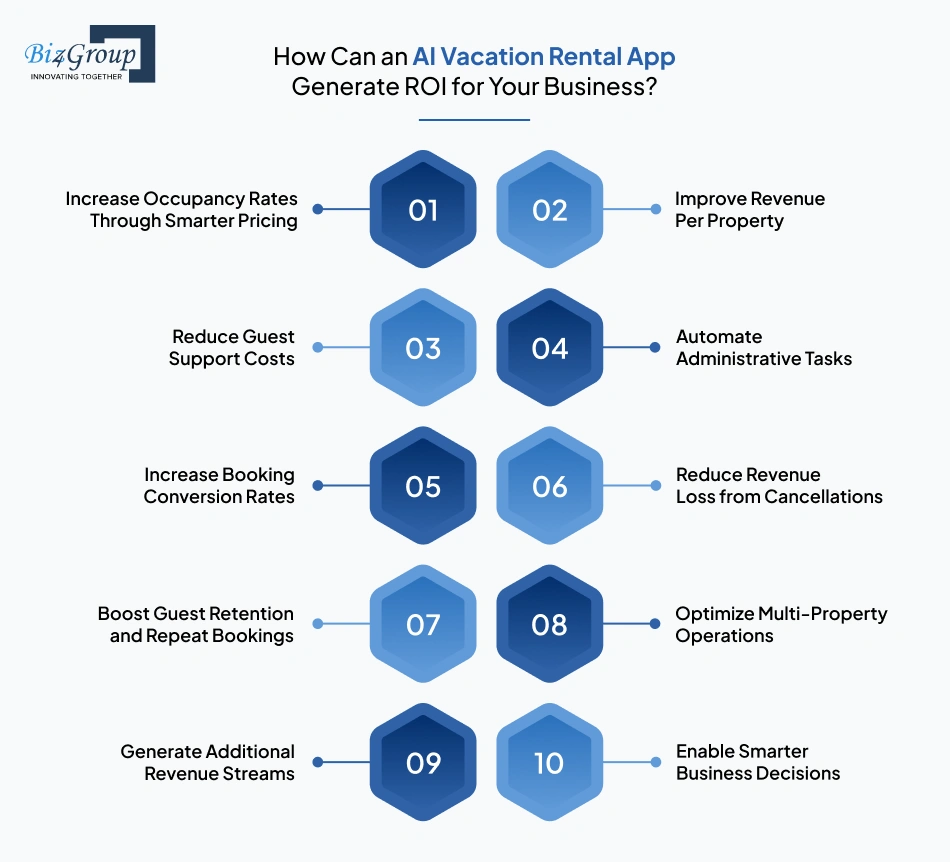
The true value of AI vacation rental app development extends beyond bookings. AI can help vacation rental businesses increase revenue, reduce operational costs, improve guest satisfaction, and scale more efficiently if implemented strategically. The result is a stronger return on investment and a more profitable rental operation.
Ways an AI Vacation Rental App Drives ROI
AI-powered dynamic pricing engines analyze demand patterns, seasonality, competitor rates, local events, and booking trends to recommend optimal pricing. This helps maximize occupancy while maintaining profitability.
Intelligent pricing and demand forecasting allow property owners to capture more revenue during peak periods and minimize vacancies during slower seasons.
AI-powered guest communication assistants can handle booking inquiries, FAQs, check-in instructions, and routine support requests 24/7, reducing the need for large customer service teams.
Tasks such as booking confirmations, calendar management, payment reminders, and guest communications can be automated, allowing staff to focus on higher-value activities.
Personalized property recommendations and intelligent search capabilities help travelers find relevant properties faster, improving the likelihood of completing a booking.
AI can identify booking patterns and cancellation risks, enabling businesses to take proactive measures that reduce potential revenue loss.
Personalized experiences, tailored recommendations, and faster support interactions encourage guests to return for future stays.
Businesses managing multiple rental units can use AI to monitor occupancy, pricing performance, guest satisfaction, and operational efficiency across their entire portfolio.
AI concierge features can recommend local experiences, transportation services, premium upgrades, and partner offerings, creating new upselling opportunities.
Predictive analytics and performance insights help operators identify growth opportunities, improve underperforming properties, and allocate resources more effectively.
This combination allows the platform to grow revenue while simultaneously improving operational efficiency. Next, we will explore the future trends of AI vacation rental App development.
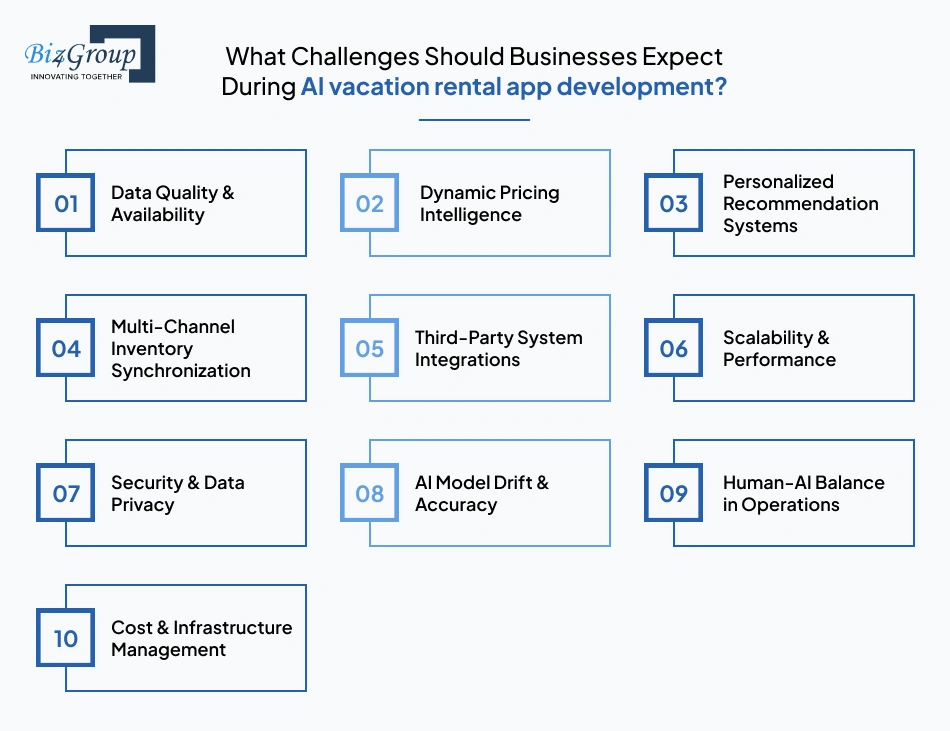
Every AI-powered feature that improves guest experiences or increases revenue also introduces new layers of complexity behind the scenes. More automation means more data, more integrations, more infrastructure, and more decisions that must work correctly at scale. To better understand the complexities involved in building intelligent vacation rental platforms, here are some of the most common challenges businesses encounter during development.
Aspect |
Why It's a Challenge |
How to Solve It |
|---|---|---|
Data Quality & Availability |
AI depends on accurate, complete, and consistent data. Fragmented booking records, missing guest details, and inconsistent pricing reduce model accuracy. |
Build centralized data pipelines, enforce data validation rules, and integrate all systems into a unified data warehouse for clean and structured datasets. |
Dynamic Pricing Intelligence |
Pricing must adapt to seasonality, demand shifts, competitor rates, and local events in real time, which is complex to model accurately. |
Use machine learning-based revenue management systems with real-time data ingestion and continuous model training. |
Personalized Recommendation Systems |
Recommendations require deep behavioral insights and large datasets to avoid irrelevant or generic suggestions. |
Implement collaborative filtering, behavioral tracking, and reinforcement learning models that improve over time. |
Multi-Channel Inventory Synchronization |
Listings across Airbnb, Booking platforms, and direct channels must stay updated to avoid double bookings or pricing conflicts. |
Use channel managers with real-time API synchronization and event-driven architecture. |
Third-Party System Integrations |
Payment gateways, PMS tools, smart locks, CRMs, and mapping services increase system complexity and dependency risks. |
Use modular microservices architecture with standardized APIs and middleware integration layers. |
Scalability & Performance |
Systems that work for small portfolios may fail under high traffic, large datasets, and AI processing workloads. |
Deploy cloud-native infrastructure with auto-scaling, load balancing, and distributed computing. |
Security & Data Privacy |
Platforms handle sensitive guest identities, payment data, and booking information, requiring strict compliance. |
Implement encryption, secure authentication, role-based access control, and compliance with data protection standards. |
AI Model Drift & Accuracy |
Market trends and user behavior change over time, causing AI predictions to become less accurate. |
Continuously retrain models using fresh data and implement monitoring systems for performance drift detection. |
Human-AI Balance in Operations |
Full automation may fail in complex guest scenarios requiring human judgment and personalized handling. |
Use hybrid systems where AI handles routine tasks and escalates complex cases to human agents. |
Cost & Infrastructure Management |
AI processing, cloud infrastructure, and third-party services can become expensive at scale. |
Optimize cloud usage, use cost-efficient model architectures, and implement usage monitoring and budget controls. |
As AI capabilities expand, so do security risks and compliance requirements. Here's what businesses must consider before launching an AI-powered vacation rental platform.
Build around challenges before they become problems.
Connect With Us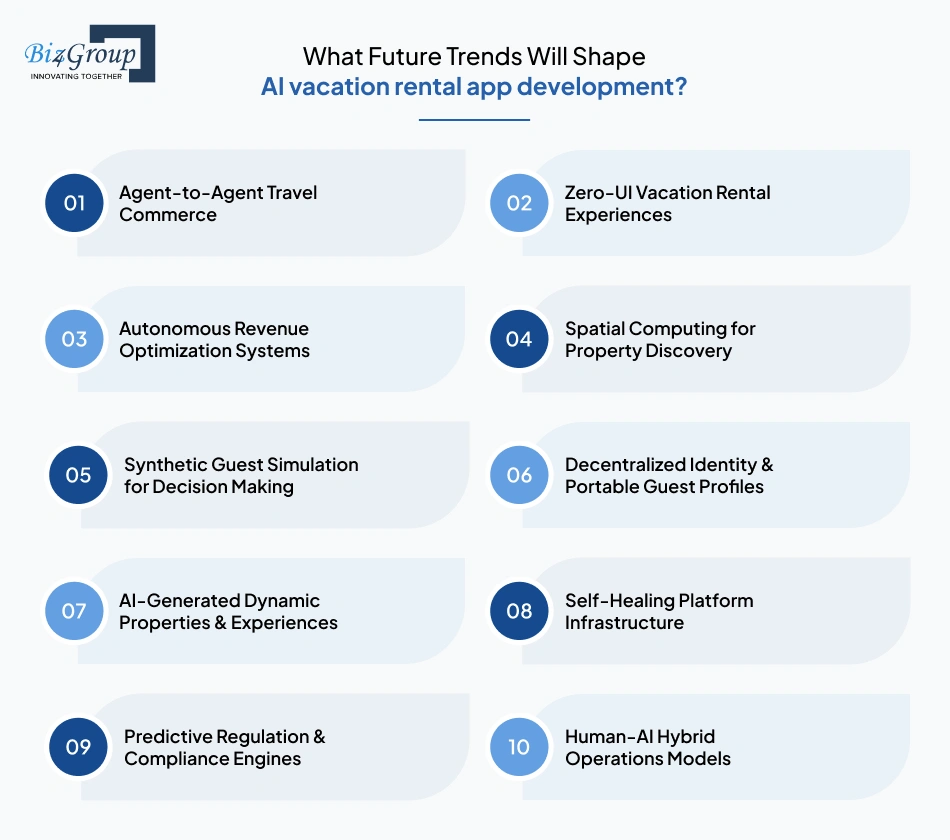
The vacation rental platforms of the future may look very different from the ones we use today. Instead of just helping users search and book properties, future systems may actively make decisions, optimize operations, and manage experiences with little human involvement.
Future Trend |
Expected Impact |
|---|---|
Agent-to-Agent Travel Commerce |
AI agents representing travelers may negotiate directly with property AI systems to compare listings, optimize pricing, and complete bookings autonomously. |
Zero-UI Vacation Rental Experiences |
Traditional apps may gradually shift toward invisible interfaces where bookings occur through AI assistants, wearables, AR glasses, or ambient computing environments. |
Autonomous Revenue Optimization Systems |
Future systems may continuously adjust pricing, promotions, marketing budgets, and inventory allocation without requiring human intervention. |
Spatial Computing for Property Discovery |
Travelers may explore vacation rentals through immersive 3D environments, mixed reality experiences, and virtual property walkthroughs before booking. |
Synthetic Guest Simulation for Decision Making |
Businesses may use AI-generated traveler personas to simulate booking behavior, test pricing strategies, and optimize operations before making decisions. |
Decentralized Identity & Portable Guest Profiles |
Guests may carry verified digital identities and preference profiles across platforms, enabling frictionless bookings and personalized experiences. |
AI-Generated Dynamic Properties & Experiences |
Rental platforms may automatically personalize property packages, amenities, experiences, and pricing combinations for each traveler in real time. |
Self-Healing Platform Infrastructure |
Future systems may automatically detect outages, optimize resources, resolve failures, and recover infrastructure without manual intervention. |
Predictive Regulation & Compliance Engines |
AI systems may automatically adapt pricing, taxes, local regulations, and compliance requirements across different geographies. |
Human-AI Hybrid Operations Models |
Instead of replacing humans, future hospitality businesses may operate with AI-first workflows where humans intervene only for high-value or complex decisions. |
Businesses that embrace these emerging innovations early will be better positioned to scale efficiently, improve guest experiences, and unlock new revenue opportunities. Now, let's understand how partnering with Biz4Group can turn out to be a great decision for you to build a custom vacation rental app with AI.
"We're looking for a company that can develop an AI-powered vacation rental app with booking, pricing, and property management features."
If those questions sound familiar, you're exactly where you need to be.
Biz4Group, a leading AI house rental app development company in USA, helps startups, hospitality businesses, and enterprises build intelligent vacation rental solutions tailored to their unique goals. From dynamic pricing and personalized recommendations to AI-powered guest communication and operational automation, every solution is designed to improve efficiency, increase revenue, and enhance guest experiences.
With expertise across AI, cloud, mobile, web, and enterprise technologies, Biz4Group develops scalable platforms that can grow alongside your business. Whether you're launching a new rental marketplace or modernizing an existing property management system, the team provides end-to-end support from strategy and development to deployment and ongoing optimization.
The result is a future-ready platform built to help you compete, scale, and succeed in an increasingly AI-driven hospitality market.
Key Takeaways for Businesses Planning AI Vacation Rental App Development
The vacation rental game has changed. It isn't just about great properties, it's about smarter operations. Growing businesses are using AI to automate bookings, optimize pricing, personalize guest experiences, and uncover revenue opportunities in real time.
"We are evaluating vendors for AI travel app development and want to create a scalable vacation rental platform" is this sounds like your current situation, choosing the right technology partner becomes critical. With deep expertise in AI, cloud technologies, mobile app development, and enterprise software solutions, Biz4Group LLC helps businesses transform ambitious ideas into intelligent vacation rental platforms that drive occupancy, improve operational efficiency, and maximize ROI.
Connect with our AI development experts to discover how you can launch a smarter, scalable vacation rental platform that stands out in a competitive market.
The cost of AI vacation rental app development typically ranges from $30,000 to $250,000+, depending on the platform's complexity, AI features, integrations, supported platforms, and scalability requirements.
A typical AI-powered vacation rental platform can take anywhere between 6-8 weeks to develop for an enterprise. The timeline depends on the feature set, AI capabilities, third-party integrations, and customization requirements.
Some of the most valuable AI features include dynamic pricing, personalized property recommendations, AI-powered guest communication, occupancy forecasting, fraud detection, and revenue optimization tools.
Yes. Businesses can create an Airbnb-style marketplace enhanced with AI features such as automated pricing, intelligent search, booking automation, guest personalization, and predictive analytics.
AI automates repetitive tasks such as guest communication, booking management, pricing adjustments, reporting, and occupancy forecasting, allowing businesses to manage more properties with fewer resources.
Modern platforms typically use technologies such as React, Flutter, Node.js, Python, PostgreSQL, AWS, TensorFlow, OpenAI models, and third-party integrations with Airbnb, Vrbo, and Booking.com.
Yes. AI-powered pricing optimization, demand forecasting, personalized recommendations, and marketing automation can help improve occupancy, increase booking conversions, and maximize revenue per property.
Common challenges include data quality, AI model accuracy, third-party integrations, inventory synchronization, scalability, security compliance, and ongoing AI optimization.
Existing software may work for standard requirements, but businesses seeking unique features, advanced automation, better scalability, and full control over the user experience often benefit from a custom AI-powered solution.
Biz4Group combines expertise in AI, cloud infrastructure, mobile app development, and enterprise software engineering to help businesses build scalable vacation rental platforms that improve occupancy, automate operations, enhance guest experiences, and drive long-term ROI.

with Biz4Group today!
Our website require some cookies to function properly. Read our privacy policy to know more.