Location :
Orlando, FL, USA
Location :
Orlando, FL, USA +1 (407) 714-1616
 info@biz4group.com


















Imagine a digital system that doesn’t wait for instructions but instead, understands your business goals, learns from real-time feedback, and takes independent actions to get the job done.
Read More

 AI Summary Powered by Biz4AI
How do you find a software testing company that can improve release quality without turning QA into another bottleneck?
If you're evaluating software testing companies in USA, the decision goes beyond comparing service lists. Quality engineering is changing rapidly as enterprises adopt AI, automation, and continuous testing. According to the World Quality Report 2025-26 by Capgemini and Sogeti, 43% of organizations are experimenting with generative AI in QA, yet only 15% have scaled it across the enterprise. The same research found that 60% struggle with secure, scalable test data and 58% face challenges adopting AI-powered testing tools.
For SaaS platforms, enterprise applications, and mobile products, testing needs to support both product quality and release velocity. Coverage, automation, security, performance, and scalability all need to work together. The same World Quality Report found an average 19% productivity improvement from Gen AI in quality engineering, while one-third of organizations reported minimal gains. The difference often comes down to how effectively AI is integrated into the QA process, not simply whether the tools are available.
This makes vendor selection more than a comparison of testing services. Your QA partner needs to fit your application architecture, technology stack, development workflow, CI/CD environment, risk profile, and long-term automation strategy.
We've compared leading software testing companies in the USA across QA capabilities, automation expertise, domain experience, scalability, and delivery models to help you identify the right fit.
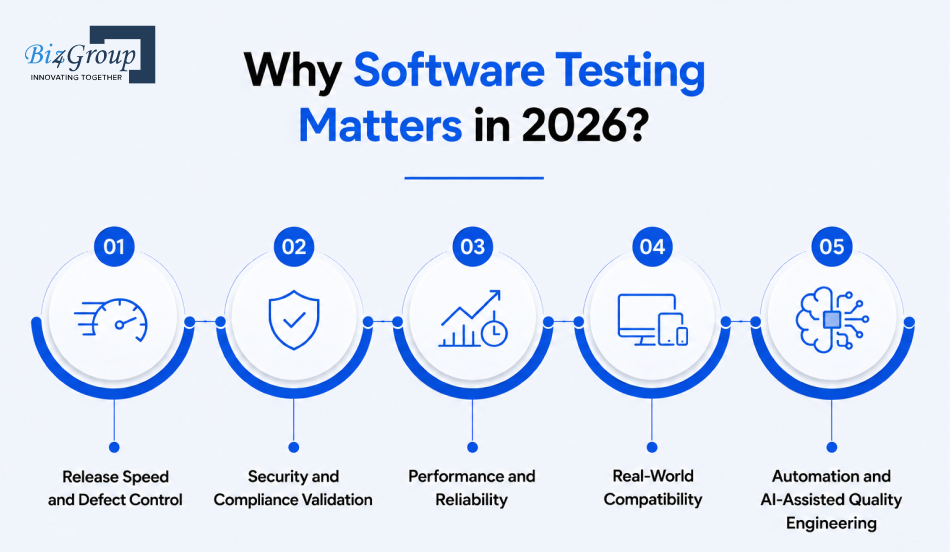
Software testing in 2026 directly affects release velocity, reliability, security, and operational risk. DORA's 2025 State of AI-assisted Software Development report found that 90% of technology professionals use AI at work, with more than 80% reporting productivity gains, while 30% report little to no trust in AI-generated outputs.
For software teams, faster development increases the need for reliable feedback before code reaches production. DORA's analysis found that AI's productivity gains come with a "verification tax," meaning the time saved writing code is often re-spent auditing it. The research also found that AI tends to act as an amplifier, strengthening the practices of high-performing teams while exposing the gaps in under-resourced ones. This reinforces the need for automated testing, continuous integration, fast feedback, and strong reliability practices as AI accelerates development.
Automated regression testing, API testing, integration testing, and CI/CD quality gates help teams identify defects earlier in the development cycle. The objective is not maximum automation coverage, but the right balance between automated checks, exploratory testing, and risk-based validation.
Enterprise applications require more than functional validation. Security testing can cover authentication, authorization, API vulnerabilities, data handling, access controls, and application-specific compliance requirements. Testing should reflect the application's threat model and regulatory environment.
Functional tests cannot determine whether an application will remain stable under production workloads. Load, stress, scalability, endurance, and resilience testing can identify bottlenecks and failure conditions before they affect users.
Applications must operate across browsers, operating systems, mobile devices, network conditions, APIs, third-party integrations, and different deployment environments. Testing across representative configurations helps identify issues that controlled development environments may not expose.
Automation reduces repetitive testing effort, but automated suites require appropriate architecture, test data, environment stability, maintenance, and ownership. AI-assisted QA is also creating new testing workflows, making it important to evaluate not only whether a provider uses AI, but how it integrates AI into test generation, prioritization, analysis, and quality decisions.
Software testing has therefore become part of the broader software delivery system rather than a final checkpoint before release. The right testing partner should strengthen that system through appropriate automation, reliable feedback loops, specialized testing expertise, and measurable quality practices.
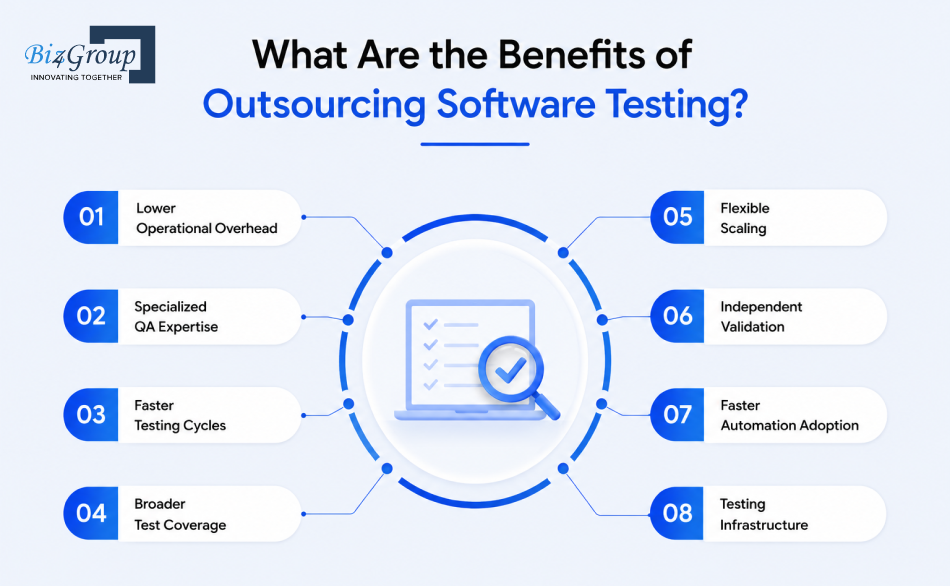
Outsourcing software testing gives companies access to specialized QA expertise, automation capabilities, testing infrastructure, and flexible capacity without building every capability in-house. It is particularly useful when internal teams face release pressure, lack specialized skills, or need broader test coverage.
|
Benefit |
Business Impact |
|---|---|
|
Lower Operational Overhead |
Reduces costs associated with additional QA hiring, training, tools, and infrastructure. |
|
Specialized QA Expertise |
Provides access to automation, performance, security, API, mobile, accessibility, and other specialized testing skills. |
|
Faster Testing Cycles |
Enables dedicated QA resources to test alongside development and support faster releases. |
|
Broader Test Coverage |
Extends testing across browsers, devices, operating systems, integrations, and environments. |
|
Flexible Scaling |
Allows QA capacity to increase for launches, major releases, and regression cycles without permanent headcount. |
|
Independent Validation |
Adds an external perspective for identifying defects, usability issues, and overlooked workflows. |
|
Faster Automation Adoption |
Helps teams build, integrate, and maintain automation frameworks and CI/CD testing. |
|
Testing Infrastructure |
Provides access to established tools, frameworks, environments, device coverage, and reporting systems. |
A hybrid QA model can be more appropriate for organizations with mature internal teams. Internal engineers can retain product knowledge and release ownership while an external partner handles specialized automation, performance, security, mobile, or additional testing capacity.
The best software testing companies in USA should demonstrate more than a broad service catalog. Evaluate providers based on testing coverage, technical capability, domain expertise, QA processes, client evidence, scalability, and their ability to integrate testing into the software delivery lifecycle.
|
Evaluation Criteria |
What to Look For |
Why It Matters |
|---|---|---|
|
Testing Service Coverage |
Functional, automation, API, performance, security, mobile, accessibility, and cross-platform testing |
Covers different application risks without requiring multiple vendors |
|
Technical Expertise |
Selenium, Cypress, Playwright, Appium, JMeter, API testing tools, CI/CD integration |
Determines whether testing can operate effectively within the development pipeline |
|
Automation Maturity |
Framework architecture, reusable test components, parallel execution, maintenance strategy, CI/CD integration |
Separates sustainable automation from brittle test scripts |
|
Domain Experience |
Relevant experience in fintech, healthcare, SaaS, retail, enterprise, or other target industries |
Helps teams address domain-specific workflows, risks, and compliance requirements |
|
QA Methodology |
Agile QA, shift-left testing, continuous testing, risk-based testing, DevOps practices |
Integrates quality activities earlier into development and release cycles |
|
Team Expertise |
QA engineers, automation specialists, performance engineers, security testers, domain specialists |
Provides the skills required for complex testing requirements |
|
Client Evidence |
Case studies, verified reviews, references, measurable project outcomes |
Provides evidence beyond vendor claims |
|
Scalability |
Ability to add testers, specialists, environments, and testing capacity as requirements change |
Supports product growth and fluctuating release demands |
|
Innovation |
AI-assisted testing, intelligent test prioritization, modern automation frameworks, test analytics |
Helps teams modernize QA without relying on outdated testing practices |
The strongest software testing outsourcing companies can explain not only what they test, but how they measure coverage, defect risk, automation effectiveness, release readiness, and ongoing QA performance.
A strong QA partner combines broad testing coverage with technical depth, measurable delivery practices, relevant domain expertise, and the ability to scale as product requirements change.
Compare QA services, automation capabilities, and delivery models to find the right fit for your product.
Explore Top QA PartnersThe leading software testing companies in the USA differ in testing depth, automation maturity, industry expertise, delivery model, and project fit. The comparison below focuses on the capabilities that matter when shortlisting a QA partner, rather than ranking companies by brand recognition alone.
|
Company |
Best For |
Key QA & Testing Strengths |
US Presence |
Pricing* |
|---|---|---|---|---|
|
QASource |
Dedicated QA and test automation |
Application testing, automation, API, performance, security |
Pleasanton, California |
$25-$49/hr; $25,000+ minimum project |
|
End-to-end software engineering and QA |
Software testing, automation, web and mobile applications, AI-enabled solutions |
Orlando, Florida |
$50-$99/hr; $25,000+ minimum project |
|
|
Testlio |
Global crowdsourced testing |
Functional, mobile, localization, usability, exploratory testing |
Austin, Texas |
Undisclosed; $75,000+ minimum project |
|
ImpactQA |
Enterprise QA and digital testing |
Application testing, automation, performance, security, ERP testing |
New York, New York |
$25-$49/hr; $10,000+ minimum project |
|
QA Wolf |
Managed test automation |
Automated end-to-end testing, test maintenance, CI/CD |
Washington, USA |
Undisclosed; $5,000+ minimum project |
|
Abstracta |
Quality engineering and performance testing |
Automation, performance, reliability, AI and software quality engineering |
US presence; global HQ in Montevideo |
$50-$99/hr; minimum project undisclosed |
|
QA Mentor |
Broad QA outsourcing |
Functional, automation, performance, mobile, compliance, localization |
New York, New York |
< $25/hr; $1,000+ minimum project |
|
Telliant Systems |
Software engineering with QA |
Software development, QA, testing, enterprise applications |
Georgia, USA |
$25-$49/hr; $50,000+ minimum project |
|
a1qa |
Enterprise QA and testing |
Application testing, automation, cybersecurity, performance |
US presence |
$25-$49/hr; $10,000+ minimum project |
|
Kualitatem |
Software testing and security |
Functional, automation, performance, security testing |
New York, New York |
$25-$49/hr; $50,000+ minimum project |
|
XBOSoft |
QA consulting and application testing |
Application testing, automation, performance, financial and healthcare QA |
Reston, Virginia |
$25-$49/hr; $1,000+ minimum project |
|
ACCELQ |
AI-powered test automation |
Codeless automation, continuous testing, web, API and enterprise applications |
San Francisco, California |
$50-$99/hr; $1,000+ minimum project |
|
Mindful QA |
On-demand US-based QA |
Manual testing, functional testing, flexible QA staffing |
Los Angeles, California |
$50-$99/hr; $1,000+ minimum project |
|
QualityLogic |
US-based QA and accessibility testing |
Functional, regression, accessibility, compatibility, performance testing |
Boise, Idaho |
$25-$49/hr; $5,000+ minimum project |
|
Testrig Technologies |
Cost-focused QA outsourcing |
Functional, regression, automation, performance and load testing |
India-based; verify US delivery presence |
< $25/hr; $25,000+ minimum project |
|
AppSierra |
Application testing and development |
Application testing, automation, web and software development |
India-based; verify US delivery presence |
$25-$49/hr; $5,000+ minimum project |
Pricing and minimum project sizes are third-party estimates and may change by project scope, team size, and engagement model. Verify current pricing directly with each provider.
Use this table to shortlist providers based on your testing requirements, automation needs, industry experience, project size, and budget. Review each company's capabilities and engagement model before making a final decision.
The following software testing companies were selected based on their testing capabilities, automation expertise, domain experience, delivery model, and suitability for different project requirements. Pricing and review figures are based on current third-party listings and should be verified directly with each provider before engagement.
Best for: Dedicated QA and quality engineering
Headquarters: Pleasanton, California, USA
Hourly Rate: $25-$49/hr
Minimum Project Size: $25,000+
Clutch Rating: 4.8/5
QASource focuses on dedicated QA and quality engineering services, with application testing representing its primary service line. Its capabilities include automation, manual testing, performance, and load testing, with engagements ranging from smaller projects to large-scale programs.
Key strengths:
Why consider QASource: Its dedicated QA model can suit organizations looking to extend or outsource an internal quality engineering function.
Best for: Software testing and QA for custom, enterprise, and AI-enabled
product
Headquarters: Orlando, Florida, USA
Hourly Rate: $50-$99/hr
Minimum Project Size: $25,000+
Clutch Rating: 4.9/5
Biz4Group provides software testing and QA alongside software development and AI engineering. Its testing capabilities can support web and mobile applications, custom software development, enterprise applications, and AI-enabled products. Clutch profile
Key strengths:
Biz4Group's broader engineering capabilities also allow QA teams to work alongside software and AI development teams. Its software development services in Florida cover custom applications, enterprise software, cloud solutions, and AI-powered products.
For AI-focused projects, its enterprise AI solutions include enterprise AI assistants, customer service automation, AI predictive maintenance, and other enterprise use cases that require application-level validation.
Why consider Biz4Group: Its combination of QA, software engineering, and AI expertise can be relevant for businesses that need testing support within a broader product development engagement.
Best for: Global testing and multi-environment coverage
US Location: Austin, Texas
Hourly Rate: Undisclosed
Minimum Project Size: $75,000+
Testlio uses a global testing network to provide application testing across different devices, environments, and user conditions. Its model combines human testing with technology-enabled workflows, making it relevant for products where geographic, device, and localization coverage are important.
Key strengths:
Why consider Testlio: It is particularly relevant for consumer-facing applications that require broad geographic and device coverage.
Best for: Enterprise application testing and QA consulting
Headquarters: Plano, Texas, USA
Hourly Rate: $25-$49/hr
Minimum Project Size: $10,000+
Clutch Rating: 4.6/5
ImpactQA is an independent software testing and QA consulting company. Application testing represents 70% of its listed service focus, with additional capabilities in ERP consulting, robotic process automation, and cloud consulting. Its listed clients include enterprise, midmarket, and small businesses across financial services, healthcare, manufacturing, telecommunications, retail, and other sectors.
Key strengths:
Why consider ImpactQA: Its broad application-testing portfolio makes it relevant for organizations managing complex enterprise or digital applications.
Best for: Managed end-to-end test automation
Headquarters: Seattle, Washington, USA
Hourly Rate: Undisclosed
Minimum Project Size: $5,000+
Clutch Rating: 4.9/5
QA Wolf focuses on end-to-end test automation for web and mobile applications. Its platform supports Playwright and Appium automation, parallel execution, regression testing, test maintenance, and continuous testing. Clutch lists 64 reviews with an overall 4.9/5 rating.
Key strengths:
Why consider QA Wolf: Its automation-first model makes it a strong fit for product teams looking to expand automated end-to-end coverage without building the entire capability internally.
Best for: Quality engineering and performance testing
Headquarters: Montevideo, Uruguay
US Presence: Yes
Hourly Rate: $50-$99/hr
Minimum Project Size: Undisclosed
Clutch Rating: 4.7/5
Abstracta provides quality engineering and application testing services alongside custom software development and generative AI capabilities. Its listed testing focus includes automation, compatibility, manual, reliability, and stress testing. Clutch lists Montevideo as its headquarters and additional international locations.
Key strengths:
Why consider Abstracta: Its combination of quality engineering and performance-oriented testing makes it relevant for organizations dealing with reliability and scalability requirements.
Best for: Broad QA outsourcing
Headquarters: New York, USA
Hourly Rate: < $25/hr
Minimum Project Size: $1,000+
Clutch Rating: 4.9/5
QA Mentor provides a broad range of application testing services, including automation, compatibility, compliance, load, localization, manual, performance, and reliability testing. Its Clutch profile lists more than 30 QA testing services and locations in New York and Ukraine.
Key strengths:
Why consider QA Mentor: Its broad testing portfolio and flexible staffing model make it relevant for businesses requiring multiple QA capabilities from one outsourcing partner.
Best for: Software development with integrated QA
Headquarters: Alpharetta, Georgia, USA
Hourly Rate: $25-$49/hr
Minimum Project Size: $50,000+
Clutch Rating: 4.9/5
Telliant Systems is primarily a software development company that also provides application testing and QA capabilities. Its positioning makes it relevant for organizations that want development and testing handled within a broader product engineering engagement.
Key strengths:
Why consider Telliant Systems: It can suit organizations that prefer a combined software engineering and QA engagement rather than a testing-only provider.
Best for: Independent QA and enterprise testing
Headquarters: Denver, Colorado, USA
Hourly Rate: $25-$49/hr
Minimum Project Size: $10,000+
Clutch Rating: 4.9/5
a1qa provides independent software QA and testing services across multiple industries. Application testing represents 80% of its Clutch service focus, with cybersecurity accounting for the remaining 20%. Its listed clients span small businesses, midmarket companies, and enterprises.
Key strengths:
Why consider a1qa: Its independent testing model and broad application-testing focus make it relevant for organizations seeking an external QA function.
Best for: QA and security-focused testing
Headquarters: New York, USA
Hourly Rate: $25-$49/hr
Minimum Project Size: $50,000+
Clutch Rating: 4.7/5
Kualitatem combines software testing with information security services. Its capabilities include application testing, automation, performance, and security-related services, making it relevant for applications where software quality and security risk need to be evaluated together.
Key strengths:
Why consider Kualitatem: Its combination of QA and security capabilities can be useful for security-sensitive applications and regulated environments.
Best for: QA consulting and application quality
Headquarters: Reston, Virginia, USA
Hourly Rate: $25-$49/hr
Minimum Project Size: $1,000+
Clutch Rating: 4.9/5
XBOSoft specializes in QA consulting and software testing, with particular experience in financial, healthcare, and e-commerce applications. Its services include application testing, test automation, performance testing, and quality process improvement.
Key strengths:
Why consider XBOSoft: Its industry-specific QA experience makes it relevant for organizations where domain workflows and application quality require specialized testing expertise.
Best for: AI-assisted and codeless test automation
Headquarters: San Francisco, California, USA
Hourly Rate: $50-$99/hr
Minimum Project Size: $1,000+
ACCELQ differs from most companies on this list because it is primarily a test automation platform rather than a conventional outsourced QA services provider. Its platform focuses on continuous testing and automation across web and API applications.
Key strengths:
Why consider ACCELQ: It is more appropriate for engineering organizations evaluating an automation platform to strengthen internal QA capabilities than for businesses seeking a fully outsourced testing team.
Best for: Flexible US-based QA support
Headquarters: Los Angeles, California, USA
Hourly Rate: $50-$99/hr
Minimum Project Size: $1,000+
Clutch Rating: 5.0/5
Mindful QA provides flexible software testing services for organizations that need additional QA capacity without committing to a large permanent testing team. Its services include manual, functional, regression, compatibility, accessibility, performance, and compliance testing.
Key strengths:
Why consider Mindful QA: Its flexible engagement model can suit startups and product teams that need additional US-based QA capacity for specific releases or ongoing testing.
Best for: US-based QA and accessibility testing
Headquarters: Boise, Idaho, USA
Hourly Rate: $25-$49/hr
Minimum Project Size: $5,000+
Clutch Rating: 4.9/5
QualityLogic provides US-based software testing and QA services and has operated in the testing industry for more than 35 years. Its current service focus includes functional, regression, integration, compatibility, compliance, performance, reliability, and accessibility-related testing.
Key strengths:
Why consider QualityLogic: Its US-based delivery model and established accessibility-testing capability make it relevant for organizations with accessibility, compliance, and multi-platform QA requirements.
Best for: Cost-focused QA outsourcing and automation
Headquarters: Pune, India
US Presence: Global delivery
Hourly Rate: < $25/hr
Minimum Project Size: $25,000+
Testrig Technologies provides application testing as its primary service, covering functional, regression, acceptance, integration, IoT, automation, manual, load, and performance testing. Its current Clutch profile lists Pune, India, as its location, so it should not be presented as a Texas-headquartered company.
Key strengths:
Why consider Testrig Technologies: Its broad application-testing focus and lower listed hourly range make it relevant for businesses evaluating cost-focused QA outsourcing.
Best for: Application testing combined with software development
Headquarters: Noida, India
US Presence: Global delivery
Hourly Rate: $25-$49/hr
Minimum Project Size: $5,000+
AppSierra combines software development with application testing. Its testing services cover functional, compatibility, load, localization, manual, and performance testing, making it relevant for organizations that want testing alongside broader application development.
Key strengths:
Why consider AppSierra: Its combination of application development and QA can suit small and midmarket businesses seeking a broader technology partner.
The choice between USA-based software testing companies and global or offshore providers depends on your testing requirements, budget, compliance obligations, communication needs, and required team capacity. Location alone does not determine QA quality. The vendor's technical expertise, security practices, delivery model, and ability to integrate with your engineering team matter more.
|
Factor |
USA-Based Testing Company |
Global/Offshore Testing Company |
|---|---|---|
|
Time Zone |
Strong overlap with US teams |
May require scheduled handoffs |
|
Communication |
Easier real-time collaboration |
Greater reliance on structured communication |
|
Cost |
Generally higher |
Generally lower |
|
Team Scaling |
Depends on local talent availability |
Larger global talent pools |
|
Specialized Expertise |
Depends on the provider |
Access to international specialists |
|
Security & Compliance |
Convenient for US-specific requirements when the vendor has relevant controls |
Depends on vendor location, controls, contracts, and compliance requirements |
|
Testing Coverage |
Primarily aligned with US operating hours |
Can support extended or follow-the-sun coverage |
|
Best Fit |
US-centric teams and high-collaboration projects |
Cost-sensitive projects and large-scale QA requirements |
For US-centric projects, a USA-based testing company can offer easier collaboration, local stakeholder access, and alignment with specific US requirements. Global providers can offer lower costs, larger talent pools, and extended testing coverage. A hybrid model combines US-based coordination with global QA execution, making it suitable for projects that need both close collaboration and scalable testing capacity.
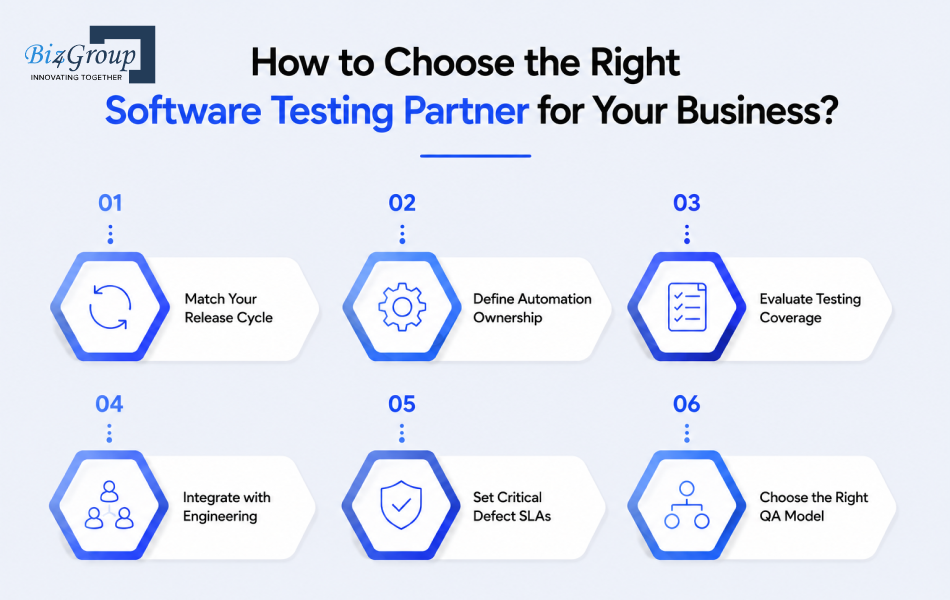
Choosing between software testing companies in USA should come down to how well a provider fits your release cycle, technical environment, testing requirements, and level of ownership.
Weekly or continuous releases require strong automation, CI/CD integration, and fast regression testing. For less frequent releases, a largely manual approach may be more cost-effective. Match the testing model to your actual release cadence rather than paying for automation you will not use.
Clarify who builds, maintains, debugs, and updates automated tests. Ask how the vendor handles flaky tests, application changes, test data, framework upgrades, and failed CI/CD runs. Test ownership should be defined before the engagement begins.
Look beyond the number of test cases executed. Evaluate coverage across critical workflows, APIs, integrations, edge cases, failure scenarios, performance, security, and compatibility based on your application's risk profile.
Confirm how testers participate in sprint planning, requirements analysis, defect management, CI/CD, release validation, and production issue resolution. A testing partner should fit into the existing engineering workflow rather than operate as a separate handoff.
Define escalation paths and expected response times for release-blocking defects. Ask who is available during critical releases, how severity is determined, and how quickly retesting can be completed after a fix.
Project-based testing can work for a specific release, migration, or testing cycle. Ongoing QA support is more appropriate when testing spans multiple releases and requires continuous regression, automation maintenance, and production support.
The right software testing partner should match your release cadence, testing risks, automation requirements, and engineering workflow without creating additional management overhead.
Understand which software testing services in USA match your product, budget, and timeline.
Talk to Our QA ExpertsThe US software testing market is moving toward synthetic test data, production-informed testing, AI application evaluation, and broader quality engineering practices.
The use of synthetic data for testing increased from 14% in 2024 to 25% in 2025, according to the report shared earlier in the blog.
Synthetic data enables realistic test scenarios without exposing sensitive production data, making it useful for applications with strict privacy, security, or regulatory requirements.
The World Quality Report 2025-26 found that 94% of organizations review production data to inform quality practices, as per the world quality shared earlier.
Production defects, user behavior, application telemetry, and operational data can inform regression priorities and identify areas requiring additional testing.
AI applications require testing beyond conventional functional validation. QA teams increasingly evaluate:
Non-deterministic AI behavior can make traditional pass/fail testing insufficient for some use cases. Evaluation datasets, quality thresholds, continuous monitoring, and human review are increasingly used to assess AI application quality.
Quality engineering extends testing into requirements, architecture, development, deployment, and production. This requires collaboration between QA engineers, developers, product teams, security teams, and operations.
For businesses evaluating software testing companies in USA, providers should demonstrate capabilities beyond test execution, including quality strategy, risk analysis, automation architecture, production feedback, and AI application evaluation.
The right software testing company in USA should fit your product complexity, release cadence, technology stack, and QA requirements. Compare providers based on automation maturity, testing depth, communication, development integration, and ability to scale with your product.
Before committing to a long-term engagement, start with a pilot or defined testing scope. Assess test coverage, defect reporting, automation quality, turnaround time, communication, and how effectively the QA team works within your development workflow.
For companies building custom software or AI-enabled products, Biz4Group LLC combines software development, AI engineering, and QA capabilities within one delivery model. This allows testing to remain closely connected to product architecture, development, and release requirements.
If you need automated testing, functional QA, performance testing, mobile testing, or testing support for an AI-enabled application, Biz4Group can help build a QA strategy around your product and release requirements.
Talk to us about your software testing requirements and get a testing approach aligned with your application, technology stack, and delivery goals.
Software testing costs vary by application complexity, testing type, automation requirements, team size, engagement model, and vendor location. A short manual testing engagement will generally require less investment than a dedicated automation or enterprise QA program with CI/CD integration and ongoing maintenance.
A QA SLA should define scope, response times, defect severity levels, escalation procedures, reporting requirements, testing coverage, release support, and responsibilities for both teams. For ongoing engagements, it should also define measurable quality and delivery KPIs rather than only the number of test cases executed.
Ownership should be defined in the contract. Confirm who owns the source code, test cases, framework architecture, test data, documentation, and CI/CD integrations, and whether your internal team receives the knowledge transfer required to maintain them.
Yes. A QA partner can begin with requirements reviews, test planning, API validation, and early automation before the full application is complete. Early involvement can also allow defects and unclear requirements to be addressed before they reach final regression testing.
A provider should use controlled access based on the minimum data and permissions required for testing. Depending on the application, teams may use masked, anonymized, synthetic, or dedicated test data instead of unrestricted production data. Access controls, data retention, logging, and contractual security requirements should be established before testing begins.
Yes, but AI application testing requires additional evaluation beyond conventional functional testing. Depending on the system, testing may cover hallucinations, response accuracy, prompt robustness, retrieval quality, model behavior, agent workflows, safety controls, and output consistency.
Track outcomes such as escaped defects, defect severity, regression effectiveness, automation stability, test execution time, release-blocking issues, and turnaround time for critical defects. The right KPIs depend on the application's risk profile and release model.
The testing strategy should evolve with the application. Major changes such as a new framework, architecture, API layer, cloud environment, or mobile platform may require changes to test automation, environments, test data, and coverage. Confirm that the provider includes framework updates and test maintenance within the engagement.
Yes. A QA provider can support parallel release streams when it has sufficient staffing, environments, test data, and automation infrastructure. Before committing, confirm how the vendor handles concurrent releases and prioritizes urgent defects.
Start by reviewing the agreed scope, SLAs, KPIs, defect data, communication process, and ownership model. If performance problems persist, consider a defined remediation period or pilot with an alternative software testing service provider before moving the full engagement.

Our website require some cookies to function properly. Read our privacy policy to know more.