Location :
Orlando, FL, USA
Location :
Orlando, FL, USA +1 (407) 714-1616
 info@biz4group.com


















Imagine a digital system that doesn’t wait for instructions but instead, understands your business goals, learns from real-time feedback, and takes independent actions to get the job done.
Read More

 AI Summary Powered by Biz4AI
Think about what happens when a tenant reports a leaking pipe at 11 PM. Can AI understand the issue, check the lease and property records, determine its urgency, create a work order, contact the right vendor, and keep the tenant updated? What happens when the request falls outside the rules? Who gets involved then?
These are the kinds of decisions teams face when they build AI for residential real estate.
Biz4Group LLC, an AI product development company in the USA, has seen one challenge come up repeatedly while building residential real estate AI solutions: giving an AI model access to information is relatively straightforward. Giving it enough context and control to take the correct action inside a live business workflow takes much more planning.
In residential property management, a single action may depend on lease terms, tenant history, property data, payment records, vendor availability, and permissions spread across several systems.
That raises a few practical questions. Which property management tasks are safe to automate? How much authority should an AI agent have? Should AI sit on top of your existing PMS, or does your operation need a purpose-built platform?
Those decisions shape the system you eventually build and how useful it becomes in day-to-day property operations.
See where AI can cut repetitive work across leasing, tenant support, maintenance, payments, and renewals.
Map My AI OpportunitiesThe strongest candidates for residential property management automation have recurring triggers, structured tenant or property data, repeatable decisions, and clear escalation rules.
This is one of the first questions property managers ask when exploring AI automation:
"I manage residential properties and my team spends too much time handling tenant questions, maintenance requests, leasing tasks, and routine follow-ups. I want to build AI into our property management system, but I do not know which workflows should be automated first?"
Start with high-volume, repeatable workflows where the rules and outcomes are fairly clear. Tenant communication, leasing follow-ups, maintenance triage, payment reminders, and renewals are strong starting points because the time savings can be measured easily.
AI automates repetitive work between the first inquiry and a scheduled tour or application. By developing AI leasing assistant, you can qualify prospects, match them with available units, answer listing questions, and move qualified leads toward a tour or application.
AI property management for residential real estate handles routine tenant interactions by connecting incoming requests with relevant lease, property, and account information.
Maintenance follows defined triage and routing patterns, making it a practical area for AI-driven workflow automation.
AI-driven payment workflows connect transaction events with timely communication and exception handling while keeping financial approvals under defined controls.
Renewal workflows have predictable timelines, while resident history provides additional signals for prioritizing outreach and intervention.
AI-powered residential property management reduces the manual effort involved in reviewing portfolio data and brings operational exceptions to the manager's attention.
A practical selection rule is to prioritize workflows where the system has a defined trigger, sufficient context, an approved action, and a clear escalation path. This keeps the first round of automation focused on processes where outcomes are easier to measure and control.
In AI property management system development, the core capabilities typically cover tenant support, leasing, maintenance, document processing, reporting, predictive insights, and workflow execution.
A common concern when planning a custom platform is deciding how much to put into the first version:
"We are considering building a custom AI property management platform because our current system does not support the workflows and automation we need. How should we decide which AI features to build first without spending too much on an oversized first version?"
Choose features that solve frequent, measurable problems for property teams. Start with a focused combination such as leasing automation, tenant support, maintenance triage, or document processing, then expand once those workflows deliver consistent results.
An intelligent tenant communication layer handles everyday questions across text, email, chat, and voice. It pulls relevant details from tenant records, leases, and property data to keep responses specific to each situation.
An AI leasing layer reviews new inquiries, identifies what each prospect is looking for, and compares those preferences with current availability. Qualified prospects move toward the next leasing step without waiting for manual follow-up.
An AI-powered maintenance workflow turns a tenant's description into a structured request. It identifies the likely issue, checks urgency, gathers missing details, and routes the work order according to property-specific rules.
Document intelligence makes leases, inspection reports, property records, invoices, and other files easier to search and use. Relevant information becomes available inside the workflows that depend on it.
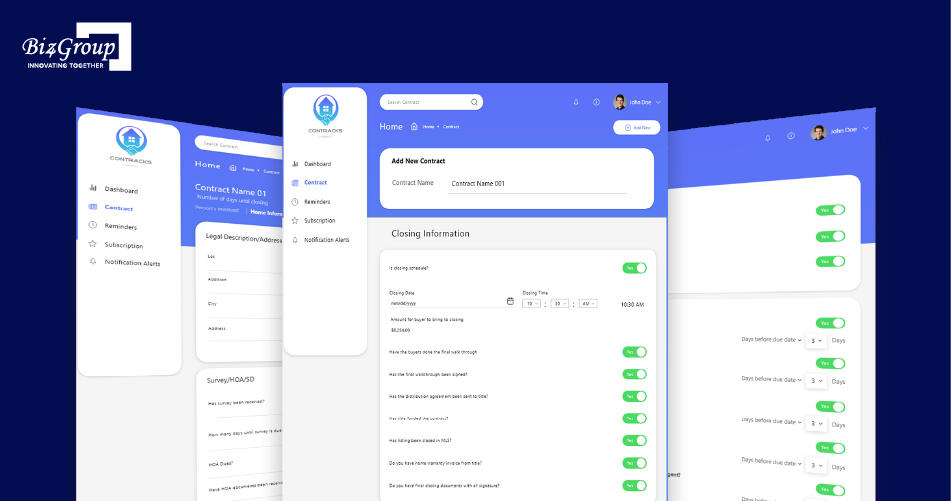
Contracks was developed by Biz4Group to handle real estate contract information and time-sensitive formalities. The platform focused on tracking contract details, important dates, notifications, and outstanding actions, showing how structured property documents can become part of an automated workflow instead of remaining static files.
AI-powered residential property management gives managers a faster way to work with operational data. Instead of manually pulling figures from different reports, property teams can ask questions and surface the metrics or exceptions that matter.
Predictive analytics looks at historical and current property data to spot patterns that deserve attention. Recommendations then turn those patterns into practical next steps for property managers.
Through custom AI property management system development, workflow automation connects individual capabilities into a complete property-management process. The platform follows defined steps, accesses approved tools, checks outcomes, and hands the task to staff when it reaches a predefined limit.
The strongest feature set is the one that fits the operator's existing processes, data, and software stack. That makes each AI capability useful on its own while also allowing several features to work together as larger workflows.
Once businesses look beyond individual AI features, they usually have a bigger question about how much of the daily operation can actually be automated:
"I want to use AI to improve leasing, tenant communication, maintenance coordination, rent collection, and renewal workflows across our residential properties, but I need to understand what it would take to develop a secure and scalable system that our team can actually use?"
The platform needs connected data, tool access, workflow rules, and human escalation points to make that level of automation practical.
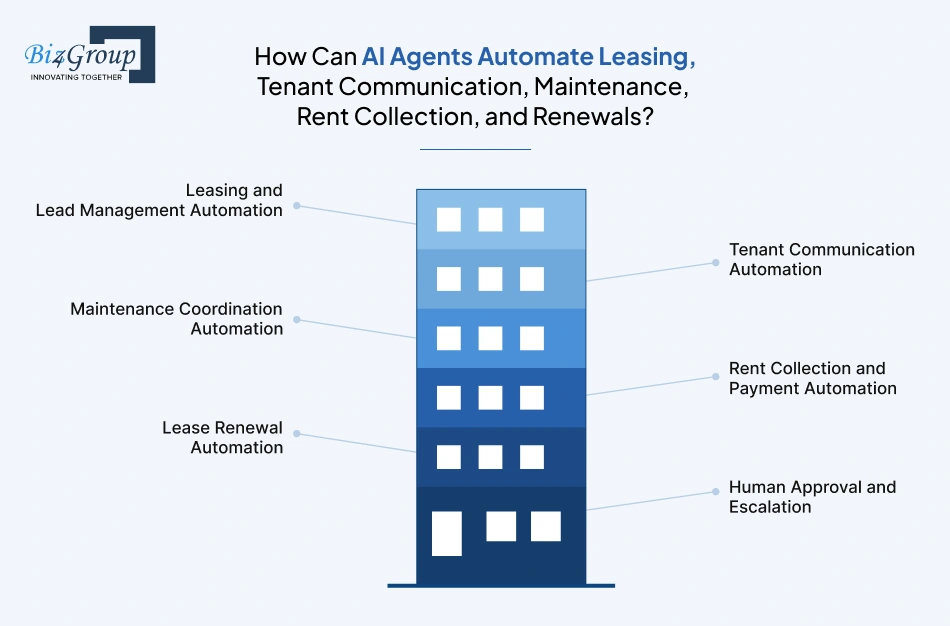
AI agents move workflows from trigger to action by gathering context, using connected tools, checking results, and escalating when needed. This is especially important in AI property management system development, where one workflow may involve several systems.
A leasing agent picks up new inquiries, checks prospect preferences and property availability, then moves qualified leads toward the next step. This is a practical use case for real estate AI agent development because the workflow involves multiple decisions and actions.
A tenant communication agent understands the request, finds the relevant resident or property information, and responds with the right context.
A maintenance agent turns a tenant's message into a structured service workflow, from identifying the issue to coordinating the next step.
Payment agents respond to account events and start the appropriate follow-up while keeping sensitive financial decisions under staff control.
A renewal agent follows the lease timeline, starts approved outreach, and keeps track of responses and outstanding tasks.
Agents need clear limits. When a workflow involves a sensitive issue, missing information, or an action outside its rules, it should stop and bring in the appropriate staff member.
The real advantage comes from letting agents work across connected property-management tools. That turns separate tasks into one continuous workflow.
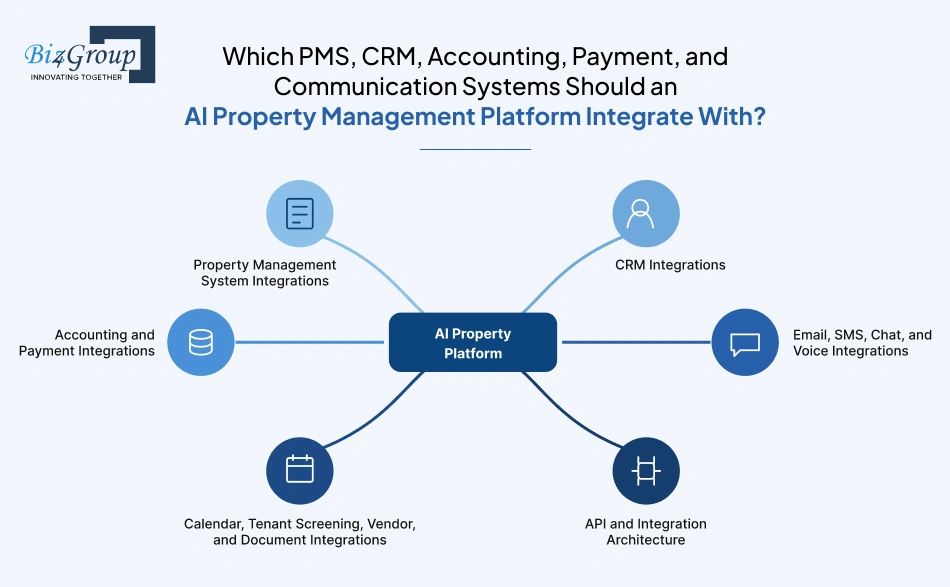
A residential AI property management platform should connect to the systems that hold the data its workflows depend on. The PMS provides property and resident records, the CRM handles prospects, accounting and payment tools provide financial events, and communication, calendar, screening, vendor, and document tools support specific operational steps.
The PMS should be the main data source for residential AI workflows. It gives leasing, maintenance, tenant support, and renewal agents the current property and resident details they need to act.
CRM data gives leasing workflows more context around prospects, including conversations, lead sources, follow-ups, and pipeline stages. This helps automate outreach based on where each prospect stands.
Accounting and payment connections provide balances, transaction statuses, invoices, and payment events. These records support automated communication while keeping financial authority with the appropriate systems and staff.
Communication integrations connect AI workflows to the channels residents and prospects already use. Conversation history stays attached to the relevant person and property record.
These connections handle supporting steps around leasing and property operations. They provide appointment availability, screening results, vendor information, and lease or property documents when a workflow needs them.
APIs move data between platforms, while webhooks let the AI workflow react to events as they happen. Authentication, error handling, and retry logic keep those connections reliable.
For growing property portfolios, disconnected software quickly becomes a problem. Teams often ask:
"We manage a growing residential property portfolio, but our current systems are disconnected and our staff still moves information between multiple tools manually. How can we build an AI property management system that connects these workflows and reduces operational workload?"
Build an integration layer that lets AI workflows pull information from the right systems and send approved updates back. Start with the PMS and the tools tied to the first workflows, then add more connections as the platform grows.
The right integration strategy connects each workflow to its required source of truth while keeping permissions and failure handling clear.
Building AI for residential real estate starts with the workflows that need improvement, then moves into data preparation, AI development, integrations, testing, and controlled rollout.
Start by mapping how leasing, tenant support, maintenance, payments, and renewals work today. This shows where manual work, delays, and repeated tasks are slowing property teams down.
Choose workflows where AI has enough data and clear rules to produce reliable results. Prioritize opportunities based on business value, frequency, and automation potential.
Through the MVP development services, keep the first release focused on a small set of connected property-management workflows. A focused MVP makes it easier to measure results and refine the automation.
Prepare the information that supports each workflow before development moves too far. Clean, structured records give AI workflows better context for decisions and responses.
Design the architecture around how property data will be retrieved, processed, and used in workflows. Clear boundaries between AI services, business logic, integrations, and permissions make the platform easier to control.
Develop the AI capabilities around the workflows selected for the MVP. This layer handles information retrieval, reasoning, tool use, workflow rules, and escalation.
Integration complexity is another concern that comes up when companies move from an AI idea to actual development:
"I want to develop an AI property management system for our residential real estate business, but I am concerned about the complexity of integrating tenant data, accounting systems, payment platforms, CRM tools, and our existing property management system."
Break the integration work into stages instead of trying to connect everything at once. The MVP should include only the systems required for its initial workflows, with additional integrations added as the platform expands.
Connect the platform with the PMS, CRM, accounting, payment, communication, calendar, vendor, and document tools required by each workflow.
For broader implementation considerations, AI property management system development covers the wider development process and architecture involved in these platforms.
Test the platform against everyday requests as well as incomplete, unusual, and conflicting cases. Measure both response quality and whether each workflow takes the correct action.
Start with a limited group of properties, workflows, or users before expanding across the portfolio. A controlled pilot shows how the automation performs under real operating conditions.
Use pilot results to improve reliability before adding more properties or workflows. Scale gradually as accuracy, adoption, and operational results reach the required level.
A measured rollout gives property teams room to improve the platform as real operating data comes in.
A practical AI residential real estate platform development stack combines LLMs, data infrastructure, agent workflows, integrations, and secure cloud services. The technology choices should match the residential workflows being automated and the PMS environment already in use.
|
Technology Layer |
What It Does |
Example Tech Stack |
|---|---|---|
|
AI and LLM Technology |
Handles tenant conversations, lead qualification, document understanding, summarization, and workflow decisions. |
OpenAI GPT models, Anthropic Claude, LangChain |
|
Data and Knowledge Technology |
Stores and retrieves leases, tenant records, property details, maintenance history, policies, and other operational data. |
PostgreSQL, Redis, Pinecone, pgvector, AWS S3 |
|
AI Agent and Workflow Technology |
Coordinates multi-step tasks such as lead qualification, tour scheduling, maintenance triage, and renewal follow-ups. |
LangGraph, LangChain, Temporal, OpenAI Agents SDK |
|
API and Integration Technology |
Connects the platform with PMS, CRM, accounting, payment, communication, calendar, screening, and vendor systems. |
REST APIs, GraphQL, webhooks, FastAPI, Node.js |
|
Cloud and Security Infrastructure |
Provides hosting, compute, storage, monitoring, authentication, access controls, and data protection. |
AWS, Azure, Docker, Kubernetes, OAuth 2.0, AWS KMS |
These components also form the foundation when you develop an AI property management app, particularly when the product needs to support mobile tenant interactions alongside the main property-management platform.
The best technology choices are the ones that fit the platform's workflows and existing property-management stack, while keeping future integrations and scaling straightforward.
For residential property management, security needs to follow the data and actions used in everyday workflows. Tenant records, leases, payments, maintenance details, and AI actions should each have clear rules for who can access them and what can be done with them.
Security becomes a major concern as soon as AI gets access to real tenant and property data:
"We are planning to build AI for our residential property operations, but I am worried about tenant data security, inaccurate AI responses, system integrations, and human oversight. What should we consider before developing and deploying an AI property management system?"
Plan security alongside the AI workflows from the beginning. Use role-based access, tenant data isolation, secure integrations, response testing, audit trails, and human approval for actions that could create financial, legal, or safety risks.
Keep sensitive information separated by purpose and give each workflow access only to what it needs. Lease details may be useful for tenant support, while payment information may belong only in rent-related workflows.
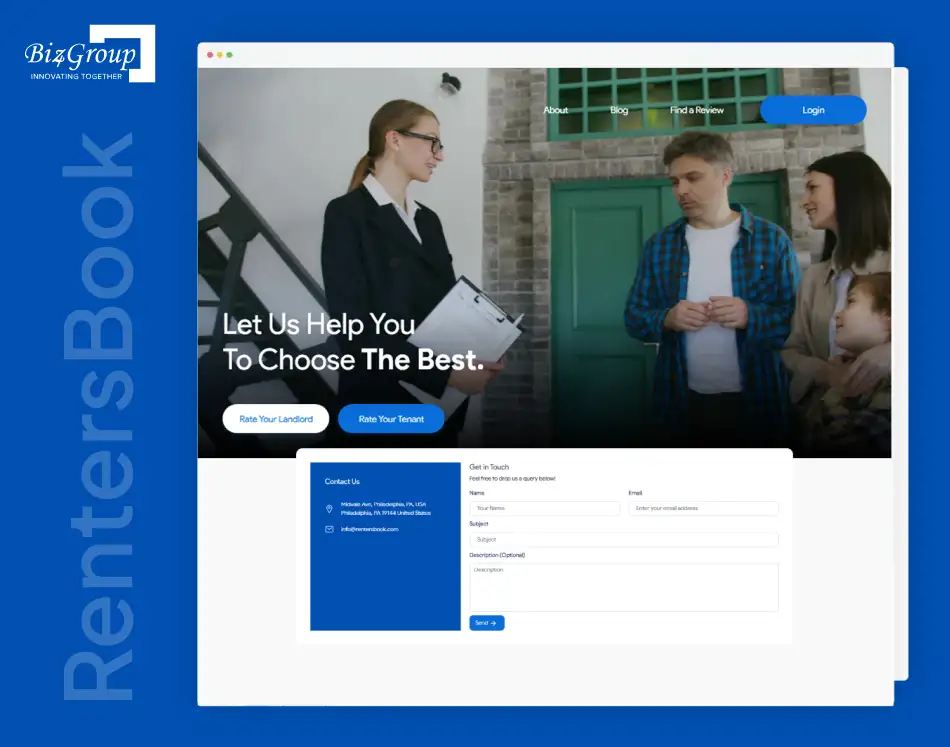
Biz4Group's Renters Book project brought tenant, landlord, and rental-property information into a review and ratings platform, with search and data-protection considerations built into the product. For residential AI platforms, this reinforces the need to think carefully about how people, property, and rental information is collected, verified, and exposed to users.
A leasing agent, maintenance coordinator, property manager, owner, and finance employee should not see or change the same things. Permissions should follow the person's actual responsibilities.
This becomes especially important when one platform manages hundreds or thousands of units. Data retrieved for one property, owner, or tenant should stay within the correct account and workflow.
When an external LLM handles a task, send only the context needed to complete it. The development team should also check how the provider stores, retains, and processes submitted data.
Property teams need to know what happened when an automated workflow takes an action. Keep records of the trigger, information retrieved, decision made, action taken, and any human approval involved.
Set clear limits for actions that carry financial, legal, safety, or tenant-impact risks. When a workflow reaches one of those limits, it should pause and hand the case to the right person.
Residential property workflows should also be checked for privacy, fair treatment, and appropriate use of tenant and applicant data. Review automated decisions regularly, especially where they affect leasing, payments, or resident treatment.
Strong controls should fit into the workflow itself, so property teams can automate routine work without losing visibility or control over sensitive decisions.
There are three practical options: add AI to the PMS you already use, build a new AI property management platform, or combine both. The right choice depends mainly on how well your current PMS works and how much you want to change.
If your PMS already handles properties, tenants, leases, payments, and maintenance well, adding an AI layer can be the quickest way to bring in automation. The existing PMS stays in place while AI takes over selected tasks.
This works well when:
If the existing PMS is too restrictive, businesses may choose to build a real estate AI platform around their own workflows, data model, and user experience. You get to decide how the property data, user experience, AI features, and workflows should work together.
What you gain:
What to plan for:
One lesson from Biz4Group's property management platform development work is that the quality of the AI depends heavily on the property data and workflow around it.
While building Homer AI, the team had to structure property information such as preferences, listings, floor plans, and dimensions so the conversational layer could retrieve the right details and guide users toward the next action.
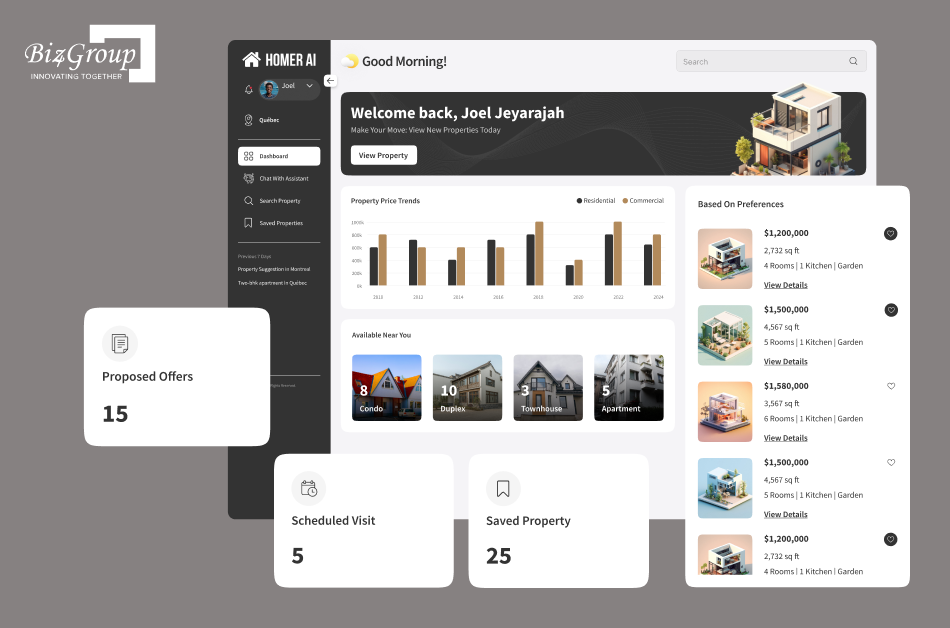
That same principle matters in residential property management: if tenant, lease, unit, maintenance, and availability data are poorly structured, even a capable model will struggle to produce reliable results.
A hybrid setup gives you a middle ground. The PMS keeps handling core records, while a separate AI layer handles tasks such as leasing conversations, maintenance triage, tenant requests, or renewal follow-ups.
A typical workflow looks like:
PMS data → AI layer → decision → approved action → PMS update
This approach is useful when the existing PMS is worth keeping, but its built-in automation is not enough for the workflows you want to run.
A quick way to choose is to look at your current setup and how much change you actually need.
|
Your Situation |
Better Fit |
Why |
|---|---|---|
|
Your PMS works well and has good APIs |
AI integration |
Add AI without changing the core platform |
|
You're building a new property-management product |
Standalone |
Build the product around your own workflows |
|
Your PMS works, but its automation is limited |
Hybrid |
Keep the PMS and add stronger AI capabilities |
|
You manage a large portfolio across older systems |
Hybrid or integration |
Avoid a disruptive full migration |
|
Your workflows are highly specialized |
Standalone or hybrid |
Gives you more control over how they work |
For many businesses, the decision comes down to one question: Is the existing PMS good enough to build on, or is it holding the workflow back? That answer usually makes the right architecture much easier to see.
The cost to develop an AI property management system for residential real estate can range from $50,000 to $300,000+, depending on the platform scope, AI complexity, integrations, and portfolio size.
|
Development Level |
Estimated Cost |
Typical Scope |
|---|---|---|
|
MVP |
$50,000–$100,000 |
2–4 core workflows, basic AI assistant, tenant communication, leasing automation, limited PMS/CRM integrations, basic dashboard, essential security |
|
Mid-Level |
$100,000–$200,000 |
Multiple AI workflows and agents, maintenance automation, rent and renewal workflows, document intelligence, predictive insights, several third-party integrations, role-based access |
|
Enterprise |
$200,000–$300,000+ |
Large portfolio support, advanced AI agents, extensive PMS/CRM/accounting integrations, custom analytics, complex permissions, multi-property data isolation, advanced security, monitoring, and scalable infrastructure |
The main cost drivers are:
For a more accurate estimate, define the first few workflows and integrations before pricing the full platform. That gives you a development scope based on actual residential property-management needs rather than a broad feature list.
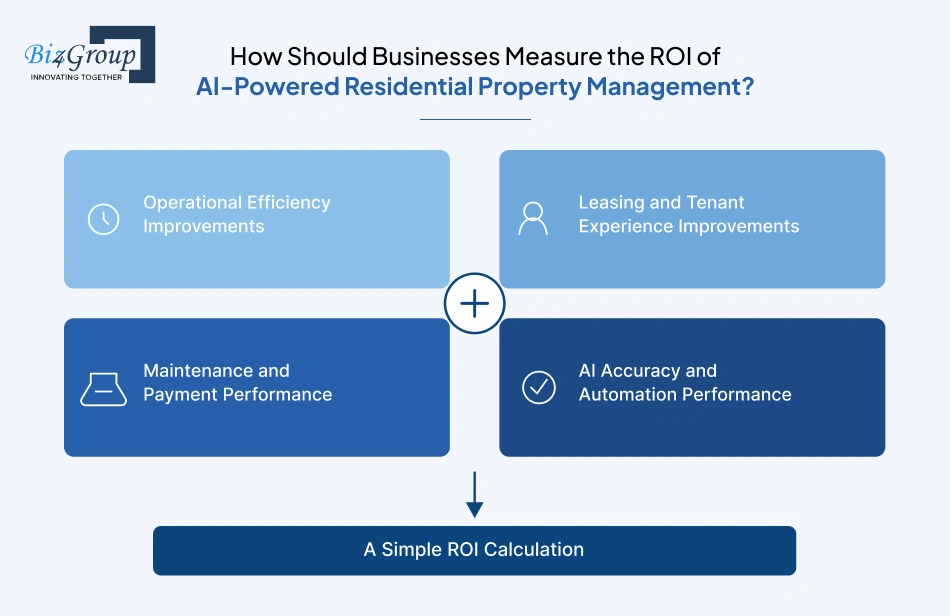
Measure ROI by looking at what changed after automation: how much staff time was saved, whether leasing and tenant outcomes improved, whether operational costs fell, and how reliably the AI handled its assigned work.
Start with the time and effort spent on repetitive property-management work before and after automation. Fewer manual tasks, faster response times, and fewer staff hours per workflow are clear efficiency gains.
Useful metrics include:
Track whether AI-supported leasing brings prospects through the funnel faster and whether tenants get quicker, more useful support. Look at both business outcomes and the experience people have during each interaction.
Useful metrics include:
For maintenance, compare how quickly requests are classified, assigned, scheduled, and resolved. For payments, look at whether automated reminders and follow-ups improve collection performance and reduce avoidable delays.
Useful metrics include:
Cost savings only matter when the automation is doing the right work. Track how often AI produces correct responses, follows the right workflow, escalates when needed, and completes actions without creating extra work for staff.
Useful metrics include:
A basic ROI calculation can show whether the savings and additional revenue generated by the platform justify its cost:
ROI (%) = [(Annual AI Benefits − Annual AI Costs) ÷ Annual AI Costs] × 100
For example, if AI saves $120,000 a year in staff time and operational costs, while generating another $30,000 through improved leasing and collections, the total benefit is $150,000. If the annual platform, AI, integration, and maintenance costs are $75,000:
ROI = [($150,000 − $75,000) ÷ $75,000] × 100 = 100%
The clearest ROI picture comes from comparing these results with the actual development, AI usage, integration, and maintenance costs. That shows whether automation is creating measurable business value.
Look for a company that understands both AI and residential property management. They should know how leasing, tenant support, maintenance, payments, and renewals work, and be able to connect those workflows with the systems your business already uses.
Start with the company's experience in residential property management. Look at whether they have worked with property listings, tenant records, leases, maintenance requests, payments, or similar workflows.
A team that already understands these processes will spend less time figuring out the basics and more time working on how AI should fit into them.
Check what the AI agent development company has actually built with AI agents. You want a team that understands how an agent retrieves information, uses tools, completes several steps, and knows when to hand a task to a person.
Ask for examples where AI moved beyond answering questions and actually supported a business workflow.
Your platform will probably need to connect with a PMS, CRM, accounting tools, payment services, email, SMS, calendars, and other systems. Make sure the development team knows how to keep these connections working when data changes or an integration fails.
This matters even more if you plan to build an AI layer around an existing PMS.
Tenant and property data should be handled carefully from day one. Ask how the company manages permissions, encryption, tenant data separation, AI provider access, audit logs, and human approval for sensitive actions.
You should also understand what happens to data when it is sent to an external LLM or AI service.
A good partner should help you decide what belongs in the first release and what can wait. If you're comparing the top MVP development companies in USA, look beyond their rankings and ask how they actually scope an MVP for a product like yours.
The roadmap should show which workflows come first, what integrations are needed, how success will be measured, and what can be added after the initial launch.
Launching the platform is only the beginning. AI workflows may need tuning as new tenant questions, property data, business rules, and edge cases appear.
Make sure the development company can handle ongoing improvements, new integrations, AI updates, monitoring, and scaling as the portfolio grows.
The right partner should make the development path easier to understand and help you avoid building more than the business needs at the start.
A useful thing to look for in an AI development company is how they handle product decisions before development gets too far. In Biz4Group's real estate AI work, the team has had to account for different user journeys, from searching and comparing properties to getting property details and moving toward a scheduled visit.
That kind of early workflow thinking matters in residential property management too, where a leasing employee, property manager, and tenant may all use the same platform in very different ways.
Explore how an AI layer can work with your existing property-management stack and turn everyday data into useful actions.
Plan My AI IntegrationBuilding AI residential real estate works best when the technology follows the way property teams already work. Start with the workflows that create the most repetitive effort, connect the right property and tenant data, and give AI enough access to complete useful tasks while keeping sensitive decisions under human control.
The right architecture may be an AI layer around an existing PMS, a standalone platform, or a hybrid setup. What matters is whether the approach improves measurable outcomes across leasing, tenant support, maintenance, payments, and renewals.
If you're still working out which workflows to automate, what to include in the MVP, or how your existing PMS should fit into the architecture, AI consulting services can help turn those questions into a practical development plan.
Book an appointment to discuss your residential AI property-management requirements.
Developing an AI property management system for residential properties involves connecting property, tenant, lease, maintenance, payment, and communication data with AI-driven workflows. The scope can range from a few automated tasks connected to an existing PMS to a complete platform with AI agents, dashboards, integrations, and custom data infrastructure.
The timeline depends on the number of workflows, AI capabilities, integrations, and level of customization. A focused MVP may take a few months, while a larger residential platform with multiple AI agents, extensive integrations, and enterprise-level infrastructure can take considerably longer.
Custom AI property management system development gives businesses more control over how their property data, workflows, user roles, integrations, and AI features work together. It is particularly useful when existing PMS products cannot support specialized residential workflows or the level of automation required.
Yes. An AI layer can sit alongside the existing PMS and handle selected workflows while the PMS continues managing core property and tenant records. This approach is useful when the existing platform works well but lacks the AI capabilities needed for leasing, maintenance, tenant communication, or renewals.
Look for experience across both AI development and residential property-management workflows. It also helps to check whether the developer has handled PMS integrations, AI agents, tenant data, security controls, workflow automation, and post-launch improvements.
Traditional property-management software mainly follows predefined rules and user actions. AI residential property management platform development adds capabilities such as natural-language interaction, document understanding, predictive insights, and agents that can work through multiple steps using connected data and tools.
A custom platform makes sense when the business has a large or specialized portfolio, unique operating workflows, complex integrations, or requirements that standard PMS products cannot handle well. It can also be a better fit when AI needs to be built into the core product rather than added as a separate feature.
Compare companies based on their experience with residential workflows, AI agents, integrations, security, MVP development, and scaling. Ask to see relevant product work and understand how they approach workflow discovery, data preparation, AI testing, and ongoing optimization before choosing a partner.

Our website require some cookies to function properly. Read our privacy policy to know more.