 Location :
Orlando, FL, USA
Location :
Orlando, FL, USA +1 (407) 714-1616
 info@biz4group.com

- Real estate AI app ideas work best when they focus on frequent, data-backed decisions like pricing, lead handling, and risk checks.
- Successful teams evaluate AI app ideas for real estate business based on data readiness, measurable impact, and how easily AI fits into existing workflows.
- The most reliable real estate AI application ideas start small, solve one clear problem, and expand only after proving value in production.
- Build vs integrate decisions matter early, choosing the wrong approach can increase cost, slow delivery, and limit scalability later.
- Many AI projects fail due to weak data foundations, lack of monitoring, or over-automation without human oversight.
- AI becomes a long-term advantage when treated as a product decision, with a proper strategy for long-term maintenance, compliance, and growth.
Real estate companies are paying closer attention to how artificial intelligence can support everyday decisions. Tasks such as pricing, lead qualification, document review, and risk checks now rely on large volumes of data that are difficult to process manually. As a result, real estate AI app ideas are increasingly viewed as practical software initiatives rather than experimental concepts.
However, not every AI idea translates into a usable application. Many teams begin with broad real estate AI application ideas without fully understanding what makes an AI system reliable in production. Questions around data availability, system integration, and long-term maintenance often surface late, after time and budget have already been committed. This gap between idea and execution is where many projects lose momentum.
At a foundational level, AI applications in real estate depend on three factors: consistent data inputs, repeatable decision patterns, and clearly defined outcomes. Without these elements, even well-designed models struggle to deliver value. This is why real estate AI software development efforts increasingly focus on aligning business goals with technical constraints before development begins.
For organizations exploring AI for the first time, early guidance can help reduce uncertainty. In many cases, AI consulting services are used to evaluate feasibility, identify risks, and determine whether AI is appropriate for a given use case. This early clarity helps teams avoid unnecessary complexity and focus on ideas that are realistic to build and maintain.
The sections that follow break down AI app ideas for real estate business in a structured way, helping decision-makers understand which ideas are viable, how they create value, and how to prioritize them responsibly.
What Qualifies As Real Estate AI App Idea?
A real estate AI app idea qualifies when it makes use of data and trained AI models to support decisions that directly affect business results. To put it simply, real estate AI app ideas focus on areas like pricing, lead handling, risk checks, or document review - where patterns can be learned from past data.
A Clear Definition Of Real Estate AI App Ideas
Real estate AI app ideas are software applications that use machine learning to analyze data and improve outputs over time. These apps go beyond basic automation or fixed rules. They continuously learn from new information and refine results like valuation estimates, lead rankings, compliance alerts, and more. Most AI powered real estate app ideas are put directly into business systems so they can support everyday work instead of operating as individual analytics tools.
The Minimum Technical Requirements For An AI Driven Real Estate Application
An AI driven real estate application needs a basic technical foundation to function properly. Without this foundation, results become inconsistent and difficult to trust.
Minimum requirements shall include:
- Sufficient data volume: Usually thousands or more historical records
- Clear use case: A defined task like prediction, classification, or ranking
- Reliable data pipelines: Ongoing data gathering, cleaning, and updates
- Measurable performance metrics: Accuracy, error rate, or confidence benchmarks
- System connectivity: APIs or services that integrate AI into an app used by teams
Many companies rely on AI integration services to meet these requirements so they can reduce early stage technical risk.
When An Idea Is Technically Feasible Versus Aspirational
Not all innovative AI ideas for real estate companies are meant for execution. Feasibility depends on data readiness, how often decisions need to be taken, and how big of an error can be tolerated.
|
Evaluation Factor |
Technically Feasible |
Aspirational |
|---|---|---|
|
Data Availability |
Large and consistent datasets |
Limited or fragmented data |
|
Decision Frequency |
Frequent and repeatable |
Infrequent or one time |
|
Error Impact |
Errors are manageable |
Errors create legal or financial risk |
|
Workflow Fit |
Fits current systems |
Requires major process changes |
Ideas that meet feasibility conditions are more likely to succeed as real estate AI app solutions ideas, while aspirational concepts usually demand more preparation, like data standardization, before they can deliver real value.
Validate Real Estate AI App Ideas Before You Build
Assess whether your real estate AI app ideas are feasible, data-ready, and aligned with real business outcomes.
Review My AI App IdeaIs AI Worth Investing In For Real Estate App Business?
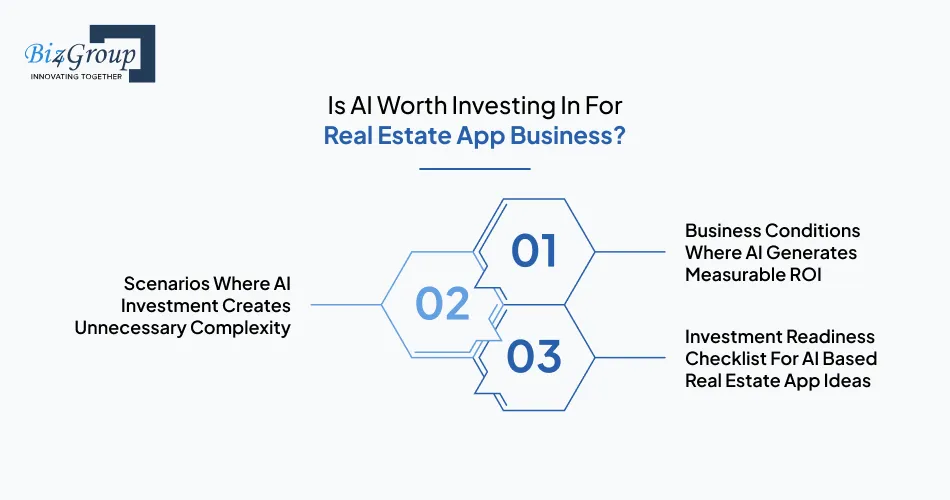
The short answer is yes, but only under specific conditions. Real estate AI app ideas tend to succeed when they are applied to everyday decisions such as pricing updates, lead handling, or document review. In proven use cases, AI systems often improve speed or accuracy by a minimum of 15 to 30 percent, which sets a realistic benchmark for evaluating whether the investment makes sense or not.
Business Conditions Where AI Generates Measurable ROI
AI generates return when it is connected directly to business outcomes that can be measured and tracked. In real estate, this means high volume decisions supported by existing data.
AI is more likely to deliver ROI when:
- Decisions happen frequently, such as lead qualification or pricing changes
- Historical data is already available and usable
- Results can be measured using clear metrics like time saved or conversion rate
- Teams are expected to use AI outputs as part of daily work
Under these conditions, many AI based real estate app ideas begin to show value within one to two years, especially when they improve existing processes rather than replace them.
Scenarios Where AI Investment Creates Unnecessary Complexity
AI becomes a poor investment when it is applied to problems that are either not ready or relevant for it. This leads to higher costs without clear benefits.
Common scenarios include:
- Limited or unreliable data
- Decisions that are taken rarely and cannot be learned from
- Workflows that change frequently or are poorly defined
- High risk situations where small errors have major consequences
In these cases, intelligent AI real estate app concepts may add complexity instead of clarity. Some teams attempt large enterprise AI solutions before fixing basic data or process issues, which often slows down business growth.
Investment Readiness Checklist For AI Based Real Estate App Ideas
Before investing, teams should confirm basic readiness by considering these factors:
- The problem is clearly defined
- Data is available or easy to collect
- Success can be measured
- Teams are ready to act on AI outputs
- Ongoing support and updates are planned
When these conditions are met, AI initiatives are easier to scale and maintain. This helps organizations focus on real estate business AI app ideas that are practical to build and support over time, instead of experimenting without clear direction or relying too heavily on AI automation services without building proper foundations.
Turn AI App Ideas For Real Estate Business Into Clear Use Cases
Identify which AI app ideas for real estate business can drive revenue, efficiency, or risk control without overengineering.
Map Business Goals To AIWhat are the Most Valuable Real Estate AI App Ideas by Business Goal
The value of AI in real estate depends on the business problem it solves. The most effective real estate AI app ideas are designed around clear goals like revenue growth, operational efficiency, risk control, or long-term product development. Grouping ideas by business goal makes evaluation easier and more practical. Here are the some of the most promising AI app ideas in 2026 that you should consider:
1. Revenue Generating Real Estate AI App Ideas
Revenue-focused AI applications aim to improve deal flow, lead quality, and pricing decisions. These ideas work best when they support actions that directly affect transactions, which is why many teams start exploring AI real estate app ideas in this category.
AI App Ideas for Real Estate Investors and Brokers Focused on Deal Flow
- Opportunity scoring based on historical deal outcomes
- Property matching using investor and buyer preferences
- Alerts for pricing gaps and under-the-radar listings
Real Estate AI App Ideas for Lead Generation and Qualification
- Lead ranking based on behavior and engagement signals
- Automated follow-up timing suggestions
- Segmentation to prioritize high-intent prospects
Pricing Intelligence and Negotiation Support Systems
- Market-based price adjustment suggestions
- Comparable analysis updated in real time
- Scenario support for offer and counteroffer decisions
These use cases are often where teams first ask is AI worth investing in for real estate app business, because revenue impact can be tracked more easily.
2. Operational Efficiency AI Powered Real Estate App Ideas
Efficiency-focused AI applications reduce manual work and processing time. They are common in internal workflows and scale-driven operations, especially in AI app ideas for real estate business.
Workflow Orchestration Using AI Driven Task Prioritization
- Task assignment based on urgency and workload
- Delay detection in transaction pipelines
- Status tracking across teams
Intelligent Document Processing for Contracts and Disclosures
- Automated data extraction from contracts
- Error and missing field detection
- Faster review and approval cycles
Communication Automation with Human Oversight
- Drafting routine messages with approval steps
- Follow-up reminders based on context
- Reduced response delays without full automation
Many of these ideas require teams to build real estate AI software that connects smoothly with existing tools.
3. Risk And Compliance Focused AI Based Real Estate App Ideas
Risk-focused AI applications aim to reduce exposure and errors. These ideas are often driven by real estate AI application ideas that are mainly about compliance and trust.
Fraud Detection In Transactions And Identity Verification
- Pattern checks for unusual transaction behavior
- Identity mismatch alerts
- Risk flags during onboarding
Compliance Intelligence For Regulatory Adherence
- Rule checks by region or jurisdiction
- Automated compliance alerts
- Audit-ready reporting
Risk Scoring Across Properties, Tenants, And Portfolios
- Asset-level risk summaries
- Early warning signals for defaults
- Portfolio-wide exposure views
4. Profitable Real Estate AI Startup App Ideas And Monetization Logic
Monetization plays a key role in when choosing what kind of real estate AI app to develop for your business. Many profitable real estate AI startup app ideas succeed via pricing intelligence instead of raw usage.
Subscription Models Built On Recurring Intelligence
Subscription models charge for continuous access to insights. They work best when AI outputs update regularly and remain relevant.
- Monthly access to forecasts and benchmarks
- Tiered plans based on insight depth
Transaction Based Monetization Tied To Decision Value
This model links fees to completed actions. It aligns cost with results and lowers adoption-related issues.
- Fees per closed deal
- Charges per processed transaction
Data Intelligence And Analytics Licensing Opportunities
Licensing allows insights to be reused across platforms. It suits companies selling data-driven signals instead of full products.
- Market intelligence feeds
- White-labeled analytics
Platform And API Based Real Estate AI App Solutions Ideas
APIs allow AI features to be embedded into other products. This supports partnerships with other brands and faster reach.
- Usage-based API access
- Partner integrations
Next Gen Real Estate AI App Ideas That Will Matter In 2026
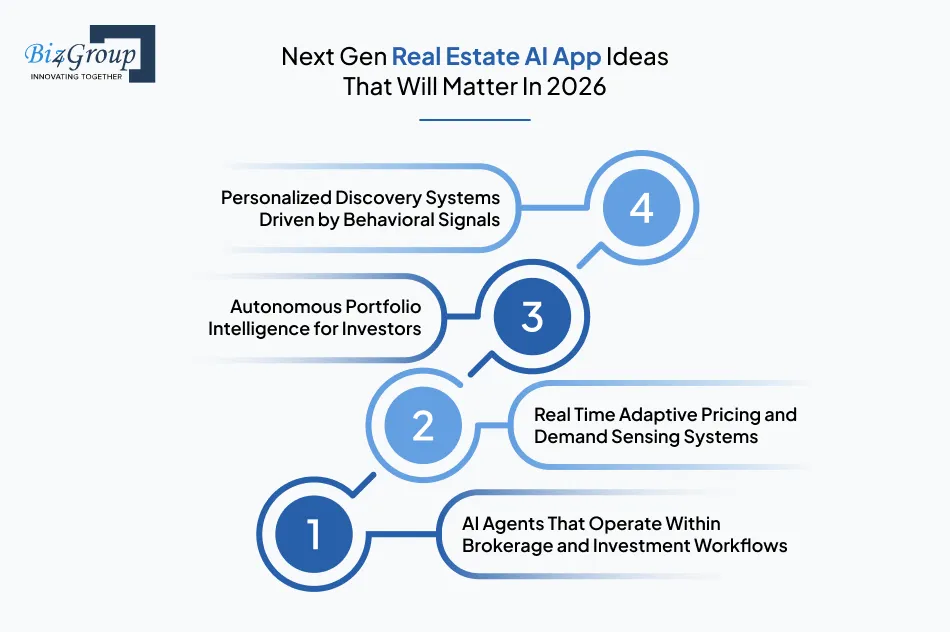
In 2026, real estate AI applications focus on predictive coordination, real-time market response, and portfolio-level intelligence. These systems learn continuously from live data and support operational and investment decisions at scale. Here are the top ideas that matter:
AI Agents That Operate Within Brokerage and Investment Workflows
AI agents assist by coordinating several tasks across different types of systems. They monitor activity, trigger actions, and support users without removing human control. Many of these systems rely on generative AI.
Real Time Adaptive Pricing and Demand Sensing Systems
These systems adjust prices using live market signals. They respond faster than manual updates and are becoming part of the most in demand AI features in real estate apps.
Autonomous Portfolio Intelligence for Investors
Portfolio tools track performance and risk across assets of different categories. They help investors make decisions using combined insights instead of isolated metrics.
Personalized Discovery Systems Driven by Behavioral Signals
Discovery systems adapt recommendations based on user behavior. They improve relevance over time and are important for many AI powered real estate app ideas.
Together, these categories reflect the best real estate AI app ideas for 2026, especially when teams validate data readiness, choose realistic scopes, and follow structured approaches such as how to build AI real estate app MVP planning and how to use AI for real estate responsibly.
Build On The Right Data For Real Estate AI Applications
Strong real estate AI application ideas start with usable data, clean pipelines, and realistic performance expectations.
Check My Data ReadinessMost In Demand AI Features In Real Estate Apps
The most common AI features in real estate apps are those that focus on improving everyday decisions. Across current real estate AI app ideas, demand is highest for features that help teams price properties correctly, respond to leads faster, search listings easily, and reduce overall risk. These features are practical, well tested, and already used in many real estate products:
|
AI Feature |
What It Does |
Why Teams Use It |
Data Needed |
|---|---|---|---|
|
Predictive Pricing and Valuation Systems |
Estimates property values using past and current data |
Helps set prices and support negotiations |
Sales history, listings, market data |
|
AI Driven Lead Scoring and Prioritization |
Ranks leads by likelihood to convert |
Saves time and improves follow-up |
CRM records, engagement data |
|
Natural Language Search and Conversational Interfaces |
Understands search queries and questions |
Makes listing discovery easier |
Search logs, listing details |
|
Image Based Property Analysis and Tagging |
Identifies features from photos |
Improves listing accuracy and filters |
Property images, labeled examples |
|
Risk Scoring and Anomaly Detection Engines |
Flags unusual or risky activity |
Reduces fraud and compliance issues |
Transaction and user data |
Predictive pricing and lead scoring are often adopted first because their impact is easy to calculate. Conversational features are gradually added through AI conversation app designs to improve natural conversations. Image and risk analysis come into the picture when teams build real estate AI software to support accuracy and trust.
Together, these features form the core of practical real estate AI app solutions that help businesses maintain proper data and set clear goals.
Data Requirements Behind Real Estate AI Application Ideas
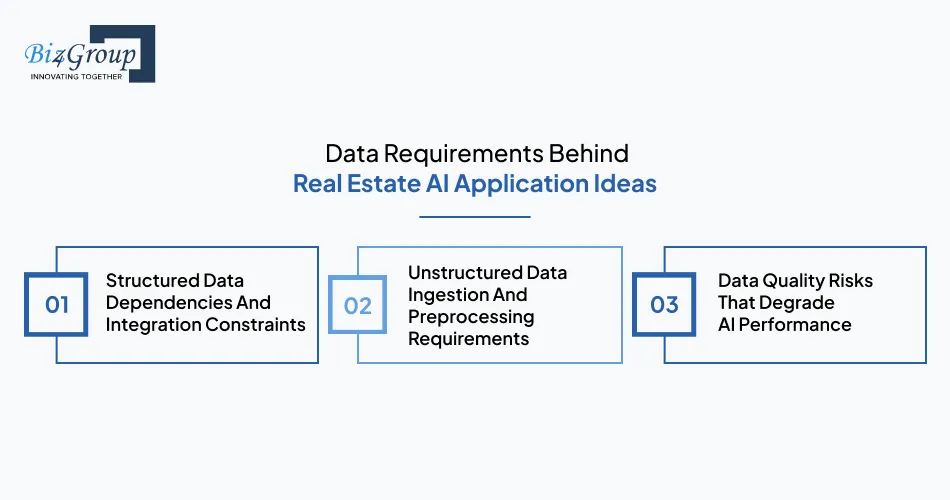
Data is what makes AI work. Most real estate AI app ideas depend on having enough usable data, need to be updated on a regular basis, and connected across most (if not all) systems. Without this foundation, AI models cannot produce stable or trusted results.
1. Structured Data Dependencies And Integration Constraints
Structured data includes listings, transaction records, pricing history, CRM entries, and user activity logs. These datasets are needed in large volumes to support predictions and rankings used in AI driven real estate technology ideas. Problems usually come up when this data is scattered across tools and cannot be synced or accessed consistently.
2. Unstructured Data Ingestion And Preprocessing Requirements
Unstructured data includes property images, scanned documents, emails, and chat messages. This data must be regularly cleaned, labeled, and converted before AI models can use it, which adds a lot of time and cost. Many AI app ideas for real estate investors and brokers rely on this step to analyze contracts, photos, or conversations with accuracy.
3. Data Quality Risks That Degrade AI Performance
Poor data quality leads to weak results. Common issues related to data include missing fields, outdated listings, duplicate records, and biased samples. These problems often surface during AI model development, when models fail to perform as expected.
|
Data Dimension |
What Is Required |
Common Gaps |
Impact If Ignored |
|---|---|---|---|
|
Structured Data |
Listings, transactions, CRM records, pricing history |
Data spread across tools, outdated records |
Low model accuracy and unreliable predictions |
|
Unstructured Data |
Images, contracts, emails, chat logs |
Missing labels, inconsistent formats |
High preprocessing cost and delayed deployment |
|
Data Volume |
Thousands to millions of historical records |
Sparse or incomplete datasets |
Models fail to generalize or scale |
|
Data Freshness |
Regular updates and synchronization |
Stale or delayed inputs |
Declining performance over time |
|
Data Consistency |
Standardized fields and definitions |
Duplicates and conflicting values |
Increased errors and model instability |
|
Data Governance |
Access controls and validation rules |
No ownership or quality checks |
Compliance risk and loss of trust |
Strong data practices reduce long-term risk, so businesses planning to build AI software should confirm data access, preprocessing effort, and quality controls early. Doing this groundwork helps make sure that next gen real estate AI app ideas can move beyond prototypes and perform reliably in real-world use.
Build Vs Integrate Decisions for Real Estate AI App Solutions Ideas
The choice to build or integrate AI affects how fast a product can launch and how complex it becomes later. For most real estate AI app ideas, this decision depends on available data, internal skills, and how central AI is to the product.
When Third Party AI Services Are Sufficient
- The use case is common, such as chat, search, or image tagging
- Speed is more important than deep customization
- Data is limited or not unique
- Ongoing maintenance needs to stay minimal
This option works well for early AI app ideas for real estate business that need quick testing.
When Fine Tuned Models Create Competitive Advantage
- The business has domain-specific data
- Accuracy directly affects outcomes
- Generic tools do not perform well enough
- Teams can manage updates and retraining
This approach fits many real estate AI application ideas where local context matters.
When Fully Custom AI Systems Are Justified
- Large proprietary datasets are available
- AI is a core product feature
- Long-term control is important
- Internal teams can support development
Companies often choose this path when they plan to build real estate AI software for long-term use.
Trade Offs In Hybrid AI Architectures
- Mixes third-party tools with custom components
- Balances speed and control
- Adds integration complexity
- Requires clear system boundaries
Hybrid setups are common in AI powered real estate app ideas that need flexibility.
Summary Table
|
Approach |
Speed |
Cost |
Control |
Best Use Case |
|---|---|---|---|---|
|
Third Party Services |
High |
Low |
Low |
Fast validation |
|
Fine Tuned Models |
Medium |
Medium |
Medium |
Specialized tasks |
|
Custom Systems |
Low |
High |
High |
Core AI features |
|
Hybrid Architecture |
Medium |
Medium |
Medium |
Scalable products |
Many innovative AI ideas for real estate companies start with simple integrations and evolve over time as data grows and teams gain experience, including products built for AI for real estate agents.
Choose The Right Path For AI Powered Real Estate App Ideas
Decide when to build, integrate, or hybridize AI powered real estate app ideas without locking yourself into costly rework.
Plan My AI ArchitectureWhy Real Estate AI Apps Fail In Production?
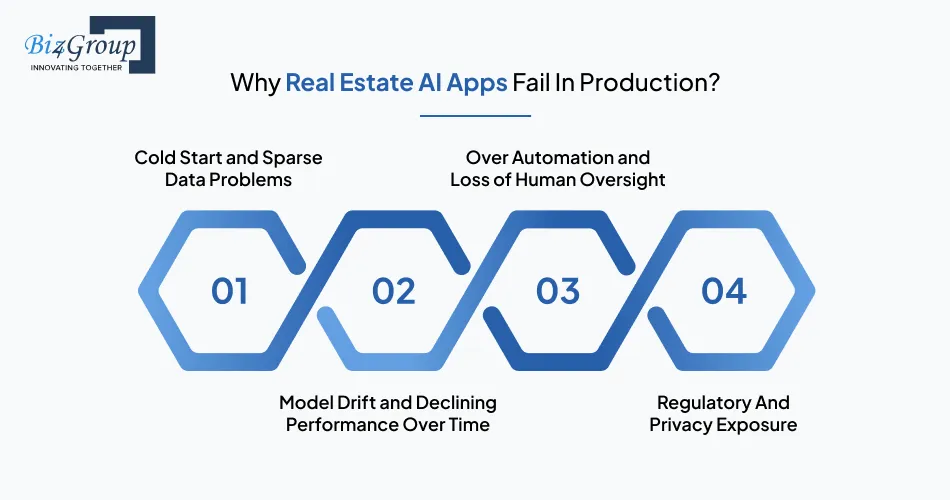
Many AI products fail after they go live. Even well-planned real estate AI app ideas can struggle in production when data, usage patterns, or controls are not ready. Most failures follow a few common and predictable causes.
1. Cold Start and Sparse Data Problems
AI systems need enough past data to learn patterns. In early stages, many apps do not have sufficient real-world data to produce stable results. This is a frequent issue in AI based real estate app ideas launched before data collection is mature.
2. Model Drift and Declining Performance Over Time
Real estate markets change often, which affects model accuracy. If models are not monitored and updated, predictions slowly become unreliable. This problem commonly appears in long-running real estate AI app solutions.
3. Over Automation and Loss of Human Oversight
AI should support decisions, not replace them completely. Fully automated systems can make errors that go unnoticed without human review. This risk is higher in tools such as an AI conversation app that interact directly with users.
4. Regulatory And Privacy Exposure
Real estate data often includes sensitive personal and financial information. Poor controls increase compliance and privacy risks. These issues are more likely when teams rush business app development using AI without clear data governance.
Most production failures are avoidable. Teams that plan for data growth, regular monitoring, human review, and compliance early are more likely to build AI systems that remain reliable over time.
Avoid Common Pitfalls In Real Estate AI App Solutions
Reduce risk early by understanding why many real estate AI app solutions fail after launch and how to prevent it.
Evaluate My AI Risk FactorsHow To Prioritize Real Estate Business AI App Ideas?
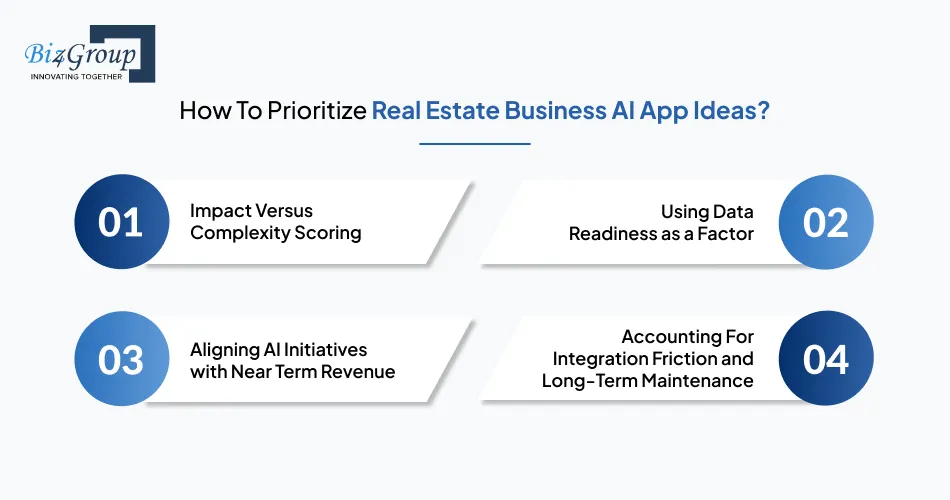
Prioritization helps teams in avoiding situations where wrong things get built first. For most real estate AI app ideas, success depends on choosing use cases that balance impact, feasibility, and long-term effort. Clear prioritization reduces wasted time and improves outcomes.
1. Impact Versus Complexity Scoring
This method compares expected business impact with implementation difficulty. High-impact, low-complexity ideas should come first because they deliver value faster for businesses. Many intelligent AI real estate app concepts fall into this category when they improve existing workflows.
2. Using Data Readiness as a Factor
AI ideas should not move forward without usable data. If data is missing, fragmented, or outdated, results will be unreliable. This is a common filter used when evaluating AI driven real estate technology ideas.
3. Aligning AI Initiatives with Near Term Revenue
AI projects are easier to justify when they support revenue in the short term. Use cases tied to pricing, leads, or transaction flow usually rank higher. This alignment helps teams focus on real estate business AI app ideas with measurable returns.
4. Accounting For Integration Friction and Long-Term Maintenance
AI systems require ongoing monitoring, updates, and support. Integration complexity and maintenance costs often exceed initial estimates. These factors matter even more when teams plan to hire AI developers for long-term ownership.
In practice, strong prioritization combines impact scoring, data checks, revenue alignment, and maintenance planning. Teams that apply these steps consistently are better positioned to invest in next gen real estate AI app ideas without overextending resources or timelines.
Prioritize Next Gen Real Estate AI App Ideas With Confidence
Focus on next gen real estate AI app ideas that are realistic to build, maintain, and scale in production environments.
Create My AI RoadmapHow Biz4Group LLC Can Help You Turn Real Estate AI App Ideas Into Reality In 2026
Turning AI ideas into working products takes a lot of clear planning and steady execution. Biz4Group LLC helps real estate companies move from concept to launch by focusing on data readiness, practical use cases, and reliable delivery. As an experienced AI app development company, the goal is to build systems that work in real business settings.
How Biz4Group LLC Supports Real Estate AI Projects:
- Assesses whether an AI idea is realistic and worth building
- Designs systems that fit existing real estate workflows
- Builds and integrates AI features into live applications
- Provides ongoing support, monitoring, and improvements
Below are real estate-focused platforms built by Biz4Group LLC that show how AI ideas are applied in practice.
Homer AI
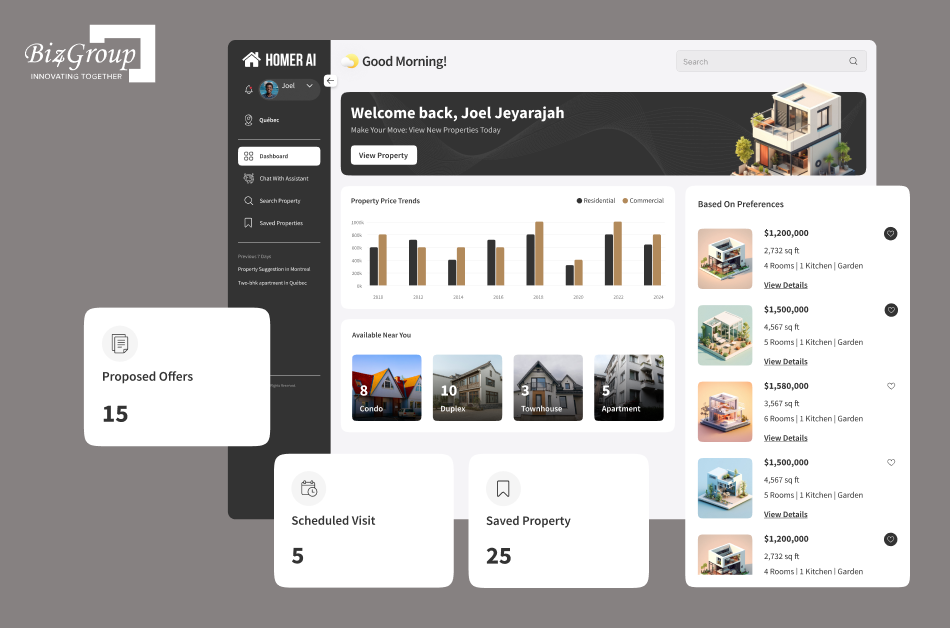
Homer AI is a conversational real estate platform that helps users discover properties through guided interactions. It simplifies early-stage decision-making by answering questions and recommending listings based on user input, while still keeping agents involved where needed.
Contracks
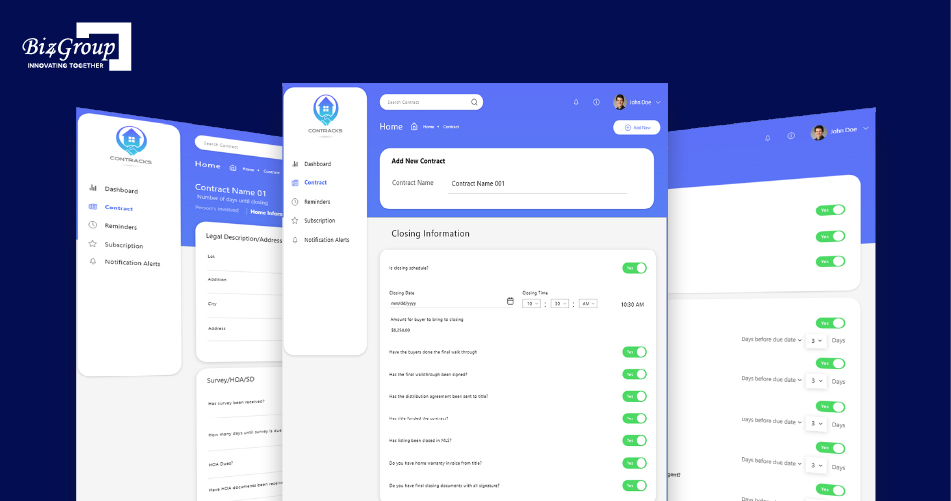
Contracks is a contract and transaction management platform for real estate teams. It tracks deadlines, milestones, and dependencies across deals to reduce manual follow-ups. The platform improves visibility and consistency in document-heavy workflows.
Groundhogs
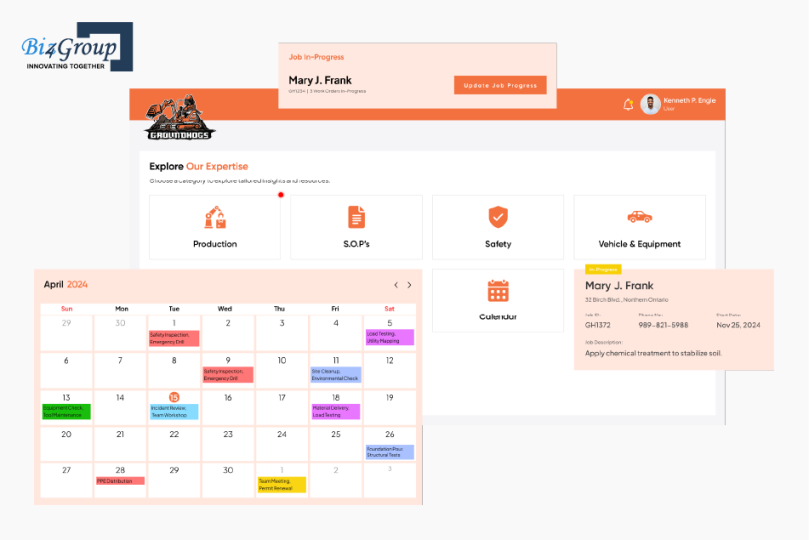
Groundhogs is a construction management system used in real estate development projects. It supports real-time job tracking, safety checks, and centralized documentation, helping teams monitor progress and reduce on-site risk.
Facilitor
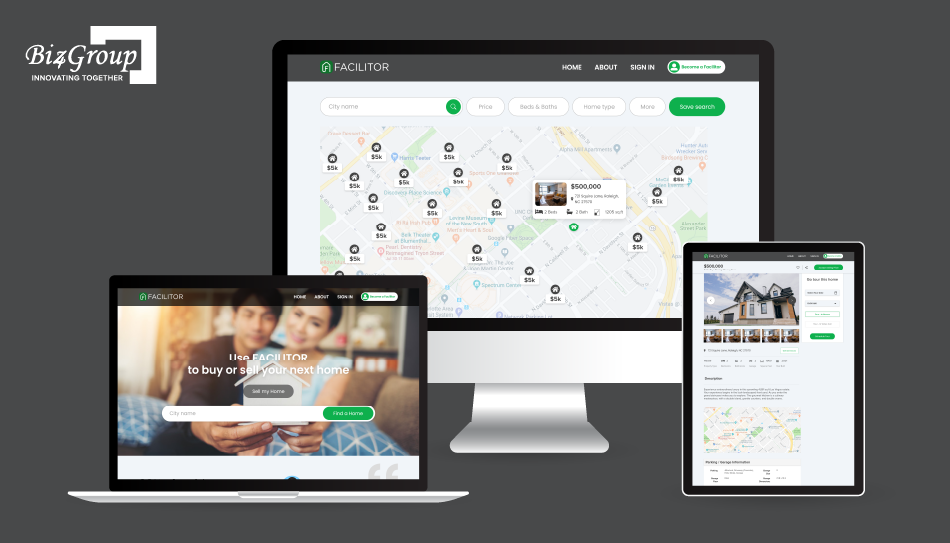
Facilitor is an AI-powered real estate platform that supports secure property exploration and guided buyer journeys. It combines intelligent assistance with human support to improve trust and usability throughout the buying process.
Across these projects, Biz4Group LLC supports teams that want to scale responsibly, and carefully implements generative AI in real estate products that are ready for production use.
Final Thoughts
Real estate AI is all about deciding what is practical, scalable, and worth maintaining. As this guide shows, real estate AI app ideas create value only when they are tied to clear business goals, supported by usable data, and designed for real workflows. The strongest solutions focus on everyday decisions and favor consistent gains instead of short-term flashy features.
What separates successful AI products from stalled experiments is execution. Teams that think through feasibility, integration, risk, and long-term ownership early avoid costly rewrites later. Whether the objective is revenue growth, efficiency, compliance, or future readiness, AI delivers results when it is treated as a product decision. With the right approach and reliable product development services, AI becomes a durable capability instead of a one-time experiment.
Review Your Real Estate AI App Idea for Practical Fit and Scale. Call us today!
FAQs
1. How Long Does It Typically Take to Launch a Real Estate AI App?
The timeline depends on scope and data readiness. A focused MVP can take 3 to 4 months, while a full-scale AI application with integrations and monitoring often takes 6 to 9 months. Delays usually come from data preparation rather than model building.
2. What Type of Data Is Hardest to Obtain for Real Estate AI Apps?
Behavioral and outcome-linked data is often the hardest to collect. This includes buyer intent signals, negotiation outcomes, and post-transaction performance. These datasets are valuable but are rarely structured or consistently stored across systems.
3. Can Small or Mid-Sized Real Estate Businesses Use AI Effectively?
Yes, but the use cases must be narrow and well-defined. Smaller teams benefit most from AI that improves lead handling, pricing suggestions, or document review. Large, fully automated systems usually require more data and operational scale.
4. How Do You Measure Success After Launching A Real Estate AI App?
Success is measured by operational or financial impact, not model accuracy alone. Common metrics include time saved per transaction, increase in conversion rates, reduction in errors, or improved response times. These metrics should be defined before development begins.
5. Do Real Estate AI Apps Require Ongoing Maintenance After Launch?
Yes. AI systems require regular monitoring, data updates, and retraining to remain accurate. Market changes, new regulations, and shifting user behavior all affect performance, making ongoing maintenance a core requirement rather than an optional step.
6. What Are the Biggest Misconceptions About AI In Real Estate Apps?
A common misconception is that AI works out of the box. In reality, most value comes from data preparation, integration, and workflow design. AI does not replace decision-making, it supports it, and works best when humans remain part of the process.
