 Location :
Orlando, FL, USA
Location :
Orlando, FL, USA +1 (407) 714-1616
 info@biz4group.com

 AI Summary Powered by Biz4AI
- A CRE acquisition platform can bring deal intake, buy-box screening, document extraction, underwriting, pipeline management, and IC reporting into one connected workflow.
- AI can extract data from OMs, rent rolls, and T-12s, run first-pass screening, and populate existing Excel models while analysts handle exceptions and investment judgment.
- A searchable deal registry can preserve active, passed, and closed deals, including underwriting versions, assumptions, decisions, and historical deal context.
- Market data and comps can help validate broker assumptions around rents, vacancy, expenses, exit cap rates, and NOI growth.
- Firms can build a custom platform, use an existing product, or combine both depending on workflow complexity, integration needs, and desired control.
- Development costs can range from roughly $20,000 for a focused MVP to $300,000+ for an advanced platform, with integrations, AI, underwriting complexity, security, and more.
A good CRE acquisition platform should make the first few hours of a deal much easier. CRE acquisition platform development can connect broker emails, deal portals, offering memorandums, rent rolls, T-12s, underwriting models, and pipeline records in one workflow. New deals can be captured, checked against the firm's buy box, and prepared for analyst review without someone copying the same information between files.
The important part is knowing what to automate when you build AI platform for acquisitions. AI can handle document extraction, first-pass screening, model population, and basic assumption checks. Analysts still need to review unusual deals, question weak assumptions, and make the investment call.
This is especially important when evaluating AI-powered offering memorandum and rent roll extraction software. Getting numbers out of a PDF is useful. Keeping those numbers tied to their source, flagging uncertain extractions, and putting them into the firm's existing underwriting model is what makes the workflow useful.
One CRE-specific issue we pay close attention to at Biz4Group during AI product developmemt services, is the gap between extracting a number and knowing what that number means in an acquisition model. A rent-roll extraction can be technically accurate while still causing problems if unit types, lease dates, concessions, recoveries, or occupancy fields are mapped incorrectly. That is why the extraction layer needs to preserve source context and pass structured values into underwriting with clear validation rules.
For an acquisitions team, that small distinction can determine whether AI actually saves analyst time or simply moves the manual checking to a different part of the process.
What Should a CRE Acquisition Platform Include?
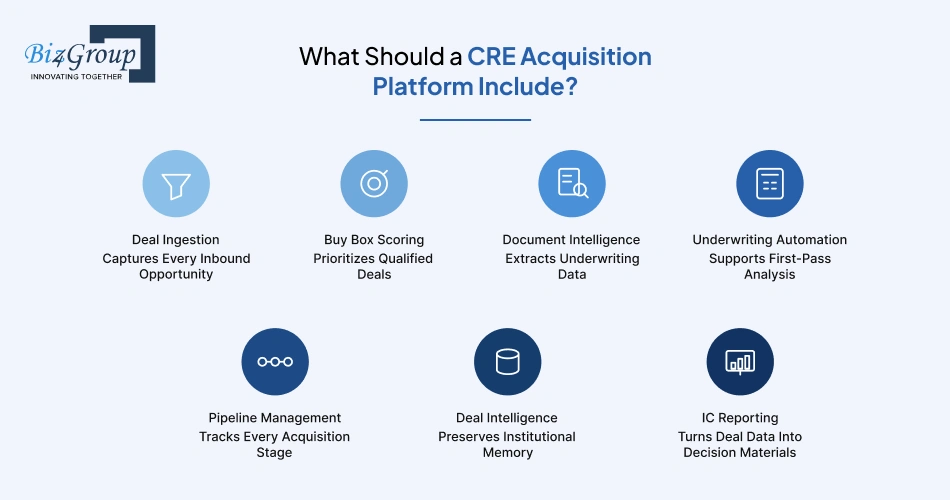
A CRE acquisition platform should connect the main steps of the acquisition process: deal intake, buy-box screening, document extraction, underwriting, pipeline management, deal history, and IC preparation. Each capability should work from the same underlying deal data, so analysts spend less time moving information between emails, PDFs, spreadsheets, and systems.
A common question from acquisitions teams dealing with a high volume of broker packages is:
“I run acquisitions for a real estate fund and we receive dozens of broker packages every week, so I want to know how to build a platform that screens each deal against our buy box before an analyst spends any time on it.”
Build the workflow around configurable buy-box rules covering markets, asset types, deal size, occupancy, pricing, and return thresholds. The platform can extract the relevant deal data, run the rules, and route only qualified or review-needed deals to an analyst.
Deal Ingestion Captures Every Inbound Opportunity
Deal ingestion pulls opportunities from broker emails, deal portals, and data rooms into a central deal record. Property details, broker information, asking price, documents, and other basic data can be captured as the deal enters the system.
The useful question here is simple: does every deal reach the same starting point, regardless of where it came from?
Buy Box Scoring Prioritizes Qualified Deals
Buy box scoring checks each opportunity against the firm's criteria, such as market, asset type, deal size, occupancy, pricing, and target returns. The platform should show which criteria passed, failed, or need review so an analyst understands the reasoning behind the result.
Document Intelligence Extracts Underwriting Data
AI can extract relevant data from offering memorandums (OMs), rent rolls, T-12s, and other deal documents. Depending on the document, that might include property details, rents, occupancy, NOI, expenses, lease dates, and tenant information.
The important part is source traceability. If an extracted number looks wrong, the analyst should be able to see where it came from rather than hunting through a 100-page OM.
Biz4Group Insights: extraction accuracy alone can be misleading. A system may correctly read “$2,500” from a rent roll and still put that value into the wrong field or lose the context around lease term, unit type, or concessions. For acquisition workflows, every extracted value should carry its source, field definition, and confidence level so an analyst can quickly understand what the number actually represents.
Underwriting Automation Supports First-Pass Analysis
Once the data is structured, the platform can feed it into the firm's existing Excel model and run the calculations needed for an initial review. This can cover metrics such as NOI, cap rate, leverage, cash flow, and projected returns.
The aim is to give analysts a usable first pass quickly. Investment assumptions and unusual deal characteristics still need human judgment.
Pipeline Management Tracks Every Acquisition Stage
The platform should track deals through the firm's actual process, such as Sourced → Screened → Underwriting → LOI → PSA → Due Diligence → Closed.
Each stage can hold its own owner, tasks, documents, deadlines, and decisions. That gives the team one place to see what is active, what needs attention, and what happened to a deal previously.
Deal Intelligence Preserves Institutional Memory
What happens when a similar property crosses your desk six months after you passed on another one? A searchable deal registry can retain active, passed, lost, and closed deals alongside their underwriting, documents, assumptions, and decision history.
Over time, this creates a useful internal record of how the firm has evaluated properties and markets.
IC Reporting Turns Deal Data Into Decision Materials
Once deal and underwriting data are structured, generative AI can help prepare recurring sections of investment committee (IC) memos and decks. Property facts, financial metrics, assumptions, and supporting data can flow directly from the underlying deal record.
The team still owns the investment thesis and recommendation. The platform handles the repetitive work of assembling information and keeps the numbers tied to the underlying underwriting data.
How Does a CRE Acquisition Platform Work?
A typical workflow starts when a broker package arrives and ends when the deal is either advanced or rejected. The platform captures the opportunity, checks it against the firm's criteria, turns documents into usable underwriting data, supports analyst review, and keeps the deal moving through the acquisition process.
Inbound Deals Enter Through Email and Deal Portals
A broker sends an OM and rent roll to the acquisitions inbox. The platform can capture the message, identify the property, store the files, and create the initial deal record. The same workflow can extend to deal portals and other approved sources.
Deals Are Screened Against the Firm's Buy Box
The first filter is simple: does this deal fit the strategy? The platform can check market, asset type, price, size, occupancy, cap rate, and other investment criteria, then filter out clear misses or flag borderline deals for review.
Documents Are Extracted Into Structured Deal Data
OMs, rent rolls, and T-12s contain different pieces of the underwriting puzzle. AI can extract property details, rents, occupancy, revenue, expenses, NOI, and lease information into structured fields while keeping each value tied to its source.
Qualified Deals Move Into First-Pass Underwriting
Once a deal clears screening, extracted data can populate the firm's existing Excel model or underwriting engine. Analysts get an initial view of the deal economics without manually transferring every number from the source documents.
Analysts Review Exceptions and Validate Assumptions
The platform can flag missing data, unusual figures, low-confidence extractions, or assumptions that need a closer look. Analysts then focus on the exceptions and investment judgments rather than checking every automated output.
Approved Opportunities Move Through the Deal Pipeline
Deals that move forward can progress through stages such as LOI, PSA, due diligence, and closing. Tasks, documents, decisions, and underwriting versions remain attached to the same deal record.
Underwriting Data Feeds IC Materials and Reporting
The approved deal data can feed IC memos, decks, pipeline reports, and management views. This reduces duplicate entry and keeps decision materials connected to the latest underwriting data.
How to Develop a CRE Acquisition Platform?
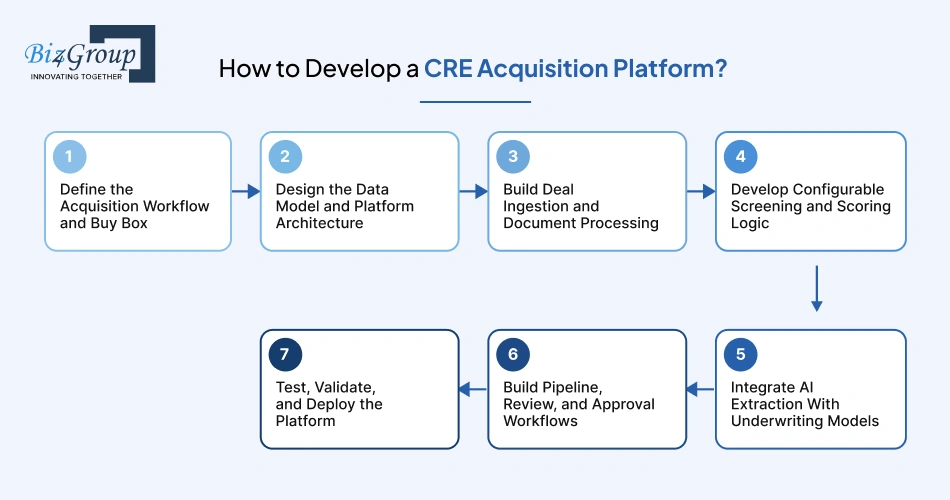
The development process should follow the acquisition team's real workflow. Start with the decisions the team makes, define the data those decisions depend on, then build the automation and review layers around them. The first release should prove the core workflow with real deals before expanding the platform.
Define the Acquisition Workflow and Buy Box
Before writing code, map one deal from the moment it arrives to the point where the team decides to pursue, reject, or hold it.
Capture:
- Where deals enter
- Which buy-box rules are hard filters
- Which criteria need analyst judgment
- What data is needed for first-pass underwriting
- Who approves each stage
A UI/UX design company can then turn this process into screens that match how acquisition teams actually work instead of making analysts adapt to a generic CRM-style interface.
Design the Data Model and Platform Architecture
The data model is the backbone of the platform. A property should connect to its deals, documents, tenants, financials, underwriting versions, assumptions, and decisions.
The architecture also needs to account for the systems around it: email, CRM, Excel, market data providers, document storage, and AI services. This is where decisions about APIs, databases, permissions, and data ownership get made.
Build Deal Ingestion and Document Processing
The first build layer handles the messy inputs: broker emails, attachments, portal downloads, OMs, rent rolls, and T-12s.
The workflow can look like:
Email or portal → Document classification → Data extraction → Validation → Deal record
For specialized document types, the team may need to train AI models using representative CRE documents and clearly defined extraction fields.
Develop Configurable Screening and Scoring Logic
Don't bury the buy box inside application code. Store criteria such as markets, asset types, deal sizes, occupancy thresholds, and return requirements as configurable rules.
That lets the acquisitions team change its screening criteria without asking developers to rewrite the screening engine.
Integrate AI Extraction With Underwriting Models
This is where the platform starts saving serious analyst time. Extracted values need to map into the firm's actual underwriting model, including its formulas, assumptions, and required inputs.
If the team already relies on Excel, the goal can be to feed the existing model rather than force a new underwriting system. Low-confidence fields, missing values, and conflicting figures should be surfaced before they affect the model.
One detail worth deciding early: As per Biz4Group’s experience, AI should usually write to controlled model inputs, not freely edit the workbook. Keep formulas, assumptions, and calculation logic protected, and let the system flag values that need review. This makes it much easier to trace why a model changed when someone asks about an underwriting number later.
Build Pipeline, Review, and Approval Workflows
Once screening and underwriting work, connect them to the rest of the acquisition process.
Sourced → Screened → Underwriting → LOI → PSA → Due Diligence → Closed
Each stage can carry its own owner, tasks, documents, approvals, and review requirements. This is also where MVP development services can be useful: start with the workflow that handles the most manual work, prove it with real deals, then add secondary workflows.
Test, Validate, and Deploy the Platform
Don't validate the platform only with clean sample documents. Run it against real broker packages, messy rent rolls, incomplete T-12s, unusual properties, and deals that the team has already underwritten.
Check four things before wider deployment:
- Extraction: Did the system capture the right values?
- Screening: Did it apply the buy box correctly?
- Underwriting: Did the model receive the right inputs?
- Review: Can analysts quickly find and correct exceptions?
Once those workflows hold up in a focused pilot, the platform can move into production and expand across teams, asset classes, and data sources.
A useful testing trick is to build an exception set, not just a test set. Keep examples of scanned documents, missing fields, conflicting NOI figures, unusual rent structures, and poorly formatted broker packages. These cases tell you far more about whether the system is ready for real acquisition work than a folder of clean PDFs ever will.
Build vs. Buy: Custom CRE Acquisition Platform vs. Dealpath, Altrio, or Archer
Should you build your own platform or start with an existing product? The answer usually depends on how much of your acquisition process is standard and how much is specific to your firm.
|
Factor |
Custom CRE Acquisition Platform |
Dealpath |
Altrio |
Archer |
|---|---|---|---|---|
|
Primary approach |
Built around the firm's specific acquisition workflow |
CRE deal management and acquisitions platform |
Real estate investment and portfolio management platform |
Real estate investment and asset management platform |
|
Workflow customization |
Fully tailored to internal processes |
Configurable workflows, fields, dashboards, and approvals |
Configurable based on selected workflows |
Configurable based on platform setup |
|
Deal screening |
Custom buy-box rules and scoring |
Supports deal screening and acquisition workflows |
Supports investment analysis and workflows |
Supports investment and underwriting workflows |
|
Document and data handling |
Designed around the firm's documents and data model |
AI extraction and deal data workflows |
Centralized investment data and workflows |
Investment data and underwriting workflows |
|
Underwriting |
Can connect directly to proprietary Excel models or custom engines |
Supports underwriting and Excel-based workflows |
Supports real estate investment analysis |
Supports real estate underwriting |
|
Integrations |
Built around required internal and third-party systems |
Integrations, open API, and CRE data connections |
Available integrations depend on requirements |
Available integrations depend on requirements |
|
Deployment |
Requires design, development, testing, and deployment |
Existing product with implementation |
Existing product with implementation |
Existing product with implementation |
|
Control |
Highest control over data, workflows, and roadmap |
Vendor-managed |
Vendor-managed |
Vendor-managed |
|
Best fit |
Firms with highly specific acquisition workflows |
Teams seeking a dedicated CRE deal management platform |
Firms seeking broader investment management capabilities |
Firms seeking established investment and underwriting capabilities |
Capabilities and integrations can change, so confirm current functionality and implementation requirements with each provider.
Assess Native Capabilities and Customization Needs
Before choosing, ask a simple question: Which parts of our process can we change, and which parts do we need the software to change?
Separate your requirements into native, configurable, and custom. This quickly shows whether the platform can support your process as-is or whether your team will need workarounds.
Use an Existing Platform When Standard Workflows Fit
If your acquisitions process already follows a fairly standard path, why build everything yourself? An existing platform can get the team operational faster and leave software maintenance, upgrades, and infrastructure with the vendor.
Build Around Proprietary Acquisition Workflows
What makes your acquisition process different from everyone else's? If the answer includes proprietary buy-box rules, underwriting logic, approval workflows, internal data, or years of deal history, those requirements may justify a custom layer that the firm controls.
Combine an Existing Platform With Custom Acquisition Layers
There is also a middle ground. Keep the commercial platform for core deal management, then build custom layers for the areas that matter most to your team, such as AI extraction, proprietary screening, Excel integration, or internal deal intelligence.
This approach can be useful when the question is not "build or buy everything?" but "which parts should we own?"
What Technology Does a CRE Acquisition Platform Need?
A CRE acquisition platform needs a structured data layer, AI document processing, APIs, Excel connectivity, strong security, and an architecture that can support additional data sources as the firm's acquisition activity grows.
Use a Structured Data Layer for Deal Data
Store properties, deals, tenants, financials, documents, underwriting versions, assumptions, and decisions in a connected data model. A relational database such as PostgreSQL can link these records so the team can quickly answer questions like, "Have we evaluated this property before?" without searching through old spreadsheets and emails.
Add AI Document Processing for CRE Files
Use AI to extract fields from OMs, rent rolls, T-12s, and lease documents, then map them into defined deal fields. Services such as the OpenAI API can support structured extraction, while source references and validation flags help analysts check questionable values before they enter underwriting.
Connect APIs for CRM and Market Data
The platform can connect directly to systems the acquisition team already uses. Salesforce REST API or HubSpot CRM API, for example, can keep broker and deal records synchronized, while property data providers such as CoStar or Cherre can supply market and property information where the firm's licensing and API access allow it.
Integrate With Existing Excel Models
If analysts already underwrite in Excel, the platform can populate the existing model instead of forcing a new underwriting engine. Microsoft Graph Excel APIs can work with Excel workbooks stored in Microsoft 365, allowing structured deal data to flow into designated model inputs while the firm's existing formulas remain intact.
Secure Sensitive Investment and Property Data
Protect underwriting files, tenant information, transaction terms, and IC materials with role-based permissions, encryption, audit logs, secure document storage, and controlled API access. Deal-level permissions are particularly important when different acquisition teams should see different opportunities or underwriting data.
Design for Future Integrations and Scale
Keep the core deal data model separate from individual integrations so new CRMs, market-data providers, document types, or asset classes can be added without rebuilding the platform. This matters when a pilot starts with one workflow and later expands across the firm's acquisition teams.
|
Technology Layer |
Typical Options |
CRE Acquisition Use |
|---|---|---|
|
Data Layer |
PostgreSQL, cloud database |
Deals, properties, tenants, underwriting history |
|
AI & Document Processing |
OpenAI API, OCR/document AI |
OM, rent roll, T-12 extraction |
|
CRM & Market Data |
Salesforce API, HubSpot API, CoStar/Cherre |
Broker records, comps, property data |
|
Underwriting |
Excel, Microsoft Graph API |
Existing models and first-pass underwriting |
|
Security |
RBAC, encryption, audit logs |
Protect investment and property data |
|
Integration Layer |
REST APIs, webhooks |
Connect systems and support future data sources |
Too Many Deals, Not Enough Analyst Hours?
If broker packages keep piling up, a CRE acquisition platform can automate intake, screening, extraction, and first-pass underwriting before your team starts digging through spreadsheets.
Turn Your Acquisition Workflow Into a Smarter SystemWhat Is the Cost to Develop a CRE Acquisition Platform?
A CRE acquisition platform can cost around $20,000 to $300,000+, depending on the scope. A focused MVP may sit near the lower end, while a platform with AI extraction, underwriting automation, multiple integrations, and enterprise security can move well beyond $150,000.
|
Development Scope |
Typical Cost |
What It Usually Covers |
|---|---|---|
|
Focused MVP |
$20,000–$60,000 |
Deal intake, basic screening, document extraction, and pipeline |
|
Mid-Range Platform |
$60,000–$150,000 |
AI extraction, buy-box scoring, Excel integration, APIs, and workflow automation |
|
Advanced Platform |
$150,000–$300,000+ |
Custom underwriting, multiple integrations, advanced AI, IC workflows, analytics, and enterprise security |
Hidden Costs to Consider
The initial development quote rarely covers everything. Watch for:
- AI and API usage fees
- Market data and property data subscriptions
- Cloud hosting and storage
- Security and compliance requirements
- Ongoing maintenance and bug fixes
- Model improvements and AI tuning
- New integrations after launch
Factors That Affect Development Cost
What pushes a project toward $300,000 instead of $50,000? Usually, it comes down to:
- Document complexity: Different OM, rent roll, and T-12 formats require more extraction logic.
- Underwriting complexity: Custom Excel models and proprietary calculations increase development effort.
- Integration scope: Salesforce, market data, email, Excel, CRM, and data-room connections add work.
- AI requirements: Basic extraction costs less than validation, exception handling, and custom AI workflows.
- User and security needs: Multiple teams, permissions, audit trails, and enterprise controls increase scope.
- Platform scale: Supporting more asset classes, markets, users, and workflows requires a more scalable architecture.
Which Underwriting Tasks Can AI Automate, and Which Still Need Analyst Judgment?
AI automation services can take a lot of the repetitive work out of CRE underwriting, especially pulling information from documents, checking basic criteria, and preparing a first pass. The analyst still needs to make sense of unusual situations and decide what the numbers actually mean for the deal.
Automate Document Extraction and Data Entry
AI can pull property details, rents, occupancy, expenses, NOI, lease dates, and tenant information from OMs, rent rolls, T-12s, and other documents. That information can then move into the deal record or existing underwriting model.
- For example: Instead of entering 200 rent-roll rows by hand, an analyst can review the extracted rents, lease dates, and occupancy figures and focus on anything the system flagged.
Automate Screening and First-Pass Underwriting
Once the data is structured, AI can run the deal through the firm's buy box and prepare the initial underwriting. It can check market, asset type, deal size, occupancy, pricing, and return thresholds before the analyst spends time on the opportunity.
- For example: A deal that falls outside the firm's target market or minimum yield can be flagged immediately, while a qualifying deal moves into the analyst's first-pass model.
Keep Unusual Cases and Investment Judgments With Analysts
Some deals simply do not fit neatly into a set of rules. Maybe occupancy is temporarily low because of renovations, the seller has unusual lease assumptions, or the property's future potential matters more than its current numbers. Those situations need someone who understands the deal.
- For example: AI might flag a property because its occupancy is below the firm's threshold, while the analyst recognizes that a renovation program is already underway and reviews the opportunity in that context.
Add Human Review and Accuracy Checks
The goal is not for analysts to check every field AI touches. Let the platform surface the things that deserve attention, such as conflicting numbers, missing information, or low-confidence extractions.
- For example: If the OM shows different NOI from the T-12, the platform can flag the mismatch so the analyst can resolve it before the figure reaches the underwriting model.
Maintain an Audit Trail of AI Outputs
When AI changes or supplies a number, the team should be able to see where it came from and what happened to it afterward. This becomes particularly useful when an IC member questions an assumption several weeks later.
- For example: The team can trace a projected rent back to the original rent roll, see the AI-extracted value, view the analyst's correction, and identify which underwriting version used the final number.
How Does AI Validate Broker Assumptions Against Market Comps?
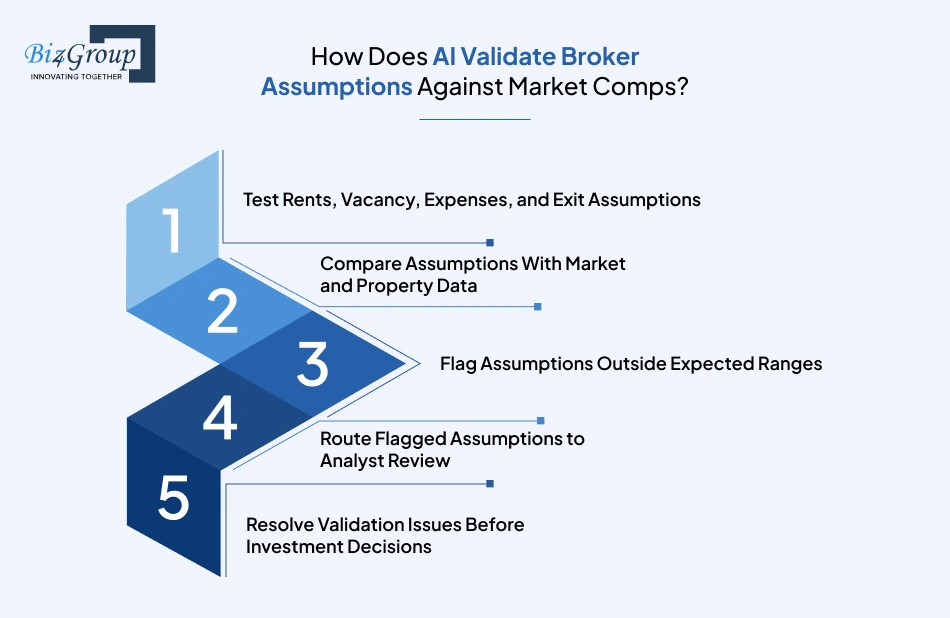
AI validation works by taking the assumptions in the broker's package, comparing them with relevant market and property data, and sending meaningful variances to the analyst. It should support the analyst's review, not decide whether a broker assumption is right or wrong.
Test Rents, Vacancy, Expenses, and Exit Assumptions
Which assumptions deserve the most attention? Usually, the ones that can materially change the deal economics:
|
Assumption |
What AI Can Check |
|---|---|
|
Rents |
In-place and projected rents against comparable properties |
|
Vacancy |
Underwritten vacancy against market and property occupancy |
|
Expenses |
Expense per unit, SF, or other relevant property metric |
|
Exit Cap Rate |
Exit assumption against recent comparable transactions |
|
NOI Growth |
Projected growth against historical and market trends |
Compare Assumptions With Market and Property Data
The next question is, "Compared with what?" A useful validation process uses relevant comps rather than broad market averages. Property type, submarket, size, vintage, occupancy, renovations, and transaction timing can all affect the comparison.
For example, a broker projecting $2.25/SF in rent should ideally be compared with similar properties in the same submarket and quality range.
Flag Assumptions Outside Expected Ranges
What happens when an assumption sits well outside the range supported by the available data? The platform can flag the variance and show the supporting comps without automatically declaring the broker's number wrong.
Broker assumption → Comparable range → Variance → Analyst review
Route Flagged Assumptions to Analyst Review
The analyst then asks the more important question: "Is there a property-specific reason for this difference?" Renovations, superior property quality, lease-up plans, or a particularly strong location may justify an assumption that initially looks aggressive.
Resolve Validation Issues Before Investment Decisions
Once the issue is reviewed, the analyst can accept the assumption, adjust it, or request more information. The platform should retain the original assumption, supporting comps, analyst adjustment, and final underwriting value so the reasoning remains visible when the deal reaches the IC.
How to Build a Deal Pipeline and Searchable Registry That Preserves Institutional Memory
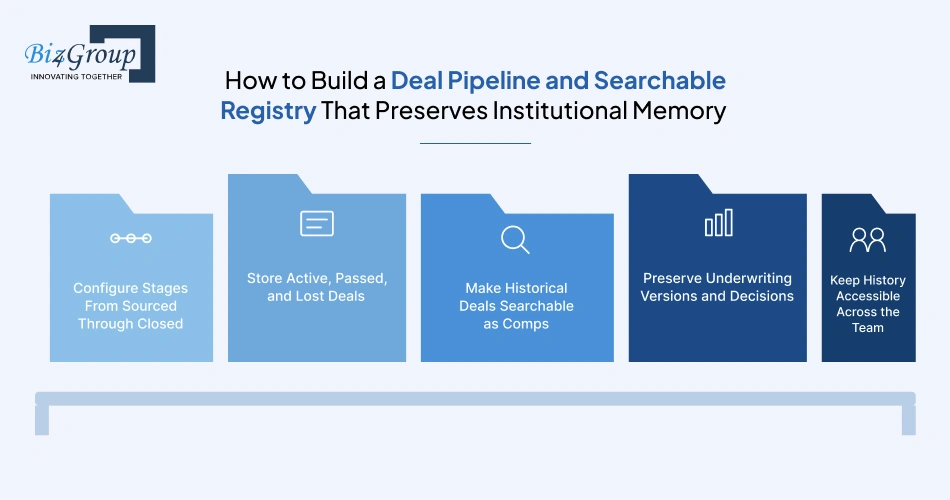
A useful deal registry should do more than show what is currently in the pipeline. It should preserve why deals moved forward, why they were rejected, what was underwritten, and what the team learned, so that past acquisition work remains useful.
For firms managing acquisitions across multiple markets and teams, a common question is:
“We track our deal pipeline across email threads, spreadsheets, and shared folders, and I want to understand how to build a single system that shows every deal, its stage, and its prior history in one place.”
Create a centralized deal registry that connects each opportunity to its stage, documents, underwriting versions, decisions, and notes. That gives the team one searchable record from Sourced through Closed, including deals that were previously passed.
Configure Stages From Sourced Through Closed
Start with the firm's actual acquisition process rather than forcing a generic CRM pipeline onto the team.
Sourced → Screened → Underwriting → LOI → PSA → Due Diligence → Closed
Each stage should carry the relevant owner, documents, tasks, approvals, and decision dates.
Store Active, Passed, and Lost Deals
What happens to a deal after the team says no? Keep it.
A searchable registry should retain active opportunities alongside passed, withdrawn, and lost deals. Capture the reason for the decision where possible, such as pricing, market, returns, property condition, or financing.
Make Historical Deals Searchable as Comps
The real value appears when an analyst can search past deals while evaluating a new one.
New deal: 200-unit multifamily in Dallas Registry search: Similar Dallas multifamily deals reviewed in the last 3 years Useful results: Underwritten rents, cap rates, purchase prices, assumptions, and final decisions
This gives the team an internal reference point alongside external market comps.
Preserve Underwriting Versions and Deal Decisions
A deal can look very different between initial screening and final IC review. Keep the major underwriting versions, assumption changes, analyst comments, and investment decisions attached to the deal.
That way, six months later, the team can answer "What changed?" instead of trying to reconstruct the deal from old Excel files.
Keep Deal History Accessible Across the Team
Institutional memory only works when people can actually find it. Give acquisition teams a common search layer across properties, markets, brokers, deals, assumptions, and decisions, with permissions controlling sensitive information.
The goal is simple: when a similar deal arrives, the team should be able to learn from the firm's own history before starting from scratch.
How Can a Platform Generate Investment Committee Memos and Decks From Underwriting Data?
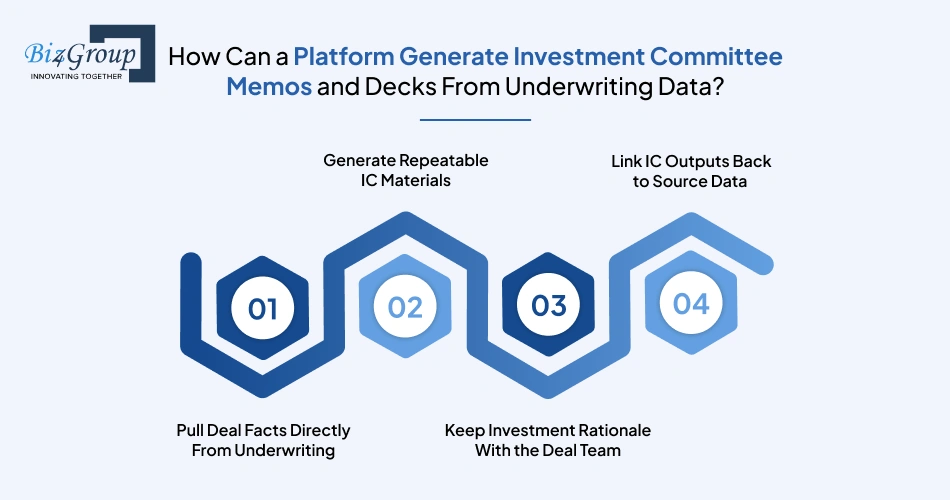
Once the underwriting is approved, the platform can turn the same deal data into a structured IC memo or deck. The workflow can look like this:
Underwriting data → Approved deal facts → IC narrative → Memo/deck → Analyst review
Pull Deal Facts Directly From Underwriting
The platform can pull purchase price, NOI, cap rate, financing assumptions, projected returns, property details, and other approved figures directly from the underwriting record.
Result: fewer copy-paste errors and one consistent set of numbers across the deal.
Generate Repeatable IC Materials
What does the team prepare for almost every IC meeting? Those recurring sections can become templates.
|
IC Section |
Platform Can Populate |
|---|---|
|
Deal Overview |
Property, location, asset type, purchase price |
|
Financial Summary |
NOI, cap rate, leverage, returns |
|
Operating Case |
Revenue, expenses, occupancy, growth assumptions |
|
Market View |
Relevant market and comp data |
|
Key Risks |
Flagged assumptions and analyst inputs |
|
Recommendation |
Deal team's final rationale |
Keep Investment Rationale With the Deal Team
The platform can leave space for the parts that require judgment: Why this deal? What could go wrong? Why do the assumptions make sense? What is the team recommending?
That commentary stays attached to the deal rather than getting lost across emails, spreadsheets, and separate drafts.
Link IC Outputs Back to Source Data
An IC member may ask, "Where did this figure come from?" The platform should make that easy to answer by linking memo and deck figures back to their underwriting fields and, where relevant, the original OM, rent roll, T-12, or market data.
That also means an approved underwriting change can flow into the IC materials without rebuilding the document from scratch.
What Data and Integrations Does a CRE Acquisition Platform Need?
The platform should connect deal sources, internal systems, underwriting models, market data, and document repositories so information can move through the acquisition workflow without repeated manual entry.
|
Acquisition Need |
Example Systems / Data Sources |
Primary Purpose |
|---|---|---|
|
Deal Intake |
Outlook, Gmail, broker portals, data rooms |
Capture opportunities and source documents |
|
CRM & Internal Data |
Salesforce, HubSpot, SharePoint, internal systems |
Sync relationships and internal records |
|
Market & Property Data |
CoStar, Cherre, ATTOM |
Support comps and market validation |
|
Underwriting |
Excel, Microsoft 365, internal models |
Feed existing models and retrieve outputs |
|
Documents |
OMs, rent rolls, T-12s, leases |
Store and process source material |
|
Security & Governance |
SSO, RBAC, encryption, audit logs |
Control access and track activity |
Connect Email, Portals, and Data Rooms
Don't treat every source as a separate workflow. Normalize incoming deals into the same structure regardless of whether an OM arrives through Outlook, a broker portal, or a data room. That gives the screening and extraction layers one consistent input.
Connect CRM and Internal Systems
Decide which system is the source of truth for each data type before building the integrations. For example, Salesforce might own broker relationships while the acquisition platform owns underwriting and deal-stage data. This prevents two systems from independently changing the same record.
Add Market Data and Comps Providers
Check licensing before designing the integration. Having API access to a data provider does not automatically mean every field can be stored, redistributed, or displayed throughout the platform. Data rights should be part of the architecture decision.
Connect Existing Excel Models
Treat the Excel model as a dependency rather than simply a file upload. Define which cells are inputs, which outputs the platform needs to read, and how model versions are managed. This prevents an automated workflow from overwriting formulas or creating uncertainty around which underwriting version is current.
Build Security, Permissions, and Audit Controls
Permissions should follow the acquisition workflow.
- Who can change underwriting assumptions?
- Who can approve a deal?
- Who can view sensitive broker or tenant information?
Those decisions should shape the access model from the beginning rather than being added after the platform is built.
How Long Does It Take to Build a CRE Acquisition Platform?
A working CRE acquisition proof of concept can often be built in a matter of hours, and a focused platform in a few days, when the scope is tight and the team uses AI-assisted development, existing APIs, and managed cloud services. A production-ready platform typically takes one to three weeks, and a complex enterprise rollout can take several weeks, depending on integrations, document complexity, underwriting workflows, security, and testing.
Start With a Focused Pilot
What can you realistically prove in the first few days? Keep the first release narrow. Broker email intake, OM and rent-roll extraction, buy-box screening, and first-pass underwriting are enough to test whether the workflow works with real deals.
Validate the Workflow Before Production
Use actual broker packages during testing. Throw in the messy rent roll, incomplete T-12, unusual property, and conflicting numbers too. You want to see where AI gets things wrong and where analysts still need to step in.
Move Validated Workflows Into Production
Once the workflow holds up, production adds the pieces needed for daily use: permissions, security, monitoring, integrations, data migration, and user onboarding. This stage can take longer than expected if the platform needs to connect with several existing systems.
Expand Across Teams and Asset Classes
After the first workflow proves itself, you can add more markets, asset classes, users, and data sources. A multifamily workflow may need different extraction fields and screening rules from an industrial or office workflow.
Base Timelines on Actual Project Scope
|
Scope |
Typical Timeline |
|---|---|
|
Proof of concept |
A few hours to 1 day |
|
Focused MVP |
2-5 days |
|
Production-ready platform |
1-3 weeks |
|
Complex enterprise rollout |
3-6 weeks |
The biggest timeline drivers are usually integrations, document complexity, underwriting models, security requirements, and workflow variations. A platform with 10 screens and two integrations can take less time than one with five screens that has to work across several CRMs, data providers, Excel models, and document formats.
How Should a CRE Firm Measure the ROI of an Acquisition Platform?
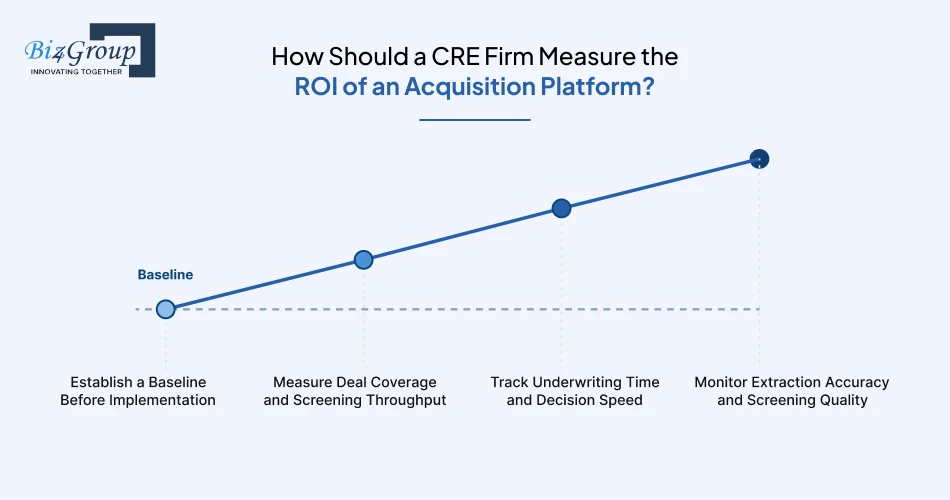
Start with the firm's current acquisition workload, then compare the same metrics after implementation. The strongest ROI case usually comes from time saved, greater deal coverage, faster decisions, and fewer manual errors.
Establish a Baseline Before Implementation
Capture the current numbers before the platform goes live:
- Deals received per month
- Average screening time per deal
- Average first-pass underwriting time
- Deals reviewed per analyst
- Time from deal receipt to investment decision
- Manual data corrections
- Percentage of deals reaching deeper underwriting
This gives the team something concrete to compare against later.
Measure Deal Coverage and Screening Throughput
If the team can process more opportunities with the same headcount, that is a measurable benefit.
Before: 80 deals received → 35 screened After: 80 deals received → 65 screened
The useful metric is not simply more deals processed. Look at whether the additional coverage produces more qualified opportunities for analyst review.
Track Underwriting Time and Decision Speed
Compare the time required to move a deal from broker package to first-pass underwriting and final screening.
|
Metric |
Before Platform |
After Platform |
|---|---|---|
|
Screening time per deal |
___ hours |
___ hours |
|
First-pass underwriting time |
___ hours |
___ hours |
|
Deal-to-decision time |
___ days |
___ days |
|
Analyst hours per deal |
___ hours |
___ hours |
|
Deals processed per analyst |
___ per month |
___ per month |
Monitor Extraction Accuracy and Screening Quality
Speed needs to be measured alongside quality. Track how often extracted values require correction, how frequently screening rules produce false positives or false negatives, and how many deals require manual rework.
Measure Platform Adoption Across Acquisition Teams
A platform only creates operational value when it becomes part of the team's daily workflow. Track the percentage of live deals processed through the platform, active users, workflow completion, and usage across acquisition teams.
A useful final calculation is:
ROI = (Annualized benefits − Annual platform costs) ÷ Annual platform costs
Still Chasing Numbers Across OMs and Excel?
Let AI pull deal data from broker packages, check it against your buy box, and feed validated inputs into the underwriting workflow your team already uses.
Build a Better CRE Acquisition WorkflowWhat Should a CRE Firm Consider Before Building Its Platform?
Before building a CRE acquisition platform, get clear on what the team actually needs to improve. Start with the workflows, data, integrations, and controls that matter most to acquisitions.
Define the Workflows That Need Customization
Look at where the firm's process differs from standard acquisition software. That could be the buy box, underwriting model, approval process, or how analysts review deals.
Identify the Data and Integrations Required
Map where deal information comes from and where it needs to go. This may include broker emails, data rooms, CRM, market data, Excel models, and internal systems.
Set Requirements for Security and Data Ownership
Decide who can access deal and property data, who owns it, and how it should be stored. If the firm plans to implement generative AI in real estate acquisitions, be clear about what data is being sent outside the firm's environment and how it will be handled.
Determine Where Internal Teams Need Ongoing Control
Some things will change often. Buy-box rules, screening thresholds, and workflow settings should be easy for authorized team members to update without calling a developer every time.
Align Platform Scope With Acquisition Goals
Focus the first release on the work that takes the most time today, such as deal intake, document extraction, screening, and first-pass underwriting. Prove those workflows first, then expand.
From Broker Inbox to Investment Committee: Make Every Step Count
A good acquisition platform should help the team answer three things quickly: What came in? Does it fit our buy box? What deserves a closer look? CRE acquisition platform development works best when those answers are built around the firm's actual workflow, existing models, and deal history. Why automate ten steps when two are causing most of the delay?
At Biz4Group LLC, we have seen the harder part of CRE automation is connecting extracted data to the decisions that follow. A rent roll can be parsed correctly and still produce a bad underwriting input if lease dates, unit types, concessions, or occupancy fields are mapped incorrectly. That is where our AI consulting services focus: keeping extraction tied to source documents, validation rules, and the firm's existing underwriting logic so analysts spend their time reviewing deals rather than repairing data.
If you're exploring a CRE acquisition platform, talk to talk to our AI experts about the workflows, integrations, and AI capabilities that make sense for your acquisition team.
FAQs
1. What should a CRE acquisition platform automate first?
Start with high-volume manual work: broker deal intake, OM and rent roll extraction, buy-box screening, and first-pass underwriting. These steps create the clearest time savings before adding more advanced automation.
2. Can AI populate our existing CRE Excel underwriting model?
Yes. A platform can extract data from OMs, T-12s, and rent rolls and map approved fields into an existing Excel model. The model structure, formulas, and validation rules should remain under the firm's control.
3. How accurate is AI extraction from CRE offering memorandums?
Accuracy depends heavily on document quality and field complexity. Digital PDFs are easier to process than scanned or inconsistent files, so firms should test extraction against their own broker packages and track corrections.
4. Can AI check broker underwriting assumptions against market comps?
Yes. AI can compare rents, vacancy, expenses, cap rates, and other assumptions against configured market and property data, then flag material variances for analyst review.
5. Should a CRE acquisition platform replace Excel?
Usually, no. Many acquisition teams still rely on proprietary Excel models. The platform can handle intake, extraction, screening, workflow, and data management while feeding the firm's existing model.
6. How can a CRE platform preserve deals we previously passed on?
Store passed, active, and closed deals in a searchable registry with underwriting versions, assumptions, documents, and decision reasons. That gives analysts a usable record when a similar property comes back around.
7. What should be stored in a CRE deal registry?
At minimum: property details, deal stage, broker, source documents, underwriting versions, key assumptions, market comps, analyst notes, approval decisions, and reasons for passing or advancing.
8. Can AI generate CRE investment committee memos from underwriting data?
Yes. The platform can pull approved deal facts and model outputs into a repeatable IC memo or deck structure. Analysts should still control the investment rationale, risks, and final recommendation.
9. How much does CRE acquisition platform development cost?
A focused MVP can start around $20,000 to $60,000, while a broader production platform can reach $150,000 to $300,000+. Integrations, underwriting complexity, AI workflows, security, and document volume are major cost drivers.
10. How long does it take to build a CRE acquisition platform?
A proof of concept can be built in a few hours to a day, and a focused MVP in roughly 2 to 5 days. A production-ready platform typically takes 1 to 3 weeks, while complex enterprise rollouts with multiple integrations, custom underwriting workflows, and security reviews can take 3 to 6 weeks.
11. Is it better to build a custom CRE platform or use Dealpath, Altrio, or Archer?
It depends on how closely the firm's acquisition workflow matches the platform's existing capabilities. Custom development makes more sense when proprietary screening, underwriting, integrations, or deal intelligence are central to the workflow.
