 Location :
Orlando, FL, USA
Location :
Orlando, FL, USA +1 (407) 714-1616
 info@biz4group.com

 AI Summary Powered by Biz4AI
- Connect lease, accounting, billing, budget, and property data to uncover missed recoveries, expense overruns, revenue gaps, and other sources of NOI leakage.
- Use AI lease abstraction and anomaly detection to surface hidden lease obligations and unusual property performance patterns earlier.
- Prioritize findings by estimated NOI impact, confidence, recurrence, and urgency so asset managers know which issues need attention first.
- Link material findings to the underlying lease, accounting, billing, budget, or property records so teams can verify the numbers.
- A CRE asset management platform can cost approximately $80,000 to $800,000+, depending on integrations, AI complexity, detection logic, workflows, and security.
- Biz4Group brings experience in AI, automation, and enterprise platform development to help CRE firms build tailored solutions for identifying and acting on NOI losses.
Ask any asset manager and they'll tell you the NOI line in the monthly report is the last place you find out something's wrong.
Nobody gets hit with one big loss. It's a vacancy that ran longer than budgeted, a repair line creeping up for three quarters, a CAM recovery nobody billed. Each one looks small, so nobody chases it.
A commercial real estate asset management platform exists to catch that drift early. It sits on top of your rent rolls, leases, expenses, and budgets, and shows which property is slipping from plan before the quarter closes. The "why" is the valuable part. Seeing that NOI is down is easy. Knowing it's down because two renewals came in below market and one building's utilities jumped is what lets you do something about it.
That's where AI earns its keep: doing the digging your team never has time for.
Having built AI products for real estate at Biz4Group like Contracks and Homer AI, we tend to look for NOI leaks in the paperwork first: a lease clause, a missed recovery, a contract date. The financial statements only show the damage later.
So if you're thinking about putting a platform like this in place, skip "what dashboards do I want?" and ask "where is money leaking right now?"
Why Do NOI Losses Only Surface After the Quarterly Report?
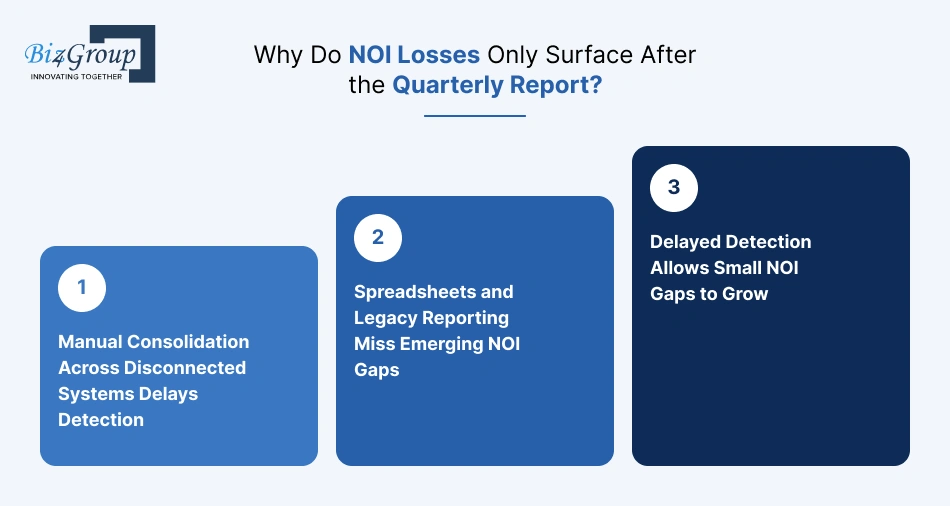
NOI losses often go unnoticed because the data needed to spot them lives in different systems. Accounting records show income and expenses, lease documents spell out tenant charges, and property systems track occupancy and operations. When these records aren't connected, asset managers may not spot a problem until the quarterly numbers are ready. A commercial real estate asset management platform brings these signals together so teams can investigate issues sooner.
Manual Consolidation Across Disconnected Systems Delays Detection
When teams have to pull reports from multiple systems and match the numbers themselves, finding a problem takes time. A missed tenant charge might sit in a lease document, while the accounting system shows less income than expected. Unless someone connects the two, the shortfall can go unnoticed.
Would your team catch that missed charge this month, or only when the quarterly numbers don't add up?
Connecting these records makes mismatches easier to spot without waiting for the next reporting cycle.
Spreadsheets and Legacy Reporting Miss Emerging NOI Gaps
Spreadsheets are useful, but they often show what has already happened rather than what needs attention now. They can also make it difficult to connect small changes across different reports.
For example, rent coming in below budget might not look serious on its own. Add rising maintenance costs, and the property's net operating income (NOI) may be taking a bigger hit than either report suggests.
Delayed Detection Allows Small NOI Gaps to Grow
Small losses add up when nobody catches them early. A recurring $1,500 monthly billing shortfall, for instance, reaches $9,000 over six months, although the amount ultimately recoverable depends on lease terms and collection outcomes.
What else might be slipping through while the team waits for the next report?
Earlier detection gives the team time to check what went wrong and fix it before more income is lost. The aim isn't to flag every fluctuation. It's to find the gaps that matter and give someone a clear reason to act.
What Counts as an NOI Loss or Property Performance Gap?
An NOI loss or property performance gap happens when a property brings in less income than expected or costs more to run than planned. Either can reduce net operating income (NOI). The trick is to spot what's going wrong, understand why, and decide whether it needs action.
Revenue Shortfalls Occur When Actual Income Falls Below Expectations
A property may bring in less income because rent wasn't billed correctly, tenant charges were missed, payments came in late, or a unit stayed empty longer than expected.
Comparing actual income with lease terms and budget figures helps asset managers see where the numbers fall short and what needs checking.
Expense Overruns Reduce NOI Even When Revenue Meets Budget
Even when rent comes in as expected, higher costs can eat into NOI. Think unexpected repairs, rising utility bills, duplicate invoices, or service charges that keep creeping up.
Are costs going up for a good reason, or is something being missed? Comparing expenses across months and properties can help the team find out.
Missed Recoveries Create Contractual Revenue Leakage
Some commercial leases require tenants to pay their share of certain property expenses. If those charges aren't billed or reconciled properly, the owner may end up paying costs that could have been recovered.
A commercial real estate asset management platform can compare lease terms with accounting records and flag possible missed charges. The team still needs to check the lease and confirm what can actually be recovered.
Vacancy Creates Measurable Exposure to Future NOI
An empty unit usually means less rental income, but many property costs continue. The longer the space stays vacant, the greater the potential impact on NOI.
Tracking vacancy alongside expected rent and ongoing costs helps asset managers estimate the exposure. It's important to remember that this is a potential loss, not always money already lost.
Combined Revenue and Expense Variances Reveal Hidden Problems
Sometimes, the bigger problem only becomes clear when you look at several numbers together. Rent might be a little below budget while maintenance costs are rising. Neither issue may seem serious alone, but together they can take a bigger bite out of NOI.
|
What you notice |
What it could mean |
|---|---|
|
Rent is below budget |
Income is falling short |
|
Maintenance costs are rising |
Expenses are eating into NOI |
|
Tenant charges are missing |
The owner may be covering extra costs |
|
A unit stays vacant |
Expected rental income is delayed |
Would you catch the full picture if each number sat in a different report? Looking at income, expenses, recoveries, and vacancy together helps asset managers spot problems earlier and decide what to investigate first.
How to Build a CRE Asset Management Platform for NOI Loss Detection
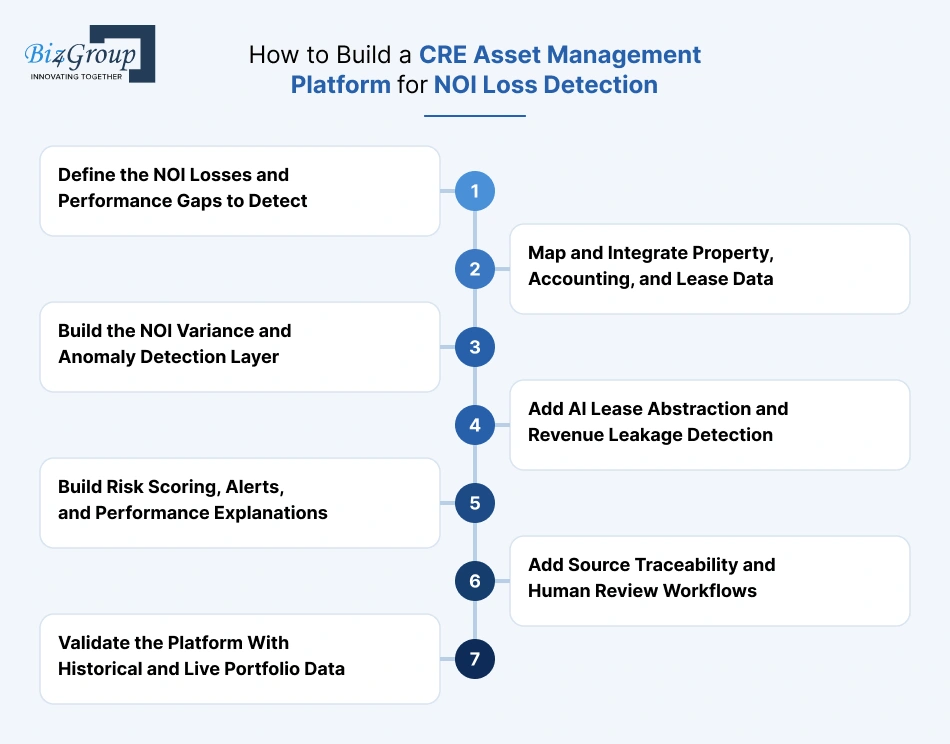
A useful CRE asset management platform for NOI loss detection should be built around one question: where is this property earning less or spending more than it should, and can we prove why? That means the build needs to connect financial results with lease obligations, property activity, and historical performance rather than simply adding an AI layer to existing reports.
Step 1: Define the NOI Losses and Performance Gaps to Detect
Start with the leakage patterns that matter to your portfolio, not a long list of generic platform features. For one portfolio, the priority might be missed expense recoveries and incorrect rent charges. For another, it could be recurring operating-cost overruns, unexplained vacancy exposure, or properties consistently missing budget.
This is where MVP development services should focus on a small number of high-value detection cases. For example, an MVP could start by answering three questions:
- Is actual property income below what the lease and budget indicate?
- Are operating expenses materially above the expected run rate?
- Are recoverable tenant expenses being left with the owner?
Define the financial threshold, evidence required, and action expected for each type of finding before building the detection logic.
Before you build AI platforms, decide which losses you want to catch first. Missed recoveries, rent shortfalls, and recurring cost overruns are more useful starting points than a long list of features.
Step 2: Map and Integrate Property, Accounting, and Lease Data
The difficult part is not simply connecting systems. It is making records from those systems comparable.
A lease may identify a tenant by one name, the property system by another identifier, and the general ledger by a unit or account code. The platform needs a common property, unit, tenant, and transaction structure so that a lease obligation can actually be compared with what was billed and collected.
Connecting these systems is where AI integration services can help, especially when lease, billing, and accounting records use different IDs or formats.
For each source, establish:
Source → Data needed → How it will be used
- General ledger: actual income and operating expenses → measure realized NOI
- Budget: planned income and expenses → establish expected performance
- Lease data: rent, escalations, recoveries, exclusions → determine contractual expectations
- Property data: occupancy, units, tenant status → explain revenue changes
- AP or operating data: recurring vendor and property costs → identify expense pressure
This data model is what allows the platform to move from “NOI is $20,000 below budget” to “$8,000 relates to missed recoveries and $12,000 comes from recurring maintenance costs.”
Step 3: Build the NOI Variance and Anomaly Detection Layer
Do not treat every budget variance as a loss. A property may legitimately spend more on repairs one month and less the next. The detection layer needs to distinguish a one-off movement from a pattern that deserves investigation.
Use different logic for different signals:
|
Signal |
Useful detection approach |
|---|---|
|
Rent below budget |
Budget and lease comparison |
|
Expense running above plan |
Variance plus historical run rate |
|
Recurring cost increase |
Period-over-period pattern detection |
|
Unusual property expense |
Historical and peer comparison |
|
Recovery shortfall |
Lease obligation vs. billed amount |
The platform should also calculate the estimated NOI impact rather than simply flagging a percentage variance. A 5% variance on a small expense category may matter less than a 1% variance on a major revenue stream.
Step 4: Add AI Lease Abstraction and Revenue Leakage Detection
This is where AI becomes useful because important revenue rules are often buried in lease language. The system can extract base rent, escalation dates, recovery provisions, caps, exclusions, and other clauses that affect what the property should be billing or recovering.
But extraction alone doesn't cut it. To train AI models effectively, use reviewed lease examples that reflect the actual portfolio, including different lease structures, amendments, scanned documents, and unusual clauses. Test whether the model correctly identifies both the clause and the financial implication.
If your team plans to build this in-house, you may need to hire AI developers who can work with lease documents, financial data, and the rules that determine what a property can recover.
A common question among CRE asset managers is:
“We recently found out we missed a revenue recovery clause buried in a lease for over a year, and I want to understand how AI lease abstraction can prevent this kind of leakage across our whole portfolio.”
AI lease abstraction can extract recovery clauses, rent terms, caps, exclusions, and other financial obligations across leases, then compare those terms with billing and accounting data to flag potential leakage for review.
For example, if a lease permits recovery of a tenant's share of operating expenses subject to a cap, the platform should not simply flag every difference between actual expenses and tenant charges. It needs to apply the relevant lease rule before calling something potential leakage.
Step 5: Build Risk Scoring, Alerts, and Performance Explanations
An asset manager doesn't need 300 alerts. They need to know which five findings deserve attention today.
AI automation services can take repetitive checks off the team's plate, but the alerts still need to show the evidence and give someone a clear next step.
Score each finding using factors such as:
- Estimated annualized NOI impact
- Confidence in the underlying data
- Whether the issue is recurring
- How long the variance has existed
- Whether the issue is still growing
- Whether the cause can be acted on
The explanation should then connect the numbers. Instead of saying “recoveries are 7% below budget,” the platform should show that a specific property has $42,000 in potentially recoverable expenses that have not appeared in tenant billing, identify the relevant lease provisions, and show the supporting accounting records.
For a large portfolio, enterprise AI solutions need to do more than generate alerts. They should help the team spot which findings could have the biggest impact on NOI.
Step 6: Add Source Traceability and Human Review Workflows
Financial teams need to be able to challenge an AI finding. Every material alert should therefore lead back to the underlying transaction, lease clause, budget line, or operational record used to produce it.
The review workflow should let an asset manager mark a finding as confirmed, explainable variance, false positive, or requiring investigation. That feedback can then improve future detection without allowing the system to silently change financial records.
The UI/UX design should reflect this investigation process. An asset manager should be able to move from property-level NOI variance → contributing account → transaction → lease provision without hunting through separate screens.
Step 7: Validate the Platform With Historical and Live Portfolio Data
Validation should test more than whether the software runs. Take historical properties where known NOI issues have already been identified and see whether the platform would have caught them earlier.
Measure:
- True positives: genuine losses correctly flagged
- False positives: normal variations incorrectly flagged
- Missed findings: known issues the system failed to detect
- Detection lead time: how much earlier the issue was identified
- Financial accuracy: whether estimated impact matched the eventual outcome
Then run the platform alongside the existing reporting process for a live pilot. If the system repeatedly flags issues that experienced asset managers dismiss, the answer is not simply to suppress the alerts. Review the baseline, source data, and detection logic to understand why the system is getting the signal wrong.
The end goal is a platform that can move from “something is off” to “this property is losing NOI because of this specific issue, here is the evidence, this is the estimated impact, and this is what the team should investigate.”
How Does AI Distinguish a Genuine Performance Gap From Normal Variance?
AI can distinguish a real performance gap by looking at the property's normal behavior before raising a flag. It can compare current results with budget, past performance, seasonal patterns, and similar assets, then look at how long the change has lasted and what it could do to NOI.
Set Baselines Using Budget, History, Seasonality, and Peers
Budget gives you the expected result. It doesn't tell you whether a change is actually unusual for that property.
Take a retail property with higher utility costs in July and August. If that happens every year, there is little reason to treat it as a warning. If utility costs suddenly rise in March while similar properties remain stable, the situation looks different.
A useful baseline can pull together:
- Budget: What did you expect the property to earn or spend?
- Property history: What usually happens at this asset?
- Seasonality: Is this change normal for this period?
- Peer performance: Are similar properties seeing the same thing?
Would your team know whether a variance is unusual without checking several reports first? A well-designed AI system should make that context available alongside the alert.
Match Detection Methods to Different Performance Signals
A missed rent charge and a sudden maintenance spike don't leave the same trail. The platform needs to look for the right evidence based on the problem.
|
Performance signal |
Useful detection approach |
|---|---|
|
Rent below the contracted amount |
Compare lease terms with billing records |
|
Expenses running above plan |
Compare budget with historical spending |
|
Unusual vendor costs |
Check past costs and comparable properties |
|
Missed expense recoveries |
Compare lease provisions with tenant billing |
|
Persistent vacancy |
Compare occupancy with expected rental income |
For example, a missed tenant charge can be found by checking what the lease says against what was actually billed. A maintenance spike may require a look at work orders, previous spending, vendor charges, and similar properties.
That distinction matters because a generic “variance above 5%” rule will create plenty of alerts without telling the asset manager which ones deserve attention.
Calculate the Estimated NOI Impact of Each Gap
A variance becomes easier to act on when the platform shows its actual financial effect.
Suppose operating expenses are 8% above budget. That number alone doesn't tell you much. The expense category could be small, or it could be one of the property's biggest recurring costs.
The platform should show the dollar impact alongside the percentage change and make clear whether the figure is:
- An actual NOI loss already recorded
- A recurring loss based on an ongoing pattern
- An estimated future exposure
- An annualized impact based on current results
This matters when an asset manager has several properties competing for attention. A small variance at one property may need less attention than a larger recurring loss somewhere else.
Which would you investigate first: a large one-time expense or a smaller charge that has been quietly recurring for six months? The answer depends on the property's numbers and the reason behind the variance.
Reduce False Positives With Thresholds and Historical Patterns
Nobody wants an NOI monitoring system that sends an alert every time a number moves. Thresholds should reflect the property, the expense category, historical volatility, and confidence in the underlying data.
A $5,000 variance could be meaningful for one property and routine for another. A one-month spike could also be normal if the same thing happens every year.
The stronger signal may come from several changes happening together. Imagine maintenance costs running above normal for three months while NOI falls below budget. That pattern deserves more attention than a single unusual invoice.
What would make you trust an AI alert enough to investigate it? The platform should give you a clear answer: what changed, why it looks unusual, how much NOI could be affected, and which records support the finding.
How Should an NOI Monitoring Platform Prioritize Detected Losses?
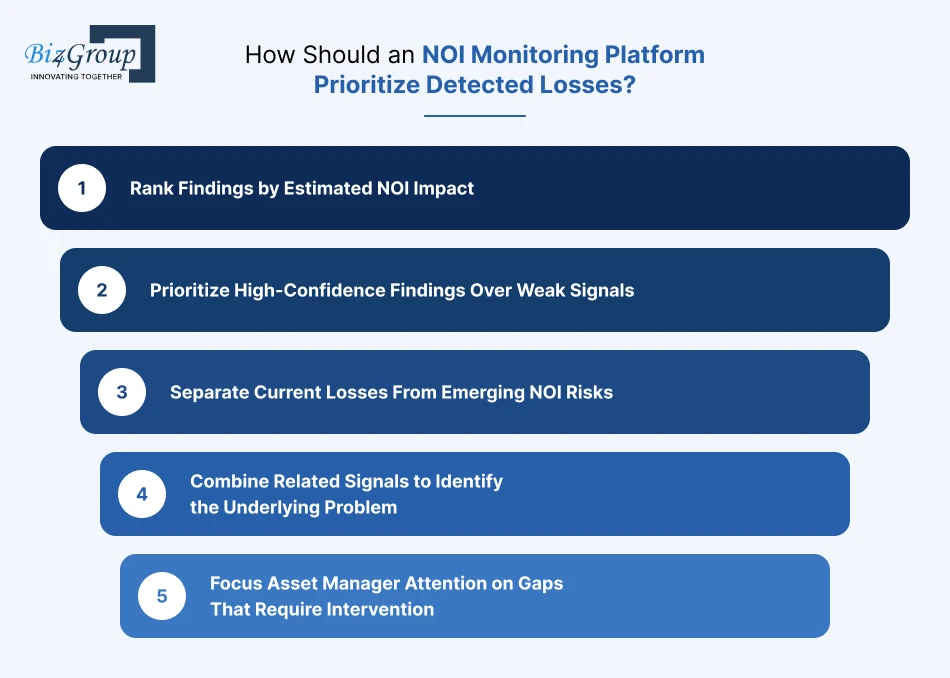
When ten properties produce dozens of variances, the asset manager cannot investigate every one. A $4,000 monthly recovery shortfall may deserve attention before a $20,000 one-time repair expense because the recovery issue keeps draining NOI and may be fixable. The platform needs to surface that difference clearly.
Rank Findings by Estimated NOI Impact
Start with the money. A small monthly variance can become more important than a large one-time expense when it keeps repeating.
Say Property A has a $15,000 unexpected repair. Property B has a $4,000 monthly recovery shortfall that has been running for six months. The repair has the larger immediate hit. Property B has already lost $24,000 and could lose another $4,000 next month.
That is why the platform should show both the current NOI impact and the potential recurring or annualized impact. It gives the asset manager a better sense of where the real exposure sits.
Prioritize High-Confidence Findings Over Weak Signals
The platform also needs to tell you how much you can trust a finding.
A $20,000 recovery gap backed by a lease clause, billing record, and accounting entry is easy to investigate. A possible expense anomaly based on a short history is a different story.
Which one would you open first? Most asset managers will choose the finding where the evidence already points toward a specific problem.
Confidence can come from the quality of the source data, the number of supporting records, the strength of the lease evidence, and whether the same pattern has appeared over time.
Separate Current Losses From Emerging NOI Risks
An issue that is already costing the property money needs a different response from a pattern that could create a loss later.
A current loss might be $12,000 in tenant recoveries that were never billed. The team can review the leases, check the charges, and determine whether the amount can still be recovered.
An emerging risk might look like falling occupancy, several upcoming lease events, and declining expected rental income. The property may not have a major NOI loss today. The numbers are starting to point in that direction.
Would you put both findings in the same priority bucket? Probably not. One calls for investigation now. The other calls for closer monitoring and early planning.
Combine Related Signals to Identify the Underlying Problem
Sometimes several small alerts are really one problem.
Imagine a property where operating expenses are $30,000 above budget. Tenant recoveries are $18,000 below expectations. The affected leases allow those expenses to be recovered, yet the related charges are missing from billing.
A platform that keeps those findings separate gives the asset manager three or four things to chase. A platform that connects them can surface a much clearer explanation: the property may be carrying $18,000 in costs that should have been recovered from tenants.
That connection is where monitoring becomes useful. The team can go straight to the affected leases and billing records instead of starting another round of spreadsheet checks.
Focus Asset Manager Attention on Gaps That Require Intervention
The best priority queue contains findings that are financially meaningful, well supported, and possible to act on.
|
Finding |
What the team sees |
Priority |
|---|---|---|
|
Missed tenant recovery |
Lease supports recovery and billing is missing |
Immediate |
|
Recurring vendor overcharge |
Cost has stayed above normal for several months |
High |
|
Seasonal utility increase |
Pattern matches previous years |
Monitor |
|
One-month expense spike |
Limited evidence and no recurring pattern |
Review |
What happens if the platform gives the team 50 alerts every month? People start ignoring them. The system should narrow that list to the issues where the numbers, evidence, and likely action all point in the same direction.
Still Finding NOI Leaks After the Quarter Ends?
Missed recoveries, and lease gaps can quietly eat into NOI long before they show up in a quarterly review. A CRE asset management platform can help surface where the money is going and why.
Find Your NOI GapsHow Does an NOI Monitoring Platform Turn Findings Into Action?
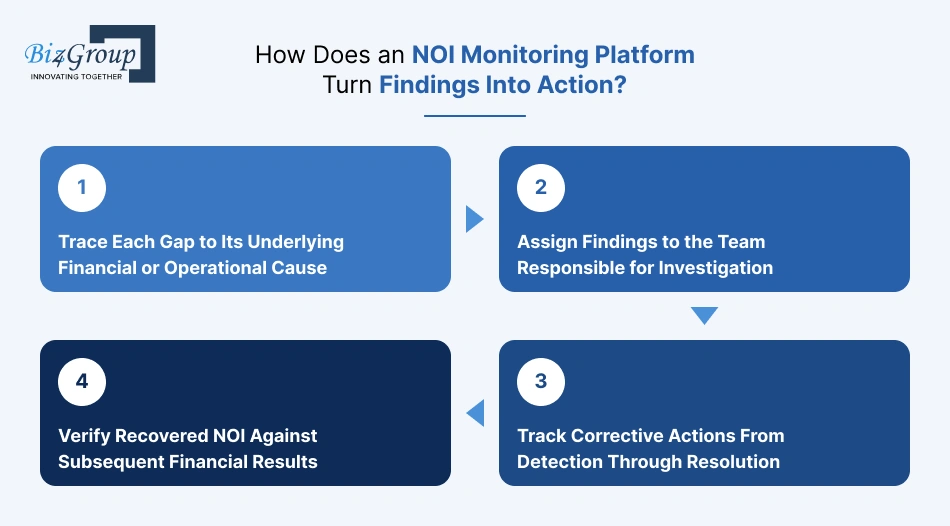
An alert is only useful when someone can do something with it. If the platform tells you that a property's NOI is $25,000 below expectations, the next step should be clear: find the cause, get it to the right person, fix the issue, and check whether the numbers improve afterward.
Trace Each Gap to Its Underlying Financial or Operational Cause
Start with the question every asset manager asks: Why is this number off?
Say tenant recoveries are $18,000 below expectations. The platform should let the team follow that number into the affected leases, billing records, and accounting entries. Maybe the charges were never posted. Maybe a recovery cap was applied incorrectly. Maybe the expense wasn't actually recoverable.
The same applies to expenses. If maintenance costs suddenly jump, the team should be able to see the vendors, work orders, and transactions behind the increase.
Would you rather see “recoveries are down 12%” or see exactly which charges are missing? The second one gives the team somewhere to start.
Assign Findings to the Team Responsible for Investigation
Once the likely cause is clear, someone needs to own the investigation.
A missed tenant charge may belong with property accounting. A lease interpretation may need review by the lease administration team. A recurring maintenance issue may need the property operations team to look at the vendor and work orders.
The platform can route each finding based on the property, issue type, and responsible team. The assignee should receive the supporting evidence with the finding so they aren't starting from scratch.
Track Corrective Actions From Detection Through Resolution
Real problems rarely disappear after the first alert. Someone may need to correct a billing record, contact a vendor, update a tenant charge, or review a lease provision.
The workflow can stay simple:
Detected → Assigned → Investigating → Action taken → Resolved
That history becomes useful when the same issue comes back. The asset manager can see what happened last time, who handled it, and whether the fix actually worked.
Verify Recovered NOI Against Subsequent Financial Results
Closing an alert doesn't mean the money came back.
If a missed $18,000 recovery was corrected, the platform should check later billing and accounting records to see whether the charge was actually posted and collected. If expenses were running high, it should check whether spending returned to a normal range.
Did the property actually recover the NOI, or did someone simply mark the issue as resolved?
That final check gives the asset manager a much clearer picture of what the monitoring system is accomplishing. Over time, it also shows which types of findings lead to real financial recovery and which ones need better detection rules.
Can You Trust AI-Generated NOI Numbers?
Yes, when the platform shows where the number came from and gives the asset manager a way to check it. AI can handle the repetitive work of comparing budgets, leases, and financial results. Decisions involving material NOI changes still need human review.
Source Traceability Makes AI-Generated NOI Reports Verifiable
If the platform reports a $22,000 recovery gap, the asset manager should be able to see the lease terms, billing records, GL entries, and calculation behind it.
Could you defend that number in an investment or ownership meeting? If the answer is yes because the supporting evidence is one click away, the AI output becomes much easier to trust.
Link Each Flagged Variance to Its Underlying Source
Every material finding should lead back to the records used to create it.
For a missed recovery, that could mean the relevant lease clause and missing tenant charge. For an expense variance, it could show the GL account, vendor transaction, and budget comparison.
A common question among CRE teams is:
“I do not fully trust AI-generated numbers in our reporting software because I cannot see where they came from, so I need a platform where every flagged performance gap links back to the source document.”
The platform should link each finding to its supporting lease, GL entry, billing record, budget, or property record and show how the source data produced the flagged NOI impact.
A simple review path works well:
Flag → Source record → Calculation → NOI impact
The asset manager can verify the finding without rebuilding the analysis in a spreadsheet.
Show the Evidence Behind AI-Generated Performance Explanations
An explanation such as “operating expenses are driving the NOI decline” isn't enough. The platform should show which expense category changed, when it changed, and which transactions caused the movement.
It should also separate recorded figures from estimates. A $18,000 expense in the GL is a fact. A projected $18,000 annual impact is an estimate based on the current pattern.
Automate Repeatable Analysis While Preserving Human Review
AI works well for repetitive checks across a portfolio. It can compare actuals with budgets, review lease provisions, spot recurring variances, and prepare findings for the asset manager.
Human review becomes important when the context is unclear. A large repair may be completely justified. A lease may contain an unusual recovery clause. A property's expense pattern may have changed because of a planned renovation.
Would you want an AI system deciding whether those situations represent a genuine NOI problem without showing you the evidence? The platform should support the review rather than replace that judgment.
Require Approval for Material Financial Adjustments and Decisions
AI can flag a potential $30,000 recovery gap. The responsible team should verify the lease, confirm the amount, and approve any billing or accounting adjustment.
This keeps financial records under human control and creates a useful audit trail: what the system found, what the team verified, and what action followed.
How Should a CRE Firm Scope an NOI Loss Detection Platform?
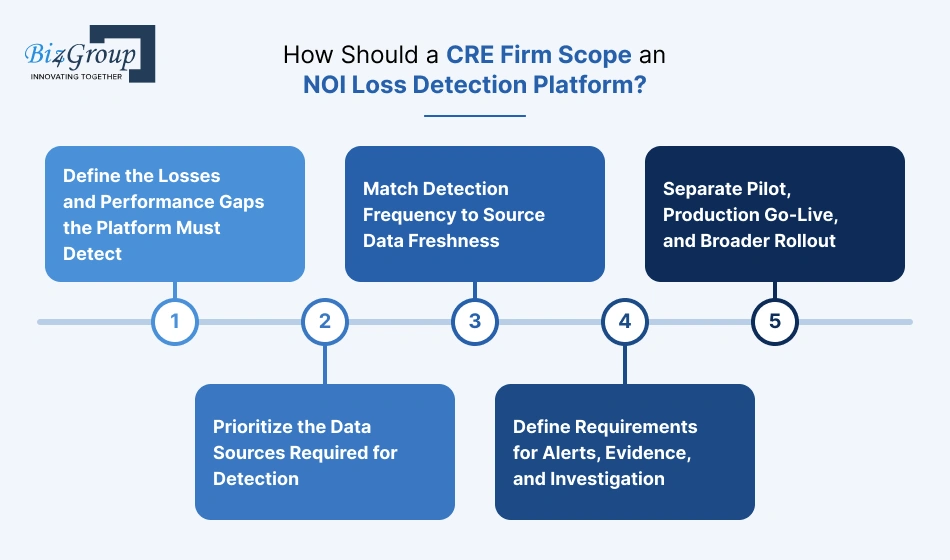
Start with the NOI problems your team deals with every month. If asset managers spend hours checking missed recoveries, unexpected expenses, or budget gaps, those are good places to start. The first version should solve a few real problems well and use data the firm can actually access.
Define the Losses and Performance Gaps the Platform Must Detect
Pick the loss patterns that matter most to your portfolio. An office portfolio may need to catch missed tenant recoveries. An industrial portfolio may care more about rising property costs or income lost through extended vacancy.
For each use case, spell out:
What changed → What should have happened → What proves it → How much NOI is affected → Who needs to act
“Find revenue leakage” is too broad. “Find tenant recoveries that fall below the amount supported by the lease and show the missing charges” gives the team a clear target.
Prioritize the Data Sources Required for Detection
Start with the data needed for those first use cases. A missed recovery may require lease terms, tenant billing, expenses, and GL data. An expense problem may need the GL, budget, and vendor records.
|
What you want to find |
Data you may need |
|---|---|
|
Missed rent or recoveries |
Lease data, billing, GL |
|
Expense overruns |
GL, budget, AP/vendor data |
|
Vacancy-related exposure |
Occupancy, lease, rent data |
|
Unusual property costs |
GL, vendor history, property data |
Check the data before building the integration. Missing lease amendments, inconsistent property IDs, or old records can lead to bad findings even when the detection logic is sound.
Match Detection Frequency to Source Data Freshness
The monitoring schedule should match how often the underlying data changes.
Billing or occupancy data that updates daily can support frequent checks. Accounting data that updates monthly may be better suited to monthly monitoring.
If your accounting data is only refreshed once a month, what would a daily NOI alert actually tell you? The answer helps set a realistic monitoring schedule for each signal.
Define Requirements for Alerts, Evidence, and Investigation
An alert should give the asset manager enough information to decide what to do next. At a minimum, show:
- What changed
- Expected versus actual result
- Estimated NOI impact
- Why it was flagged
- Supporting lease or financial records
- Who should review it
An alert saying “NOI variance detected” leaves too much work for the team. An alert showing a $14,000 recovery gap, the affected tenants, and the missing billing records is far more useful.
Separate Pilot, Production Go-Live, and Broader Rollout
Start with a small group of properties where the data is reliable and the selected loss types can be checked easily. Run the platform alongside the current reporting process and compare its findings with what the asset managers already know.
The pilot should answer a few simple questions: Did it find real issues? Were the alerts accurate? Could the team check the evidence? Did anyone recover or prevent NOI loss because of the finding?
Once the answers are clear, expand to more properties and use cases. Different asset types may need different rules, so give the detection logic room to adapt as the platform grows.
What Is CRE Asset Management Platform Development Cost and What Drives It?
CRE asset management platform development can cost $80,000 to $800,000+. A focused NOI detection MVP may sit near $80,000, while a large platform with multiple integrations, AI lease analysis, advanced detection, workflows, and enterprise security can exceed $800,000.
CRE leaders often ask:
“We are evaluating whether to buy an existing platform like RealPage or VTS or build a custom asset management system focused specifically on catching NOI losses, so I need to understand the cost and what a custom build would actually deliver.”
A custom CRE asset management platform can cost roughly $80,000 to $800,000+, depending on integrations, data complexity, AI lease analysis, detection logic, workflows, and security. The value is control over the specific NOI loss patterns, evidence, prioritization, and workflows the firm needs.
What Factors Affect CRE Asset Management Platform Development Cost?
Several parts of the build can move the cost significantly. The main ones are:
- System integrations: Connecting accounting, property management, lease, AP, and budgeting systems takes more work when APIs are limited or data formats differ.
- Portfolio and document volume: More properties, leases, tenants, and historical transactions increase processing, storage, and data-management needs.
- Data cleanup: Inconsistent property IDs, account codes, tenant records, or incomplete lease data can add substantial preparation work.
- Detection and AI complexity: Basic budget-versus-actual checks cost less than anomaly detection, seasonal analysis, peer comparisons, lease abstraction, and revenue leakage detection.
- Infrastructure and security: Cloud hosting, AI processing, document storage, monitoring, integrations, access controls, and ongoing maintenance add to the total cost.
How Does Scope Change the Development Budget?
|
Platform scope |
Indicative development range |
|---|---|
|
Focused NOI detection MVP |
$80K–$150K+ |
|
Multi-system production platform |
$150K–$400K+ |
|
Enterprise CRE asset management platform |
$400K–$800K+ |
|
Large, highly customized platform |
$800K+ |
A platform with three clean integrations and a few detection workflows can stay relatively focused. A portfolio-wide system handling complex lease terms, large document volumes, multiple property systems, advanced AI, and enterprise security needs will require a much larger budget.
Which side of the range will your project fall on? The answer becomes clearer once the firm has defined the properties, data sources, NOI problems, integrations, and level of automation required for the first production release.
Build vs. Buy: Custom NOI Monitoring Platform vs. Existing CRE Platforms
There are three practical ways to approach NOI monitoring: build a custom platform, use an existing CRE platform, or add a custom detection layer around the platforms already in place. The right choice depends on how specific your NOI loss detection needs are, what your current platforms already handle, and how much control you need over the analysis.
|
Consideration |
Build |
Buy |
Hybrid |
|---|---|---|---|
|
NOI detection |
Built around your specific loss patterns |
Based on available platform capabilities |
Custom detection added around existing platforms |
|
Customization |
High |
Limited |
High for priority use cases |
|
Integration effort |
Higher upfront |
Lower when required integrations are available |
Moderate |
|
Time to launch |
Longer |
Faster |
Moderate |
|
Upfront cost |
Higher |
Usually lower |
Mid-range |
|
Control over detection logic |
High |
Depends on the platform |
High for the custom layer |
|
Best fit |
Specialized NOI requirements |
Requirements that match existing capabilities |
Existing platforms with specific detection gaps |
Compare Each Platform’s Coverage of NOI Detection Requirements
Start with the NOI gaps your team actually needs to detect. Check whether the platform can connect lease, accounting, property, and budget data to identify the cause and financial impact of a variance.
Would your team still need spreadsheets and manual investigation after the platform flags an NOI gap? If so, there is a detection gap worth addressing.
Evaluate Integration Depth, Customization, Cost, and Deployment
Compare API development and data integration requirements, configuration limits, implementation effort, ongoing maintenance, and the ability to change detection rules as portfolio needs evolve. The real cost includes manual work that remains outside the platform.
Know When a Custom Detection Platform Makes Sense
Build when your NOI monitoring depends on portfolio-specific rules, complex recovery structures, unusual lease provisions, or custom methods for calculating and prioritizing NOI impact. A custom platform also provides greater control over source traceability and detection logic.
Know When an Existing Platform Provides Enough Coverage
An existing platform may be sufficient when it can show what changed, why it changed, how much NOI is affected, and the evidence behind the finding without requiring extensive manual analysis.
Consider a Hybrid Detection Layer Around Existing Platforms
A hybrid approach fits when current platforms handle core property, accounting, leasing, or operational workflows but lack focused NOI detection. A separate detection layer can connect the required data, apply custom rules, estimate NOI impact, and prioritize findings without replacing the existing platforms.
Know Your Properties Are Underperforming. Know Why.
Connect lease, accounting, billing, and property data to turn unexplained variances into findings your team can actually investigate.
Build a Smarter NOI Monitoring PlatformHow Do You Measure the ROI of an NOI Loss Detection Platform?
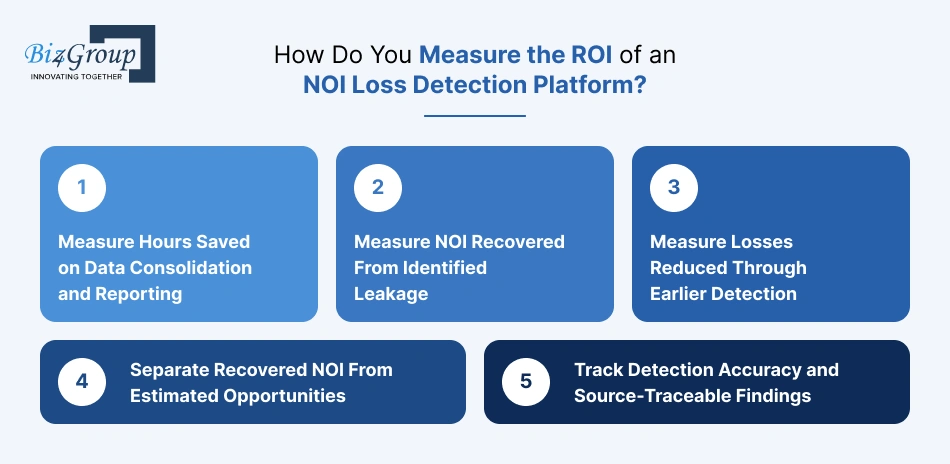
Measure the ROI of an NOI loss detection platform through four outcomes: time saved, NOI recovered, losses prevented, and the accuracy of detected issues. Keep confirmed financial results separate from estimated opportunities so the ROI calculation remains credible.
Measure Hours Saved on Data Consolidation and Reporting
Compare the time teams previously spent pulling property, lease, accounting, and budget data with the time required after implementation. Hours saved on recurring reporting can be converted into labor cost savings.
Measure NOI Recovered From Identified Leakage
Track actual NOI recovered from issues the platform identifies, such as missed recoveries, billing gaps, or recurring expense errors. This is one of the clearest measures of financial ROI.
Measure Losses Reduced Through Earlier Detection
Measure how much loss was avoided because an issue was found earlier. A $5,000 monthly variance found in month one can have a very different impact from the same issue discovered six months later.
How much would the property have lost if the issue had waited until the next quarterly review?
Separate Recovered NOI From Estimated Opportunities
Keep confirmed recovery separate from potential value. A $50,000 flagged opportunity does not mean $50,000 of NOI was recovered.
Track findings as recovered NOI, prevented loss, estimated opportunity, or under investigation. This keeps the business case grounded in measurable results.
Track Detection Accuracy and Source-Traceable Findings
Measure how many alerts are confirmed as genuine issues, how many prove to be false positives, and whether material findings can be traced back to the lease, accounting, budget, billing, or property record that supports them.
Would your team trust an ROI number if it could not verify where the underlying findings came from?
From “Something Looks Off” to “Here’s Where NOI Went”
NOI usually does not disappear in one dramatic event. A recovery goes unbilled, a vendor cost keeps creeping up, a lease provision gets overlooked, or a vacancy lasts a little longer than expected. Individually, these can look harmless. Across a portfolio, they can quietly become a very expensive habit. A commercial real estate asset management platform helps connect those dots, estimate what each gap is costing, and give the asset manager enough evidence to decide what deserves attention first.
So, where is your portfolio leaking NOI today? And more importantly, would you find out this month or at the next quarterly review? Biz4Group combines CRE-focused platform development with AI product development services to help turn fragmented lease, accounting, and property data into traceable, actionable intelligence. The goal is not to create more alerts. It is to make sure the right ones actually lead to recovered NOI.
FAQs
1. What are the most common sources of NOI leakage in commercial real estate?
Common sources include missed tenant recoveries, billing errors, unexpected operating expenses, prolonged vacancy, incorrect lease charges, and recurring cost overruns. The exact leakage points vary by property type and lease structure.
2. How can a CRE platform detect missed tenant recoveries?
It can compare lease recovery obligations with property expenses, billing records, and actual collections. A gap between what the lease permits the owner to recover and what was actually billed can then be flagged for review.
3. Can AI identify why a property’s NOI is below budget?
Yes. AI can compare actual results with budget, historical performance, lease data, occupancy, and expense patterns to identify likely drivers of the variance. The finding should still be supported by source records.
4. How do you calculate the NOI impact of a property performance gap?
Calculate the difference between expected and actual income or expenses, then determine whether the gap is one-time or recurring. For recurring losses, the platform can also show the annualized NOI impact.
5. How can asset managers reduce false positives in NOI variance alerts?
Use property-specific thresholds, historical patterns, seasonality, and confidence scores. A $10,000 expense variance should not automatically receive the same treatment across every property or expense category.
6. What data does an NOI loss detection platform need?
Typically, it needs general ledger, budget, lease, billing, occupancy, property, AP, and operating expense data. The required sources depend on the NOI gaps the platform is designed to detect.
7. How frequently should a CRE platform monitor NOI losses?
The monitoring frequency should match the freshness of the underlying data. Daily monitoring adds little value if accounting data is only updated monthly. Higher-frequency operational data can support more frequent detection.
8. How do you know whether an AI-generated NOI finding is reliable?
Each finding should show its source records, calculation, assumptions, confidence level, and estimated NOI impact. Material financial decisions should remain subject to human review.
9. What is the ROI of an NOI loss detection platform?
ROI can be measured through NOI recovered, losses prevented, reporting hours saved, and detection accuracy. Keep confirmed recovered NOI separate from estimated opportunities so the business case remains measurable.
