 Location :
Orlando, FL, USA
Location :
Orlando, FL, USA +1 (407) 714-1616
 info@biz4group.com

 AI Summary Powered by Biz4AI
- eCommerce AI review summarization app development helps online stores convert large volumes of customer reviews into concise, trustworthy insights that improve product discovery and purchase confidence.
- The right AI review summarization solution combines LLMs, NLP, sentiment analysis, and seamless eCommerce integrations to deliver accurate, scalable review summaries.
- Businesses can choose to build in-house, buy, or partner with an experienced AI development company based on their goals, budget, and customization needs.
- The cost to develop eCommerce AI review summarization app solutions typically ranges from $8,000 for an MVP to $150,000+ for an enterprise-grade platform, depending on features, AI capabilities, and integrations.
- With 20+ years of experience, 1,000+ successful projects, and 500+ global clients, Biz4Group helps businesses build secure, scalable, and custom AI-powered review summarization applications tailored to their growth goals.
"My products receive hundreds of customer reviews every month, but shoppers still ask the same questions before buying. Should I build an AI review summarization app, use a SaaS tool, or partner with a company to create a custom solution?"
You're not the only one wondering that. It's one of the biggest challenges facing growing eCommerce businesses today, and it's a major reason why eCommerce AI review summarization app development has become a priority for retailers looking to improve product discovery and increase conversions.
If you've shopped on Amazon recently, you've probably noticed AI-generated review highlights appearing above customer reviews. Yotpo, Reviews.io, and several Shopify apps now offer similar capabilities, reflecting a broader shift toward AI-powered shopping experiences where customers expect quick, trustworthy insights instead of reading hundreds of individual reviews.
The data reinforces this trend. According to a recent review survey 2026, 97% of consumers read online reviews before choosing a business, while 41% always read reviews before making a decision, up from 29% the previous year. The survey also found that shoppers now consult an average of six review platforms before making a purchase.
Customer expectations are evolving just as quickly. AI shopping assistants are making it easier to compare products, answer buying questions, and surface insights from thousands of reviews in seconds. For businesses, that means review summarization is becoming a core capability rather than an optional feature.
As a custom software development company, Biz4Group has seen growing demand for AI review insights application development from businesses that want more than an off-the-shelf widget. They want custom AI solutions that fit their customer experience, integrate with their existing eCommerce ecosystem, and scale with their long-term product strategy.
Before we dive into the details, let's begin with the basics.
What Is an AI Review Summarization Solution, and Why Does Your eCommerce Business Need One?
An AI review summarization solution is an AI-powered system that analyzes hundreds or even thousands of customer reviews and turns them into a concise, easy-to-read summary. Instead of asking shoppers to sift through pages of feedback, it highlights recurring themes such as product quality, fit, durability, comfort, shipping experience, or value for money.
Think of it as a smart layer that sits on top of your existing reviews. It doesn't replace authentic customer feedback. It helps shoppers understand it faster.
This is exactly why AI product review summarization is becoming a standard feature across modern eCommerce platforms. According to the Nielsen Norman Group, AI-generated review summaries help shoppers quickly identify key themes from customer feedback, which makes product evaluation faster and reducing information overload.
For businesses, the benefits extend well beyond customer convenience. A well-designed AI review summarization solution can:
- Help shoppers make faster purchase decisions by surfacing the most discussed product attributes.
- Increase confidence by presenting balanced positive and negative insights instead of relying solely on star ratings.
- Turn large volumes of customer feedback into actionable insights for product and marketing teams.
- Improve the shopping experience across large catalogs where products accumulate hundreds or thousands of reviews.
This is one of the reasons why companies like Amazon, Yotpo, and Reviews.io have invested heavily in review summarization experiences. Yotpo notes that AI review summaries are designed to reduce "walls of text" for shoppers while giving brands meaningful customer insights, and its review summary widget has been shown to increase conversions by an average of 5.4%.
How Does an eCommerce AI Review Summarization App Actually Work?
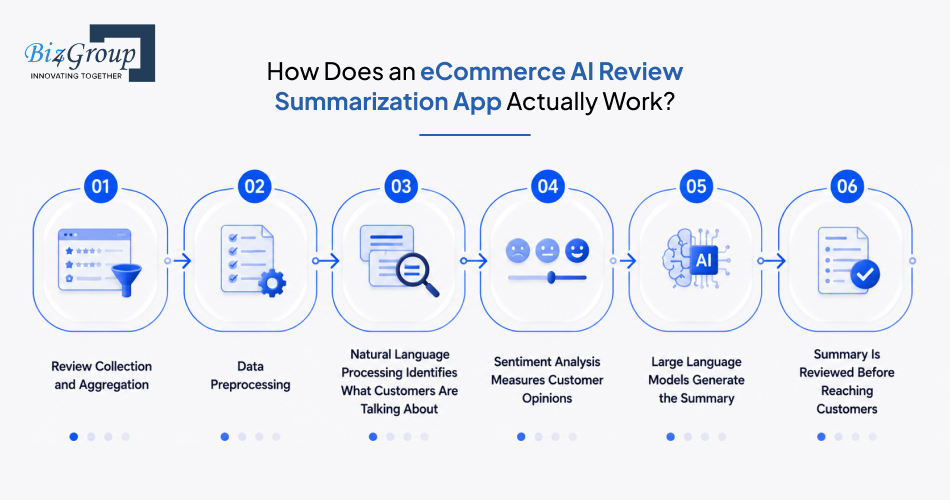
An eCommerce AI review summarization app works by collecting customer reviews, analyzing them with large language models (LLMs), natural language processing (NLP), and sentiment analysis, identifying recurring themes and opinions, and generating concise summaries that help shoppers quickly understand what customers collectively think about a product.
A typical ecommerce AI review summarization app development process follows these stages.
1. Review Collection and Aggregation
The first step is collecting reviews from one or multiple sources. Depending on your business, this could include your eCommerce store, marketplaces like Amazon, review platforms, mobile apps, or customer feedback channels.
Bringing all reviews into a single repository creates a complete picture of customer sentiment instead of relying on isolated data sources.
2. Data Preprocessing
"I am the Director of eCommerce at a consumer electronics retailer, and fake or biased reviews are affecting customer trust. Can AI identify suspicious reviews before generating summaries, or does that require a separate solution?"
The answer is yes, but it usually requires a dedicated review validation layer before the AI begins summarizing customer feedback.
Raw reviews often contain duplicate submissions, spam, promotional content, emojis, slang, grammatical errors, and incomplete sentences. If these reviews are passed directly to the AI, they can reduce the quality and reliability of the generated summaries.
Before summarization begins, the review dataset is typically prepared by:
- Removing duplicate or irrelevant reviews
- Detecting the review language
- Filtering spam or inappropriate content
- Identifying fake, manipulated, or low-quality reviews
- Standardizing the data for consistent AI processing
Think of this stage as quality control. The cleaner and more trustworthy the review data, the more accurate and credible your AI review summarization solution will be.
3. Natural Language Processing Identifies What Customers Are Talking About
Once the data is prepared, natural language processing (NLP) extracts the key themes discussed across reviews. Rather than viewing every review as a single block of text, the system identifies specific product aspects such as:
- Fit
- Quality
- Durability
- Battery life
- Delivery experience
- Customer support
This allows the application to understand what customers are discussing before determining how they feel about those aspects.
4. Sentiment Analysis Measures Customer Opinions
Not every five-star review is entirely positive, and not every one-star review is completely negative. AI sentiment analysis evaluates the emotional tone behind each comment and associates it with individual product attributes. For example, customers may appreciate a laptop's performance while consistently criticizing its battery life.
This layer helps create summaries that reflect balanced customer opinions instead of overly positive or negative narratives.
5. Large Language Models Generate the Summary
This is where generative AI review summarization development comes into play. After identifying the most discussed topics and customer sentiment, a large language model generates a natural-language summary that is easy to read and factually grounded in the source reviews.
Instead of producing generic statements, modern models can generate summaries like, "Customers consistently praise the lightweight design and display quality. Some reviewers mention that the battery lasts a full workday, while others expected longer performance during gaming sessions".
The objective is to present an accurate overview without altering what customers actually said.
6. Summary Is Reviewed Before Reaching Customers
Many businesses add an additional validation layer before displaying summaries on their storefront. Depending on the application's complexity, this may include:
- Confidence scoring
- Source verification
- Human review for high-value products
- Scheduled summary refreshes as new reviews are added
This helps maintain consistency as customer feedback evolves over time.
Where Can Businesses Use AI Review Summarization?
Businesses can use AI review summarization across various use cases. Some practical applications include:
- Product pages that highlight common pros and cons.
- Category pages that summarize reviews for multiple products.
- Commerce Marketplace listings with thousands of customer reviews.
- Merchant dashboards that reveal recurring product issues.
- Customer support portals where agents can quickly understand historical feedback.
- Internal product teams using review summaries to identify feature requests and quality concerns.
Businesses across industries are already using AI to summarize and analyze large volumes of unstructured content. At Biz4Group, we've built similar AI-powered applications that demonstrate the same core capabilities required for AI review summarization solutions, including summarization, natural language processing, semantic search, and conversational AI. Here is one example.
PDF Consultant AI is an AI-powered document intelligence platform developed by Biz4Group. Built with OpenAI GPT and advanced NLP, it enables users to summarize lengthy PDF documents, extract key information, generate research ideas, and ask questions using natural language.
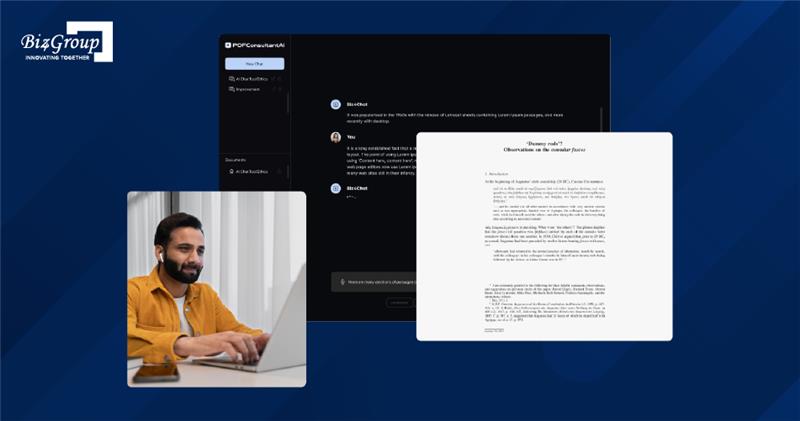
Key capabilities include:
- AI-powered document summarization
- Intelligent data extraction
- Natural language Q&A
- Text analysis and keyword extraction
- Voice and avatar-based search
While PDF Consultant AI was designed for document intelligence, the same AI technologies can be leveraged to develop eCommerce AI review summarization app solutions that help businesses transform thousands of customer reviews into concise, actionable insights.
An effective AI review summarization solution helps businesses organize customer feedback into insights that shoppers can understand quickly, and teams can act on confidently. After understanding the process, let's look at where the real value lies in the business benefits.
Which Businesses Benefit the Most from AI Product Review Summarization?
If you are asking yourself this question: "I am a product manager in a D2C fashion brand and my team wants to reduce cart abandonment, so can an AI review summarizer actually help improve our conversion rate". The answer depends on your business, product catalog, and review volume.
As your catalog grows and popular products accumulate hundreds or even thousands of customer reviews, helping shoppers find the information they need quickly becomes just as important as collecting the reviews themselves. That's why the following businesses often see the greatest value from AI product review summarization.
|
Business Type |
How They Benefit |
|---|---|
|
D2C brands |
Help shoppers quickly understand product quality, fit, ingredients, or durability, leading to better purchase confidence and lower cart abandonment. |
|
Online marketplaces |
Summarize thousands of reviews across multiple sellers, making it easier for customers to compare products without reading extensive feedback. |
|
Enterprise retailers |
Deliver consistent review experiences across large catalogs while gaining customer insights at scale. |
|
Fashion and apparel stores |
Surface insights around sizing, comfort, fabric quality, and fit, helping customers make more informed purchasing decisions. |
|
Beauty and skincare brands |
Highlight recurring feedback on skin type, ingredients, effectiveness, fragrance, and product suitability. |
|
Consumer electronics retailers |
Summarize opinions on battery life, performance, display quality, durability, and ease of use, reducing research time for high-value purchases. |
|
Home and furniture brands |
Present common feedback on assembly, material quality, comfort, dimensions, and long-term durability. |
|
Multi-language retailers |
Provide consistent review summaries across different languages, improving the shopping experience for global customers. |
|
Subscription and replenishment businesses |
Identify recurring customer feedback to improve retention and product experience over time. |
|
eCommerce agencies and SaaS platforms |
Offer AI review summarization solution capabilities as a value-added feature for multiple client stores or merchants. |
These benefits don't happen automatically. They depend on the features and AI capabilities built into your application. So, what should every eCommerce AI review summarization application include? Let's start with the core features.
Which Core Features Should You Include in an eCommerce AI Review Summarization Application?
Every eCommerce AI review summarization application should include features for review collection, AI-powered summarization, sentiment analysis, theme extraction, spam detection, multilingual support, seamless platform integrations, and an intuitive user interface. These capabilities form the foundation of an accurate, scalable, and user-friendly AI review summarization solution.
If you're wondering, "We are developing a E-Commerce store with over 5000 SKUs and we want an AI feature that shows pros and cons of each product from reviews, so what is the best way to build this", you're asking the right question.
The answer starts with building the right foundation. The following core features are essential for creating a scalable AI review summarization solution that delivers meaningful value to both shoppers and your business.
|
Core Feature |
Why It Matters |
|---|---|
|
AI-generated review summaries |
Condenses hundreds or thousands of reviews into concise, balanced summaries that help shoppers make faster purchase decisions. |
|
Aspect-based sentiment analysis |
Identifies customer sentiment for specific product attributes such as quality, fit, durability, sizing, battery life, or value for money. |
|
Pros and cons extraction |
Automatically surfaces the most frequently mentioned strengths and weaknesses for every product. |
|
Keyword and topic extraction |
Detects recurring themes, phrases, and customer concerns to improve review discoverability. |
|
Smart review filtering and search |
Allows users to filter reviews by rating, keywords, product attributes, verified purchases, or sentiment. |
|
Review source aggregation |
Consolidates reviews from websites, marketplaces, mobile apps, and third-party review platforms into a unified dataset. |
|
Automatic summary refresh |
Updates summaries whenever new reviews are added, ensuring customers always see current insights. |
|
Confidence score and source traceability |
Increases trust by showing how well a summary represents the underlying reviews and linking key insights back to supporting feedback. |
|
Admin dashboard |
Enables merchants to monitor summaries, review performance, approve AI-generated content if required, and manage configurations. |
|
API and eCommerce platform integrations |
Connects with Shopify, WooCommerce, Magento, BigCommerce, custom storefronts, CRMs, and other business systems for seamless deployment. |
This core feature set provides everything needed to build eCommerce AI review summarization application that delivers accurate summaries and a smooth shopping experience.
Once these capabilities are established, businesses can enhance the platform with advanced AI features that improve personalization, intelligence, and enterprise scalability.
Which Advanced AI Capabilities Can Future-Proof Your eCommerce AI Review Summarization Application?
To future-proof an eCommerce AI review summarization application, consider adding capabilities such as personalized review summaries, multilingual AI support, fake review detection, conversational AI search, predictive review insights, explainable AI, multimodal review analysis, and AI-powered recommendation engines. These features extend your AI review summarization solution beyond basic summaries and create a more intelligent shopping experience.
Here the table explores each one of them precisely.
|
Advanced AI Capability |
Business Value |
|---|---|
|
Personalized AI review summaries |
Generates tailored summaries based on shopper preferences, purchase history, location, or product usage, making reviews more relevant to each customer. |
|
Multilingual review summarization |
Summarizes reviews written in multiple languages while preserving context and sentiment, enabling a consistent experience for global customers. |
|
AI-powered trust intelligence |
Detects suspicious review patterns, spam, and potential review manipulation before they influence customer-facing summaries. |
|
Theme clustering and trend detection |
Groups related feedback into emerging themes, helping businesses identify recurring product issues and customer expectations over time. |
|
Analyzes review trends to anticipate product quality concerns, customer satisfaction shifts, and future buying behavior. |
|
|
Voice and video review summarization |
Converts spoken reviews and video testimonials into searchable summaries, allowing businesses to capture insights from multiple content formats. |
|
Explainable AI summaries |
Enables shoppers to view the customer reviews that support specific summary statements, improving transparency and trust. |
|
Custom AI prompts and brand guidelines |
Allows businesses to control the tone, structure, summary length, and moderation rules so AI-generated content aligns with their brand voice. |
|
AI Recommendation engine integration |
Combines AI product review summarization with personalized product recommendations to improve discovery and increase cross-selling opportunities. |
|
Enterprise AI governance and security |
Supports role-based access, audit trails, compliance, encryption, and secure deployment for enterprise-grade AI review insights application development. |
The right mix of advanced capabilities depends on your business goals, customer expectations, and growth strategy. While many businesses begin with a focused MVP, adding these capabilities over time can transform a basic review summary tool into a strategic asset that strengthens customer trust, improves product decisions, and creates a more personalized shopping experience.
What Tech Stack Is Best for eCommerce AI Review Summarization App Development?
The best tech stack for eCommerce AI review summarization app development typically includes LLMs, NLP frameworks, a scalable backend like Python or Node.js, a frontend built with React or Next.js, cloud platforms like AWS, Azure, or Google Cloud, vector databases, and APIs that integrate with eCommerce platforms. The ideal combination depends on your business requirements, expected traffic, and scalability goals.
Instead of choosing technologies based on popularity alone, focus on a stack that supports accurate AI processing, seamless integrations, secure infrastructure, and long-term scalability as your customer base and product catalog grow.
|
Layer |
Recommended Technologies |
Why They're Used |
|---|---|---|
|
Frontend |
React, Next.js, Vue.js |
Next.js development and more, builds responsive interfaces for product pages, dashboards, and review widgets. |
|
Backend |
Python (FastAPI, Django), Node.js (NestJS, Express) |
Python development, Node.js development and more, handle APIs, business logic, authentication, and AI orchestration. |
|
GPT-4.1, Claude 4, Gemini 2.5, Llama 4 |
Generate accurate, context-aware review summaries and insights. |
|
|
Natural Language Processing (NLP) |
spaCy, Hugging Face Transformers, NLTK |
Process reviews, extract entities, classify sentiment, and identify product aspects. |
|
Embeddings |
OpenAI Embeddings, Voyage AI, BAAI BGE |
Convert reviews into vector representations for semantic understanding. |
|
Vector Database |
Pinecone, Weaviate, Milvus, pgvector |
Store and retrieve embeddings for semantic search and advanced AI capabilities. |
|
Primary Database |
PostgreSQL, MongoDB |
Store reviews, summaries, user data, and application metadata. |
|
Search Engine |
Elasticsearch, OpenSearch |
Enable fast keyword search, filtering, and review discovery. |
|
Cloud Storage |
Amazon S3, Google Cloud Storage, Azure Blob Storage |
Securely store review data, media assets, and AI-generated outputs. |
|
Message Queue |
RabbitMQ, Apache Kafka, Amazon SQS |
Process review ingestion and summary generation asynchronously. |
|
Caching |
Redis |
Improve response times and reduce repeated AI processing. |
|
Cloud Platform |
AWS, Microsoft Azure, Google Cloud |
Provide scalable infrastructure, managed AI services, and enterprise deployment options. |
|
Containerization & DevOps |
Docker, Kubernetes, GitHub Actions |
Simplify deployment, scaling, monitoring, and CI/CD workflows. |
|
Monitoring & Observability |
Prometheus, Grafana, Datadog, New Relic |
Track application health, AI performance, and infrastructure metrics. |
The best stack isn't always the most advanced. A startup with a few thousand monthly reviews may benefit from managed AI APIs, like OpenAI API and cloud services that reduce development time, while an enterprise retailer with millions of reviews may prioritize open-source models, dedicated infrastructure, and greater control over data.
How Do You Develop an eCommerce AI Review Summarization App Step-by-Step?
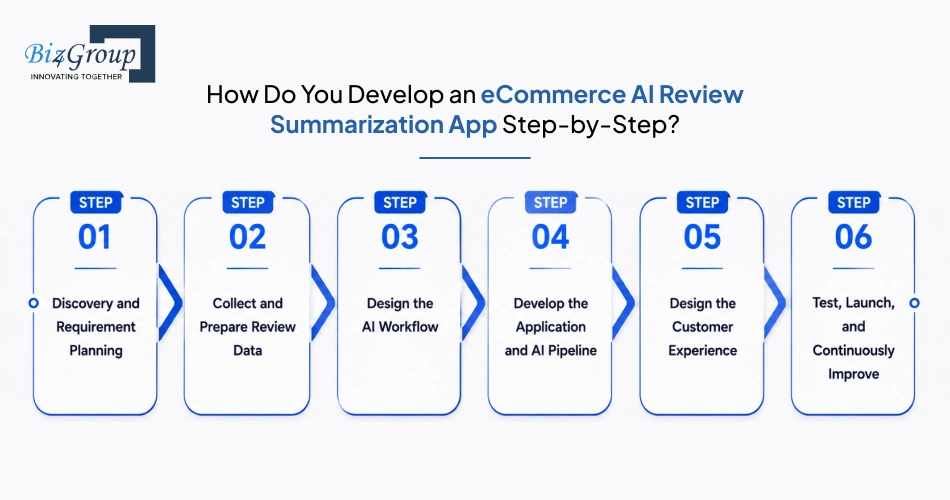
eCommerce AI review summarization app development typically involves six key stages: defining business requirements, preparing review data, designing the AI workflow, developing the application, creating an intuitive user experience, and testing before deployment. Following a structured development process helps ensure the solution is accurate, scalable, and aligned with your business goals.
Skipping any of these stages can lead to inaccurate summaries, higher development costs, or an experience that customers simply don't trust.
Step 1. Discovery and Requirement Planning
The first step is to define what your AI review summarization solution should achieve. This includes identifying your review sources, deciding how summaries should be presented, setting accuracy goals, and prioritizing the features needed for the first release. Many businesses start with MVP development to validate the solution before expanding it with advanced AI capabilities.
Typical activities include:
- Defining business goals and user personas
- Identifying primary use cases
- Prioritizing MVP and future features
- Creating a development roadmap
- Estimating budget and timeline
A well-defined discovery phase helps prevent scope changes and unnecessary development effort later in the project.
Also read: 12+ MVP development companies in USA
Step 2. Collect and Prepare Review Data
An AI review summarization solution is only as reliable as the data it processes. Before any AI model can generate meaningful summaries, customer reviews need to be collected, cleaned, and organized. This often means bringing together reviews from multiple channels and ensuring the data is consistent enough for AI analysis.
This phase typically includes:
- Connecting review sources such as Shopify, Judge.me, Yotpo, Reviews.io, marketplaces, or internal databases
- Removing duplicate and spam reviews
- Standardizing review formats
- Detecting review language
- Organizing reviews by product, category, or brand
Businesses often underestimate this phase, yet data quality has one of the biggest influences on the accuracy of AI-generated summaries.
Step 3. Design the AI Workflow
With the review data prepared, the next step is deciding how the AI should process and present customer feedback. This involves selecting the most suitable language model, designing prompts, defining the summary format, and establishing rules that ensure summaries remain accurate, balanced, and aligned with your brand's tone.
Key decisions include:
- Selecting an appropriate LLM
- Designing prompts for different product categories
- Choosing between paragraph summaries, pros and cons, or aspect-based summaries
- Defining evaluation criteria for summary quality
- Planning how frequently summaries should be refreshed
Step 4. Develop the Application and AI Pipeline
Once the strategy is finalized, development begins. The engineering team builds the backend services, APIs, AI workflow, and integrations that enable the application to process reviews and deliver summaries efficiently. This is also where scalability and performance become important considerations.
A typical workflow looks like this:
Review ingestion → Data preprocessing → AI summarization → Validation → Storage → API delivery
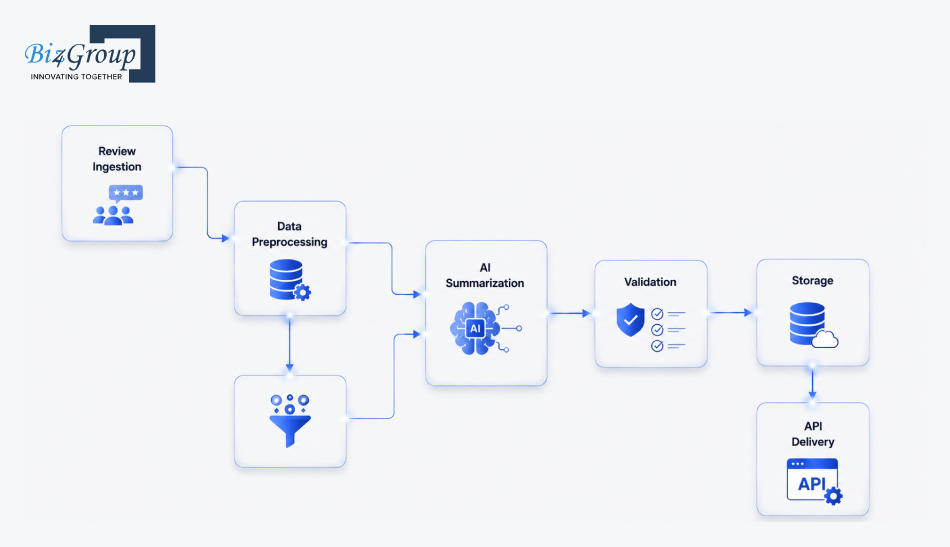
Development activities usually include:
- Building backend APIs
- Developing the AI processing pipeline
- Creating databases for reviews and summaries
- Integrating with Shopify, WooCommerce, Magento, or custom platforms
- Implementing authentication and security controls
The objective is to create an application that can process growing review volumes without compromising speed or reliability.
Step 5. Design the Customer Experience
Even the most accurate summary won't add value if customers don't notice it or understand how to use it. The best way is to partner with a UI/UX development company to design an intuitive experience that blends naturally into the shopping journey while giving merchants the controls they need to manage the application.
Questions teams often consider include:
- Where should the review summary appear on the product page?
- Should key pros and cons be displayed separately?
- How can shoppers access the supporting reviews behind a summary?
- What should the experience look like on ecommerce mobile apps?
- How should merchants review or configure AI-generated summaries?
A thoughtful user experience encourages customer trust and increases engagement with the feature.
Also read: Top 15 UI/UX design companies in USA
Step 6. Test, Launch, and Continuously Improve
Before the application reaches customers, both the software and the AI-generated summaries need to be evaluated using real-world review data. Unlike traditional software, AI applications require ongoing monitoring because customer feedback, buying behavior, and product catalogs continue to evolve.
After deployment, teams should regularly assess:
- Summary accuracy and consistency
- AI hallucinations or unsupported claims
- Processing performance
- Customer engagement metrics
- Infrastructure and AI usage costs
- Feedback from shoppers and internal teams
The most successful AI review summarization solution isn't one that's launched quickly. It's one that continues to improve as new reviews, products, and customer expectations evolve. Next, we'll explore the necessary compliance consideration to build AI review summarization app development.
What Compliance Considerations Should You Address During eCommerce AI Review Summarization App Development?
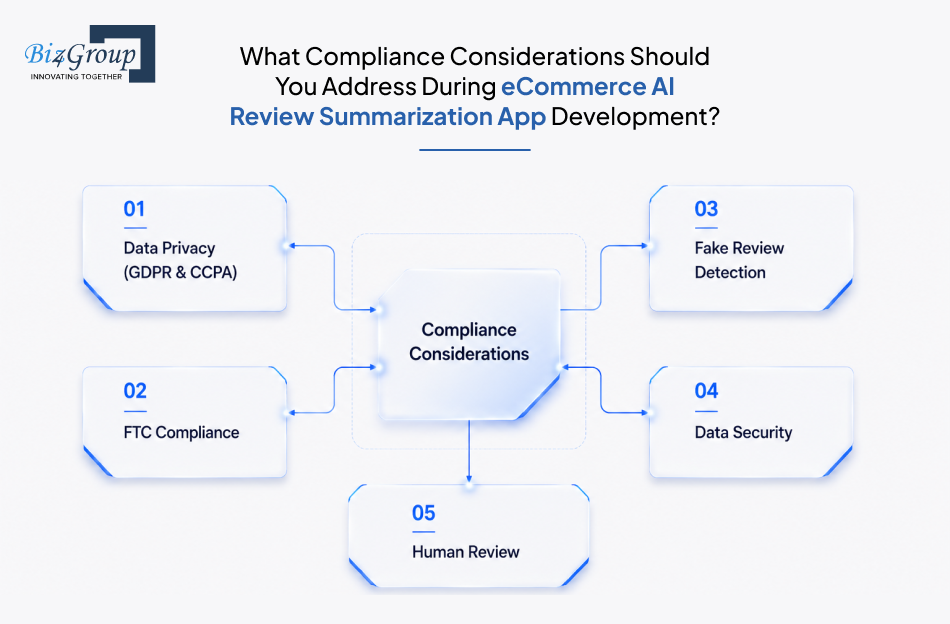
During eCommerce AI Review Summarization App Development, businesses should address data privacy, AI transparency, review authenticity, security, and regulatory compliance. Incorporating these requirements from the start helps build an AI review summarization solution that is accurate, trustworthy, and compliant with evolving regulations.
|
Compliance Area |
Why It Matters |
|---|---|
|
Data Privacy (GDPR & CCPA) |
Ensure customer review data is collected, processed, and stored in compliance with regional privacy laws. |
|
FTC Compliance |
AI-generated summaries should accurately represent genuine customer reviews and be clearly disclosed when required. |
|
Fake Review Detection |
Filter spam, manipulated, or low-quality reviews before generating summaries. |
|
Data Security |
Protect review data with encryption, secure authentication, and role-based access controls. |
|
Human Review |
Allow merchants to review or regenerate AI summaries when needed to maintain accuracy and trust. |
Addressing these requirements early reduces compliance risks, strengthens customer trust, and prepares your AI review summarization solution for long-term growth.
Let's explore which approach is right for your business to develop AI review summarization app development.
Should You Build, Buy, or Partner for eCommerce AI Review Summarization App Development?
Each approach comes with its own advantages and trade-offs. The right choice depends on your technical expertise, budget, timeline, long-term product strategy, and the level of customization you need from your AI review summarization solution.
Decision-makers often ask, "I am the founder of a growing D2C brand and we're debating whether to build our own AI review summarization feature or use an existing SaaS solution. How do we decide which approach makes more sense for our business?"
Here's a table for your help.
|
Approach |
Best For |
Advantages |
Limitations |
|---|---|---|---|
|
Build In-House |
Businesses with experienced engineering and AI teams |
Full ownership, complete customization, greater control over data, architecture, and future enhancements |
High development costs, longer implementation time, ongoing maintenance, and the need for specialized AI talent |
|
Buy a SaaS Solution |
Businesses looking for the fastest deployment |
Quick implementation, lower upfront investment, vendor-managed maintenance, and predictable pricing |
Limited customization, recurring subscription costs, vendor dependency, and restricted control over AI capabilities |
|
Partner with an AI Development Company |
Businesses that need a custom solution without building an internal AI team |
Custom development, faster delivery, expert guidance, scalable architecture, long-term support, and full product ownership |
Success depends on choosing a partner with proven experience in AI development, AI integration, and scalable product engineering. |
A SaaS solution works well for standard requirements, custom development offers greater flexibility and long-term control. Partnering with an experienced AI development company can help you achieve that without the complexity of building an in-house AI team.
So, if you have been saying, "I need to understand the real cost and timeline to develop a custom AI review summarization feature from scratch", the next sections will help you evaluate how to choose the right approach that best fits your budget.
How Much Does It Cost to Develop an eCommerce AI Review Summarization App?
The cost of ecommerce AI review summarization app development typically ranges from $8,000 to over $150,000, depending on the application's scope, AI capabilities, integrations, and deployment requirements. An MVP designed for a growing online store requires a very different investment than an enterprise-grade platform supporting multiple languages, marketplaces, and advanced AI features.
Here's a general estimate to help with budgeting.
|
Project Scope |
Estimated Cost |
Typical Timeline |
|---|---|---|
|
MVP |
$8,000 - $20,000+ |
2 to 4 weeks |
|
Custom Mid-Market Solution |
$20,000 - $50,000+ |
4 to 6 weeks |
|
Enterprise Solution |
$50,000 - $150,000+ |
6 to 8 weeks |
The final investment depends on the features you prioritize, the level of customization required, and whether you're integrating the solution into an existing eCommerce ecosystem or building a standalone platform.
What Factors Influence the Development Cost?
The initial development budget is primarily determined by the scope and technical complexity of your application.
|
Cost Factor |
Impact on Budget |
Estimated Cost Contribution |
|---|---|---|
|
Feature Scope |
The number of core and advanced features directly affects development effort. |
$3,000-$40,000+ |
|
AI Capabilities |
Features such as multilingual summarization, explainable AI, predictive insights, or conversational AI require additional engineering. |
$5,000-$35,000+ |
|
AI Model Selection |
Choosing commercial APIs, open-source LLMs, or fine-tuned models influences development complexity. |
$2,000-$20,000+ |
|
Platform Integrations |
Connecting with Shopify, WooCommerce, Magento, CRMs, ERPs, review platforms, or marketplaces increases implementation effort. |
$2,000-$15,000+ per integration |
|
Review Volume & Scalability |
Applications designed for millions of reviews require more sophisticated architecture than smaller deployments. |
$5,000-$30,000+ |
|
UI/UX Design |
Custom dashboards, review widgets, merchant portals, and responsive interfaces increase design and frontend development effort. |
$3,000-$15,000+ |
|
Testing & QA |
Functional testing, AI evaluation, performance testing, and user acceptance testing ensure the application performs reliably before launch. |
$2,000-$10,000+ |
What Hidden Costs Should You Budget For?
The initial development cost covers building the application. After launch, ongoing operational expenses typically add 15% to 30% of the original development cost annually.
- LLM API Usage: Typically accounts for 5% to 12% of ongoing costs, ranging from $200 to $3,000+ per month, depending on review volume and AI model usage.
- Cloud Infrastructure: Represents 3% to 8% of operational costs, with expenses between $100 and $2,000+ per month for hosting, databases, storage, caching, and monitoring.
- Third-Party Services: Contributes 2% to 5% of recurring costs, or approximately $50 to $1,000+ per month, covering translation APIs, authentication, analytics, and review platform subscriptions.
- Application Maintenance: Requires 8% to 15% of the annual budget, typically 15% to 20% of the initial development cost per year, for bug fixes, framework updates, AI model improvements, and feature enhancements.
- Security & Compliance: Accounts for 2% to 5% of annual operating costs, with businesses spending around $1,000 to $10,000+ annually on security audits, compliance updates, and backup management.
Planning for these costs upfront helps ensure your AI review summarization solution remains scalable, secure, and cost-effective over the long term.
How Can You Optimize Development Costs?
Reducing development costs doesn't mean sacrificing quality. A well-planned roadmap helps you maximize ROI while keeping the project within budget.
- Launch an MVP first to validate your idea before investing in advanced AI capabilities.
- Leverage pre-trained LLMs instead of building custom models from scratch.
- Prioritize features that directly improve customer experience and conversions.
- Build a modular architecture so future enhancements require minimal redevelopment.
- Automate review ingestion and AI processing to reduce manual effort and operational expenses.
- Partner with an experienced AI development company to avoid costly rework and accelerate time to market.
By accounting for both upfront costs and long-term operational expenses, you can plan a realistic budget and build an AI review summarization solution that's sustainable as your business grows. Even with the right budget in place, preparing for the technical and operational challenges of development is equally important for long-term success.
What Challenges Should You Expect When Building an AI Review Summarization Solution?
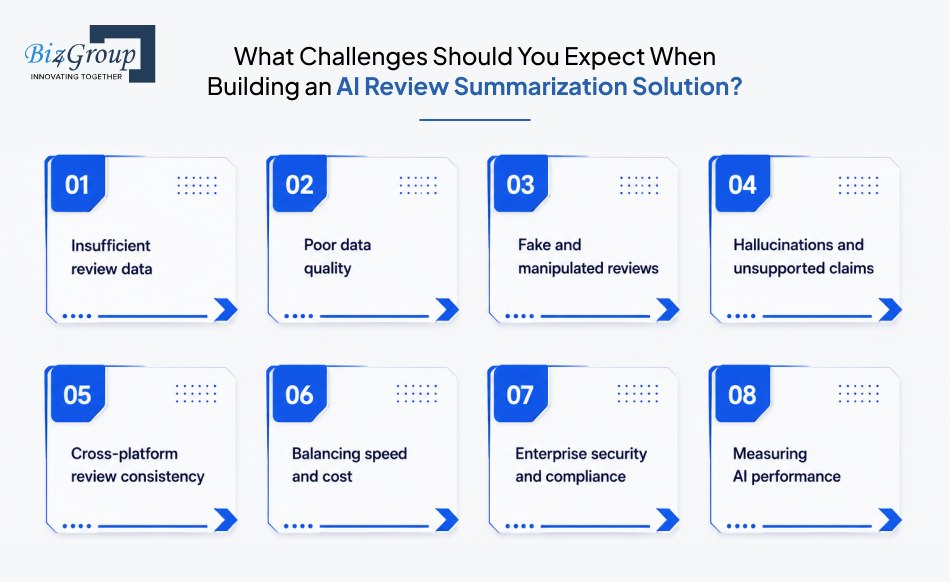
When building an AI review summarization solution, businesses commonly face challenges related to review quality, fake or biased reviews, AI accuracy, multilingual content, scalability, security, and maintaining reliable summaries as customer feedback grows. Addressing these challenges early is essential for developing an application that customers can trust and that scales with your business.
Here are the most common challenges businesses should prepare for.
|
Challenge |
Why It Matters |
Recommended Approach |
|---|---|---|
|
Insufficient review data |
Products with very few reviews don't provide enough context for meaningful summaries. |
Set minimum review thresholds before generating summaries. |
|
Poor data quality |
Duplicate, irrelevant, outdated, or poorly written reviews reduce summary accuracy. |
Clean, normalize, and validate review data before AI processing. |
|
Fake and manipulated reviews |
AI can unintentionally summarize misleading or fraudulent reviews, reducing customer trust. |
Implement fraud detection, moderation, and verified purchase checks before summarization. |
|
Hallucinations and unsupported claims |
LLMs may generate information that isn't supported by customer reviews. |
Ground summaries in source reviews and validate outputs before publishing. |
|
Cross-platform review consistency |
Reviews collected from websites, marketplaces, and third-party platforms often vary in format and quality. |
Standardize data from every source before generating summaries. |
|
Balancing speed and cost |
Generating summaries in real time can significantly increase AI processing costs. |
Use scheduled or event-based summary updates for most products. |
|
Enterprise security and compliance |
Customer feedback may contain sensitive information that requires secure handling. |
Apply encryption, access controls, audit logs, and regulatory compliance measures. |
|
Measuring AI performance |
Without clear evaluation metrics, it's difficult to know whether summaries remain accurate over time. |
Regularly evaluate summary quality using automated checks and human feedback. |
These challenges shouldn't discourage businesses from investing in ecommerce AI review summarization app development. They should help shape a realistic implementation strategy. Addressing them early results in a solution that's more reliable, easier to scale, and better aligned with customer expectations.
Next, we will have a look on the future of the AI review summarization development.
What Does the Future Hold for Generative AI Review Summarization Development?
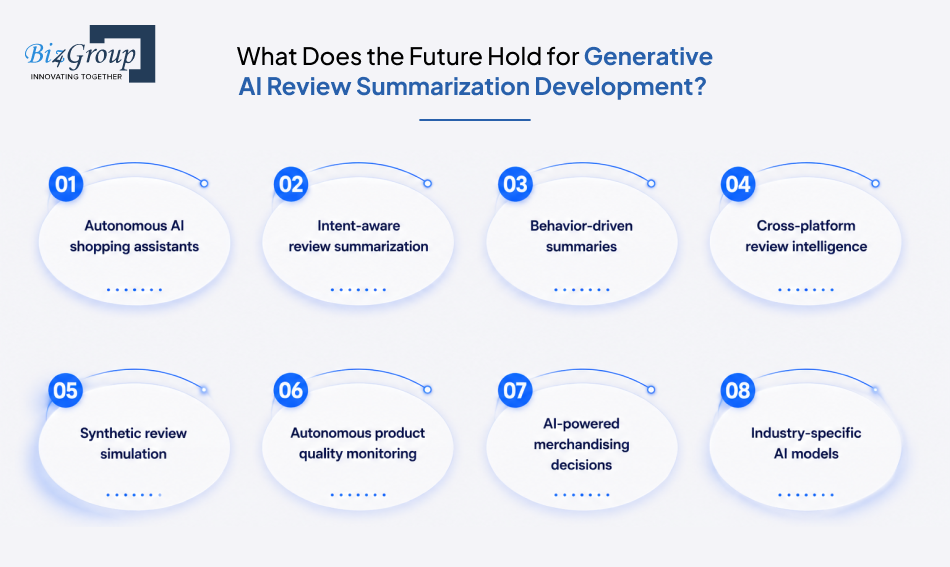
AI is evolving at a fast pace, and so are customer expectations. While today's AI review summarization solutions help shoppers understand reviews faster, the next generation of applications will focus on delivering smarter, more contextual, and highly personalized shopping experiences.
|
Future Trend |
Why It Matters |
|---|---|
|
Autonomous AI shopping assistants |
AI agents will compare products, summarize reviews, answer follow-up questions, and recommend products without requiring shoppers to search manually. |
|
Intent-aware review summarization |
AI will generate different summaries depending on whether a shopper is comparing products, researching features, or looking for specific use cases. |
|
Behavior-driven summaries |
Review summaries will adapt in real time based on customer behavior, browsing history, and shopping context rather than remaining static. |
|
Cross-platform review intelligence |
AI will combine reviews from marketplaces, social media, communities, support tickets, and return data to generate more holistic product insights. |
|
Synthetic review simulation |
Businesses may use AI to simulate customer reactions to product changes before launch by learning from historical review patterns. |
|
Autonomous product quality monitoring |
AI will continuously detect emerging product defects, shipping issues, or customer complaints and alert product teams before problems become widespread. |
|
AI-powered merchandising decisions |
Review intelligence will automatically influence product rankings, recommendations, promotional campaigns, and inventory planning. |
|
Industry-specific AI models |
Instead of general-purpose LLMs, retailers will increasingly adopt AI models trained specifically for industries like fashion, beauty, healthcare, or electronics to improve summarization accuracy. |
Preparing for these emerging trends starts with choosing the right technology partner. An experienced development team can help you build a solution that not only meets today's requirements but is also ready to adapt as AI continues to evolve.
Speaking of experienced development company...
Why is Biz4Group LLC the Best Partner for AI Review Insights Application Development in the USA?
If you're asking, "I am running an eCommerce business, and I am getting hundreds of reviews on my products every month, so can you suggest companies that can build an AI tool to summarize them for me", you're already thinking beyond the idea stage.
By now, you understand what goes into building a successful AI review summarization solution. The next step is choosing a development partner with the expertise to transform your requirements into a scalable, production-ready application that aligns with your business goals.
At Biz4Group, a leading ecommerce development company in USA, we've been helping businesses build innovative digital solutions for more than 20 years. From custom AI review summarization solutions to intelligent document platforms like PDF Consultant AI, Biz4Group develops AI-powered applications that combine NLP, generative AI, and advanced data analysis to solve real business challenges.
Our approach goes beyond development. We help you validate your idea, define the right roadmap, build a scalable architecture, integrate AI seamlessly into your eCommerce ecosystem, and continue optimizing the solution as your business evolves.
If you're looking for a technology partner that understands both AI innovation and eCommerce product development, Biz4Group is ready to help you build a solution that delivers measurable business value.
Let's talk.
Final Thoughts
Building an AI review summarization solution isn't about keeping up with the latest AI trend. It's about giving customers faster access to the information they need while giving your business greater control over how product reviews influence buying decisions.
The right development approach depends on your goals, budget, and how much control you want over the customer experience.
At Biz4Group LLC, we help businesses develop eCommerce AI review summarization app solutions tailored to their unique goals. From AI strategy and product design to custom development, seamless integrations, and post-launch support, we work with you to build scalable solutions that align with your product vision and growth plans.
Ready to turn customer reviews into a competitive advantage? Connect with our AI experts to discuss your requirements and start building an eCommerce AI Review Summarization App that's designed to grow with your business.
FAQ’s
1. How much does it cost to build an AI review summarization solution?
The cost of ecommerce AI review summarization app development typically ranges from $8,000 for an MVP to over $150,000 for an enterprise-grade platform. The final investment depends on factors such as feature complexity, AI capabilities, integrations, infrastructure, and customization requirements.
2. Can small online stores use an AI review summarizer for online stores?
Yes, but review volume matters. Products with very few reviews often don't provide enough data for meaningful summaries. Many businesses wait until a product reaches a minimum review threshold before enabling AI-generated summaries.
3. How accurate is AI product review summarization?
Accuracy depends on how the solution is built. High-quality review data, fraud detection, prompt engineering, grounding techniques, and continuous evaluation all play an important role in generating reliable summaries.
4. Should I buy a SaaS plugin or develop an eCommerce AI review summarization app?
If you need a quick deployment with standard functionality, a SaaS plugin may be the right choice. If you need greater customization, complete ownership, enterprise integrations, or AI tailored to your business, a custom solution is often the better long-term investment.
5. How long does eCommerce AI Review Summarization App Development take?
A basic MVP typically takes 2 to 4 weeks, while a fully customized enterprise solution may require 6 to 8 weeks, depending on the project's complexity and integration requirements.
6. Is it legal to use AI to summarize customer reviews?
Yes. Businesses can use AI to summarize genuine customer reviews, provided the summaries accurately reflect the underlying feedback and comply with applicable regulations. Transparency about AI-generated content also helps build customer trust.
7. Which AI model is best for AI customer review analysis platform development?
There isn't a single best model for every business. GPT, Claude, Gemini, and open-source models each offer different strengths in terms of accuracy, speed, cost, customization, and deployment flexibility. The right choice depends on your business goals and technical requirements.
8. Can an AI review summarization solution work with Shopify, WooCommerce, or Magento?
Yes. Most custom solutions can integrate with popular eCommerce platforms, review management tools, CRMs, and marketplaces to collect reviews and display AI-generated summaries within the existing shopping experience.
9. Can AI detect fake reviews before generating summaries?
Yes, but it usually requires additional fraud detection capabilities. A well-designed solution can identify suspicious review patterns, duplicate content, and unusual user behavior before those reviews influence customer-facing summaries.
10. Why should I partner with an experienced company for AI review insights application development?
Building an AI-powered review summarization application involves more than integrating an LLM. An experienced development partner can help you define the right strategy, select appropriate AI technologies, build a scalable architecture, integrate with your existing systems, and support the solution as your business grows.
