 Location :
Orlando, FL, USA
Location :
Orlando, FL, USA +1 (407) 714-1616
 info@biz4group.com

- AI hallucinations in enterprise applications create business, legal, and operational risks.
- Legal, healthcare, finance, and insurance face the highest hallucination exposure.
- RAG helps reduce AI hallucinations enterprise systems face but has limitations.
- Strong enterprise AI hallucination prevention strategies start with quality knowledge management.
- Enterprise AI accuracy hallucination reduction is achievable, elimination is not.
- Biz4Group LLC builds enterprise AI solutions designed for accuracy, trust, and scale.
Have you ever wondered how many business decisions are being made today based on information that
was never true in the first place? As AI adoption accelerates across industries, a growing number
of organizations are discovering that their biggest challenge is no longer implementation.
It is trust.
According to industry research, 47% of enterprise AI users admitted making at least one significant business decision based on hallucinated content. This growing concern has pushed AI hallucinations in enterprise applications from a technical issue to a boardroom discussion.
The danger becomes even greater because these errors often look convincing. According to Foxit’s research, employees now spend an average of 4.3 hours every week verifying AI-generated outputs, creating substantial productivity costs across large organizations. As a result, many technology leaders are actively searching for enterprise AI hallucination problem solutions before a costly mistake reaches customers, regulators, or stakeholders.
Many enterprise leaders ask, "How do we detect hallucinations in production before users see them?" It is a fair concern. Effective AI hallucination detection enterprise applications strategies require stronger architecture, governance, monitoring, and validation systems.
That brings us to an even bigger question... How does enterprise AI hallucination occur and what
specific conditions in production deployments increase the frequency and severity of AI generated
false information?
Understanding the answer is the first step toward reducing risk,
improving accuracy, and building AI systems your organization can confidently scale.
For now, let’s begin with understanding what AI hallucinations are in enterprise applications.
What Are AI Hallucinations in Enterprise Applications and Why Are They More Dangerous Than Traditional Software Errors
So, what exactly qualifies as an AI hallucination in enterprise software and why is it considered more dangerous than a normal system error?
Before discussing causes, costs, or prevention, it is important to define the problem correctly.
Many organizations treat hallucinations as ordinary AI mistakes. They are not.
An AI hallucination occurs when an AI system generates information that appears credible, authoritative, and relevant but is factually incorrect, unsupported, fabricated, or disconnected from verified data sources.
In enterprise environments, these outputs often look legitimate enough to be accepted without immediate verification. That is what makes them dangerous.
A Practical Definition of AI Hallucinations in Enterprise Applications
An enterprise AI hallucination happens when an AI model produces false information during a business workflow while presenting that information as if it were accurate.
Examples include:
- Inventing policy details that do not exist
- Creating non-existent citations or references
- Misstating regulatory requirements
- Generating inaccurate customer guidance
- Fabricating financial or operational data
- Misinterpreting internal company documentation
The key issue is not that the answer is wrong. The key issue is that the answer sounds right.
Traditional Software Errors vs AI Hallucinations
At first glance, both may appear to be system failures.
The reality is very different.
|
Factor |
Traditional Software Error |
AI Hallucination |
|---|---|---|
|
Visibility |
Usually obvious |
Often difficult to detect |
|
Root Cause |
Coding defect |
Probabilistic content generation |
|
User Trust Level |
Lower |
Higher due to natural language responses |
|
Error Pattern |
Consistent and repeatable |
Dynamic and unpredictable |
|
Detection Speed |
Typically immediate |
Often discovered after use |
|
Business Impact |
Usually isolated |
Can spread across teams and customers |
A traditional software bug may prevent a transaction from processing.
A hallucination may
process the transaction while providing incorrect reasoning behind it.
One creates operational disruption. The other creates misplaced confidence.
Why Enterprise Users Are More Vulnerable to Hallucinations
Employees often interact with AI differently than they interact with software.
When a dashboard displays an error, users become cautious.
When an AI assistant responds in
complete sentences, cites sources, and explains its reasoning, users naturally assume the answer
has already been validated.
That assumption creates risk.
Consider what happens when AI becomes embedded into:
- Customer service workflows
- Internal knowledge systems
- Insurance operations
- Financial reporting processes
- Contract review platforms
- Healthcare support tools
A single inaccurate response can quickly influence dozens, hundreds, or even thousands of downstream decisions.
Hallucinations Behave More Like Trust Failures Than Technical Failures
One of the biggest misconceptions surrounding the enterprise AI hallucination problem solutions
conversation is that hallucinations are purely technical issues.
They are actually trust
issues.
When users stop trusting AI outputs, adoption falls. When users trust incorrect outputs, risk
rises.
Enterprise leaders must balance both outcomes.
The challenge becomes even more significant when AI systems are integrated across departments through large-scale AI integration services, where one inaccurate response can propagate through multiple business processes before anyone notices.
What AI Hallucinations Are Not
To avoid confusion, it helps to separate hallucinations from other AI limitations.
|
AI Behavior |
Hallucination? |
Why |
|---|---|---|
|
Providing outdated information |
Not always |
May be based on old but real data |
|
Refusing to answer |
No |
Safety mechanism |
|
Producing incomplete answers |
No |
Response quality issue |
|
Generating fabricated facts |
Yes |
Information does not exist |
|
Inventing sources or citations |
Yes |
Unsupported content |
|
Misrepresenting company policies |
Yes |
False information presented as fact |
This distinction matters because different problems require different solutions.
An outdated answer may require data updates. A hallucination requires stronger controls around generation, validation, and verification.
The Enterprise Reality
As organizations continue investing in enterprise AI solutions, the goal should not be achieving perfect AI outputs. No enterprise system can realistically guarantee that.
The goal is ensuring that AI-generated information remains grounded, traceable, and trustworthy enough for business use.
That starts with understanding one fundamental truth...
AI hallucinations are not software
bugs.
They are confidence-rich information failures that operate inside systems people
increasingly rely on to make important decisions.
And that difference changes everything.
What If Your AI Is Already Hallucinating and Nobody Knows It Yet?
A hallucination does not need to go viral to become expensive. It only needs to be trusted once.
Audit My AI SystemHow Does Enterprise AI Hallucination Occur and What Specific Conditions in Production Deployments Increase the Frequency and Severity of AI Generated False Information
You must be wondering, what causes hallucinations in enterprise AI systems even when they are connected to company data and trained for business use?
Many enterprise teams assume hallucinations originate from the AI model itself.
In reality, production deployments introduce conditions that rarely appear during testing. A system that performs well in controlled environments can behave very differently when exposed to thousands of users, evolving data sources, and complex business workflows.
That is why understanding AI hallucinations enterprise applications causes costs fixes begins with understanding what changes after deployment.
Hallucinations Rarely Come From One Problem
Most enterprise hallucination incidents occur when multiple conditions overlap.
The AI model
may be functioning exactly as designed while the surrounding ecosystem quietly introduces errors.
|
Production Condition |
What Happens |
Impact on Output Quality |
|---|---|---|
|
Incomplete business knowledge |
Critical information is missing |
AI fills gaps with assumptions |
|
Conflicting documents |
Multiple sources provide different answers |
Inconsistent responses |
|
Unstructured enterprise data |
Relevant information becomes difficult to interpret |
Reduced factual accuracy |
|
Rapid business updates |
New policies are not reflected immediately |
Outdated responses |
|
High-volume user activity |
Unexpected query patterns emerge |
Increased error frequency |
The result is a system that appears knowledgeable but gradually drifts away from verified business reality.
Five Production Conditions That Increase Hallucination Frequency
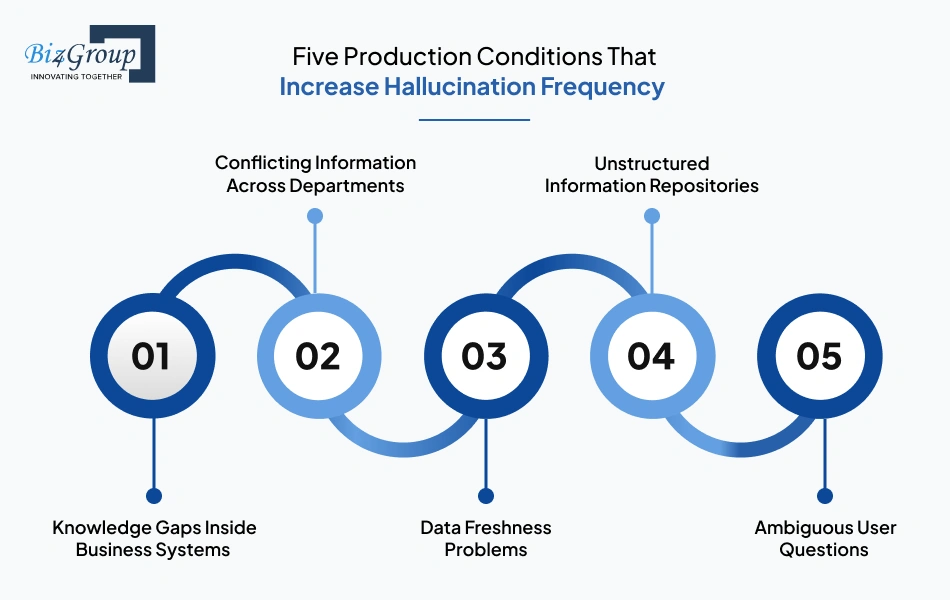
Rather than focusing on model behavior alone, enterprise teams should evaluate the environment surrounding the model.
1. Knowledge Gaps Inside Business Systems
AI cannot reference information that does not exist within its accessible knowledge environment.
This sounds obvious.
Yet many organizations discover after deployment that important
procedures, policies, product updates, or internal documentation were never incorporated into the
system.
When information is unavailable, the model often attempts to construct the most probable response based on surrounding context.
That is where false information begins to emerge.
2. Conflicting Information Across Departments
Large enterprises rarely maintain a single source of truth.
Operations teams may follow one process.
Compliance teams may follow another.
Sales
documentation may differ from customer support documentation.
When AI encounters conflicting business knowledge, it struggles to determine which source should be treated as authoritative.
The likelihood of incorrect outputs rises significantly.
3. Data Freshness Problems
Enterprise knowledge changes constantly.
Examples include:
- Insurance policy updates
- Product pricing changes
- Regulatory revisions
- New employee procedures
- Customer support protocols
If updates are delayed, users receive responses based on information that no longer reflects reality.
4. Unstructured Information Repositories
Many organizations store critical business knowledge in:
- PDFs
- Emails
- Meeting notes
- PowerPoint files
- Shared drives
- Legacy databases
While humans can often interpret fragmented information, AI systems perform best when knowledge is structured and organized.
Poorly managed repositories create fertile ground for hallucinations.
5. Ambiguous User Questions
Enterprise users frequently ask questions without providing enough context. For example: "What
coverage applies in this situation?"
Without details about policy type, customer category,
location, or product version, the AI must infer missing information.
The more assumptions required, the greater the risk of false outputs.
What Biz4Group Learned While Building Insurance AI
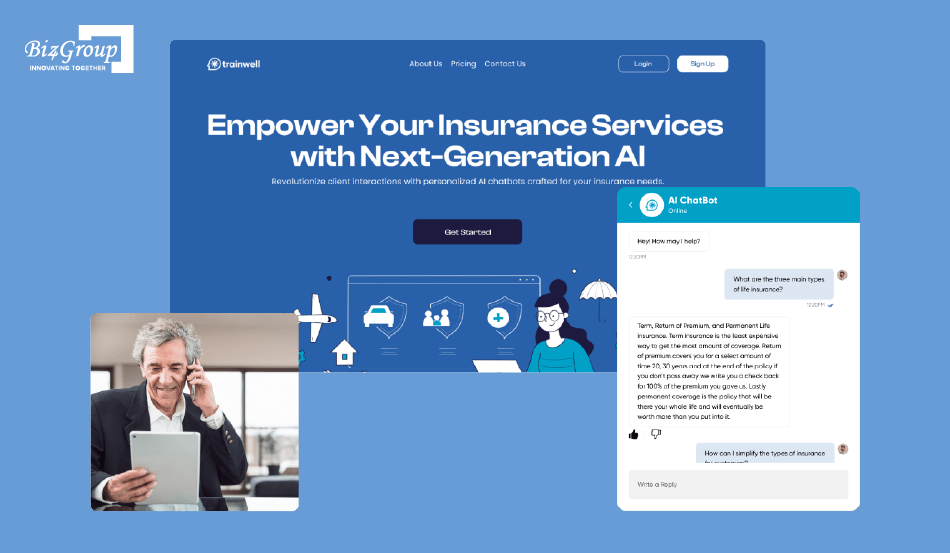
While developing Insurance AI, a custom enterprise training assistant for insurance professionals, one of the key objectives was ensuring agents could access accurate answers without relying on constant live training sessions.
At first glance, the challenge seemed straightforward. Train the system on insurance documentation
and allow agents to ask questions.
The reality was far more complex.
The project revealed three common production risks that affect many enterprise AI deployments:
|
Challenge |
Potential Hallucination Risk |
|---|---|
|
Large volumes of training documents |
Important information becomes difficult to surface consistently |
|
Frequent policy updates |
Older information can influence responses |
|
Repetitive user questions phrased differently |
Context interpretation becomes more difficult |
To address these issues, Biz4Group implemented structured document management, controlled knowledge updates, and a feedback-driven improvement process that allowed administrators to continuously refine the system's performance.
This experience reinforced an important lesson... The quality of enterprise AI outputs depends heavily on the quality, structure, and maintenance of the business knowledge supporting them.
Organizations exploring custom solutions through an experienced AI chatbot development company often discover that knowledge architecture has a greater influence on reliability than model selection alone.
Why Production Complexity Amplifies Hallucinations
The following pattern appears repeatedly across enterprise deployments.
|
Testing Environment |
Production Environment |
|---|---|
|
Limited users |
Thousands of users |
|
Predictable questions |
Unpredictable questions |
|
Clean data |
Mixed-quality data |
|
Controlled scenarios |
Real-world scenarios |
|
Stable information |
Constantly changing information |
Many systems perform well during demonstrations because they operate inside a simplified environment.
Production deployments introduce complexity at every level. That complexity creates more opportunities for false information generation.
The Common Thread Across Most Enterprise Hallucination Incidents
After reviewing numerous enterprise deployments, one observation that consistently stands out is that the majority of AI hallucination causes enterprise software teams encounter are not caused by a lack of AI capability. They stem from gaps between business knowledge and AI access to that knowledge.
When information is incomplete, inconsistent, difficult to retrieve, or rapidly changing, the probability of hallucinations increases.
Understanding these production conditions is the foundation of any effective enterprise generative AI hallucination solutions strategy.
The next logical question is even more important... Once hallucinations begin appearing in production, what do they actually cost an organization?
Why Are AI Hallucination Costs Enterprise Organizations Cannot Afford to Ignore
Now, how much do AI hallucinations cost enterprise organizations annually and what financial damage do they create across business operations?
When conversations about AI hallucinations happen inside the boardroom, the discussion rarely
starts with model accuracy.
It starts with money.
Enterprise leaders want to know how much risk exists today, how much it could cost tomorrow, and whether that exposure is growing faster than their ability to control it.
AI hallucinations in financial analysis tools contributed to $2.3 billion in avoidable trading losses in Q1 2026 alone, according to TechCrunch/SEC data. That figure alone makes one thing clear. Hallucinations are no longer isolated technical incidents. They have become a measurable business expense.
Where Does the Money Actually Go
Many organizations assume the biggest financial impact comes from one catastrophic failure. In reality, costs accumulate across multiple areas long before a headline-worthy incident occurs.
|
Cost Category |
Estimated Global Impact |
Primary Cost Drivers |
|---|---|---|
|
Direct financial losses |
$18.2 billion |
Incorrect decisions, contract errors, compensation payouts |
|
Operational cleanup |
$21.5 billion |
Investigation, rework, verification, remediation |
|
Reputational damage |
$27.7 billion |
Client churn, trust erosion, reduced adoption |
|
Total |
$67.4 billion |
Combined enterprise impact |
Notice something interesting.
The largest category is not direct financial loss. It is the
long-term cost of damaged trust.
Once confidence in an AI system declines, organizations often face additional spending on audits, reviews, retraining programs, and adoption recovery efforts.
The Hidden Cost Most Enterprises Never Budget For
Many AI deployments create a second expense that rarely appears in business cases... Verification
labor.
Knowledge workers increasingly spend time checking AI-generated outputs before using
them.
Current estimates suggest employees spend approximately 4.3 hours every week validating AI responses, translating to roughly $14,200 per employee annually in verification-related productivity costs.
The scale becomes substantial very quickly.
|
Organization Size |
Annual Verification Cost |
|---|---|
|
100 employees |
$1.42 million |
|
500 employees |
$7.1 million |
|
1,000 employees |
$14.2 million |
|
5,000 employees |
$71 million |
These costs occur even when hallucinations never reach customers. Simply checking whether information is accurate carries a significant operational price tag.
The Cost of a Single Hallucination Incident
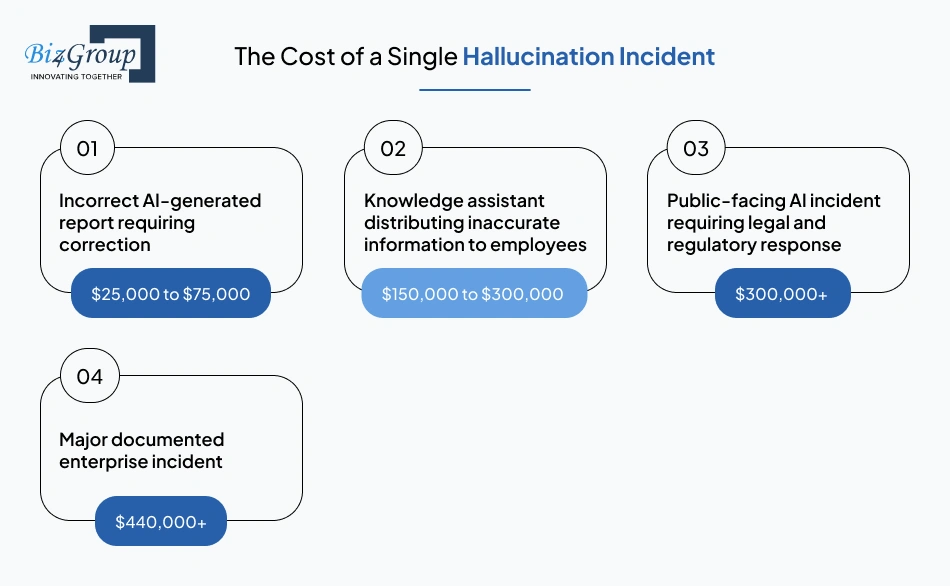
Not every hallucination creates a multimillion-dollar crisis. Many incidents start small.
Unfortunately, even small incidents become expensive once remediation begins.
The following ranges are commonly seen across enterprise environments:
|
Incident Type |
Estimated Cost Range |
|---|---|
|
Incorrect AI-generated report requiring correction |
$25,000 to $75,000 |
|
Knowledge assistant distributing inaccurate information to employees |
$150,000 to $300,000 |
|
Public-facing AI incident requiring legal and regulatory response |
$300,000+ |
|
Major documented enterprise incident |
$440,000+ |
The financial impact often extends far beyond the original mistake. Organizations must investigate what happened, determine who was affected, correct outputs, communicate with stakeholders, and document remediation efforts.
When Decision-Making Becomes the Cost Multiplier
A hallucination does not need to reach a customer to become expensive. It only needs to influence a decision.
Examples include:
- Approving an incorrect recommendation
- Acting on inaccurate operational guidance
- Using fabricated research in planning discussions
- Relying on unsupported business insights
Every decision influenced by false information creates a new layer of financial exposure.
Calculate Your Annual Hallucination Exposure
Enterprise leaders often ask a simple question... "How much is this problem costing us right
now?"
The following framework provides a practical starting point.
Annual Hallucination Exposure = Daily Query Volume × Hallucination Rate × Average Downstream Error Cost × (1 − Detection Rate)
Example:
|
Metric |
Value |
|---|---|
|
Daily AI queries |
500 |
|
Hallucination rate |
15% |
|
Average downstream error cost |
$5,000 |
|
Detection rate |
60% |
|
Annual exposure |
$150,000 |
The exact numbers will vary.
The objective is not precision. The objective is visibility.
Most organizations already
measure operational risk, cybersecurity risk, and compliance risk. AI hallucination exposure
deserves the same level of scrutiny.
The Cost Question Every Executive Team Should Ask
Before approving another AI rollout, expanding an internal assistant, or launching a customer-facing AI experience, leadership teams should ask one question:
What is the financial impact of false information generated at scale?
That question becomes especially important when organizations expand AI across automation workflows, customer interactions, and knowledge management initiatives supported through modern AI automation services and advanced AI product development services.
The organizations that answer that question early often avoid the largest remediation costs later.
Quick Cost Snapshot
|
Metric |
Enterprise Impact |
|---|---|
|
Global hallucination losses |
$67.4 billion |
|
Verification cost per employee |
$14,200 annually |
|
Enterprise users acting on hallucinated content |
47% |
|
Typical incident cost |
$25,000 to $440,000+ |
|
Largest cost category |
Reputational damage |
The financial reality is straightforward... Hallucinations create costs whether they are detected or not. The only difference is when the invoice arrives.
Is Fixing Your AI Cheaper Than Letting It Keep Making Mistakes?
Many enterprises discover that one hallucination incident costs more than the investment required to prevent future ones. Calculate your potential ROI before the next error arrives.
Estimate My AI InvestmentWhich Industries Face the Highest AI Hallucination Risk Enterprise Applications Challenges
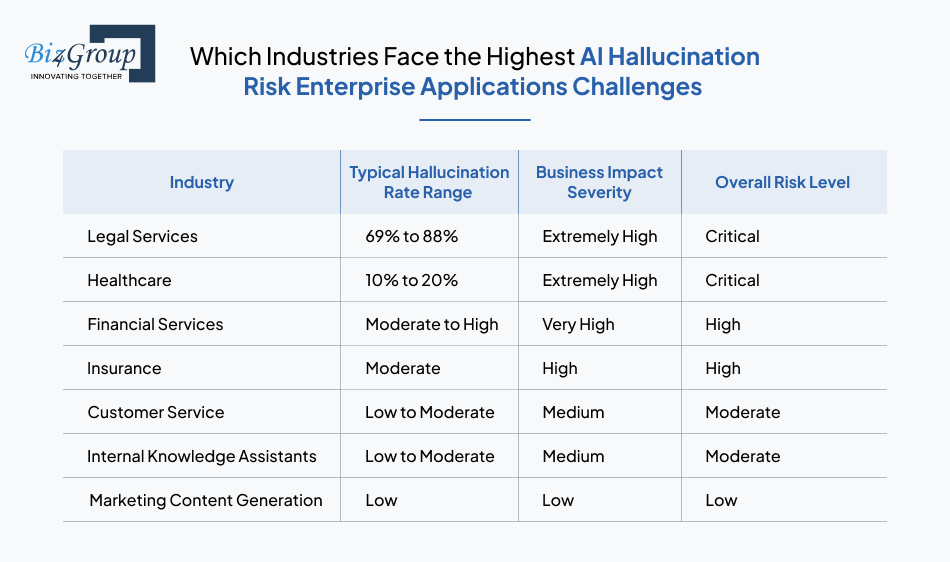
For those thinking, “Which enterprise AI use cases have the highest hallucination rates and where
should organizations focus their risk management efforts first?”
Not every hallucination
carries the same level of risk.
An incorrect movie recommendation and an incorrect legal citation may both be hallucinations, but the business consequences are worlds apart.
For enterprise leaders, the more important question is not whether hallucinations happen. It is where they create the greatest damage when they do happen.
The answer depends largely on two factors:
- The accuracy requirements of the industry
- The consequences of acting on incorrect information
Industry Hallucination Risk Comparison
The table below highlights how hallucination risk differs across common enterprise AI deployments.
|
Industry |
Typical Hallucination Rate Range |
Business Impact Severity |
Overall Risk Level |
|---|---|---|---|
|
Legal Services |
69% to 88% |
Extremely High |
Critical |
|
Healthcare |
10% to 20% |
Extremely High |
Critical |
|
Financial Services |
Moderate to High |
Very High |
High |
|
Insurance |
Moderate |
High |
High |
|
Customer Service |
Low to Moderate |
Medium |
Moderate |
|
Internal Knowledge Assistants |
Low to Moderate |
Medium |
Moderate |
|
Marketing Content Generation |
Low |
Low |
Low |
The highest-risk industries are not necessarily those with the highest hallucination frequency. They are the industries where even a single incorrect answer can trigger serious consequences.
Legal AI Faces the Greatest Exposure
Legal environments operate with little tolerance for factual inaccuracies. AI systems supporting legal research, contract analysis, compliance reviews, or case preparation frequently interact with highly specialized information.
Small factual errors can quickly become major problems.
Common legal AI applications include:
- Contract review
- Legal research
- Regulatory interpretation
- Due diligence support
- Litigation preparation
Because legal professionals often require precise references, citations, and statutory interpretation, hallucinated information becomes particularly dangerous in this environment.
Healthcare Carries the Highest Consequence Risk
Hallucination rates in healthcare may be lower than legal applications, but the potential consequences are far greater.
Healthcare AI frequently supports:
- Clinical documentation
- Patient communication
- Administrative workflows
- Treatment information retrieval
- Care coordination
An inaccurate recommendation, omitted detail, or fabricated medical reference can directly affect patient outcomes.
Financial Services Operate Under Continuous Scrutiny
Financial institutions increasingly deploy AI across customer support, compliance operations, internal research, and reporting workflows.
Accuracy matters because financial information influences:
- Customer decisions
- Regulatory obligations
- Investment activity
- Risk assessments
Even minor inaccuracies can create downstream business consequences when financial information is distributed at scale.
Insurance Organizations Face Unique Knowledge Risks
Insurance companies rely heavily on policy documentation, coverage rules, underwriting guidelines, and regulatory requirements. These environments contain large volumes of specialized information that change frequently.
AI deployments commonly support:
- Agent training
- Claims assistance
- Policy research
- Customer support
- Internal knowledge management
The challenge is not always the complexity of the information. It is the sheer volume of information that must remain accurate, accessible, and current.
Lower-Risk Industries Are Not Risk-Free
Some organizations assume customer service and internal productivity tools create minimal
hallucination exposure.
That assumption can be misleading.
While individual errors may carry lower impact, these systems often operate at enormous scale.
Examples include:
- Employee knowledge assistants
- Internal search tools
- HR support systems
- Customer service chatbots
A lower-risk error repeated thousands of times can still create significant operational disruption. Scale changes the equation.
Hallucination Risk Is Better Measured by Impact Than Frequency
One of the most common mistakes organizations make is focusing exclusively on hallucination rates. A more useful framework combines frequency and consequence.
|
Risk Factor |
Key Question |
|---|---|
|
Frequency |
How often can hallucinations occur? |
|
Exposure |
How many people interact with the system? |
|
Consequence |
What happens if the information is wrong? |
|
Recoverability |
How easily can the mistake be corrected? |
Industries with high consequence scores generally require stronger safeguards than industries with higher frequency but lower business impact.
Understanding which industries face the highest risk is important. Understanding why those risks
occur is even more important.
That is where the conversation shifts from industry exposure to
architecture.
Why Does RAG Reduce AI Hallucinations Enterprise Systems but Still Fail in Production
Do you think RAG is enough to prevent AI hallucinations in enterprise applications, or are there limitations organizations should know about?
If AI hallucinations are one of the biggest challenges facing enterprises, Retrieval-Augmented Generation, better known as RAG, is often presented as the answer.
There is a good reason for that.
Instead of relying solely on what the model learned during training, RAG allows AI systems to retrieve information from external knowledge sources before generating a response. This significantly improves factual grounding and reduces the likelihood of fabricated answers.
In fact, studies
show that RAG can reduce hallucinations by as much as 71% in many enterprise use cases.
The
important word here is "reduce." Not eliminate.
What RAG Actually Solves
Traditional language models generate responses based on patterns learned during training. RAG changes that process by introducing a retrieval step.
A simplified workflow looks like this:
|
Standard LLM |
RAG-Based System |
|---|---|
|
Generates from training knowledge |
Retrieves current business information first |
|
Limited by training cutoff |
Can access updated knowledge sources |
|
Higher chance of unsupported responses |
Better factual grounding |
|
Less visibility into information origin |
Responses tied to retrieved content |
This is why RAG has become a core component of many enterprise generative AI hallucination solutions.
Why RAG Still Struggles in Production
Many organizations deploy RAG expecting hallucinations to disappear. Production environments quickly reveal otherwise.
The challenge is simple... RAG only improves the information available to the model.
It does
not guarantee the model will use that information perfectly.
Several situations can still create inaccurate outputs:
- Irrelevant information gets retrieved
- Multiple documents provide competing answers
- Critical information is missing from the knowledge source
- Retrieved content lacks enough context
- The model incorrectly interprets retrieved information
When any of these occur, hallucinations can still appear despite having a retrieval layer.
The Remaining 29 Percent Problem
This creates what many AI teams call the "remaining 29 percent problem."
If retrieval reduces hallucinations significantly but not completely, organizations must account for the residual risk that remains after implementation.
|
Question |
Reality |
|---|---|
|
Does RAG improve accuracy? |
Yes |
|
Does RAG reduce hallucinations? |
Yes |
|
Does RAG guarantee factual responses? |
No |
|
Can RAG eliminate enterprise risk? |
No |
That distinction becomes important when evaluating enterprise LLM hallucination problem
solutions.
A retrieval layer improves reliability. It should never be treated as a guarantee
of correctness.
Why RAG Remains Essential Despite Its Limitations
Despite these limitations, RAG remains one of the most effective approaches available today for organizations looking to reduce AI hallucinations enterprise systems face at scale.
Without retrieval, enterprise AI often lacks access to current organizational knowledge.
With
retrieval, it gains access to relevant information but still requires additional safeguards.
This is one reason organizations building advanced AI products through an experienced AI app development company increasingly view RAG as a foundation rather than a complete solution.
RAG significantly improves the quality of enterprise AI outputs. The next challenge is determining how organizations identify the hallucinations that still manage to slip through.
RAG Reduced the Risk. What About the Remaining 29%?
Most enterprise teams stop at retrieval. The smartest ones prepare for the failures retrieval cannot catch.
See My Risk GapsHow Do Enterprise Organizations Detect AI Hallucinations Before They Reach End Users and What Automated Monitoring Systems Identify False Information Generation in Production AI Applications
Many businesses question, “How do we detect hallucinations in production before users see them and what monitoring systems should we implement?”
Detecting hallucinations after a customer, employee, or stakeholder spots them is already too late. The most mature enterprise AI teams focus on identifying suspicious outputs before they spread through business workflows.
That requires visibility into how AI systems behave in production, not only how they perform during testing.
What Does Hallucination Detection Actually Look Like
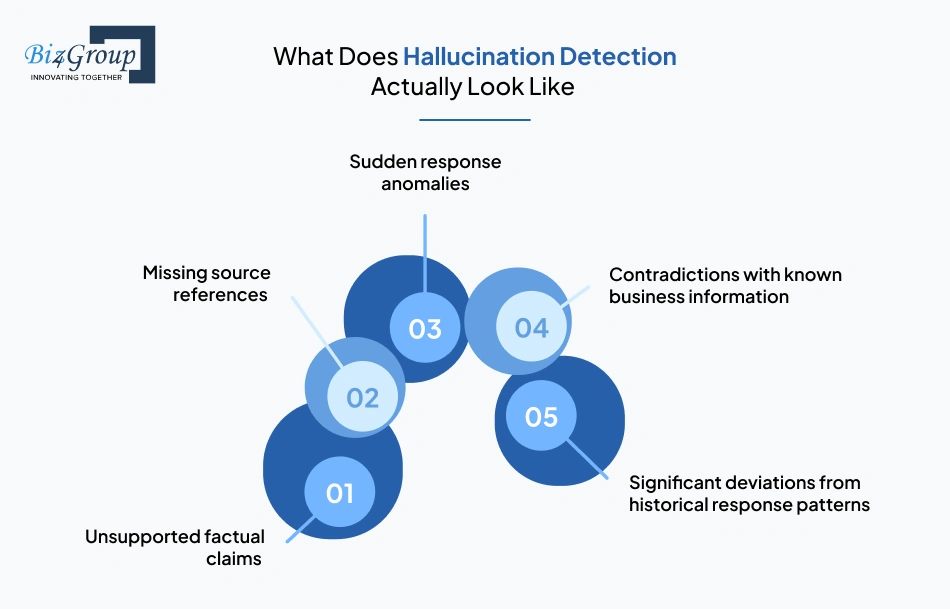
Many organizations imagine hallucination detection as a simple pass-or-fail check. In practice, it involves continuously monitoring signals that suggest an output may be unreliable.
Common indicators include:
- Unsupported factual claims
- Missing source references
- Sudden response anomalies
- Contradictions with known business information
- Significant deviations from historical response patterns
Rather than looking for one warning sign, enterprises monitor multiple signals simultaneously.
Key Monitoring Layers Used in Production
The most effective AI hallucination detection enterprise applications strategies combine several monitoring layers.
|
Monitoring Layer |
Purpose |
|---|---|
|
Response validation |
Checks whether outputs align with approved knowledge sources |
|
Citation tracking |
Verifies source references exist and are relevant |
|
Consistency analysis |
Identifies conflicting answers to similar questions |
|
User feedback monitoring |
Flags responses frequently reported as inaccurate |
|
Behavioral analytics |
Detects unusual response patterns over time |
Together, these layers help organizations identify hallucinations that might otherwise go unnoticed.
Why User Feedback Remains One of the Most Valuable Signals
Automated systems are powerful. Users often spot issues first.
That is why many enterprise AI
teams build structured feedback loops directly into their applications.
A simple rating mechanism can reveal patterns that automated monitoring may miss. Examples include:
- Repeated complaints about specific topics
- Consistently low-rated responses
- Areas where users frequently request clarification
- Questions requiring repeated escalation
Over time, this feedback becomes a valuable source of operational intelligence.
How Biz4Group Applied This Approach in Practice
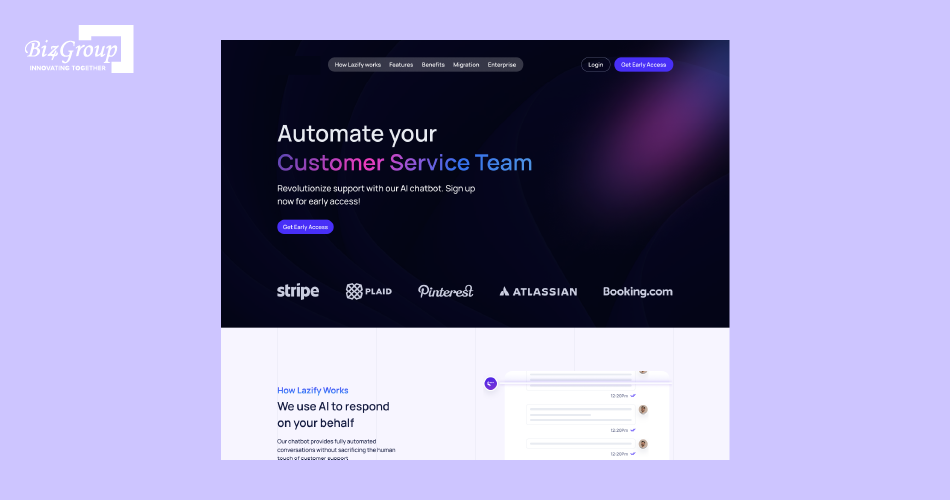
While developing an AI-powered customer support assistant, one priority was ensuring the chatbot could handle complex customer conversations without sacrificing response quality.
The chatbot was trained to learn from historical human-agent interactions and adapt responses dynamically across scenarios such as:
- Refund requests
- Subscription modifications
- Payment-related issues
- Escalation-driven conversations
Because customer support environments generate large volumes of conversations daily, feedback became an essential monitoring mechanism.
The system continuously collected interaction insights, allowing teams to identify patterns, improve response quality, and refine how the chatbot handled future conversations. This approach helped transform customer conversations into an ongoing feedback source rather than treating monitoring as a separate process.
Metrics Worth Tracking
Many organizations track adoption metrics but overlook reliability metrics. For production AI systems, the following indicators often provide more value:
|
Metric |
What It Reveals |
|---|---|
|
Response dispute rate |
How often users challenge outputs |
|
Escalation frequency |
How often conversations require human intervention |
|
Feedback score trends |
Long-term output quality patterns |
|
Repeat question rate |
Whether users trust initial responses |
|
Source utilization rate |
How frequently outputs rely on approved knowledge |
Monitoring these metrics helps organizations identify emerging issues before they become widespread operational problems.
The next step is determining which prevention strategies reduce the likelihood of hallucinations appearing in the first place.
Which Enterprise AI Hallucination Prevention Strategies Deliver the Highest Accuracy Improvements
What are the most effective ways to prevent AI hallucinations in enterprise applications without sacrificing usability and adoption?
By the time hallucinations appear in production, the damage has often already started. The better approach is prevention.
While no organization can eliminate hallucinations entirely, certain strategies consistently produce better accuracy outcomes than others. The key is focusing on prevention techniques that improve information quality before responses are generated.
Not All Prevention Strategies Deliver Equal Results
Many organizations invest heavily in AI improvements without understanding which initiatives create the greatest impact.
The table below provides a practical comparison.
|
Prevention Strategy |
Accuracy Improvement Potential |
Implementation Complexity |
Enterprise Adoption |
|---|---|---|---|
|
High-quality knowledge management |
High |
Medium |
Very High |
|
Structured data governance |
High |
Medium |
High |
|
Domain-specific model customization |
Medium to High |
High |
Medium |
|
Prompt standardization |
Medium |
Low |
High |
|
Query refinement workflows |
Medium |
Medium |
Medium |
|
User education and training |
Low to Medium |
Low |
High |
The highest-performing strategies focus on improving information quality instead of attempting to correct outputs after generation.
Four Prevention Principles Used by Leading Enterprises
Rather than relying on isolated tactics, mature organizations typically follow a combination of prevention principles.
1. Reduce Information Ambiguity
AI performs better when business information is clear, consistent, and well organized.
This includes:
- Standardized terminology
- Consistent documentation
- Clearly defined business rules
- Controlled content updates
Less ambiguity often leads to more reliable outputs.
2. Design for Specific Business Domains
General-purpose systems perform reasonably well across many tasks. Enterprise applications often require deeper specialization.
Organizations operating in regulated or knowledge-intensive environments frequently benefit from solutions designed around their specific industry requirements.
3. Improve Input Quality
The quality of user questions influences the quality of AI responses. Many organizations now guide users through structured input flows that reduce ambiguity before requests reach the model.
Strong user experiences developed by an experienced UI/UX design company can significantly improve the clarity of information entering the system.
Also read: Top 15 UI/UX design companies in USA
4. Continuously Refine Knowledge Assets
Enterprise knowledge evolves constantly. Successful organizations treat business knowledge as a living asset.
Regular reviews help maintain accuracy as products, policies, and procedures change.
Enterprise AI Hallucination Prevention Strategies Ranked by Long-Term Value
|
Strategy |
Short-Term Impact |
Long-Term Value |
|---|---|---|
|
Prompt optimization |
Moderate |
Moderate |
|
Knowledge quality improvements |
High |
Very High |
|
Domain customization |
High |
High |
|
User workflow optimization |
Moderate |
High |
|
Governance of business content |
High |
Very High |
The strongest long-term gains typically come from improving the information ecosystem surrounding AI, not just focusing exclusively on the model itself.
Prevention Starts Long Before Deployment
One reason many organizations struggle with hallucinations is that prevention efforts begin after
launch.
The most successful projects address accuracy requirements much earlier.
Teams building AI products through experienced generative AI development company often integrate accuracy objectives directly into the planning and design process.
A Practical Takeaway
The most effective enterprise AI hallucination prevention strategies improve the quality of information entering and surrounding the AI system.
Organizations that focus solely on model performance often see incremental gains.
Organizations that improve the broader ecosystem supporting AI typically achieve the greatest
enterprise AI accuracy hallucination reduction over time.
Prevention reduces risk.
The next step is understanding how organizations systematically address hallucinations that still remain despite those prevention efforts.
Prevention Costs Less Than Remediation. Every Time.
The best time to address hallucinations is before customers, auditors, or executives discover them for you.
Build a Safer AI StackHow Can Organizations Fix AI Hallucinations Enterprise Software Without Slowing Down Business Operations
Founders often ask, “How can we reduce hallucinations without adding manual reviews to every AI response?”
One of the biggest concerns enterprise leaders have is speed. Many organizations discover hallucination risks and immediately consider adding more approvals, more reviews, and more checkpoints.
The problem is if every AI output requires human validation, much of the productivity gain
disappears.
The goal is not to choose between speed and accuracy. The goal is to improve
both.
Why Some Fixes Create New Problems
Certain approaches reduce hallucinations but introduce operational friction.
|
Approach |
Impact on Accuracy |
Impact on Productivity |
|---|---|---|
|
Manual review of every response |
High |
Very Low |
|
Selective review workflows |
High |
Moderate |
|
Workflow-level controls |
Medium to High |
High |
|
Automated quality controls |
High |
High |
The most successful organizations focus on improvements that strengthen reliability while preserving workflow efficiency.
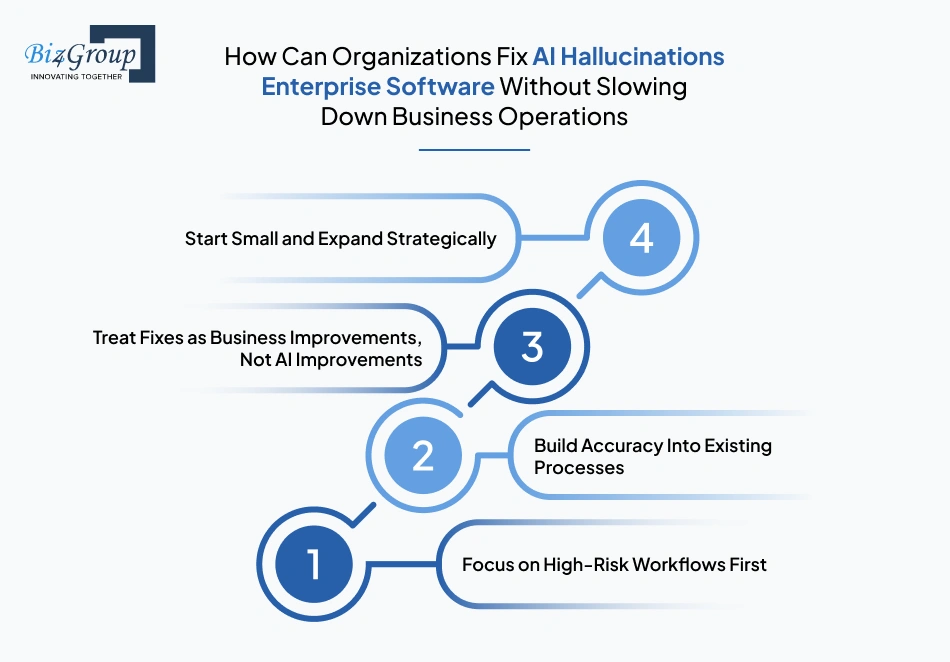
Focus on High-Risk Workflows First
Not every AI interaction requires the same level of attention. A common mistake is applying identical controls across every use case.
Organizations typically achieve better results by prioritizing areas where inaccurate information creates the greatest business impact.
Examples include:
- Customer-facing recommendations
- Regulatory communications
- Policy interpretation
- Financial reporting support
- Executive decision-support systems
This targeted approach helps teams allocate resources more effectively.
Build Accuracy Into Existing Processes
Many enterprises attempt to solve hallucinations by creating entirely new review processes. A more sustainable approach is embedding quality safeguards into workflows employees already use.
For example:
|
Existing Workflow |
Accuracy Improvement Opportunity |
|---|---|
|
Customer support process |
Escalation triggers for sensitive requests |
|
Internal knowledge systems |
Content ownership and approval cycles |
|
Operational reporting |
Source verification checkpoints |
|
Policy management |
Controlled document publication workflows |
Organizations often see stronger adoption when improvements fit naturally into existing business operations.
Treat Fixes as Business Improvements, Not AI Improvements
Hallucination reduction initiatives are most successful when they align with broader business goals.
This includes:
- Improving knowledge quality
- Reducing process ambiguity
- Standardizing information sources
- Strengthening content governance
Many of these improvements create benefits that extend well beyond AI performance.
Start Small and Expand Strategically
Large-scale remediation programs often struggle because they attempt to solve everything simultaneously.
Many organizations begin with:
- A single high-value workflow
- A focused AI use case
- A limited group of users
- Measurable success criteria
This phased approach creates faster learning cycles and reduces implementation risk.
Teams launching new AI initiatives through structured MVP development services frequently use this approach to validate accuracy improvements before scaling across the organization.
Also read: Top 12+ MVP development companies in USA
What Effective Remediation Looks Like
The strongest fix AI hallucinations enterprise software initiatives share three characteristics:
|
Characteristic |
Outcome |
|---|---|
|
Minimal workflow disruption |
Strong user adoption |
|
Measurable accuracy gains |
Improved trust |
|
Scalable implementation model |
Faster expansion across teams |
So basically, organizations that focus exclusively on restrictions often slow down
operations.
Organizations that focus on workflow-aligned improvements tend to achieve more
sustainable results.
How Should Enterprise Organizations Develop an AI Hallucination Risk Management Strategy That Protects Against the Financial Legal and Reputational Consequences of False Information Generation
Now, what should an enterprise AI hallucination risk management strategy include to satisfy executives, legal teams, and compliance stakeholders?
Most organizations begin their hallucination journey by focusing on technology. Eventually, leadership teams realize a larger challenge exists.
Risk cannot be managed application by application. It must be managed across the organization. That is where a formal AI hallucination risk enterprise applications strategy becomes essential.
What an Enterprise Risk Management Strategy Should Cover
A strong strategy creates consistency. Without it, every department develops its own standards, processes, and tolerance levels. The result is fragmented risk management.
A stronger approach defines expectations across the enterprise.
|
Risk Area |
Key Question |
|---|---|
|
Ownership |
Who is accountable for AI-generated information? |
|
Escalation |
What happens when a hallucination is discovered? |
|
Reporting |
Which incidents must be reported to leadership? |
|
Documentation |
How are incidents recorded and reviewed? |
|
Accountability |
Who approves corrective actions? |
These questions may seem operational. In reality, they determine how effectively an organization responds when problems occur.
Classify AI Systems by Business Risk
Not every AI application deserves identical oversight. A meeting assistant and a regulatory guidance system operate under very different risk profiles.
Many organizations categorize AI systems into tiers.
|
Risk Tier |
Example Applications |
|---|---|
|
Low Risk |
Internal productivity tools |
|
Moderate Risk |
Employee knowledge assistants |
|
High Risk |
Customer-facing support systems |
|
Critical Risk |
Financial, legal, healthcare, or compliance applications |
This structure helps leadership allocate resources where exposure is greatest.
Establish Clear Incident Thresholds
One of the biggest governance gaps appears when teams cannot agree on what qualifies as a reportable hallucination. Organizations should define thresholds before incidents occur.
Examples may include:
- Customer-impacting misinformation
- Incorrect regulatory guidance
- Executive decision-support errors
- Contract or policy misrepresentation
- Public-facing inaccuracies
Predefined thresholds reduce confusion during high-pressure situations.
Create a Hallucination Risk Register
Most enterprises already maintain:
- Cybersecurity risk registers
- Vendor risk registers
- Compliance risk registers
AI deserves similar treatment.
A hallucination risk register helps organizations track:
|
Category |
Example Entry |
|---|---|
|
System name |
Customer Support Assistant |
|
Risk level |
High |
|
Potential impact |
Customer misinformation |
|
Mitigation owner |
AI Governance Team |
|
Review frequency |
Quarterly |
This creates visibility at both operational and executive levels.
Measure Trends, Not Individual Events
A single incident rarely tells the full story. Risk leaders often focus on patterns.
Questions worth asking include:
- Are incidents increasing?
- Are specific departments affected more often?
- Are certain applications generating repeated issues?
- Are remediation efforts reducing recurrence?
Trend analysis provides a clearer picture of organizational exposure over time.
What Mature Organizations Do Differently
Organizations with strong enterprise AI hallucination problem solutions programs tend to share several characteristics.
They:
- Assign clear ownership.
- Define escalation procedures.
- Maintain risk documentation.
- Review incidents regularly.
- Track long-term trends.
These practices help transform hallucination management from a reactive exercise into a repeatable business process.
The Bigger Objective
The goal of a risk management strategy is not to eliminate every hallucination. The goal is ensuring the organization knows:
- Where risk exists
- Who owns it
- How it is monitored
- How it is addressed when it appears
Once those foundations are in place, enterprise leaders gain something that technology alone cannot provide.
Control.
Would Your Board Be Comfortable Reviewing Your AI Risk Plan Today?
If that question feels uncomfortable, it may be time for a conversation. Our AI strategists help enterprises identify risk blind spots before they become business problems.
Call an AI StrategistCan Enterprise AI Accuracy Hallucination Reduction Ever Reach Zero
Now, do you think AI hallucinations can ever be completely eliminated, or should enterprises focus on reducing them to acceptable levels?
If enough safeguards, monitoring systems, and controls are implemented, can hallucinations disappear entirely?
The short answer is no.
Current large language models generate responses by predicting probabilities. They do not possess an intrinsic understanding of truth, facts, or certainty. Because of this fundamental characteristic, hallucinations remain an inherent possibility.
Why Zero Hallucinations Remains Unrealistic
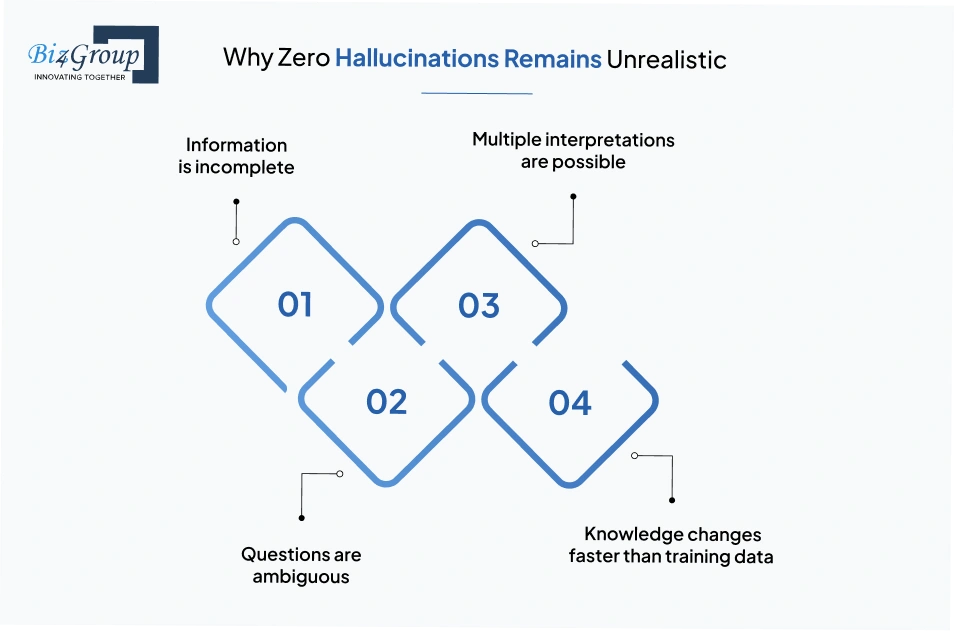
Even highly advanced AI systems face situations where:
- Information is incomplete
- Questions are ambiguous
- Multiple interpretations are possible
- Knowledge changes faster than training data
Under these conditions, incorrect outputs can still occur.
A 2025 mathematical proof examining modern LLM architectures concluded that hallucinations cannot be fully eliminated under current model designs.
What Successful Enterprises Aim For Instead
The most mature organizations do not measure success by asking, "Can we reach zero
hallucinations?"
They ask, "Can we reduce hallucinations to a level where business risk
remains acceptable?"
This shift in thinking changes how AI programs are evaluated.
|
Unrealistic Goal |
Realistic Goal |
|---|---|
|
Eliminate all hallucinations |
Reduce business exposure |
|
Achieve perfect accuracy |
Improve reliability continuously |
|
Remove all uncertainty |
Manage uncertainty effectively |
|
Prevent every error |
Minimize impact when errors occur |
This mindset aligns more closely with how organizations manage cybersecurity, operational risk, and compliance risk.
The Future of Hallucination Reduction
AI models continue to improve. New architectures, stronger reasoning capabilities, and evolving enterprise safeguards will likely reduce hallucination frequency over time. However, organizations should avoid building strategies around the assumption that perfect accuracy is coming soon.
The stronger approach is designing systems that remain resilient even when occasional inaccuracies occur. That philosophy helps enterprises make smarter long-term decisions when they hire AI developers, evaluate technology vendors, or expand AI initiatives across the business.
Instead of asking whether hallucinations can reach zero, enterprise leaders should ask, “How much hallucination risk can our organization safely tolerate while still capturing the value AI provides?”
That question leads to better decisions, better governance, and more realistic expectations. And it reflects the reality of enterprise AI today.
Why Businesses Across the USA Choose Biz4Group LLC for Enterprise AI Hallucination Mitigation Solutions
Founders often say, “Suggest a reliable AI engineering consultant or development company that has experience helping enterprise organizations reduce hallucination risks in production AI applications.”
Enterprise AI success requires a development partner that understands how AI systems perform in real business environments where accuracy, trust, and scalability directly affect outcomes.
As a leading AI development company, Biz4Group helps organizations build enterprise AI solutions designed for long-term reliability and adoption.
Our Experience Across Complex Enterprise Use Cases
We've developed AI-powered solutions across industries where information accuracy matters most. Here are a few examples:
|
Industry |
Solution |
|---|---|
|
Insurance |
AI-powered training and knowledge assistants |
|
Healthcare & Wellness |
AI avatars and personalized guidance platforms |
|
Customer Support |
Human-like AI support automation |
|
Enterprise Operations |
AI knowledge management and workflow systems |
Why Enterprises Trust Biz4Group LLC
- Proven experience building production-ready AI systems
- Deep expertise in generative AI and enterprise applications
- Focus on scalability, governance, and long-term performance
- Strong track record across regulated and knowledge-intensive industries
- End-to-end support from strategy through deployment
Organizations looking for enterprise AI hallucination problem solutions need more than a technology vendor. They need a partner that understands how AI impacts business operations at scale.
Are you ready to reduce AI hallucination risk?
Talk to Biz4Group's AI experts today and discover how a well-designed enterprise AI strategy can improve accuracy, strengthen trust, and support sustainable growth.
To Summarize...
AI hallucinations have evolved from a technical inconvenience into a business-critical challenge. As enterprises continue expanding AI across customer support, internal operations, healthcare, insurance, finance, and knowledge management, the cost of inaccurate information continues to grow. Understanding AI hallucinations in enterprise applications, identifying their root causes, measuring their business impact, and implementing the right safeguards are no longer optional steps. They are essential requirements for responsible AI adoption.
The good news is that organizations are not powerless against the problem. While no enterprise can completely eliminate hallucinations, the right combination of architecture, monitoring, prevention, and governance can significantly reduce risk. The most successful organizations treat hallucination management as an ongoing business discipline, not a one-time technical fix. That mindset creates stronger trust, better outcomes, and greater long-term value from AI investments.
For organizations searching for reliable enterprise AI hallucination problem solutions, Biz4Group brings years of experience building enterprise-grade AI systems across industries where accuracy, scalability, and user trust matter. As a leading USA-based software development company, we help businesses design, develop, and optimize AI solutions that are built for real-world performance, not demo environments.
Ready to build AI systems your teams and customers can trust? Connect with Biz4Group today and discover how our experts can help you fix AI hallucinations enterprise software challenges before they become costly business problems.
FAQs
1. How can enterprise leaders tell whether an AI mistake is a hallucination or a data quality issue?
The distinction lies in the source of the error. A data quality issue occurs when the AI receives inaccurate, incomplete, or outdated information and produces an incorrect response based on that data. A hallucination occurs when the AI generates information that cannot be traced back to any verified source. Identifying the difference helps organizations determine whether they need better data management or stronger AI controls.
2. Do newer AI models automatically solve enterprise hallucination problems?
Not necessarily. Newer models often improve reasoning, context handling, and language quality, but improved performance does not guarantee lower hallucination rates across every enterprise use case. Organizations should evaluate models based on real-world business requirements instead of assuming newer means more reliable.
3. What role does employee training play in reducing AI-related business risks?
Employee training remains one of the most overlooked components of AI success. Users who understand AI limitations, validation practices, and escalation procedures are more likely to identify suspicious outputs and use AI responsibly. Even the most advanced systems benefit from informed users.
4. Can small and mid-sized enterprises face the same hallucination risks as large organizations?
Yes. While large enterprises typically process higher volumes of AI interactions, small and mid-sized businesses often have fewer resources available for oversight and remediation. A single inaccurate AI-generated recommendation can have a significant operational or financial impact regardless of company size.
5. How often should enterprises review and update their AI governance policies?
Most organizations review AI governance policies quarterly or whenever significant changes occur in regulations, business processes, or AI deployments. Regular reviews help ensure governance frameworks remain aligned with evolving business objectives and risk requirements.
6. What are the warning signs that an enterprise AI deployment needs immediate attention?
Common indicators include declining user trust, increasing complaint volumes, inconsistent responses across departments, rising escalation rates, and growing reliance on manual corrections. These signs often suggest deeper issues that require investigation before they affect business performance.
