 Location :
Orlando, FL, USA
Location :
Orlando, FL, USA +1 (407) 714-1616
 info@biz4group.com

- Businesses adopting AI agents automate sales in USA are reducing manual sales effort, improving pipeline efficiency, and lowering operational costs.
- Companies using AI sales agents in USA often measure ROI through faster responses, better conversions, and improved use of existing sales resources.
- Investing in AI sales automation software helps businesses scale sales operations without proportionally increasing workload or headcount.
- As organizations continue to automate sales process in USA, AI is becoming a core part of revenue operations rather than just another support tool.
- Partnering with companies like Biz4Group helps businesses build customized AI-powered sales solutions faster while reducing implementation complexity.
“I am a startup founder in USA and I cannot afford a full sales team right now, how can AI agents handle my sales pipeline on a low budget”
This is no longer a hypothetical question.
As more businesses explore how AI agents automate sales in USA, enterprises, startups and growing companies are discovering new ways to manage sales pipelines without the cost of building large sales teams. With limited budgets and increasing pressure to drive revenue, founders are looking for solutions that can help them scale sales operations efficiently while keeping operational expenses under control.
The pressure is only increasing. Industry projections suggest that nearly 80% of B2B sales interactions are expected to happen through digital channels, making faster and more scalable sales systems increasingly important.
Businesses are responding by adopting AI sales agents that go beyond simple automation. These systems qualify for leads, personalize outreach, manage follow-ups, update CRMs, and help create more efficient revenue operations. Research also shows that 74% of sales professionals believe AI is already reshaping how sales teams operate, signaling a shift toward more intelligent sales systems.
But how do AI agent systems are developed, how do they work, what does it cost to build them, and can they truly help businesses reduce costs while increasing revenue?
To answer that, let us first understand what AI sales agents actually are.
What Is an AI Agent for Sales and How AI Agents Help in Sales in USA?
AI sales agents are AI-powered software systems designed to perform sales-related tasks with minimal human intervention. Rather than functioning as another automation tool, these agents operate more like intelligent digital teammates that help businesses manage repetitive sales activities while maintaining speed, consistency, and scalability.
Now let’s see how AI agents are actually used in sales. They help sales teams stay on top of the entire pipeline without getting buried in manual work.
- Qualifying leads by understanding intent signals and engagement behavior
- Engaging customers across email, chat, and other channels in a consistent way
- Managing follow-ups so prospects stay active and don’t slip through the cracks
- Monitoring the sales pipeline to track deal progress and spot bottlenecks early
- Handling routine sales tasks that usually require significant manual effort
Unlike traditional automation that follows predefined rules, AI sales automation software can analyze information, make decisions, take actions, and adapt based on goals, customer interactions, and changing sales conditions.
The growing adoption of AI-powered sales solutions is driven by a simple goal: scale revenue operations without scaling sales teams at the same pace.
This shift also raises an important question: what types of AI sales agents are businesses actually using, and where do they create the most value?
Still treating speed-to-lead like a manual game?
Want to know how AI keeps your response time instant?
Connect with usWhat Are the Types of AI Agents That Automate Sales in USA and Where Can They Be Used?
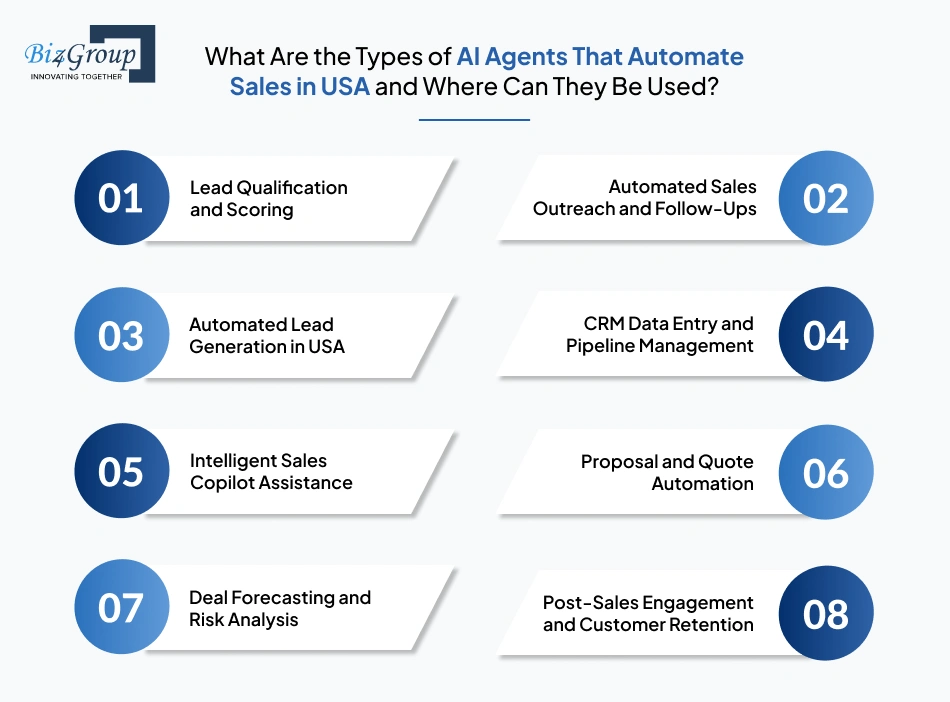
Businesses use different types of AI sales agents depending on their sales process, customer journey, and revenue goals. Some agents focus on customer acquisition, while others are designed to improve conversions, customer interactions, or revenue operations.
Here is a list of AI sales agents IN USA and common uses.
1. Lead Qualification and Scoring
AI sales agents constantly read signals from customer behavior—what people click, how they engage, what they ignore—and use that to figure out which leads are actually worth a salesperson’s time. Instead of static scoring rules, they update priority in real time as intent changes.
Common use cases:
- Lead scoring
- Intent analysis
- Opportunity prioritization
- Qualification workflows
2. Automated Sales Outreach and Follow-Ups
These agents manage conversations with prospects across email and other channels, adjusting messaging based on how people respond. The goal isn’t just sending sequences—it’s keeping every lead warm without sounding repetitive or generic.
Common use cases:
- Personalized outreach
- Email sequences
- Follow-up automation
- Multi-channel communication
3. Automated Lead Generation in USA
AI agents continuously look for new potential buyers by scanning multiple sources, then clean and enrich that data so it’s actually usable for sales teams. It’s an always-on system for building and improving the pipeline.
Common use cases:
- Prospect discovery
- Lead enrichment
- Contact research
- Pipeline generation
4. CRM Data Entry and Pipeline Management
Instead of sales reps updating systems manually, AI agents track interactions in the background and keep the CRM updated automatically. This keeps pipeline data accurate without extra effort from the team.
Common use cases:
- CRM updates
- Pipeline tracking
- Activity monitoring
- Opportunity management
5. Intelligent Sales Copilot Assistance
These agents sit alongside sales reps during calls or conversations and pull up relevant context instantly. They help reps respond better by suggesting next steps or surfacing key deal information at the right moment.
Common use cases:
- AI conversation assistance
- Next-best-action recommendations
- Context retrieval
- Sales guidance
6. Proposal and Quote Automation
AI agents take over the repetitive part of closing deals—turning requirements into structured proposals and quotes. They pull from past deals, pricing rules, and customer needs to speed up the process.
Common use cases:
- Proposal generation
- Quote creation
- Pricing assistance
- Documentation workflows
7. Deal Forecasting and Risk Analysis
Instead of relying on gut feeling, AI agents track how deals are actually moving—who’s engaging, how fast things are progressing, and where things are stalling—to predict outcomes more accurately.
Common use cases:
- Forecasting
- Risk detection
- Revenue analysis
- Pipeline monitoring
8. Post-Sales Engagement and Customer Retention
After a deal closes, AI agents keep tracking how customers use the product and whether their needs are changing. This helps catch renewal risks early and surface expansion opportunities naturally.
Common use cases:
- Renewal reminders
- Upselling opportunities
- Cross-selling workflows
- Customer engagement automation
Different businesses use different AI sales agents depending on their sales processes, customer journeys, and growth goals. Let's look at what industries are using AI sales agents IN USA today.
Why let your best deals slip through because of delays?
Find out how AI prevents missed opportunities
Connect with usWhich Industries Are Using AI Sales Agents in USA?
AI sales agents in USA are no longer limited to technology companies or early adopters. Businesses across industries are increasingly integrating AI into sales operations to handle growing customer expectations, improve responsiveness, and create more scalable revenue processes. While the challenges vary by industry, the demand for faster and more efficient sales operations is driving adoption across multiple sectors.
1. SaaS & Technology
AI sales agents in SaaS don’t wait for sales teams to notice expansion opportunities in SaaS businesses. They read product usage directly and act on it. If a team suddenly increases usage or starts adopting advanced features, the AI treats it as a buying signal and initiates an upgrade conversation immediately.
Impact: Revenue expansion becomes continuous and automated, not rep-driven.
2. Real Estate
Instead of just responding to inquiries in real estate busniess, AI learns from browsing behavior to understand intent that buyers themselves may not articulate yet. It quietly refines recommendations until only high-probability listings are shown, reducing wasted viewings.
Impact: Better matching replaces broad property search.
3. Financial Services & Banking
AI agents shift banks from offering products to anticipating financial decisions in the finance industry. They pick up early indicators—like spending shifts or account activity changes—and surface relevant financial products before customers actively search for them.
Impact: Products are offered at decision point, not after.
4. Insurance
Insurance AI continuously re-evaluates coverage fit based on customer life changes in insurance businesses. Instead of annual renewal cycles, policies are dynamically reviewed and adjusted as risk or needs evolve.
Impact: Coverage stays aligned without manual intervention.
5. Ecommerce & Retail
Every customer interaction reshapes the storefront in e-commerce industry. AI adjusts pricing, bundles, and product visibility in real time based on likelihood to purchase, not static segmentation.
Impact: Storefronts become dynamic conversion engines.
6. Manufacturing & Automotive
AI sales agents connect fragmented deal information across multiple stakeholders in manufacturing business. It detects misalignment early—like technical approval delays or procurement hesitation—and surfaces what’s blocking closure.
Impact: Sales cycles become visible and controllable.
7. Education & EdTech
Instead of treating all applicants equally, AI sales automation software continuously ranks enrollment likelihood and focuses attention where it matters in edtech businesses. It prevents drop-offs by identifying disengaged applicants early and re-engaging them with targeted outreach.
Impact: Enrollment efficiency improves without increasing outreach volume.
8. Telecommunications
AI- -powered sales solutions focuses on preventing revenue loss rather than generating new leads in telecommunication industry. It spots subtle behavioral shifts that indicate dissatisfaction and triggers targeted retention actions before churn decisions solidify.
Impact: Retention becomes predictive, not reactive.
9. Travel & Hospitality
AI sales agents in USA builds long-term traveler profiles and uses them to influence future bookings in travel businesses. It doesn’t just respond to searches—it anticipates travel intent and shapes offers around likely trips.
Impact: Booking value increases through timing and personalization.
While industries adopt AI sales agents differently, many businesses are trying to solve similar sales and operational challenges. Let's look at a real-world example to understand how AI sales agents are impactful for businesses.
Real-World Example: AI Sales Agent Developed by Biz4Group
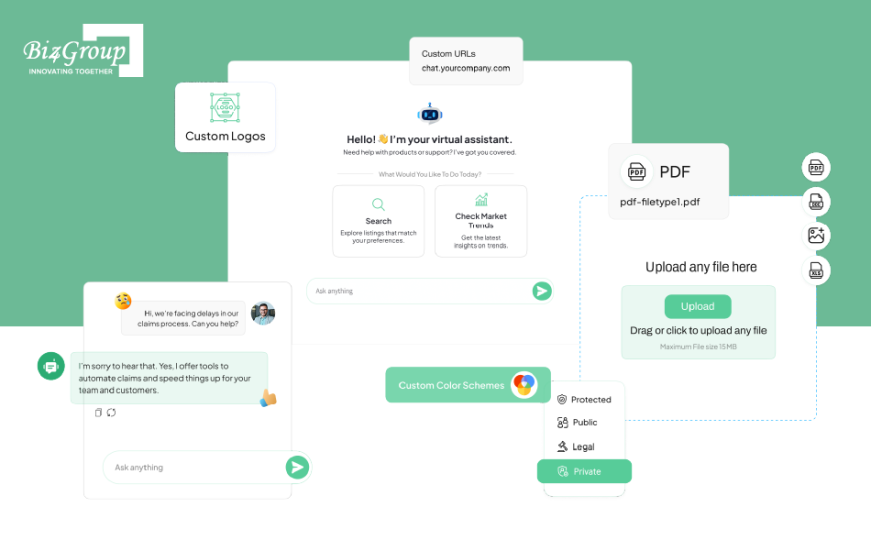
To understand what AI sales agents look like beyond theory, here is an example of an enterprise AI agent developed by Biz4Group.
The project focused on building a secure AI agent that could automate customer interactions, support internal workflows, process documents, and handle sensitive business data while maintaining strict compliance requirements.
Here is the kind of impact it created:
- Reduced manual work by automating customer support, employee inquiries, and repetitive workflows
- Improved response speed through multilingual interactions and automated engagement
- Maintained secure data handling with HIPAA and GDPR compliance support
- Worked alongside enterprise tools like Salesforce and Slack without disrupting existing workflows
- Helped businesses scale operations with customizable workflows, API integrations, and document processing capabilities
The result was simple: businesses could automate more work, improve efficiency, and scale operations without increasing operational complexity.
This example shows what AI implementation can look like in practice, but the bigger question is what problem these systems actually solve to create the most value in day-to-day sales operations .Let’s have a look at those problems to understand the need of the AI automated sales agent.
What Problems Can AI Sales Agents Solve in USA?
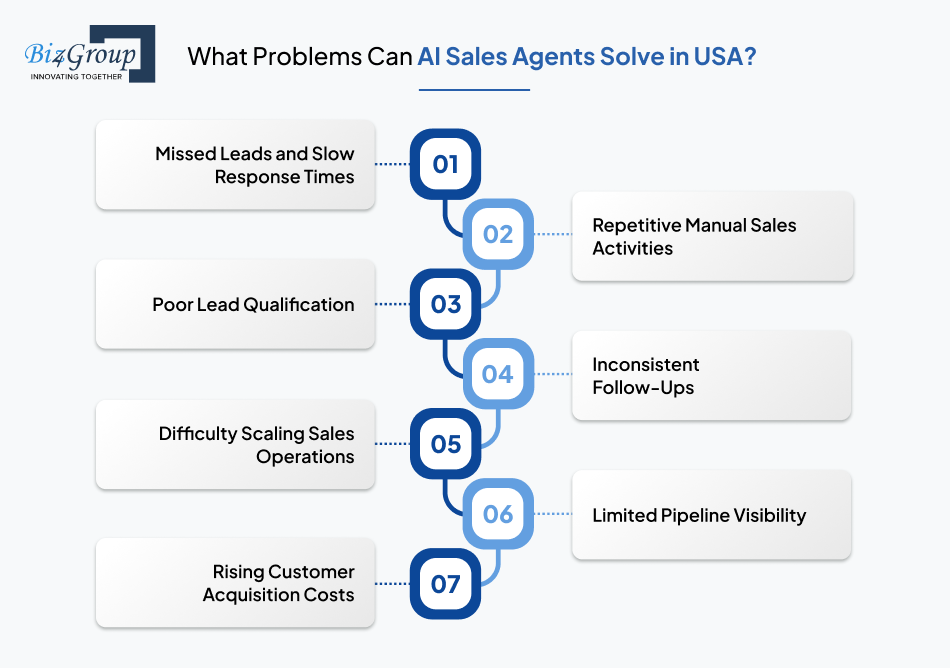
Sales teams today have more tools than ever, yet common sales problems continue to persist. Research shows that businesses responding to leads within the first five minutes are 21 times more likely to qualify prospects, highlighting how even small delays can directly impact revenue outcomes.
Rather than replacing sales teams, AI sales agents IN USA are increasingly being used to solve these operational bottlenecks. Here are some of the common areas where AI sales agents are creating a measurable impact.
1. Missed Leads and Slow Response Times
Sales teams often struggle to manage inquiries coming from multiple channels while simultaneously handling ongoing sales activities.
Why this becomes a problem:
- Delayed engagement reduces conversion opportunities
- Leads become inactive before sales teams respond
- Missed opportunities directly impact revenue growth
How AI sales agents help:
- Automatically capture incoming leads
- Prioritize high-intent prospects
- Trigger immediate engagement workflows
2. Repetitive Manual Sales Activities
Sales teams spend significant time updating CRMs, scheduling meetings, researching prospects, and handling administrative tasks.
Why this becomes a problem:
- Reduced productivity
- Increased operational costs
- Less time available for revenue-generating activities
How AI sales agents help:
- Automate repetitive workflows
- Reduce administrative burden
- Allow teams to focus more on selling
3. Poor Lead Qualification
Large lead volumes make it difficult to consistently identify high-quality opportunities.
Why this becomes a problem:
- Sales teams spend time on low-value prospects
- Better opportunities receive delayed attention
- Pipeline quality becomes inconsistent
How AI sales agents help:
- Analyze customer intent signals
- Score leads automatically
- Prioritize higher-value opportunities
4. Inconsistent Follow-Ups
As sales pipelines grow, maintaining personalized and consistent follow-ups becomes increasingly difficult.
Why this becomes a problem:
- Leads lose interest over time
- Pipeline leakage increases
- Conversion rates decrease
How AI sales agents help:
- Automate follow-up sequences
- Maintain continuous engagement
- Trigger personalized communication workflows
5. Difficulty Scaling Sales Operations
Growing sales operations often requires additional hiring, process changes, and operational complexity.
Why this becomes a problem:
- Higher customer acquisition costs
- Increased management complexity
- Slower scaling efforts
How AI sales agents help:
- Handle larger sales volumes
- Reduce dependency on proportional hiring
- Support scalable revenue operations
6. Limited Pipeline Visibility
Sales data often becomes fragmented across multiple tools and teams.
Why this becomes a problem:
- Poor forecasting accuracy
- Slower decision-making
- Reduced operational visibility
How AI sales agents help:
- Continuously monitor sales activities
- Improve pipeline visibility
- Provide better sales insights
7. Rising Customer Acquisition Costs
Competition and inefficient sales processes continue increasing customer acquisition expenses.
Why this becomes a problem:
- Lower profitability
- Reduced growth potential
- Increased pressure on sales teams
How AI sales agents help:
- Improve operational efficiency
- Optimize resource allocation
- Increase conversion opportunities
Solving these challenges requires more than isolated automation tools. AI sales agents work across multiple stages of the sales cycle to create connected workflows that move leads from acquisition to conversion with minimal manual effort. Here's how AI agents automate sales in USA through a typical sales workflow.
What if your CRM actually worked for you instead of collecting dust?
Discover how AI makes your CRM actionable
Connect with usHow AI Agents Automate Sales in USA: Step-by-Step Sales Workflow?
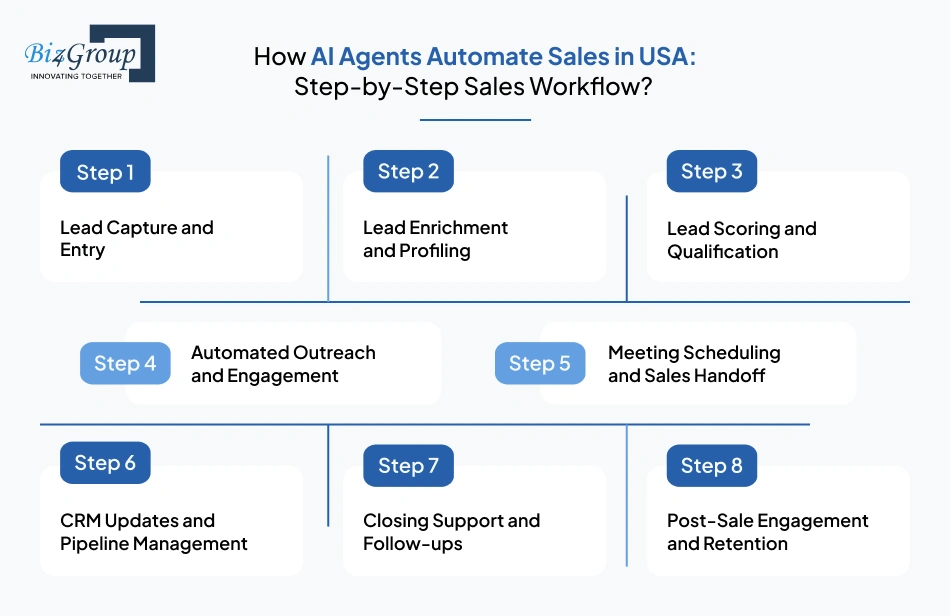
AI sales automation doesn’t work as isolated tasks. It follows a continuous flow where AI agents handle each stage of the sales journey, from capturing a lead to closing and even post-sale engagement.
Here’s what that workflow typically looks like in practice:
Step 1: Lead Capture and Entry
The process starts when a potential customer interacts with a business through websites, ads, emails, social media, or CRM integrations.
At this stage, AI agents automatically capture and organize incoming leads without manual data entry.
Outcome:
- Every lead is recorded instantly
- No inquiries are missed
- Data is structured for processing
Step 2: Lead Enrichment and Profiling
Once a lead enters the system, AI agents gather additional information such as company details, behavior signals, and intent data.
This helps build a clearer profile of who the lead is and what they are interested in.
Outcome:
Complete lead profiles
Better context for sales teams
Improved targeting accuracy
Step 3: Lead Scoring and Qualification
AI evaluates each lead based on engagement, intent signals, demographics, and past behavior to determine how likely they are to convert.
Only high-quality leads are prioritized for human sales attention.
Outcome:
- Qualified vs unqualified leads separated
- Sales teams focus on high-intent prospects
- Faster pipeline movement
Step 4: Automated Outreach and Engagement
Qualified leads are then engaged through AI-driven communication such as emails, WhatsApp, chat, or other channels.
Messaging is personalized based on user behavior and stage in the funnel.
Outcome:
- Instant response to leads
- Consistent follow-ups
- Higher engagement rates
Step 5: Meeting Scheduling and Sales Handoff
When a lead shows strong intent, AI agents automatically handle scheduling and hand over the lead to human sales representatives (if needed).
Outcome:
- No scheduling delays
- Smooth transition to sales teams
- Reduced drop-offs
Step 6: CRM Updates and Pipeline Management
Throughout the process, AI continuously updates CRM systems with activity, status changes, and interaction history.
Outcome:
- Always-updated pipeline
- No manual data entry
- Better visibility for sales managers
Step 7: Closing Support and Follow-ups
Even after handoff, AI continues supporting the process by sending reminders, handling follow-ups, and re-engaging stalled leads.
Outcome:
- Reduced lead leakage
- Higher conversion rates
- Faster deal closure
Step 8: Post-Sale Engagement and Retention
After conversion, AI agents continue engaging customers for onboarding, upselling, cross-selling, and retention.
Outcome:
- Improved customer lifetime value
- Stronger retention
- Ongoing revenue generation
While the workflow may appear seamless from the outside, multiple features work together behind the scenes to make AI sales automation possible. Let's look at the core and advanced features for AI agents automate sales in USA.
What Are the Functional Features of AI Sales Agents IN USA?
As sales processes become more complex and customer expectations continue to rise, businesses need systems that can scale without increasing operational burden. These features explain what makes sales automation AI tools effective in modern sales environments and why more businesses are adopting them.
|
Feature |
Why It Matters |
Business Impact |
|---|---|---|
|
Natural Language Processing (NLP) |
Customers increasingly expect fast, natural, and personalized interactions across channels |
Improves customer engagement and communication quality |
|
Data-Driven Personalization |
Generic outreach becomes less effective as customer expectations increase |
Creates more relevant experiences and improves conversion opportunities |
|
Automated Workflows |
Manual processes become difficult to scale as businesses grow |
Reduces repetitive work and improves operational efficiency |
|
CRM Integration |
Sales activities spread across disconnected systems create operational inefficiencies |
Improves data accessibility and creates unified sales workflows |
|
Multi-Channel Communication |
Customers interact across multiple platforms rather than a single channel |
Creates more consistent customer engagement experiences |
|
Growing sales complexity makes manual forecasting increasingly difficult |
Improves forecasting accuracy and decision-making |
|
|
Autonomous Workflow Execution & Decision Support |
Growing sales operations require faster execution and better prioritization |
Improves productivity, consistency, and scalability |
|
Businesses increasingly require faster customer interactions at larger scale |
Supports voice-based engagement and communication workflows |
|
|
Real-Time Optimization |
Customer behavior changes continuously throughout the sales cycle |
Improves responsiveness and conversion opportunities |
|
Customization and Flexibility |
Different industries require different workflows and sales processes |
Creates better alignment with business operations |
|
Analytics and Performance Tracking |
Businesses require visibility into increasingly complex revenue operations |
Supports optimization and better decision-making |
|
Larger sales operations often require multiple systems working together |
Supports more complex and scalable sales environments |
While features explain what AI sales agents can do, businesses ultimately care about measurable outcomes. The real question is not whether AI can automate sales activities, but how these capabilities translate into revenue growth, efficiency improvements, and scalable sales operations.
Let's explore how businesses are using AI sales automation to increase revenue and create more predictable growth.
How to Increase Revenue 50% With AI Sales Automation?
AI agents for revenue growth rarely depends on a single fix. More often, it comes from improving several parts of the sales funnel at once. That is why businesses exploring how AI agents automate sales in USA are increasingly using AI across lead generation, qualification, follow-ups, and customer retention. When these improvements work together, they can boost conversion efficiency, reduce lost opportunities, and create stronger long-term revenue growth. Let's understand how revenue can be increased significantly.
1. Faster Conversion Through Better Lead Handling
One of the most immediate gains from AI sales automation software is speed and consistency in follow-ups. When responses are instant and leads are prioritized correctly, more prospects move forward in the pipeline.
This is how AI agents for faster lead conversion in USA typically improve outcomes:
- High-intent leads are prioritized automatically
- Follow-ups happen without delay or drop-off
- Engagement stays consistent across the funnel
The result is higher conversion efficiency without changing the core sales strategy.
With AI sales automation software, businesses can manage larger pipelines without expanding teams at the same rate. This is a key part of automate sales process IN USA strategies used by growing companies.
In practice:
- Repetitive tasks are handled through automation
- Lead qualification becomes faster and more structured
- Sales teams focus more on closing than manual work
This is one of the most direct ways companies cut sales costs with AI while maintaining growth.
2. Reducing missed revenue opportunities
A major issue in sales operations is pipeline leakage, where potential customers drop off because they are not followed up with at the right time or consistently enough. This usually happens when sales teams are managing too many leads manually or relying on delayed responses.
This improves:
- Pipeline visibility and tracking
- Follow-up consistency across stages
- Recovery of stalled opportunities
For many teams, this is where AI reduces sales team workload in US companies most noticeably.
3. Driving higher customer lifetime value
After the first conversion, AI agents for revenue growth help identify expansion opportunities that are often missed in manual systems.
This includes:
- Identifying upsell and cross-sell signals
- Maintaining ongoing engagement loops
- Supporting retention-focused workflows
This strengthens long-term revenue performance, not just initial sales.
4. Improving predictability and revenue planning
With AI-powered sales automation tools, businesses in the USA can turn sales data into something more structured and actionable. Instead of scattered inputs across multiple systems, teams get a clearer view of what’s working and where to focus next.
This supports:
- More accurate forecasting
- Better pipeline health tracking
- Smarter resource allocation
This is a major advantage of AI in driving business growth across competitive markets in the USA.
Businesses using AI-powered sales solutions are not just automating tasks. They are rebuilding how revenue flows through the system, from first contact to long-term retention. In many cases, this is how teams approach goals like how to increase revenue 50% with AI sales automation, especially when automation is applied across the full funnel rather than a single stage.
This naturally leads to a closer look at the practical advantages these systems bring in day-to-day operations and overall performance.
What Are the Benefits of AI Sales Agents in USA?
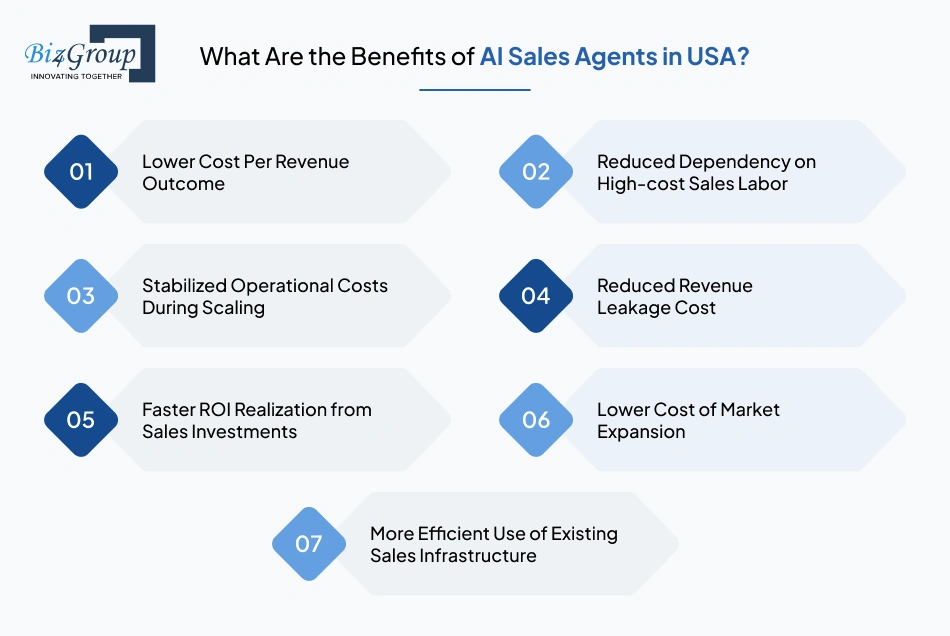
At this stage in evaluation, the focus is less on what AI agents do and more on what changes after deployment, especially in cost structure, efficiency, and operational control.
For organizations assessing how AI agents automate sales in USA to cut costs, the benefits are best understood through measurable business impact rather than functional capability.
1. Lower Cost Per Revenue Outcome
The primary financial shift comes from reducing the cost required to generate and convert each opportunity. Instead of scaling headcount with pipeline growth, workload is absorbed through AI automation.
This improves:
- Cost per qualified lead
- Cost per closed deal
- Efficiency of AI sales automation software investments
2. Reduced Dependency on High-cost Sales Labor
AI agents do not replace sales strategy, but they reduce reliance on manual execution layers that typically drive operational cost.
This is particularly relevant for companies optimizing cut sales costs with AI initiatives, where repetitive sales activities represent a significant expense center.
The result is a more efficient allocation of human effort toward high-value conversations.
3. Stabilized Operational Costs During Scaling
In traditional models, cost increases linearly with growth. With AI-powered sales solutions, operational cost growth becomes flatter even as lead volume increases.
This creates:
- More predictable budgeting
- Controlled expansion costs
- Improved AI for business growth IN USA scalability
4. Reduced Revenue Leakage Cost
Missed follow-ups, delayed responses, and inconsistent pipeline handling directly translate into lost revenue. AI reduces these inefficiencies, which effectively lowers the hidden cost of lost opportunities.
This improves:
- Pipeline yield efficiency
- Recovery of at-risk leads
- Consistency in automate sales process IN USA execution
5. Faster ROI Realization from Sales Investments
Because AI systems improve throughput without requiring proportional infrastructure changes, the payback period on sales infrastructure investments tends to shorten.
This is often a key evaluation point for organizations considering AI agents for revenue growth as part of broader transformation initiatives.
6. Lower Cost of Market Expansion
Expanding into new geographies or segments typically requires building parallel sales capacity. With AI sales agents in USA, much of this structure can be reused, reducing the incremental cost of expansion.
This supports:
- Faster go-to-market execution
- Lower entry cost for new segments
- Scalable automated lead generation IN USA systems
7. More Efficient Use of Existing Sales Infrastructure
Rather than replacing systems, AI enhances existing CRM and sales stacks by improving utilization efficiency.
This leads to:
- Better ROI on existing tools
- Reduced redundancy in workflows
- Stronger alignment with business automation IN USA strategies
While these outcomes highlight where cost efficiency improves, it is equally important to understand the practical constraints and operational risks that can affect adoption and performance in real sales environments.
Growing revenue or growing workload?
Scaling sales should not mean scaling effort equally.
Explore SolutionsWhat Are the Challenges and Limitations of AI Agents in Sales IN USA?
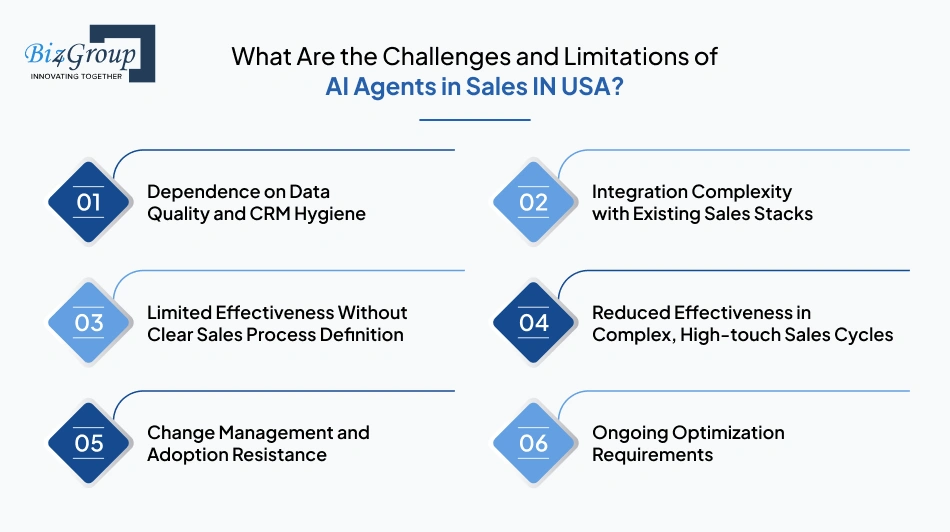
While AI-powered sales agents can improve cost efficiency and pipeline performance, their adoption in the USA comes with practical challenges that organizations need to address.
Understanding these factors is important when evaluating AI strategies for business growth in the USA, especially in environments where sales systems are already established. Let's explore the challenges and limitations of AI agents in sales in USA.
1. Dependence on Data Quality and CRM Hygiene
AI performance is directly tied to the quality of input data. In many organizations, CRM records are incomplete, inconsistent, or outdated, which limits the effectiveness of AI sales automation software.
This can result in:
- Incorrect lead prioritization
- Inaccurate engagement triggers
- Reduced reliability of automated lead generation IN USA outputs
Without structured data discipline, outcomes become less predictable.
2. Integration Complexity with Existing Sales Stacks
Most enterprises already use multiple tools across CRM, marketing automation, and communication systems. Integrating AI-powered sales solutions into these environments can require significant configuration effort.
Common issues include:
- Fragmented data sources
- API and system compatibility gaps
- Workflow misalignment across tools
This can delay value realization in automate sales process IN USA deployments.
3. Limited Effectiveness Without Clear Sales Process Definition
AI systems perform best when workflows are already well-defined. In organizations where sales processes are inconsistent, AI can automate inefficiency rather than improve it.
This is especially relevant for companies adopting sales automation AI tools without standardized qualification or follow-up structures.
4. Reduced Effectiveness in Complex, High-touch Sales Cycles
In enterprise or consultative sales environments, decision-making often depends on nuanced human interaction. While AI sales agents in USA can support engagement, they may not fully replicate relationship-driven selling.
This can limit impact in:
- Multi-stakeholder enterprise deals
- Long negotiation cycles
- High customization sales processes
5. Change Management and Adoption Resistance
In enterprise or consultative sales, decisions usually come down to trust, relationships, and how well people connect. AI sales agents in USA can help with engagement and share useful insights.
This can affect:
- Adoption speed
- Trust in AI recommendations
- Consistency of usage across teams
Successful implementation of AI agents for revenue growth often depends as much on internal alignment as on technology.
6. Ongoing Optimization Requirements
AI sales systems are not static. They require ongoing AI model training and optimization to adapt to changing customer behavior, sales performance trends, and evolving business goals. Without active optimization, results from AI-powered sales solutions can be plateaued over time.
How Can Businesses Choose Between Building AI Sales Agents and Buying AI Sales Automation Software in USA?
As organizations explore ways to reduce sales costs and improve revenue efficiency, one of the biggest decisions is whether to build a custom AI solution, purchase an existing platform, or work with a specialized development partner.
The right choice depends on factors such as budget, internal expertise, customization requirements, and how quickly the business wants to deploy automation. Let’s explore how each option differentiates from the others.
|
Approach |
Best For |
Advantages |
Considerations |
|---|---|---|---|
|
Build in-house |
Large organizations with dedicated AI and engineering teams |
Full control over workflows, integrations, data, and system architecture |
Higher development costs, longer implementation timelines, ongoing maintenance and optimization requirements |
|
Buy existing software |
Businesses looking for faster implementation and lower upfront investment |
Quicker deployment, proven workflows, lower technical complexity |
Limited flexibility and customization compared to custom-built solutions |
|
Work with a specialized development partner |
Companies that need tailored solutions without building everything internally |
Faster implementation, customized workflows, reduced technical burden, scalable architecture |
Requires choosing the right partner and clearly defining business requirements |
There is no single approach that works for every business.
Organizations with strong technical resources and highly specific requirements may prefer building a custom solution. Businesses looking for a faster and more predictable implementation often benefit from established sales automation platforms. For companies that need customization without managing the entire development process themselves, partnering with an experienced AI development firm can provide a practical middle ground.
The best choice ultimately depends on your sales process, growth objectives, available resources, and long-term plans. The goal is not simply to add automation, but to implement a solution that improves efficiency, supports revenue growth, and remains scalable as the business evolves.
As implementation decisions become clearer, the next step is understanding how the right development partner can translate these requirements into a scalable and production-ready solution.
How Can Biz4Group Help Businesses Develop AI Sales Agents IN USA?
When companies plan to implement AI agents automate sales in USA, the real challenge is not the concept, but building something that actually fits existing sales operations while reducing cost and complexity.
That is where Biz4Group, one of the leading AI sales agent development companies in USA, comes in as a development partner. Instead of generic tools, Biz4Group builds custom AI sales agents tailored to specific business requirements and revenue goals.
The focus is on removing repetitive work across the sales cycle, especially in areas like lead handling, follow-ups, qualification, and CRM updates. AI-powered sales solutions are designed to work with existing CRM and sales tools, so businesses can automate sales process IN USA without restructuring their current systems.
To further strengthen this approach, Biz4Group has built an enterprise AI agent that helps streamline and automate key sales operations.
Each solution is also built with adaptability in mind that allows it to evolve as sales strategies and business needs change, ensuring long-term relevance of AI-powered sales solutions.
This approach sets the foundation for more structured, scalable, and cost-efficient sales operations, which naturally leads to how these systems will continue evolving as businesses adopt them more deeply.
What Is the Future of AI Agents in Sales IN USA?
The future of AI sales agents is not about doing today's sales activities faster—it's about fundamentally changing how businesses generate revenue.
- AI-first sales operations will become the norm: Businesses will increasingly build sales processes around AI agents from the start, rather than using them as add-on tools.
- Leaner sales teams will drive larger pipelines: Companies will be able to manage growing lead volumes and customer interactions without expanding sales headcount at the same rate.
- 24/7 revenue generation will become standard: AI sales agents will engage, qualify, and nurture prospects continuously, reducing dependence on business hours and geographic boundaries.
- Sales roles will become more strategic: Human teams will spend less time on repetitive sales activities and more time on relationship building, complex negotiations, and account growth.
- Autonomous sales workflows will emerge: AI agents will increasingly identify opportunities, initiate outreach, manage follow-ups, and optimize engagement with minimal human intervention.
- Revenue operations will become more AI-driven: Businesses will rely on AI agents not only for sales execution but also for supporting forecasting, planning, and growth strategies.
- Competitive advantage will shift toward AI adoption: Companies that successfully integrate AI sales agents will be able to scale faster, respond to market changes more quickly, and operate more efficiently than competitors relying on traditional sales models.
The future of AI sales agents is centered on creating AI-powered revenue systems where growth becomes more scalable, continuous, and less dependent on manual processes.
What if sales could run while you sleep?
That is where automation starts becoming useful.
Discover MoreFinal Thoughts: The Evolving Role of AI in Sales
AI sales agents are quickly becoming more than just automation tools. Businesses are using them to respond faster, reduce manual work, and keep sales processes running smoothly without adding unnecessary operational complexity.
For companies exploring how AI agents automate sales in USA, the goal is not simply to automate a few tasks. It is about building a sales operation that can handle growth more efficiently while keeping costs under control. By taking over repetitive activities like lead qualification, follow-ups, appointment scheduling, and CRM updates, AI agents allow sales teams to spend more time on conversations, relationships, and closing deals.
That said, results can vary from one business to another. Factors such as industry, sales cycle complexity, lead volume, data quality, and implementation approach all influence the outcome. Businesses generally see the greatest value when AI is used as part of a broader sales improvement strategy rather than as a standalone solution.
As AI sales agents in USA evolve, they will play a stronger role in how pipelines are managed, opportunities are prioritized, and revenue performance is sustained over time. This makes AI-powered sales solutions an important foundation for businesses aiming to stay competitive in increasingly fast-moving markets.
If you’re thinking along this line “I am looking for a company in USA that can build a custom AI sales agent for my business within 30 days”, then working with a specialized partner like Biz4Group can make this transition significantly easier. With the right expertise, businesses can avoid trial-and-error development, reduce implementation complexity, and get a system that is built around their actual sales process from the start. This not only speeds up deployment but also improves long-term efficiency and cost control.
In the end, businesses that take a structured approach, and choose the right development partner, are better positioned to improve sales efficiency, reduce operational burden, and scale revenue growth in a more predictable way, that’s why partnering with Biz4Group can be a great choice to build a custom AI sales agent in USA for your business.
FAQs
1. Can AI agents automate sales in USA without replacing existing CRM systems?
Yes. Most AI sales solutions are designed to integrate with existing CRM platforms rather than replace them. This allows businesses to automate sales activities while continuing to use their current infrastructure.
2. How long does it take to deploy AI agents to automate sales in USA for a mid-sized business?
Deployment timelines vary based on complexity, integrations, and customization requirements. Standard implementations may take 2-4 weeks for MVP and 5-8 for enterprises, while more customized solutions can take longer.
3. Are AI Sales Agents suitable for businesses with long sales cycles?
Yes. AI sales agents can support longer sales cycles by maintaining follow-ups, tracking engagement signals, and helping sales teams manage opportunities consistently across extended periods.
4. What industries benefit the most when AI agents automate sales in USA?
Industries with large lead volumes, repetitive sales workflows, or high customer engagement requirements often benefit the most. This includes SaaS, ecommerce, finance, and real estate.
5. Can AI agents automate sales in USA while maintaining compliance and data security?
Yes, provided businesses implement appropriate security controls, access policies, and compliance frameworks. Security and governance should always be part of implementation planning.
6. How much customization is usually required for AI Sales Agents IN USA?
The level of customization depends on sales complexity. Businesses with unique workflows, qualification logic, or customer journeys generally require more tailored implementations.
7. Can AI agents automate sales in USA for businesses with small sales teams?
Yes. Smaller businesses often use AI sales agents to manage repetitive work, allowing lean teams to handle larger sales volumes without expanding headcount.
8. What should businesses evaluate before investing in AI sales automation software?
Businesses should evaluate sales process maturity, integration requirements, available data quality, scalability goals, and expected operational impact before selecting a solution.
9. How do companies measure ROI after implementing AI agents automate sales in USA?
Common metrics include conversion improvements, response time reduction, cost savings, pipeline efficiency, customer acquisition cost, and sales productivity improvements.
10. Can AI agents automate sales in USA alongside human sales teams instead of replacing them?
Yes. Most organizations use AI sales agents to support sales teams rather than replace them, allowing humans to focus on relationship building, negotiation, and complex decision-making.
