 Location :
Orlando, FL, USA
Location :
Orlando, FL, USA +1 (407) 714-1616
 info@biz4group.com

 AI Summary Powered by Biz4AI
- How do social casinos make money? Primarily through virtual currency purchases, in-app purchases, VIP programs, rewarded ads, LiveOps, tournaments, gifting, brand partnerships, and direct-to-consumer (DTC) web shops.
- The social casino revenue model relies on free-to-play experiences, player engagement, virtual economies, payer conversion, repeat purchases, and retention.
- Social casino vs. sweepstakes casino vs. real-money iGaming comes down to currency, redemption, wagering, payments, eligibility, and regulatory requirements, making the product model an important architectural decision.
- Social casino monetization extends beyond coin packs, with personalized offers, loyalty programs, limited-time events, subscriptions, and social features helping increase player lifetime value.
- Key social casino revenue benchmarks include payer conversion, ARPDAU, ARPPU, LTV, retention, churn, CPI, and ROAS, but results vary significantly by audience, geography, product design, and monetization strategy.
- Stackr by Biz4Group demonstrates how an AI-driven social casino platform can combine 800+ games, a dual-coin wallet, personalization, VIP progression, rewards, and social engagement into a scalable gaming ecosystem.
Imagine giving players hundreds of casino-style games for free, asking them to use virtual coins with no cash-out value, and still building a business worth millions.
Sounds backwards?
That is precisely why the "how do social casinos make money" question is so interesting.
The answer sits inside a carefully designed free-to-play economy. Players enter for free, play with virtual currency, return for bonuses and new content, and some eventually purchase more coins, premium features, VIP benefits or event access. Operators then add other revenue layers such as rewarded ads, subscriptions, LiveOps offers, tournaments, brand partnerships and direct-to-consumer (DTC) web shops.
The basic loop looks like this:
Free gameplay → engagement → virtual economy → purchase → repeat play → retention → additional monetization
The clever part is that the money does not come from players winning cash. It comes from creating enough entertainment value, progression and social interaction for players to willingly spend on the experience.
What Is the Social Casino Revenue Model?
The social casino revenue model is a free-to-play business model where players access casino-style games without paying upfront, while operators generate revenue through virtual currency purchases, premium content and supporting monetization channels.
Think of it as a funnel with several layers:
|
Stage |
What Happens |
|---|---|
|
Free Gameplay |
Players enter and explore games without an upfront payment |
|
Virtual Currency |
Gameplay uses non-redeemable coins or credits |
|
Engagement |
Bonuses, progression, social features and new content bring players back |
|
Payer Conversion |
A percentage of players purchase coins or premium features |
|
Repeat Spending |
Offers, events and progression create new purchase moments |
|
Retention |
Loyalty systems encourage continued activity |
|
Additional Revenue |
Ads, VIP programs, partnerships, tournaments and DTC sales add revenue |
|
This model gives operators several ways to monetize the same audience without requiring every player to become a paying customer. |
It also explains why the platform architecture matters. Virtual wallets, player profiles, loyalty systems, payment flows, analytics and content management need to work together. Biz4Group's experience building AI-driven gaming products such as Stackr gives it practical exposure to these interconnected layers, not merely individual features. |
How Does a Social Casino Differ from a Sweepstakes Casino or Real-Money iGaming Platform?
A social casino, sweepstakes casino, and real-money iGaming platform can look surprisingly similar on the surface, but their revenue models, currency systems, redemption mechanics, and technical requirements are different. That distinction matters before a founder decides how to build and monetize the product.
|
Model |
How Players Play |
Currency & Redemption |
Common Monetization |
Product Complexity |
|---|---|---|---|---|
|
Social Casino |
Free-to-play casino-style games |
Virtual currency with no cash redemption |
Coin purchases, ads, VIP programs, DTC offers |
Moderate |
|
Sweepstakes Casino |
Casino-style games with promotional mechanics |
Often uses dual currencies, with eligibility for prize redemption depending on the model |
Coin purchases, promotional offers, player engagement |
Higher |
|
Real-Money iGaming |
Players wager real money |
Real-money balance with withdrawals |
Wagers, gaming activity, fees or revenue share |
High |
For founders researching social casino vs sweepstakes casino, the important distinction is what happens to the currency after purchase or gameplay.
A conventional social casino can keep its virtual economy centered on entertainment and non-redeemable currency. Sweepstakes and real-money models introduce additional considerations around eligibility, payments, verification, jurisdiction, and compliance.
That difference can change the architecture before a single game is integrated. Wallet logic, player verification, payment flows, geographic controls, reporting, and responsible gaming features may all need to be designed around the chosen model.
For businesses comparing social casino vs real-money iGaming, the product decision should therefore come before the technology stack. A platform built for one model may require substantial changes if its monetization mechanics later move toward redeemable value.
Also read: How much does it cost to develop an AI social casino platform?
What Regulatory Risks Should Social Casino Founders Consider?
Social casino development can involve fewer regulatory complexities than real-money gaming, but the product model still needs careful review before launch. The biggest variable is how the platform handles currency, prizes, purchases, promotions, player eligibility, and redemption.
A social casino built around non-redeemable virtual currency has a different regulatory profile from a sweepstakes model that introduces promotional currencies or prize redemption. A real-money iGaming platform sits in a different category again, with licensing, player verification, responsible gaming, payments, and jurisdiction-specific requirements becoming central to the product.
There is also a platform-policy layer. For example, Google Play's current policies explicitly restrict simulated gambling content, including social casino apps, and impose additional rules around gambling-related functionality and promotions.
That means social casino app development should account for the intended markets and distribution channels before architecture and monetization are finalized. Founders should validate the specific business model, promotional mechanics, target jurisdictions, and app-store requirements with qualified gaming counsel before launch.
Is Your Revenue Model Built to Grow?
Virtual coins bring players in. The right monetization mix keeps the revenue moving.
Map Your Revenue StrategyHow Do Social Casinos Make Money from In-App Purchases?
Social casino in-app purchases generate revenue by selling virtual currency and digital items that players use to continue gameplay, unlock content, accelerate progression or access special experiences.
This is the heart of the model.
How Do Virtual Currency and Coin Packs Generate Revenue?
Virtual currency generates revenue when players purchase additional coins after using their free balance or receiving coins through gameplay.
Common examples include:
- Gold Coins
- Coin packs
- Bonus coins
- Extra spins
- Piggy-bank rewards
- Limited-time bundles
- Event-specific currency
- Starter packs
Pricing can span multiple spending levels. A low-cost starter pack can make a first purchase feel easy, while larger bundles cater to players who already understand the game's economy.
The important design detail is not the coin itself. It is what the coin unlocks.
If purchasing 10,000 coins lets a player keep playing during a high-engagement session, the transaction solves an immediate problem. If a bundle also includes bonus spins or event rewards, its perceived value increases.
How Do Virtual Goods and Gameplay Enhancements Increase Spending?
Virtual goods give players additional reasons to purchase beyond replenishing coins.
Examples include:
- Extra spins or turns
- Boosts and multipliers
- Premium game access
- Cosmetic items
- Event passes
- Progression accelerators
- Exclusive rewards
A well-designed store can connect these purchases to moments that already matter to the player.
Running out of coins during an exciting session is one moment. Unlocking the next VIP tier is another. Entering a limited-time tournament can create a third.
That gives product teams multiple monetization moments without forcing the store into every part of the experience.
Why Does Non-Redeemable Currency Generate Revenue?
Non-redeemable currency has value because it buys access to entertainment, progression and gameplay, not a financial return.
Players may spend real money because they want another session, faster progress, access to a special event or a more rewarding experience. The virtual economy therefore becomes the commercial engine sitting underneath the game experience.
For a platform development team, this means wallet logic, purchase validation, offer management, player balances and transaction history deserve careful architecture. A payment button may look small on screen, but the system behind it certainly isn't.
What Other Social Casino Revenue Streams Can Operators Use?
Beyond IAP, social casino revenue streams can include VIP subscriptions, rewarded video ads, LiveOps events, tournament entries, gifting and brand partnerships. Mature products typically combine several of these channels to diversify monetization.
How Do VIP Programs and Subscriptions Generate Revenue?
VIP programs monetize loyalty by giving frequent players additional benefits, recognition and exclusive offers.
These programs can include:
- VIP levels
- Exclusive bonuses
- Faster progression
- Special tournaments
- Personalized offers
- Loyalty rewards
- Premium access
A subscription can turn those benefits into recurring revenue, while tiered VIP systems can give players a visible reason to keep progressing.
How Do Rewarded Video Ads Make Money for Social Casinos?
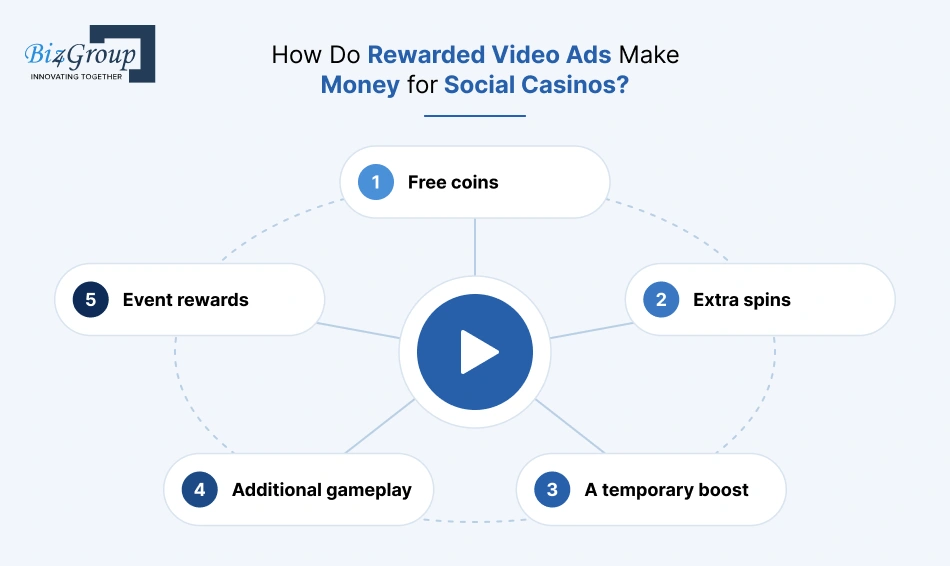
Rewarded video advertising lets players exchange attention for an in-game benefit.
A player might watch an ad to receive:
- Free coins
- Extra spins
- A temporary boost
- Additional gameplay
- Event rewards
This creates a monetization path for non-payers while giving advertisers access to an engaged gaming audience.
How Do LiveOps Events and Limited-Time Offers Increase Revenue?
LiveOps keeps the game changing after launch through seasonal events, daily challenges, limited-time offers, leaderboards and special campaigns.
The commercial value comes from creating fresh reasons to return.
A Halloween event can introduce themed rewards. A weekend tournament can create a new competitive goal. A limited-time coin bundle can give existing players a reason to purchase again.
For founders, LiveOps also means the platform needs content-management tools capable of launching and adjusting offers without rebuilding the product every time.
How Do Tournaments, Gifting and Brand Partnerships Add Revenue?
Tournaments can monetize competitive play through entry fees or premium participation. Gifting creates opportunities for players to exchange virtual items or rewards. Brand partnerships can add sponsored games, themed events or promotional experiences.
These features also strengthen the social layer.
That matters because a social casino has more to monetize when players have reasons to interact with one another, not only with the game itself.
Why Do Players Pay in Social Casinos?
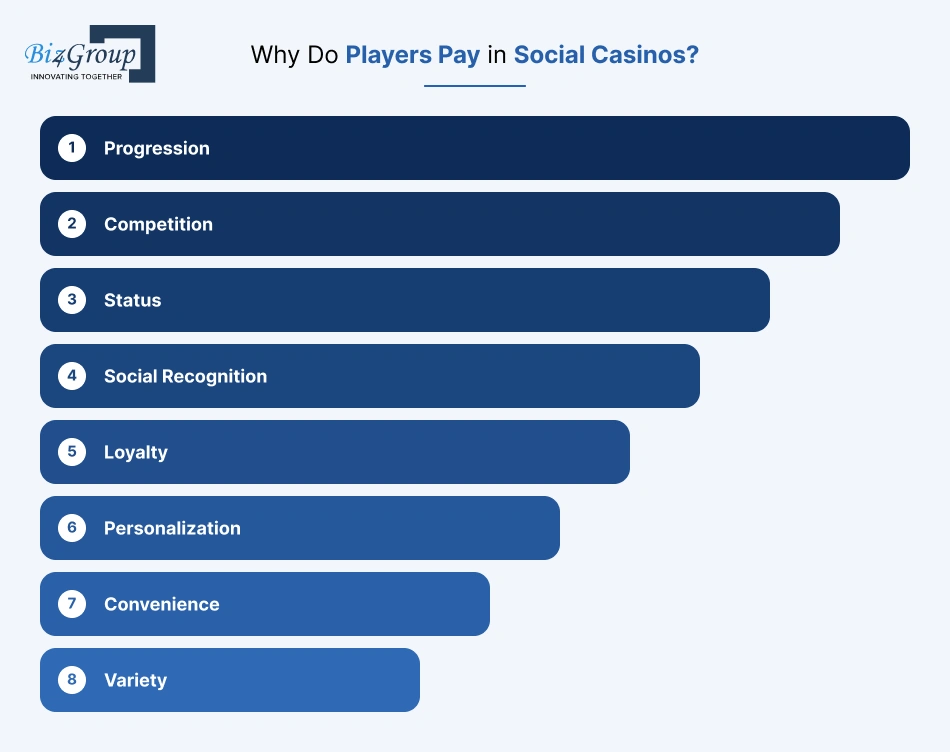
The answer to why do players pay is simple: they are buying a better or longer entertainment experience.
The purchase may provide more gameplay, faster progression, status, social recognition or access to something they find valuable.
|
Player Motivation |
Example |
|---|---|
|
Progression |
Unlocking a new level or reward tier |
|
Competition |
Improving leaderboard position |
|
Status |
Reaching VIP milestones |
|
Social Recognition |
Sending gifts or joining clubs |
|
Loyalty |
Receiving benefits for continued activity |
|
Personalization |
Seeing offers matched to gameplay habits |
|
Convenience |
Replenishing coins without waiting |
|
Variety |
Accessing new games or seasonal content |
This is where terms such as whales, dolphins and minnows become useful.
Whales are high-value spenders. Dolphins occupy a middle spending range. Minnows tend to make smaller purchases.
The segments behave differently, so treating every player the same can leave money and engagement opportunities on the table. Retention, churn and LTV help operators understand how these groups behave over time.
Personalization can then connect player behavior to relevant offers, games, rewards and loyalty tiers.
The key is relevance. A player who spends heavily on tournaments may respond to a competitive event offer. Someone who mainly plays slots may respond to a new-game recommendation.
That is one area where Biz4Group's AI and personalization experience becomes relevant to social casino development, especially when behavioral data needs to inform recommendations, rewards and player journeys.
Also read: How much does it cost to start an online casino?
Are Your Players Spending or Simply Playing?
Turn player behavior, retention, and personalization into a monetization strategy built for ROI.
Explore Your ROI PotentialWhat Are the Key Social Casino ARPDAU and Payer Conversion Benchmarks?
Social casino ARPDAU and payer conversion show how effectively an operator turns active users into revenue. They should be read together with retention, LTV, ARPPU and acquisition costs because no single KPI tells the whole story.
|
Metric |
Purpose |
|---|---|
|
DAU/MAU |
Measures engagement |
|
Payer Conversion |
Measures monetization reach |
|
ARPDAU |
Measures revenue per daily active user |
|
ARPPU |
Measures revenue per paying user |
|
LTV |
Estimates player value over the lifecycle |
|
Retention |
Measures how many users return |
|
Churn |
Measures user loss |
|
CPI |
Measures acquisition cost |
|
ROAS |
Measures return on acquisition spend |
What Is Payer Conversion in Social Casinos?
Payer conversion measures the percentage of active users who make a purchase during a defined period.
DoubleDown Interactive reported a 9.4% payer conversion rate in Q2 2026, compared with 7.0% in Q2 2025. The company noted that its social casino KPIs included WHOW Games following its acquisition.
That figure is useful as a public operator benchmark, not as a universal target for every new social casino.
What Does ARPDAU Tell Social Casino Operators?
ARPDAU, or Average Revenue Per Daily Active User, measures the revenue generated per daily active user during a defined period.
DoubleDown reported $1.42 ARPDAU in Q2 2026, up from $1.33 in Q2 2025. Its average monthly revenue per payer was $218 during the same quarter. According to Yahoo Finance, the company also reported $77.3 million in Q2 2026 social casino and free-to-play revenue, up 11.5% year over year.
These figures show why a founder should look beyond downloads. A large audience means little if players rarely return or convert.
Why Do Social Casino Benchmarks Vary?
Benchmarks shift with geography, audience maturity, game portfolio, acquisition channel, monetization design, retention and product lifecycle.
A new app with 20,000 users should not treat a mature public publisher's KPI as its launch forecast.
For a development team such as Biz4Group LLC, these metrics can also influence product architecture. Analytics dashboards, event tracking, segmentation and recommendation systems need to capture the data required to understand monetization after launch.
The numbers should guide product decisions, not become vanity trophies.
How Are Social Casinos Using DTC Web Shops to Increase Revenue?
A social casino DTC web store gives players another way to purchase virtual currency and digital goods outside the traditional in-app purchase flow. In 2026, the shift is becoming significant enough to influence product architecture, payment design and monetization strategy.
DoubleDown also reported that DTC revenue reached 52.4% of social casino revenue in Q2 2026, with $40.5 million in DTC revenue during the quarter.
Appcharge's 2026 industry report, based on more than $700 million in DTC transactions, found that 56% of Payment Link buyers were new to DTC and that 97% of web-store revenue came from repeat buyers. The report also found average U.S. web-store purchase value was around three times higher than Payment Link purchase value.
The message for product teams is clear: the web store can become part of the player journey, not a lonely checkout page sitting somewhere on the internet.
Why Do App-Store Fees Affect Social Casino Monetization?
App-store economics can influence the margin on digital purchases, which is one reason social casino operators are exploring direct-to-consumer, or DTC, web shops alongside their mobile apps. The exact fee is not a universal 30%. It varies by platform, market, transaction type, developer program, and revenue structure.
Apple's updated EU terms taking effect October 1, 2026, for example, set a 26% commission for App Store apps using Apple In-App Purchase, while qualifying developers and certain transactions can fall to lower rates. Apple's EU terms also specify different rates for alternative payments, link-outs, and apps distributed through alternative channels.
Google Play similarly uses multiple service-fee structures. Its current 2026 framework distinguishes between new and existing installs in markets including the U.S., UK, EEA, Japan, and Australia, with different rates for subscriptions, other transactions, and eligible programs. In some cases, the applicable fee can be 15% or less, while other transaction structures can reach 20% or 25% plus a billing fee.
For a social casino processing significant volumes of in-app purchases, those differences can materially affect unit economics. A DTC web shop can give operators another purchasing channel where permitted, allowing them to evaluate payment costs, promotional flexibility, player experience, and repeat-purchase behavior alongside app-store sales.
The key is not to treat DTC as an automatic replacement for app purchases. For many operators, the practical model is app + web shop, with each channel serving a different role in the customer journey.
How Does a Social Casino DTC Web Shop Work?
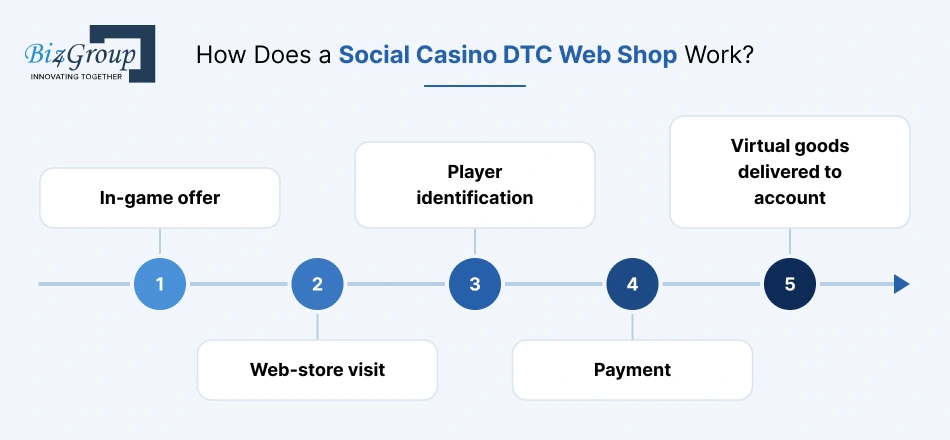
A typical journey looks like:
In-game offer → web-store visit → player identification → payment → virtual goods delivered to account
The store can sell:
- Coin bundles
- VIP packages
- Limited-time offers
- Event passes
- Bonus packs
- Personalized promotions
The web experience can also support payment links, local payment methods and merchant-of-record services, depending on the operator's market and setup.
Why Are Social Casino Operators Adding Direct-to-Consumer Sales?
DTC can create a second commercial surface while allowing the app to remain the primary engagement environment.
Appcharge's research also points to a shift in how publishers think about the web store. Its 2026 report describes web stores as LiveOps products, with merchandising, repeat purchase behavior and regional payment preferences becoming part of the monetization strategy.
That changes the development brief.
A DTC shop needs account linking, offer management, payment processing, analytics, fraud controls, taxation considerations and a reliable way to deliver purchased virtual goods.
Biz4Group can bring that broader product perspective into the planning stage, connecting the gaming experience, monetization layer and supporting platform architecture instead of treating the web shop as a last-minute add-on.
Is App + Web Shop Better Than App-Only Monetization?
App + web shop creates two monetization surfaces:
|
Model |
Payment Surface |
Main Consideration |
|---|---|---|
|
App-Only |
In-app purchases |
Simple journey, platform payment economics |
|
App + DTC |
IAP + web shop |
More payment and merchandising flexibility |
|
DTC-Led Hybrid |
App engagement + direct transactions |
Requires strong web UX, attribution and account linking |
The important shift is architectural. The app and web shop need to behave like parts of one product.
Ready to Build Your Social Casino?
Stackr by Biz4Group shows what happens when games, virtual economies, personalization, and engagement come together.
Call Our Gaming ExpertsHow Does Stackr Apply the Social Casino Revenue Model?
Stackr shows what the social casino revenue model looks like when virtual currency, personalization, loyalty and a large game library are designed as one product experience.
Developed by Biz4Group, Stackr is an AI social casino platform featuring 800+ games, a dual-coin wallet, personalized game recommendations, VIP progression, rewards and social engagement features.
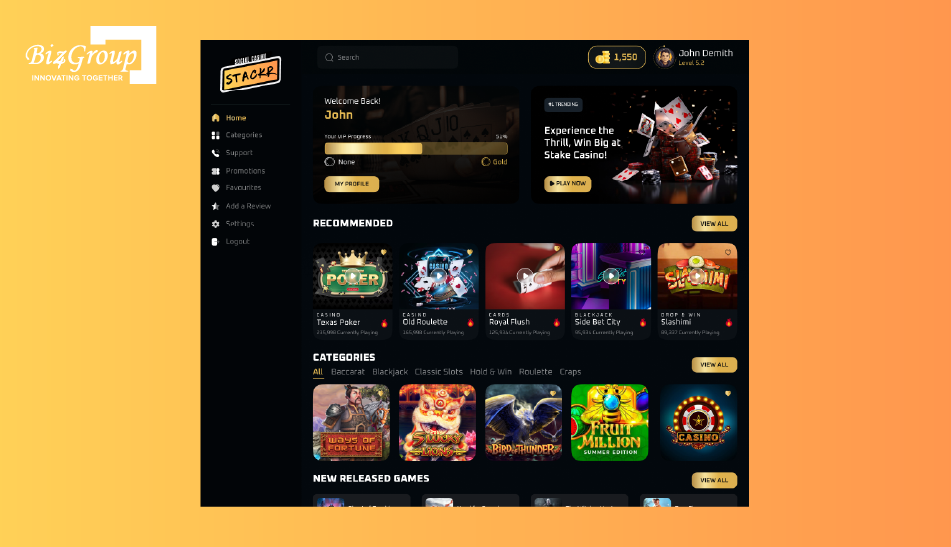
The product demonstrates several of the monetization principles discussed above:
- 800+ games create a deep content pool for repeat sessions.
- Dual-coin wallet architecture supports the platform's virtual economy.
- VIP progression gives high-engagement players another reason to return.
- Personalized recommendations help players discover relevant content.
- Rewards and gamification create recurring engagement opportunities.
- Social features add interaction beyond individual gameplay.
Biz4Group, an experienced AI development company, handled the platform's development across backend architecture, AI integration and front-end experience. Its work on Stackr also connects neatly with the company's broader experience in AI-driven gaming, personalization and entertainment products.
The important takeaway for founders is that monetization does not live inside a single “Buy Coins” button. It touches the wallet, player profile, content library, recommendation layer, loyalty system, analytics and payment infrastructure.
Also read: How to build an AI social casino platform like Stackr?
Wrapping Up
So, how do social casinos make money in 2026? They turn free gameplay into a virtual economy and then build multiple revenue layers around it.
Virtual currency and IAP form the foundation. VIP programs, rewarded ads, LiveOps, tournaments, gifting and partnerships expand the monetization mix. DTC web shops are adding another major channel, with public operators and industry datasets showing how quickly direct purchasing is becoming part of the mobile gaming model.
For founders, the interesting question is no longer only how to sell virtual coins. It is how to connect game content, player data, loyalty, personalization, payments and DTC commerce into one product that can evolve after launch.
That requires strong product thinking and solid technical execution.
Biz4Group brings experience across AI, gaming and iGaming development, with Stackr serving as a practical example of how those capabilities can come together inside a social casino product.
If you're planning a social casino platform, the next step is to map the revenue model to the features, architecture and development budget before the first sprint begins.
FAQs
1. How do social casino games acquire new players?
Social casino games typically use a mix of paid user acquisition, app-store discovery, social referrals, content marketing, influencer campaigns and cross-promotion. Acquisition strategy matters because CPI needs to be evaluated against payer conversion, retention and LTV to understand the economics of each channel.
2. What is LiveOps in social casino gaming?
LiveOps refers to the ongoing management of game content, events, rewards, offers and seasonal experiences after launch. A strong LiveOps system lets operators refresh the player experience frequently without rebuilding the core platform, helping create new engagement and monetization moments.
3. Can social casinos sell virtual coins through a web shop?
Yes. A social casino can connect its app account to a DTC web shop where eligible players purchase virtual coins, bundles, event items or other digital goods. The implementation needs secure account linking, payment processing, purchase validation and reliable delivery of virtual goods to the player's account.
4. How does AI personalization work in social casino apps?
AI personalization can analyze signals such as game preferences, session behavior, purchase history and engagement patterns to recommend games, rewards or offers. The goal is to make the experience more relevant while giving operators better tools for segmentation and content discovery.
5. What should a social casino MVP include?
A practical MVP can start with a focused game library, player accounts, virtual currency, wallet management, core IAP flows, basic social features, analytics and an admin system for managing content and offers. More advanced capabilities such as AI personalization, large-scale LiveOps and DTC commerce can be introduced in later phases.
