Location :
Orlando, FL, USA
Location :
Orlando, FL, USA +1 (407) 714-1616
 info@biz4group.com


















Imagine a digital system that doesn’t wait for instructions but instead, understands your business goals, learns from real-time feedback, and takes independent actions to get the job done.
Read More

I want to build an AI social casino platform and I need an expert cost guide that tells me exactly how much each development component costs how long the project will take and what ongoing operational expenses I should budget for after the platform is launched and running with real players?"
If this sounds like your question, you are not alone.
The timing could not be better. The global social casino market is projected to cross $10 billion in revenue during 2026, while future forecasts indicate the industry could exceed $14 billion by 2030, fueled by mobile-first gaming, AI personalization, social engagement features, and growing demand for free-to-play casino experiences. Market analysts also expect consistent CAGR growth between 8% and 10% throughout the forecast period, signaling strong investment opportunities for startups and enterprises alike.
An AI social casino platform is fundamentally different from real-money gambling platforms. Instead of actual wagering, users play using virtual chips, participate in casino-style experiences like slots, poker, roulette, and interact within social ecosystems designed around entertainment, competition, and player engagement rather than cash betting.
Artificial intelligence is rapidly becoming the foundation of modern social casino experiences. AI-powered recommendation engines personalize gameplay sessions, player behavior analytics improve retention, fraud detection systems identify suspicious activities, and dynamic difficulty systems continuously optimize player engagement. These AI capabilities directly influence user satisfaction, monetization potential, and platform scalability.
Before starting development, one question matters most: how much does it actually cost to build?
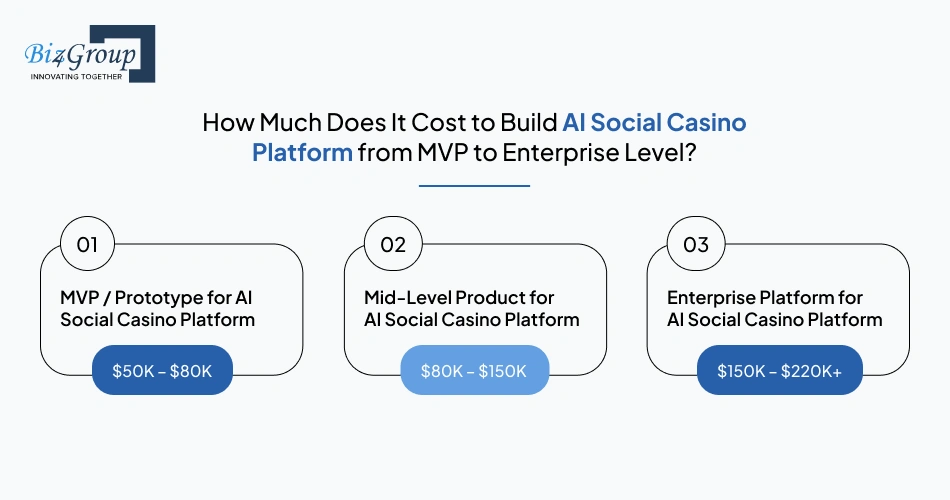
The realistic AI social casino platform development cost typically ranges from $50,000 for a lean MVP to $220,000+ for enterprise-grade platforms with advanced AI capabilities, scalable infrastructure, multi-platform support, and large concurrent player capacity.
This guide provides a complete develop AI social casino platform cost breakdown, including development timelines, cost estimation for AI social casino platform components, hidden expenses, infrastructure requirements, post-launch operational costs, and strategies for building scalable solutions without overspending.
Whether you are a startup validating an idea with an MVP approach or an enterprise planning large-scale deployment, this guide breaks down the realistic development cost for an AI social casino platform in 2026 and beyond, helping you make informed investment decisions before writing your first line of code.
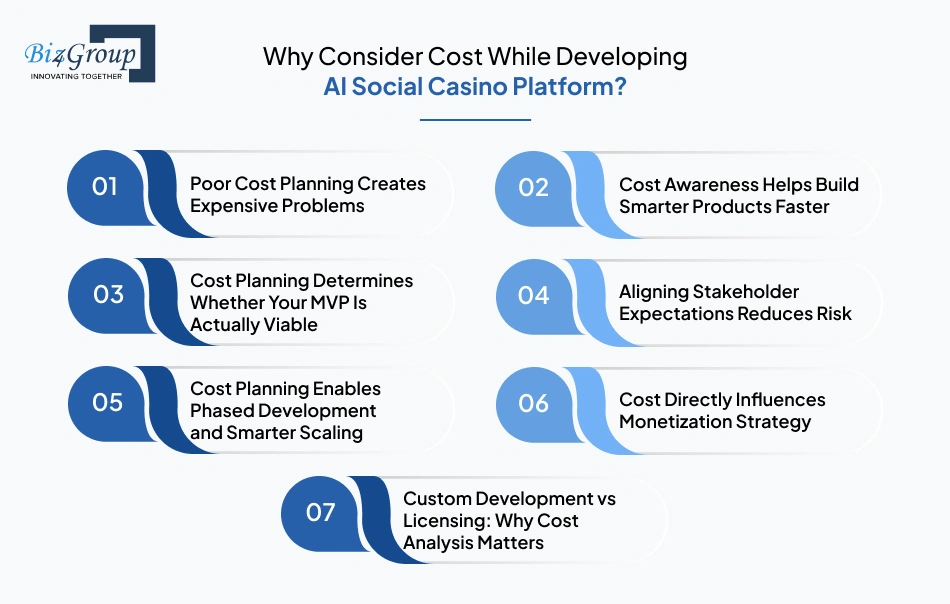
Building an AI-powered social casino platform is not simply a technology investment. It is a business decision that directly impacts product quality, speed to market, scalability, monetization, and long-term profitability. Understanding the cost to develop an AI social casino platform early allows founders and enterprises to make strategic decisions before significant resources are committed.
Many companies enter development believing that building a social casino platform primarily involves creating games and launching an app. In reality, AI integration, backend infrastructure, real time analytics, personalization engines, multiplayer systems, and ongoing operational costs create a far more complex financial picture. Without proper budget planning, projects frequently encounter delays, feature cuts, or scalability issues that affect user retention and revenue generation.
Underestimating development budgets often leads to problems that extend far beyond finances. Some of the most common consequences include:
When cost planning happens too late, companies often make reactive decisions rather than strategic ones. This increases risk throughout the entire product lifecycle.
Understanding social casino platform development pricing integrating AI helps businesses make better technical and operational decisions from day one. Budget visibility influences nearly every aspect of development, including:
Your available budget determines whether you build highly customized infrastructure or use managed services to reduce initial expenses. Choosing the wrong stack early can create unnecessary costs later when scaling becomes difficult.
Budget planning helps determine whether an organization should choose:
Making these decisions early prevents expensive restructuring during development.
Not every feature must be built immediately. Cost planning allows businesses to identify essential functionality for launch while postponing advanced capabilities until traction is achieved.
This approach prevents scope creep from expanding timelines and budgets unnecessarily.
For startups, especially, validating product viability before committing large investments is critical.
An MVP focused approach answers important questions such as:
Without these answers, companies risk building expensive products that fail to achieve product market fit.
Accurate budget planning creates alignment between founders, investors, development teams, and decision makers. Clear financial visibility helps stakeholders understand:
Projects with clear cost visibility typically move faster because decision making becomes easier throughout development.
One of the biggest mistakes businesses make is attempting to build enterprise scale platforms immediately.
Successful companies typically follow a phased strategy:
Phase 1: Build a lean MVP with core gameplay and limited AI functionality
Phase 2: Introduce personalization, player analytics, and engagement optimization
Phase 3: Expand infrastructure, add advanced AI capabilities, and support large concurrent user volumes
This approach allows businesses to launch faster, collect real user feedback, and scale based on actual demand rather than assumptions.
Your budget also affects how revenue generation should be approached.
Different monetization models create different infrastructure and feature requirements:
|
Monetization Model |
Cost Impact |
Development Complexity |
|---|---|---|
|
Free to Play |
Lower entry barrier but higher retention costs |
Medium |
|
Premium Access |
Higher upfront development quality requirements |
Medium |
|
Subscription Model |
Requires analytics, personalization, and retention systems |
High |
|
Hybrid Monetization |
Highest complexity with multiple revenue streams |
Very High |
Choosing monetization without understanding development economics often creates long term sustainability problems.
Businesses frequently ask about the cost of building a custom AI social casino platform compare to licensing existing social gaming platforms.
Licensing solutions may reduce short term expenses but often introduce limitations such as:
Custom development requires higher upfront investment but offers greater scalability, ownership, and long-term cost efficiency for businesses planning aggressive growth.
Cost planning is not simply about controlling expenses. It creates strategic advantages that directly affect business outcomes.
Companies that understand development costs early typically:
✓ Launch faster
✓ Prioritize features more effectively
✓ Avoid unnecessary spending
✓ Scale infrastructure efficiently
✓ Improve investor confidence
✓ Build stronger monetization models
Ultimately, understanding the cost to develop an AI social casino platform is not only a financial exercise. It is the foundation for building a scalable, competitive, and profitable platform in an increasingly crowded market.
Also Read: How to Build an AI Social Casino Platform Like Stackr?
Many social gaming founders begin development expecting a budget of $50,000 to $75,000 to be enough for a complete platform. However, once AI personalization, player analytics, multiplayer functionality, cloud infrastructure, and long-term scalability requirements enter the picture, development costs often increase significantly.
Consider this scenario:
"I am a social gaming entrepreneur who has been building an AI social casino platform with an offshore development team for eight months and I am running out of budget with only a partial product completed and significant AI personalization features still unbuilt and I need to understand what the realistic total investment is to complete a market competitive product?"
This situation is more common than most founders realize. Initial budgets frequently cover game development and core platform functionality, but advanced AI systems, player retention features, infrastructure scaling, security architecture, and post-launch optimization are often underestimated during planning.
The reality is that the cost of building an AI social casino platform varies significantly depending on product scope, AI complexity, user capacity, and growth objectives. A startup validating an AI idea requires a very different investment than an enterprise platform designed to support hundreds of thousands of active players.
The table below provides a realistic AI social casino platform development cost estimation for businesses planning to launch in 2026.
|
Development Level |
Cost Range |
Timeline |
Best For |
|---|---|---|---|
|
MVP / Prototype for AI Social Casino Platform |
$50K – $80K |
3–5 Months |
Startups, Concept Validation |
|
Mid-Level Product for AI Social Casino Platform |
$80K – $150K |
6–9 Months |
Growth-Stage Businesses |
|
Enterprise Platform for AI Social Casino Platform |
$150K – $220K+ |
10–18 Months |
Large-Scale Operators |
Focus: Validate your concept with core gameplay and basic social engagement.
Features Included:
AI Capabilities:
Infrastructure:
Team Size:
MVP does not mean cheap; it means focused on validating core features efficiently.
Focus: Enhance platform engagement, retention, and monetization.
Features Included:
AI Capabilities:
Infrastructure:
Team Size:
Focus: Full-scale operations with advanced AI personalization, analytics, and multi-region support.
Features Included:
AI Capabilities:
Infrastructure:
Team Size:
AI implementation alone can add $20K–$60K depending on complexity. Examples:
|
AI Component |
Estimated Cost |
|---|---|
|
Basic Recommendation Engine |
$5K – $15K |
|
Behavioral Analytics |
$10K – $20K |
|
Churn Prediction Models |
$10K – $25K |
|
Fraud Detection Systems |
$10K – $30K |
|
Full Personalization Engine |
$20K – $60K+ |
Annual operational costs typically account for 15%–20% of total development costs, covering cloud hosting, AI model upkeep, security monitoring, feature enhancements, and bug fixes.
|
Initial Build Cost |
Estimated Annual Maintenance |
|---|---|
|
$50,000 |
$7,500 – $10,000 |
|
$100,000 |
$15,000 – $20,000 |
|
$200,000 |
$30,000 – $40,000 |
Key Takeaways
By understanding startup AI social casino development pricing, enterprise AI social casino platform development cost, and social casino technology development cost, founders can plan realistic budgets, prioritize features, and ensure a market-competitive product launch.
Also Read: AI App Development Cost
When social gaming founders plan for an AI social casino platform, one of the first questions is: “How much will it cost to build a competitive AI social casino platform with AI personalization, multiplayer features, and social interactions?”
On average, AI social casino platform development cost ranges between $50,000 and $200,000+, depending on feature complexity, AI/ML requirements, infrastructure, and social functionality. To help make early decisions, a cost estimator framework can give a rough budget based on selected inputs.
Estimated Cost = Base Platform Cost + (AI Feature Cost × Complexity Factor) + Integration Cost + UI/UX Design + Licensing + Maintenance Reserve
Where:
Suppose a startup wants to build an MVP-level AI social casino platform with two slot games, AI recommendation engine, multiplayer support, and basic social chat:
Estimated Cost = ($50,000 + $15,000) × 1.2 + $10,000 + $8,000 + $5,000 + $10,000 = $117,000
This example shows how combining core development, AI, integrations, and design with a complexity multiplier provides a realistic, actionable budget.
A simple AI social casino platform development cost estimator can be built as a spreadsheet, dropdown tool, or interactive calculator where you select features, AI complexity, integrations, and hosting preferences. This gives founders a practical framework to calculate costs quickly and with confidence.
Using this approach, a realistic total investment for a market-ready AI social casino platform ranges:
This structured formula ensures budgets align with scope, AI complexity, and long-term operational needs, helping founders avoid surprises during development.
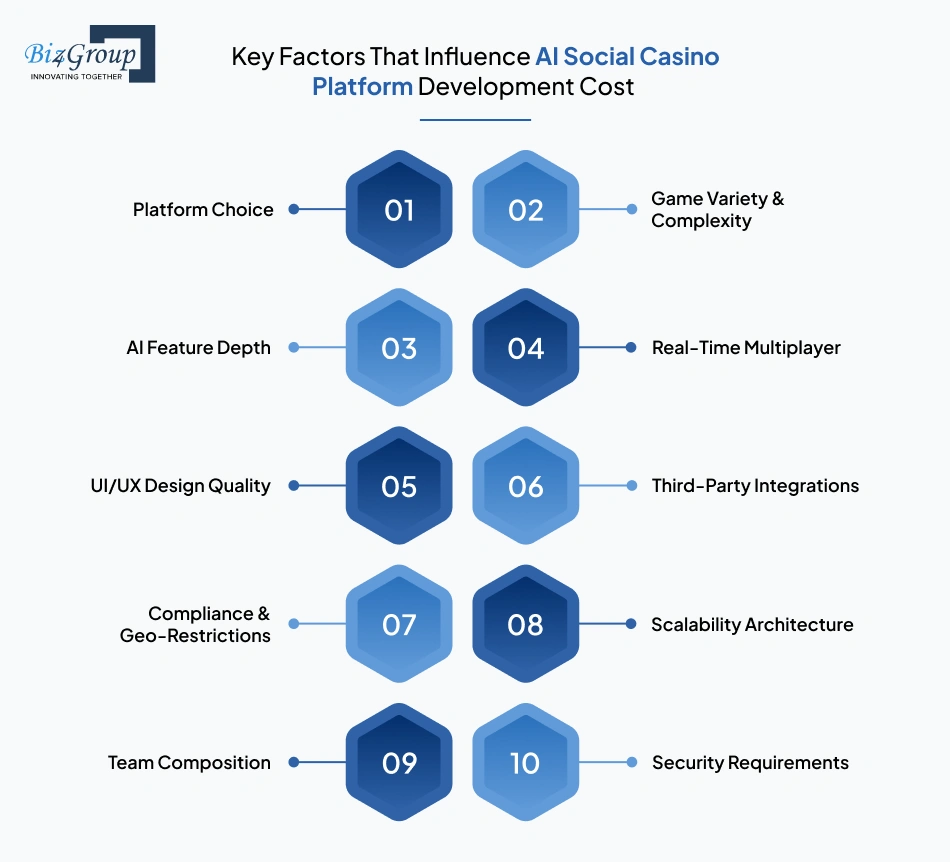
Estimating the development pricing of AI social casino platform is more than a simple number. Several key factors influence the final budget and understanding them can help founders plan realistic investments and avoid cost overruns.
Consider this scenario:
"I am planning to launch an AI social casino platform targeting mobile and web, with multiple games, AI-driven personalization, and social features, but I am unsure why development quotes vary so widely and what factors will push the total investment from $50,000 to over $200,000."
Below is a breakdown of the major cost drivers.
Cost Impact: Medium to High
Choosing between web-only, iOS, Android, or a cross-platform approach directly affects development costs. Single-platform MVPs are cheaper, while cross-platform development can increase budgets by 30 to 40 percent due to extra testing, compatibility adjustments, and additional UI considerations. A web-only solution might start at $50,000, whereas a cross-platform mobile and web launch can push costs toward $150,000–$200,000+.
Cost Impact: High
The type and number of games significantly influence the creation cost of AI social casino platform. Simple slots cost less than poker or blackjack, while custom mini-games with unique mechanics, animations, and sound effects can add tens of thousands. For example, a two-slot game MVP may be feasible around $50,000–$80,000, while a multi-game suite with blackjack and poker plus mini-games can easily reach $150,000–$200,000.
Cost Impact: Medium to High
AI integration drives both engagement and costs. Basic recommendation systems are achievable at lower budgets, but full adaptive personalization engines, predictive analytics, or generative AI NPCs can add $20,000–$60,000. The depth of AI functionality is one of the main reasons budgets scale from startup-level to enterprise-level investments.
Cost Impact: High
Supporting live multiplayer tournaments or social interactions requires specialized backend architecture, such as WebSockets, game servers, and real-time data synchronization. Adding multiplayer functionality can increase development costs by 25–40 percent and is a major factor in projects exceeding $150,000.
Cost Impact: Medium
Casino-grade graphics, animations, custom assets, sound effects, and intuitive user flows significantly affect budgets. High-quality design can add $10,000–$30,000, influencing whether a platform looks polished for large audiences or feels minimalistic for MVP testing.
Also Read: Top UI/UX Design Companies in USA
Cost Impact: Medium
Integrations such as social login, analytics platforms, push notifications, CDNs, and payment gateways increase complexity and cost. Simple MVPs may include one or two integrations, while enterprise-level platforms with multiple third-party systems may require $15,000–$25,000 in integration efforts.
Cost Impact: Medium
Platforms targeting multiple regions must implement age verification, GDPR/CCPA compliance, and region-specific content filtering. Compliance requirements can add $5,000–$20,000 depending on the number of geographies and legal complexities.
Cost Impact: High
Choosing microservices over monolithic architecture, adding auto-scaling, cloud deployment, or multi-region support impacts the AI social casino platform development cost for startups and enterprises. MVP platforms can manage with monolithic architecture at $50,000–$80,000, but scalable enterprise-grade solutions often reach $150,000–$200,000+.
Cost Impact: Medium
The mix of senior vs. junior developers, dedicated vs. shared resources, and AI specialists can change costs substantially. Dedicated teams with AI engineers and senior developers accelerate delivery but increase the comprehensive AI social casino platform development budget.
Cost Impact: Medium to High
Anti-cheat systems, data encryption, and DDoS protection are critical for long-term stability. Minimal security might be included in MVP budgets, but enterprise platforms investing in robust anti-cheat, monitoring, and encryption systems may spend $10,000–$30,000 on security.
Considering all these factors together, the total cost of ownership for an AI social casino platform depends on scope and ambition:
A well-planned platform accounting for AI depth, multiplayer functionality, multiple games, cross-platform support, social features, and enterprise-level security often approaches the higher end of the range. Understanding these cost drivers allows founders to prioritize features, plan realistic budgets, and evaluate AI social casino investment strategically.
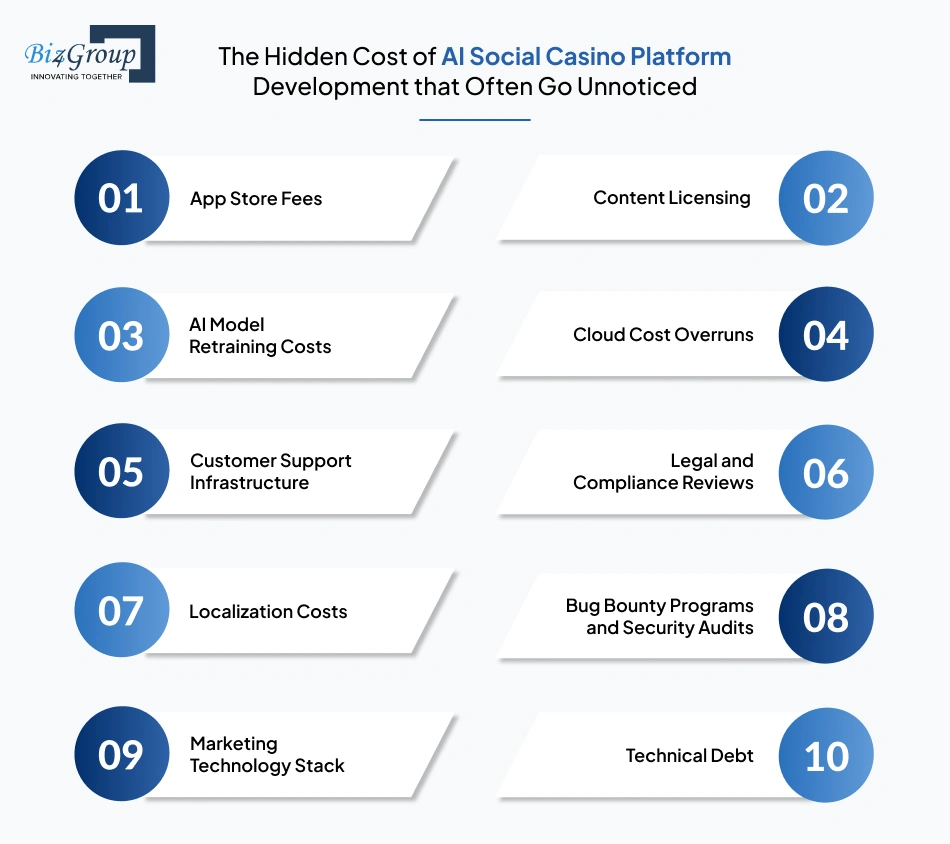
Building an AI social casino platform is rarely expensive because of the features you planned for. More often, budgets get stretched because of the costs you did not expect. Many founders calculate game development, AI functionality, and infrastructure but overlook the operational expenses that appear during testing, launch, and growth stages.
These hidden costs rarely show up in the initial proposal, but they can significantly increase the AI social casino platform development cost after development begins or once real players start using the platform.
If your goal is building a sustainable product rather than simply launching one, these are the budget killers you should plan for early.
Cost Impact: Medium to High
Estimated Cost: Revenue dependent
Many businesses calculate development expenses but forget distribution costs.
For mobile launches:
If monetization heavily depends on virtual currency purchases, store commissions can become one of your largest ongoing expenses.
Cost Impact: Medium
Estimated Cost: $2,000 to $30,000+ annually
Casino platforms often require:
Many founders mistakenly assume these are one-time purchases. In reality, recurring licensing subscriptions can continuously increase operational costs.
Cost Impact: Medium to High
Estimated Cost: $5,000 to $50,000+ annually
AI systems do not remain effective forever.
Player behaviors evolve constantly, requiring:
Costs include cloud compute resources, GPU usage, engineering time, and model monitoring.
The more sophisticated your personalization systems become, the larger this expense grows.
Cost Impact: High
Estimated Cost: Can increase infrastructure costs by 5x to 10x
Cloud infrastructure looks inexpensive during early development.
However:
can dramatically increase monthly bills.
A platform spending $2,000 per month may suddenly face infrastructure costs exceeding $10,000 during rapid growth periods.
This hidden factor dramatically impacts the comprehensive AI social casino platform development budget.
Cost Impact: Medium
Estimated Cost: $500 to $10,000+ monthly
Social gaming platforms require more support than many founders anticipate.
Common expenses include:
As player volume increases, support operations become a recurring operational expense rather than a temporary launch cost.
Cost Impact: Medium
Estimated Cost: $3,000 to $25,000+
Legal costs frequently appear later than expected.
Expenses often include:
Skipping legal reviews may appear cheaper initially but often creates larger risks later.
Cost Impact: Medium
Estimated Cost: $2,000 to $20,000+
Expanding internationally introduces new expenses:
Localization becomes particularly expensive when platforms continuously release new games and content updates.
Cost Impact: Medium to High
Estimated Cost: $5,000 to $50,000+
Security investments are frequently delayed until problems occur.
Typical costs include:
Fixing vulnerabilities before launch is usually much cheaper than recovering from a breach afterward.
Cost Impact: Medium
Estimated Cost: $1,000 to $15,000+ monthly
Player acquisition and retention require technology investments.
These may include:
Marketing technology often becomes one of the fastest-growing expenses after launch.
Cost Impact: Very High
Estimated Cost: Can add 20% to 50% to future development budgets
Technical debt is one of the most dangerous hidden expenses.
Examples include:
Shortcuts taken during MVP development frequently result in expensive rewrites later.
Many platforms discover that rebuilding parts of the product becomes more expensive than building correctly from the start.
Many founders budget only for initial development and overlook operational realities.
A platform initially estimated at $50,000 can easily require $80,000 to $120,000 after hidden expenses are included.
Similarly, enterprise platforms estimated at $150,000 often move beyond $200,000+ once scaling, compliance, AI maintenance, and operational expenses are considered.
Understanding these hidden expenses provides a more realistic view of the actual cost of building an AI social casino platform and helps businesses avoid budget surprises during growth.
The team structure behind your platform can significantly impact development timelines, overall investment, scalability, and product quality. A platform with identical features may cost substantially different amounts depending on whether development is handled internally, outsourced offshore, or distributed across hybrid teams.
Consider this scenario:
"I want to launch an AI social casino platform with advanced personalization and multiplayer functionality, but I am confused whether hiring an internal team, working with offshore developers, or using a hybrid model will give me the best balance between cost, speed, and quality."
Below is a practical comparison of in-house versus offshore development.
|
Factor |
In-House Team |
Offshore Development |
|---|---|---|
|
Avg. Hourly Rate |
$100–$180/hr |
$20–$70/hr |
|
Total Build Cost (Mid-Level Product) |
$180K–$300K |
$60K–$120K |
|
Communication |
Easy, real-time |
Time zone gaps possible |
|
IP Control |
High |
Depends on contracts |
|
Speed to Hire |
Slow (3–6 months) |
Fast (2–4 weeks) |
|
Quality Consistency |
High (direct oversight) |
Varies by vendor |
|
Long-Term Flexibility |
Lower (fixed headcount) |
Higher (scale up/down) |
Building internally usually makes sense when the platform represents a long-term strategic product rather than a short-term project.
Advantages include:
Challenges include:
For businesses building long-term products, in-house teams often increase the overall development pricing of AI social casino platform, but provide stronger ownership and continuity.
Offshore development is commonly used when businesses want faster delivery and lower initial costs.
Advantages include:
Challenges include:
This approach works particularly well for MVP development, feature expansion projects, and businesses optimizing their AI social casino platform development cost for startups and enterprises.
Also Read: Top Software Development Outsourcing Companies
Many companies are increasingly adopting hybrid structures because they balance cost efficiency with quality control.
A typical hybrid approach includes:
This model often provides the best balance between speed, quality, and budget while reducing the risks associated with fully outsourced development.
Nearshore regions such as Eastern Europe and Latin America provide another option.
Benefits include:
Nearshore development typically costs more than offshore teams but less than fully internal teams.
Regardless of location, vendor evaluation is critical.
When evaluating development partners, look for:
Management overhead should also be included in planning because outsourced development still requires active coordination and oversight.
The impact on your comprehensive AI social casino platform development budget can be significant depending on team structure:
Ultimately, the right approach depends on product goals, budget constraints, internal expertise, and long-term growth plans.
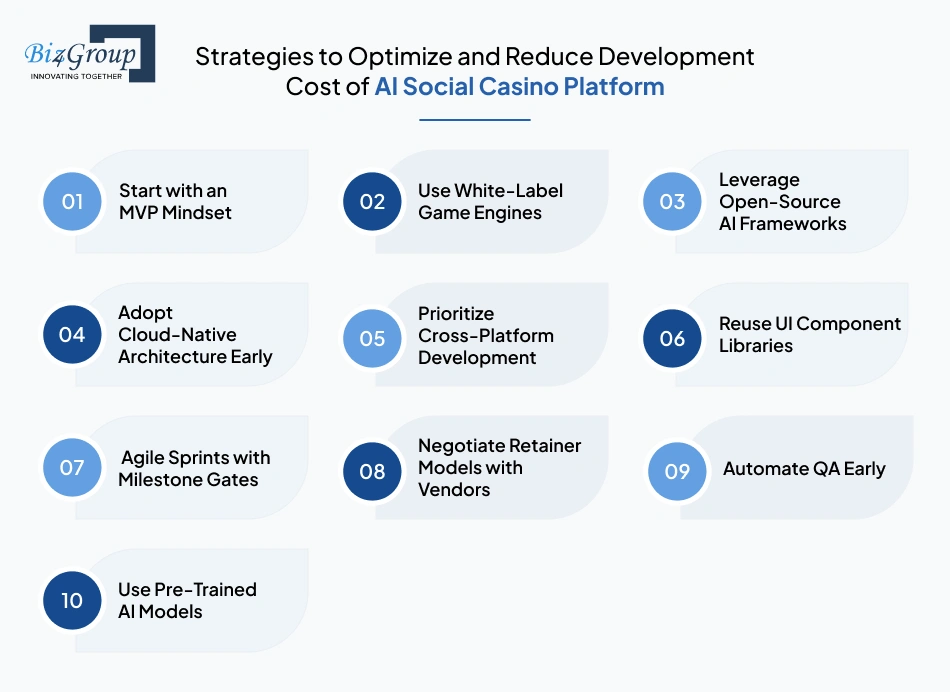
Reducing the creation cost of AI social casino platform without compromising quality is achievable with strategic planning and careful technology choices. The goal is to focus on what drives engagement and monetization while avoiding unnecessary spend. Here are actionable strategies with practical cost-saving insights.
Launch with 2–3 core games rather than a large library. A lean MVP can reduce development hours by 30–40% while allowing you to test player engagement and AI features before expanding. For example, an MVP with 2 slots and one poker table may cost $50,000–$80,000 compared to $120,000–$150,000 for 10–15 games.
Licensing a proven slot or poker engine avoids building complex mechanics from scratch. White-label engines can save 20–30% of development costs on game logic and reduce time-to-market by several months. Initial licensing may cost $5,000–$15,000 per game instead of $50,000–$80,000 to develop internally.
Using frameworks like TensorFlow, PyTorch, or Hugging Face reduces AI development time. Pre-built models and libraries can save $10,000–$25,000 compared to building custom AI solutions from scratch and reduce AI engineer hours by 30–50%.
Serverless functions and cloud-native approaches reduce idle server costs and simplify scaling. Platforms that implement cloud-native design can lower infrastructure expenses by 15–25% in the first year and avoid costly re-architecture later.
Building with React Native or Flutter instead of separate native iOS and Android apps can save 30–40% in development costs while maintaining a consistent user experience. This approach also reduces QA effort since most testing is shared across platforms.
Casino-themed UI kits and pre-built components reduce design and front-end coding time. This can save $5,000–$15,000 on design and development while ensuring high-quality visual appeal. Buttons, menus, modals, and animations can all be reused.
Pay for progress rather than a fixed full-project cost. Using agile sprints with milestone approvals allows early course corrections, reduces wasted development effort, and can optimize costs by 10–20% compared to traditional waterfall contracts.
Long-term relationships with development partners using monthly retainers often cost less than paying per feature or project. Retainer models can save 15–25% on labor compared to ad hoc project billing.
Investing in automated testing for UI, game logic, and AI functionality reduces manual QA hours. Automation can save 40–60% of QA costs over time. For a mid-level platform with QA costs of $20,000, automation could reduce it to $8,000–$12,000 annually.
Fine-tuning pre-trained models for recommendations, personalization, or fraud detection is far cheaper than training from scratch. This approach can cut AI development costs by 25–50%, especially for early MVPs or mid-level platforms.
Implementing these strategies can reduce the total cost of ownership for an AI social casino platform by $20,000–$80,000 depending on platform complexity. Startups can launch high-quality MVPs with 30–40% less investment, while enterprises can optimize ongoing operational costs without sacrificing user engagement or AI sophistication.
By combining MVP prioritization, cloud efficiency, pre-built engines, and automation, founders can maximize ROI and maintain flexibility for future growth.
Deciding between building a custom AI social casino platform or using a white-label/SaaS solution is a critical strategic decision. The right choice depends on your budget, timeline, competitive advantage, and long-term growth plans. Use this framework to evaluate your options.
|
Factor |
Build (Custom) |
Buy (White-Label / SaaS) |
Hybrid Approach |
|---|---|---|---|
|
Control & Customization |
Full control over features, AI logic, branding |
Limited customization, vendor-dependent |
Custom AI/personalization on top of white-label base |
|
Time to Market |
Months |
Weeks |
Weeks to months |
|
Upfront Cost |
$80K–$220K+ |
$5K–$30K + revenue share |
$5K–$30K + $30K–$80K for AI layer |
|
Best For |
Funded startups, enterprises, differentiation strategy |
Quick market testing, lean budgets |
Mid-stage companies needing speed + differentiation |
|
Long-Term Flexibility |
High |
Low |
Medium |
|
Risks |
Requires ongoing development and maintenance |
Vendor lock-in, limited AI customization |
Integration complexity, partial dependency on vendor |
Custom Build provides complete ownership of features, AI logic, and branding. It is ideal for startups and enterprises that view the platform as a long-term strategic asset. While the upfront cost of creating AI social casino platform is higher, you gain full flexibility and scalability.
White-Label / SaaS Platforms enable rapid launches at low initial investment. They are well-suited for market testing or budgets under $30K, but come with limited customization and potential vendor dependency.
Hybrid Approach combines the best of both worlds. Using a white-label base with a custom AI/personalization layer reduces time-to-market while allowing differentiation through advanced AI features. This strategy is increasingly popular for mid-stage companies in 2025–2026.
When deciding, consider the total cost of ownership for an AI social casino platform, not just the upfront investment. Proper evaluation ensures that the AI social casino platform development costing aligns with your timeline, brand requirements, and long-term growth goals.
This comparison helps founders and enterprises choose the most cost-effective and strategic path for launching a competitive platform, balancing speed, customization, and ongoing investment in AI and social features.
The economics of building AI social casino platforms are changing rapidly. Features that were considered premium only a few years ago are becoming standard expectations in 2026. At the same time, new technologies are introducing additional infrastructure, compliance, and AI expenses that directly influence development budgets.
For founders asking:
"If I start building an AI social casino platform today, which emerging technologies and market trends will increase development costs and which investments are becoming necessary to stay competitive by launch?"
The answer lies in understanding how modern player expectations, AI innovation, and infrastructure requirements are reshaping costs.
Below are the biggest trends influencing development budgets in 2026 and beyond.
Cost Impact: +15% to +25%
Generative AI is moving beyond chatbots and entering gameplay experiences.
Platforms are increasingly adopting:
While these features increase engagement, they also introduce:
As a result, platforms integrating generative AI often require significantly larger budgets than traditional social casino applications.
Cost Impact: Medium to High
Modern players increasingly expect platforms to understand preferences automatically.
Examples include:
Real-time personalization requires:
Platforms lacking personalization increasingly struggle with retention and monetization.
Cost Impact: +$20,000 to +$50,000+
Blockchain integration remains optional but continues growing.
Popular implementations include:
These features introduce:
Most companies still treat Web3 as an expansion layer rather than an initial launch requirement.
Cost Impact: +10% to +15%
Voice interactions are beginning to appear in social gaming experiences.
Examples include:
Supporting these experiences requires:
This creates another layer of front-end and AI investment.
Cost Impact: High
Immersive casino environments continue gaining attention.
Early implementations include:
These experiences introduce:
While still emerging, early adopters are already budgeting significantly larger investments for immersive experiences.
Cost Impact: +$5,000 to +$20,000+
Privacy requirements continue expanding globally.
Platforms increasingly require:
Compliance is no longer simply a legal consideration. It has become a technical requirement influencing architecture decisions.
Cost Impact: Medium
Social casino experiences increasingly depend on:
Edge computing reduces delays but requires:
The result is higher infrastructure investment but better player experiences.
Cost Impact: +$10,000 to +$25,000
AI safety systems are gaining importance as regulators focus more on player protection.
Modern platforms increasingly implement:
These systems introduce:
Responsible gaming capabilities are quickly shifting from optional features to expected functionality.
These trends are changing the cost structure of AI social casino platforms in two ways:
Factors increasing costs:
Factors reducing costs:
Cost Impact Summary
|
Trend Adoption Level |
Estimated Budget Impact |
|---|---|
|
Minimal AI + Basic Social Features |
$50,000–$80,000 |
|
Advanced Personalization + Multiplayer |
$80,000–$150,000 |
|
Generative AI + Large Scale Infrastructure |
$150,000–$220,000+ |
So, understanding these trends early allows founders to prioritize investments strategically instead of discovering new cost drivers halfway through development.
Before getting too caught up in numbers and estimates, it helps to pause and look at how AI actually works in real products. These examples give you a clearer sense of what gets built, what problems are solved, and what kind of results come out of it.
They also illustrate how AI social casino platform development cost for startups and enterprises translates into tangible value.
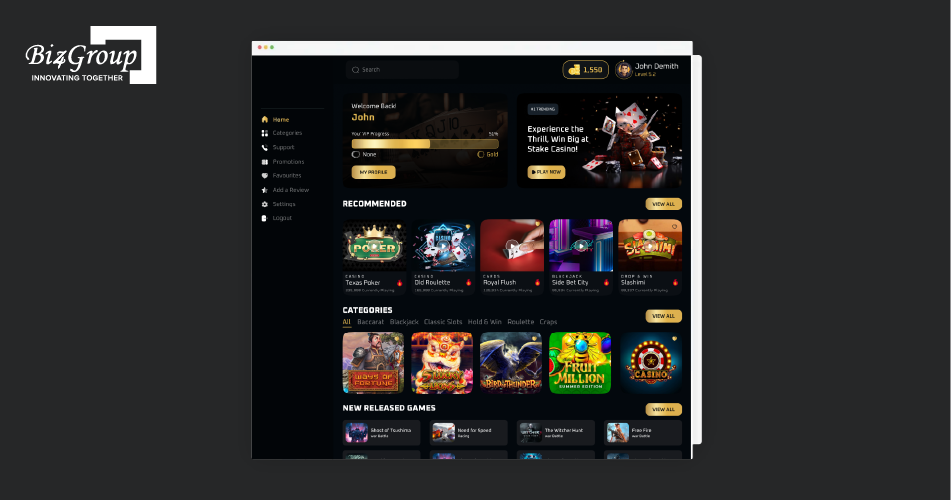
Stackr is a social casino platform that leverages AI to create personalized player experiences. The platform uses machine learning to recommend games, optimize virtual rewards, and detect unusual activity. AI also adjusts game difficulty and engagement patterns based on individual player behavior, helping retain users longer and increase session times.
Biz4Group handled the full development cycle, including backend architecture, AI engine integration, and front-end design. By focusing on both social and AI-driven personalization, Stackr was able to launch a product that feels engaging and responsive to every player, showing how strategic AI social casino investment improves user retention.
View Project: Stackr Portfolio
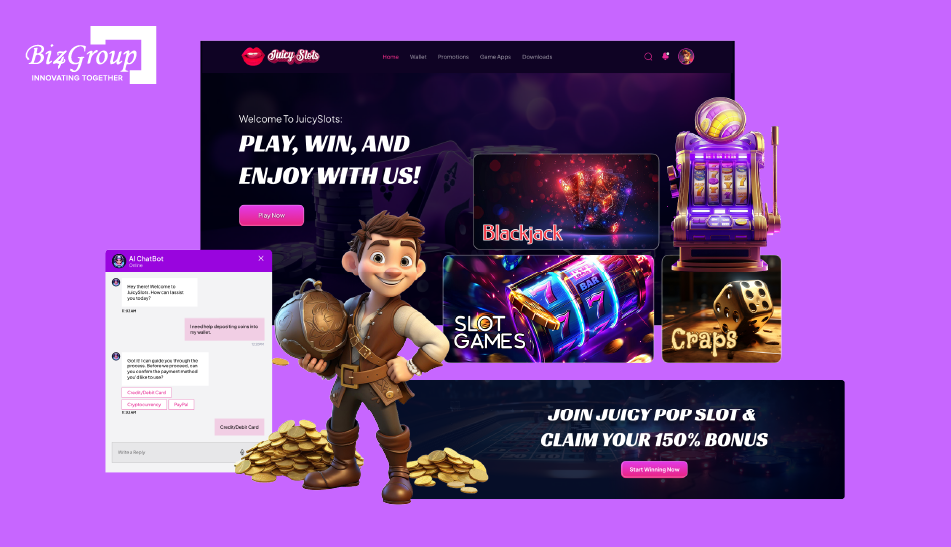
JuicySlots aggregates a variety of casino games in a single social platform, combining AI personalization with a broad game library. The platform uses AI to analyze player preferences, recommend the most engaging games, and dynamically adjust rewards. This approach ensures players spend more time on the platform and return regularly.
Biz4Group developed the system with a focus on scalability, multi-game integration, and seamless AI-driven user experiences. This project demonstrates a comprehensive AI social casino platform development budget in action and highlights how prioritizing user experience over raw features optimizes cost efficiency.
View Project: JuicySlots Portfolio
Looking across these examples, one thing stands out. The value did not come from adding AI for the sake of it. It came from solving a real problem in a way that felt natural to the user.
That is usually the difference. When the problem is clear and the execution is right, the building price of social casino platform integrating AI starts to make sense because it is tied to something people actually use.
Once you move beyond cost estimates and start planning actual execution, one thing becomes obvious very quickly: the development partner you choose directly influences how much you spend, how quickly you launch, and how effectively your platform scales.
Building an AI social casino platform requires more than development expertise. It requires balancing AI capabilities, infrastructure, personalization, scalability, and monetization while keeping the AI social casino platform development cost aligned with business goals.
This is where experienced partners make a difference. Biz4Group focuses on building solutions around real business use cases rather than simply implementing technology. This approach helps businesses optimize the cost of building an AI social casino platform while reducing unnecessary development expenses.
Biz4Group a leading AI development company in USA brings experience across gaming, AI, and enterprise software with:
✓ 100+ AI-powered solutions delivered
✓ 70+ custom AI models trained and deployed
✓ 50+ enterprise AI integrations implemented
Whether you are validating an MVP or building enterprise-grade infrastructure, the goal is not simply to launch fast. The goal is to build smart, control costs, and create scalable products that grow efficiently.
Ready to estimate costs, validate your idea, or build your AI social casino platform roadmap? Schedule a call with Biz4Group and start building with confidence.
AI social platform development typically costs between $50K–$220K+ depending on features, AI complexity, platform type, and team location. An MVP starts around $50K–$80K, while a full enterprise platform can exceed $220K.
Development timelines of AI social casino platform depend on the scale of the platform. An MVP takes 3–5 months, a mid-level product 6–9 months, and an enterprise platform 10–18 months. Complexity of AI features, number of games, and team size are the biggest factors affecting the timeline.
Generally, no. Since AI social casino platforms don't involve real-money gambling, most regions don't require a gambling license. However, age verification, data privacy compliance (GDPR, CCPA), and app store policies still apply.
AI Social casino platforms use virtual coins or chips with no real-money wagering, making them legal in most regions without a gambling license. Real-money platforms require strict licensing, compliance, and payment processing infrastructure.
AI features typically add $20K–$60K to the base development cost for AI social casino platform depending on complexity, basic recommendation engines sit at the lower end, while full personalization and adaptive game logic push toward the higher end.
Yes. Starting with an MVP focused on 2–3 core games, basic AI personalization, and essential social features can be achieved between $50K–$80K. You can scale features of AI social platforms progressively based on traction and revenue.

with Biz4Group today!
Our website require some cookies to function properly. Read our privacy policy to know more.