 Location :
Orlando, FL, USA
Location :
Orlando, FL, USA +1 (407) 714-1616
 info@biz4group.com

- How much does it cost to start an online casino? Startup costs typically range from $200,000 to $1.2 million, depending on licensing jurisdiction, platform complexity, features, and marketing scale.
- Licensing costs vary significantly by region, with Curaçao licenses starting around $20,000 to $30,000, while Malta licenses often exceed $100,000 to $150,000.
- Online casino software and game development is one of the largest cost drivers, ranging from $20,000 to $500,000+, depending on whether you choose white-label or custom solutions.
- Marketing can consume up to 50 percent of the total budget, primarily through SEO, affiliate programs, influencer partnerships, and paid advertising.
- Affiliate programs offer scalable, performance-based growth, allowing operators to acquire players with minimal upfront marketing spend.
- Long-term success depends on strategic planning, regulatory compliance, scalable technology, and retention-focused user experience design.
Starting an online casino in 2026 typically costs between $200,000 and $1.2 million, depending on licensing jurisdiction, platform architecture, game providers, compliance requirements, and marketing scale.
An online casino is a licensed digital gambling platform that operates under specific regulatory frameworks and requires significant upfront and ongoing investment to remain compliant and profitable.
This guide provides a detailed breakdown of online casino startup costs, including licensing fees, casino software development, game integration, payment processing, compliance, and marketing. It is designed for entrepreneurs and investors evaluating white label versus custom casino platforms with a focus on ROI and long-term scalability.
The global iGaming industry continues to expand rapidly, driven by increasing digital adoption and the growth of regulated online gambling markets worldwide, according to Statista. However, profitability depends heavily on licensing quality, operational costs, and technology choices made at the planning stage.
Total Estimated Cost to Start an Online Casino
If you are evaluating how much does it cost to start an online casino, the initial investment typically ranges between $200,000 and $1.2 million, depending on licensing jurisdiction, software architecture, game portfolio, compliance requirements, and marketing scale.
This cost range reflects the combined expenses required to launch a legally compliant and operational online casino platform, not just the technology layer.
Online Casino Startup Cost Breakdown
|
Category |
Estimated Cost Range (USD) |
Notes |
|---|---|---|
|
Casino Software License |
$10,000 to $500,000 |
Depends on white label versus proprietary software |
|
Gaming License |
$10,000 to $150,000 annually |
Jurisdiction dependent such as Malta, Curaçao, Isle of Man |
|
Payment Processing Integration |
$5,000 to $20,000 |
Includes fiat and crypto gateways, KYC and AML checks |
|
Website Design and Development |
$3,000 to $15,000 |
Custom UX design versus pre built templates |
|
Game Content |
$20,000 to $500,000+ |
Slots, table games, live dealer games licensed per provider |
|
Server and Hosting Infrastructure |
$3,000 to $10,000 annually |
Cloud hosting, scalability, DDoS protection |
|
Security and Encryption |
$2,000 to $10,000+ |
SSL certificates, fraud detection, secure transactions |
|
Legal and Compliance Fees |
$5,000 to $50,000 |
Regulatory audits, GDPR compliance, legal advisory |
|
Marketing and Advertising |
$10,000 to $300,000+ |
SEO, paid ads, influencer and affiliate campaigns |
|
Affiliate Management Software |
$1,000 to $20,000 annually |
Tracking and optimizing affiliate performance |
|
Customer Support Setup |
$2,000 to $15,000 |
Live chat tools, ticketing systems |
|
Operational Staff Salaries |
$10,000 to $100,000 |
Initial marketing, support, and operations team |
|
Banking and Transaction Reserves |
$50,000 to $200,000 |
Liquidity for player payouts and fraud mitigation |
Recurring Operational Costs to Plan For
Beyond initial setup, online casino operators should budget for ongoing annual operating expenses that often reach low six figures, depending on platform scale and market focus. These recurring costs typically include server maintenance, staff salaries, compliance renewals, payment processing fees, and continuous marketing spend.
Understanding these baseline and recurring costs is essential when assessing how much does it cost to start an online casino that remains compliant, scalable, and financially sustainable from day one.
Cost to Start an Online Casino in the EU
When evaluating how much does it cost to start an online casino in the EU, licensing jurisdiction is one of the most decisive cost drivers. European licenses offer high credibility, but they also introduce stricter compliance requirements and higher upfront investment compared to offshore options. These considerations differ significantly from regulated US markets, where Online Casino Platform Providers in Pennsylvania must comply with state-specific gaming laws, platform certifications, and operator partnerships.
Among EU-focused operators, Malta and Curaçao are the most commonly compared jurisdictions due to their contrasting cost structures, regulatory depth, and market access.
Malta: High Trust, Fully Regulated EU Licensing
Malta is considered one of the most reputable licensing jurisdictions in Europe. Casinos licensed by the Malta Gaming Authority (MGA) benefit from strong player trust, broad payment provider acceptance, and regulatory recognition across the EU.
Estimated Cost
Starting an online casino under a Malta license typically costs $100,000 to $150,000, including license application fees, legal advisory, compliance setup, and regulatory audits.
Advantages
- Strong credibility with European players and financial institutions
- Legal access to multiple EU markets
- Robust consumer protection and data security standards
Limitations
- Higher upfront and ongoing compliance costs
- Frequent regulatory reporting and operational audits
Malta is best suited for operators prioritizing long term brand trust, stable banking relationships, and regulated EU market access.
Curacao: Lower Cost Entry with Reduced EU Trust
Curaçao remains a popular option for startups exploring how to start an online casino with limited initial capital. While not an EU license, it is often used by operators targeting international or test markets.
Estimated Cost
Launching an online casino with a Curaçao license typically costs $20,000 to $30,000, covering sub license acquisition and initial legal structuring.
Advantages
- Faster and more affordable licensing process
- Lower regulatory burden and taxation
- Suitable for MVP launches and early stage operators
Limitations
- Lower trust among European players and banks
- Restricted access to some payment providers and affiliate networks
Curaçao is commonly chosen by operators focused on speed to market rather than long term EU compliance positioning.
How Much Does It Cost to Start an Online Casino in the EU?
The total cost to start an online casino in the EU depends on whether you prioritize regulatory credibility or cost efficiency. Licenses such as Malta, Isle of Man, or UKGC require higher upfront investment but provide stronger market access and trust. Jurisdictions like Curaçao or Kahnawake reduce launch costs but limit banking and affiliate scalability within Europe.
Your decision should align with long-term market focus, budget flexibility, and growth strategy.
Cost Optimization Tip for EU Focused Operators
When calculating how much does it cost to start an online casino, platform strategy plays a major role in budget control. Turnkey and white label casino platforms allow operators to launch faster by bundling software, game integrations, licensing assistance, and payment gateways into a single solution.
These platforms can significantly reduce upfront costs, often bringing launch budgets closer to $200,000 instead of exceeding $1 million, especially for first time operators.
Growth and ROI Consideration
For operators planning long term EU visibility, early investment in affiliate management systems and on site SEO is critical. These channels support sustainable player acquisition and reduce long term dependency on high cost paid advertising.
Choosing the right licensing and infrastructure decisions early can prevent six figure operational inefficiencies later.
Want to Know What It Really Costs to Launch a Casino?
From licenses to games to marketing—we'll break it all down based on your goals and region.
Get a Custom EstimateCost Breakdown to Start an Online Casino: Detailed Cost Breakdown: Where the Money Goes
Understanding how much it costs to start an online casino requires a category-by-category breakdown of both upfront and recurring expenses. Each cost component directly affects compliance readiness, scalability, and time to market.
1. Initial Startup Costs
When assessing how much does it cost to build a casino online, the majority of expenses are incurred before launch. These are the core upfront investments required to make the platform operational.
Casino Software License
Estimated Cost: $10,000 to $500,000
Casino software licensing costs vary based on whether you choose a white label platform or a custom proprietary solution. White label software reduces development time and upfront investment, while custom platforms offer greater flexibility at a significantly higher cost.
Game Content and Platform Integration
Estimated Cost: $20,000 to $500,000+
This includes integration of RNG based slot games, table games, and live dealer content. Costs increase based on the number of game providers, exclusivity agreements, and the inclusion of live streaming infrastructure.
Website Design and Development
Estimated Cost: $3,000 to $15,000
Website development covers front end UX and UI design, mobile responsiveness, and content management setup. Custom designed platforms increase branding control but require higher development investment than pre built frameworks. For a deeper technical overview of design, architecture, and development considerations, you can also refer to this guide on how to create a casino website
Affiliate Management Software
Estimated Cost: $1,000 to $20,000 annually
Affiliate management tools are essential for tracking traffic sources, player value, and commission payouts. These platforms support scalable player acquisition through affiliate partnerships.
2. Ongoing Operational Costs
After launching, operators should plan for continuous expenses that affect the long-term cost to start and operate an online casino.
Hosting and Server Infrastructure
Estimated Cost: $3,000 to $10,000 annually
This includes cloud hosting, uptime monitoring, DDoS protection, and scalability resources. High traffic casinos require dedicated infrastructure to maintain performance and security standards.
Staff and Customer Support
Estimated Cost: $10,000 to $100,000 initially
Operational staffing costs include marketing management, compliance oversight, technical support, and customer service teams. Live support availability significantly impacts player retention and trust.
Licensing and Regulatory Compliance
Estimated Cost: $10,000 to $150,000 annually
Recurring compliance expenses include license renewals, regulatory audits, tax filings, and responsible gambling certifications. Costs vary by jurisdiction and regulatory strictness.
Marketing and Promotions
Estimated Cost: $10,000 to $300,000+
Marketing is a major ongoing investment and includes SEO, paid advertising, influencer partnerships, and affiliate commissions. Sustainable growth depends heavily on long term marketing efficiency.
For operators researching how much does it cost to start an online casino, entry level launches can be achieved near the $200,000 range, while premium platforms with extensive game libraries, strict compliance standards, and aggressive marketing strategies can exceed $1 million before going live.
These figures provide a realistic foundation for planning a compliant and scalable online casino operation.
Strategic Planning to Start an Online Casino
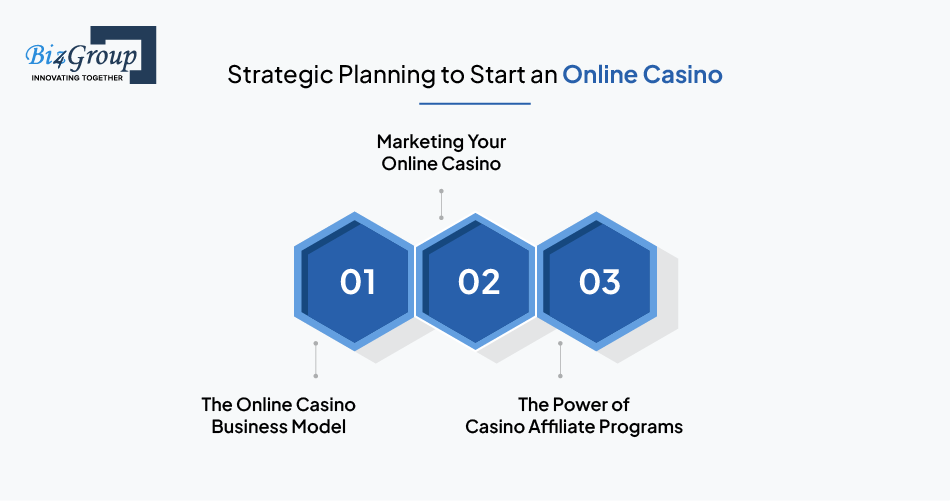
Strategic planning is the foundation of any successful online casino. Before calculating how much does it cost to start an online casino, operators must align business model, compliance obligations, technology choices, and marketing strategy into a long-term operating plan. These decisions determine profitability, scalability, and regulatory stability.
1. Online Casino Business Model
An online casino is not built solely on game variety or visual appeal. It operates on a structured revenue model designed to maximize player lifetime value while remaining compliant with gambling regulations. Understanding this model is essential when projecting ROI and managing startup costs.
Core Revenue Streams
Most online casinos generate revenue through a combination of the following sources:
- House edge from player gameplay, where statistical odds favor the operator
- Commission based revenue from third-party game providers
- Affiliate and influencer driven player acquisition, resulting in high lifetime value users
- VIP memberships and loyalty programs that increase repeat deposits and average spend
Defining these revenue streams early allows operators to forecast earnings relative to casino setup and operating costs.
Player Retention and Lifetime Value Strategy
Retention is one of the most important profitability levers in iGaming. Acquiring players is expensive, and long-term success depends on keeping them active.
Effective retention strategies typically include:
- Loyalty programs, cashback offers, and gamified rewards
- Personalized bonuses powered by CRM and player behavior data
- Live dealer games that increase engagement and session duration
Investing in retention reduces reliance on constant acquisition and helps offset casino game development and marketing costs over time.
Regulatory Compliance as a Strategic Priority
Compliance is a business requirement, not a technical formality. Failure to meet regulatory standards can halt operations entirely.
Key compliance components include:
- Know Your Customer (KYC) and Anti-Money Laundering (AML) policies
- GDPR-compliant user data protection
- Regular audits for fairness, security, and responsible gambling
Building compliance into the business model from day one supports legal operation and long-term trust with players, payment providers, and regulators.
2. Marketing Strategy for an Online Casino
Marketing plays a critical role in determining how much it costs to start and scale an online casino. A balanced acquisition strategy combines long-term sustainability with short-term visibility.
Search Engine Optimization (SEO)
SEO is one of the most cost-efficient long-term acquisition channels for online casinos.
A strong SEO foundation includes:
- Content targeting high-intent searches such as casino bonuses and game categories
- Affiliate landing pages supported by educational blog content
- Technical SEO, site speed optimization, and crawl efficiency
SEO reduces dependency on paid traffic and supports consistent player acquisition over time.
Influencer and Affiliate Marketing
Influencer and affiliate marketing are core growth drivers in iGaming due to their trust-based nature.
These channels are effective because:
- Streamers and reviewers showcase real gameplay and user experience
- Traffic comes from trusted third-party sources
- Acquisition is largely performance based
Platforms with strong UX, gamification, and live dealer support perform particularly well in influencer and affiliate driven acquisition models, where visible gameplay and experience directly influence conversion.
Paid Advertising (PPC)
Paid advertising can generate immediate traffic but requires strict cost control.
Common PPC approaches include:
- Search ads in permitted jurisdictions
- Native ads on gaming platforms
- Retargeting campaigns across social and programmatic networks
PPC is best used as a tactical accelerator rather than a long-term foundation, especially when managing early-stage casino launch costs.
Struggling to Budget Your iGaming Startup?
Our plug-and-play budget template helps you map every dollar from concept to launch.
Let's Connect3. Casino Affiliate Programs as a Growth Engine
Affiliate marketing is one of the most scalable and predictable acquisition channels in the online casino industry and should be implemented from the beginning.
Cost Efficiency of Affiliate Marketing
Affiliate programs reduce upfront risk by operating on a performance basis:
- Affiliates are paid only when they deliver real players
- Large fixed advertising budgets are avoided
- Traffic comes from established content and review platforms
This model helps operators manage how much does a casino cost over time without excessive spend.
Performance-Based Scaling
Successful affiliate programs rely on data-driven optimization:
- Tracking referrals, player value, and payout efficiency
- Adjusting commissions based on lifetime value and ROI
- Building long-term partnerships with top-performing affiliates
For operators focused on sustainable growth and predictable acquisition costs, affiliate marketing remains a core pillar of online casino expansion.
Technical Setup & Vendor Selection to Start and Online Casino
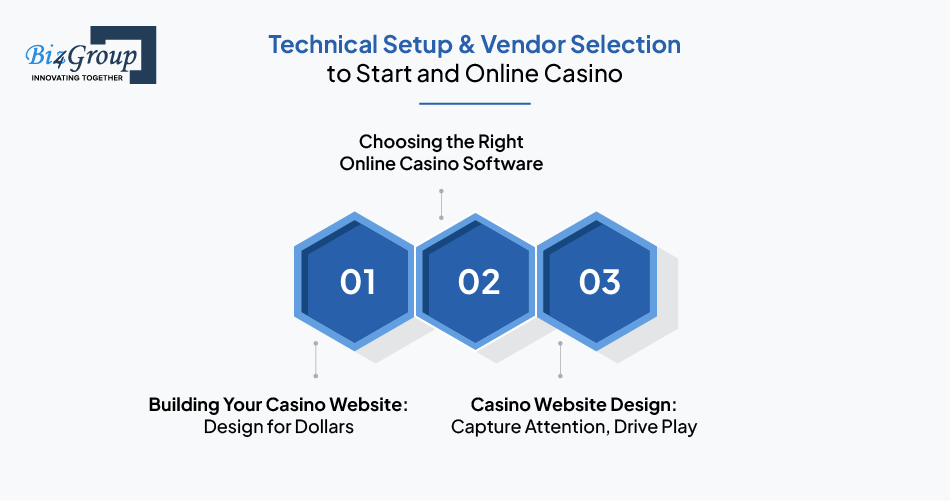
When evaluating how to start an online casino, the technology stack is one of the most critical cost and performance decisions. Beyond visual appeal, the platform must support scalability, security, regulatory compliance, and long-term player engagement.
These factors directly influence how much does it cost to start an online casino and how efficiently that investment converts into revenue.
1. Building Your Casino Website: Design That Drives Revenue
The casino website front end is where user experience, conversion, and monetization intersect. Design choices directly affect registration rates, deposits, and player lifetime value.
UX and UI Principles That Increase Conversions
High-performing online casinos prioritize:
- Clean, intuitive layouts with clear calls to action
- Mobile-first design for seamless gameplay across devices
- Streamlined onboarding flows for fast registration and deposits
Reducing friction at this stage improves first-time deposit rates and lowers acquisition costs.
Gamification and Conversion Rate Optimization
Gamification features are revenue drivers, not cosmetic additions.
Effective conversion tools include:
- Point systems, badges, and leaderboards to increase session duration
- Level-based progression with unlockable bonuses
- Continuous A/B testing of signup and deposit flows
These elements increase engagement and lifetime value, helping justify how much a casino costs to build through higher revenue per user.
2. Choosing the Right Online Casino Software Platform
Software selection is a core factor when calculating how much does it cost to start an online casino, as it determines operational flexibility, scalability, and future development expenses.
Essential Features to Prioritize
A robust casino software platform should include:
- Certified RNG systems to ensure fair gameplay
- Live casino support with streaming infrastructure
- Player dashboards with real-time analytics and reporting
- Multi-language and multi-currency capabilities
- Built-in tools for promotions, bonuses, and loyalty programs
Platforms lacking these features often require expensive custom development later.
Scalability and Long-Term Cost Control
To support growth without escalating costs, casino software should allow:
- Thousands of concurrent users without performance loss
- Easy integration with third-party games and payment gateways
- Modular upgrades without rebuilding the entire system
Selecting scalable software early helps control casino game development costs, which can rise quickly when core functionality must be custom built.
3. Strategic Casino Website Design and Player Psychology
Casino design decisions influence how players interact, deposit, and return. When assessing how much does it cost to build a casino, UI should be evaluated as a monetization tool, not a design expense.
Design Psychology That Increases Engagement
High-converting casino interfaces commonly use:
- Color psychology to guide player actions and urgency
- Visual feedback through progress bars and animations
- Time-sensitive offers and countdowns to encourage deposits
High-Converting UI Elements
Examples of interface components that improve performance include:
- Sticky deposit buttons optimized for mobile users
- Game thumbnails with interactive previews
- Personalized lobbies recommending games based on player behavior
Investing in user-focused design from the beginning reduces bounce rates, increases deposits, and improves ROI, whether evaluating how much does it cost to open a casino or optimizing an existing platform.
Real-World iGaming Platforms: Stackr and JuicySlots
To make your planning more practical and grounded in real delivery experience, it helps to see how advanced casino platforms are built in the real world. Two notable projects that demonstrate full-stack iGaming execution are Stackr and JuicySlots, developed by Biz4Group LLC for global audiences.
Stackr — AI-Powered Social Casino Platform
Stackr is a modern, AI-driven social casino platform designed to deliver highly personalized and gamified gaming experiences. It goes beyond traditional online casinos by incorporating engagement mechanics and smart recommendations to boost player interaction.
Key features include:
- AI-powered game recommendations that tailor gameplay to individual player behavior
- A library of 800+ games, including slots, card games, and roulette
- Gamification elements that increase session duration and retention
- Multi-device support for seamless gameplay on mobile, tablet, and desktop
- Real-time rewards and badge systems that drive repeat engagement
Stackr showcases how advanced technology and personalization engines can be used to differentiate a casino platform, improving engagement without proportionally increasing acquisition costs , a key factor when assessing your overall investment and ROI.
JuicySlots — Scalable Online Casino Game Hub
JuicySlots represents a full casino aggregation platform, giving users access to a curated collection of popular casino games from multiple providers in one interface.
Key components of the platform include:
- Aggregation of games from top providers like Game Vault, Vegas Sweeps, Fire Kirin, and more
- User-centric features such as in-platform wallet management and real-time balance updates
- Personalized user profiles that store preferences and gameplay history
- Secure transaction processing across fiat and cryptocurrency gateways
- Advanced search and filtering by game type and popularity
The architecture was built with Next.js for the frontend, Node.js for the backend, and PostgreSQL for database management, enabling both scalability and real-time interactions. JuicySlots is a blueprint for operators planning mid- to large-scale casino platforms and illustrates the type of investment and technical planning required for robust deployments.
Why These Portfolios Matter for Your Casino Cost Planning
Stackr and JuicySlots aren’t just case studies; they are blueprints for engineering roadmaps, feature prioritization, and architectural planning. These portfolio examples show:
- What components are typically included in a modern casino platform
- How third-party integrations (games, wallets, payment processors) influence development costs
- The impact of technology choices on scalability and long-term operational costs
- How UX, personalization, and gamification tie directly to player retention (and therefore revenue)
By reviewing these real implementations, you can better estimate both initial development investment and ongoing operational costs, especially when comparing white-label vs custom builds.
Obtaining the Necessary Licenses While Staring an Online Casino
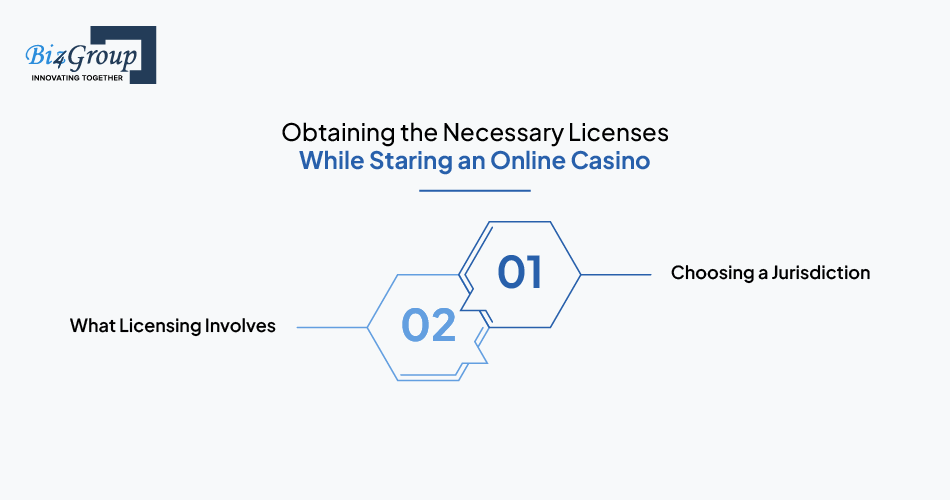
One of the most decisive factors when calculating how much does it cost to start an online casino is licensing. A gambling license is not only a legal requirement, but also a gateway to payment processors, affiliate networks, banking partners, and player trust. Licensing choices directly affect startup cost, credibility, and long-term scalability.
1. Choosing the Right Licensing Jurisdiction
Online casino licensing costs and requirements vary widely by jurisdiction. Operators typically choose between speed to market and regulatory prestige.
Curaçao
Estimated Cost: $20,000 to $30,000
Curaçao is one of the most affordable and fastest licensing options for online casino startups.
Advantages
- Quick approval timelines, often within 4 to 6 weeks
- Covers casino, sportsbook, and poker under a single license
- Lower upfront and ongoing regulatory costs
Limitations
- Lower trust among European players
- Restricted access to some banks and payment providers
Curaçao is commonly used for MVP launches or operators prioritizing speed and budget efficiency.
Malta (MGA)
Estimated Cost: Often exceeds $100,000
Licenses issued by the Malta Gaming Authority are among the most respected in the iGaming industry.
Advantages
- Strong credibility across European markets
- High acceptance by banks and payment processors
- Robust regulatory and player protection framework
Limitations
- Higher upfront and operational costs
- Longer approval timelines and ongoing audits
Malta is best suited for operators targeting regulated EU markets and long-term brand trust.
Other Licensing Jurisdictions
Estimated Cost: $50,000 to $150,000
Jurisdictions such as Gibraltar, Isle of Man, and Kahnawake offer a balance between regulatory credibility and operational flexibility.
These licenses often provide:
- Strong international reputation
- Favorable tax structures
- More complex legal and compliance requirements
They are typically chosen by operators planning multi-market expansion.
2. What Online Casino Licensing Involves
Licensing is more than an application fee. Most jurisdictions require comprehensive operational validation, including:
- Background checks on directors and shareholders
- Submission of business plans and financial projections
- Independent audits for RNG fairness and software integrity
- Verification of server location and hosting compliance
- Implementation of KYC and AML policies
These requirements add time and cost but are essential for legal operation.
For operators evaluating how to start an online casino, licensing decisions influence both startup cost and growth potential. While Curaçao allows lower cost entry, licenses such as Malta or Isle of Man provide greater trust, stronger banking access, and broader market reach.
Choosing the right jurisdiction is critical when assessing how much does it cost to open a casino with sustainable long-term ROI.
Planning your casino launch? Let's make it profitable.
Book a free strategy call with an iGaming expert to assess your business model.
Schedule My Free CallMarketing Strategy & Industry Trends for Online Casino
In the competitive iGaming market, marketing strategy directly impacts how much does it cost to start an online casino and how efficiently that investment converts into paying players. Beyond launch, sustainable growth depends on compliant acquisition channels and awareness of emerging industry trends.
Developing an Effective Online Casino Marketing Strategy
A successful marketing strategy balances long-term authority building with short-term visibility, while remaining compliant with gambling regulations.
SEO as a Long-Term Growth Foundation
Search engine optimization remains one of the most cost-efficient and sustainable acquisition channels for online casinos.
Effective casino SEO strategies focus on:
- Structuring websites and landing pages around high-intent search queries
-
Publishing content targeting commercial and regulatory intent, such as:
- Best online casinos for crypto
- No-deposit bonus casinos
- How to start an online casino legally
- Technical SEO, site speed optimization, and mobile performance
Strong SEO foundations reduce reliance on paid advertising and stabilize acquisition costs over time.
Localized Content and Compliance Messaging
Localization plays a critical role in both conversion and regulatory alignment.
Key localization practices include:
- Adapting language, currency, and promotions to specific markets
- Ensuring marketing materials comply with jurisdictional requirements such as UKGC or MGA regulations
- Highlighting responsible gambling measures, certifications, and player protection policies
Localized and compliant messaging improves trust, increases conversion rates, and supports licensing obligations.
Online Gambling Industry Trends Shaping Growth
Staying aligned with industry trends helps operators control operational costs and remain competitive as the market evolves.
Artificial Intelligence (AI) in Online Casinos
AI is increasingly used to improve efficiency, compliance, and player experience.
Common applications include:
- Real-time fraud detection and risk scoring
- Personalized game and bonus recommendations
- Player behavior monitoring and responsible gambling triggers
AI-driven automation helps reduce manual overhead while improving player retention.
Mobile-First Casino Experience
Mobile devices now account for a significant share of online casino traffic, making mobile optimization essential.
A mobile-first casino platform should support:
- Fully responsive, touch-optimized interfaces
- Biometric authentication such as fingerprint or face ID
- Stable live game streaming on mobile data connections
Optimizing for mobile improves accessibility and increases deposit frequency.
Cryptocurrency and Digital Payments
Cryptocurrency support has become a competitive expectation rather than a niche feature.
Benefits of crypto integration include:
- Faster deposits and withdrawals
- Lower transaction fees
- Global access with reduced banking friction
Supporting digital assets such as Bitcoin, Ethereum, and USDT expands market reach and payment flexibility.
Strategic Insight
Incorporating SEO, compliant localization, and emerging technologies helps operators manage how much does a casino cost to operate while improving scalability and future readiness. Casinos that align marketing strategy with industry trends are better positioned to attract players, maintain regulatory compliance, and sustain long-term profitability.
Monetization Through Affiliates
Affiliate marketing is one of the most effective ways to scale an online casino while controlling acquisition costs. When evaluating how much does it cost to start an online casino or how quickly profitability can be achieved, affiliate programs offer a proven, performance-based growth model with minimal upfront risk.
Maximizing Revenue Through Casino Affiliate Programs
Casino affiliate programs operate on a results-driven structure. Operators pay affiliates only when measurable outcomes occur, such as player registrations, first deposits, or net revenue generation.
This model aligns acquisition spending directly with revenue performance.
Common Casino Affiliate Commission Models
Online casinos typically use one of the following commission structures:
- CPA (Cost Per Acquisition)
A fixed, one-time payment for each new depositing player. This model is useful for short-term budget predictability and early-stage launches. - Revenue Share
Affiliates earn a percentage of a player’s net losses over time. This approach supports long-term growth and incentivizes affiliates to deliver high-quality, retained players. - Hybrid Models
A combination of CPA and revenue share. Hybrid structures balance immediate acquisition with long-term partnership value.
This flexibility allows operators to align commission strategies with their growth phase, whether they are learning how to start an online casino or scaling into multiple markets.
Tools Required to Run a Successful Affiliate Program
To manage affiliates effectively and protect margins, casinos typically require:
- Reliable affiliate tracking and reporting software
- Fraud detection systems and anti-bot filtering
- Tiered commission structures to reward high-performing partners
Automation and transparency are essential for scaling affiliate programs without increasing operational overhead.
Example of Affiliate Revenue Performance
Consider a revenue share commission of 30 percent.
If a referred player generates $500 in net losses in a month, the affiliate earns $150, while the casino retains the remaining revenue.
When scaled across hundreds of referred players, affiliate marketing becomes a high-ROI acquisition channel with limited upfront cost.
This performance-based structure is especially valuable when managing casino game development costs and other fixed operational expenses, since acquisition spend is directly tied to revenue generation.
Strategic Affiliate Insight
The most successful casino affiliate programs are automated, transparent, and performance-driven. Operators that reward top-tier affiliates consistently benefit from sustained traffic, predictable acquisition costs, and reduced reliance on traditional advertising.
For long-term growth, affiliate marketing remains one of the most scalable and cost-efficient pillars in the online casino industry.
Cost, ROI, and Profitability of an Online Casino
Understanding how much does it cost to start an online casino is only part of the decision. Long-term success depends on whether that investment can generate sustainable profitability. Calculating return on investment (ROI) helps operators assess whether their casino business model is viable, scalable, and efficient.
How to Calculate Online Casino ROI
There is no single formula that guarantees returns, but ROI can be evaluated using a simple framework.
Net Profit
Total Revenue minus Total Costs
Total Investment
Initial setup costs plus ongoing operational expenses over a defined period
ROI Example
If an operator invests $500,000 over 12 months and generates $800,000 in total revenue, the net profit would be $300,000.
This level of return is considered strong within the iGaming industry, given its regulatory complexity, operational risk, and competitive acquisition costs.
Investment Benchmarks for Online Casino Profitability
Online casinos that are strategic about licensing, marketing efficiency, and player retention typically reach breakeven within 12 to 24 months.
Below is a common budget allocation framework used by profitable operators:
|
Category |
Expected Percentage of Total Budget |
|---|---|
|
Licensing and Legal |
10% to 15% |
|
Platform and Game Development |
25% to 40% |
|
Marketing and Affiliate Costs |
30% to 50% |
|
Operational Expenses |
10% to 20% |
High-performing casinos often invest heavily in player acquisition during the first year, particularly through SEO, affiliates, and influencer partnerships. Over time, returns compound as retention improves and acquisition costs stabilize.
Strategic ROI Insight
For operators asking how much does a casino cost not only to launch but to sustain profitably, efficiency is the defining factor. Strong ROI depends on controlled acquisition costs, scalable technology, compliant operations, and long-term player value.
With the right infrastructure, marketing mix, and retention strategy, online casinos can achieve stable and significant returns despite the industry’s regulatory and competitive challenges.
Conclusion: How Much Does It Cost to Start an Online Casino
To make your planning more practical and grounded in real delivery experience, it helps to examine how advanced casino platforms are built in real-world scenarios and how AI social casino platform development cost varies based on architecture, personalization features, and scalability requirements.
Platforms such as Stackr and JuicySlots demonstrate how technology choices, game aggregation, AI-driven engagement, and infrastructure decisions directly influence both upfront investment and long-term operational costs.
Key Online Casino Cost Summary
Below is a high-level recap of the main cost components:
- Casino software license and game content: $30,000 to $500,000+
- Licensing fees (Curaçao, Malta, and others): $20,000 to $150,000+
- Website development and hosting: $5,000 to $25,000
- Affiliate programs and marketing tools: $10,000 to $300,000+
- Staffing, compliance, and customer support: $50,000 to $100,000+
These categories represent the minimum investment required to operate legally, attract players, and scale sustainably.
What Successful Online Casino Operators Do Differently
Whether you are still learning how to start an online casino or actively planning your launch, successful operators consistently:
- Plan for long-term compliance and regulatory scalability
- Invest early in affiliate marketing and SEO for sustainable player acquisition
- Prioritize user experience, retention, and operational efficiency
These decisions have a greater impact on profitability than cutting corners on upfront costs.
Final Strategic Insight
Launching an online casino is not a low-cost venture, but with the right licensing strategy, technology stack, and growth model, it can become one of the most profitable digital business models available today.
Treat the project as a regulated business, not a gamble. Understand your investment, optimize for ROI, and build a platform designed to scale and last. If you want expert input on your budget, licensing options, or technical roadmap, you can book an appointment to review your online casino plan with an iGaming specialist.
FAQ
1. How much does it cost to open an online casino?
Opening an online casino typically costs between $200,000 and $1.2 million. This includes licensing, casino software, game content, payment integration, security, marketing, and customer support infrastructure. The final cost depends on the licensing jurisdiction, platform type (white label or custom), and launch scale.
2. How much does it cost to build an online casino from scratch?
If you are building a fully custom online casino platform, costs generally range from $300,000 to over $1 million. This includes custom game integration, backend development, hosting infrastructure, licensing, compliance, staffing, and operational reserves.
By comparison, land-based casinos often require millions to billions of dollars, depending on size and location.
3. What does a typical online casino licensing cost breakdown look like?
Online casino licensing costs vary by jurisdiction:
- Curaçao: $20,000 to $30,000 (fast approval, lower cost)
- Malta (MGA): $100,000 to $150,000+ (high credibility, strict compliance)
- Isle of Man or Gibraltar: $50,000 to $120,000+ (strong reputation, favorable tax structures)
- Annual renewal and compliance fees: $10,000 to $50,000+
Your licensing choice affects not only cost, but also access to banking, advertising platforms, and affiliate networks.
4. How long does it take to launch an online casino?
Most online casinos take 3 to 6 months to launch. Timelines depend on licensing approval, software readiness, payment gateway onboarding, and compliance verification. White-label platforms typically launch faster than custom-built solutions.
5. Is an online casino business profitable?
Yes, online casinos can be highly profitable when operated efficiently. Operators that control acquisition costs, invest in retention, and scale through affiliates and SEO often reach breakeven within 8 to 16 weeks. Profitability depends on licensing strategy, marketing efficiency, and player lifetime value.
6. How to become an online casino agent or affiliate?
To become an online casino agent or affiliate, you typically need to:
- Partner with a licensed online casino or platform
- Access affiliate or agent tracking dashboards
- Promote the casino through SEO, content, or social media channels
- Focus on compliant markets and responsible gambling messaging
Many agents also cross-promote casino products with sportsbook or betting platforms.
6. Can I start an online casino without a license?
No. Operating an online casino without a gambling license is illegal in most jurisdictions and prevents access to payment processors, banking partners, and reputable affiliates. A valid license is required for legal operation and long-term scalability.
