 Location :
Orlando, FL, USA
Location :
Orlando, FL, USA +1 (407) 714-1616
 info@biz4group.com

 AI Summary Powered by Biz4AI
- AI buyer matching connects luxury buyers with properties based on preferences, lifestyle, architecture, and behavior.
- Private and off-market inventory can be matched through controlled access and listing permissions.
- Visual AI helps understand architectural styles, interiors, finishes, and other visual preferences.
- Agent workflows combine AI recommendations with agent feedback, buyer conversations, and relationship-driven decisions.
- Platform development requires clean property data, buyer profiles, matching logic, integrations, and data governance.
- Development cost typically ranges from $30,000 to $300,000+, depending on AI capabilities, visual matching, private inventory, integrations, and platform complexity.
Luxury real estate search platform development starts with a simple question: how well can the system understand a buyer?
A buyer might care about contemporary architecture, natural light, imported finishes, privacy, entertaining space, or the feel of a particular neighborhood. They may struggle to describe all of that in a search box. Their browsing behavior, saved properties, rejected listings, conversations with an agent, and viewing history can reveal a lot more.
An AI-powered matching system can bring those signals together and turn them into property recommendations. It can also compare images and property details to recognize similarities in design, finishes, and overall character. When private or coming-soon inventory is available, the same matching layer can help agents identify suitable properties for buyers who meet the required access criteria.
The development work comes down to getting these pieces to work together reliably, especially when AI integration services need to connect matching models with property data, CRM systems, and private inventory.
- What buyer data should be captured?
- How should preferences be represented?
- How should visual similarity influence a match? Where does the agent step in?
One practical lesson from Biz4Group LLC's real estate AI product development work is that these systems depend heavily on how property and buyer data is organized before the matching logic is applied. That becomes especially important in luxury real estate, where useful buyer signals often sit across images, free-text notes, behavioral data, and agent feedback.
Why Do Public Portal AI Tools Have Limitations for Luxury Property Search?
Public portal AI tools are built around the inventory, data, and search context available within their own platforms. That creates a gap for luxury home developers whose buyers may care about highly specific design and lifestyle preferences, while the developer may also have private or coming-soon inventory that never enters the public search pool. Zillow AI Mode and Redfin Conversational Search make public property discovery more conversational, but a custom luxury platform can control the data, matching logic, and inventory access around the developer's own buyer experience.
Luxury brokerages often reach a point where general-purpose property search tools no longer reflect how their buyers actually search, especially when design, privacy, lifestyle, and private inventory matter.
"I keep noticing that tools like Zillow AI Mode and Redfin AI work fine for regular buyers, but they fall apart for our luxury clients above two million dollars, so I want to understand what a purpose-built luxury matching platform would need to do differently."
A purpose-built platform can combine detailed buyer profiles, visual and lifestyle matching, proprietary inventory, private listings, and agent feedback within a search experience designed around luxury buying behavior.
Public Portals Primarily Search the Inventory Available Within Their Platforms
Zillow AI Mode works with Zillow's live listings and housing data, while Redfin's conversational search works across Redfin's listing inventory.
For a luxury developer, the inventory can look very different. You may have residences that are coming soon, privately marketed, or shared only with selected buyers and agents. A custom platform can bring those properties into the matching system while keeping the right access rules around them.
Conversational Search Still Misses Nuanced Luxury Preferences
A buyer can tell a public search tool they want a modern kitchen, a shorter commute, or a home near a particular amenity. Luxury buyers often have preferences that are harder to put into a search box: a certain architectural feel, exceptional finishes, privacy, indoor-outdoor flow, or a particular neighborhood character.
Those signals can come from what the buyer says, the properties they save or reject, the images they spend time viewing, and feedback from the agent. Generative AI can help interpret those less structured requests, while the matching system brings the signals together and ranks properties around the individual buyer.
Automated Valuations Have Limitations for Unique Luxury Properties
A valuation model answers a different question from a buyer-matching system. It estimates what a property may be worth. Matching asks whether that property fits a specific buyer.
Zillow notes that Zestimate accuracy depends on the amount and quality of available property data, with unique homes and areas with limited comparable sales presenting additional challenges.
For a luxury developer, valuation can therefore be one input among several. Property characteristics, images, buyer preferences, and market context can all contribute to the recommendation.
Private Inventory Requires a Different Search Environment
Private inventory introduces another layer: who is allowed to see each property?
One residence might be visible only to qualified buyers, another to a selected group of agents, and another publicly available after launch. The platform needs those rules built into the inventory and matching layers.
The AI can then match buyers against properties they are actually eligible to discover, while restricted listing details remain protected.
What Data Signals Matter Most for Matching High-Net-Worth Buyers to Luxury Properties?
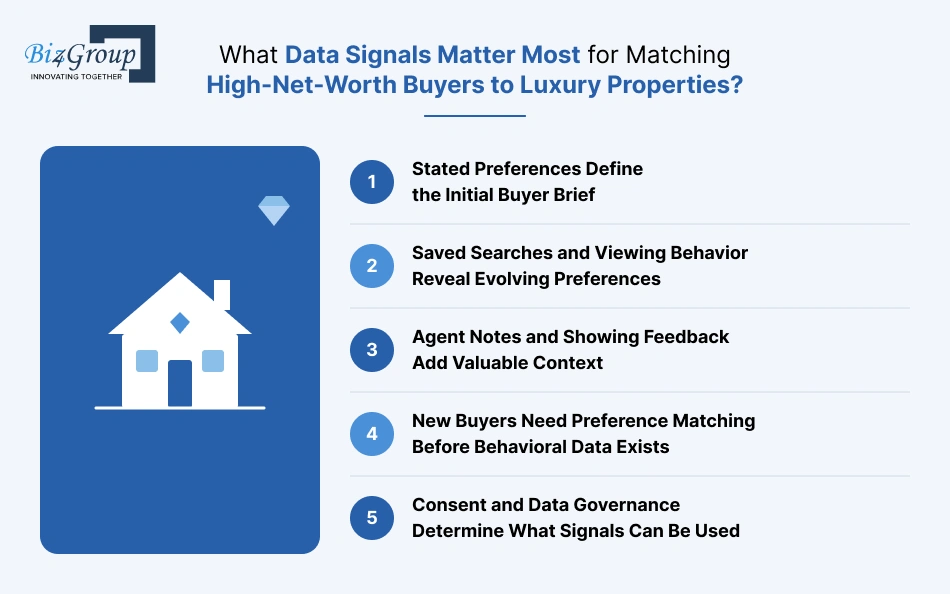
A practical starting point for understanding how to use AI for real estate is to look at what the buyer says, what they do, what the agent learns, and which properties they respond to. That gives a luxury real estate search platform enough context to understand the buyer beyond basic filters and make more relevant recommendations.
This matters as buyers become more comfortable with AI in the search process. In NAR's 2026 technology report, 71% of agents said improving client experience was a reason they adopted technology.
Stated Preferences Define the Initial Buyer Brief
Start with what the buyer can tell you directly. Budget, location, property type, bedrooms, and size are obvious inputs. Luxury matching needs to go further.
A buyer might say:
- Contemporary architecture with warm natural materials
- Strong indoor-outdoor living
- A private setting with limited neighboring properties
- High-end finishes and a chef-grade kitchen
- Space for entertaining without sacrificing quiet areas
- Easy access to specific schools, clubs, airports, or cultural areas
These preferences become the initial buyer brief. Some are hard requirements, while others are preferences that can influence how properties are ranked.
Saved Searches and Viewing Behavior Reveal Evolving Preferences
What buyers do can tell you things they never put into a search form. A saved home, a repeated visit to a listing, time spent looking at particular photos, or repeatedly rejecting homes with a certain characteristic can all become useful signals.
NAR highlighted a similar shift in its 2026 coverage of AI-enabled listings, where platforms are looking at engagement quality through signals such as time spent on a listing, features viewed, questions asked, repeat visits, and neighborhood research.
So what happens when a buyer keeps saving homes with large terraces while never mentioning outdoor space? The system can start treating that behavior as evidence of a preference.
Over time, the buyer profile becomes more useful because it reflects actual behavior rather than a single onboarding questionnaire.
Agent Notes and Showing Feedback Add Valuable Context
Agents often hear the most useful details after a buyer has actually walked through a property.
A buyer may say:
"I like the house, but the finishes feel too cold."
Or:
"The privacy is excellent. I would give up some square footage for that."
Those comments can be more useful than another checkbox in a search form. They give the system context around why a property worked or failed.
Agent feedback can also help correct the model. If the system keeps recommending large contemporary homes while the agent knows the buyer prefers classic architecture, that feedback should influence future recommendations.
New Buyers Need Preference Matching Before Behavioral Data Exists
A new buyer has no viewing history, saved searches, or previous recommendations. The platform still needs enough information to make a useful first set of matches.
A simple onboarding flow can ask the buyer to:
- Set hard requirements such as location, budget, and property type.
- Choose between examples of architectural styles or interiors.
- Identify priorities such as privacy, views, entertaining space, or outdoor living.
- Mark a few sample properties as appealing or unsuitable.
Those answers create an initial preference vector, which can then become more accurate as the buyer interacts with the platform.
Consent and Data Governance Determine What Signals Can Be Used
Not every piece of buyer information should automatically become a recommendation signal. The platform needs clear rules around what data is collected, why it is used, who can access it, and how long it is retained.
This is especially important when the system combines CRM records, agent notes, behavioral data, and private property information. The data model should distinguish between information that can influence matching and information that should remain restricted.
There is also a real compliance consideration around how AI uses buyer information. NAR's 2026 Code of Ethics continues to prohibit discriminatory preferences and limitations in real estate advertising and transactions, which is an important boundary when designing AI-assisted property recommendations.
For a luxury developer, the practical rule is: collect the signals that help understand property preferences, define how they can be used, and keep sensitive or restricted information out of the recommendation logic unless there is a clear, lawful reason to use it.
How AI Matches Luxury Buyers to Properties Using Style and Lifestyle Signals?
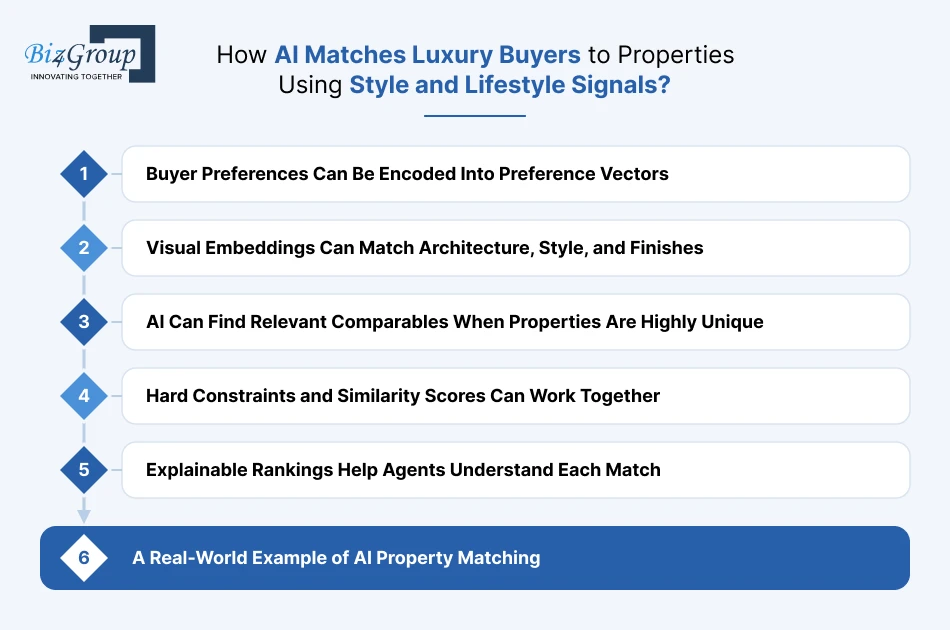
AI matching works by turning different kinds of buyer and property information into comparable signals, then using those signals to rank properties around the individual buyer. For a luxury home developer, this means the system can consider architectural style, finishes, lifestyle preferences, behavior, and practical requirements together.
Buyer Preferences Can Be Encoded Into Preference Vectors
A preference vector is a machine-readable representation of what a buyer appears to value. Think of it as a profile made up of many signals rather than a list of search filters.
For example, a buyer might have:
- Strong preference for contemporary architecture
- High priority for privacy
- Moderate preference for large entertaining areas
- Strong preference for natural materials
- Minimum requirements for location and budget
The system can assign different weights to these preferences and compare the resulting profile with property profiles.
The vector can also change. If a buyer repeatedly saves homes with floor-to-ceiling windows and rejects properties with traditional interiors, those actions can gradually influence the profile.
Visual Embeddings Can Match Architecture, Style, and Finishes
Property images contain information that standard listing fields rarely capture. A visual model can convert images into numerical representations called visual embeddings, which allow the system to compare visual characteristics across properties.
This can help identify similarities in areas such as:
- Architectural form
- Interior design style
- Kitchen and bathroom finishes
- Flooring and material choices
- Lighting and color palettes
- Landscaping and outdoor spaces
What if the buyer cannot describe the exact style they want? They can still show the system what they like. A few saved or positively rated properties can provide visual signals that help the model find similar homes.
AI Can Find Relevant Comparables When Properties Are Highly Unique
Luxury homes often have limited direct comparables. One property may have a custom architectural design, another may sit on an unusually large parcel, and another may combine features rarely found together.
AI can broaden the comparison by looking at multiple dimensions of similarity. Location, size, amenities, architectural characteristics, images, property descriptions, and buyer preferences can all contribute to the match.
This gives the platform more ways to identify relevant properties when a simple "find homes like this one" query would return very few useful results.
Hard Constraints and Similarity Scores Can Work Together
A useful matching system should handle requirements in stages.
Hard constraints can eliminate properties that clearly do not qualify:
- Budget range
- Geographic area
- Property type
- Minimum size
- Required bedrooms
- Availability
The remaining properties can then be ranked using softer signals such as architectural style, privacy, finishes, lifestyle fit, and visual similarity.
What if a property looks perfect but falls outside the buyer's budget or preferred location? It should not outrank properties that meet those essential requirements simply because its visual similarity score is high.
Explainable Rankings Help Agents Understand Each Match
Agents need to know why a property appeared in a buyer's recommendations. A useful system can show the signals that contributed to the match.
For example:
92% match: Contemporary architecture, high privacy, large outdoor entertaining area, preferred neighborhood, and similar interior finishes to three properties the buyer saved.
The exact score is less important than the explanation behind it. Agents can review the reasoning, correct a mistaken assumption, and feed that feedback back into the buyer profile.
That creates a useful feedback loop: buyer preferences → property matching → agent review → improved recommendations.
A Real-World Example of AI Property Matching
Some of the same product questions come up when you actually build AI for property search. Biz4Group LLC worked on Homer AI, where the platform uses a conversational experience to understand what a buyer is looking for, including factors such as budget and location, and then helps surface relevant properties. The work also covered property data APIs, map-based search, and 3D property views.
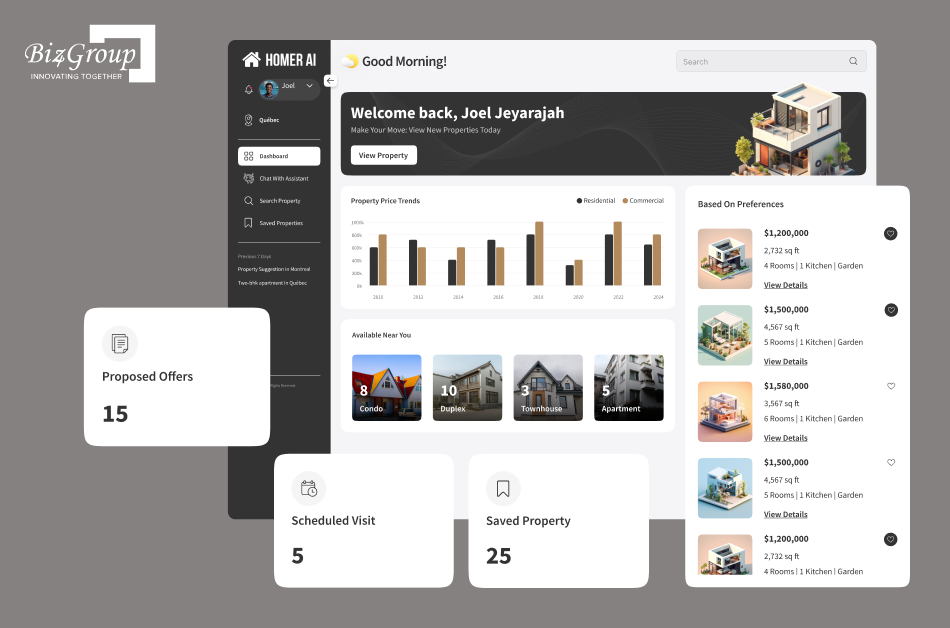
That experience shows where the matching problem gets practical. A buyer can describe what they want in everyday language, but the platform still needs structured property data and the right search logic to turn that into useful results. For a luxury platform, the same thinking can extend to preferences around architectural style, privacy, lifestyle, finishes, and other details that standard filters often miss.
How Can a Luxury Search Platform Surface Off-Market and Private Exclusive Listings?
A luxury search platform can surface off-market and private exclusive listings by connecting controlled property sources with buyer preferences and access rules. The key is to let AI identify relevant properties while keeping seller instructions, listing confidentiality, and buyer eligibility in place.
Private inventory creates a different search problem, somewhat like:
"We have private exclusive and off-market listings that never show up in standard portal search, and I want to build a platform that can still match qualified buyers to these properties using AI."
The platform can match buyers against restricted property data while applying listing permissions that control what information each buyer or agent can see.
Private Inventory Comes From Controlled Brokerage and Agent Sources
Private inventory usually comes from people who are already close to the property, such as developers, brokerages, agents, and selected partners. These sources can add properties that are coming soon, privately marketed, or intentionally kept away from public portals.
For a luxury home developer, that could include:
- A new property that has not been publicly launched
- A residence being offered privately to selected buyers
- A developer-owned property shared through its sales team
- An exclusive listing available through one brokerage
- A property where the seller wants limited exposure
The platform needs to know where each property came from and what the source has allowed it to do with that information. That source context becomes part of the inventory record, alongside details such as availability, location, price, and property characteristics.
Visibility Tiers Can Reflect Seller and Listing Permissions
Not every property needs to appear in the same way. A public listing can be shown openly, while a private property may only appear to a qualified buyer through an agent.
A simple visibility model could include:
|
Visibility |
How It Could Work |
|---|---|
|
Public |
Available to all users |
|
Registered |
Available after buyer registration |
|
Qualified |
Available to buyers who meet defined criteria |
|
Private |
Introduced through an agent or concierge |
|
Restricted |
Stored internally with limited or no buyer-facing details |
What happens when a seller wants a property shared selectively? The listing can remain searchable within the permitted audience while its address, photos, owner details, or other sensitive information stay hidden.
The important part is keeping these rules attached to the property record. That way, the same permissions can apply when the property appears in search, recommendations, agent dashboards, or concierge workflows.
Qualified Buyers Can Be Matched Without Exposing Confidential Details
What if the AI finds a private property that looks almost perfect for a buyer, but the property cannot be publicly disclosed?
The platform can match the buyer to the property's underlying attributes without revealing the restricted listing details. The buyer might see a message saying that a private property appears to fit their preferences, while the agent receives the information needed to decide whether and how to make the introduction.
For example, the matching engine could identify strong alignment around:
- Contemporary architecture
- High privacy
- Large outdoor entertaining areas
- A preferred neighborhood
- Specific finishes
- A required property size
The buyer does not need to see the full listing for the system to recognize the match. The agent can handle the next step according to the seller's instructions.
This is particularly useful for luxury home developers because the value of private inventory often comes from controlled access. The platform should support that relationship rather than automatically turning every match into a public listing.
Inventory Permissions and Freshness Must Remain Synchronized
How useful is a private-property recommendation if the home has already sold or the seller has changed the access terms? Very little. Private inventory needs the same attention to freshness as public inventory, with additional controls around who can see it.
The platform should keep track of:
- Current availability
- Listing visibility
- Buyer eligibility
- Source and ownership permissions
- Last-updated timestamps
- Temporary access or expiration dates
- Changes made by agents or administrators
If a property moves from private to public availability, the platform should update its visibility automatically where possible. If it sells or is withdrawn, it should stop appearing in recommendations immediately.
For a luxury home developer, this keeps the AI experience tied to real inventory. Buyers receive relevant opportunities, agents work from current information, and private listings remain under the control of the people authorized to share them.
Too Many Listings, Too Few Right Matches?
Luxury buyers have specific tastes, and endless property lists rarely capture them. Build an AI-powered search experience that understands preferences and surfaces properties worth exploring.
Build a Smarter Property SearchWhat Features Should a Luxury Real Estate Search Platform With AI Matching Include?
A luxury real estate search platform with AI matching should help buyers express detailed preferences, help agents act on better recommendations, and give the business control over inventory and access.
Buyer-Facing Search and Preference Tools
Buyers need ways to describe what they want beyond standard property filters. Core features include:
- Conversational property search
- Budget, location, size, and amenity filters
- Lifestyle and architectural preferences
- Visual preference and image-based discovery
- Saved properties and searches
- Match explanations
- Preference updates based on buyer feedback
What if a buyer says, "I want a modern home with privacy and space for entertaining"? The platform should translate that request into useful search and matching signals without making the buyer work through dozens of filters.
Agent and Concierge Recommendation Tools
Agents need a clear view of the buyer's preferences and the properties that fit them. Useful tools include:
- AI-generated property recommendations
- Buyer preference profiles
- Match explanations
- Private and off-market property suggestions
- Shortlist and sharing tools
- Showing and buyer feedback
- Alerts for newly matching inventory
The agent can then accept, reject, or refine recommendations based on what they learn from the client.
Administration, Permissions, and Inventory Controls
The business needs control over the data and who can access it. Key capabilities include:
- Property and inventory management
- Public and private visibility controls
- Buyer and agent permissions
- Listing status and availability updates
- Data quality checks
- Source and integration management
- Consent and data controls
- Recommendation monitoring and reporting
These controls keep buyer recommendations relevant while ensuring private inventory and sensitive property information are only shown to authorized users.
How to Build a Luxury Real Estate Search Platform With AI Buyer Matching
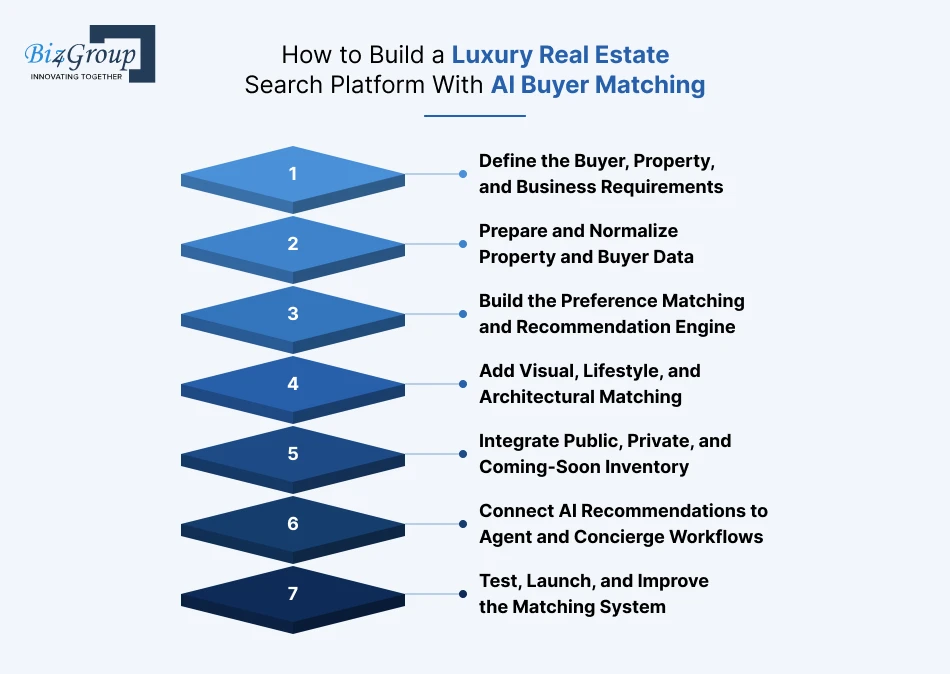
To build AI platform for luxury property matching, start with the buyer journey and property data, then build the matching layer around them. The strongest approach is to get the core search and recommendation experience working first, then add visual matching, private inventory, and deeper personalization as real usage provides more data.
A common question among luxury brokerages is:
"I run a luxury real estate brokerage and our website search still works like a basic filter system, so I want to know how to build an AI platform that actually understands what our high-net-worth buyers are looking for."
The answer is to combine stated preferences, buyer behavior, agent feedback, property attributes, and visual signals into a matching system that can rank properties around the buyer's actual priorities.
Define the Buyer, Property, and Business Requirements
Before you hire AI developers, define three things: what buyers need to find, what property information the business has, and how agents will use the recommendations.
For a luxury home developer, this could include budget, location, architecture, finishes, privacy, lifestyle needs, availability, and access to private inventory. Map how a buyer moves from the first search to a shortlist, agent conversation, and property viewing.
Prepare and Normalize Property and Buyer Data
AI matching is only as useful as the information behind it. Property data should be standardized across location, size, amenities, architecture, finishes, availability, and listing status.
Buyer data can include stated preferences, saved properties, feedback, and relevant agent observations, with clear rules for consent and data access.
Build the Preference Matching and Recommendation Engine
The matching engine should separate requirements from preferences. Budget, location, or minimum property size might be essential, while architectural style, finishes, privacy, and entertaining space can influence the ranking.
What happens when no property fits everything a buyer wants? The system can find the closest relevant options and show where each one matches or falls short.
For an early version, MVP development services can help validate this core matching experience before the platform takes on more advanced AI capabilities.
Add Visual, Lifestyle, and Architectural Matching
Luxury buyers often respond to things that are difficult to capture in standard listing fields. Images can reveal architectural style, materials, proportions, landscaping, and interior design preferences.
The platform can combine these visual signals with lifestyle preferences such as privacy, entertaining, wellness, waterfront living, or proximity to specific amenities.
Once enough relevant data exists, the team can train AI models or adapt existing models to improve matching for the platform's particular property types and buyer preferences.
Integrate Public, Private, and Coming-Soon Inventory
Bring together the inventory sources that matter to the developer, including public listings, developer-owned properties, private opportunities, and coming-soon homes.
Each property should retain its own visibility and access rules. A private property might be available to the matching engine while its details remain visible only to an authorized agent.
How do you keep a recommendation useful when inventory changes constantly? Synchronize listing status, availability, permissions, and source data so sold, withdrawn, or restricted properties are removed or updated quickly.
Connect AI Recommendations to Agent and Concierge Workflows
AI should fit into the existing client relationship. Agents can review recommendations, see why a property matched, correct buyer preferences, and add feedback after conversations or showings.
The buyer experience also needs to make this handoff feel natural. A UI/UX design company can help design the search, recommendation, shortlist, and agent interaction around the way luxury buyers actually move through a property search.
Test, Launch, and Improve the Matching System
Test the platform with realistic buyer profiles before expanding the inventory or market coverage. Look at whether recommendations are relevant, whether buyers save or inquire about suggested properties, and whether agents find the matches useful.
What matters after launch is how quickly the system learns from real feedback. Poor matches should reveal gaps in the data, weighting, rules, or model behavior. Use those signals to refine the experience continuously rather than treating the first model as the finished product.
|
Build Area |
What to Focus On |
|---|---|
|
Buyer Experience |
Conversational search, preferences, visual discovery |
|
AI Matching |
Buyer profiles, property similarity, recommendation logic |
|
Inventory |
Public, private, and coming-soon listings |
|
Agent Workflow |
Match explanations, feedback, shortlists |
|
Data & Controls |
Data quality, permissions, availability |
|
Improvement |
Testing, feedback, and model refinement |
What Does It Cost to Develop a Luxury Real Estate Search Platform?
A luxury real estate search platform can cost around $30,000 to $300,000+, depending on how much AI, private inventory, visual matching, and integration work you need. A focused first version can stay near the lower end, while a full platform built around proprietary data and advanced matching can move well above $300,000.
|
Platform Scope |
Approx. Cost |
Typical Focus |
|---|---|---|
|
Focused MVP |
$30,000–$75,000 |
Search, buyer profiles, basic AI matching, admin |
|
Growing Platform |
$75,000–$150,000 |
Advanced matching, agent tools, integrations |
|
Full AI Platform |
$150,000–$300,000+ |
Visual AI, private inventory, deeper personalization |
Hidden Costs to Consider
The budget for AI in real estate is only one part of the picture. You may also need to budget for:
- AI model and API usage
- Property data and third-party feeds
- Cloud hosting and storage
- Image processing and visual search
- CRM and brokerage integrations
- Security and monitoring
- Ongoing maintenance and AI improvements
These costs can become meaningful once the platform starts handling large property inventories and frequent buyer activity.
Factors That Affect the Cost
What makes one luxury search platform cost $50,000 while another costs $250,000? Usually, it comes down to the depth of the buyer experience and the complexity of the data behind it.
The biggest cost factors are:
- AI depth: Rules-based matching costs less than advanced recommendation and visual AI.
- Data: Clean, structured inventory is easier to work with than multiple inconsistent sources.
- Integrations: CRM, MLS, brokerage, and private inventory connections add development work.
- Personalization: Buyer behavior, agent feedback, and evolving preference profiles require more sophisticated systems.
- Access controls: Private and off-market listings need additional permission and visibility logic.
- Scale: More markets, properties, users, and channels increase infrastructure and maintenance needs.
For a luxury home developer, the useful question is where personalization will genuinely improve the buying experience. That gives you a clearer basis for deciding what belongs in the first release and what can come later.
When Should You Build, Buy, or Use a Hybrid Approach?
The choice between building, buying, or combining both depends on how much control you need over buyer matching, proprietary inventory, integrations, and the overall customer experience.
|
Approach |
Best Fit |
Advantages |
Trade-offs |
|---|---|---|---|
|
Build Custom |
Unique buyer experience and proprietary data |
Full control over AI matching, workflows, inventory, and UX |
Higher cost and longer development |
|
Buy Existing |
Standardized search and listing needs |
Faster launch with established features |
Limited control over customization and proprietary workflows |
|
Hybrid |
Existing infrastructure with custom AI needs |
Uses proven systems while adding tailored matching |
Requires careful integration between systems |
If you already have CRM, listing, or property-data systems working well, a hybrid approach can make sense. You can keep those systems in place and put the custom development effort into what buyers actually notice, like better preference matching, property recommendations, visual search, and access to private listings.
How Does AI Matching Fit Into Agent and Concierge Workflows?
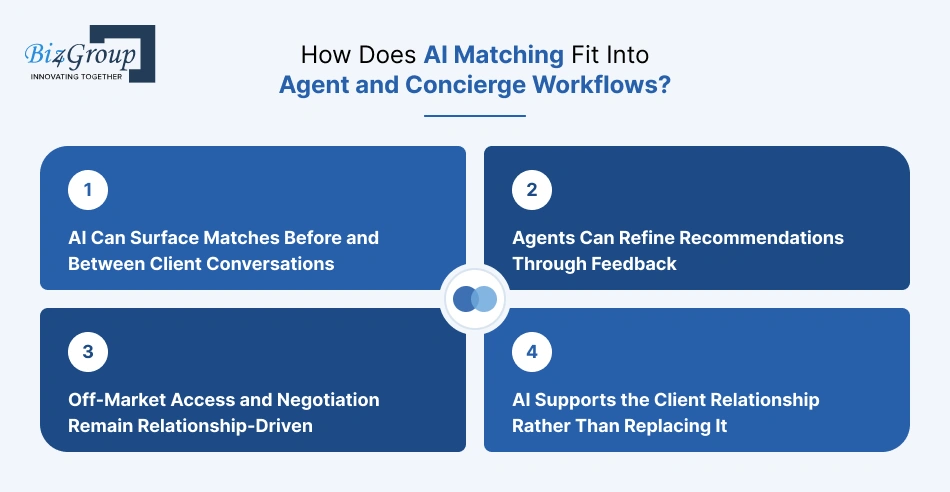
AI for real estate agents works best here as a background layer that handles repetitive property discovery while agents focus on the buyer, the recommendations, and the relationship. Agents can then spend their time understanding the buyer, reviewing the best matches, and deciding which opportunities are actually worth bringing forward.
AI Can Surface Matches Before and Between Client Conversations
A buyer does not have to be actively searching for the system to find something relevant. As new properties enter the inventory, AI can compare them with existing buyer preferences and flag potential matches for the agent.
- Example: A buyer has been looking for a contemporary home with privacy, natural materials, and generous outdoor space. A matching property comes in while the buyer is away, and the agent gets the recommendation before their next conversation.
Agents Can Refine Recommendations Through Feedback
The agent often learns things that a search form never captures. A buyer might say they like a certain architectural style, then reject several homes for reasons that reveal a more specific preference.
- Example: After a few viewings, an agent realizes the buyer likes contemporary architecture but prefers warmer interiors. That feedback can be added to the buyer profile and used to improve the next set of recommendations.
Off-Market Access and Negotiation Remain Relationship-Driven
AI can point an agent toward a potentially strong private-property match, but the agent still decides how and when to introduce it. Seller instructions, buyer qualifications, timing, and existing relationships all matter.
- Example: The system identifies a private residence that fits a buyer's preferences closely. The agent checks the seller's access requirements and the buyer's qualifications before sharing any details.
AI Supports the Client Relationship Rather Than Replacing It
What should change for the buyer? Ideally, they spend less time sorting through irrelevant listings and more time having useful conversations with an agent who already understands what they want.
- Example: Instead of sending 30 new listings after every search update, the agent receives a short list of relevant properties with the reasons behind each match and can decide which ones are worth discussing.
The AI handles the background matching. The agent brings the context, judgment, and relationship that turn those matches into an actual buying experience.
How Long Does It Take to Build a Luxury AI Property-Matching Platform?
With AI-assisted development, a focused luxury AI property-matching platform can reach a working pilot in 3 to 7 days. A production-ready version can typically take 10 to 21 days, while broader rollout work depends on the number of markets, data sources, and personalization features being added.
A Focused Pilot Can Validate the Core Matching Workflow
A 3 to 7-day pilot can cover the core buyer-to-property matching experience when the property data is already available and the scope is tightly defined.
A typical pilot can include:
- Day 1: Buyer preference structure and property data setup
- Days 2–3: Search and matching logic
- Days 4–5: Recommendation interface and match explanations
- Days 6–7: Testing with sample buyer profiles and refinement
The goal is to answer one practical question: Are the recommended properties actually closer to what buyers want than a standard search would produce?
Production Requires Integration and Operational Readiness
Taking the validated pilot into production can add 10 to 21 days, depending on the systems involved. This stage covers the work that makes the platform usable with real business data and real users.
|
Production Requirement |
Typical Development Addition |
|---|---|
|
CRM or listing integration |
2–4 days |
|
User accounts and permissions |
1–3 days |
|
Private inventory controls |
1–3 days |
|
Analytics and reporting |
1–2 days |
|
Security and production testing |
2–4 days |
These tasks can overlap, so the total does not equal the sum of every row. Data readiness and third-party API access can also affect the final timeline.
Broader Rollout Adds Markets, Inventory, and Personalization
Once the core platform is live, additional capabilities can be added incrementally. A second market might take 2 to 5 days if its data structure is similar, while visual matching or deeper behavioral personalization can add 3 to 7 days per major capability.
For example:
- 3–7 days: Working pilot
- 10–21 days: Production-ready platform
- 2–5 days: Additional comparable market
- 3–7 days: Major AI capability such as visual matching
This gives a developer a faster path to testing the buyer experience without waiting for the entire platform to be finished.
How Should Luxury Brokerages Measure the Impact of AI Matching?
The simplest way to measure AI matching is to follow what happens after a recommendation is made: does the buyer find it relevant, engage with it, book a showing, and eventually move toward a transaction? That gives a brokerage a much clearer picture than measuring search activity alone.
Match Quality Shows Whether Recommendations Are Relevant
Before looking at revenue, check whether the AI is actually understanding the buyer. Saves, shortlists, dismissals, and agent feedback can show whether recommended properties feel relevant.
|
Metric |
What to Look For |
|---|---|
|
Match acceptance |
Buyers keep or engage with suggested properties |
|
Save/shortlist rate |
Recommendations create genuine interest |
|
Dismissal rate |
The system is missing important preferences |
|
Agent rating |
Agents consider the matches useful |
A high number of recommendations means very little if buyers consistently dismiss them.
Engagement and Qualified Showings Show Buyer Value
Once match quality looks healthy, look at what buyers do next. Track property views, inquiries, shortlist additions, and qualified showings that started from an AI recommendation.
For example: if 100 AI-recommended properties generate 25 qualified showings, that gives the brokerage a useful benchmark to compare with its existing discovery process.
Offers and Closed Transactions Connect Matching to Business Outcomes
The bigger question is whether better discovery helps create real opportunities. Track AI-influenced offers, negotiations, accepted offers, and closed transactions.
Attribution should remain realistic. AI may have introduced the property, while the agent, pricing, financing, negotiation, and buyer circumstances all influence the final outcome.
Buyer and Agent Feedback Improves the Matching System
Numbers can tell you that a recommendation failed, but feedback can tell you why. Buyers and agents can identify preferences the system missed or assumptions it got wrong.
Example: buyers repeatedly reject homes with formal interiors even when the properties match their stated filters. That pattern can be used to adjust the buyer profile and improve future recommendations.
The useful loop is: recommend → observe → learn → refine. If that loop consistently improves match quality and downstream buyer activity, the AI is becoming more useful to the brokerage.
What If Your Search Knew Their Taste?
From architectural style to privacy, lifestyle, and private inventory, AI can turn scattered buyer preferences into more relevant property recommendations.
Explore AI-Powered Property MatchingHow Does AI Search Visibility Affect Luxury Real Estate Brands and Listings?
AI search visibility matters when buyers start asking questions such as where to find a particular type of luxury home, which developments offer certain amenities, or what makes a neighborhood suitable for their lifestyle. Your property and market information needs to be available in a form AI systems can understand and reference.
AI Answer Engines Need Reliable Information They Can Retrieve and Understand
AI cannot reliably recommend what it cannot find or understand. Keep property details current and clearly written, including location, architecture, amenities, availability, and developer information.
Structured Property and Market Information Improves Machine Readability
Give important property details a consistent structure across listings. This helps AI connect a buyer's question with the right property instead of trying to interpret scattered information.
For example, if a buyer asks for contemporary waterfront homes with private outdoor space, the platform should have those attributes clearly associated with the relevant properties.
First-Party Expertise Gives AI Systems Authoritative Material to Cite
Your website can also cover information that exists nowhere else, such as development details, architectural choices, neighborhood insights, and original market research.
What questions do buyers repeatedly ask your sales team? Those questions are a good starting point for useful first-party content.
AI Visibility Should Be Measured Separately From Traditional Search Traffic
Traditional SEO tells you about rankings and organic visits. AI visibility requires different signals, such as whether your brand or properties appear in AI answers, which pages are cited, and which buyer questions trigger those appearances.
|
Traditional Search |
AI Search |
|---|---|
|
Rankings |
AI answer appearances |
|
Organic traffic |
AI referral traffic |
|
Keyword visibility |
Question coverage |
|
Search conversions |
AI-influenced actions |
For a luxury developer, this distinction matters because a property can receive little traditional search traffic while still becoming relevant to buyers who discover it through an AI-generated answer.
From Endless Listings to the Right Few
Luxury buyers rarely think in filters. They think, "I want this kind of home, in this kind of setting, with this kind of feel." That is where luxury real estate search platform development gets interesting. The right AI layer can turn those fuzzy preferences, property data, visual cues, and agent feedback into recommendations that actually make sense. Why make buyers wander through hundreds of listings when the platform can narrow the field intelligently?
The tricky part is making the AI useful without making the experience feel robotic. Biz4Group LLC brings relevant experience as a U.S.-based AI product development company, including the practical work of turning complex business requirements into usable AI products. Its AI consulting services can help businesses work through the data, matching logic, integrations, and product decisions behind a personalized property-search experience. The AI finds the possibilities; the human relationship closes the gap.
FAQ’s
1. How much does it cost to build an AI-powered luxury property search platform?
A practical range is $30,000 to $300,000+. A focused MVP can fall around $30,000 to $75,000, while visual AI, private inventory, advanced personalization, and multiple integrations can push the cost above $150,000.
2. Can AI match luxury buyers based on architectural style and interior design?
Yes. Visual AI can analyze property images and create visual embeddings that help match buyers with preferred architecture, materials, finishes, layouts, and overall design characteristics.
3. Can a luxury real estate platform include off-market properties?
Yes. Private listings can be included with visibility rules that determine which buyers or agents can access the property and how much information they can see.
4. How quickly can an AI property-matching platform be built?
A focused pilot can be developed in around 3 to 7 days when the scope and data are ready. A production-ready version can take roughly 10 to 21 days, depending on integrations, permissions, and data preparation.
5. What data does AI need to personalize luxury property recommendations?
Useful signals include stated preferences, budget, location, saved properties, viewing behavior, agent feedback, architectural preferences, lifestyle requirements, and property characteristics.
6. Can AI recommend properties that a buyer has never searched for?
Yes. Recommendation models can identify similarities across buyer preferences, property attributes, images, and behavior, allowing the system to surface properties outside the buyer's exact search terms.
7. Should a luxury developer build a custom platform or use an existing property search system?
Custom development makes more sense when proprietary buyer matching, private inventory, or unique workflows are central to the experience. Existing systems can cover standardized search needs, while a hybrid approach can combine existing infrastructure with custom AI matching.
8. How can luxury brokerages measure whether AI matching is working?
Track recommendation acceptance, saves, qualified showings, AI-influenced inquiries, offers, transactions, and buyer and agent feedback. These metrics show whether recommendations are improving the journey beyond simple search traffic.
