 Location :
Orlando, FL, USA
Location :
Orlando, FL, USA +1 (407) 714-1616
 info@biz4group.com

 AI Summary Powered by Biz4AI
- Product development companies help businesses move from product concept to production through strategy, UX/UI, engineering, QA, deployment, and ongoing improvement.
- The top product development companies in the USA differ in their strengths, with some focused on enterprise engineering, others on UX-led digital products, AI, mobile development, or end-to-end product delivery.
- The right partner depends on product complexity, technical requirements, budget, industry, and the level of ownership you expect from the development team.
- For AI-powered products, evaluate more than LLM integration. Production experience with AI architecture, model evaluation, data security, reliability, deployment, monitoring, and cost management matters.
- Companies such as Biz4Group, DockYard, LaunchPad Lab, STRV, and Rootstrap stand out for different product development strengths, so the final choice should be based on the capabilities most relevant to your product.
What if the company that can build your product fastest is not the company you should hire?
That question matters in 2026 because product development companies in the USA are working in an engineering environment increasingly shaped by AI. Gartner's 2026 AI Coding Agent Market Guide estimates the enterprise AI coding agent market at $9.8 billion to $11 billion annualized as of April 2026, with 90% of engineering leaders reporting productivity improvements and a net average gain of 19.3%.
But faster development does not automatically mean better delivery. DORA's latest research found that a 25% increase in AI adoption was associated with a 1.5% decrease in delivery throughput and a 7.2% decrease in delivery stability in its research dataset. The implication for buyers is straightforward: AI can accelerate implementation, but architecture, testing, review, and delivery practices still determine whether that velocity translates into a reliable product.
So, how do you know whether a product development company can actually take ownership of your product rather than simply build what you ask for?
Look for evidence that the company can question assumptions, make sound technical trade-offs, use AI where it delivers real value, manage production risks, and support the product beyond launch. Those capabilities matter more than a long technology list or a low hourly rate.
This guide ranks leading product development companies in the USA based on these criteria, along with their relevant experience, case studies, client reputation, and available pricing information, so you can compare them on factors that actually matter when choosing a partner.
What Product Development Means in 2026: From Software Delivery to Product Ownership
Product development has shifted from shipping software to managing product decisions across the lifecycle. In 2026, that lifecycle increasingly includes AI architecture, model evaluation, data governance, and production monitoring alongside strategy, design, engineering, and QA.
What Should You Expect From a Product Development Company?
The most useful distinction is where the vendor takes ownership. A full-cycle partner may contribute across:
Discovery → Product Strategy → UX/UI → Architecture → Engineering → QA → Launch → Post-Launch
For an MVP development, you want a partner that can help you validate the idea quickly, prioritize what actually needs to be built, and create an architecture that can grow without adding unnecessary complexity. With an enterprise product, the focus shifts toward architecture, security, integrations, compliance, scalability, and long-term ownership. If you're building an AI-native product, you also need to look at how the team handles model selection, evaluation, data, inference costs, observability, and reliability.
How Product Development Differs from Software Development and Staff Augmentation?
The three models can overlap, but they solve different problems. Software development focuses on building the software, staff augmentation adds engineering capacity to an existing team, while product development can cover the decisions and execution needed to take a product from concept to launch.
|
Model |
Primary Focus |
Who Owns Product Decisions? |
Best Fit |
|---|---|---|---|
|
Software Development |
Designing, building, testing, and maintaining software |
Usually the client |
Requirements and architecture are already defined |
|
Product Development |
Product strategy, UX, architecture, engineering, validation, and launch |
Shared or partner-led, depending on engagement |
You need support defining and building the product |
If your requirements, product team, and architecture are already in place, software development may be enough. If you still need product validation, technical direction, or end-to-end ownership, a product development partner is the better fit.
What Does Full-Cycle Product Development Include?
A full-cycle engagement is less about having every service under one roof and more about how well those capabilities work together. The real value comes from having clear ownership across product decisions, design, engineering, quality, deployment, and post-launch improvement, without gaps between teams.
Before hiring, buyers should establish which decisions the partner owns, which remain internal, how changes are handled, and what support continues after launch.
Those criteria form part of the evaluation framework used for the companies in this ranking.
Still Comparing Your Options?
See how Biz4Group approaches product development, from product strategy and UI/UX to engineering and AI implementation.
Explore Biz4Group's Product Development ServicesHow We Evaluated the Best Product Development Companies For You?
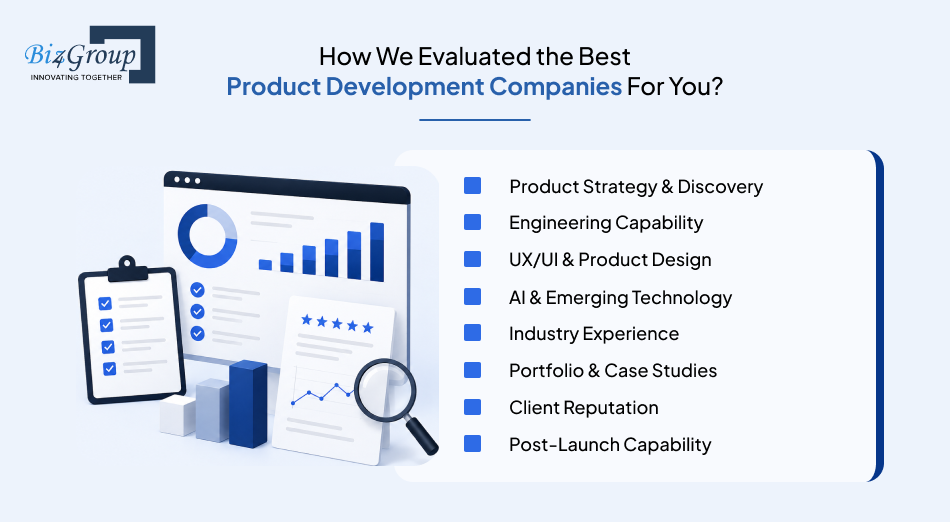
We evaluated each company using the same criteria, with greater weight given to capabilities that directly influence product outcomes, technical execution, and long-term scalability.
Our Evaluation Criteria
- Product Strategy & Discovery: Ability to validate requirements, define product direction, prioritize features, and translate business goals into a practical roadmap.
- Engineering Capability: Architecture, software engineering, integrations, scalability, QA, and production readiness.
- UX/UI & Product Design: User research, UX strategy, UI/UX development, interface design, prototyping, and design-to-development continuity.
- AI & Emerging Technology: Practical AI/ML capabilities, production implementation, and experience with relevant emerging technologies.
- Industry Experience: Relevant experience across industries, product types, and business models.
- Portfolio & Case Studies: Quality and relevance of documented projects, with greater weight given to measurable outcomes and verifiable evidence.
- Client Reputation: Third-party ratings, reviews, references, and other independently verifiable reputation signals.
- Post-Launch Capability: Ongoing maintenance, optimization, monitoring, scaling, and product engineering support.
Also Read: Top 15 UI/UX Design Companies in USA
We evaluated each company using official websites, published case studies, third-party reviews, company profiles, and other reliable sources. Pricing, ratings, team size, and service details were reviewed based on information available in 2026.
What are The Top Product Development Companies in the USA?
The right product development partner can look very different depending on what you're building. A company strong in enterprise engineering may not be the best fit for an AI-native product, while a great MVP partner may not have the capabilities needed for long-term scale.
To make the comparison useful, we looked at product strategy, engineering capabilities, AI and emerging technologies, relevant experience, portfolio strength, and post-launch support, rather than company size alone.
Here's a side-by-side look at the top product development companies in the USA:
|
Company |
Location |
Best For |
Core Development Features |
|---|---|---|---|
|
LaunchPad Lab |
Chicago, IL |
Digital products & AI-enabled applications |
Product strategy, AI, web platforms, mobile apps, custom software |
|
Biz4Group LLC |
Orlando, FL |
AI-enabled & full-cycle products |
Generative AI, AI integration, agentic AI, AI-driven SaaS, ML/NLP, MLOps |
|
DockYard |
Boston, MA |
Complex digital products & engineering |
Product strategy, UX, engineering, architecture, mobile, custom software |
|
Fresh Consulting |
Bellevue, WA |
Digital + physical products |
Software, hardware, AI/ML, IoT, embedded systems, product development |
|
Sidebench |
Los Angeles, CA |
Product strategy & custom digital products |
Product strategy, research, UX/UI, software engineering, AI |
|
ArcTouch |
San Francisco, CA |
Apps & connected products |
Mobile, web, IoT, AI, APIs, UX/UI |
|
Rootstrap |
Los Angeles, CA |
AI products & digital platforms |
AI/ML, data, cloud, UX, software engineering |
|
Cheesecake Labs |
San Francisco, CA |
Mobile, web & AI products |
Product engineering, mobile, cloud, data, AI agents, automation |
|
STRV |
Los Angeles, CA |
Mobile & digital products |
Mobile, web, UX/UI, AI/ML, data engineering, cloud |
|
Metova |
Franklin, TN |
AI, mobile & connected products |
AI, mobile, IoT, UX/UI, cloud |
|
Zco Corporation |
Nashua, NH |
Mobile & software products |
Mobile, software engineering, AI, AR/VR, enterprise applications |
|
Very |
Chattanooga, TN |
IoT & connected hardware |
IoT, embedded systems, hardware, software, product development |
|
TekRevol |
Houston, TX |
Mobile & enterprise products |
Mobile, web, AI, cloud, enterprise software |
|
Codal |
Chicago, IL |
Product strategy, UX & product engineering |
Product strategy, AI strategy, UX, cloud, custom software, AI/data, QA |
|
CognitiveClouds |
San Jose, CA |
SaaS & digital products |
SaaS, web, mobile, cloud, IoT, product development |
|
Fueled |
New York, NY |
Mobile & digital products |
Mobile, web, AI, backend, design, research |
|
Fuzzy Math |
Chicago, IL |
UX & product strategy |
UX research, product strategy, UI design, interaction design, roadmapping |
1. LaunchPad Lab
Best for: Digital products, custom web applications, mobile applications, and AI-enabled products
LaunchPad Lab is a digital product firm that combines strategy, design, and engineering through cross-functional teams. The company reports 760+ projects and 250+ clients, with 90% of clients working with the company for more than one year.
Its current capabilities span web and mobile applications, AI-enabled products, Salesforce implementations, product strategy, design, and custom software development. Published work includes projects for CDK Global, Millennium Trust Company, and Prosci, with reported outcomes including a 90% reduction in training time and more than $1 million in new annual revenue for one project.
2. Biz4Group LLC
Best for: AI-enabled products, AI-driven SaaS, agentic AI, and full-cycle product development
Biz4Group is an AI product development company with a strong AI focus, offering end-to-end development across AI, IoT, mobile, web, and SaaS. The company reports 1,000+ projects, 300+ technology experts, and an 85% client retention rate.
Biz4Group approaches product development as an end-to-end process, combining product strategy, UI/UX development, engineering, AI, mobile app development, web, cloud, testing, and post-launch support. Its AI capabilities include generative AI, AI integration, agentic AI, AI-driven SaaS, and AI-enabled digital products, supported by expertise in machine learning, NLP, MLOps, cloud infrastructure, and computer vision.
What makes Biz4Group relevant to this ranking is its ability to build and evolve complete digital products rather than focus on a single development layer. Its portfolio spans marketplace, financial, SaaS, mobile, web, and AI-powered products, giving the team experience connecting product requirements, user experience, application engineering, integrations, and AI into production-ready solutions.
The company's current AI development information cites projects starting around $25,000, with costs potentially exceeding $150,000 depending on product complexity, data requirements, and features. Project minimums and commercial rates should be confirmed directly with the company.
Biz4Group: Product Development Experience in Practice
Biz4Group's portfolio spans commerce, financial technology, and AI-powered consumer products. Three projects illustrate how the team approaches complex product requirements.
Subsciety: Subscription-Based eCommerce Marketplace
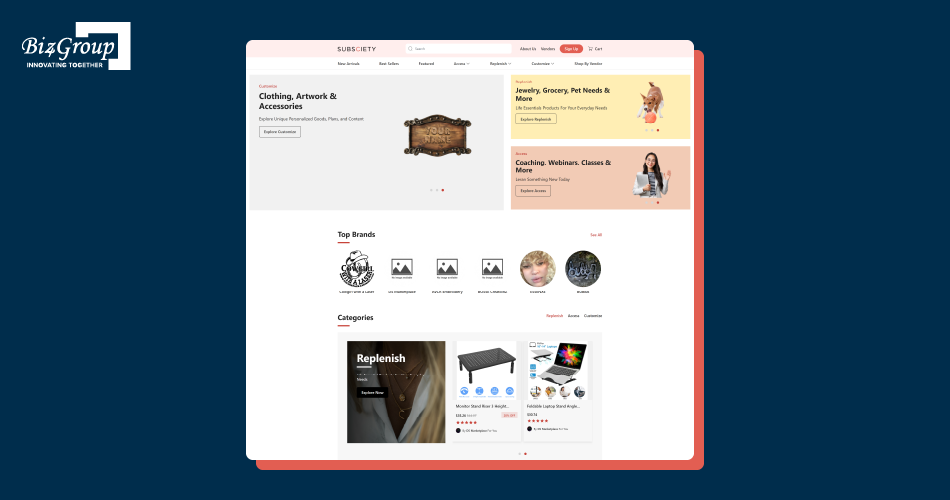
- Challenge: Build a multi-vendor marketplace supporting subscriptions, payments, delivery options, promotions, and Shopify/WooCommerce integrations.
- How we built it: We brought the marketplace, vendor management, subscriptions, payments, and integrations into one platform using React, Node.js development, Express.js, and MongoDB.
- Outcome: A unified marketplace with vendor plans, product discovery, dashboards, delivery options, secure payments, and commerce integrations.
- Key takeaway: The real challenge was coordinating multiple commerce workflows without creating disconnected systems.
Worth Advisors: Digital Financial Planning Platform
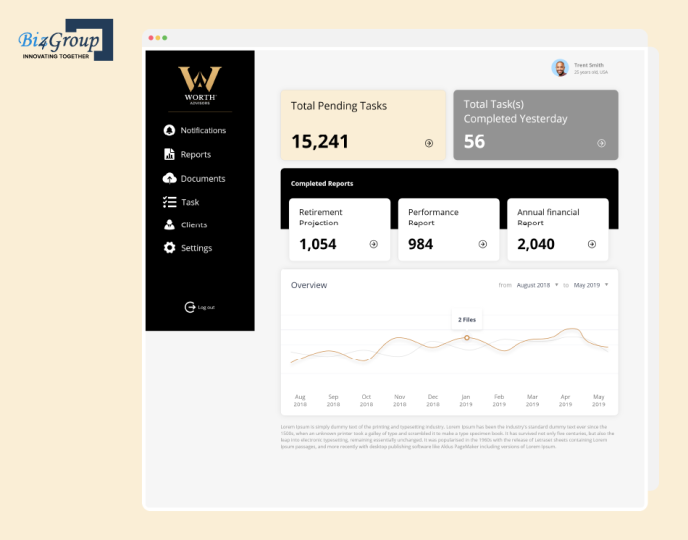
- Challenge: Bring client data, financial questionnaires, external financial systems, document uploads, and advisor workflows into one platform.
- How we built it: We addressed inconsistent third-party data through tighter synchronization rules and redesigned the report-generation system around standardized templates and controlled data states.
- Outcome: The platform brought together 14 questionnaires, five report types, secure uploads, Redtail and Intelliflo integrations, task management, and role-based workflows.
- Key takeaway: For financial products, reliable data movement and controlled workflows are as important as the interface.
Dr. Truman: AI-Powered Wellness Platform
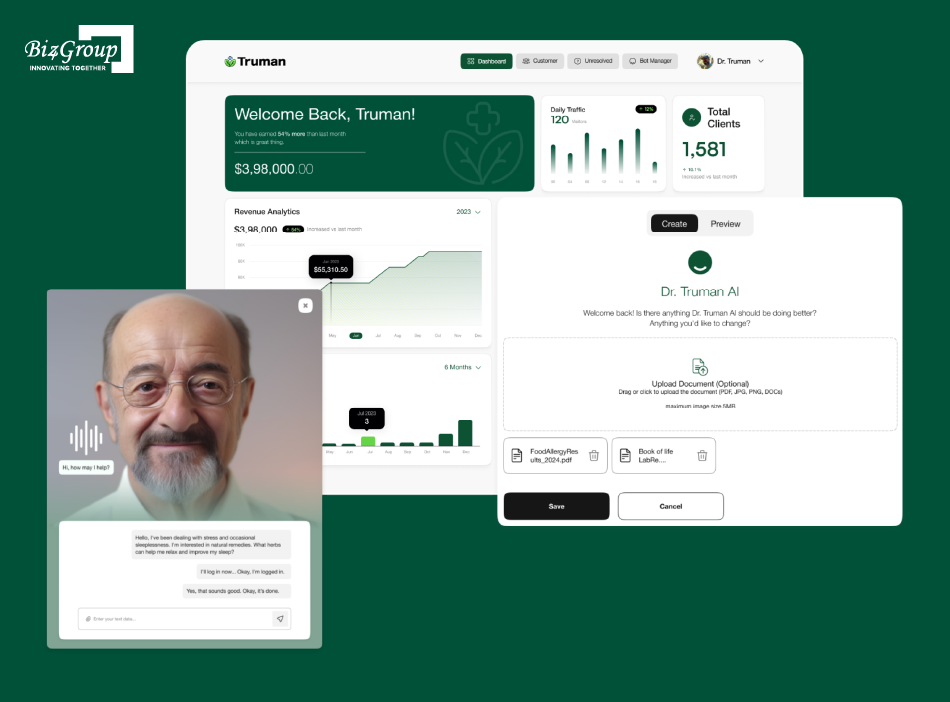
- Challenge: Create an AI wellness experience combining an AI digital avatar, AI recommendations, health history, and commerce.
- How we built it: We combined GPT-4, GPT-3.5 Turbo, Python, FastAPI, and React with AI-driven recommendations, avatar behavior, lip synchronization, and integrated shopping workflows.
- Outcome: A connected experience spanning AI conversation, AI personalization, health records, memberships, AI product recommendations, and payments.
- Key takeaway: The AI was designed as part of the product journey rather than added as a standalone chatbot. The case study reports 40% higher user engagement and 30% higher supplement sales.
Together, these projects demonstrate how Biz4Group approaches different product challenges: complex commerce workflows, data-sensitive financial platforms, and AI-native customer experiences.
3. DockYard
Best for: Complex digital products, product strategy, engineering, and technical architecture
DockYard combines product strategy, design, engineering, and architecture for organizations building or modernizing complex digital products. Its engineering capabilities include application development, mobile development, technical consulting, architecture, and application maintenance.
Its positioning makes it particularly relevant to organizations that need product thinking and engineering expertise together, rather than development capacity alone.
4. Fresh Consulting
Best for: AI/ML, IoT, hardware-software products, and multidisciplinary product development
Fresh Consulting combines strategy, design, software, hardware, AI/ML, and engineering for digital and physical products. Its current company profile reports 350+ employees, 500+ clients, and 63 awards.
Its product-development capabilities extend into hardware engineering, embedded systems, IoT, software development, industrial design, testing, and manufacturing support. That breadth makes Fresh particularly relevant for products where software must interact with physical devices or complex connected systems.
5. Sidebench
Best for: Product strategy, UX, custom software, and complex enterprise systems
Sidebench positions itself around product strategy, UX design, mobile applications, custom software, complex systems integration, and enterprise-grade solutions. Its published client list includes organizations such as Microsoft, Sony, Red Bull, Oakley, NBCUniversal, and Children's Hospital Los Angeles.
Its strength is particularly relevant to organizations that need to move from an ambiguous business problem to a defined digital product, with strategy, design, and engineering connected throughout the engagement.
6. ArcTouch
Best for: Mobile applications, connected products, IoT, and emerging digital experiences
ArcTouch develops mobile and web applications, connected products, APIs, and cloud services. Its current capabilities include native iOS and Android development, cross-platform development, connected-device protocols such as BLE, NFC, Matter and MQTT, as well as generative AI, machine learning, AR, and spatial computing.
The company also offers both complete project teams and individual specialists who can join an existing engineering organization.
7. Rootstrap
Best for: Production AI, AI-native products, SaaS platforms, and product modernization
Rootstrap positions itself as a strategic AI and product development partner for growth-stage SaaS companies and enterprise product organizations. It reports 750+ digital products launched, 14+ years of experience, and 180+ engineers, designers, and product experts.
Its current capabilities include production AI, product and UX design, cloud-native systems, data infrastructure, software engineering, and AI-powered applications. The company specifically emphasizes deploying AI inside real products rather than limiting engagements to prototypes or demonstrations.
8. Cheesecake Labs
Best for: AI products, mobile applications, web platforms, and product modernization
Cheesecake Labs combines AI strategy, product strategy, UX, engineering, data modernization, cloud, DevOps, mobile, web, and blockchain development. Its AI practice covers AI product design, LLM applications, RAG, agentic AI workflows, conversational AI, data engineering, and LLM infrastructure.
The company reports 12+ years of experience and 300+ products launched for Fortune 500 and US companies. Its published AI portfolio includes applications for finance, enterprise search, and other regulated environments.
9. STRV
Best for: Mobile applications, web products, product design, and AI/ML-enabled digital products
STRV combines product management, design, engineering, QA, mobile development, web development, AI/ML, data engineering, and cloud capabilities. Its Los Angeles operation is based in Santa Monica and forms part of a broader network across the US and Europe.
The company reports a 200+ person team and showcases products including Barry's X and The Pump. Its published case study for The Pump reports more than $1 million in revenue within 72 hours of release, while another ecommerce case reports a 98% increase in conversion rate.
10. Metova
Best for: AI, mobile applications, IoT, and connected products
Metova combines AI development, custom software, mobile applications, IoT, UX/UI, and cloud capabilities. Its current site states that simple LLM integrations can start around $25,000, while complex machine-learning platforms can reach $150,000-$400,000, depending on requirements.
The company says it serves 10+ industries, including healthcare, fintech, logistics, energy, retail, and enterprise SaaS, and identifies clients including SiriusXM, TruGreen, FitOn, and MyBambu.
11. Zco Corporation
Best for: Mobile applications, AI products, enterprise software, and AR/VR
Zco Corporation has more than 30 years of software development experience and currently reports a team of 250+ programmers, artists, and project managers. Its capabilities include iOS, Android, React Native, Flutter, AI development, enterprise software, AR, VR, and mobile games.
Its current AI portfolio includes projects involving Volkswagen, invisawear, Camp Chef, Bushnell, healthcare applications, and VR products. The company also states that its AI project teams can cover data acquisition, model building, deployment, and monitoring.
12. Very
Best for: IoT, connected hardware, embedded systems, and software-hardware products
Very is differentiated by its focus on IoT and connected products, combining product strategy, software, hardware, embedded systems, cloud infrastructure, and product development. Its positioning makes it particularly relevant when the product extends beyond a conventional web or mobile application.
For buyers developing connected devices, the important differentiator is the ability to coordinate hardware, firmware, connectivity, cloud systems, and user-facing software rather than treating each layer as a separate project.
13. TekRevol
Best for: Mobile applications, enterprise software, and large-scale digital products
TekRevol reports 500+ mobile and web applications delivered, 500+ developers, and 10 years of experience. Its Houston operation is ISO 9001 and ISO 27001 certified and serves startups through enterprise clients across multiple industries.
Its published project ranges extend from $10,000-$49,999 for smaller engagements to $80,000-$120,000+ for complex enterprise applications involving advanced architecture, AI, real-time functionality, blockchain, IoT, or enterprise security.
14. Codal
Best for: Product strategy, UX, digital transformation, and product engineering
Codal is a global technology consultancy focused on modernization, innovation, product strategy, experience design, engineering, AI strategy, and data-driven transformation. The company currently reports 270+ team members across Chicago, Toronto, Lincoln, and Ahmedabad.
Its current client portfolio includes Charles Schwab, Samsung, Hertz, Baxter, Gorewear, and CostPlus Drug, while its capabilities span strategy, design, engineering, AI, cloud, data, and commerce.
15. CognitiveClouds
Best for: SaaS products, web and mobile applications, and startup product development
CognitiveClouds focuses on software product development for startups and enterprises, with capabilities spanning SaaS, web, mobile, cloud, product strategy, and connected technologies.
Its product-development model is particularly relevant for companies that need support moving from product definition and prototyping into engineering and launch rather than simply adding developers to an existing team.
16. Fueled
Best for: Mobile applications, web products, UX, and premium digital experiences
Fueled is a digital product agency with a strong focus on mobile applications, web products, product design, research, backend engineering, and AI. Its work has included digital products for recognized brands and organizations, with a particular emphasis on user experience and consumer-facing applications.
Its positioning makes it more relevant to organizations where product experience and interface quality are major parts of the product's competitive advantage.
17. Fuzzy Math
Best for: UX research, product strategy, interaction design, and experience-led product development
Fuzzy Math is primarily a UX design, product strategy, and innovation consultancy, rather than a conventional full-service engineering company. Its capabilities include UX research, product strategy, interaction design, UI design, usability testing, and product roadmapping.
That specialization makes it a stronger fit for organizations where product discovery and user experience are the primary bottlenecks. Buyers seeking a single partner for extensive backend engineering, cloud infrastructure, and long-term software delivery may need to evaluate its delivery model more closely.
Also Read: How much does it cost to build an MVP?
What Common Mistakes Should You Avoid When Hiring a Product Development Partner?
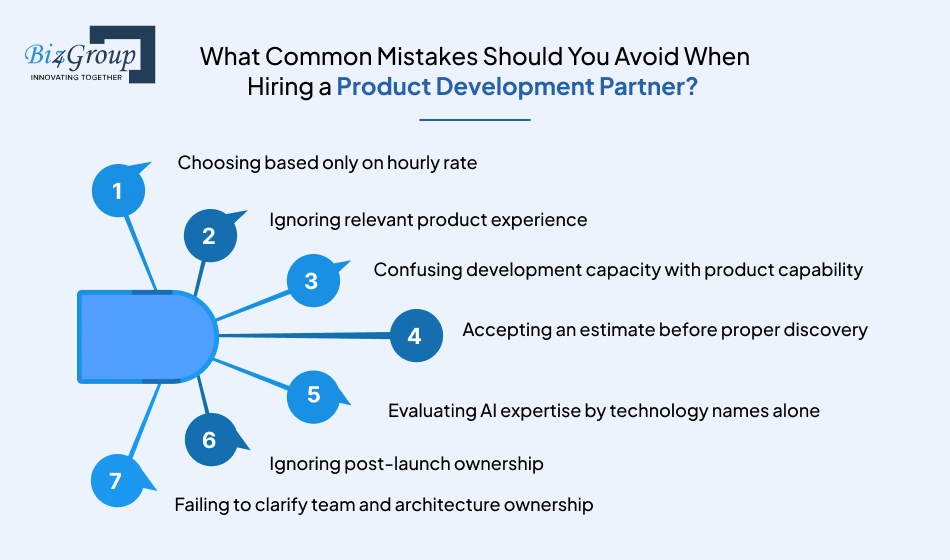
The most common mistakes are choosing on price alone, overlooking relevant product experience, accepting estimates before discovery, overestimating a vendor's AI capabilities, and failing to define ownership after launch. These decisions can lead to rework, budget overruns, technical debt, and products that miss their intended business goals.
A practical question to ask before signing is, "How do I know I'm hiring the right product development company and not just the company with the best sales pitch?"
Look beyond the sales presentation. Compare relevant case studies, the proposed delivery team, technical decision-making process, discovery approach, commercial model, and post-launch responsibilities.
|
Common Mistake |
Why It Happens |
How to Avoid or Solve It |
|---|---|---|
|
Choosing based only on hourly rate |
Hourly rates are easy to compare, while rework, supervision, delays, and team experience are harder to quantify. |
Compare total estimated effort, team composition, delivery model, and expected outcomes, not hourly rate alone. |
|
Ignoring relevant product experience |
A large portfolio can make a vendor appear capable of handling any product. |
Look for case studies involving similar product types, industries, users, integrations, and technical complexity. |
|
Confusing development capacity with product capability |
A large engineering team does not necessarily have strong product strategy or decision-making capabilities. |
Evaluate their ability to contribute across discovery, strategy, UX, architecture, engineering, QA, and post-launch development. |
|
Accepting an estimate before proper discovery |
Buyers often want a fixed budget and timeline before requirements are sufficiently defined. |
Establish scope, assumptions, dependencies, technical constraints, and acceptance criteria before committing to detailed estimates. |
|
Evaluating AI expertise by technology names alone |
Listing LLMs, machine learning, or AI platforms does not demonstrate production experience. |
Ask how the team handles model evaluation, data security, hallucinations, inference costs, monitoring, reliability, and model changes. |
|
Ignoring post-launch ownership |
The initial build receives most of the attention, while ongoing engineering is addressed later. |
Define responsibility for monitoring, maintenance, security, performance, technical debt, and future releases before development begins. |
|
Failing to clarify team and architecture ownership |
Buyers may not know who makes technical decisions or which specialists will actually work on the product. |
Confirm the project team, technical ownership, decision-making authority, escalation process, and replacement policy before signing. |
Before choosing a partner, ask one final question, "Can this team solve the specific product, technical, and business problems I am hiring them to own?"
If the evidence does not clearly support the answer, the vendor probably needs more scrutiny before you commit.
US-Based vs. Offshore Product Development: Which Should You Choose?
The choice affects more than development cost. Timezone overlap, communication, product ownership, security requirements, technical specialization, and the complexity of the work can all influence how well the engagement performs.
|
Consideration |
US-Based |
Offshore |
Hybrid |
|---|---|---|---|
|
Development cost |
Generally higher |
Generally lower |
Moderate to variable |
|
Timezone overlap |
Strong for US teams |
Varies by location |
Can be structured around core hours |
|
Product collaboration |
Easier for frequent decisions |
Requires stronger coordination |
US-facing product leadership with distributed engineering |
|
Specialized talent |
Strong access to US specialists |
Broad global talent pool |
Combines both models |
|
Enterprise requirements |
Convenient for US stakeholders and regulatory environments |
Requires careful governance |
Strong option for complex programs |
|
Best fit |
Collaboration-heavy, complex products |
Defined scopes and cost-sensitive projects |
Long-term products requiring both strategy and scale |
The deciding factor should be whether the delivery model gives your product the right balance of expertise, ownership, collaboration, security, and cost. Geography should support that decision, not replace it.
Building for the US Market? Let's Build It Right.
Your product doesn't need more vendors. It needs the right technical team, strategy, and execution to get from idea to production.
Talk to Biz4GroupWhat Should You Verify Before Choosing a Product Development Company?
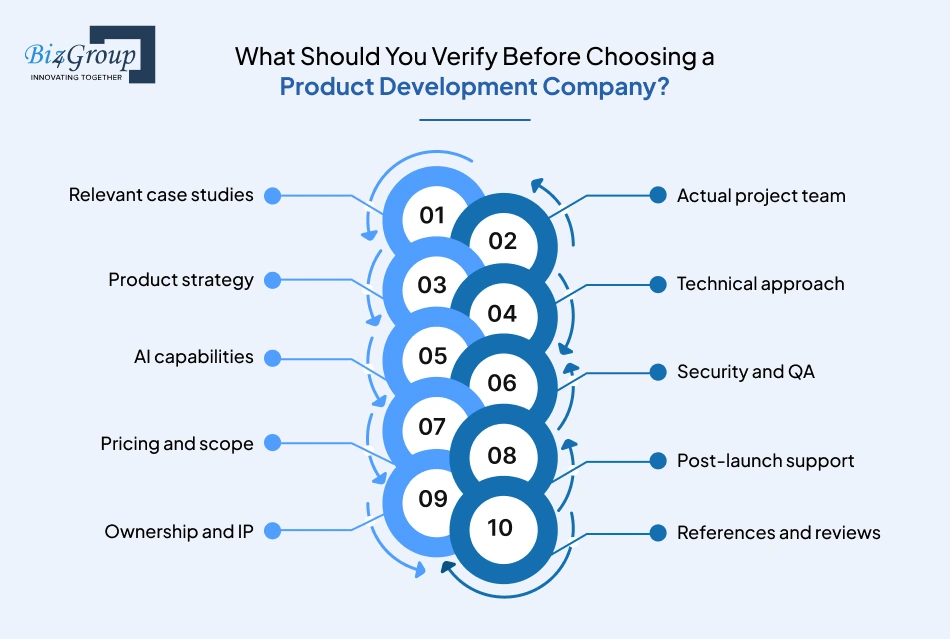
A proposal can look strong on paper and still leave important gaps around team quality, technical ownership, scope, security, and post-launch responsibilities. Before comparing final bids, verify the following details directly with each shortlisted company.
- Relevant case studies: Look for products similar to yours in industry, complexity, users, integrations, or technology.
- Actual project team: Confirm who will work on the product, their roles, seniority, and expected involvement.
- Product strategy: Understand how the company handles discovery, requirements validation, prioritization, and roadmap decisions.
- Technical approach: Review architecture, technology choices, scalability, integrations, and technical debt considerations.
- AI capabilities: For AI products, verify production experience with model evaluation, data security, monitoring, reliability, and inference costs.
- Security and QA: Ask about testing, security controls, compliance experience, deployment, and release processes.
- Pricing and scope: Clarify inclusions, exclusions, assumptions, change requests, payment terms, and potential additional costs.
- Post-launch support: Establish responsibilities for maintenance, monitoring, bug fixes, optimization, and future releases.
- Ownership and IP: Confirm ownership of source code, documentation, infrastructure, data, models, and intellectual property.
- References and reviews: Check recent third-party reviews and references from clients with comparable projects.
Before signing, turn these answers into contractual terms wherever possible. A clearly defined scope, named team, ownership model, acceptance criteria, security obligations, and post-launch support plan can prevent many disputes that only become visible after development starts.
Final Take: Choose the Partner That Reduces Product Risk
The strongest product development partner is not the one with the longest service list. It is the one that can identify risks early, challenge weak assumptions, make sound technical decisions, and connect engineering work to measurable product outcomes.
Before making your final choice, ask shortlisted companies to show a relevant case study, the actual delivery team, their discovery and architecture approach, how they will evaluate AI performance if applicable, and what post-launch support they provide. These five checks can reveal more about execution quality than a sales presentation alone.
One useful test is to give your finalists the same product problem and compare their approach. The strongest partner is often the one that identifies important questions and risks before proposing a solution.
For teams building AI-enabled products, AI-driven SaaS, agentic AI solutions, or full-cycle digital products, Biz4Group LLC brings these capabilities together across generative AI, AI integration, agentic AI, ML/NLP, MLOps, and product engineering.
Got a Product Idea? Ready to Build It? Turn your requirements into a clear product roadmap, solid technical foundation, and production-ready solution with Biz4Group's product development team.
FAQ’s
1. What services do product development companies in the USA provide?
Product development companies in the USA typically provide product discovery, strategy, UI/UX design, software engineering, QA, deployment, and post-launch development. Full-cycle digital product development services may also include cloud architecture, AI integration, data engineering, DevOps, and product modernization.
2. How much does custom product development cost in the USA?
The cost of custom product development in the USA varies by product complexity, features, integrations, technology stack, team structure, and timeline. A simple MVP may cost tens of thousands of dollars, while complex enterprise and AI products can reach hundreds of thousands. AI SaaS product development can range from approximately $25,000 to $400,000+, depending on AI architecture, integrations, compliance, and product complexity. Compare the full scope and estimated project cost rather than hourly rates alone.
3. How long does it take a product development company to build a digital product?
A basic MVP can take approximately 2-4 weeks, while complex digital products may require six months or longer. Timelines for AI product development services increase when projects involve enterprise integrations, regulatory requirements, AI capabilities, legacy modernization, or complex data architecture.
4. What is the difference between a product development company and a software development company?
A software development company primarily focuses on designing, engineering, testing, and maintaining software. A product development company can take broader ownership across product discovery, strategy, UX/UI, architecture, development, launch, and optimization. If requirements and architecture are already established, software development support may be sufficient; if the product itself still needs definition, full-cycle product development is usually more appropriate.
5. How do I choose the best product development company in the USA?
To choose among the best product development companies in the USA, compare relevant case studies, product strategy capabilities, engineering depth, proposed team, industry experience, pricing model, security practices, and post-launch support. Give shortlisted vendors the same product requirements and compare how they approach the problem, not just what they quote.
6. Which product development company is best for AI product development?
The right AI product development company should go beyond basic LLM integration and demonstrate experience with generative AI, AI agents, RAG, MLOps, data engineering, security, evaluation, and production monitoring. Companies such as Biz4Group, Rootstrap, and DataRobot offer different strengths across AI product engineering and enterprise AI. Your choice should depend on the product's AI requirements, technical complexity, and scale.
7. Can I hire a product development company only for MVP development?
Yes. Many product development companies provide MVP development services for startups and enterprises that want to validate a product before committing to full-scale development. Define the hypothesis being tested, essential features, target users, success metrics, budget, and post-MVP roadmap before development begins.
8. Do digital product development companies provide post-launch support?
Many digital product development companies provide ongoing maintenance, monitoring, bug fixes, security updates, infrastructure management, performance optimization, and feature development. Confirm whether post-launch support is included in the initial contract, provided through a retainer, or billed as a separate engagement.
9. Can a non-technical founder work with a product development company?
Yes. A full-service product development company can help a non-technical founder convert an idea into product requirements, user flows, architecture, an MVP roadmap, and a development plan. Look for a partner that explains technical trade-offs clearly and provides access to product and technical decision-makers rather than communicating only through sales or account teams.
10. Should I hire a US-based or offshore product development company?
A US-based product development company can be preferable when close stakeholder collaboration, timezone overlap, regulatory familiarity, or frequent product decisions are priorities. Offshore software product development companies can provide broader talent access and lower development costs, while hybrid teams can combine US-based product leadership with distributed engineering capacity.
