 Location :
Orlando, FL, USA
Location :
Orlando, FL, USA +1 (407) 714-1616
 info@biz4group.com

 AI Summary Powered by Biz4AI
- AI personalized product recommendations in eCommerce improve conversions only when they leverage high-quality data, real-time customer behavior, and continuous learning, not just advanced AI models.
- Recommendation accuracy often declines because of fragmented data, generic recommendation logic, outdated models, and the lack of feedback loops that help AI adapt over time.
- The most effective way to improve recommendation accuracy is by combining unified customer data, contextual signals, hybrid recommendation models, and continuous performance optimization.
- AI product recommendations engine costs range from affordable plug-and-play solutions to $12,000 to $150,000+ for MVP and custom enterprise platforms, so businesses should evaluate the total cost of ownership and expected ROI, not just the initial investment.
- Biz4Group LLC helps businesses build custom AI recommendation engines that integrate seamlessly with existing ecommerce platforms, improve recommendation accuracy, and deliver scalable personalization that drives measurable business growth.
Why do so many AI-powered product recommendations still miss the mark when 76% of shoppers say they're frustrated by poor personalization?
Because most AI personalized product recommendations in eCommerce are not limited by AI itself. They're limited by fragmented customer data, outdated recommendation logic, and AI models that fail to learn from changing shopper behavior.
The business impact is significant. According to McKinsey's report, 71% of consumers expect personalized interactions, and 76% become frustrated when brands fail to deliver them. The same report found that companies leading in personalization generate 40% more revenue from those efforts than slower-growing competitors.
For ecommerce founders, product leaders, agencies, and consultants, this means one thing. That is deploying an AI recommendation system isn't enough. Recommendation accuracy depends on how well your system understands customer intent, processes real-time behavioral signals, and continuously improves with fresh data.
At Biz4Group, we've built custom AI product recommendation systems that go beyond rule-based suggestions to deliver relevant recommendations across every stage of the customer journey. Our experience shows that improving recommendation accuracy requires the right data strategy, machine learning approach, and ongoing optimization, not just another AI tool.
Before exploring the strategies that can improve product recommendation accuracy by up to 80%, it's important to understand how recommendation accuracy works and how it directly impacts conversions and long-term ecommerce growth.
How AI Personalized Product Recommendations Engines Actually Work?
An AI-powered recommendation engine predicts what they're most likely to engage with next based on their behavior and the behavior of similar shoppers, instead of just guessing what a customer wants. Every click, search, product view, cart update, and purchase becomes a signal that helps the system decide which product to recommend at a particular moment.
Think of it as a salesperson who quietly observes every customer interaction. The more it learns about a shopper, the better it becomes at anticipating their next purchase.
Step 1: The Engine Collects Customer Signals
Every interaction tells the recommendation engine something about customer intent.
For example, it looks at signals such as:
- Products viewed
- Search queries
- Items added to or removed from the cart
- Purchase history
- Categories frequently explored
- Time spent on product pages
- Device and browsing session
- Seasonal shopping patterns
A single action rarely provides enough information. The engine combines multiple signals to build a clearer picture of what the customer is trying to accomplish.
For example, a shopper searching for "running shoes," comparing multiple brands, and reading product reviews is sending much stronger buying signals than someone who briefly lands on a product page and leaves.
Step 2: The Engine Finds the Best Product Match
Once it understands customer behavior, the recommendation engine decides how to recommend products. Most modern AI product recommendation systems rely on one or more of these approaches.
1. Collaborative Filtering
This approach learns from similar shoppers. If customers with browsing and purchasing patterns similar to yours frequently buy a particular product, the engine assumes you may also be interested in it.
Think of it as, "People with shopping habits similar to yours also bought this." This method works well when enough historical customer data is available.
2. Content-Based Filtering
Instead of comparing customers, this method compares products. If a shopper frequently purchases minimalist running shoes, the engine recommends other products with similar characteristics, such as lightweight materials, neutral cushioning, or the same brand.
Think of it as, "Because you liked this product, here are others with similar features."
This approach is particularly useful for niche catalogs where customer behavior alone isn't enough.
3. Hybrid AI Recommendation Models
Most ecommerce businesses don't rely on a single recommendation method. A hybrid recommendation engine combines customer behavior with product attributes to generate more accurate recommendations.
For example, if a shopper is looking for hiking boots, the engine may consider:
- Products purchased by similar customers
- Similar product specifications
- Current browsing session
- Seasonal demand
- Inventory availability
By combining multiple signals, hybrid models produce recommendations that feel more relevant and adapt better to changing customer behavior.
High-performing recommendation engines don't rely on one algorithm. They combine multiple recommendation techniques because no single method works equally well for every customer or shopping scenario.
Where do Customers Experience AI Personalized Product Recommendations?
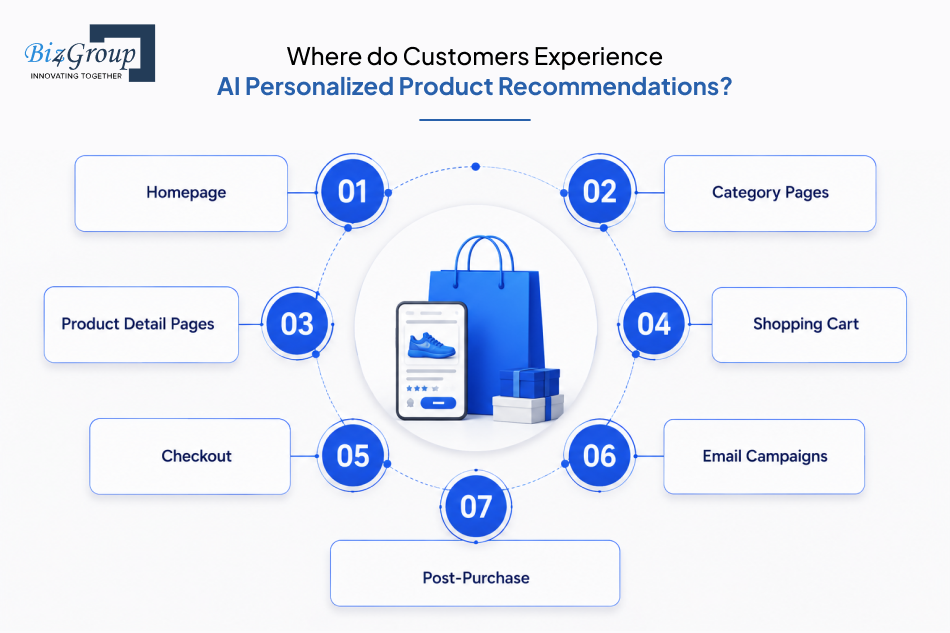
Customers experience AI personalized product recommendations across every major touchpoint of the shopping journey. Each recommendation is tailored to the customer's stage in the buying process, which makes product discovery faster and more relevant.
The table below shows how recommendation engines personalize experiences across different customer journey stages.
|
Customer Journey Stage |
Example Recommendation |
|---|---|
|
Homepage |
Products based on previous visits or browsing history |
|
Category Pages |
Popular products related to the category being explored |
|
Product Detail Pages |
Similar products and "Frequently Bought Together" suggestions |
|
Shopping Cart |
Complementary products that increase basket value |
|
Checkout |
Last-minute add-on recommendations |
|
Email Campaigns |
Personalized product suggestions based on recent activity |
|
Post-Purchase |
Replenishment reminders or complementary product recommendations |
The more consistently recommendations appear across these touchpoints, the more opportunities the business has to influence purchasing decisions.
How the AI Personalized Product Recommendations Process Works?
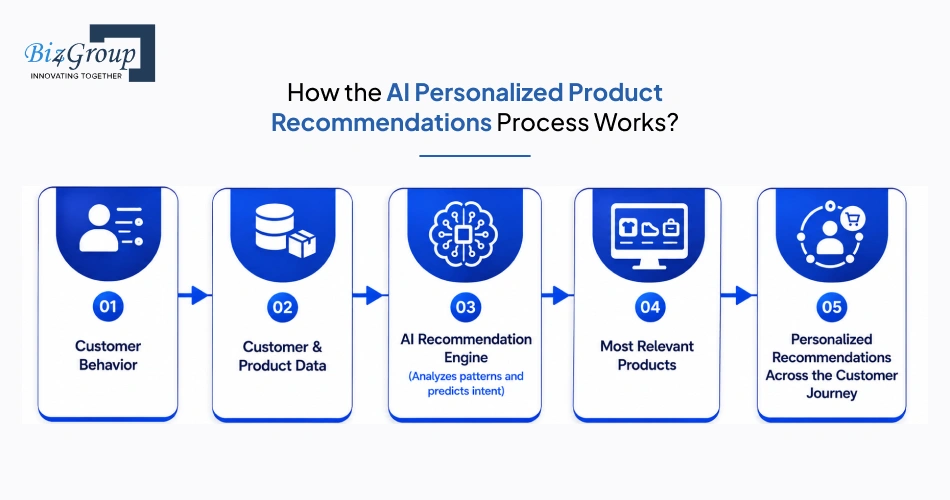
The workflow is simpler than many people expect.
If you often end up thinking, "We are a real estate business exploring how AI personalization works in ecommerce so we can apply similar ideas to our property listings. Can you explain how it works?"
The answer is yes, the underlying concept remains the same. Instead of recommending products, the AI recommends property listings based on a buyer's search behavior, budget, preferred locations, property features, and previous interactions. For ecommerce, real estate, travel, or even media, the objective remains identical... predict what a customer is most likely to engage with next using available behavioral and contextual data.
Next we'll explore why do so many recommendation engines still produce inaccurate recommendations despite having access to AI?
Still recommending products customers ignore?
Your recommendation engine should do more than display products. It should understand customer intent, improve every interaction, and drive measurable business growth. Let's build one that does.
Connect with usWhy Do Most AI Personalized Product Recommendations Engines Get It Wrong?
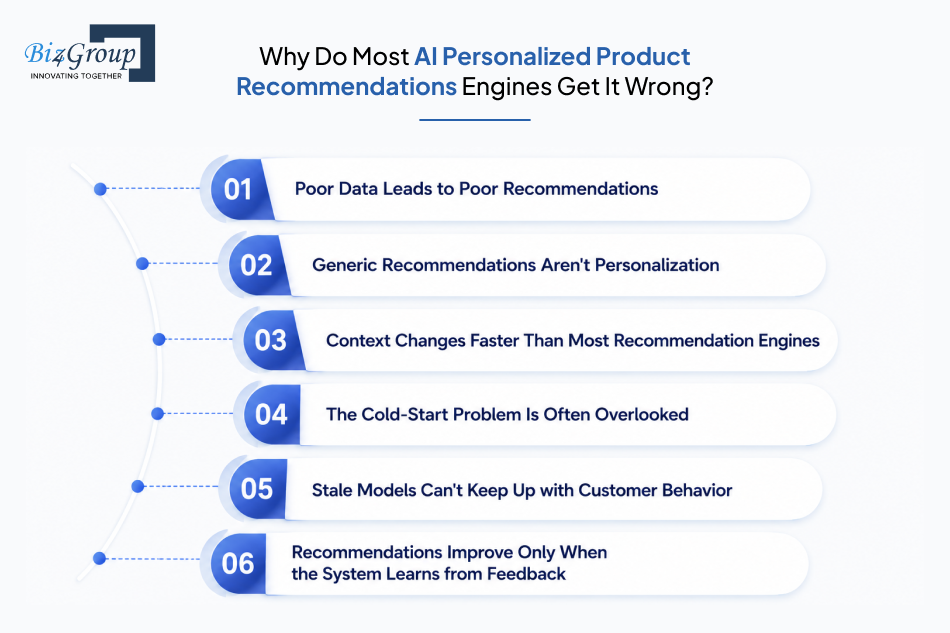
Most recommendation engines fail because the system lacks the data, context, and feedback needed to make accurate decisions. Even a sophisticated recommendation model will produce poor results if it's learning from incomplete customer behavior or outdated product information.
If your recommendations feel generic, repetitive, or irrelevant, one or more of the following issues is likely responsible.
1. Poor Data Leads to Poor Recommendations
An AI recommendation engine is only as good as the data it receives. Many ecommerce businesses collect customer data across multiple systems, including the website, mobile app, email platform, CRM, and point-of-sale (POS) software. When these systems don't communicate with each other, the recommendation engine only sees part of the customer's journey.
For example, a customer may purchase a product in-store but continue receiving recommendations for the same product online because the purchase history was never synchronized.
Ask yourself, does your recommendation engine have access to a complete customer profile or just isolated interactions?
2. Generic Recommendations Aren't Personalization
Many ecommerce stores display the same "Best Sellers" or "Trending Products" widget to every visitor and label it as personalization.
That's merchandising, not personalization. A true AI product recommendation system adapts recommendations based on individual behavior. Two customers visiting the same product page should not necessarily see the same recommendations if their interests and shopping patterns are different.
When every shopper sees identical suggestions, recommendation accuracy quickly reaches its limit.
3. Context Changes Faster Than Most Recommendation Engines
Customer intent changes throughout the shopping journey. Someone browsing office chairs on a Monday morning may return later that evening looking for standing desks or monitor arms. A recommendation engine that only relies on historical purchases may miss these shifts completely.
Context also includes factors such as:
- Current browsing session
- Device being used
- Geographic location
- Seasonality
- Inventory availability
- Time of day
Ignoring these signals often results in recommendations that feel disconnected from what the customer is trying to achieve right now.
4. The Cold-Start Problem Is Often Overlooked
Recommendation engines need data to make predictions. When a new customer visits your store or a new product is added to the catalog, there may not be enough historical information to generate meaningful recommendations.
This is known as the cold-start problem, and it's one of the most common reasons businesses struggle with recommendation accuracy during growth.
Effective AI systems solve this by combining product attributes, browsing behavior, and contextual signals instead of waiting for months of purchase history.
5. Stale Models Can't Keep Up with Customer Behavior
Customer preferences evolve constantly. Products trend on social media. Seasonal demand shifts, inventory changes and marketing campaigns influence buying behavior.
If a recommendation model is updated only once every few weeks, it continues making decisions based on yesterday's shopping patterns.
Modern AI recommendation engines continuously learn from fresh behavioral data, allowing recommendations to evolve alongside customer interests instead of lagging behind them.
6. Recommendations Improve Only When the System Learns from Feedback
Every customer interaction becomes feedback for the recommendation engine. Clicks, purchases, cart additions, and even ignored recommendations help the AI refine future suggestions and improve recommendation accuracy over time.
Without this feedback loop, recommendation quality eventually plateaus because the system has no way to distinguish successful recommendations from unsuccessful ones.
High-performing recommendation engines don't just make predictions. They measure every recommendation, learn from customer responses, and refine future suggestions accordingly.
Over-Personalization Can Reduce Customer Trust
AI personalization should feel helpful, not intrusive. If customers repeatedly see the same product they've already purchased or receive recommendations that reveal how closely their behavior is being tracked, trust begins to erode.
The best recommendation systems balance relevance with discovery. Alongside personalized suggestions, they introduce new products, seasonal collections, and complementary items to keep the shopping experience fresh.
If this sounds familiar, "We are running a multi-brand retail business and want one AI system that works across all our stores. Does something like that exist?", here us out.
Many enterprise retailers use a centralized AI recommendation system that serves multiple brands and storefronts. The system shares customer insights and behavioral patterns while allowing each brand to apply its own merchandising rules, catalog structure, and business objectives. This approach creates a more consistent customer experience and improves recommendation accuracy across the entire retail ecosystem.
Next step is learning how to evaluate recommendation accuracy from a business perspective and identify whether your current system is actually delivering measurable value.
What "Accuracy" Actually Means for Your Business in AI Personalized Product Recommendations?
Recommendation accuracy is measured by how often those suggestions influence customer behavior. If shoppers engage with recommended products, add them to their cart, complete purchases, and return for future orders, your recommendation engine is creating value. If they ignore the suggestions, accuracy is likely the problem.
For ecommerce leaders, AI personalized product recommendations in eCommerce should be evaluated using business metrics like these.
1. Are Customers Engaging with Your Recommendations?
The first sign of an effective recommendation engine is engagement.
Ask yourself:
- Are shoppers clicking on recommended products?
- Which recommendation widgets receive the most attention?
- Are recommendations generating meaningful product views?
If engagement remains consistently low, it's often a sign that the recommendations aren't aligned with customer intent.
2. Are Recommended Products Converting into Sales?
A recommendation is only valuable if it contributes to a purchase. Track whether customers who interact with recommendations are:
- Adding recommended products to their cart
- Completing purchases
- Buying complementary products together
This helps determine whether your recommendation engine is driving incremental revenue or just displaying products that customers would have purchased anyway.
3. Is Your Average Order Value Increasing?
One of the primary goals of an AI recommendation engine is to increase basket size through relevant cross-sells and upsells.
For example, if customers purchasing laptops also add laptop sleeves, wireless mice, or extended warranties because of personalized recommendations, your recommendation strategy is contributing directly to revenue growth.
If Average Order Value (AOV) remains unchanged despite active recommendations, it's worth reviewing whether the suggested products truly complement the customer's purchase journey.
4. Are Customers Coming Back?
Accurate recommendations don't just improve first-time purchases. They also encourage repeat business. Relevant post-purchase recommendations, replenishment reminders, and personalized product suggestions help keep customers engaged long after the initial transaction.
Tracking repeat purchase rate and customer lifetime value (CLV) can reveal whether your recommendation strategy is strengthening long-term customer relationships.
If this is something you often find yourself thinking, "I am evaluating vendors for my company and need to know how much an AI recommendation engine typically costs to implement and maintain." here's what you should know.
Before comparing pricing, evaluate how each solution measures success. A lower-cost platform that provides limited analytics and optimization may require more manual effort over time. However, a custom solution with stronger reporting, real-time learning, and performance monitoring can deliver better long-term ROI, even if the initial investment is higher.
Next, we'll understand what practical strategies improve recommendation accuracy.
Which Strategies and Data Practices Can Improve AI Personalized Product Recommendations Accuracy by Up to 80%?
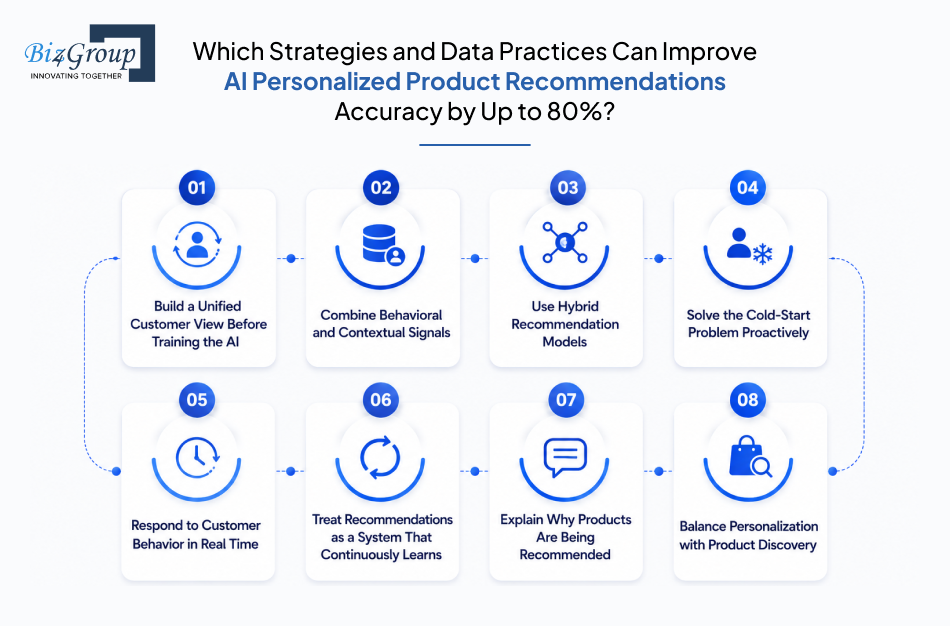
Businesses can improve AI personalized product recommendation accuracy by using high-quality customer data, real-time behavioral signals, hybrid AI models, and continuous optimization. These strategies enable recommendation engines to better understand customer intent and deliver more relevant product suggestions. Instead of relying on a single AI model, high-performing ecommerce businesses build a strong data foundation and continuously refine their personalization strategy as customer behavior evolves.
Here are the practices that make the biggest difference.
1. Build a Unified Customer View Before Training the AI
Recommendation engines perform best when they understand the complete customer journey. However, customer data is often scattered across ecommerce platforms, CRM systems, email marketing tools, loyalty programs, mobile apps, and support software. When these systems operate in isolation, the AI only sees fragments of customer behavior. Instead, create a unified customer profile by bringing together data from every touchpoint.
What does this look like in practice?
A customer browses a product on your website, opens a promotional email, redeems loyalty points in your mobile app, and later completes the purchase in-store. A unified customer profile allows the recommendation engine to learn from all of these interactions instead of treating them as separate events.
2. Combine Behavioral and Contextual Signals
Purchase history tells you what a customer bought yesterday. And context helps you understand what they're trying to buy today. Modern AI recommendation engines consider both historical behavior and real-time signals, including:
- Current browsing session
- Search queries
- Cart activity
- Device type
- Time of day
- Geographic location
- Seasonal demand
Together, these signals help the engine recommend products that match the customer's current intent rather than relying solely on previous purchases.
What does this look like in practice?
A customer who previously purchased hiking gear starts searching for camping equipment. Instead of recommending more hiking boots, the AI shifts its focus toward tents, sleeping bags, portable stoves, and other relevant camping essentials.
3. Use Hybrid Recommendation Models
No single recommendation method performs well in every scenario. Collaborative filtering works well for established products with rich customer interaction data. Content-based filtering performs better for niche catalogs or new users. Hybrid models combine multiple approaches to overcome the limitations of each.
This is why most enterprise-grade AI product recommendation systems rely on hybrid recommendation models instead of a single algorithm.
What does this look like in practice?
An online furniture retailer combines customer purchase history with product attributes such as style, material, room type, and price range to generate recommendations that remain relevant even for first-time visitors.
4. Solve the Cold-Start Problem Proactively
New customers and newly launched products don't have enough historical data for AI to make confident recommendations. Rather than waiting for data to accumulate, provide the recommendation engine with alternative signals.
These might include:
- Product attributes
- Category relationships
- Onboarding questionnaires
- Browsing behavior
- Popular products within specific customer segments
What does this look like in practice?
A skincare brand asks new visitors about their skin type and primary concerns before recommending products. This allows the AI to personalize recommendations immediately, even without previous purchase history.
You may have a similar question, "I am the founder of a D2C skincare brand and I don't have a large tech team. Is there a simple way to add personalized recommendations without hiring developers?"
The answer is yes. Many ecommerce platforms offer plug-and-play recommendation tools that support onboarding quizzes, product tagging, and behavioral personalization with minimal technical effort. As your catalog and customer base grow, these can be complemented or replaced with a custom recommendation engine tailored to your business goals.
5. Respond to Customer Behavior in Real Time
Customer intent changes throughout a browsing session, and recommendation engines that rely only on historical data often miss these shifts.
Real-time personalization allows recommendations to adapt as customer behavior evolves, creating a more relevant shopping experience.
What this looks like in practice?
A customer browsing travel luggage starts viewing passport holders and packing organizers. The recommendation engine immediately updates the suggested products instead of continuing to promote unrelated suitcases.
6. Treat Recommendations as a System That Continuously Learns
Recommendation engines improve when they learn from customer feedback. Every click, purchase, skipped recommendation, and abandoned cart provides signals that help the AI refine future recommendations.
Businesses that regularly monitor these signals and retrain their models achieve better long-term recommendation accuracy than those using static recommendation rules.
What this looks like in practice?
A retailer reviews recommendation performance every month, identifies low-performing recommendation widgets, and adjusts the recommendation logic based on customer interaction patterns rather than assumptions.
7. Explain Why Products Are Being Recommended
Customers are more likely to engage with recommendations when they understand why they're seeing them. Simple explanations such as "recommended based on your recent searches," "frequently bought together," or "popular among customers with similar preferences" add transparency and increase trust.
For businesses in regulated industries like healthcare, this becomes even more important. Customers need confidence that recommended products are relevant, compliant, and aligned with their needs.
Biz4Group has developed solutions where intelligent product discovery plays a central role. Our Enterprise eCommerce Store for Selling Medical Products, built for a U.S.-based healthcare client.

Enterprise eCommerce Store for Selling Medical Products was designed to simplify the purchase of medical cannabis products while complying with strict federal regulations. Beyond enabling online transactions, the solution focused on intelligent product discovery, personalized shopping experiences, and secure patient interactions for healthcare providers and dispensaries.
Key capabilities included:
- Smart product search with personalized product recommendations.
- Advanced product filters to help users find products based on their medical needs and preferences.
- Intuitive user dashboard for seamless navigation and order management.
- Daily deals and personalized promotional offers to improve customer engagement.
- Medical Card application workflow integrated into the shopping experience.
- Secure B2B ecommerce platform for dispensaries and healthcare institutions.
- Compliance with federal regulations governing medical cannabis sales and distribution.
- Privacy-first architecture to protect sensitive healthcare and customer information.
This project demonstrates our ability to build custom ecommerce platforms that combine intelligent product discovery, personalized user experiences, regulatory compliance, and scalable architecture for highly specialized industries.
8. Balance Personalization with Product Discovery
Showing the same types of products repeatedly can reduce engagement over time. Effective recommendation engines maintain a balance between familiarity and discovery by introducing complementary products, seasonal collections, new arrivals, and emerging trends alongside personalized suggestions.
This keeps recommendations relevant while encouraging customers to explore more of the catalog. The highest-performing recommendation engines don't optimize for clicks alone. They optimize for long-term customer value by continuously learning, adapting, and introducing the right level of variety.
If you're building a new commerce platform from the ground up, you may be asking, "We are developing a new ecommerce app and want to integrate an AI recommendation engine from the start. What should we look for?"
Start by evaluating how well the solution adapts to changing customer behavior. Prioritize capabilities such as real-time behavioral tracking, API-first integration, continuous AI model training, and robust analytics over the choice of AI algorithm alone.
Biz4Group has built solutions that solve similar ecommerce challenges. Our eCommerce marketplace for buying and selling seafood and pets is a custom multi-vendor platform designed to simplify product discovery and create a seamless shopping experience for buyers and sellers alike.
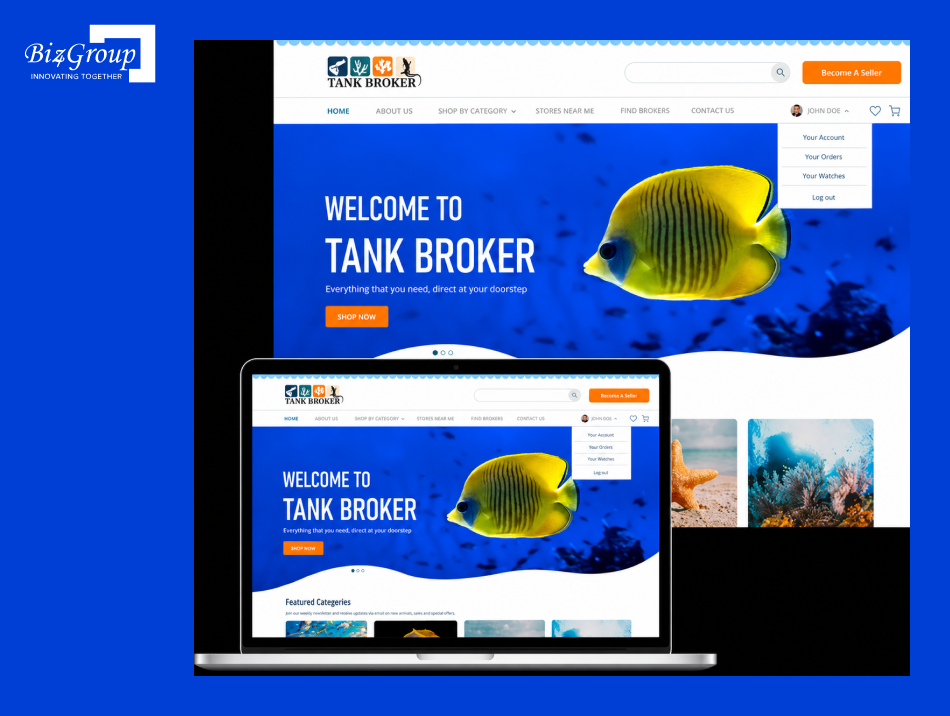
The eCommerce marketplace for buying and selling seafood and pets was developed for a retail client looking to expand into ecommerce with a niche platform for seafood, aquatic life, reptiles, and pet products. Instead of relying on standard marketplace functionality, the solution focused on helping users quickly discover relevant products while enabling vendors to efficiently manage and grow their online business.
Key capabilities included:
- Smart product search with auto-suggestions for faster product discovery.
- Shop as Guest functionality for quick and frictionless checkout.
- Location-based "Find Nearby Brokers" feature for bulk seafood purchases.
- Find Nearby Pet Stores to help customers locate trusted sellers.
- In-stock notifications to alert users when their preferred products become available.
- Multi-vendor marketplace with seamless buyer-to-seller account switching.
- Flexible membership plans for sellers based on their business requirements.
- Intuitive and responsive user experience designed for easy browsing, purchasing, and vendor management.
This project reflects our expertise in building scalable, feature-rich ecommerce platforms that can be extended with intelligent AI capabilities such as personalized product recommendations, smart merchandising, and real-time customer personalization.
Improving recommendation accuracy starts with the right strategy, but sustaining it requires continuous measurement. Further, we'll look at the key metrics and testing methods that help you determine whether your recommendation engine is actually delivering better business outcomes.
Are your recommendations earning customer trust?
Relevant recommendations create loyal customers. Generic ones create missed opportunities. Let's help you deliver experiences shoppers actually value.
Connect With UsHow to Measure Whether Your AI Personalized Product Recommendations Engine Is Actually Working?
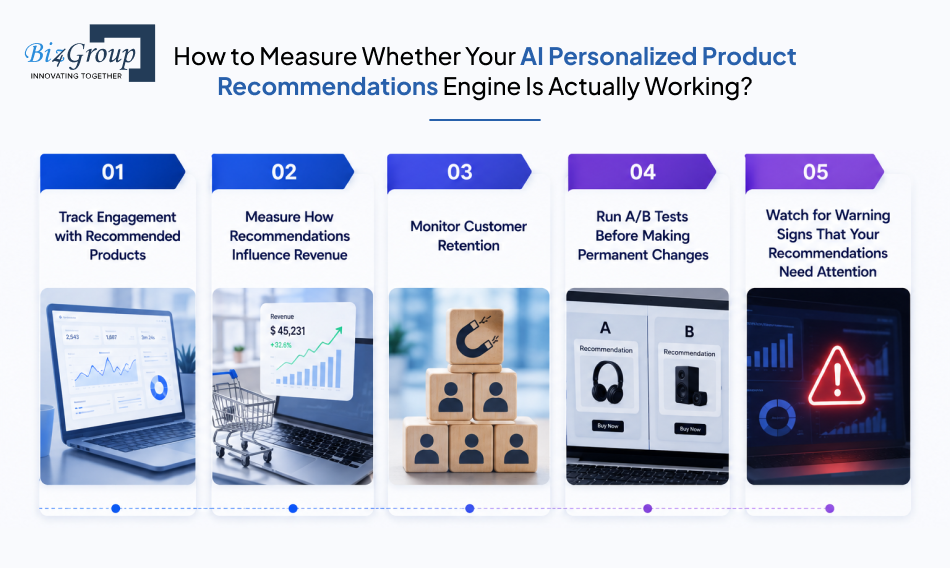
The easiest way to measure recommendation performance is through business outcomes. Look at metrics such as clicks, conversions, AOV, and repeat purchases instead of the number of recommendations generated.
The good thing is that you don't need a data science team to measure recommendation performance. A handful of business metrics can reveal if your personalization strategy is moving in the right direction.
1. Track Engagement with Recommended Products
The first question to answer is, "Are customers interacting with your recommendations?"
If shoppers consistently ignore recommendation widgets, it's often a sign that the suggested products aren't relevant.
Monitor metrics such as:
- Recommendation click-through rate (CTR)
- Product views generated through recommendations
- Time spent exploring recommended products
Improving engagement is usually the first indicator that recommendation accuracy is improving.
2. Measure How Recommendations Influence Revenue
Clicks are useful, but purchases matter more. Look beyond overall sales and identify how much revenue is directly influenced by product recommendations.
Key metrics include:
- Conversion rate from recommended products
- Average Order Value (AOV)
- Cross-sell and upsell revenue
- Revenue generated per recommendation click
These numbers provide a much clearer picture of whether your AI personalized product recommendations in eCommerce are contributing to business growth.
3. Monitor Customer Retention
Accurate recommendations shouldn't only improve the first purchase. They should encourage customers to come back.
Track metrics such as:
- Repeat purchase rate
- Customer Lifetime Value (CLV)
- Returning visitor rate
- Post-purchase recommendation engagement
When these metrics improve alongside recommendation performance, it's a strong sign that customers find your recommendations useful rather than intrusive.
4. Run A/B Tests Before Making Permanent Changes
One of the easiest ways to improve recommendation accuracy is to test different approaches instead of relying on assumptions.
For example, compare:
- AI-powered recommendations vs. bestseller widgets
- Personalized cross-sells vs. generic cross-sells
- Real-time recommendations vs. static recommendations
- Different recommendation placements on the same page
Even small improvements in click-through rate or average order value can generate significant revenue gains when applied across thousands of customer sessions.
Test one variable at a time. If you change the recommendation algorithm, page layout, and product placement simultaneously, it becomes difficult to identify what actually improved performance.
5. Watch for Warning Signs That Your Recommendations Need Attention
Performance issues don't always appear as declining sales. They often show up in smaller signals first.
Review your recommendation strategy if you notice:
- Recommendation widgets with consistently low click-through rates
- Customers repeatedly ignoring personalized suggestions
- Flat or declining Average Order Value
- Rising bounce rates on product pages
- Increasing cart abandonment despite active cross-sell recommendations
- Repeated recommendations for products customers have already purchased
These indicators often reveal that the recommendation engine isn't adapting to customer behavior quickly enough.
If you're evaluating vendors, you're probably asking, "I am evaluating vendors for my company and need to know how much an AI recommendation engine typically costs to implement and maintain."
The answer depends on your business size, data maturity, and customization requirements. We'll take a look at these details next.
How Much Does an AI Personalized Product Recommendation Engine Cost?
The cost of implementing an AI recommendation engine can range from a few hundred dollars per month for plug-and-play tools to approximately $12,000 for a basic custom MVP development. Enterprise-grade AI recommendation solutions typically range from $50,000 to $150,000+, depending on your business size, product catalog, customer traffic, personalization goals, AI integration services, and infrastructure requirements.
If you're comparing solutions, don't focus only on the implementation cost. Consider the total cost of ownership, including integration, maintenance, infrastructure, optimization, and long-term scalability.
Here is a quick table for your reference:
|
Solution Type |
Estimated Cost |
Best For |
|---|---|---|
|
Off-the-Shelf AI Recommendation Tools |
$20 to $5,000+/month |
Businesses looking for quick deployment with built-in recommendation capabilities and minimal customization. |
|
Custom AI Recommendation MVP |
$12,000 to $30,000+ |
Startups and growing ecommerce businesses that want to validate AI-powered recommendations before scaling. |
|
Enterprise AI Recommendation Solution |
$50,000 to $150,000+ |
Mid-market and enterprise businesses requiring custom recommendation logic, real-time personalization, complex integrations, and enterprise-grade scalability. |
Custom AI projects usually vary significantly based on integrations, recommendation complexity, data availability, and infrastructure requirements.
What Factors Influence the Cost of AI Personalized Product Recommendation?
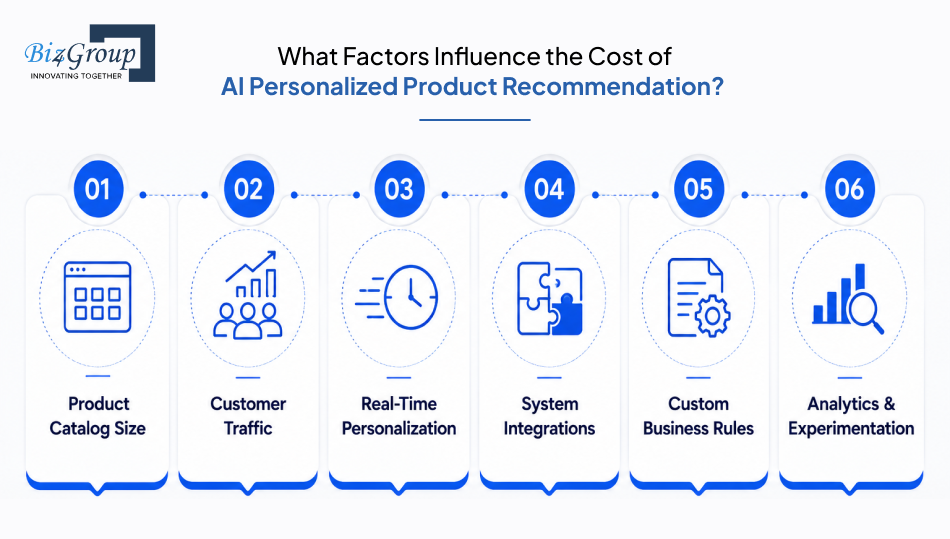
The cost of an AI personalized product recommendation solution depends on its complexity, required integrations, data volume, and personalization capabilities. The more advanced your requirements, the higher the implementation cost.
The table below outlines the key factors that influence the overall investment.
|
Cost Driver |
Estimated Cost Impact |
Why It Increases Cost |
|---|---|---|
|
Product Catalog Size |
+$2,000 to $20,000+ |
Larger catalogs require more sophisticated indexing, search, and recommendation logic. |
|
Customer Traffic |
+$500 to $10,000+/month |
Higher traffic requires scalable infrastructure and faster recommendation serving. |
|
Real-Time Personalization |
+$5,000 to $30,000+ |
Processing live customer behavior requires streaming data pipelines and low-latency AI models. |
|
System Integrations |
+$2,000 to $25,000+ |
Connecting with CRM, ERP, CDP, POS, marketing platforms, and analytics tools increases development effort. |
|
Custom Business Rules |
+$3,000 to $20,000+ |
Tailored recommendation logic requires additional AI development and testing. |
|
Analytics & Experimentation |
+$2,000 to $15,000+ |
Custom dashboards, A/B testing, and recommendation performance reporting add implementation complexity. |
What Are the Hidden Costs of AI Personalized Product Recommendations?
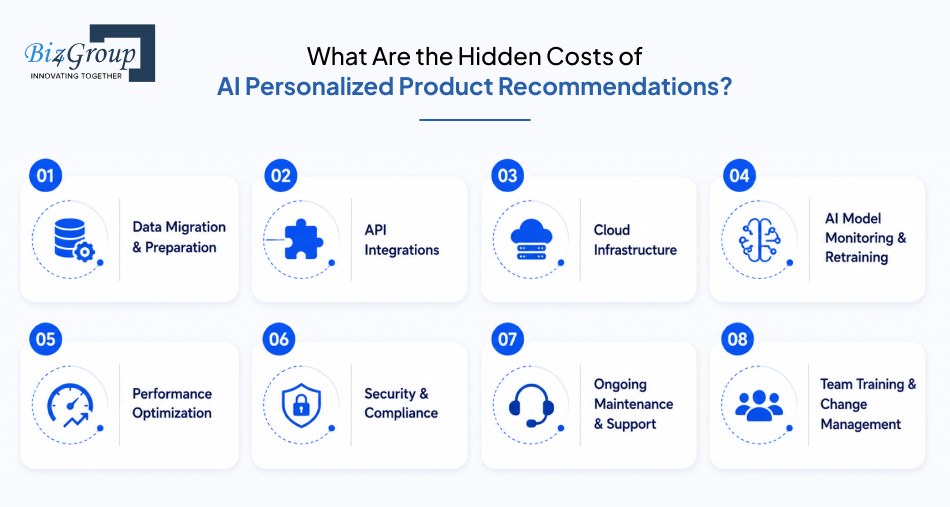
Many businesses budget for the recommendation engine but overlook the work required to keep it accurate and scalable. Expenses such as data preparation, system integrations, cloud infrastructure, and ongoing model optimization can significantly increase the total investment.
The table below highlights the most common hidden costs businesses should factor into their budget.
|
Hidden Cost |
Estimated Cost |
Why It Matters |
|---|---|---|
|
Data Migration & Preparation |
$1,000-$10,000+ |
Cleansing, organizing, and unifying customer and product data takes time and expertise. |
|
API Integrations |
$2,000-$20,000+ |
Connecting with CRM, ERP, POS, CDP, and ecommerce platforms requires development effort. |
|
Cloud Infrastructure |
$100-$5,000+/month |
AI workloads require scalable computing, storage, and networking resources. |
|
AI Model Monitoring & Retraining |
$500-$5,000+/month |
Models need regular updates to maintain recommendation accuracy. |
|
Performance Optimization |
$2,000-$15,000+ |
Continuous testing and tuning improve recommendation quality and speed. |
|
Security & Compliance |
$3,000-$25,000+ |
Meeting GDPR, CCPA, and industry-specific compliance requirements adds implementation costs. |
|
Ongoing Maintenance & Support |
15-25% of development cost/year |
Covers updates, bug fixes, security patches, and system monitoring. |
|
Team Training & Change Management |
$1,000-$10,000+ |
Helps internal teams effectively manage and optimize the recommendation system. |
The biggest hidden cost isn't infrastructure or maintenance. It's poor recommendation accuracy. A low-cost recommendation engine that delivers irrelevant suggestions can reduce conversions, lower customer trust, and cost far more in lost revenue than a well-designed AI solution.
How Can You Optimize AI Recommendation Costs Without Sacrificing Performance?
You can optimize AI recommendation costs by investing in the features that deliver the highest business value first. A phased implementation and continuous optimization help in reducing unnecessary spending while maintaining recommendation accuracy and performance.
Consider these cost optimization strategies:
- Start with an MVP: Instead of building every feature upfront, harness the power of MVP development services first. This can reduce your initial investment by 30% to 50% while helping you validate your recommendation strategy.
- Prioritize high-impact integrations: Connect only the systems that improve recommendation accuracy, such as your ecommerce platform, CRM, or analytics tools. This can save $2,000 to $15,000 in development costs.
- Roll out personalization in phases: Introduce recommendations on high-impact touchpoints like product pages and carts before expanding across the entire customer journey. This approach can lower implementation costs by 20% to 40%.
- Choose a scalable architecture: Build a solution that grows with your business. A scalable recommendation engine helps avoid future redevelopment costs that can exceed $20,000.
- Continuously monitor and optimize performance: Regularly review recommendation metrics and remove low-performing widgets. Improving existing recommendations is often more cost-effective than adding new features.
The most affordable AI recommendation engine isn't always the most cost-effective. A solution that delivers higher conversions and better customer retention often provides a stronger return on investment than one with the lowest upfront price.
The next decision is should you rely on native ecommerce features, invest in a third-party platform, or build a custom AI solution? Let's compare each approach to help you determine the best fit for your business.
Can your recommendation engine do more?
If your personalization strategy has stopped evolving, your growth probably has too. Let's build an AI solution designed for where your business is headed.
Connect with usBuild, Buy, or Partner: Which AI Recommendation Approach Is Right for Your Business?
There isn't a one-size-fits-all approach to implementing an AI recommendation engine. The right choice depends on your product catalog, customer volume, available data, internal technical expertise, and long-term business goals.
For some businesses, native ecommerce features are enough. Others need a specialized recommendation platform or a fully custom AI solution. Understanding the trade-offs helps you invest in the right technology from the beginning.
1. Native Ecommerce Recommendation Tools
If you're an early-stage ecommerce business with a relatively small catalog, your ecommerce platform may already include basic recommendation capabilities. These solutions are designed for quick implementation and require minimal technical effort.
Best suited for:
- Startups and small ecommerce stores
- Businesses with limited customer data
- Teams looking for a low-cost starting point
Things to keep in mind:
- Limited personalization capabilities
- Few customization options
- Basic analytics
- May struggle as your catalog and customer base grow
2. Third-Party AI Recommendation Platforms
Dedicated recommendation platforms offer more advanced personalization without requiring you to build the technology yourself.
These platforms typically include real-time recommendations, customer segmentation, analytics, experimentation tools, and integrations with major ecommerce platforms.
Best suited for:
- Growing ecommerce brands
- Mid-market retailers
- Businesses that want faster implementation
Things to keep in mind:
- Subscription costs increase as usage grows
- Limited flexibility compared to custom solutions
- Vendor lock-in can make future migrations more complex
3. Custom AI Recommendation Solutions
Custom development gives businesses complete control over how recommendations are generated, optimized, and integrated across digital channels.
Instead of adapting your business to fit a platform, the recommendation engine is designed around your customer journey, business rules, and data ecosystem.
Best suited for:
- Enterprise retailers
- Multi-brand businesses
- Large product catalogs
- Businesses with unique recommendation logic
- Companies investing heavily in AI-driven customer experiences
What are the Common Mistakes That Reduce Recommendation Accuracy?
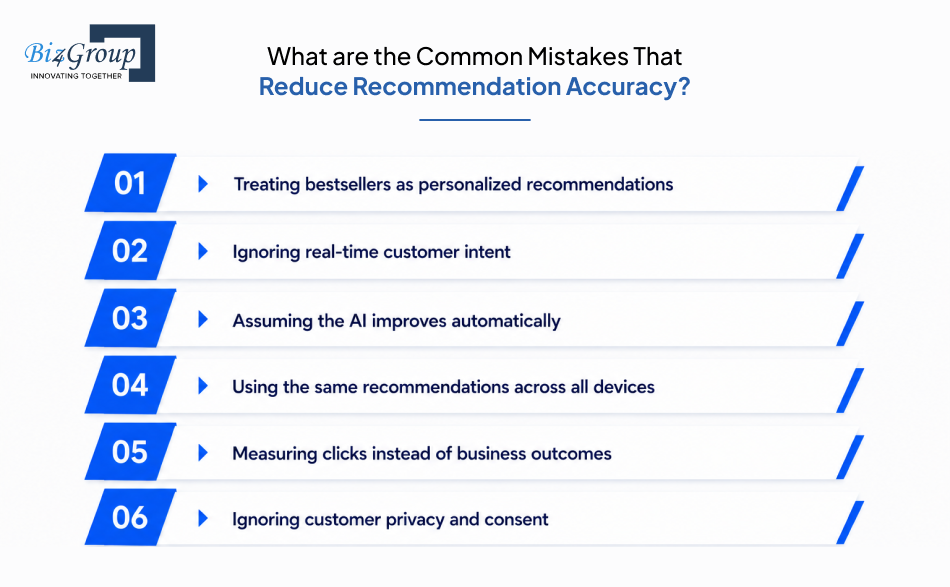
Even the most advanced AI recommendation engine can produce irrelevant suggestions if the fundamentals are overlooked. Poor data quality, limited customer insights, and a lack of continuous optimization often reduce recommendation accuracy long before the AI becomes the problem.
The following table outlines the most common mistakes businesses make and the practical steps to avoid them.
|
Common Mistake |
Why It's a Problem |
What to Do Instead |
|---|---|---|
|
Treating bestsellers as personalized recommendations |
Every customer sees the same products, reducing relevance and engagement. |
Combine product popularity with customer behavior and preferences to personalize recommendations. |
|
Ignoring real-time customer intent |
Recommendations rely only on historical data and fail to reflect what customers are looking for right now. |
Continuously analyze browsing behavior, searches, and cart activity to adapt recommendations in real time. |
|
Assuming the AI improves automatically |
Recommendation quality declines as customer preferences, products, and trends change. |
Regularly monitor performance, retrain models, and optimize recommendation strategies. |
|
Using the same recommendations across all devices |
Mobile and desktop users often browse and purchase differently, making identical recommendations less effective. |
Optimize recommendation placement and formats for each device and shopping experience. |
|
Measuring clicks instead of business outcomes |
High engagement doesn't always translate into revenue or customer retention. |
Track conversion rate, Average Order Value (AOV), repeat purchases, and Customer Lifetime Value (CLV). |
|
Ignoring customer privacy and consent |
Overly intrusive personalization can reduce trust and create compliance risks. |
Be transparent about data collection and ensure compliance with regulations such as GDPR and CCPA. |
|
Treating personalization as a one-time implementation |
Static recommendation engines become less relevant as customer behavior evolves. |
Continuously test, refine, and update your recommendation models using fresh customer data. |
Successful personalization is defined by how consistently your business monitors performance, adapts to changing customer behavior, and improves recommendation quality over time.
By avoiding these common pitfalls, you'll be in a much stronger position to deliver recommendations that customers trust and act on. Let's see what future hold in AI personalized product recommendation sector.
What is the Future of AI Personalized Product Recommendations?
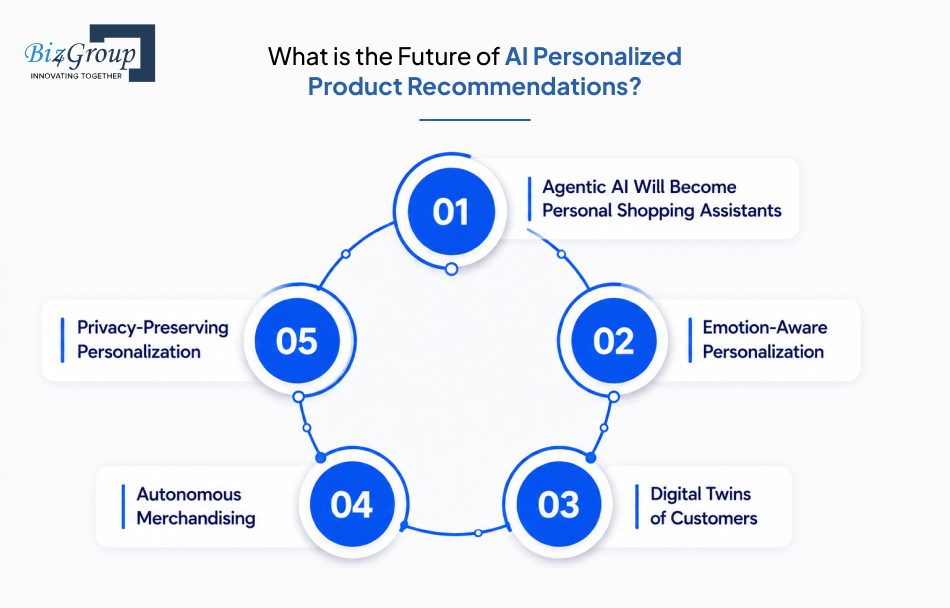
The next generation of AI recommendation engines will understand intent, anticipate needs, and make decisions alongside customers. As AI models become more autonomous and multimodal, personalization will shift from reacting to customer behavior to proactively guiding the entire buying journey.
1. Agentic AI Will Become Personal Shopping Assistants
Instead of recommending individual products, expertise of an agentic AI development company will help customers achieve broader goals.
For example, a shopper planning a hiking trip could ask an AI shopping assistant to build a complete gear list within a specific budget. The agent would compare products, check inventory, apply discounts, recommend compatible accessories, and even schedule replenishment reminders after the purchase.
2. Emotion-Aware Personalization
Future recommendation systems will consider emotional context alongside behavioral data. AI may infer whether a shopper is researching, comparing, or ready to buy. It will do it by analyzing signals such as browsing patterns, interaction speed, product exploration, and customer feedback. Recommendations will adapt to the customer's decision stage instead of treating every visitor the same.
3. Digital Twins of Customers
Rather than relying only on historical interactions, businesses will create AI-powered digital representations of customer preferences that continuously evolve.
These digital twins will simulate how customers are likely to respond to new products, promotions, and pricing strategies before recommendations are delivered. They will help businesses improve accuracy while reducing unnecessary experimentation.
4. Autonomous Merchandising
Today's merchandising teams manually configure campaigns, collections, and promotional rules.
In the future, AI will continuously optimize product placement, recommendation strategies, inventory exposure, and promotional timing without requiring constant manual intervention. Human teams will focus on strategy while AI handles day-to-day merchandising decisions.
5. Privacy-Preserving Personalization
As privacy regulations evolve, recommendation engines will move away from third-party tracking. Privacy-first AI techniques, including federated learning, on-device inference, and synthetic data generation, will enable businesses to deliver personalized experiences without compromising customer privacy.
This will enable businesses to deliver highly relevant recommendations while giving customers greater control over their personal data.
Looking ahead, the future of AI personalized product recommendations in eCommerce isn't about recommending more products. It's about creating intelligent shopping experiences that understand customer goals, adapt in real time, respect privacy, and continuously improve without increasing operational complexity.
Now, let's talk about who can help you build such intelligent systems.
Why Choose Biz4Group LLC for AI Recommendation Engine Development?
Building an AI recommendation engine isn't just about implementing machine learning models. It's about creating a system that understands your customers, integrates seamlessly with your existing ecommerce ecosystem, and continuously improves as customer behavior evolves. That's where the right AI product development partner makes the difference.
At Biz4Group, a leading AI ecommerce development company in USA, we've delivered custom ecommerce platforms for niche industries, including the eCommerce Marketplace for Buying and Selling Seafood and Pets and the Enterprise eCommerce Store for Selling Medical Products. These projects demonstrate our ability to build scalable, feature-rich commerce experiences tailored to unique customer journeys and business requirements.
Our team builds solutions attuned to your business goals. Backed by 20+ years of industry experience, we combine proven AI expertise with deep ecommerce development capabilities to help businesses build scalable, high-performing recommendation solutions.
From strategy and data preparation to AI model development, platform integration, and ongoing optimization, we work closely with your team to ensure your recommendation engine continues to deliver measurable business results as your catalog, customers, and market evolve.
Connect with our AI experts for a personalized consultation.
Final Thoughts
As customer expectations continue to rise, just offering personalized recommendations is not enough anymore. The competitive advantage lies in delivering recommendations that are timely, relevant, and accurate. Every irrelevant suggestion is a missed opportunity to build trust, increase revenue, and strengthen customer relationships.
The businesses that succeed with AI personalized product recommendations in eCommerce won't necessarily have the biggest AI budgets or the most complex algorithms. They'll be the ones that continuously improve their data quality, understand customer intent, and treat personalization as an evolving business capability rather than a one-time feature.
Throughout building a recommendation engine, the goal should remain the same: help every customer discover the right product at the right moment. When recommendation accuracy improves, better business outcomes naturally follow.
At Biz4Group LLC, we specialize in building custom AI-powered ecommerce solutions that go beyond off-the-shelf recommendation tools. Our team helps businesses transform customer data into personalized shopping experiences that deliver measurable business outcomes.
So, are you ready to improve your product recommendation accuracy? Connect with us today for a personalized consultation.
Frequently Asked Questions (FAQs)
1. What industries benefit the most from AI product recommendation systems?
While ecommerce is the most common use case, AI recommendation systems also deliver value in industries such as retail, healthcare, real estate, travel, media, education, and financial services. Any business that offers multiple products, services, or content can use AI to improve personalization and customer engagement.
2. How long does it take to implement an AI recommendation engine?
Most off-the-shelf AI recommendation platforms can be implemented in a few days to a few weeks, while custom solutions typically take 8 to 16 weeks. Biz4Group LLC can deliver a functional AI recommendation MVP in 2 to 4 weeks by using reusable AI components and proven development frameworks, reducing both implementation time and cost.
3. Do AI recommendation engines work without customer purchase history?
Yes. Modern recommendation engines can use browsing behavior, search queries, product attributes, session activity, and contextual signals to generate relevant recommendations, even for first-time visitors.
4. How often should an AI recommendation model be updated?
There is no fixed schedule. Ideally, recommendation engines should learn continuously from new customer interactions. Businesses should also review recommendation performance regularly and retrain models whenever significant changes occur in customer behavior, product catalogs, or seasonal demand.
5. Can AI recommendation engines integrate with existing ecommerce platforms?
Most modern recommendation engines support integration with platforms such as Shopify, Magento, WooCommerce, BigCommerce, Adobe Commerce, and custom ecommerce applications through APIs and connectors. The level of customization depends on the platform and business requirements.
6. How can businesses protect customer privacy while using AI recommendations?
Businesses should collect customer data transparently, obtain appropriate consent, follow regulations such as GDPR and CCPA, and use privacy-first practices like data minimization, anonymization, and secure data storage to build customer trust.
7. Can AI recommendations help reduce cart abandonment?
Yes. Personalized recommendations shown during the cart or checkout stage can encourage customers to add complementary products or discover alternatives if an item is unavailable. However, recommendations should remain relevant and not interrupt the checkout experience.
