 Location :
Orlando, FL, USA
 +1 (407) 714-1616
 info@biz4group.com


 AI Summary Powered by Biz4AI
- Real estate portal and marketplace development covers three different products: a search portal, a two-sided marketplace and a brokerage app. Each has a different business, data need and risk.
- One published estimate puts North American agency rates at $100 to $180 an hour, the closest published guide to US team rates, so the blended rate moves the total as much as features do.
- Hours multiplied by a blended rate is the only way to check any quote, and a cross-check against US government wage data is shown below.
- Hosting, maintenance, data feeds and third-party fees keep costing money after launch, so the build price is not the budget.
- A scoping worksheet at the end turns a range into a figure for your own feature list.
Real estate portal and marketplace development gets pitched as one thing, and it is at least three. A founder says "we want to build a Zillow," the agency nods, and six months later the team is arguing about whether the product is a search engine, a matchmaking service or a brokerage's app. Those are different businesses with different data needs, different costs and different ways to fail.
This page sorts them out in plain terms. The short version: decide which of the three you are before anything else, because every later choice follows from it.
How much does real estate portal and marketplace development cost, by type of build?
Published agency estimates put a basic real estate listing site at about $20,000 to $70,000, a marketplace at about $50,000 to $130,000 and a full platform at about $100,000 to $300,000 or more. The table shows what each estimate says, and the last row is the span used across this guide and the hub.
|
Source |
Basic or niche |
Marketplace or mid-market |
Full platform |
|---|---|---|---|
|
$40K to $70K |
$70K to $130K |
$100K to $160K+ |
|
|
$20K to $50K |
$50K to $120K |
$120K to $300K+ |
|
|
$5K to $50K (prototype) |
$50K to $120K |
$120K to $300K+ |
|
|
Span used here |
about $20K to $70K |
about $50K to $130K |
about $100K to $300K+ |
Most of the spread comes from scope and team rates. One of the estimates puts North American agency rates at $100 to $180 an hour, and search that has to handle MLS data is a bigger job than a basic filter. The third estimate's lowest tier is a prototype, so the basic span above starts at the other two floors.
None of the three shows its project data, so treat every figure as a ballpark.
Price your portal or marketplace line by line
Biz4Group turns your idea into hours, a rate and a first-year budget, then builds it.
Get my estimateWhy do agencies quote such different numbers for the same app?
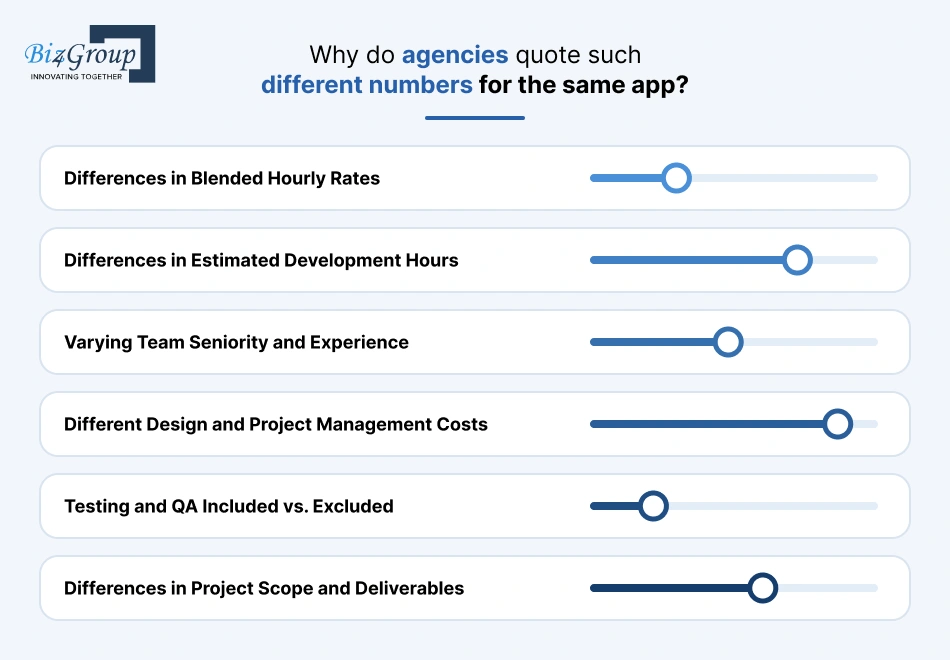
The biggest swing is the hourly rate. One of the published estimates lists North American agency rates at $100 to $180 an hour, and where a US team lands in that band depends on its seniority mix and how much design and project management the blended rate includes. At 1,000 hours, the gap between the two ends of that band is $80,000.
Hours are the second swing. The same estimate gives worked examples of roughly 800 to 1,100 hours for an MVP, 1,300 to 1,700 for a mid-size build and 2,000 to 3,000 for an enterprise one. Two US agencies can quote the same feature list at very different totals because one counts 800 hours and the other 1,100, or because one prices design and testing in and the other leaves them out.
So a quote means little until it shows hours, rate and what the hours cover. Every figure on this page can be rebuilt as hours multiplied by a blended hourly rate, and the next section does exactly that.
Do the ranges hold up against US government wage data?
Partly. A rough cross-check against federal wage figures shows that the low end of the published ranges sits below what a US team's hours cost, so US budgets should plan from the upper part of each band. The arithmetic below is a sanity check built for this guide, not a published benchmark.
The inputs come from two federal sources:
- The Bureau of Labor Statistics reports a median annual wage of $135,980 for software developers in May 2025. Spread over 2,080 working hours a year, that is about $65.38 an hour in wages.
- The BLS employer cost release for December 2023 shows wages making up 70.4% of total compensation in private industry, with benefits and other costs making up the rest. Grossing the wage up on that basis gives about $92.86 an hour in loaded employee cost.
Multiplying that loaded cost by the hours from the worked examples gives a floor for developer labor alone, set beside agency-style rates at both ends of the range:
|
Build |
Hours |
US loaded wage ($92.86/hr) |
US agency rates ($100 to $180/hr) |
|---|---|---|---|
|
MVP |
800 to 1,100 |
$74K to $102K |
$80K to $198K |
|
Mid-size |
1,300 to 1,700 |
$121K to $158K |
$130K to $306K |
|
Enterprise |
2,000 to 3,000 |
$186K to $279K |
$200K to $540K |
Three things follow from the table:
- The low end of the published ranges sits below the US math. The $20K to $70K basic span is under what 800 to 1,100 hours cost a US team in loaded developer pay alone, which is $74K to $102K.
- US agency rates push the total higher. At $100 to $180 an hour the same MVP hours come to $80K to $198K, and every tier in the table moves up in proportion.
- The loaded-wage column is a floor, not a price. Agency rates also pay for project management, design, testing and overhead.
Three caveats keep the table honest. The wage figure is a median across all software developers, not real estate specialists. The employer cost ratio covers all private industry and dates from December 2023, so a newer release may shift it slightly. And the hours come from a single agency's examples, so they show the scale of a build rather than a rule.
What drives the cost of a real estate portal or marketplace the most?
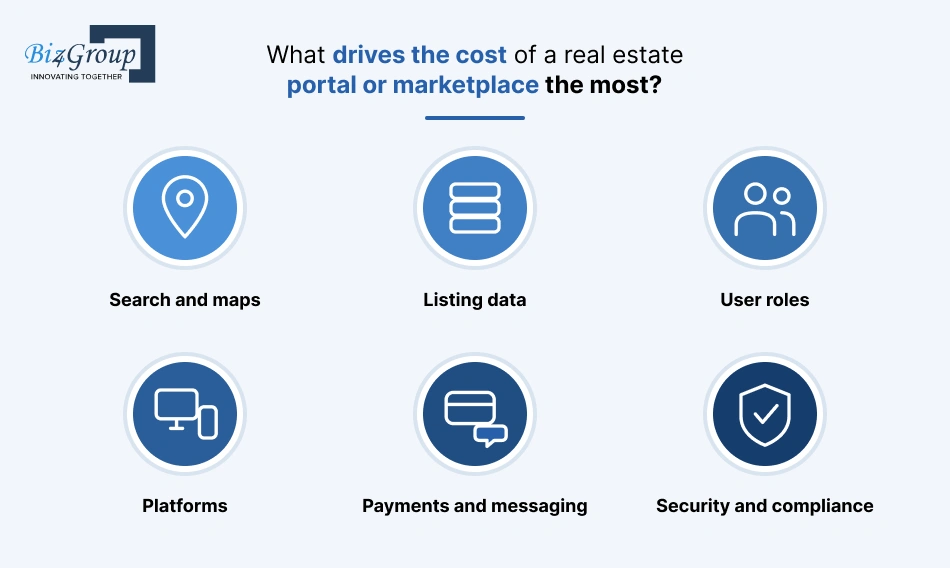
Scope drives it most, because every feature is hours and hours are the only thing a team sells. Six areas account for most of the movement between a $20,000 build and a $300,000 one:
|
Cost driver |
Why it moves the hours |
What to ask a team |
|---|---|---|
|
Search and maps |
Filters, map views, saved searches and alerts each add screens, logic and testing |
Which search features are in the first release? |
|
Listing data |
A feed has to be connected, mapped, refreshed and cleaned before a single listing looks right |
Where does the data come from, and who pays for access? |
|
User roles |
Buyers, renters, agents and admins each need their own screens and permissions |
How many account types does the first release have? |
|
Platforms |
Web, iOS and Android are three surfaces, and a cross-platform framework changes the split |
Is the first release web only, or web plus apps? |
|
Payments and messaging |
Subscriptions, lead fees, chat and notifications add third-party integrations |
Which of these are launch features, and which can wait? |
|
Security and compliance |
Account protection, data privacy and fair housing rules shape design and testing |
Who reviews the build for these before launch? |
AI features add another layer on top. Recommendations, conversational search and valuation tools need data preparation, model work and ongoing tuning, which is why the AI marketplace guide treats them as a phase of their own rather than a line item.
Starting from an existing portal changes the math as well, since only the parts that are failing get rebuilt, the scope covered in the guide to modernizing a real estate portal.
Not sure which build type fits?
The team matches your idea to a portal, a marketplace or an app before pricing it.
Match my ideaWhat does it cost to build a real estate app like Realtor.com at national scale?
A national-scale listing app sits at the top of the full-platform band or above it, because cost grows with what scale adds. That means more listing feeds to connect and refresh, heavier search traffic, web plus iOS and Android, recommendation features and a larger admin back office.
None of those has a fixed price, which is why the worksheet below beats any headline figure for a big-name app. Price each item as hours multiplied by a rate, and the result is a number for the app being planned rather than for someone else's.
What does a real estate portal or marketplace cost after launch?
A real estate portal or marketplace keeps costing money after launch, and the build price leaves these out. Budget for each of the following as its own line:
- Hosting and infrastructure. Servers, storage, backups and monitoring, which grow with traffic and image volume.
- Maintenance. Bug fixes, security patches and updates for new phone operating systems and browser versions.
- Listing data. Feeds can carry licensing terms and fees of their own, set by the data provider, so this line needs a written answer before development starts.
- Third-party services. Maps, SMS, email, payments and any AI service are usually billed per use, so they scale with the number of users.
- Support and improvements. Someone has to answer user issues and ship the changes real usage shows are needed.
Ask every team for first-year figures per line, in writing, before comparing totals.
How do you turn a cost range into a number for your own portal or marketplace?
Price your own scope by listing features, asking for hours per feature, and multiplying the total by the blended hourly rate of the team. The worksheet below follows that order, and the example column uses made-up round numbers purely to show the arithmetic.
|
Step |
What to write down |
Example (illustrative only) |
|---|---|---|
|
1. Feature list |
Every feature in the first release, one per line |
Search, listing pages, accounts, saved searches, admin panel |
|
2. Hours per feature |
The team's estimate for each line, design and testing included |
120 + 100 + 90 + 80 + 110 = 500 |
|
3. Fixed work |
Discovery, project management, quality assurance, deployment |
250 hours |
|
4. Total hours |
Step 2 plus step 3 |
750 hours |
|
5. Blended rate |
The average hourly rate across everyone on the project |
$40 an hour |
|
6. Build cost |
Step 4 multiplied by step 5 |
$30,000 |
|
7. First-year running costs |
Hosting, maintenance, data, third-party services, support |
Priced per line by the team |
|
8. Buffer |
The contingency the team recommends for unknowns |
Ask the team to state it and explain it |
Run the worksheet twice, once with the full wish list and once with only what the first release needs. The gap between the two totals shows how much of the budget is riding on features that can wait.
What are the red flags in a portal or marketplace quote?
A quote deserves a second look when it hides the working. These are the patterns that most often signal a figure that will not hold:
- One total and nothing else. No hours, no rate and no feature list means the number cannot be checked.
- A rate far below the US norm. A quote under the low end of the published $100 to $180 band usually means hours are being cut somewhere, and testing is the usual casualty.
- No line for design, project management or testing. These take real hours, and a quote that leaves them out is quoting less work than the project needs.
- Fixed price with no scope document. A fixed figure without a written feature list leaves room for change requests that bring the total back up.
- Silence on data and running costs. Listing feeds, hosting and maintenance missing from the quote just move the bill to month seven.
- No discovery phase. Skipping the step where scope is pinned down makes everything after it a guess.
Two or three of these in one quote is a reason to ask for a revised version before signing anything.
Already holding a quote?
Biz4Group checks it against hours, rate and scope, then builds the version that holds up.
Check my quoteSo, what should you budget for your portal or marketplace?
Think of a restaurant. A portal is the menu, a marketplace is the dining room that needs diners and a kitchen at once, and an app is the delivery bag. Know which one you are before you hire the chef. Still not sure which of the three you are?
Biz4Group can price your portal or marketplace line by line, show the hours and the rate behind every figure, and then build it, starting from nothing more than your idea.
FAQs
1. How much does it cost to build a real estate app like Realtor.com?
Published agency estimates put a full platform at about $100,000 to $300,000 or more, and a platform at that scale is the top tier of the table above. Team location and feature scope decide where in that band a quote lands.
2. Can you build a real estate app for under $20,000?
Only as a prototype or a very small listing site. One of the estimates in the table lists prototypes from about $5,000, but a prototype shows an idea and is not a launch-ready product.
3. Is a white-label platform cheaper than a custom build?
It can cost less up front, though licenses, limits on customization and per-use fees shift costs into later years. Comparing total cost over several years is fairer than comparing launch prices, and LINK-PENDING-decision sets out that comparison.
4. Do listing feeds cost extra?
Often, yes. Access to listing data is licensed by the data provider, and terms and fees differ, so the answer needs to be in writing before development starts.
5. Does an app cost more than a website?
Usually, when it is a native iOS and Android app, because each platform is its own surface. A website alone, or a cross-platform framework that shares part of the code, sits lower.
6. How do you compare quotes from two teams?
Put both on the same footing: hours, blended rate and what the hours cover. A cheaper total with fewer hours or no testing line is quoting less work, not offering a better price.
