 Location :
Orlando, FL, USA
 +1 (407) 714-1616
 info@biz4group.com


 AI Summary Powered by Biz4AI
- Five AI features fit a portal or marketplace: search, assistants, listing content, recommendations and valuation estimates
- Each feature depends on data. A new marketplace rarely has enough behavior history for recommendations, so start with search and assistants that work from listing data alone.
- HUD's 2024 guidance says the Fair Housing Act applies to tenant screening and housing ads even when AI or algorithms do the work, and that discriminatory effects count without intent.
- Add AI in phases after the core product works, and ask for it as its own line in any quote.
- Have counsel review any feature that ranks, recommends, targets or screens.
AI real estate marketplace development means adding machine-learning features, such as smarter search, recommendations, price estimates and chat assistants, to a portal or marketplace so buyers find the right home sooner and agents spend less time on routine work. The hard part is rarely the model. It is having the right data, choosing features that match your stage and keeping the results fair.
This guide covers where AI fits in an AI-powered real estate marketplace, what each feature needs, how fair housing rules apply and how to add AI in phases. If you have not yet chosen between a portal, a marketplace or an app, that choice decides which of these features will help you most.
Where does AI fit in a real estate portal or marketplace?
AI fits in five places: search, recommendations, valuation estimates, assistants and listing content. They differ a lot in what they need to work, as the table shows.
|
AI feature |
What it does |
Data it needs |
Start with it? |
|---|---|---|---|
|
Natural-language search |
Turns a sentence like "three bed near a park under 600K" into filters and results |
Clean listing fields and descriptions |
Yes |
|
Assistants |
Answers buyer and seller questions in chat |
Listing data and your own help content |
Yes |
|
Listing content |
Drafts descriptions and tags photos |
Photos and listing fields |
Yes |
|
Recommendations |
Ranks homes by what a buyer has viewed and saved |
Behavior history across many users |
Later |
|
Valuation estimates |
Estimates a home's value as a range |
Sales history and property details |
Later |
Search, assistants and listing content can run on listing data alone, so they suit a new product. Recommendations and valuation need history you may not have at launch. All five sit on top of listing data, which is why the data pipeline behind a portal has to be solid before any of them.
How can AI improve property search?
AI improves property search by understanding what a buyer means, not only the fields they tick. Someone who types "quiet three-bedroom near a park under $600,000" gets a price filter, a bedroom filter and a location filter from that one sentence, plus a match on description text for "quiet". Three pieces make it work:
- Query parsing, which turns the sentence into structured filters.
- Meaning-based matching, using embeddings to find descriptions that fit a phrase even when the exact words differ.
- Visible filters, so the buyer can see what the system applied and correct a wrong guess.
Test it against a list of real buyer queries before launch, and keep the normal filters on screen, since an AI search that guesses wrong with no way to fix it is worse than a plain one.
How do recommendations work, and what data do they need?
Recommendations rank homes by what a buyer's activity suggests they want, and they need behavior data that a new marketplace usually lacks. With few users, a model has little to learn from, which is the cold start problem. Until the data builds up, simple rules do the job: show homes with a similar price, location and size to the ones a buyer saved.
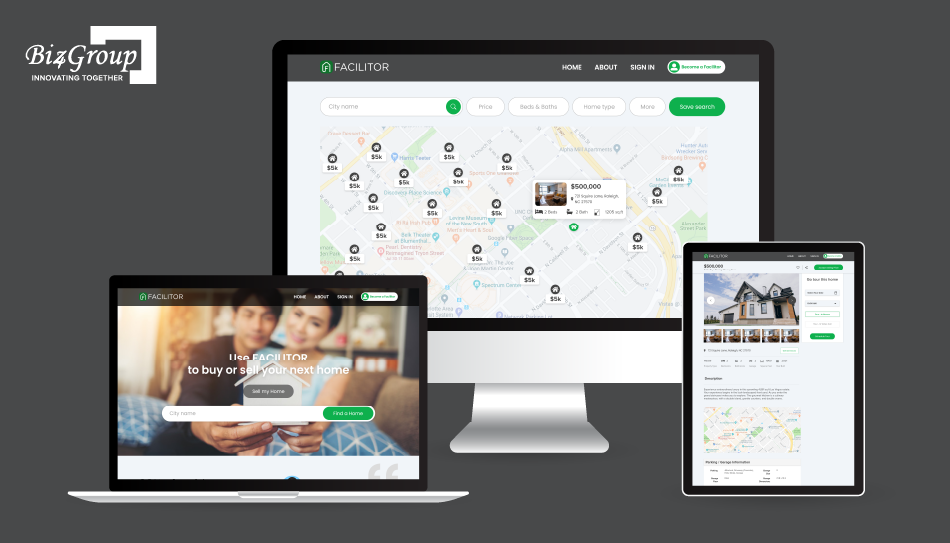
Facilitor, a Biz4Group product, pairs budget- and location-based search with AI-powered property suggestions, and its members verify their finances so the suggestions fit what they can afford.
When the volume is there, a trained model can take over, and how a property recommendation app is built is its own project.
Can a valuation model estimate home values?
AI can estimate a home's value, but the result should be shown as an estimate with a range and never as a price. A valuation model needs sales history and property details, and its accuracy varies with how much data exists for an area and how good that data is. Test it against recent sales before showing it to anyone, and label it clearly on the page. Our guide on valuation platform development covers that work in depth.
What can an AI assistant do for buyers and sellers?
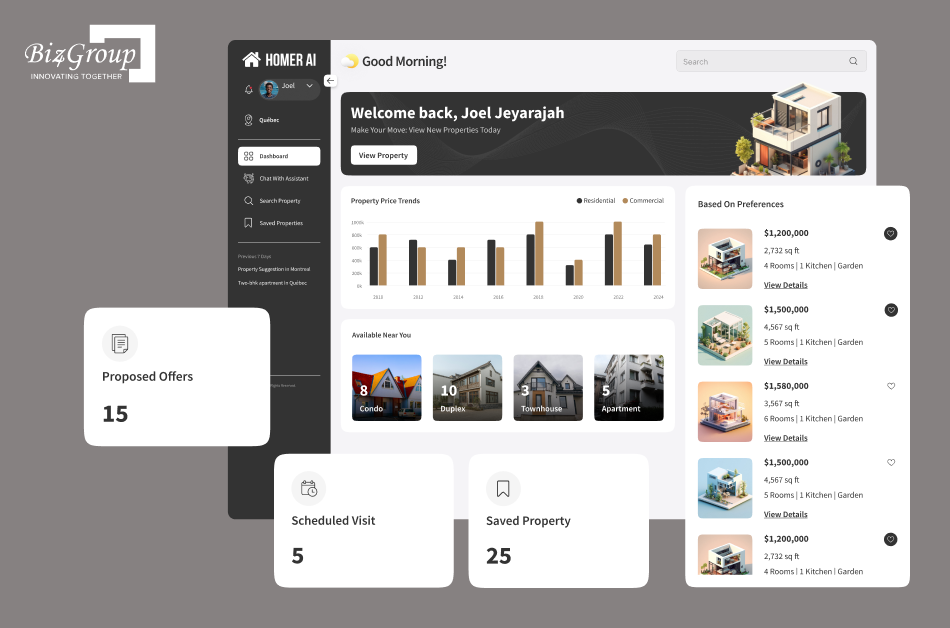
An AI assistant can answer questions and guide tasks for both sides, using your listing data and help content as its source. Homer AI, another Biz4Group build, uses one chatbot for both: it asks buyers for location and budget and shows matching properties, and it walks sellers through listing a property and previews the result before it goes live.
Assistants that act on their own across matching, moderation and support are a bigger step, and multi-agent AI for marketplace operations is a separate build.
Add AI to Your Marketplace in the Right Order.
Biz4Group builds the search, assistant and recommendation features, with fair housing checks built into the plan.
Plan My AI FeaturesHow can AI help write and tag listings?
AI can draft listing descriptions from a property's fields and tag photos by room or feature, which saves agents time on routine entries. Treat the output as a draft, since an agent knows details the system does not and has to confirm every claim. Review generated text for fair housing problems before it publishes, as the next section explains. Generative AI in real estate goes further into content uses.
How does the Fair Housing Act apply to AI features in a marketplace?
The Fair Housing Act applies when AI or algorithms handle housing tasks, and HUD says discriminatory effects count even without intent. In May 2024, HUD released guidance stating that the Act applies to tenant screening and the advertising of housing, including when AI and algorithms perform those functions. It adds that the Act covers practices with an unjustified discriminatory effect, so a tool can violate it without anyone intending to discriminate. That standard is known as disparate impact.
HUD's separate guidance on advertising through digital platforms, dated April 29, 2024, warns that automated systems can steer ads toward or away from groups without the advertiser's direction or knowledge. It says using a protected characteristic or a close proxy for one is intentional discrimination even when an automated system makes the decision, and that limiting explicit targeting options does not protect against discrimination in how ads are delivered.
HUD's pages cover tenant screening and ad targeting and delivery. Applying them to search ranking and recommendations on a marketplace is an inference, which is one more reason to have counsel review the design. Practical habits that follow from the guidance:
- Keep protected characteristics and close proxies out of ranking and targeting inputs.
- Watch outcomes, not only inputs, by checking who sees which listings and promotions.
- Review promoted placements and ad tools for the same issues, since HUD names both advertisers and platforms.
- Have a person review generated listing text before it publishes.
- Run a bias audit on a schedule and keep a record of tests and fixes, because HUD's advice to platforms includes documenting and auditing.
This section is information, not legal advice.
What listing and training data do you need before adding AI?
You need clean listing data first, and then the training data and history each feature learns from. An AI real estate marketplace platform with messy fields or duplicate listings produces messy answers, however good the model is. Check the data against what each feature needs:
- Search and assistants: accurate listing fields and descriptions.
- Recommendations: enough users and enough saved, viewed and searched activity to find patterns.
- Valuation: sales history and property details for the areas you cover.
- Every feature: a clear note to users on how their activity is used, reviewed by counsel.
In what order should you build an AI real estate marketplace?
Build the core product first and add AI one feature at a time, starting with the ones that work on listing data alone. Add AI real estate marketplace features in this order:
- Get the core product and data pipeline working.
- Add natural-language search and an assistant.
- Add listing content tools, with human review.
- Set up fair housing checks and monitoring before any feature that ranks or targets.
- Add recommendations once there is enough activity to learn from.
- Add valuation estimates last, labeled as estimates with a range.
- Measure each feature against the task it was meant to help with, and recheck it over time as model drift sets in, before adding the next.
A platform that already runs can take these one at a time through AI integration services, without rebuilding the core.
What does AI add to the cost of a real estate marketplace?
AI work adds data preparation, model work and ongoing tuning, so it is best quoted as its own line. This guide gives no figure for the AI layer, because it depends on how much of each a feature needs. A custom AI real estate marketplace costs more or less depending on which of the five features you build and how much data you must prepare first. The full cost breakdown shows how hours and team rates add up to a figure for your own scope.
Not Sure Which AI Feature to Start With?
Share your data and stage, and get a recommendation on what to build first.
Talk to Our TeamWhere this leaves your AI plans?
AI pays off in a marketplace when the data underneath is clean, the feature fits your stage and someone checks the results for fairness. Search and assistants suit an early product, while recommendations and valuation reward patience. None of it replaces counsel's review of anything that ranks or targets housing.
If you want a partner for the build, reach out to Biz4Group and the team will handle the data preparation, the model work and the fairness checks.
Frequently asked questions
1. Can a small marketplace afford AI features?
Often yes, if it starts small. Natural-language search and an assistant run on listing data, and ready-made AI services can power them without training anything from scratch. Recommendations and valuation can wait until there is enough activity and sales data to justify them.
2. Do you need to train your own model?
Not for every feature. Search and assistants can often use existing models connected to your listing data. Training your own makes sense for recommendations or valuation once you have the volume of data that makes a custom model better than a general one.
3. How do you stop an AI assistant from giving wrong answers?
Limit it to your listing data and help content, show where an answer came from and give the user an easy way to reach a person. Test it with real questions before launch and keep testing after, because new listings and policies change the right answers.
4. How do you check recommendations for bias?
Look at outcomes as well as inputs: who is shown which listings, and whether the pattern follows a protected group. How to test for that lawfully is a question for counsel, since collecting and using protected-class data carries its own rules. Record what you tested and what you changed.
5. Is it safe to send user data to an AI provider?
It depends on the provider's terms and on what you send. Read how the provider stores and uses data, send only what a feature needs, strip personal details where you can and have counsel review your privacy notice to match.
6. How do you know an AI feature is paying off?
Measure it against the task it was built for. For search, that might be how often a query ends in a saved home or a tour request. For an assistant, it might be how many questions it answers without a handoff. Judge each feature on its own number before adding the next.
