 Location :
Orlando, FL, USA
Location :
Orlando, FL, USA +1 (407) 714-1616
 info@biz4group.com

- Modernization of a real estate portal is essential to meet changing buyer behavior, improve platform performance, and stay competitive in a digital-first property market.
- Upgrading core features like search, dashboards, mobile experience, and data layers enables real estate marketplace modernization and better user engagement.
- The cost to modernize a real estate portal ranges from $20,000-$100,000 and expected outcomes allows leaders to plan upgrades with confidence and clarity.
- Choosing real estate portal modernization vs building a new platform depends on platform health, risk tolerance, and growth goals.
- The ROI of modernizing a real estate platform compounds over time through operational efficiency, stronger lead quality, and future readiness.
- Biz4Group LLC is a trusted USA-based partner that helps businesses modernize real estate portals with scalable architecture, intelligent systems, and long-term growth in mind.
In a market where 95% of all homebuyers begin their property search online, an outdated portal can mean missed leads and lost revenue.
If you run a real estate business, broker service, or property marketplace, you have likely wrestled with questions about modernization of a real estate portal.
What features do buyers expect?
What investments pay off?
What do you risk if you delay upgrades?
Most real estate companies know they need to change. The challenge is determining where and how to upgrade. A rushed update can leave you with half-solutions and fragmented systems. Smart decision makers want a clear path that aligns with business goals and user expectations.
This blog will walk you through the real estate portal modernization services you should consider now. You will learn how to evaluate your platform, which upgrades deliver real results, and why a structured strategy matters. This is a practical guide to help you transform your portal, attract more traffic, and convert visitors into loyal clients.
By the end, you will understand how to modernize real estate listing platforms with purpose and clarity and see why leaders invest in real estate portal performance optimization to stay ahead in 2026 and beyond.
Why Should You Modernize Your Real Estate Portal?
Modern real estate buyers have changed. Their patience has not.
If a portal loads slowly, feels confusing, or fails to surface the right listings fast, users leave. They rarely come back.
That reality is forcing business owners to rethink why they must modernize their real estate portal now.
In 2026, real estate portals are digital marketplaces, lead engines, and trust builders rolled into one. A legacy platform struggles to keep up with this shift. Let’s break down what is driving this urgency.
User Expectations Have Outpaced Legacy Platforms
Today’s users expect the same experience they get from top consumer apps. They want:
- Fast search results
- Location-aware listings
- Clean mobile experiences
- Simple inquiry and scheduling flows
Older portals were not built for this behavior. Many still rely on rigid architectures and outdated UI patterns. That gap leads directly to lower engagement and weak conversions.
This is where modernization of a real estate website becomes a growth move.
Lead Quality Depends on Platform Experience
Traffic alone does not close deals. The quality of leads depends on how well your portal guides users. A modernized platform helps you:
- Capture intent through smarter forms
- Segment users based on behavior
- Route inquiries faster to agents or teams
Businesses investing in real estate portal modernization for better lead conversion consistently see fewer junk leads and more serious inquiries.
Marketplaces Are Replacing Simple Listing Portals
Real estate platforms are moving toward full marketplaces. That includes:
- Buyer and seller dashboards
- Secure document handling
- Integrated communication
- Reviews and trust signals
Many companies now explore building a custom real estate portal like Zillow to stay competitive. For most, modernization is a smarter first step than rebuilding everything from scratch.
This shift is also driving real estate marketplace modernization across residential, rental, and commercial segments.
Technology Debt Is Getting More Expensive
Every year you delay modernization, costs rise quietly.
Maintenance grows harder.
New features take longer.
Security risks increase.
Integrations become fragile.
This is the hidden cost of legacy real estate portal modernization done too late. Businesses that act early gain speed and control. Those that wait often face forced rebuilds.
Modernizing your portal in 2026 is about staying relevant to how people buy, sell, and rent property today. It protects your brand, strengthens lead flow, and prepares your platform for long-term growth.
In the next section, we will define what modernization really means and how it differs from surface-level upgrades.
What Does Modernization of a Real Estate Portal Really Mean in 2026
Modernization is often misunderstood. Many teams assume it means changing the design, updating a few pages, or adding a new feature. In reality, modernization of a real estate portal in 2026 runs much deeper.
It is about rebuilding the foundation while keeping what already works.
Modernization Goes Beyond Visual Updates
A new interface alone cannot fix deeper issues. True modernization focuses on:
- How fast your portal performs
- How easily it scales with traffic
- How smoothly features integrate
- How securely data flows across systems
This applies equally to the modernization of a real estate website and the modernization of a real estate app.
If the backend struggles, the front end will eventually fail users.
Core Areas Impacted by Real Estate Portal Modernization
Modernization touches multiple layers of your platform. Here is a simple breakdown.
|
Area |
What Changes During Modernization |
|---|---|
|
Architecture |
Legacy systems move to modular, scalable setups |
|
User Experience |
Cleaner flows for search, inquiry, and onboarding |
|
Performance |
Faster load times and smoother interactions |
|
Integrations |
Easier connection with CRM, MLS, and third-party tools |
|
Security |
Stronger data protection and access controls |
This is why businesses often partner with a specialized real estate website development company instead of treating modernization as a patchwork task.
Modernization Supports Smarter Product Decisions
A modern platform allows you to experiment safely. You can:
- Launch features in phases
- Test new lead flows
- Optimize pages based on real user behavior
This flexibility is critical if you plan to evolve toward an AI real estate website with smart search & chat or explore advanced personalization later.
Without modernization, every small change feels risky and expensive. It is not about chasing trends. It is about future-proofing your real estate portal so it can grow with your business, your users, and the market.
Next, we will look at the warning signs that indicate your portal needs modernization now, not later.
Still Unsure What “Modernization” Looks Like for Your Portal?
Most portals lose leads due to unclear architecture and hidden technical debt. Clarity now saves costly rework later.
Get a Free Modernization AssessmentSigns You Need Legacy Real Estate Portal Modernization
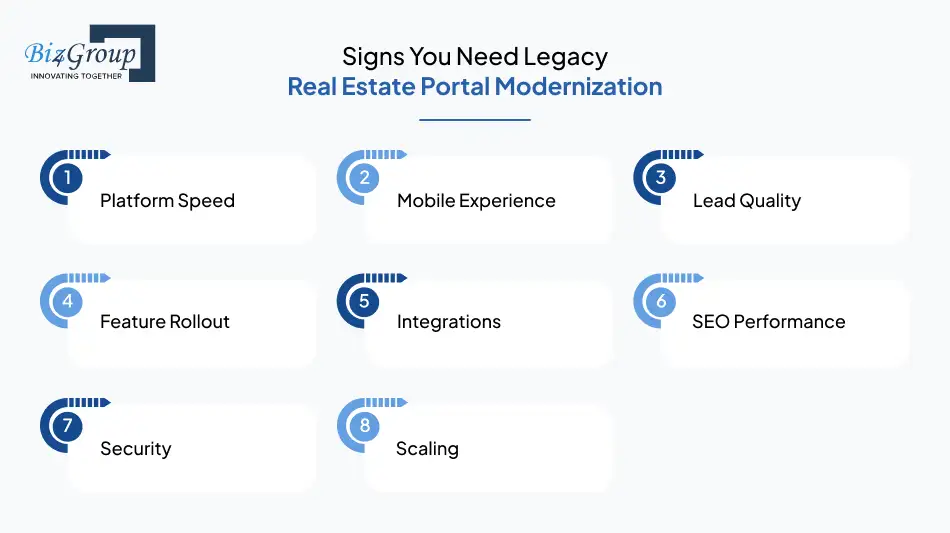
Most real estate portals do not fail overnight. They slowly lose speed, relevance, and trust.
If you are unsure whether modernization should be a priority, the signs below make the answer clear. These indicators commonly appear before lead quality drops and operational costs rise.
Warning Signs That Signal the Need for Real Estate Portal Software Modernization
|
Area |
What You Are Experiencing |
What It Indicates |
|---|---|---|
|
Platform Speed |
Pages take longer to load, especially listings with images |
Poor real estate portal performance optimization |
|
Mobile Experience |
Users struggle on phones or abandon mid-search |
Outdated approach to modernization of a real estate app |
|
Lead Quality |
High traffic but low-quality inquiries |
Need for real estate portal modernization for better lead conversion |
|
Feature Rollout |
Simple updates take weeks or months |
Legacy real estate portal modernization overdue |
|
Integrations |
CRM, MLS, or tools break frequently |
Rigid architecture blocking growth |
|
SEO Performance |
Rankings drop despite content efforts |
Technical issues tied to modernization of a real estate website |
|
Security |
Manual access control and outdated data handling |
Compliance and trust risks growing |
|
Scaling |
Portal slows down during peak demand |
Infrastructure not built for real estate marketplace modernization |
When These Signs Start Compounding
One issue alone may feel manageable. Multiple signs together usually signal deeper structural problems.
This is where businesses begin exploring options such as:
- Upgrading workflows alongside real estate CRM implementation
- Improving flexibility for a multi-tenant real estate SaaS application
- Preparing the platform to support future intelligence and automation
At this stage, patchwork fixes stop working.
Recognizing these signs early helps you modernize on your terms, not under pressure. It allows you to plan upgrades strategically rather than reacting to failures.
Up next, we will explore the business benefits of real estate portal modernization beyond financial returns and numbers.
Business Benefits of Real Estate Portal Software Modernization
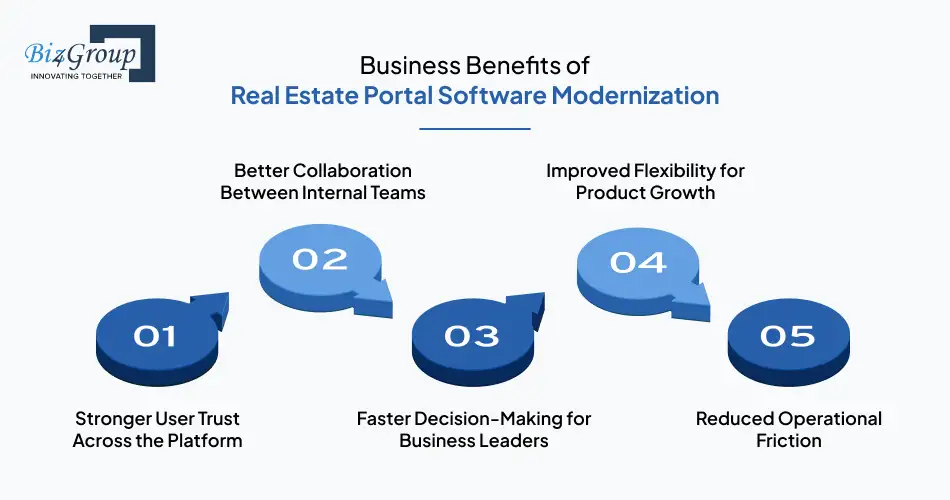
Modernization delivers value long before you measure revenue. The biggest wins often show up in daily operations, team efficiency, and customer trust.
This section focuses on those outcomes.
Stronger User Trust Across the Platform
Trust drives real estate decisions. A modern portal signals reliability the moment users land on it.
Modernization improves:
- Consistent performance across devices
- Secure logins and data handling
- Clear navigation and transparent workflows
Many businesses modernize while expanding into experiences like a rental property website with AI to meet rising user expectations.
Better Collaboration Between Internal Teams
Legacy systems create silos. Modern platforms remove them.
With real estate portal software modernization, teams benefit from:
- Shared dashboards for agents, admins, and managers
- Faster access to listing, inquiry, and user data
- Clear ownership of tasks and follow-ups
This becomes especially valuable when paired with structured web development services that focus on maintainability, not quick fixes.
Faster Decision-Making for Business Leaders
Modernized platforms surface the right data at the right time.
Leaders gain:
- Clear visibility into user behavior
- Insights into listing performance
- Better understanding of regional demand
This foundation supports future upgrades such as AI real estate valuation software, without forcing disruptive changes later.
Improved Flexibility for Product Growth
A modern portal adapts as your business evolves.
You can:
- Add new modules without breaking existing ones
- Support new property types or markets
- Introduce automation in stages
This flexibility is critical for companies planning to evolve into a scalable AI real estate SaaS product rather than staying limited to basic listings.
Reduced Operational Friction
Modernization removes everyday pain points.
Examples include:
- Fewer support tickets
- Less manual data handling
- Cleaner integrations with third-party tools
Over time, this creates a calmer, more productive environment for both teams and users.
The true value of real estate portal modernization shows up in how smoothly your platform runs and how confidently users engage with it. These benefits set the stage for measurable financial returns later.
Next, we will dive into the features you should evaluate and upgrade during real estate marketplace modernization.
What If Your Portal Helped Close Deals, Not Lose Them?
Better experience and cleaner workflows can lift lead quality by over 30% without spending more on traffic.
Reap the Benefits of Modernizing with Biz4GroupKey Features to Evaluate During Real Estate Marketplace Modernization
Modernization fails when teams focus only on technology and ignore features. Features shape user behavior. They decide whether visitors explore or exit.
Below are the core feature areas that deserve attention during real estate marketplace modernization. Each one plays a role in experience, engagement, and long-term scalability.
1. Intelligent Property Search and Discovery
Search defines the first impression.
Modern portals require search that understands intent, not keywords. Users expect filters that respond instantly and results that feel relevant.
2. Mobile-First User Journeys
Mobile traffic dominates real estate browsing. Yet many portals still treat mobile as an afterthought.
Modernization must support seamless navigation on small screens, fast listing loads, and simple inquiry flows. This applies equally to web platforms and AI real estate mobile app experiences that users expect to behave like consumer-grade products.
3. Buyer, Seller, And Agent Dashboards
Dashboards reduce chaos.
A modern portal gives each user a clear workspace. Buyers track saved listings and visits. Sellers manage properties and responses. Agents handle inquiries and follow-ups.
Project Spotlight: AI Property Management Application
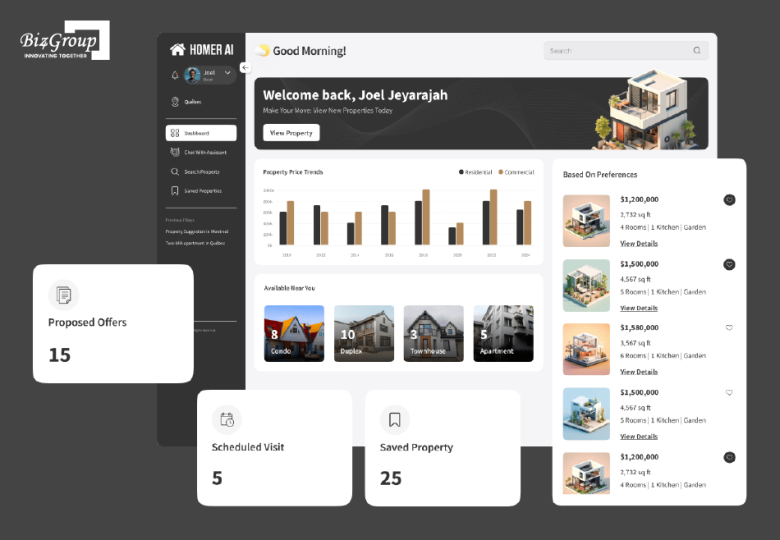
This modern AI property management application by Biz4Group reflects how modern features reshape engagement.
- Conversational property search that understands user preferences
- Smart filtering based on budget, location, and needs
- Buyer and seller dashboards with guided workflows
- Property visit scheduling without manual coordination
This project shows how AI driven real estate portal modernization turns exploration into action while keeping the experience human and intuitive.
4. Communication And Engagement Tools
Email alone no longer works. Modern portals need real-time communication. Chat, notifications, and guided conversations keep users engaged longer.
This is where businesses often explore solutions from an AI chatbot development company to support faster responses without overwhelming teams.
Engagement tools also improve follow-ups and reduce drop-offs.
5. Data, Analytics, And AI Readiness
Data without structure creates noise.
Modern portals track behavior, not vanity metrics. They capture what users search, save, ignore, and revisit. This foundation supports personalization, recommendations, and predictive insights.
Project Spotlight: AI Real Estate Platform
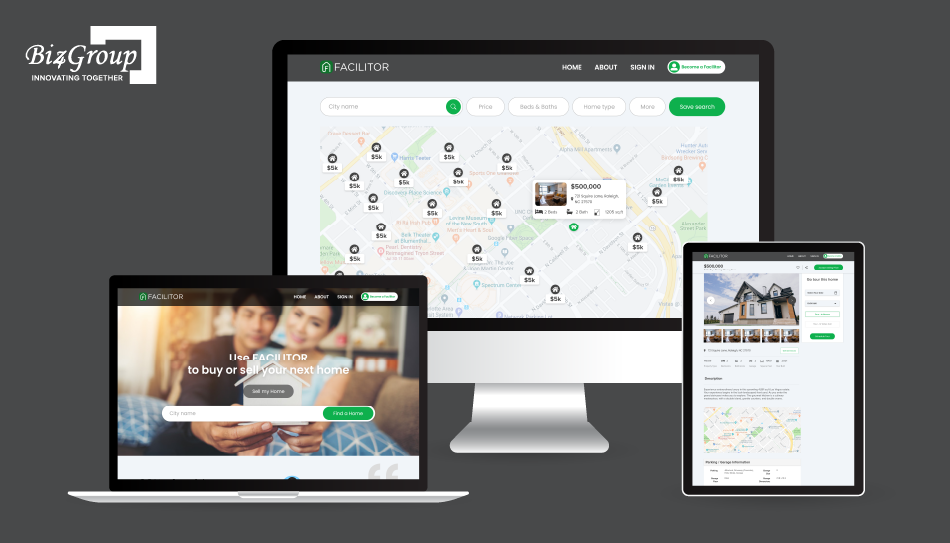
This AI real estate platform, developed by Biz4Group, highlights how features and intelligence work together.
- Budget and location-based recommendations
- AI-powered property suggestions
- Video and assisted property visits
- Guided buyer onboarding and verification
This platform shows how modernization supports safer transactions and better decision-making while reducing friction across the journey.
6. Compliance And Data Protection Features
Trust breaks quickly in real estate.
Modern platforms must support secure data handling, role-based access, and compliance workflows. This becomes critical when dealing with contracts, payments, and personal data.
Many businesses integrate or build real estate compliance software as part of modernization to protect users and reputation.
7. Design Systems and Usability
Design is not decoration. It is structure.
Consistent layouts, clear actions, and predictable flows reduce confusion. They also speed up feature adoption. Clean design supports trust and clarity at every step.
Feature upgrades shape how users experience your portal every day. When chosen thoughtfully, they turn modernization into a visible transformation rather than a silent backend change.
Next, we will look at the technology stack upgrades required to support these features at scale in 2026.
Technology Stack Upgrades Required for Proptech Platform Modernization
Features only work as well as the technology behind them. If the stack is fragile, even the best ideas struggle to scale.
This section breaks down the core technology layers that matter during proptech platform modernization. The goal is clarity, not complexity.
Core Technology Layers to Upgrade During Real Estate Portal Software Modernization
|
Technology Layer |
What Needs to Change |
Example Tools and Frameworks |
Why It Matters in 2026 |
|---|---|---|---|
|
Frontend Frameworks |
Move to modern, component-based frameworks |
React, Next.js, Vue.js |
Supports faster UI updates and better real estate portal performance optimization |
|
Backend Architecture |
Shift from monolithic to modular services |
Node.js, FastAPI, Spring Boot |
Makes modernization of an existing real estate platform easier to scale |
|
APIs and Integrations |
Standardized, well-documented APIs |
REST, GraphQL, Swagger |
Enables CRM, MLS, and third-party tools to work reliably |
|
Cloud Infrastructure |
Cloud-native hosting and deployment |
AWS, Azure, Google Cloud |
Handles traffic spikes and supports real estate marketplace modernization |
|
Databases |
Optimized data storage and retrieval |
PostgreSQL, MongoDB, Elasticsearch |
Improves search speed and analytics accuracy |
|
Security Layer |
Role-based access and encryption |
OAuth 2.0, JWT, AES encryption |
Builds trust and supports compliance requirements |
|
Analytics Stack |
Centralized tracking and reporting |
Google Analytics, Mixpanel, custom dashboards |
Prepares the platform for future intelligence and automation |
Why Stack Choices Impact Long-Term Flexibility
Many portals fail to evolve because their stack resists change. A modern stack allows teams to:
- Add features without rewriting core logic
- Integrate new tools without breaking workflows
- Experiment safely with new ideas
This flexibility becomes critical when working with AI integration services or expanding toward more advanced intelligence later.
Choosing the Right Development Partner Matters
Technology decisions should align with business goals. Not every stack suits every platform.
This is why many businesses prefer working with a proven real estate AI software development company (yep, that’s us!) that understands real estate workflows, compliance needs, and long-term product evolution.
Strong technical guidance early prevents costly rewrites later.
Next, we will walk through a clear, step-by-step process for executing a real estate portal upgrade strategy without disrupting your business.
Is Your Tech Stack Helping You Grow or Holding You Back?
Outdated stacks slow releases, break integrations, and limit scale. Modern stacks unlock speed and flexibility.
Talk to Biz4Group’s ExpertsHow To Modernize Legacy Real Estate Portals in 7 Steps?
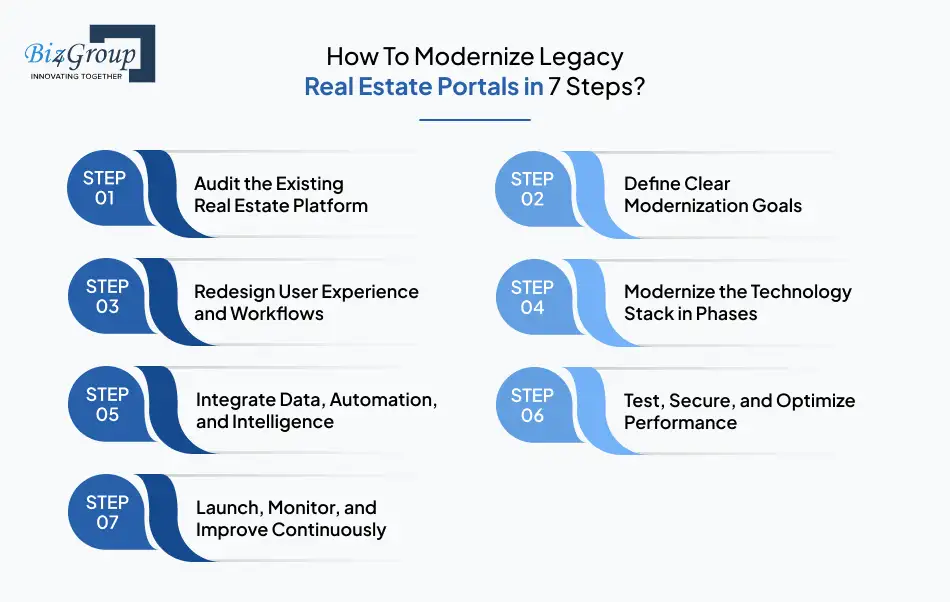
Modernization succeeds when it follows a clear plan. Rushed upgrades often create more problems than they solve.
This real estate portal upgrade strategy breaks modernization into manageable steps that reduce risk and protect business continuity.
Step 1: Audit the Existing Real Estate Platform
Start with clarity. You need to know what works and what slows you down.
Evaluate:
- Platform performance and load times
- UX bottlenecks across buyer, seller, and agent journeys
- SEO health and technical issues
- Integration gaps with CRM, MLS, and third-party tools
This step defines the scope of modernization of an existing real estate platform.
Step 2: Define Clear Modernization Goals
Modernization without goals leads to scope creep.
Set priorities such as:
- Improving lead quality
- Reducing manual operations
- Supporting mobile-first users
- Preparing for intelligent features
Many companies align this phase with MVP development services to validate upgrades before full rollout.
Also read: Top 12+ MVP development companies in USA
Step 3: Redesign User Experience and Workflows
Experience shapes adoption. Focus on:
- Simplified search and navigation
- Faster inquiry and scheduling flows
- Clear dashboards for different user roles
Pro tip: Collaborate with a dedicated UI/UX design company to ensure usability improvements are measurable and consistent.
Also read: Top 15 UI/UX design companies in USA
Step 4: Modernize the Technology Stack in Phases
Avoid big-bang releases. Modernize in stages:
- Upgrade frontend and backend foundations
- Introduce APIs for flexibility
- Move infrastructure to scalable cloud environments
Phased upgrades support smoother real estate portal software modernization without extended downtime.
Step 5: Integrate Data, Automation, and Intelligence
Once the foundation is stable, add intelligence. This includes:
- Behavior tracking
- Lead scoring support
- Personalized listing experiences
Leverage AI automation services at this stage to reduce manual workloads while keeping operations efficient.
Step 6: Test, Secure, and Optimize Performance
Testing is not optional. Ensure:
- Speed and load consistency
- Security and access control validation
- Cross-device performance
This step protects real estate portal performance optimization and builds user trust.
Step 7: Launch, Monitor, and Improve Continuously
Modernization does not end at launch. Track:
- User behavior
- Lead quality
- Feature adoption
Continuous monitoring ensures your portal evolves alongside market expectations.
A structured, step-by-step approach removes uncertainty from modernization. It helps businesses upgrade with confidence while protecting users, data, and growth momentum.
Next, we will break down the cost to modernize a real estate portal and what factors influence the budget in 2026.
How Much Does It Cost to Modernize a Real Estate Portal?
One of the first questions business leaders ask is simple.
How much will this actually cost?
In 2026, the cost to modernize a real estate portal typically falls between $20,000-$100,000+. The final number depends on scope, platform complexity, and how deep the modernization effort goes.
Below is a clear breakdown of where that budget goes and what often gets overlooked.
Core Cost Drivers of Real Estate Portal Software Modernization
|
Cost Driver |
What It Covers |
Typical Cost Range |
|---|---|---|
|
Platform Audit & Planning |
Technical review, UX analysis, roadmap creation |
$3,000-$7,000 |
|
UI/UX Redesign |
User flows, wireframes, visual design updates |
$5,000-$15,000 |
|
Frontend Modernization |
Modern UI implementation and performance tuning |
$6,000-$18,000 |
|
Backend & Architecture Upgrades |
Modular services, APIs, scalability improvements |
$8,000-$25,000 |
|
Feature Enhancements |
Search, dashboards, workflows, integrations |
$7,000-$30,000 |
|
Data, Analytics & AI Readiness |
Tracking setup, data structuring, intelligence prep |
$5,000-$20,000 |
|
Security & Compliance |
Access control, encryption, compliance workflows |
$3,000-$10,000 |
|
Testing & Quality Assurance |
Functional, performance, and security testing |
$2,000-$6,000 |
|
Deployment & Launch Support |
Cloud setup, rollout, monitoring |
$1,500-$5,000 |
These numbers reflect typical projects involving modernization of an existing real estate platform, not full rebuilds.
Hidden Costs Many Teams Miss During Modernization
Modernization budgets often stretch due to factors that surface mid-project. Ignoring these early leads to rushed decisions later.
Data Migration and Cleanup
Legacy data is rarely clean. Listings, user profiles, and inquiry histories often need restructuring.
Typical impact: Additional $3,000-$12,000
Third-Party Integration Adjustments
CRM, MLS, payment, and mapping tools evolve over time. Modernization often exposes outdated or brittle integrations.
Typical impact: $2,000-$8,000 depending on integration depth
Performance Optimization After Launch
Real-world usage reveals bottlenecks that test environments miss.
Typical impact: $2,000-$6,000 for tuning and refinements
Change Management and User Adoption
New interfaces affect internal teams too. Agents and admins need time to adapt.
Typical impact: $1,000-$4,000 for onboarding support
Putting The Cost into Perspective
Lower-end projects focus on UI, performance, and minor feature upgrades.
Mid-range budgets support deeper architectural and feature changes.
High-end modernization includes advanced intelligence, automation, and long-term scalability.
The smarter approach is aligning cost with business goals rather than chasing the lowest number.
Wondering If Modernization Fits Your Budget?
Most businesses overestimate costs and underestimate long-term gains. A clear estimate changes the conversation.
Get a Cost EstimateHow Real Estate Portal Modernization Delivers Long-Term ROI?
Return on investment is not instant. It builds steadily as your platform becomes faster, smarter, and easier to scale. The ROI of modernizing a real estate platform comes from operational gains, stronger lead pipelines, and reduced long-term risk.
Let’s break it down clearly.
Where ROI Starts Showing Up First
Most businesses notice improvements within the first few months. Common early gains include:
- Faster page loads leading to longer session times
- Higher inquiry completion rates
- Fewer support tickets from users and agents
These wins come from cleaner architecture and better real estate portal performance optimization.
Operational Efficiency Gains
Modern platforms reduce manual effort. Teams spend less time fixing issues and more time improving experiences.
|
Area |
Before Modernization |
After Modernization |
|---|---|---|
|
Feature Updates |
Weeks to deploy |
Faster, predictable rollouts |
|
Platform Maintenance |
Frequent fixes |
Lower ongoing effort |
|
Data Access |
Fragmented |
Centralized and usable |
|
Agent Workflows |
Manual follow-ups |
Streamlined processes |
Lower operational friction translates directly into cost savings over time.
Long-Term Cost Avoidance
Legacy systems become expensive quietly. Modernization helps you avoid:
- Emergency rebuilds
- Security incidents
- Forced migrations under pressure
These avoided costs often outweigh the upfront investment.
How ROI Compounds Over Time
The value of modernization increases each year.
Year one focuses on stability and performance.
Year two unlocks faster innovation.
Year three enables deeper intelligence and automation.
This compounding effect is what separates short-term fixes from strategic upgrades.
Next, we will compare real estate portal modernization with building a new platform to help you choose the right path forward.
Real Estate Portal Modernization Vs Building a New Platform
This decision shapes your budget, timeline, and risk exposure. Many businesses pause here because both options seem viable.
The table below compares real estate portal modernization vs building a new platform across the factors that matter most to founders, CTOs, and product leaders.
|
Evaluation Area |
Modernization Of A Real Estate Portal |
Building A New Real Estate Platform |
|---|---|---|
|
Time To Market |
Faster rollout using existing foundation |
Longer timelines due to ground-up development |
|
Cost Impact |
Lower upfront investment in most cases |
Higher initial cost and resource commitment |
|
SEO & Traffic |
Preserves existing rankings and authority |
SEO must be rebuilt from scratch |
|
Business Disruption |
Minimal when done in phases |
Higher risk during transition |
|
Feature Flexibility |
High when architecture is modernized |
Maximum freedom but at higher risk |
|
Data Migration |
Controlled and incremental |
Complex and often time-consuming |
|
Risk Level |
Moderate and predictable |
Higher risk if assumptions change |
|
Ideal Use Case |
Stable platform with growth bottlenecks |
Outdated platform beyond repair |
When Modernization Makes More Sense
Modernization works best when:
- Your platform already has users and traffic
- Core workflows function but feel slow or rigid
- You want faster results with lower risk
Many teams choose modernization while expanding capabilities with an AI product roadmap rather than restarting from zero.
When Building a New Platform Is the Better Choice
A new build may be justified when:
- Legacy systems cannot support modern architecture
- Security and compliance gaps are severe
- Business models have changed completely
In such cases, teams often plan long-term builds and hire AI developers early to support advanced capabilities later.
A Practical Way to Decide
Ask one simple question.
Can your current platform evolve safely within the next 12 months?
If the answer is yes, modernization usually wins.
If the answer is no, a rebuild deserves serious consideration.
Next, we will explore the challenges, risks, mistakes, and mitigation strategies involved in real estate portal modernization.
Rebuild or Modernize? One Wrong Choice Can Cost a Year.
The right decision depends on platform health, not gut instinct. Make it with data, not assumptions.
Contact Biz4Group TodayChallenges, Risks, And Mistakes in Real Estate Portal Performance Optimization
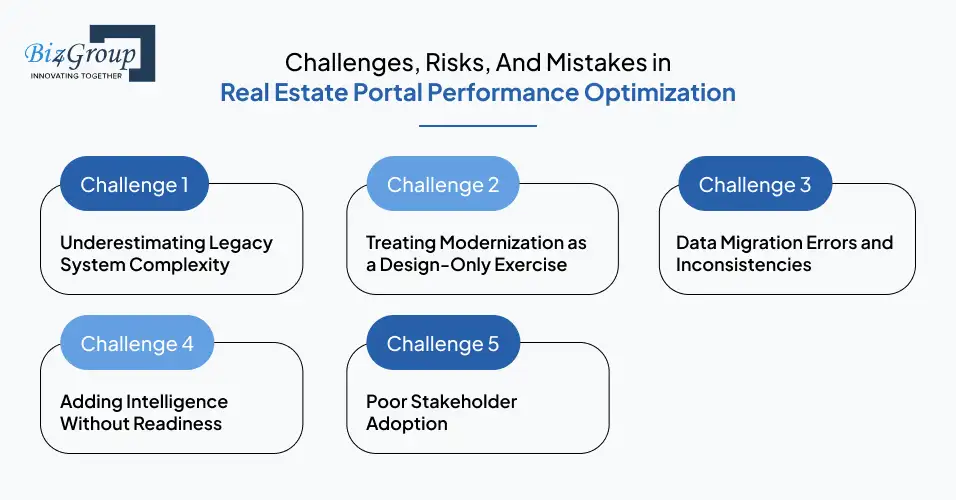
Modernization brings opportunity, but it also introduces risk when handled poorly. Most failures do not come from bad intent. They come from blind spots.
Below are the most common challenges businesses face during real estate portal performance optimization, along with practical ways to mitigate them.
Challenge 1: Underestimating Legacy System Complexity
Legacy platforms often carry hidden dependencies. Old integrations, undocumented workflows, and fragile data structures surface late.
Mitigation approach:
Start with a deep technical audit. Map dependencies early. Modernize in controlled phases rather than all at once.
Challenge 2: Treating Modernization as a Design-Only Exercise
Refreshing visuals without fixing backend issues creates short-lived results. Performance problems resurface quickly.
Mitigation approach:
Align UI upgrades with backend improvements. Performance and design must evolve together.
Challenge 3: Data Migration Errors and Inconsistencies
Real estate data is sensitive and complex. Listings, user profiles, contracts, and transaction histories must remain accurate. Even small errors can impact trust and compliance.
Mitigation approach:
Clean data before migration. Validate in stages. Test with real-world scenarios, not only sample data.
Challenge 4: Adding Intelligence Without Readiness
Advanced features require structure. Jumping into automation or generative AI without clean data and workflows creates confusion rather than value.
Mitigation approach:
Prepare the platform first. Ensure data consistency, clear user journeys, and measurable goals before introducing intelligence.
Challenge 5: Poor Stakeholder Adoption
Internal teams often struggle with change. Agents and admins may resist new workflows if they feel rushed or unclear.
Mitigation approach:
Involve users early. Provide training. Roll out changes gradually with feedback loops.
Every modernization effort faces challenges. Success depends on spotting them early and responding with clarity rather than urgency.
And choosing the right modernization partner can help you with that.
Speaking of the right partner...
Why Biz4Group LLC Is the Best Company to Modernize a Real Estate Portal In USA?
Choosing a modernization partner is not a technical decision alone. It is a business decision that affects growth, speed, and long-term stability.
This is where many projects either succeed or stall.
Biz4Group LLC is a USA-based software development company that helps entrepreneurs and enterprises turn complex ideas into scalable digital platforms. Real estate is one of our strongest domains, not because we build listing websites, but because we build systems that support growth, trust, and long-term performance.
We work with real estate businesses that have outgrown their legacy portals. Some struggle with scale. Others with lead quality, slow feature rollouts, or rigid architectures that block innovation. Our role is to step in as a strategic technology partner and modernize platforms in a way that aligns with business goals, not short-term fixes.
Why Businesses Choose Biz4Group LLC
Real estate leaders choose Biz4Group because we think beyond code.
As an AI development company, we understand how buyers search, how agents work, and how businesses scale. This perspective allows us to modernize platforms with clarity and purpose.
Clients value us for:
- Strong domain expertise in real estate and proptech platforms
- Proven experience building and modernizing intelligent digital products
- Ability to align modernization with business growth plans
- Clean, scalable architecture that supports future expansion
- Transparent communication and long-term partnership mindset
Our teams frequently work on complex initiatives involving enterprise AI solutions, intelligent workflows, and advanced platform architecture. For businesses exploring next-generation capabilities, we also offer agentic AI development services, supporting systems that act, adapt, and assist at scale.
We do not treat modernization as a one-time delivery. We modernize with intent. We build with accountability.
And we partner with businesses that want to lead, not follow.
If you’re one of those, we’re here to help you excel.
Get in touch with our experts today and take the first step toward a future-ready real estate platform. Let’s talk.
Closing Perspective
Modernizing a real estate portal in 2026 is about staying relevant to how people actually search, evaluate, and commit to property decisions today. Platforms that evolve with user behavior, performance expectations, and market dynamics place themselves in a position of long-term strength rather than short-term survival.
Throughout this guide, we learnt that when done strategically, modernization improves experience, strengthens operations, and prepares your platform for future growth without disrupting what already works.
Biz4Group helps real estate businesses navigate this journey with confidence. As a seasoned software development company with deep experience in real estate platforms and intelligent systems, we modernize portals with clarity, precision, and business intent. Our focus stays on building platforms that scale, perform, and adapt as your goals evolve.
If your real estate portal feels limited by its current setup, now is the moment to rethink what it could become. Connect with Biz4Group and turn modernization into your next competitive advantage.
FAQs
How long does it take to modernize a real estate portal end-to-end?
Most modernization projects take between 8 to 20 weeks, depending on platform size, data complexity, and scope. Biz4Group, however, can deliver in 4 to 6 weeks through focused execution and modernization frameworks.
Can a real estate portal be modernized without downtime?
Yes. With the right upgrade strategy, modernization can be executed in phases. Core systems continue running while new components are rolled out gradually, ensuring users and agents experience little to no downtime.
Does modernization affect existing SEO rankings?
When done correctly, modernization preserves and often improves SEO performance. URL structures, metadata, and indexed pages can remain intact while technical SEO issues like speed and mobile usability are improved.
Can we modernize only specific parts of the portal?
Yes. Many businesses start by modernizing high-impact areas such as search, lead forms, dashboards, or mobile experience. Partial modernization allows faster results while keeping budgets under control.
What happens to existing user data during modernization?
Existing data is retained and migrated securely. User profiles, listings, inquiries, and historical records are preserved through structured data mapping and validation processes to ensure accuracy and continuity.
How do we know if our portal is ready for advanced intelligence later?
A portal is considered ready when its data is structured, workflows are clear, and integrations are stable. Modernization focuses on building this foundation so advanced capabilities can be added later without major rework.
