 Location :
Orlando, FL, USA
Location :
Orlando, FL, USA +1 (407) 714-1616
 info@biz4group.com

- Agentic AI is reshaping legal operations by enabling autonomous workflows, driving demand for the top agentic AI development companies for legal industry in USA that build execution-ready systems.
- Modern law firms are adopting solutions from agentic AI development companies for legal industry USA to automate contracts, compliance monitoring, legal intake, and operational decision workflows.
- Selecting the right partner requires evaluating real legal expertise, governance readiness, and scalable agentic AI software development for legal firms, not just AI capabilities.
- Leading providers focus on compliance, security, and measurable efficiency, positioning themselves among the best agentic AI companies for legal services USA supporting enterprise-grade legal automation.
- Biz4Group LLC stands out by delivering practical agentic AI solutions tailored for legal innovation, helping organizations transition from experimentation to production-ready autonomous legal systems.
Legal operations are entering a moment where efficiency is no longer achieved by hiring more people but by enabling smarter execution. Across the United States, law firms and corporate legal teams are turning toward autonomous systems that can move work forward without constant supervision. This growing demand is why top agentic AI development companies for legal use in USA are becoming central to technology decisions in 2026.
- The shift is backed by measurable industry change. Global legal technology spending is expected to reach $50 billion by 2027, driven by agent-based automation, analytics, and secure cloud platforms.
- By 2028, nearly 33% of enterprise software will include agentic AI capabilities, allowing around 15% of everyday work decisions to happen autonomously.
Many organizations begin evaluating this transition through structured AI consulting services, helping leadership understand where autonomous workflows can safely support legal operations. This guide will help you:
- understand why agentic AI is reshaping legal service delivery
- evaluate the best agentic AI companies for legal services USA
- identify development partners aligned with compliance and security needs
- compare leading vendors using practical selection criteria
As adoption matures, firms increasingly rely on structured AI automation services to operationalize agentic systems securely within real legal environments.
Key Drivers Influencing the Adoption of Agentic AI in Legal Industry
Legal organizations are adopting agentic AI because every day legal work is becoming harder to manage through manual coordination alone. Increasing workload complexity and accountability requirements are pushing firms toward systems that actively manage execution, not just assistance.
- Workload Expansion: Growing contract volumes, regulatory documentation, and client expectations are pushing legal teams toward agentic AI software development for legal firms that can independently handle repetitive operational responsibilities.
- Decision Speed Needs: Legal departments must review requests, approvals, and risk signals faster than before, creating demand for systems capable of progressing workflows without waiting for continuous manual intervention.
- Operational Consistency: Legal outcomes must remain uniform across contracts, compliance checks, and internal reviews. This encouraged the adoption of structured execution models built by agentic AI development companies for legal industry in USA.
- AI Automation Gaps: Rule-based AI fails when legal context changes mid-process, which is why firms increasingly move toward agentic AI than traditional automation for workflows requiring adaptive reasoning and contextual decisions.
- Long-Term Technology Strategy: Leadership teams now prioritize scalable platforms that support governance, auditability, and evolving legal operational requirements.
Agentic AI adoption in legal industry is being shaped by operational realities rather than experimentation. Firms are investing where autonomy reduces bottlenecks, strengthens accountability, and enables legal teams to manage growing workloads without expanding overhead.
Also Read: Top Real-World Use Cases for Agentic AI
Why U.S.-Based Agentic AI Development Companies Give Legal Organizations a Strategic Advantage?
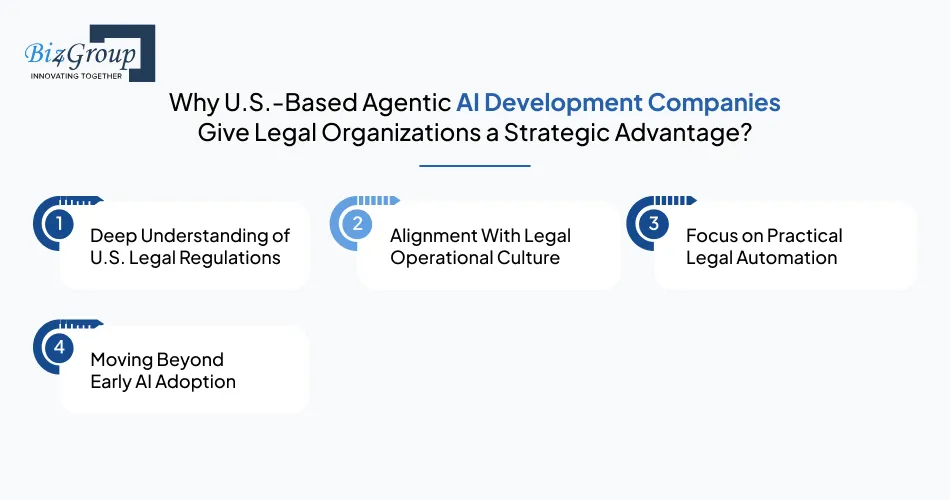
Legal organizations in the United States operate within strict regulatory expectations and fast-moving business environments. This makes the location and expertise of a development partner important, especially when agentic AI systems directly influence sensitive legal workflows.
1. Deep Understanding of U.S. Legal Regulations
U.S.-based development teams work closely with compliance standards that shape everyday legal operations. They understand data privacy expectations, audit requirements, and documentation practices that legal teams already follow. This familiarity reduces the learning curve during implementation and prevents delays caused by regulatory misalignment.
- solutions are designed with jurisdictional compliance in mind
- workflows align with existing legal reporting practices
- fewer adjustments are needed during deployment stages
2. Alignment With Legal Operational Culture
Legal departments require technology that fits established review cycles and accountability structures. Legal agentic AI development companies in USA tend to design systems that respect approval hierarchies and professional responsibility expectations.
- workflows reflect how U.S. legal teams actually operate
- collaboration models support attorneys and legal operations staff
- adoption becomes smoother across departments
3. Focus on Practical Legal Automation
Many AI development companies for legal automation in USA prioritize execution over experimentation. Their goal is to build agentic AI for legal industry that performs defined responsibilities reliably within production environments.
- automation supports real case and contract workflows
- systems integrate into existing legal tools without disruption
- operational reliability remains a primary design focus
4. Moving Beyond Early AI Adoption
Earlier tools based on generative AI helped legal teams draft and summarize information. Organizations now need systems that act on outcomes, which is why firms increasingly invest in partners who can build agentic AI capable of progressing work independently.
- systems initiate actions instead of waiting for prompts
- workflows continue without constant supervision
- legal professionals retain oversight while reducing manual effort
Working with the top agentic AI development companies for legal firms in USA often provides an advantage because solutions are shaped around real regulatory pressure and operational needs. This helps legal organizations adopt autonomy with confidence rather than uncertainty.
Jurisdiction Matters, So Does Your Technology Partner
If your legal workflows operate under strict compliance, your AI should too. Let's discuss how agentic systems can align with real regulatory expectations from day one.
Schedule a Strategy ConversationEvaluation Framework: How We Selected the Top Agentic AI Development Companies for Legal Industry in USA
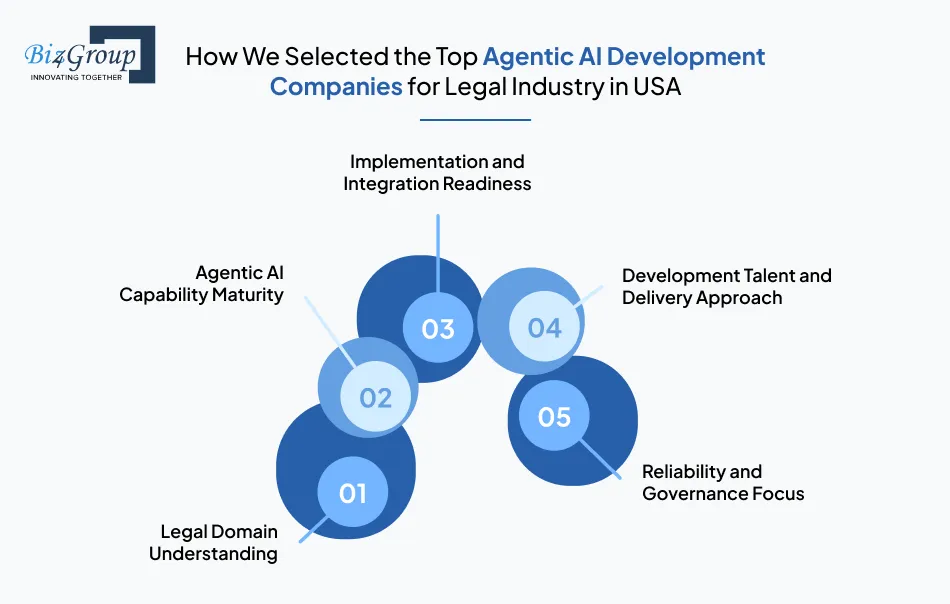
Legal organizations evaluating technology partners need more than popularity lists or marketing claims. This evaluation framework explains how companies were assessed based on practical delivery capability, legal alignment, and their ability to support real operational adoption within U.S. legal environments.
1. Legal Domain Understanding
Companies were evaluated on how well they understand legal workflows rather than general software delivery. Legal operations involve structured reviews, approvals, and accountability that technology must respect from day one.
- experience working with law firms or corporate legal teams
- familiarity with compliance-driven workflows
- ability to translate legal requirements into working systems
2. Agentic AI Capability Maturity
Not every AI vendor builds systems capable of autonomous execution. We assessed whether companies deliver solutions that actively manage tasks instead of only assisting users during isolated interactions.
- systems capable of progressing workflows independently
- structured decision handling within defined boundaries
- clear human oversight built into operational processes
3. Implementation and Integration Readiness
Successful adoption depends heavily on how smoothly new systems connect with existing legal tools. Strong vendors demonstrate practical experience with AI integration across document management platforms, internal systems, and operational environments.
- compatibility with current legal software ecosystems
- minimal disruption during deployment phases
- scalable architecture supporting long-term expansion
4. Development Talent and Delivery Approach
The evaluation also considered how organizations structure their engineering teams and delivery models. Many legal teams look to hire agentic AI developers in USA to ensure collaboration remains aligned with regulatory expectations and communication standards.
- dedicated development expertise in agent-based systems
- transparent delivery timelines and collaboration practices
- ongoing support beyond initial deployment
5. Reliability and Governance Focus
Legal environments demand predictable outcomes and clear accountability. Companies were reviewed based on how responsibly they design systems that operate within governance and audit expectations.
- strong testing and validation practices
- safeguards for sensitive legal data handling
- operational transparency for internal review teams
This framework ensures that the top agentic AI development companies for legal sector in USA are evaluated through real-world delivery capability. This helps legal organizations focus on partners prepared for long-term operational adoption rather than short-term experimentation.
Top 10 Agentic AI Development Companies Transforming the Legal Industry in USA
Legal teams are moving beyond experimentation and adopting systems that actively execute legal work. The following list highlights the top agentic AI development companies for legal in the USA enabling practical autonomy across compliance, contracts, and operational decision workflows.
1. Biz4Group LLC
Location: Orlando, Florida, USA
Website: biz4group.com
Hourly Rate: $25 - $49 / hr
Minimum Project Size: $10,000+
Clutch Rating: 4.9/5
Biz4Group LLC works closely with legal organizations looking to operationalize autonomy rather than experiment with AI concepts. As an agentic AI development company in USA, the team focuses on building systems that actively manage legal workflows such as document handling, compliance validation, and process orchestration. Their approach centers on helping firms create agentic AI systems for legal workflows in the USA that align with existing legal operations instead of forcing workflow redesign.
A legal software development company with strong agentic AI capabilities, it supports custom agentic AI development for legal sector in the USA by translating legal requirements into structured autonomous actions. This execution-driven model positions the company among the top agentic AI development companies for legal services in the USA supporting production-ready legal innovation.
Services Offered
- Agentic legal workflow automation: Development of agent-driven systems that independently manage contract reviews, and compliance checkpoints while maintaining human oversight aligned with legal operational structures.
- Autonomous contract lifecycle agents: Development of agentic AI solutions that monitor contract stages, trigger actions, track obligations, and automate follow-ups to ensure deadlines and compliance requirements are consistently enforced.
- Legal compliance monitoring agents: Creation of agentic AI systems that continuously evaluate legal workflows against predefined regulatory rules, automatically flagging risks, and initiating corrective actions without manual intervention.
- Intelligent legal intake automation: Building autonomous intake AI agents that analyze case details, categorize requests, assign priorities, and route matters to appropriate legal teams based on structured decision logic.
- Agentic legal operations integration: Integration of agentic AI capabilities into existing legal platforms, enabling autonomous coordination between document systems and internal tools without disrupting ongoing operations.
- Custom agent development for legal use cases: Designing tailored legal AI agents trained around organization-specific workflows, enabling firms to operationalize autonomy across internal legal process execution.
Key Strengths
- Deep focus on building agentic AI systems that execute legal workflows autonomously instead of limiting functionality to document generation.
- Strong capability in translating legal operational rules into structured agent behavior, enabling reliable execution across compliance-driven and approval-heavy legal environments.
- Experience designing AI agents that operate within governance boundaries, ensuring automated actions remain traceable, reviewable, and aligned with legal accountability requirements.
- Emphasis on workflow continuity by integrating agentic AI directly into existing legal ecosystems rather than requiring organizations to rebuild operational processes.
- Ability to develop customized legal agents tailored to specific practice areas, supporting scalable autonomy across contracts, compliance monitoring, and internal legal operations.
- The execution-first development approach focused on production-ready deployment, helping legal teams move from experimentation toward measurable operational automation.
Portfolio Spotlight: These capabilities are reflected through practical legal platforms where structured workflows and operational coordination were built to solve real execution challenges faced by law firms and judicial environments.
- Compare Legal

Biz4Group LLC developed a quotation comparison feature integrated into a legal recommendation platform that allowed users to evaluate multiple real estate lawyers based on submitted quotes. Compare legal automated how firms were shortlisted and compared using predefined logic and administrative reporting tools. By structuring lawyer selection into a guided digital workflow, the platform reduced manual coordination and demonstrated how legal decision processes can be organized into executable operational systems.
- Court Calendar
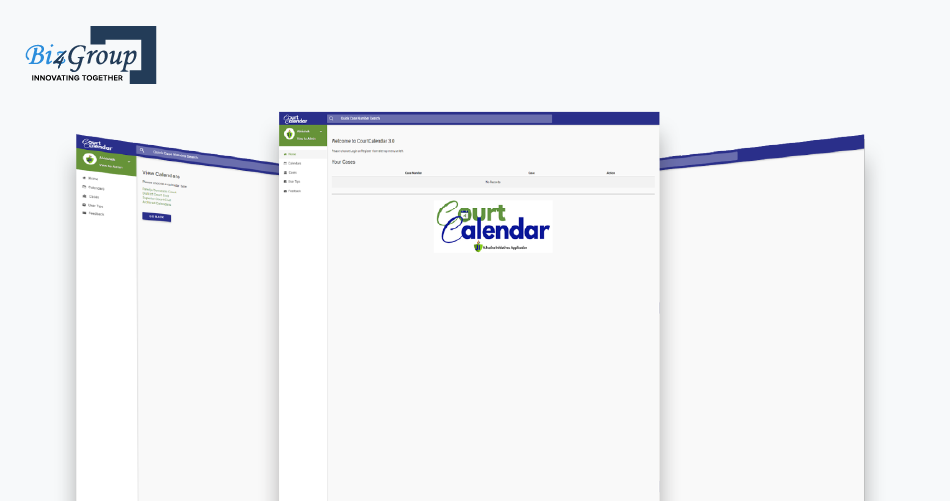
Court Calendar involved building a centralized judiciary platform where attorneys could manage cases, schedule hearings, and coordinate documents through a unified interface. It addressed administrative delays by organizing court activities into structured workflows accessible across stakeholders. By digitizing scheduling and case coordination, the platform showcased how legal operations can transition from fragmented manual handling toward system-driven workflow execution foundations.
Seen the Capability, Ready to See It Applied to Your Workflow?
Every legal organization has bottlenecks that automation alone cannot be solved. Map where agentic execution can realistically reduce workload inside your legal operations.
Talk to an Agentic AI Expert2. Harvey AI
Location: San Francisco, California
Website: harvey.ai
Harvey AI focuses on developing agentic systems designed specifically for legal professionals handling complex research, drafting, and analytical workflows. The company works closely with law firms to operationalize AI agents that assist and execute structured legal reasoning tasks within controlled environments.
Its platforms support legal teams by enabling autonomous assistance across case preparation and document analysis. This practical execution focus positions Harvey among the best agentic AI companies for legal startups USA supporting scalable innovation without disrupting established legal workflows.
Services Offered
- Agentic legal research automation
- Autonomous drafting assistance agents
- Legal reasoning workflow orchestration
- Litigation document analysis agents
- Compliance review automation systems
Key Strengths
- Deep specialization in agentic AI tailored for professional legal workflows
- Strong alignment with attorney research and drafting operational requirements
- Focus on controlled autonomy within high-accuracy legal environments
- Designed for scalable adoption across growing legal technology startups
- Enables structured reasoning agents suited for complex legal analysis
3. Anthropic
Location: San Francisco, California, USA
Website: anthropic.com
Anthropic contributes to legal agentic AI development through advanced reasoning models designed for safe and controllable autonomous behavior. Its technology enables legal platforms to build agents capable of handling complex instructions while maintaining reliability and oversight.
Legal organizations leverage these capabilities to support analysis, compliance interpretation, and structured decision workflows powered by trustworthy AI systems. Anthropic’s research-driven approach has positioned it among USA-based agentic AI developers for legal industry, enabling safer adoption of autonomy in sensitive legal environments.
Services Offered
- Agentic reasoning model integration for legal platforms
- Legal analysis automation frameworks
- Compliance interpretation support agents
- Autonomous document understanding systems
- Safe execution models for legal AI agents
Key Strengths
- Strong emphasis on safe agent behavior within regulated legal environments
- Advanced reasoning capabilities supporting complex legal decision workflows
- Designed for reliability where legal accuracy and oversight remain critical
- Enables scalable agent deployment across enterprise legal technology ecosystems
- Research-led development supporting trustworthy autonomous legal system execution
4. DataRobot
Location: Boston, Massachusetts
Website: datarobot.com
DataRobot enables legal organizations to operationalize agentic AI by combining automated decision systems with governance-aware deployment practices. Its platforms support the creation of agents that analyze legal data, monitor risks, and trigger workflow actions based on structured policies. Legal teams use these capabilities to introduce autonomy into compliance monitoring and operational analytics without losing oversight. Through its enterprise-focused execution model, DataRobot is increasingly recognized among top USA based agentic AI firms for legal services companies supporting scalable legal automation initiatives.
Services Offered
- Legal risk monitoring agents
- Compliance automation workflows
- Predictive legal analytics agents
- Autonomous decision orchestration systems
- Governance-aware AI deployment frameworks
Key Strengths
- Strong governance controls supporting regulated legal automation environments
- Focus on operationalizing agentic systems across enterprise legal infrastructures
- Enables data-driven legal decision workflows with structured accountability
- Supports scalable deployment aligned with compliance and audit expectations
- Designed for continuous monitoring within complex legal operational ecosystems
5. Ironclad
Location: San Francisco, California
Website: ironcladapp.com
Ironclad focuses on agentic automation within contract lifecycle management, helping legal teams move beyond static workflows toward autonomous contract operations. Its platform enables agents to manage agreements, monitor obligations, and initiate actions throughout contract lifecycles. Legal departments leverage these capabilities to streamline execution while maintaining visibility across negotiations and approvals. The company’s workflow-centric approach aligns closely with agentic AI consulting companies for law firms seeking structured automation embedded directly into legal operational processes.
Services Offered
- Autonomous contract lifecycle agents
- Agreement workflow orchestration
- Obligation tracking automation
- Contract approval routing agents
- Legal workflow execution monitoring
Key Strengths
- Deep specialization in agent-driven contract lifecycle automation workflows
- Designed around real legal operational processes and approval structures
- Enables proactive contract management through autonomous workflow execution
- Supports visibility and accountability across distributed legal teams
- Strong alignment with enterprise legal operations modernization initiatives
6. Lindy AI
Location: San Francisco, California
Website: lindy.ai
Lindy AI focuses on creating autonomous assistants that handle structured professional workflows, including legal coordination and communication-heavy processes. Its agentic systems help legal teams automate repetitive operational tasks such as follow-ups, information gathering, and workflow execution without constant supervision.
Law firms adopt Lindy’s technology to introduce controlled autonomy into daily legal operations while maintaining oversight. The platform’s execution-driven design helps organizations build agentic AI solutions for legal industry in USA that improve workflow continuity across legal teams.
Services Offered
- Autonomous legal workflow AI assistants
- Legal task coordination AI agents
- Case communication automation AI agents
- Workflow execution monitoring systems
- Legal operations task automation
Key Strengths
- Focus on operational agents supporting everyday legal workflow execution
- Designed for task autonomy within structured professional service environments
- Enables continuous workflow progress without constant manual legal coordination
- Supports scalable adoption across distributed legal operational teams
- Strong alignment with productivity-driven legal automation initiatives
7. Beam AI
Location: New York
Website: beam.ai
Beam AI develops agentic systems designed to execute multi-step workflows across enterprise environments, including legal operations that require structured task handling. Its platform enables organizations to operationalize autonomous agents that manage processes, coordinate actions, and maintain workflow visibility.
Legal teams use Beam AI to automate operational sequences while preserving accountability within regulated environments. The company’s execution-first model positions it among top rated agentic AI companies for legal sector USA supporting scalable agent deployment in complex legal workflows.
Services Offered
- Multi-step legal workflow AI agents
- Autonomous process orchestration systems
- Legal operations automation AI agents
- Enterprise legal task automation
Key Strengths
- Strong capability in orchestrating complex multi-step legal workflow execution
- Designed for operational visibility across autonomous legal process environments
- Enables scalable deployment of agents across enterprise legal functions
- Focus on accountability within automated workflow execution systems
- Supports structured autonomy aligned with regulated legal operational requirements
8. StackAI
Location: San Francisco, California
Website: stack-ai.com
StackAI provides infrastructure that allows organizations to design and deploy autonomous agents capable of executing workflows across enterprise systems. Its platform enables legal teams to build agent-driven processes that read documents, trigger actions, and coordinate tasks inside existing software environments.
With strong governance controls and workflow orchestration capabilities, StackAI supports legal organizations implementing structured autonomy across operational processes while maintaining visibility and control over agent behavior within regulated environments.
Services Offered
- Agentic AI workflow orchestration for legal operations
- Legal document processing AI agents
- Autonomous research workflow AI agents
- Enterprise legal task automation AI agents
- Governance-enabled agent deployment frameworks
Key Strengths
- Enables creation of agents executing tasks across integrated legal systems
- Strong workflow builder supporting controlled autonomous legal process execution
- Built-in governance features supporting compliance-driven legal automation environments
- Supports scalable deployment of agents across enterprise legal infrastructures
- Designed for secure execution within regulated operational workflows
9. Adept AI Labs
Location: San Francisco, California
Website: adept.ai
Adept AI Labs develops action-oriented agents designed to translate human intent into executable digital actions across software environments. Its technology enables autonomous systems that interact directly with applications, allowing legal organizations to automate multi-step operational workflows without redesigning existing tools.
By enabling agents to reason, plan, and execute tasks across interfaces, Adept supports legal teams introducing autonomy into research, compliance handling, and procedural execution workflows that require consistent operational accuracy.
Services Offered
- Autonomous software-operating legal agents
- Multi-application legal workflow automation
- Agentic task execution systems
- Legal process orchestration agents
- Cross-platform operational automation agents
Key Strengths
- Agents translate intent into actions across real software environments
- Enables automation without rebuilding existing legal technology ecosystems
- Strong capability for multi-step workflow execution requiring structured reasoning
- Designed for operational autonomy across complex enterprise software workflows
- Supports scalable agent deployment handling repetitive procedural legal tasks
10. Ciroos
Location: San Francisco, California
Website: ciroos.ai
Ciroos focuses on developing agentic systems designed to automate operational decision workflows within regulated industries, including legal environments that require structured execution and oversight. Its platform enables autonomous agents that coordinate tasks, interpret workflow conditions, and trigger actions based on predefined operational logic. Legal organizations leverage these capabilities to operationalize autonomy across compliance monitoring and internal legal processes. Ciroos supports teams introducing agent-driven execution into legal workflows while maintaining transparency and controlled system behavior aligned with governance requirements.
Services Offered
- Agentic AI workflow execution platforms
- Legal compliance automation agents
- Legal process orchestration systems
- Governance-aware workflow automation agents
Key Strengths
- Focus on decision-driven agents supporting structured legal workflow execution
- Designed for regulated environments requiring accountability and operational transparency
- Enables autonomous task coordination across complex legal operational processes
- Supports governance-aligned automation within compliance-sensitive legal environments
- Strong capability in operationalizing agentic execution across enterprise legal workflows
Selecting the right partner requires understanding execution capability, legal workflow alignment, and governance readiness. The list above helps clarify how to choose agentic AI development companies for the legal sector in USA based on real operational impact, not surface-level innovation claims.
Also Read: Agentic AI vs AI Agents: Insights for Enterprise Leaders
Side-by-Side Comparison of Leading Agentic AI Companies for Legal Services in USA
Legal teams often evaluate multiple vendors before making long-term technology decisions. The comparison below helps you understand how the top agentic AI development companies for legal in USA differ based on specialization, agentic focus, and legal workflow alignment.
|
Company |
Location |
Core Agentic Focus |
Ideal Use Case |
|---|---|---|---|
|
Biz4Group LLC |
Orlando, FL |
Custom agentic workflow development |
Firms building tailored legal agent systems |
|
Harvey AI |
San Francisco, CA |
Legal reasoning agents |
Legal startups and innovation teams |
|
Anthropic |
San Francisco, CA |
Safe reasoning models |
Regulated legal environments |
|
DataRobot |
Boston, MA |
Decision automation agents |
Enterprise legal analytics workflows |
|
Ironclad |
San Francisco, CA |
Contract lifecycle agents |
Corporate legal departments |
|
Lindy AI |
San Francisco, CA |
Task execution assistants |
Operational productivity automation |
|
Beam AI |
New York, NY |
Multi-step workflow agents |
Complex legal operations scaling |
|
StackAI |
San Francisco, CA |
Agent orchestration platforms |
Legal system integrations |
|
Adept AI Labs |
San Francisco, CA |
Action-based software agents |
Tool interaction automation |
|
Ciroos |
San Francisco, CA |
Decision execution agents |
Governance-heavy legal environments |
This comparison highlights how agentic capabilities vary depending on execution depth and legal specialization. Understanding these differences helps organizations evaluate agentic AI development companies for legal industry USA based on operational fit rather than feature lists.
How to Choose the Right Agentic AI Partner for Legal Innovation in USA
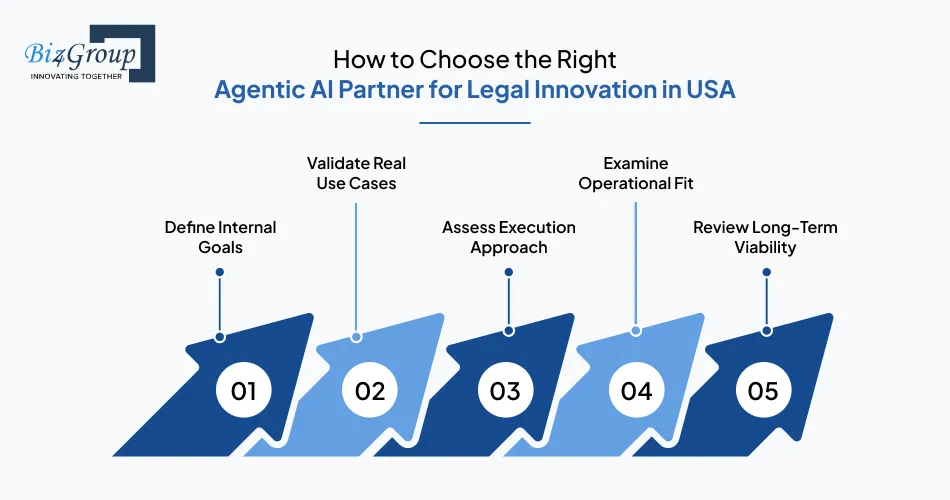
Legal innovation succeeds when decisions are made with clarity, not urgency. While reviewing the top agentic AI development companies for legal industry in USA, your goal is to evaluate partners through practical decision steps that reduce risk before implementation begins.
1. Define Internal Goals
- Problem scope definition: Start by listing operational challenges you want solved, so discussions stay focused on measurable outcomes instead of broad technology conversations.
- Success criteria mapping: Define how improvement will be measured, such as reduced review time or faster approvals, before engaging agentic AI consulting companies for legal firms in USA.
2. Validate Real Use Cases
- Workflow demonstration review: Ask vendors to demonstrate live workflows relevant to your legal operations instead of relying on presentations or conceptual product explanations.
- Scenario-based evaluation: Provide real legal scenarios and observe how systems respond, ensuring solutions handle practical situations rather than ideal test conditions.
3. Assess Execution Approach
- Delivery roadmap clarity: Review how implementation phases will unfold, including timelines, testing stages, and responsibilities shared between your internal teams and development partners.
- Iteration process visibility: Confirm how feedback will be incorporated during development, so adjustments happen early instead of after deployment challenges appear.
4. Examine Operational Fit
- Team collaboration method: Evaluate how frequently communication occurs and whether legal stakeholders remain involved throughout development rather than only during kickoff discussions.
- Adoption readiness planning: Understand how the partner prepares users for change, especially when transitioning from traditional legal AI app development toward agent-driven workflows.
5. Review Long-Term Viability
- Scalability planning review: Ask how the system expands across departments once initial success is achieved, ensuring architecture supports future growth without rebuilding foundations.
- Autonomy governance checks: Confirm how oversight works after deployment when systems begin to build legal AI agent capabilities that act within defined operational boundaries.
The right decision framework helps legal teams move beyond vendor evaluation toward confident adoption. Organizations working with agentic AI software development companies for legal automation in USA often succeed because partner selection follows structured, outcome-driven evaluation rather than technology enthusiasm alone.
Still Comparing Vendors? Start With Your Use Case Instead
A short discussion can clarify whether agentic AI fits your legal processes today or later. Bring your challenges; we'll help you evaluate the right path forward.
Book a Use-Case ConsultationHow Agentic AI Development Companies Address Legal Compliance, Security, and Governance Challenges?
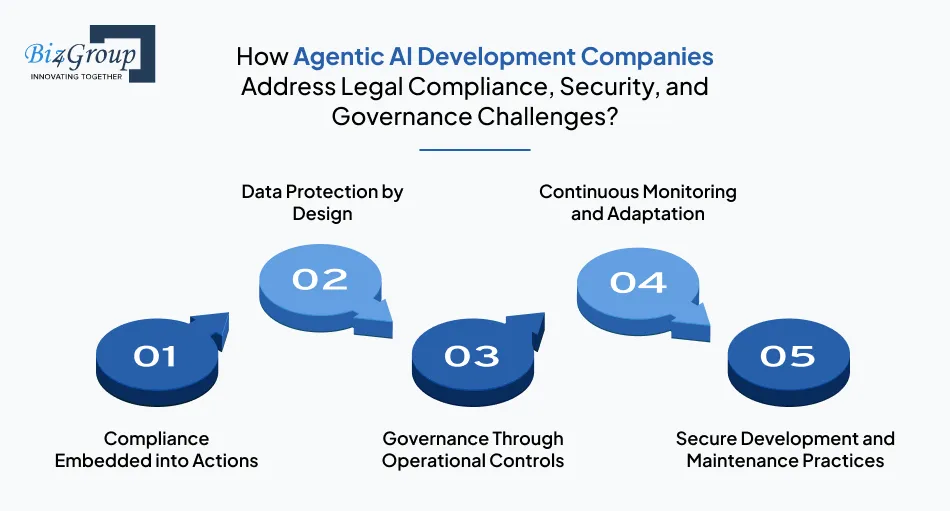
Legal organizations cannot rely on autonomy unless trust is built into how systems operate. The top agentic AI development companies for legal services in USA address compliance, security, and governance challenges by designing operational safeguards directly into how agentic systems function every day.
1. Compliance Embedded into Actions
Agentic AI systems are structured so compliance checks happen during execution rather than after tasks finish. Rules are translated into operational logic that guides system behavior automatically.
- workflows validate required conditions before progressing
- restricted actions pause automatically when compliance criteria are unmet
- legal teams maintain confidence without adding manual verification layers
2. Data Protection by Design
Instead of securing data only at storage level, development teams control how information moves across workflows. Access adapts dynamically depending on task context and user responsibility.
- sensitive legal records remain isolated within defined boundaries
- permissions adjust based on workflow stage and participant role
- exposure risks reduce without slowing operational execution
3. Governance Through Operational Controls
Governance is enforced through structured checkpoints that align with legal accountability expectations. Systems are built to respect approval hierarchies already followed inside legal departments.
- escalation triggers activate when predefined risk signals appear
- approvals remain mandatory for sensitive legal outcomes
- governance operates continuously rather than through periodic reviews
4. Continuous Monitoring and Adaptation
Regulations evolve, and agentic AI systems must adapt without rebuilding workflows. Teams developing enterprise AI solutions implement monitoring layers that evaluate behavior against updated policies.
- system activity is reviewed in real time for anomalies
- policy updates adjust execution rules without workflow disruption
- compliance remains active as legal environments change
5. Secure Development and Maintenance Practices
Organizations that hire AI developers with legal domain experience prioritize long-term reliability. Security testing and governance validation continue after deployment to ensure sustained operational safety.
- regular validation checks maintain predictable system behavior
- updates follow controlled release practices aligned with legal oversight
- operational risks are addressed before scaling adoption further
Agentic AI development companies for legal efficiency and compliance succeed by embedding accountability into system behavior itself. Legal AI software development companies in USA enable autonomy only when governance, security, and compliance operate as continuous functions rather than external controls.
Common Mistakes Law Firms Make When Choosing an Agentic AI Development Partner for Legal Industry in USA
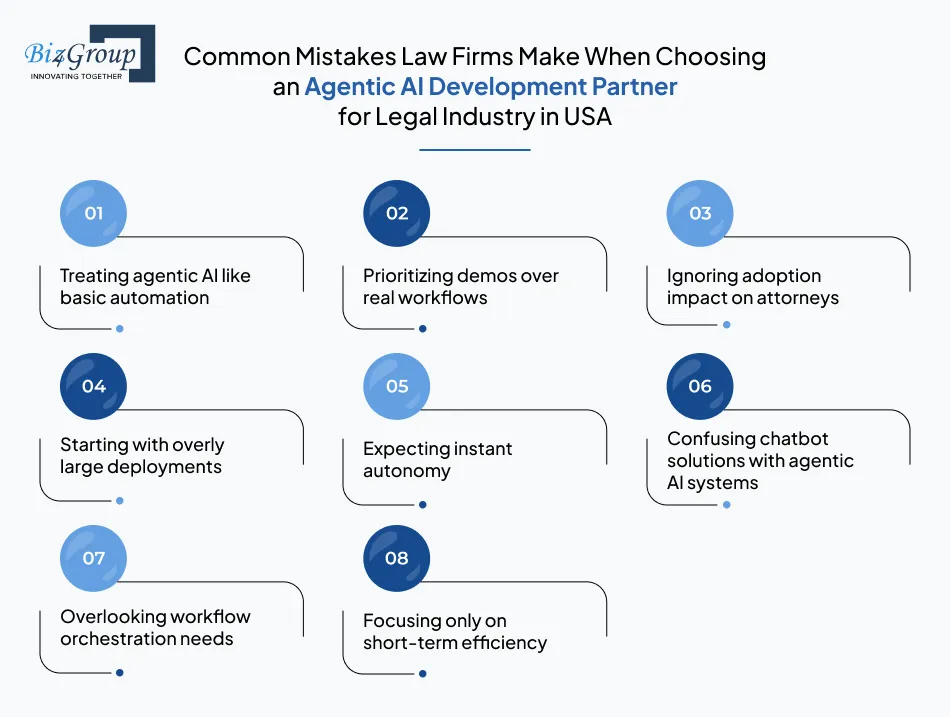
Legal firms often assume that working with top agentic AI development companies for legal services in USA automatically guarantees success. In reality, most implementation challenges begin with early decision mistakes that quietly create long-term operational friction.
|
Common Mistake |
How to Avoid It |
|---|---|
|
Treating agentic AI like basic automation |
Understand that agentic systems act on goals, not simple triggers. Define expected responsibilities before implementation begins. |
|
Prioritizing demos over real workflows |
Request demonstrations using your legal scenarios, so that outcomes reflect daily operations instead of polished product environments. |
|
Ignoring adoption impact on attorneys |
Plan early communication and onboarding so teams understand how systems support work instead of replacing professional judgment. |
|
Starting with overly large deployments |
Begin with a focused workflow where success can be measured clearly before expanding across departments or practice areas. |
|
Expecting instant autonomy |
Establish gradual rollout stages so systems learn operational patterns before handling sensitive legal responsibilities independently. |
|
Confusing chatbot solutions with agentic AI systems |
An agentic AI chatbot may assist in conversations, but autonomy requires structured execution capabilities beyond interaction-based tools. |
|
Overlooking workflow orchestration needs |
When building a web application to automate the legal services, ensure processes connect across approvals, documents, and internal systems. |
|
Focusing only on short-term efficiency |
Evaluate how the solution adapts as legal processes evolve rather than optimizing immediate productivity improvements. |
Avoiding these mistakes helps legal teams approach adoption with clarity and realistic expectations. Organizations working with USA-based agentic AI development companies for legal industry often achieve stronger outcomes when early decisions prioritize operational fit, gradual adoption, and long-term sustainability.
Conclusion
Legal innovation is no longer about experimenting with new tools. It is about building systems that can responsibly act while supporting how legal teams already function. Working with an AI product development company allows you to move beyond early automation and introduce agentic capabilities that operate with clear accountability. a shift increasingly reflected across modern legal tech insights.
Throughout this guide, you have seen how the top agentic AI development companies for legal services in USA approach autonomy differently. Their focus stays on practical execution, governance readiness, and long-term operational value instead of short-term technological excitement.
If you are evaluating how agentic AI could realistically fit into your legal workflows, the best starting point is a focused discussion around your current operational challenges. Book a consultation to identify where autonomy can deliver measurable value, and understand what a practical implementation roadmap could look like for your organization.
FAQ’s
1. What do the top agentic AI development companies for legal in USA actually build for law firms?
The top providers typically develop autonomous legal workflows such as contract review agents, compliance monitoring systems, legal research assistants, and operational automation tools that help legal teams reduce manual coordination while maintaining oversight.
2. How do agentic AI development companies for legal industry USA differ from traditional legal AI vendors?
Unlike traditional tools that assist with drafting or search, agentic AI solutions are designed to execute multi-step legal tasks independently, manage workflows, and trigger actions based on predefined legal rules and objectives.
3. How should law firms evaluate agentic AI consulting companies for legal firms before starting a project?
Law firms should assess real legal domain experience, workflow understanding, governance readiness, and the ability to deliver production-ready systems rather than experimental prototypes or generic AI implementations.
4. What types of legal workflows benefit most from agentic AI software development for legal firms?
High-volume and rule-driven processes such as contract lifecycle management, compliance tracking, legal intake, document validation, and internal approvals often see the fastest operational improvements through agentic automation.
5. Are USA based agentic AI development companies for legal industry better suited for compliance-focused projects?
Many U.S.-based teams have deeper familiarity with regulatory expectations, data governance standards, and legal accountability requirements, which helps ensure systems align with compliance and audit needs from the start.
6. How long does it take to build agentic AI solutions for legal industry use cases?
Timelines vary depending on workflow complexity, but most organizations begin with a focused pilot lasting a few months before expanding into broader legal automation through scalable agentic AI software development companies for legal automation in USA.
