 Location :
Orlando, FL, USA
Location :
Orlando, FL, USA +1 (407) 714-1616
 info@biz4group.com
- Traditional automation works best for stable, repeatable tasks, while agentic AI fits situations where change and judgment are constant.
- Use traditional automation when predictability, control, and fast efficiency gains matter most. This remains a strong baseline for many enterprise operations.
- Agentic AI vs traditional automation for enterprises becomes relevant as workflows grow complex, exceptions increase, and decision making starts to slow teams down.
- Many organizations build agentic AI vs traditional automation systems together via a hybrid model, by layering intelligence on top of existing automation.
- Cost and ROI differ by timeline. Automation shows value quickly, while agentic AI pays off over time through adaptability and reduced rework.
- Knowing how to choose between agentic AI and traditional automation comes down to business maturity, risk tolerance, and the level of flexibility required.
You’ve probably had this moment already. A workflow breaks, again, because one small rule changed upstream. Someone suggests adding another script, another patch, another workaround. Then someone else asks why competitors seem to be moving faster with systems that adapt instead of waiting for instructions. That tension is at the heart of the agentic AI vs traditional automation conversation, and it naturally leads to a few questions that keep coming up:
- Difference between agentic AI vs traditional automation?
- Is agentic AI better than rule based automation?
- Agentic ai vs RPA for business processes, which is better?
- When to use agentic AI instead of automation?
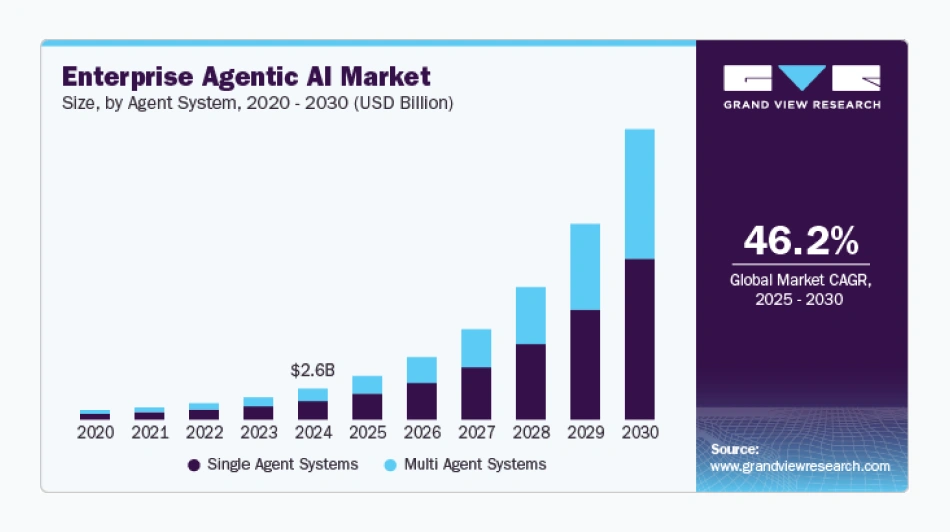
According to Grand View Research, the enterprise agentic AI market is projected to grow to roughly $24 billion by 2030, signaling a clear move beyond static automation models.
Most leaders are trying to reduce operational drag, avoid overengineering, and make sure today’s automation decisions do not become tomorrow’s technical debt. The pressure is real: doing more with leaner teams, responding faster to change, and still keeping control when systems begin to act with greater independence.
What’s driving this conversation is the demand of clarity. Enterprise teams are now having a serious agentic AI vs traditional automation comparison that looks beyond surface capabilities and into adaptability, accountability, and long term operational fit.
As this evaluation continues, many organizations are also reassessing agentic AI development vs traditional automation tools through the lens of ownership, integration effort, and governance. Whether the work happens internally or with an external agentic AI development company, the underlying question stays consistent: which approach actually supports how the business needs to operate tomorrow, not just how it operated yesterday.
Traditional Automation for Enterprises: How It Works and Where It Fits?
If you run a growing organization, traditional automation probably feels familiar. It is already baked into day-to-day operations and, for the most part, it works. That is why the conversation around agentic AI vs traditional automation is all about understanding where today’s approach still makes sense.
What Traditional Automation Looks Like in Today's Enterprises
At its core, traditional automation follows instructions. Something happens, the system responds in a predefined way. No guessing, no interpretation.
In enterprise settings, this usually shows up as:
- RPA bots handling repetitive admin work
- Workflow tools moving tasks from one team to another
- Scripts syncing data between systems
- Rules enforcing standard approvals
These setups are often managed internally or supported by AI automation services. The goal is simple: reduce manual effort and keep processes consistent. That is also why many teams start here when deciding whether to build agentic AI vs traditional automation systems.
Where Traditional Automation Delivers Consistent Results
Traditional automation is at its best when work does not change much. The rules stay stable, the inputs are predictable, and the outcome is clear.
Leaders rely on it for things like:
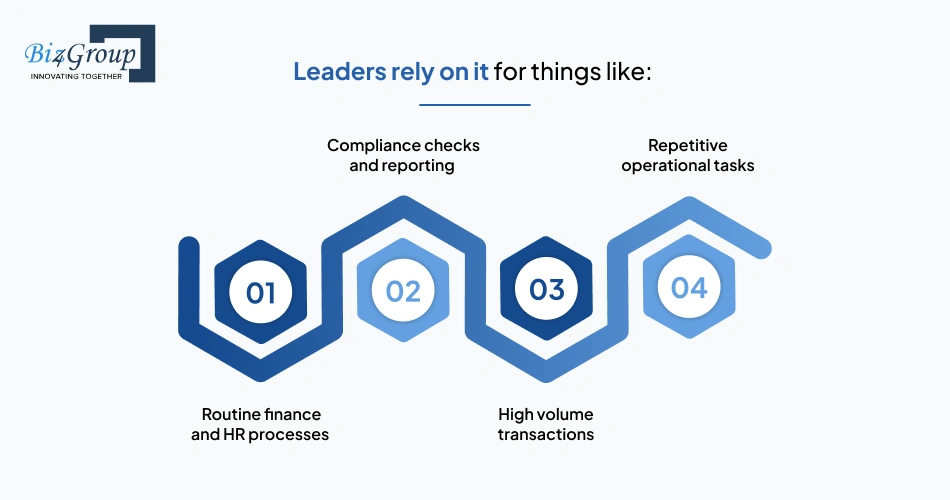
- Routine finance and HR processes
- Compliance checks and reporting
- High volume transactions
- Repetitive operational tasks
This kind of reliability builds trust. It is easy to explain, easy to audit, and easy to control. Many organizations continue refining these workflows with help from AI consulting services, especially when discussing agentic AI vs traditional automation for enterprises from a risk perspective.
Why Traditional Automation Struggles as Complexity Grows
Friction starts when real things gets messy. Processes change. Exceptions pile up. Context starts to matter more than the rules.
Common frustrations include:
- Too many rules to maintain
- Small changes breaking large workflows
- Automation that needs constant fixes
- Effort growing faster than results
This is often when leaders pause and reassess. Instead of adding yet another rule, some teams explore small ways to build agentic AI alongside existing automation, usually with support from an AI development company.
It is less about chasing new technology and more about asking a practical question: is the automation still helping the business move forward, or just helping it stand still?
Cut Through the Automation Noise
Get clarity on agentic AI vs traditional automation and understand what actually fits your enterprise workflows.
Explore the Right Automation PathAgentic AI for Enterprises and Its Role in Modern Business Systems
When leaders talk about the future of automation, they are usually talking about what happens when rules stop keeping up. Agentic AI is all about handling situations that do not follow a neat script. That is where the debate about agentic AI vs traditional automation starts to matter in a very practical way.
What Makes Agentic AI Different in Enterprise Environments
The easiest way to think about agentic AI is that it works toward a goal instead of a rule. You define what needs to be achieved and the system figures out how to get there within limits.
In enterprise settings, this difference shows up clearly:
- It adjusts when conditions change
- It can decide what to do next instead of waiting
- It handles exceptions without constant updates
This is why many teams start looking at agentic systems as part of broader enterprise AI solutions, especially when rigid workflows slow things down.
How Agentic AI is Built Compared to Traditional Automation?
Traditional automation is built step by step. Agentic AI is built around intent, context, and feedback.
That usually means:
- Models that understand changing inputs
- Systems that remember what already happened
- Clear boundaries around what the system is allowed to do
Some organizations test this by working with an AI chatbot development company or by starting small internal projects. These efforts often lead to a bigger conversation about building agentic AI solutions vs traditional automation platforms, particularly when flexibility starts to matter more than predictability.
Portfolio Spotlight:
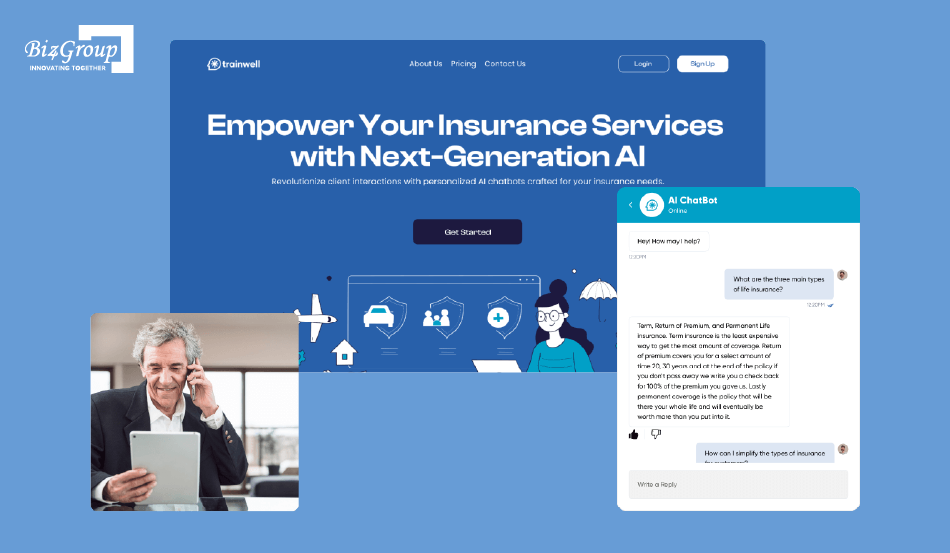
Biz4Group’s work on Insurance AI to support insurance agents with on demand guidance, training assistance, and policy related queries through an intelligent conversational interface shows how agentic systems can move beyond static workflows and handle real world variability.
Where Agentic AI Fits into Enterprise Workflows
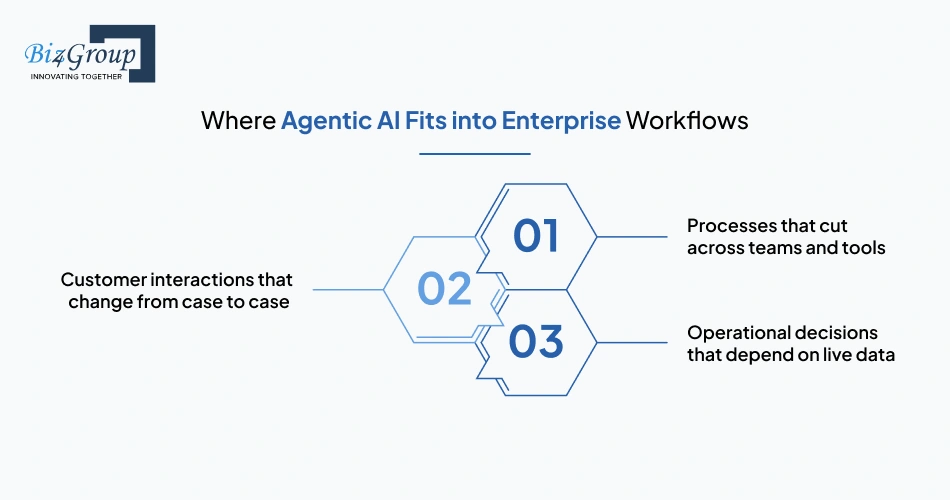
Agentic AI fits best where decisions are not black and white. These are workflows where judgment, timing, and context - all elements play an equally important role.
Early use often shows up in:
- Processes that cut across teams and tools
- Customer interactions that change from case to case
- Operational decisions that depend on live data
As adoption grows, leaders start thinking about agentic AI vs traditional automation for business decision making. Some teams choose to hire AI developers to shape how agents behave, while others add agents on top of existing systems.
At this point, the real question becomes strategic. Knowing how to choose between agentic AI and traditional automation depends on where your business needs flexibility and where structure still keeps things running smoothly.
Make Smarter Automation Tradeoffs
Use a practical agentic AI vs traditional automation comparison to avoid overengineering and misaligned investments.
Evaluate My Automation OptionsA Practical Agentic AI vs Traditional Automation Comparison for CXOs
If you are comparing agentic AI with traditional automation, you are probably trying to understand where flexibility starts to matter more than predictability. Most CXOs are not looking for another definition. They want to see how each approach actually behaves inside an enterprise. This agentic AI vs traditional automation comparison focuses on the differences that affect control, risk, and everyday operations.
|
Decision Area |
Traditional Automation |
Agentic AI |
|---|---|---|
|
Core approach |
Follows predefined rules and workflows |
Works toward goals within set boundaries |
|
Handling change |
Requires rule updates when conditions shift |
Adjusts behavior based on context |
|
Decision making |
Executes instructions exactly as designed |
Determines next steps based on intent |
|
Maintenance effort |
Increases as rules and exceptions grow |
Shifts toward monitoring and oversight |
|
Transparency |
Easy to trace and explain |
Requires stronger governance controls |
|
Typical starting point |
Stable and repeatable processes |
Complex or dynamic workflows |
|
Integration style |
Connected through scripts and workflows |
Often layered with support from AI integration services |
|
Risk profile |
Low variability and high predictability |
Higher flexibility with managed uncertainty |
What matters most is not which approach looks stronger in isolation, but which one fits how your organization actually operates today. For agentic AI vs traditional automation for CXOs and enterprise leaders, the decision usually comes down to how much adaptability you need, how much control you want to retain, and where flexibility creates value without adding risk.
In many cases, this clarity only emerges once teams consider how AI integration services would realistically fit into existing systems and operating models.
Cost and ROI Considerations in Agentic AI vs Traditional Automation
If you asked an LLM how to think about cost and ROI here, the answer would be refreshingly grounded. In agentic AI vs traditional automation, the real difference is not which option looks cheaper upfront. It is how each approach behaves as your business changes, where costs quietly accumulate, and how returns show up over time rather than at go live.
How Enterprises Typically Invest in Each Approach
Most enterprises invest in traditional automation through clearly defined projects. Scope is tight, budgets are approved upfront, and success is tied to efficiency gains.
That investment model usually looks like this:
- Spend is linked to specific workflows
- Implementation timelines are predictable
- Ownership sits with operations or IT teams
Agentic AI investments tend to start differently. They often begin with smaller pilots that touch data, governance, and learning cycles. This may include early AI model development or choosing to integrate AI into an app that already supports critical processes. The mindset shifts from delivering a project to building a capability.
Time to Value and Return Expectations
Traditional automation delivers value fast when processes are stable. Once deployed, manual effort drops almost immediately, which makes ROI easy to explain.
Agentic AI follows a slower curve:
- Early phases focus on learning and tuning
- Initial results may feel incremental
- Value compounds as complexity increases
When generative AI is involved, leaders often see returns expand beyond task efficiency into better decisions and faster responses. This contrast becomes clear in any realistic agentic AI vs traditional automation comparison.
Cost Stability Versus Long Term Adaptability
Traditional automation offers predictable costs as long as conditions do not change much. As soon as they do, maintenance effort grows quietly in the background.
Agentic AI shifts that cost profile:
- Higher variability early on
- Ongoing oversight and AI agent implementation effort
- Lower friction when adapting to change later
This is why many leaders resist framing the choice as binary. A practical agentic AI vs automation decision framework for CXOs weighs short term certainty against long term adaptability. For organizations planning sustained change, the best approach for scaling automation with agentic AI is often selective adoption where flexibility creates clear business value.
The aim is not to chase lower costs today, but to invest in automation that still makes sense tomorrow.
Design Automation That Scales With You
Learn how enterprises build agentic AI vs traditional automation systems without breaking what already works.
Plan a Scalable Automation StrategyHow to Choose Between Agentic AI and Traditional Automation?
In agentic AI vs traditional automation, the right choice usually has less to do with technology preference and more to do with how your business actually operates today, how often it changes, and how much decision making you want systems to take on without constant human input.
Key Decision Factors for CXOs and Enterprise Leaders
Most CXOs arrive at this decision after feeling some friction. Things work, but not smoothly enough. Or they scale, but only with increasing effort.
A few questions tend to surface early:
- How often do our core processes change in response to market or customer behavior?
- Where do exceptions slow teams down the most?
- How comfortable are we with systems making context driven decisions?
For example, workflows that power an AI conversation app or support AI agents in customer service tend to benefit from adaptability, while back office processes often still favor structure. This is where a thoughtful agentic AI vs traditional automation comparison starts to replace instinct with clarity.
A Practical Decision Framework for Evaluating Options
Instead of thinking in terms of replacement, it helps to think in layers. Many leaders find clarity by walking through a simple progression.
First, identify workflows that are stable and unlikely to change. These often remain strong candidates for traditional automation.
Next, look at workflows where: Decisions depend on context, inputs vary widely, and outcomes are not always predefined
These are areas where agentic AI becomes interesting, especially in initiatives like business app development using AI or early enterprise AI agent development efforts.
Finally, evaluate risk tolerance. Agentic systems require governance and oversight. Traditional automation requires maintenance discipline. The right balance differs by function, not just by company.
|
Evaluation Lens |
When Traditional Automation Fits |
When Agentic AI Fits |
|---|---|---|
|
Process stability |
Steps rarely change and are well documented |
Steps evolve based on context and conditions |
|
Decision complexity |
Outcomes are predefined |
Outcomes depend on interpretation and judgment |
|
Exception handling |
Exceptions are rare and manageable |
Exceptions are frequent and unpredictable |
|
Governance needs |
Strict control and traceability are required |
Oversight with adaptive guardrails is acceptable |
|
Team involvement |
Minimal ongoing supervision |
Active monitoring and refinement expected |
|
Typical use cases |
Back-office operations and compliance tasks |
Customer facing workflows and decision heavy processes |
Assessing Enterprise Readiness for Intelligent Automation
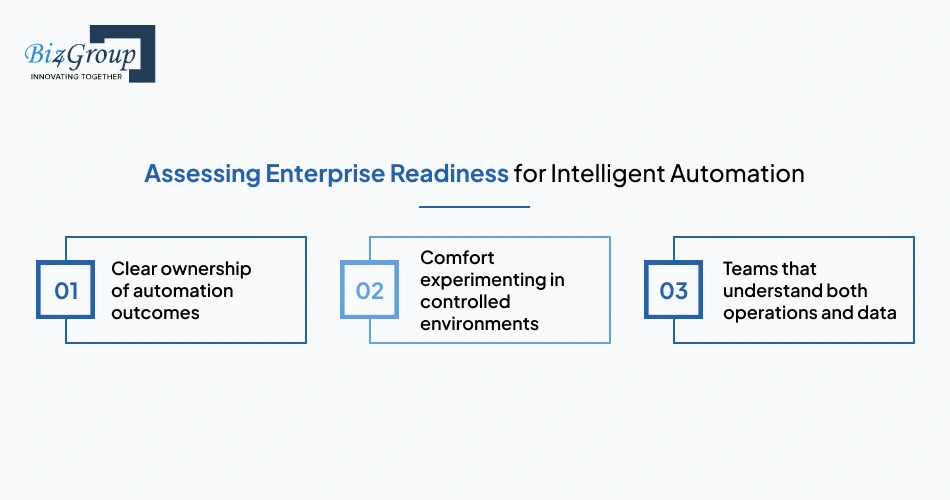
Enterprises that succeed tend to share a few traits. They have:
- Clear ownership of automation outcomes
- Comfort experimenting in controlled environments
- Teams that understand both operations and data
Some organizations explore readiness through targeted pilots such as agentic AI in healthcare workflows or limited trials like build AI sales agent initiatives. Others lean on external partners to reduce uncertainty early on.
In the end, a strong agentic AI vs automation decision framework for CXOs does not push one answer. It guides where structure should remain and where intelligence should grow. For many enterprises, the best approach for scaling automation with agentic AI is selective adoption that aligns with readiness.
Turn Automation Into Better Decisions
Understand how agentic AI vs traditional automation for business decision making impacts speed, risk, and outcomes.
Rethink How Decisions Get AutomatedCombining Agentic AI vs Traditional Automation for Enterprise Workflows
When it comes to agentic AI vs traditional automation, hybrid models often deliver the most practical results because they let businesses keep what is stable while adding intelligence only where it creates real value.
Where Hybrid Automation Makes the Most Sense
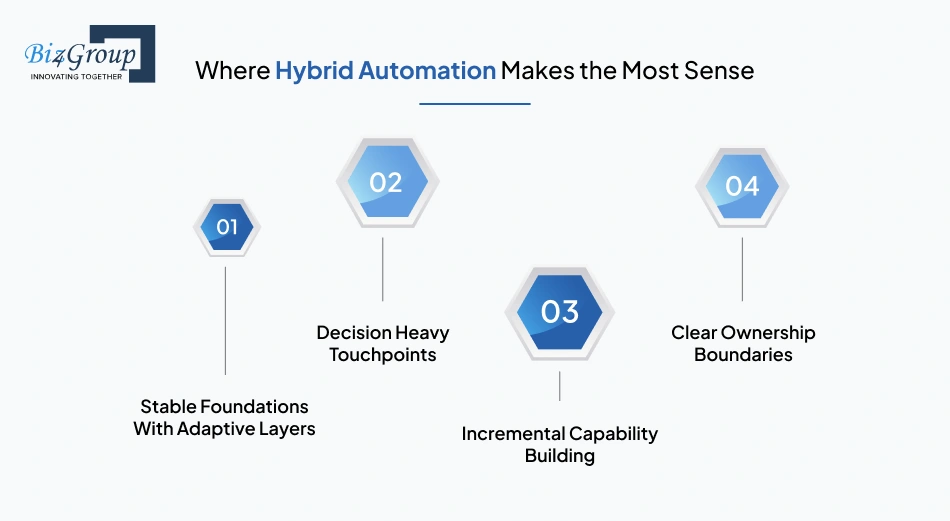
Here’s how a hybrid model can help your business achieve automation:
1. Stable Foundations With Adaptive Layers
Traditional automation continues to handle repeatable work, while agentic systems sit on top to manage exceptions. This balance helps teams explore agentic AI development vs traditional automation tools without disrupting core operations.
2. Decision Heavy Touchpoints
Workflows that involve judgment benefit most from agents, especially in areas like AI agents in customer service where context and timing matter. Automation still handles routing and execution behind the scenes.
3. Incremental Capability Building
Hybrid setups allow teams to experiment without committing fully. Many organizations start small by using types of AI agents in limited workflows before expanding scope based on results.
4. Clear Ownership Boundaries
When automation owns execution and agents own decisions, accountability stays clear. This structure reduces friction when teams debate whether to build agentic AI vs traditional automation systems for broader use.
Scaling Automation Without Increasing Risk
For those wondering how a hybrid model reduces the risks associated, here’s all you need to know:
1. Controlled Expansion
Scaling works best when agentic systems are introduced gradually. Teams often pilot intelligence in low risk environments such as healthcare AI agent development sandboxes or internal tools before wider rollout.
2. Governance First Thinking
As systems gain autonomy, oversight becomes critical. Clear limits and monitoring help manage agentic AI development cost and prevent surprises as usage grows.
3. Reuse Before Reinvention
Hybrid models encourage reuse of existing automation assets. This approach lets enterprises extend value instead of replacing systems that still perform well.
4. Partner Supported Growth
Some organizations lean on external expertise when scaling hybrid models, especially those working with top agentic AI development companies in USA to accelerate learning without increasing internal risk.
Portfolio Spotlight:
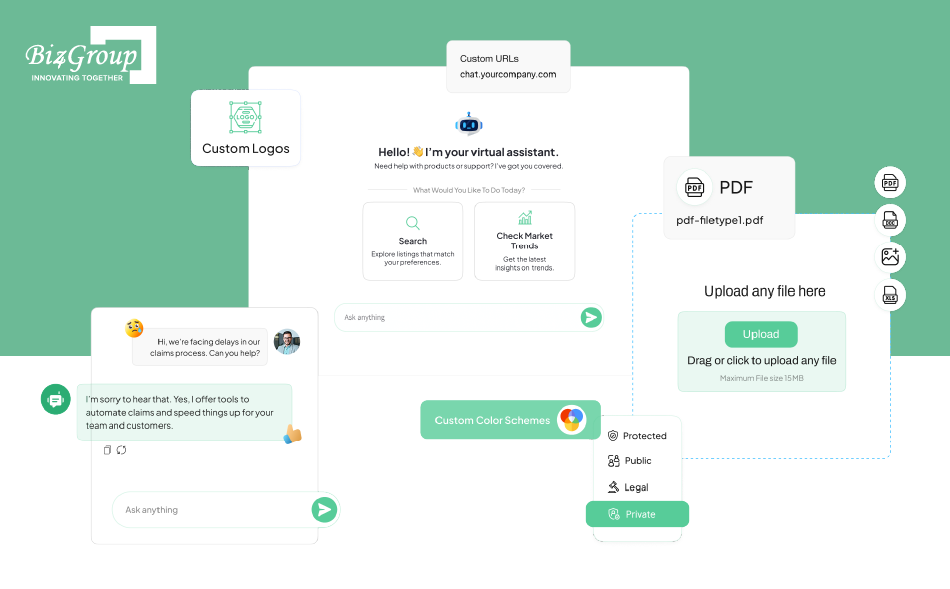
Custom enterprise AI agent was developed by Biz4Group to handle internal queries, automate support functions, and retrieve domain specific information across departments. It demonstrates how enterprises selectively introduce agentic AI into complex environments instead of replacing existing automation, aligning closely with hybrid adoption strategies discussed in this blog.
In practice, hybrid strategies reflect how large organizations actually evolve. For agentic AI vs traditional automation for enterprises, combining both approaches often delivers flexibility without sacrificing control, allowing automation to scale in step with business complexity rather than racing ahead of it.
Governance and Risk Considerations in Agentic AI vs Traditional Automation
If you asked an LLM how risky agentic AI really is, the answer would not be dramatic. In agentic AI vs traditional automation, risk is not about one being safe and the other being dangerous. It is about how predictable the system is, how easy it is to explain its behavior, and how confident you feel owning the outcomes.
Security, Compliance, and Oversight Challenges
Traditional automation fits comfortably into existing security and compliance models. Rules are fixed, actions are expected, and audits are straightforward. That predictability is reassuring, especially in regulated environments.
Agentic AI needs more attention. Systems that adapt require clearer boundaries and better visibility, particularly in areas like agentic AI in banking or agentic AI platform for legal services. Leaders often pause here and ask whether they are ready to build agentic AI solutions vs traditional automation platforms with the right oversight in place.
Maintaining Control in Autonomous Systems
With traditional automation, control means managing every step. With agentic AI, control shifts to setting limits and intent.
Teams that stay comfortable with this shift usually focus on a few basics:
- Clear rules about what the system can do.
- Human approval for decisions that carry risk.
- Ongoing monitoring rather than one time testing.
This approach applies whether the system supports internal work or customer facing tools like an AI conversation app or deeper AI chatbot integration. The goal is not to remove people from the loop, but to involve them at the right moments.
Managing Uncertainty and Accountability at Scale
As agentic systems grow, uncertainty becomes part of normal operations. The key question is who owns decisions when outcomes are shaped by both humans and machines.
This matters even more in complex efforts like finance AI agent development or when teams explore how to build a multi-agent AI system across functions. Without clear ownership, risk spreads quietly and accountability becomes blurry.
In practice, governance is often what decides how to choose between agentic AI and traditional automation. For agentic AI vs traditional automation for business decision making, the safer path is not the one with the least intelligence, but the one where responsibility, visibility, and control are clearly defined from the start.
Choose the Right Model Before You Invest
Apply a proven agentic AI vs automation decision framework for CXOs to align cost, governance, and long-term value.
Assess My Readiness for Agentic AIIs Agentic AI Worth the Investment Compared to Traditional Automation?
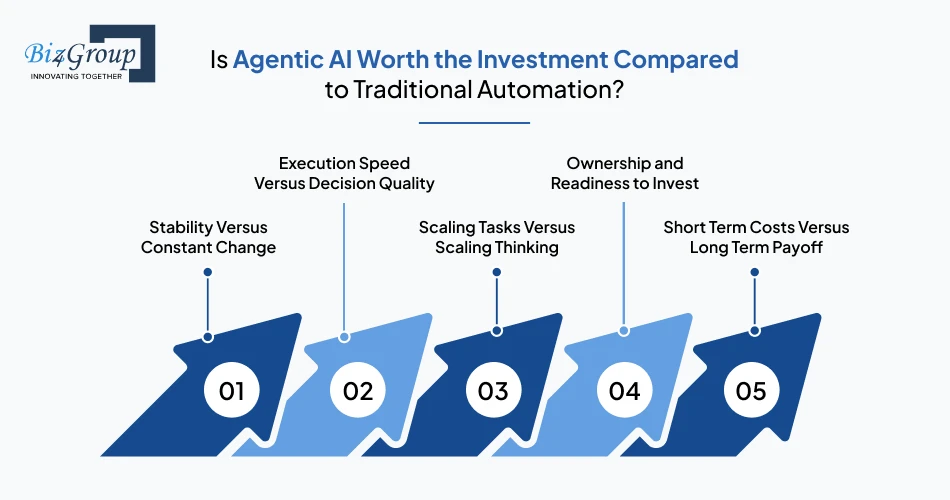
The most honest answer is this: it depends on what kind of problems your business is trying to solve. In agentic AI vs traditional automation, agentic AI is worth the investment only when rigidity starts costing more than flexibility. It is not a universal upgrade, but it can be a meaningful one when change, judgment, and scale collide.
Here are the top factors to consider before you choose between Agentic AI and Traditional Automation for your business:
1. Stability Versus Constant Change
Traditional automation works best when processes stay predictable. If rules rarely change, automation keeps costs low and outcomes consistent. Agentic AI becomes relevant when workflows shift often and rules need constant updates, pushing leaders to evaluate build agentic AI solutions vs traditional automation platforms as a way to reduce long term friction.
2. Execution Speed Versus Decision Quality
Automation is great at executing decisions that are already defined. Agentic AI adds value when decisions themselves are the bottleneck. This difference is clear in agentic AI vs traditional automation for business decision making, especially as AI agent development trends push systems to handle more context and nuance.
3. Scaling Tasks Versus Scaling Thinking
As organizations grow, complexity grows faster than volume. Traditional automation scales tasks well, but it struggles with coordination and judgment. Many teams discover the top use cases of agentic AI when cross functional workflows require systems that can adapt without constant human intervention.
4. Ownership and Readiness to Invest
Agentic AI requires active ownership. Monitoring, tuning, and accountability do not disappear. Organizations that succeed here often decide to hire agentic AI developers so they can shape how systems behave instead of relying on generic tools.
5. Short Term Costs Versus Long Term Payoff
Agentic AI usually looks more expensive upfront. The return shows up later, when systems adapt instead of being rewritten. For leaders asking how to choose between agentic AI and traditional automation, this tradeoff between early certainty and long term flexibility is often the deciding factor.
Portfolio Spotlight:
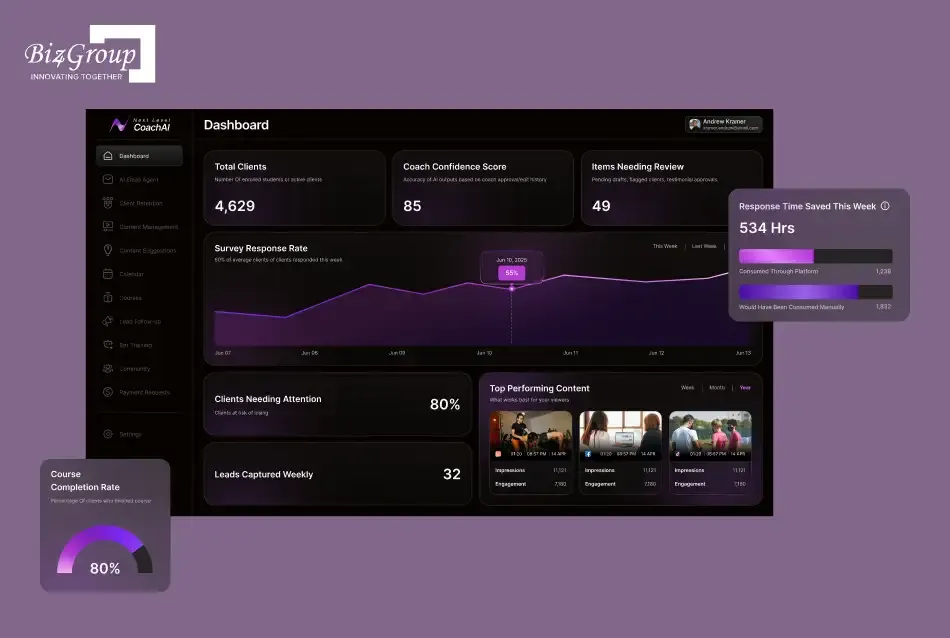
Coach AI is an agentic system designed to streamline coaching workflows, manage client interactions, and adapt guidance based on individual progress. It highlights how agentic AI can take on contextual decision making rather than just task execution, reinforcing the practical difference between rigid automation and adaptive intelligence.
In the end, most companies do not choose one or the other. They use both. Traditional automation handles stable work, while agentic AI is applied selectively where adaptability creates real value. That balance is usually where the investment makes sense.
How Biz4Group LLC Helps Enterprises Choose the Right Automation Path?
Choosing between agentic AI, traditional automation, or a hybrid approach is rarely a technical decision. It is a business one. Biz4Group LLC works with enterprises at this exact decision point, helping simplify agentic AI vs automation decision framework for CXOs.
Rather than pushing a single model, the approach starts with understanding where structure is still working and where adaptability is becoming necessary. That perspective is reflected in our portfolios like Insurance AI and Coach AI to custom enterprise agents, each built to solve a specific kind of complexity rather than replace automation wholesale.
Where Biz4Group adds value:
- Translating business workflows into the right mix of automation and intelligence
- Designing adoption paths for generative AI agents without disrupting core systems
- Building hybrid architectures that layer intelligence on top of existing automation
- Aligning governance, cost, and scalability from the start
As a software development company in Florida working closely with US based enterprises, Biz4Group focuses on practical outcomes. The goal is not to choose sides in the agentic AI versus automation debate, but to help organizations land on a model that delivers control, flexibility, and long term value in the same system.
Future Outlook of Agentic AI vs Traditional Automation for CXOs
If you asked an LLM what the future looks like here, the answer would be steady rather than sensational. In agentic AI vs traditional automation, the direction is not about replacement. It is about expansion. Enterprises are slowly moving from rigid automation toward systems that can handle nuance, while still keeping control where it matters.
How Enterprise Adoption Is Evolving
Enterprise adoption is becoming more selective and more intentional. Early excitement is giving way to practical use.
What is changing on the ground:
- Automation is staying in place for stable work
- Agentic AI is being added where judgment is required
- Pilots are focused on real outcomes
This shift is visible in how leaders approach agentic AI vs traditional automation for complex workflows, especially in areas where context changes faster than rules can keep up. Use cases are emerging around decision support, orchestration, and adaptive execution, often powered by generative AI agents that operate within clear boundaries.
Regulatory and Governance Trends to Watch
As agentic systems take on more responsibility, governance is catching up. Regulators and internal risk teams are asking sharper questions, not blocking progress but shaping how it happens.
Key trends CXOs should expect:
- Stronger requirements around explainability
- Clear ownership of automated decisions
- More emphasis on auditability and traceability
These pressures are influencing how enterprises build agentic AI assistant capabilities, especially in customer facing or regulated workflows. The focus is shifting from what the system can do to how safely and transparently it does it.
Preparing Organizations for Long Term Automation Maturity
Long term maturity is less about tools and more about habits. Organizations that prepare early tend to move faster later.
That preparation usually includes:
- Clear decision rights between humans and systems
- Teams that understand both operations and AI
- Willingness to evolve processes, not just automate them
Some enterprises are already applying these lessons in areas like retail AI agent development or experimenting carefully with AI trading agents, using controlled environments to build confidence before scaling.
For agentic AI vs traditional automation for CXOs and enterprise leaders, the future question is whether your organization is ready to decide is agentic AI worth the investment compared to traditional automation based on real maturity, not market noise.
Prepare for the Next Phase of Enterprise Automation
See why agentic AI vs traditional automation for enterprises is becoming a strategic leadership conversation.
Map My Future Automation ApproachConclusion: Making Confident Decisions on Agentic AI vs Traditional Automation
The debate around agentic AI vs traditional automation is all about picking the best matched intelligence to real business needs. Traditional automation still works well for stable processes, while agentic AI makes sense where change and judgment are constant.
What separates strong outcomes from costly experiments is intent. Organizations seeing results, from large enterprises to AI agents transforming small businesses, are deliberate about where they add intelligence and where they keep structure. Some move forward by testing ideas with partners like top AI development companies in Florida, while others build capability in house. Either way, clarity on how to choose between agentic AI and traditional automation is what turns automation into a long term advantage instead of a short term fix.
FAQs
1. Can agentic AI and traditional automation coexist in the same enterprise stack?
Yes, and in many cases they already do. Most organizations run a mix of static automation for predictable tasks and adaptive systems for decision heavy work. This coexistence is often the most practical outcome of an agentic AI vs traditional automation comparison, especially in large, layered environments.
2. Does agentic AI require a full replacement of existing automation tools?
No. Agentic systems are typically introduced incrementally rather than as replacements. Enterprises often retain their automation foundation while adding agents where adaptability is needed. This is why many teams approach adoption as agentic AI development vs traditional automation tools, not an all or nothing decision.
3. How do enterprises evaluate success after deploying agentic AI?
Success is rarely measured only by cost savings. Leaders look at decision quality, reduction in escalations, and operational responsiveness. These metrics become more relevant in agentic AI vs traditional automation for business decision making, where outcomes matter more than execution speed alone.
4. What types of workflows benefit the most from agentic AI?
Agentic AI is most effective in workflows that involve frequent exceptions, contextual decisions, or changing inputs. These environments highlight the limits of rigid systems and explain why adoption often begins with agentic AI vs traditional automation for complex workflows rather than simple processes.
5. How do CXOs avoid overengineering automation strategies?
Overengineering usually happens when technology is chosen before the problem is fully understood. A structured evaluation helps leaders align automation depth with business needs. This is where an agentic AI vs automation decision framework for CXOs becomes useful, guiding scope, risk, and sequencing.
6. Is agentic AI mainly suited for large enterprises?
Not necessarily. While large organizations adopt it at scale, smaller teams also use it selectively to handle complexity without adding headcount. This is why discussions around agentic AI vs traditional automation for enterprises increasingly focus on fit rather than company size.
