 Location :
Orlando, FL, USA
Location :
Orlando, FL, USA +1 (407) 714-1616
 info@biz4group.com

 AI Summary Powered by Biz4AI
- The top mobile application development trends in 2026 focus on building smarter, faster, and more user-centric mobile experiences.
- AI-native apps, on-device AI, privacy-first design, and hyper-personalization are driving the biggest shift in mobile application development trends.
- Cross-platform development has matured into a practical choice for businesses looking to scale efficiently.
- Invest in technologies that solve real business challenges instead of chasing every emerging trend.
- The latest mobile app development trends deliver the best ROI when they align with customer needs and long-term product goals.
- At Biz4Group LLC, we help businesses turn emerging technologies into scalable, future-ready mobile applications with a strategy-first approach.
If you're planning a mobile app in 2026, chances are these questions have crossed your mind:
- Are we already behind if our mobile app doesn't have AI?
- Which mobile application development trends will still matter three years from now?
- How do we avoid investing in features that increase development costs without delivering meaningful business value?
- If we're building a mobile app today, what capabilities will users expect from day one?
These conversations happen in almost every product discovery session we have with founders, CTOs, and business leaders. One thing has become increasingly clear over the past year: making the right technology decisions has become more challenging than building the technology itself.
Every new innovation promises to reshape mobile applications, yet only a handful of them create lasting value for businesses and their users. Identifying those opportunities early is what separates a future-ready product from one that's constantly playing catch-up.
The pace of change reflects that reality. According to Sensor Tower's State of AI 2026 report, users are projected to spend more than 36 billion hours on generative AI apps during the first half of 2026, while over 200,000 mobile applications now promote AI-powered capabilities. User expectations are evolving just as quickly. People increasingly expect mobile experiences to understand context, personalize interactions, safeguard their data, and deliver consistent performance across devices.
At Biz4Group, these are the same challenges we help businesses navigate while designing AI-powered mobile products across industries. As an AI app development company, we've learned that successful products begin with the right product strategy, followed by the right technology decisions. Every trend deserves a simple question: Will this improve the experience for our users or create measurable value for the business? If the answer is clear, the investment usually makes sense. If it isn't, more technology rarely changes the outcome. Whether you're building an AI app or upgrading an existing one, that principle continues to guide every successful product roadmap we've worked on.
What Are the Top Mobile Application Development Trends in 2026?
The top mobile application development trends in 2026 include AI-native applications, on-device AI, hyper-personalization, agentic and conversational experiences, privacy-first application design, enterprise-ready cross-platform development, and connected ecosystems powered by wearables, spatial computing, and multimodal interfaces. As these technologies mature, many businesses are also evaluating AI integration services to incorporate intelligent capabilities into existing mobile applications without rebuilding them from scratch.
A common question we hear is, "We are planning to build a mobile app for our business in 2026, but we are confused about which app development trends are actually worth investing in."
The answer depends on your business goals, but one principle remains consistent: prioritize technologies that solve a measurable business or user problem.
Top Mobile Application Development Trends Snapshot
|
Trend |
Why It Matters |
Business Impact |
Adoption Readiness |
|---|---|---|---|
|
AI-Native Mobile Applications |
AI is becoming a core part of the product experience. |
Smarter workflows, automation, and user engagement. |
High |
|
On-Device AI |
Delivers faster, more private, and reliable AI experiences. |
Better performance with reduced cloud dependency. |
High |
|
Hyper-Personalization |
Users expect experiences tailored to their needs and behavior. |
Higher engagement, retention, and customer satisfaction. |
High |
|
Agentic and Conversational Experiences |
AI can complete tasks instead of only responding to prompts. |
More intuitive interactions and improved productivity. |
Medium-High |
|
Privacy-First Mobile Applications |
User trust increasingly depends on data transparency and security. |
Stronger compliance and customer confidence. |
High |
|
Cross-Platform Development |
Mature frameworks support faster delivery across platforms. |
Lower development costs and faster time to market. |
High |
|
Connected Ecosystems |
Mobile experiences now extend across wearables, spatial devices, and multimodal interfaces. |
New engagement opportunities beyond smartphones. |
Medium |
The trends above provide a high-level view of where mobile application development is headed in 2026. Some are already shaping how businesses design and deliver digital experiences, while others are steadily gaining traction across industries. The next sections take a closer look at each trend, explaining why it matters, where it creates business value, and how to determine whether it deserves a place in your product roadmap.
AI-Native Mobile Applications Are Becoming the New Standard
AI-native applications are one of the top mobile application development trends in 2026 because AI is becoming part of the product from the very beginning. Instead of adding AI after an app is built, businesses are using it to improve how the app works every day. From understanding user preferences to automating routine tasks and delivering smarter recommendations, AI is helping mobile applications become more useful, responsive, and valuable over time.
What Defines an AI-Native Mobile Application?
An AI-native mobile application is designed with AI built into its core experience. It doesn't rely on AI for just one feature. AI helps the app understand what users are trying to do, personalize their experience, automate repetitive actions, and make the app smarter with every interaction. As a result, users spend less time figuring things out and more time getting things done.
How is AI transforming mobile application development? AI is helping mobile apps move beyond fixed workflows. Applications can now understand context, adapt to user behavior, automate routine tasks, and provide more relevant experiences in real time. That shift is changing how businesses think about building mobile products.
Business Use Cases Driving AI-Native Experiences
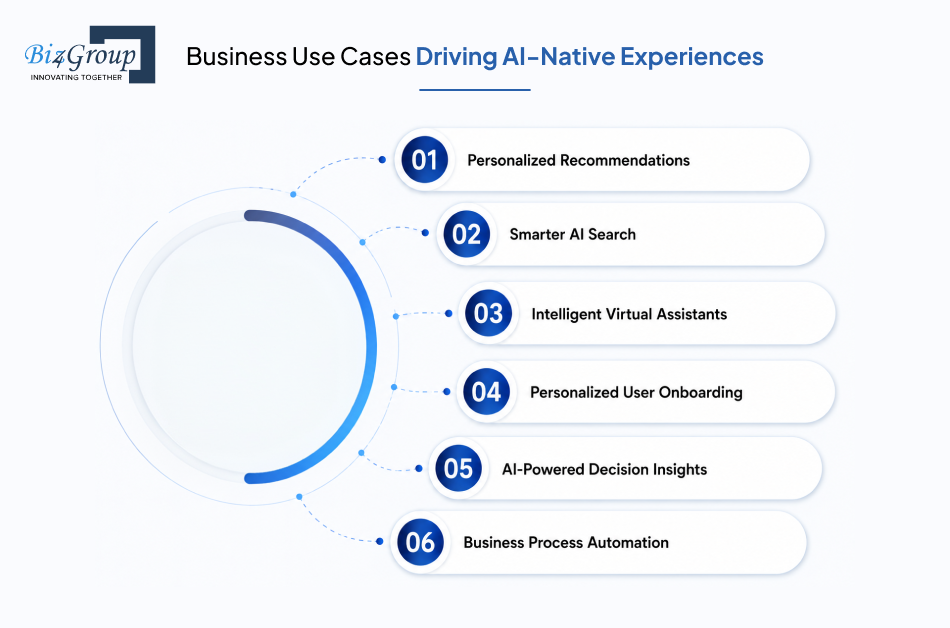
The biggest advantage of AI-native applications is that they solve practical problems for both users and businesses. As organizations invest in enterprise AI solutions, the focus is shifting toward features that save time, simplify everyday tasks, and improve the overall user experience.
Some of the most valuable use cases include:
- Recommending products or content based on user behavior.
- Making search faster by understanding what users actually mean.
- Automating customer support with intelligent virtual assistants.
- Personalizing the onboarding experience for every user.
- Providing insights that help users make better decisions.
- Automating repetitive business tasks to improve efficiency.
AI delivers the best results when it improves an experience people already use. If users don't see a clear benefit, adding AI is unlikely to create long-term value.
When AI-Native Development Is Worth the Investment
AI-native development makes sense when intelligence is an important part of your product experience. If your users expect personalized recommendations, faster support, smarter search, or automated workflows, AI can create a meaningful advantage. If your application performs well without those capabilities, introducing AI may not be the right investment yet.
AI-native development is worth considering when:
- Your app relies on personalized user experiences.
- Users perform repetitive tasks that can be automated.
- Intelligent recommendations can improve decision-making.
- Automation can reduce manual work for your team.
- AI supports your long-term product strategy and business goals.
Before investing, ask a simple question: Will AI make the experience noticeably better for our users? If the answer is yes, it's worth exploring. If the answer is unclear, strengthening the core product experience should remain the priority.
On-Device AI Is Bringing Intelligence Closer to Users
One of the biggest shifts in mobile application development trends this year isn't about adding more AI. It's about deciding where AI should run. More businesses are moving certain AI capabilities directly onto users' devices instead of sending every request to the cloud. The result is a mobile experience that feels faster, works more reliably, and gives users greater control over their data.
Why AI Processing Is Moving to the Device
A few years ago, almost every AI feature depended on cloud servers. Today, modern smartphones are powerful enough to handle many AI tasks on their own.
So why does that matter to your business? Because users don't care where AI runs. They care about how quickly your app responds. If an application can recognize speech, translate text, analyze an image, or provide recommendations without waiting for a cloud response, the experience feels almost instant.
That doesn't mean every AI workload belongs on the device. The goal is to let each task run where it performs best. Quick interactions can happen locally, while larger AI workloads continue to use the cloud.
How On-Device AI Improves Speed, Privacy, and Reliability
Imagine a customer using your mobile app while traveling with a weak internet connection. Should any of the important features stop working? the answer is NO.
That's one of the biggest reasons on-device AI is gaining momentum. Since part of the processing happens directly on the phone, many features continue working even when connectivity isn't perfect. Users also benefit from faster responses because information doesn't always need to travel back and forth to a remote server.
Businesses planning to integrate AI into an app are increasingly combining on-device and cloud AI to deliver a smoother experience while keeping sensitive user information closer to the device whenever possible.
Technical Considerations Before Adoption
On-device AI isn't automatically the right choice for every application.
“Should every AI feature run on the user's device?” Probably not.
Phones still have limits on processing power, battery life, and storage. Some AI models are simply too large or too complex to run efficiently on mobile hardware. That's why choosing the right deployment strategy matters just as much as choosing the right AI capability.
Before adopting on-device AI, think about questions like:
- Which AI features need an instant response?
- Which tasks can continue relying on cloud processing?
- Will users benefit from offline functionality?
- Can the AI model run efficiently across different devices?
- How will the model stay updated after your app is released?
Well-planned AI model development helps answer these questions early, making it easier to balance performance, cost, and user experience without overcomplicating the product.
Hyper-Personalization Is Raising the Standard for Mobile User Experiences
One thing we've noticed over the last couple of years is that users don't compare your app with your competitors anymore. They compare it with every great digital experience they use every day. If an app feels generic, people notice it almost immediately. That's why hyper-personalization has become one of the top mobile application development trends in 2026. Users expect apps to understand what they like, remember what they've done before, and make every interaction feel relevant without requiring extra effort.
Why Generic User Experiences Are No Longer Enough
Think about the apps you use most often. They already know what you usually search for, what content you're interested in, and even what you're likely to do next. That level of convenience is gradually becoming the standard across industries.
What features and technologies do users expect from modern mobile applications in 2026?
The answer is surprisingly simple. People want applications that save them time. Personalized recommendations, smarter search, relevant notifications, adaptive onboarding, and content that matches their interests all contribute to that experience. Most users won't describe these features as "personalization." They'll simply describe the app as easy to use.
We've also had businesses ask us:
"We already have a mobile application, but user engagement has declined. Which emerging mobile app trends should we implement in 2026 to improve customer experience and stay ahead of competitors?"
Our first recommendation is rarely to add more features. We usually encourage businesses to look at whether the app is still relevant to different types of users. Small improvements, such as personalized content, context-aware recommendations, or a simplified user journey, often have a bigger impact on engagement than launching an entirely new feature.
How Businesses Can Personalize Responsibly?
Personalization should feel helpful, not invasive. Users are generally comfortable sharing information when they understand why it's being collected and when they receive something valuable in return. That balance is becoming increasingly important, which is why many organizations exploring AI consulting services are also reviewing how they collect, manage, and use customer data.
A conversation that comes up quite often is:
"We are modernizing our customer experience through a mobile application and want to understand the latest app development trends before finalizing our product roadmap. Can you suggest the most impactful trends and experienced mobile app development companies?"
Our advice is to start with the parts of the app your customers use every day. Improve those experiences first. Personalized onboarding, relevant recommendations, smarter notifications, and journeys that adapt to user behavior usually deliver value much faster than introducing complex new capabilities. Once those foundations are in place, deciding which trends to invest in becomes much more straightforward.
Agentic and Conversational Experiences Are Changing Mobile Interactions
Most people don't open a mobile app because they want to explore its features. They open it because they want to get something done. Whether that's booking a service, resolving an issue, finding information, or completing a purchase, every extra step increases the chances of them leaving. That's why agentic and conversational experiences are becoming an important part of the latest mobile app development trends. Instead of asking users to navigate the application, these experiences help users reach their goal faster by understanding intent and taking action where appropriate.
How Agentic Interfaces Go Beyond Traditional Chatbots
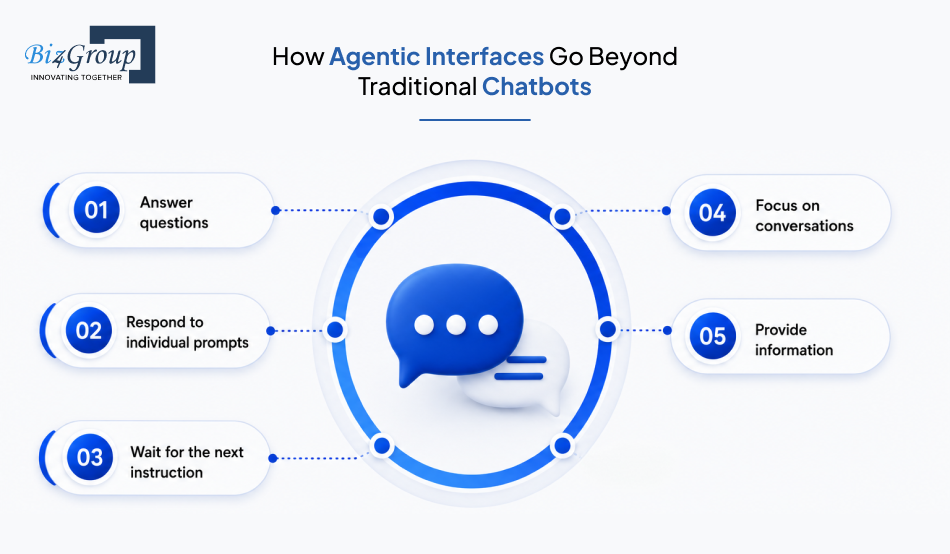
Traditional chatbots were built to answer questions. Agentic interfaces are designed to understand what users want to accomplish and help complete the task from start to finish. That's a significant change because the conversation is no longer the end goal. The outcome is.
|
Traditional Chatbots |
Agentic Interfaces |
|---|---|
|
Answer questions |
Help complete tasks |
|
Respond to individual prompts |
Understand the user's overall goal |
|
Wait for the next instruction |
Take the next logical step when appropriate |
|
Focus on conversations |
Focus on outcomes |
|
Provide information |
Help users make decisions and finish tasks |
The difference may seem subtle, but it changes how people interact with mobile applications. Instead of asking, "Where do I find this feature?", users can simply describe what they want to achieve, and the application guides them through the process.
Where Agentic Experiences Create the Most Business Value
The best agentic experiences remove unnecessary effort without taking control away from the user. They work particularly well when people perform the same multi-step tasks repeatedly or need guidance to complete something quickly. Businesses investing in AI assistant app design are increasingly focusing on these practical scenarios because they improve both customer experience and operational efficiency.
Agentic experiences create the most value when your application helps users:
- Schedule appointments or book services.
- Complete purchases with fewer steps.
- Resolve customer support requests more efficiently.
- Fill out lengthy forms with guided assistance.
- Find products, services, or information based on their intent.
- Automate repetitive workplace tasks and approvals.
One question worth asking before investing is, "Will this reduce the effort it takes for users to complete their most important tasks?" If the answer is yes, an agentic experience can create meaningful value. If the conversation doesn't lead to a better outcome, a traditional interface may still be the better choice.
Build a Mobile App That's Ready for 2026
Adopt the latest mobile app development trends with a roadmap built for scalability, performance, and long-term growth.
Start Your Mobile App JourneyPrivacy-First Mobile Applications Are Becoming a Competitive Advantage
Imagine downloading a new app and, before you've even explored what it does, you're asked to grant access to your location, contacts, camera, microphone, and photos. For most users, that moment shapes their first impression. If those requests don't make sense, trust starts to disappear before the experience even begins.
That's one reason privacy has become one of the latest mobile app development trends. People still want personalized and connected experiences, but they also want to understand what data is being collected and why.
Why Privacy Is Becoming a Business Differentiator
Privacy has become a business decision because users have more choices than ever. If an app feels intrusive, switching to another one takes only a few seconds. That's why businesses are paying closer attention to permission requests, data collection practices, and the overall feeling of transparency throughout the user journey.
We've had clients ask, "Do users really care about privacy that much?" In our experience, they care most when something feels unexpected. Asking for information at the wrong time, requesting permissions without context, or collecting more data than necessary can quickly reduce confidence. On the other hand, when users understand why information is needed and how it improves their experience, they're much more likely to engage with the product.
This is becoming especially important for businesses investing in business app development using AI, where customer trust plays a major role in long-term adoption.
Building Trust Through Secure and Transparent Experiences
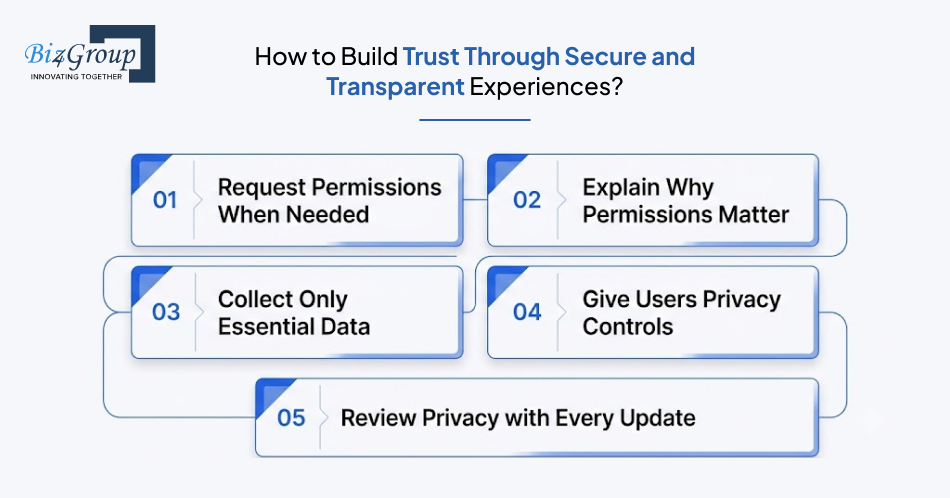
Building trust doesn't always require adding more security features. In many cases, it comes down to making users feel informed and in control. The best mobile applications explain their intentions clearly, ask for permissions only when they're needed, and make privacy settings easy to find.
Think about the apps you trust the most. They rarely interrupt you with unnecessary permission requests or make you search through multiple screens to manage your data. The experience feels straightforward because transparency has been built into the product from the start.
A few practical steps can make a noticeable difference:
- Ask for permissions only when users are about to use that feature.
- Explain how each permission improves the experience.
- Collect only the information your application genuinely needs.
- Give users simple controls to manage their privacy preferences.
- Review your privacy practices every time new features are introduced.
Privacy is no longer something users expect to find hidden in the settings page. They experience it every time they interact with your app. When that experience feels clear and respectful, trust grows naturally, and so does long-term user loyalty.
Cross-Platform Development Is Reaching Enterprise Maturity
One question comes up in almost every mobile strategy discussion we have: "If our app needs to run on both Android and iOS, do we still need to build everything twice?" A few years ago, the answer depended on the application's complexity and long-term goals. Today, the conversation is much simpler. Modern cross-platform app development has matured into a reliable approach for building production-ready mobile applications. Businesses are increasingly choosing it because it helps them move faster, simplify maintenance, and keep the user experience consistent across platforms.
What's Changed in Cross-Platform Development?
Cross-platform app development has evolved significantly over the past few years. The conversation has shifted from "Can this approach support our application?" to "Does our product actually need separate development efforts?" Modern frameworks have addressed many of the concerns that once made businesses hesitant.
Some of the biggest improvements include:
- More mature frameworks that support complex, enterprise-grade mobile applications.
- Better access to native device features, making it easier to build feature-rich experiences.
- Faster release cycles, allowing new features to reach Android and iOS users at the same time.
- Simplified maintenance, with one primary codebase supporting future updates.
- Improved development tools that make testing, debugging, and performance optimization more efficient.
- Greater enterprise adoption, giving businesses more confidence in using cross-platform development for long-term products.
Where Cross-Platform Development Delivers the Greatest Value
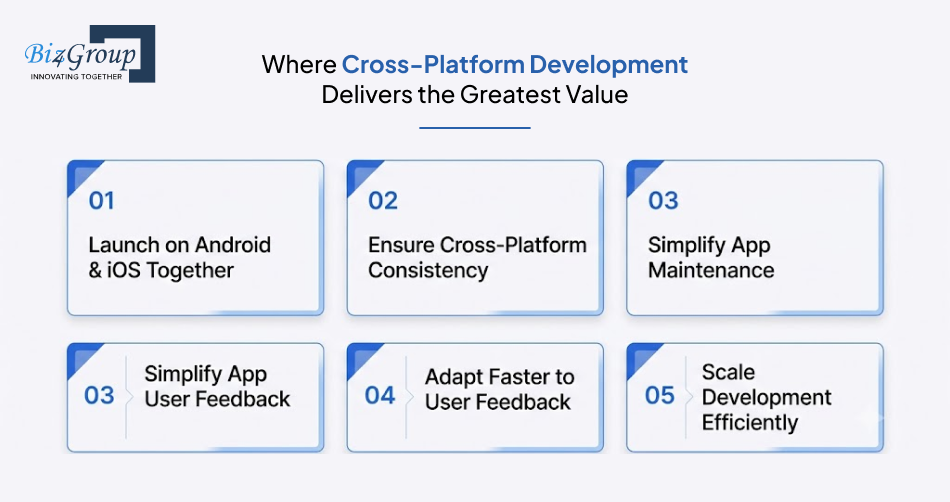
Cross-platform development creates the most value when businesses want to deliver a consistent experience across devices while keeping development and maintenance manageable over time. The focus shifts from maintaining separate applications to continuously improving a single product experience.
It's a strong choice when your business wants to:
- Launch Android and iOS applications within the same release cycle.
- Keep features and user experiences consistent across platforms.
- Reduce the effort required to maintain and update the application.
- Respond more quickly to customer feedback and changing market needs.
- Make better use of development resources as the product grows.
We've also noticed that many businesses initially choose this approach to reduce development effort. As their product evolves, they often discover that the bigger advantage is operational simplicity. Managing one evolving product instead of multiple independent applications makes it easier to innovate, release updates, and scale over time. That's why it’s considered ideal to partner with a custom software development company that can recommend a development approach based on long-term product goals rather than short-term delivery timelines.
Increase User Retention by Up to 35% With Smarter Mobile Experiences
The right mobile application development trends can improve engagement, retention, and customer satisfaction through AI-driven personalization and intelligent workflows.
Build a High-Performing Mobile AppConnected Ecosystems Are Expanding the Mobile Experience
If your mobile app is designed only for a smartphone, there's a good chance you're missing opportunities to engage users in other moments of their day. People now switch between phones, smartwatches, cars, voice assistants, and other connected devices without thinking about it. As a result, one of the top mobile application development trends in 2026 is building experiences that continue seamlessly across multiple devices instead of ending when users leave the app.
A question we're hearing more often is:
Which emerging technologies are shaping the future of mobile app development?
Three areas stand out: connected devices, spatial computing, and multimodal experiences. Together, they're changing how users interact with mobile applications and how businesses think about digital experiences.
1. Wearables and Connected Devices
Users don't always want to pull out their phones to complete a task. Sometimes they just want to glance at their smartwatch, receive an alert in their car, or check a fitness tracker.
Does every business need to build for wearables? No. It makes sense when quick updates, notifications, health data, location tracking, or hands-free interactions are an important part of the user experience.
Businesses exploring AI automation services are also connecting these devices to automate routine actions and create a more consistent experience across multiple touchpoints.
2. Spatial Computing and Immersive Experiences
Spatial computing is moving beyond product demos and early experimentation. Businesses are using it to help customers visualize products, train employees, assist technicians remotely, and simplify complex workflows.
Is this something every mobile app should invest in today? Probably not. It creates the most value in industries where seeing, interacting with, or visualizing information improves decision-making or reduces errors.
3. Multimodal User Experiences
Users no longer expect to interact with an app in only one way. They might start with a voice command, continue with touch, and receive a notification on another device later.
That's why AI chatbot development companies are designing experiences that combine voice, text, touch, and visual interactions instead of treating each one as a separate feature.
Before investing in any of these technologies, ask a simple question: Will this make it easier for users to complete the tasks they already perform? If the answer is yes, expanding beyond the smartphone is likely to strengthen the overall product experience.
Which Mobile Application Development Trends Should Businesses Prioritize?
By this point, you're probably trying to separate the trends you should act on today from the ones that can wait. That's exactly how we encourage businesses to think about it. Some mobile application development trends have become foundational for building competitive products, while others are better treated as strategic opportunities that depend on your industry, customers, and long-term vision.
1. High-Priority Trends for Most Businesses
The trends that deserve immediate attention are the ones that improve customer experience, strengthen product performance, and continue creating value as your application grows.
That naturally leads to another question:
Which mobile app development trends should businesses invest in for long-term growth?
For most businesses, the answer includes AI-native experiences, on-device AI, hyper-personalization, privacy-first design, and mature cross-platform development. These aren't short-term trends. They're becoming part of what users expect from modern mobile applications.
If you're planning to adopt generative AI, begin with one or two high-impact use cases where it can improve customer experience or automate repetitive business processes. Expanding from there is usually far more effective than trying to introduce AI everywhere at once.
2. Trends That Depend on Industry or Use Case
Some technologies create tremendous value, but only when they solve the right business problem.
We've had businesses ask us:
"I want to develop a future-ready mobile app, but I am unsure whether AI, super apps, AR/VR, or cross-platform development should be my priority. Which technologies offer the best long-term ROI, and which development companies can help?"
There's no universal answer because every product solves a different problem. If your focus is improving customer engagement or automating workflows, AI often delivers the fastest return. If you're building for multiple platforms with limited development resources, cross-platform development is usually a smart investment. AR and spatial experiences create the greatest value when visualization or real-world interaction is central to the product. Super apps, on the other hand, require a much broader ecosystem and aren't the right fit for every business.
The best technology decision is the one that aligns with your users' needs, not the one receiving the most attention.
3. Emerging Trends Worth Monitoring
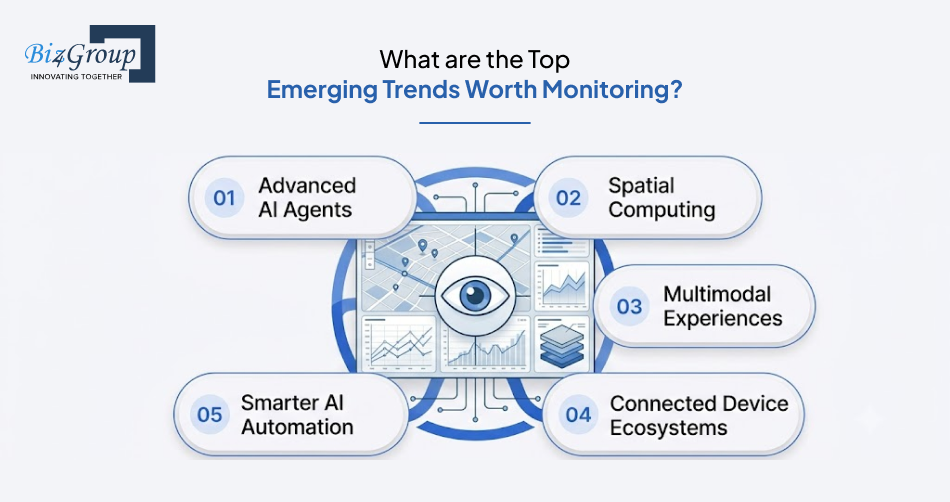
Some technologies are evolving quickly, but they don't need to become immediate priorities for every product roadmap. They're worth monitoring because user expectations and hardware capabilities continue to evolve.
Keep an eye on:
- AI agents capable of handling increasingly complex tasks.
- Spatial computing as device adoption grows.
- Multimodal experiences combining voice, touch, and visual interactions.
- Connected ecosystems extending beyond smartphones.
- Smarter AI-powered automation across mobile experiences.
If you're planning several years ahead, it's also worth considering whether you need to hire AI developers with experience in these emerging technologies. Building the right expertise early can make future adoption much smoother.
The businesses that gain the most from the top mobile application development trends aren't necessarily the ones that adopt every new technology first. They're the ones that invest with a clear understanding of their users, their business goals, and the problems they're trying to solve. That's what turns technology decisions into long-term competitive advantages.
Why Businesses Trust Biz4Group to Build Future-Ready Mobile Applications?
Every product roadmap includes decisions about AI, cross-platform development, personalization, privacy, and emerging technologies. The real challenge is understanding which investments will continue creating value as your product grows, especially when every decision influences the future of your mobile app development strategy.
At Biz4Group LLC, we've spent years helping startups, growing businesses, and enterprises turn those decisions into practical product strategies. Our work goes beyond writing code. Every engagement begins by understanding the business objective, the user journey, and the long-term product vision before recommending a technology stack. That approach helps ensure new capabilities support measurable business outcomes instead of adding unnecessary complexity.
Today, our teams build AI-powered mobile applications across industries, helping businesses:
- Evaluate which mobile application development trends align with their product strategy.
- Design scalable AI-native and cross-platform mobile applications.
- Integrate intelligent automation where it creates measurable business value.
- Build secure, privacy-conscious mobile experiences that earn user trust.
- Plan product roadmaps that remain relevant as technology and customer expectations evolve.
One question we encourage every client to ask is:
"Will this technology still create value for our users three years from now?"
That single question often leads to better product decisions than asking whether a trend is popular today. It's the same mindset we bring to every mobile application we design and develop. As an AI development company, we help businesses invest in technologies that support long-term growth instead of short-term momentum.
Real-World Examples of How These Trends Translate into Products
The trends we've covered aren't just predictions. We've helped businesses apply many of them to solve real user problems across different industries. Here are a few examples from our recent AI mobile app projects:
|
Project |
Trend Demonstrated |
What We Built |
|---|---|---|
|
Agentic AI, Conversational Experiences, AI-Native Apps |
Developed an avatar-based AI companion capable of natural voice and video conversations using conversational AI, speech recognition, and avatar technology to create a more human-like user experience. |
|
|
On-Device Intelligence, Hyper-Personalization |
Built an AI-powered fitness application that analyzes users' body composition from images and generates personalized workout recommendations using computer vision and AI models selected after extensive evaluation. |
|
|
Hyper-Personalization, AI-Powered Wellness |
Created a personal development application that combines fitness, nutrition, sleep, mental wellness, and habit tracking into a single AI-driven experience, giving users personalized insights across multiple aspects of well-being. |
These projects reflect a principle we follow across every engagement: technology is only valuable when it solves a real business or user problem. Whether it's building an AI companion, delivering personalized wellness recommendations, or creating intelligent fitness experiences, the focus remains the same, applying the right technology to create measurable outcomes rather than simply following the latest trend.
Common Mistakes Businesses Make When Following Mobile Application Development Trends
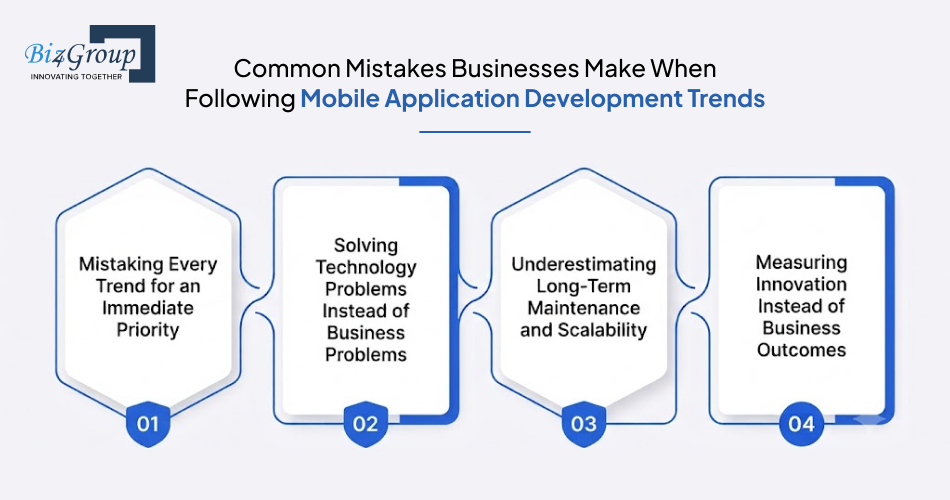
By now, you've seen the top mobile application development trends shaping 2026. The next question is just as important: How do you avoid investing in the wrong ones? We've had plenty of conversations with businesses that were ready to adopt a new technology simply because everyone else was talking about it. In most cases, the better decision wasn't adding more technology. It was making smarter product decisions.
1. Mistaking Every Trend for an Immediate Priority
A common question we hear is, "If we don't adopt this trend now, will we fall behind?"
Usually, no.
Some trends are becoming standard expectations, while others are still finding their place. Trying to implement everything at once often stretches budgets, delays releases, and makes the product harder to manage. Prioritize the trends that solve today's biggest challenges before thinking about what's next.
2. Solving Technology Problems Instead of Business Problems
Another mistake is starting with the technology instead of the customer.
For example, we've seen businesses ask for an AI conversation app before identifying where conversations would actually improve the user experience. A better starting point is much simpler: "What problem are we trying to solve?"
Once that answer is clear, choosing the right technology becomes much easier.
3. Underestimating Long-Term Maintenance and Scalability
Launching a feature is the easy part. Supporting it over the next few years is where the real work begins. Before introducing any new capability, ask yourself:
- Who will maintain this feature?
- How often will it need updates?
- Will it still support our product as the business grows?
Those questions usually reveal whether a trend is a smart investment or an unnecessary complication.
4. Measuring Innovation Instead of Business Outcomes
It's easy to celebrate launching a new feature. It's much harder to answer:
"Did this actually improve the business?"
The metrics that matter are higher engagement, stronger retention, faster task completion, improved efficiency, and better customer satisfaction. If those numbers don't improve, the technology probably isn't delivering the value you expected.
|
Instead of Asking... |
Ask This Instead... |
|---|---|
|
Should we adopt this trend? |
Does this solve an important customer or business problem? |
|
What new technology should we add next? |
What friction can we remove from the user experience? |
|
Can we build this feature? |
Can we maintain and improve it over time? |
|
Is this innovative? |
Will this create measurable business value? |
Whether you're working with a software development company in Florida or building with an internal team, the same principle applies: don't choose a trend because it's popular. Choose it because it helps your users achieve something faster, easier, or better. That's how good products continue delivering value long after the trend itself has changed.
Transform Ideas Into Intelligent Mobile Experiences
From AI-native features to connected ecosystems, we help businesses apply the right technologies at the right time.
Let's Build Your Next Mobile AppConclusion
The top mobile application development trends in 2026 all point in the same direction: smarter experiences, stronger user trust, and products that continue delivering value as customer expectations evolve. The real opportunity isn't adopting every emerging technology. It's identifying the trends that align with your business goals, your users, and your long-term product vision.
At Biz4Group, we've seen that successful mobile products are built on well-informed technology decisions, not short-term hype. Whether you're looking to build AI software for a new venture or modernize an existing application, every investment should solve a meaningful business problem and improve the overall user experience.
If you're looking for an experienced AI product development company to help validate your roadmap, choose the right technologies, and build a future-ready mobile application, our team is ready to help you turn those ideas into scalable, real-world products.
Frequently Asked Questions
What are the top mobile application development trends in 2026?
The top mobile application development trends in 2026 include AI-native applications, on-device AI, hyper-personalization, agentic experiences, privacy-first design, cross-platform development, and connected ecosystems. These trends are shaping mobile apps that are more intelligent, secure, and user-centric.
Which mobile application development trends should businesses invest in?
Businesses should prioritize trends that create measurable value. For most organizations, that includes AI-native experiences, on-device AI, hyper-personalization, privacy-first design, and cross-platform development. The right investment depends on your business goals and customer needs.
How is AI transforming mobile application development?
AI is making mobile applications smarter by enabling personalization, intelligent search, workflow automation, predictive recommendations, and context-aware experiences. Instead of being an add-on feature, AI is becoming part of the core product experience.
What features do users expect from modern mobile applications?
Users expect personalized experiences, fast performance, intelligent search, relevant recommendations, secure data handling, and seamless interactions across devices. Above all, they expect apps to help them complete tasks quickly and effortlessly.
Which mobile application development trends are worth monitoring beyond 2026?
Agentic AI, spatial computing, multimodal experiences, connected ecosystems, and advancements in on-device AI are worth monitoring. Businesses should adopt them when they align with product goals and solve real user problems.
