Location :
Orlando, FL, USA
Location :
Orlando, FL, USA +1 (407) 714-1616
 info@biz4group.com

 AI Powered Summary by Biz4AI
- AI front door vs traditional patient access shows how AI can move patient access from fragmented channels and manual workflows toward conversational, coordinated patient access automation.
- AI front door integration connects EHRs, scheduling, registration, eligibility, and patient portals so approved requests can be completed across systems with defined permissions and human escalation.
- AI front door healthcare platforms require HIPAA-aligned security, PHI protection, authentication, audit trails, AI guardrails, and applicable healthcare regulations to support safe patient access automation.
- AI front door implementation should begin with high-volume workflows, followed by integration, controlled pilots, performance measurement, and ongoing optimization, with typical implementation costs ranging from $25,000 to $120,000 depending on scope.
- Biz4Group provides AI healthcare development, integration, automation, and implementation capabilities for organizations evaluating an AI front door development company and planning scalable patient access solutions.
When a patient needs an appointment, they usually do not care which department owns the scheduling workflow or which system stores their insurance information. They simply want the request handled without unnecessary delays, transfers, or repetition.
But what happens when a simple request becomes three or four separate tasks?
A patient may need to find an available appointment, confirm insurance coverage, complete registration, provide missing information, and receive confirmation. Behind the scenes, those steps can involve a patient portal, contact center, registration team, scheduling system, eligibility workflow, and EHR.
That creates a practical question for healthcare leaders: Is traditional patient access automation enough, or is it time to rethink how these workflows connect?
The gap is still visible in 2026. Experian Health found that 46% of providers said patient access had improved, while only 18% of patients said the same.
At the same time, AI adoption across healthcare is moving beyond isolated experiments. McKinsey reported in April 2026 that half of the U.S. healthcare organizations surveyed had implemented generative AI, with more than 80% having deployed their first use cases to end users.
That is where the conversation around AI front door vs. traditional patient access becomes relevant.
But is an AI Front Door simply another name for a digital front door, patient portal, chatbot, or call-center automation? What is the difference between AI Front Door and traditional patient access systems? And more importantly, what actually changes for a health system when these approaches are compared at the workflow level?
This guide examines those questions across patient access workflows, automation, integration, security, implementation, cost, and operational impact, so you can see where an AI Front Door fits and where traditional patient access still plays a role.
Traditional Patient Access vs. AI Front Door: What Has Actually Changed?
Patient access has evolved through layers of technology rather than one major replacement. Health systems now combine scheduling, registration, eligibility, portals, contact centers, and digital self-service with the EHR and other operational systems.
To understand AI front door vs. traditional patient access, it helps to first separate the two models at a high level.
What Is Traditional Patient Access?
Traditional patient access is the collection of processes that help a patient enter and manage care.
It typically includes:
- Appointment scheduling
- Registration and preregistration
- Insurance eligibility and benefits verification
- Referrals and prior authorization
- Patient inquiries and contact-center support
- Appointment reminders and follow-ups
These functions do not necessarily live in one system. A patient may use a portal or phone to initiate a request while staff work across the EHR, scheduling software, payer systems, and other tools to complete it.
That underlying infrastructure is already becoming more connected. According to the Office of the National Coordinator for Health IT's 2026 data brief, about 9 in 10 U.S. hospitals enabled patient electronic access through an API in 2024, and 7 in 10 hospitals used standards-based APIs such as HL7 FHIR for patient access.
That matters because an AI Front Door does not need to replace this infrastructure to become useful.
What Is an AI Front Door?
An AI Front Door is an AI-based patient access layer that connects the patient's interaction with the healthcare workflows and systems needed to address the request.
The distinction is important: it is not simply another patient-facing chatbot.
HIMSS's 2026 architecture guidance describes an AI Front Door around coordinated handling of patient requests, specialized task handling, system integrations, guardrails, and defined escalation paths.
So, the underlying EHR, scheduling platform, eligibility system, patient portal, and human teams can remain in place. The AI Front Door sits across that environment as an additional access and orchestration layer.
This is also where AI healthcare workflow automation becomes relevant. Automating one task, such as sending a reminder or checking a predefined eligibility rule, is different from coordinating access activities around a patient's request. AI healthcare workflow automation can therefore be viewed as part of the broader shift toward connected operational workflows rather than isolated automation.
What Has Actually Changed?
The biggest change is not the disappearance of traditional patient access.
Scheduling still requires scheduling infrastructure. Registration still requires patient data. Eligibility still depends on payer information. Complex cases still require staff involvement.
The shift is toward making the patient's request the starting point for the access experience, rather than requiring the patient to understand which individual access function or channel can handle it.
That distinction gives us the right foundation for the next question: When the same patient-access request enters an AI Front Door instead of a traditional access workflow, what actually happens differently?
That is the comparison we can now make at the workflow level.
Still Running Patient Access the Old Way?
See where an AI front door could fit into your existing patient access workflows, without replacing the systems that already work.
Contact UsAI Front Door vs. Traditional Patient Access: Where Does the Workflow Really Change?
The difference becomes clearer at the workflow level. Traditional patient access can already include portals, IVR, online scheduling, eligibility automation, and other digital tools. The distinction with an AI front door patient access workflow automation model is how the patient's request is interpreted and connected to the underlying workflows.
|
Patient access area |
Traditional patient access |
AI Front Door approach |
|---|---|---|
|
Patient interaction |
Patients use specific channels such as phone, IVR, portal, web forms, or chat. |
Patients can state their request through supported conversational channels, with AI identifying the relevant access workflow. |
|
Intent handling |
Menus, forms, keywords, and predefined routing direct patients to specific workflows. |
AI can interpret natural-language intent and identify one or more relevant workflows. |
|
Scheduling |
Patients self-schedule through a portal or work with staff using scheduling rules. |
AI can collect scheduling requirements and initiate approved scheduling actions when connected to the scheduling system. |
|
Registration |
Patients' complete forms or provide information to registration staff. |
AI can collect required information, identify missing details, and pass information into the appropriate workflow. |
|
Eligibility |
A dedicated eligibility workflow or staff member handles coverage checks. |
AI can initiate approved eligibility workflows and communicate available results within the same interaction. |
|
Multiple requests |
Patients may be routed between separate workflows or teams. |
AI can identify multiple intents and coordinate relevant workflows within defined boundaries. |
|
EHR interaction |
Staff and applications access the EHR through established workflows and interfaces. |
AI can retrieve permitted information or trigger approved actions through configured integrations. |
|
Exceptions |
Requests outside predefined workflows are transferred to staff. |
AI can escalate unresolved, restricted, or higher-complexity requests with available context. |
|
Human involvement |
Staff may handle routine requests as well as exceptions. |
Staff can focus on exceptions, judgment-based decisions, and requests outside the AI's approved scope. |
|
Automation model |
Primarily task-based or rule-based automation. |
Intent-driven automation combined with workflow orchestration, rules, integrations, and escalation. |
The key difference is not that an AI front door replaces the existing patient access stack. EHRs, scheduling systems, eligibility tools, and staff remain essential. The change is how a patient's request can be interpreted and connected across those workflows. This makes AI front door integration with EHR systems a core part of the model, because the AI can only retrieve information or perform actions that its integrations, permissions, rules, and governance allow. Understanding how to integrate AI with EHR/EMR systems is therefore an important part of evaluating what an AI Front Door can actually do.
So, AI patient access vs. traditional patient access is not simply about replacing existing automation. It is about determining where AI can coordinate access workflows while keeping appropriate human oversight.
Is an AI Front Door Really Different from a Patient Portal, Call Center, or Rule-Based Automation?
An AI front door is not simply another name for a patient portal, chatbot, or automated call center. Each technology addresses a different part of patient access. The important distinction is how the technology handles patient intent, connects to operational workflows, and determines when a request should be automated or handed to staff.
AI Front Door vs. Patient Portal
A patient portal provides an authenticated digital environment where patients can access information and complete predefined tasks. An AI front door can sit across those capabilities as an intelligent interaction layer, allowing patients to describe what they need rather than selecting a specific function first.
|
Area |
Patient Portal |
AI Front Door |
|---|---|---|
|
Primary role |
Digital channel for patient self-service |
AI-driven access layer across supported workflows |
|
Patient interaction |
Patients select specific functions, forms, or options |
Patients can describe their request in natural language |
|
Intent recognition |
Based largely on the function selected |
AI interprets the patient's stated intent |
|
Scheduling |
Provides predefined scheduling functions |
Can identify scheduling intent and initiate approved scheduling workflows |
|
Registration |
Presents forms and required fields |
Can collect information conversationally and identify missing details |
|
Multiple requests |
Patients may complete separate tasks individually |
Can identify multiple intents within the same interaction |
|
Workflow coordination |
Primarily operates within portal-supported functions |
Can coordinate supported workflows across connected systems |
|
EHR interaction |
Depends on configured portal and EHR connectivity |
Can retrieve or trigger permitted actions through configured integrations |
|
Human escalation |
Usually requires messaging or another support channel |
Can route requests outside its scope with available context |
|
Main limitation |
Patients must work within the functions exposed by the portal |
Capabilities depend on integrations, permissions, workflow design, and governance |
This makes AI front door vs. patient portal less about choosing one technology over the other. A portal can remain the authenticated patient-facing environment while the AI layer helps connect a patient's request to the appropriate workflow.
AI Front Door vs. Traditional Call Center
A traditional call center combines staff, telephony, IVR, routing, knowledge resources, and operational systems. It remains important for complex requests and situations requiring human judgment. An AI front door changes which routine requests need to reach an agent in the first place.
|
Area |
Traditional Call Center |
AI Front Door |
|---|---|---|
|
Primary role |
Human-assisted patient access |
AI-assisted patient access and workflow orchestration |
|
First interaction |
Phone, IVR, or other contact channel |
Conversational interaction through supported channels |
|
Intent handling |
Agent or IVR identifies the reason for contact |
AI interprets the patient's request |
|
Routine requests |
Often handled by agents or IVR |
Can be automated when workflows are approved and integrated |
|
Information collection |
Agent asks questions and enters information |
AI can collect required information conversationally |
|
Repeated information |
Patients may repeat information after transfers |
Relevant context can be retained and passed during supported escalation |
|
Scheduling |
Agent works with scheduling systems |
AI can initiate approved scheduling actions through integration |
|
Exceptions |
Agent investigates, resolves, or escalates |
AI identifies requests outside its scope and routes them to staff |
|
Human role |
Central to routine and complex requests |
Focuses more heavily on exceptions and judgment-based work |
|
Main limitation |
High dependence on staff for routine interactions |
Cannot act beyond approved workflows, permissions, and integrations |
The distinction in AI front door vs. traditional call center is therefore not simply AI versus human support. The model can use AI for eligible routine interactions while keeping staff responsible for exceptions, sensitive cases, and decisions that require human judgment.
AI Front Door vs. Rule-Based Patient Access Automation
Rule-based automation is already useful for healthcare workflows where conditions and actions can be clearly defined. For example, a system can trigger a reminder when an appointment meets a specific condition or initiate an eligibility check when required information is available.
An AI front door adds a layer that can interpret natural-language requests and determine which approved workflow applies.
|
Area |
Rule-Based Automation |
AI Front Door |
|---|---|---|
|
Decision mechanism |
Predefined rules and conditions |
AI-based intent interpretation combined with rules and workflow logic |
|
Patient input |
Structured fields, selections, or predefined triggers |
Natural-language requests |
|
Workflow selection |
Triggered by predefined conditions |
AI identifies the relevant workflow from patient intent |
|
Multiple intents |
Usually requires separate workflow triggers |
Can identify multiple intents within one interaction |
|
Unstructured requests |
Limited to configured conditions |
Can interpret varied natural-language requests |
|
Scheduling |
Executes defined scheduling rules |
Can interpret scheduling requests and trigger approved workflows |
|
Registration |
Processes predefined fields and conditions |
Can collect and organize information before the registration workflow |
|
Exceptions |
Follows predefined exception paths |
Can identify requests outside its approved scope and escalate |
|
Governance |
Rules determine permitted actions |
Rules, permissions, guardrails, integrations, and escalation determine permitted actions |
|
Main limitation |
Performs poorly outside configured conditions |
Still cannot safely act outside approved workflows and system permissions |
This is the key distinction in AI front door vs. rule-based patient access automation. AI does not remove deterministic controls. Instead, it can determine which existing workflow should be activated while rules continue to define what the system is permitted to do.
AI Front Door vs. Manual Registration and Scheduling
Manual registration and scheduling require staff to collect information, check requirements, locate appointments, and resolve issues. Digital self-service can reduce some of this work, but patients still have to interact with the specific workflow provided.
|
Area |
Manual Registration and Scheduling |
AI Front Door |
|---|---|---|
|
Patient interaction |
Forms, phone calls, or staff-assisted requests |
Conversational request through supported channels |
|
Information collection |
Staff manually collect or review information |
AI can collect required information and identify missing fields |
|
Scheduling |
Staff search and book according to scheduling rules |
AI can initiate approved scheduling workflows when integrated |
|
Registration |
Staff enter or validate patient information |
AI can collect and pass information into the registration workflow |
|
Eligibility questions |
Staff review information or use separate tools |
AI can initiate approved eligibility workflows and communicate available results |
|
Multiple needs |
Often handled as separate tasks |
AI can identify multiple requests in one interaction |
|
Exceptions |
Staff investigate and resolve issues |
AI can route exceptions with available context |
|
Automation |
Primarily human-driven |
AI coordinates eligible automated workflows |
|
System dependency |
Staff work directly across operational systems |
AI depends on APIs, permissions, workflow logic, and connected systems |
|
Human involvement |
High across routine and exception work |
Concentrated more heavily on exceptions and judgment-based decisions |
This is where AI front door scheduling and registration automation becomes materially different from basic digital self-service. The objective is not simply to replace a registration form or reduce a phone call. It is to connect the patient's request with the appropriate workflow while keeping scheduling, registration, eligibility, and EHR controls intact.
What the Comparison Means for Health Systems
These technologies can coexist rather than replace one another:
|
Technology |
Primary function |
Role in patient access |
|---|---|---|
|
Patient portal |
Digital self-service |
Patient-facing access channel |
|
Call center |
Human-assisted support |
Conversational and exception handling |
|
Rule-based automation |
Deterministic task execution |
Workflow automation |
|
Manual registration and scheduling |
Staff-driven operations |
Operational execution |
|
AI front door |
Intent recognition and workflow coordination |
Intelligent access layer |
The practical question is not whether a health system already has these technologies. It is where an AI front door healthcare automation solution can coordinate existing capabilities without bypassing the controls that govern patient access. That makes the underlying patient access workflow orchestration and system integration just as important as the conversational AI itself.
This is also why evaluating AI healthcare workflow automation system development is relevant when designing an AI front door. The focus needs to extend beyond the AI interface to how workflows are triggered, connected, monitored, and escalated across the existing healthcare technology stack.
How Does AI Front Door Integration Work with EHRs, Scheduling Systems, and Patient Portals?
An AI front door integration with EHR systems connects the patient's request to the systems that execute patient access workflows. The AI acts as an orchestration layer, while APIs, authentication, permissions, workflow rules, and system-specific controls determine what information it can access and what actions it can perform.
1. How Does AI Front Door Integration with EHR Systems Work?
An AI front door can retrieve permitted patient information or initiate approved EHR actions through APIs and other integration interfaces. Access should be governed by authentication, authorization, and workflow-specific permissions rather than unrestricted EHR access.
Actual flow:
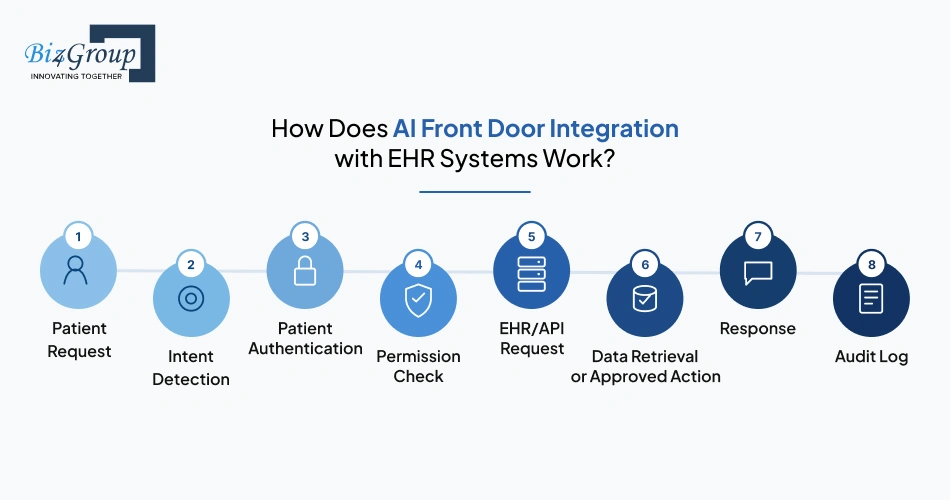
Patient request → Intent detection → Patient authentication → Permission check → EHR/API request → Data retrieval or approved action → Response → Audit log
2. How Does AI Front Door Integration with Scheduling Systems Work?
Scheduling integration connects the patient's request with provider availability, appointment types, locations, and scheduling rules. The AI can initiate booking, cancellation, or rescheduling only when the connected scheduling system supports the requested action.
Actual flow:
Patient request → Appointment intent detected → Required details collected → Availability checked → Scheduling rules validated → Appointment booked/rescheduled → Confirmation sent
3. How Does AI Front Door Integration with Patient Portals Work?
The patient portal can remain the authenticated digital access channel while the AI handles conversational requests within approved workflows. This combines AI patient portal SaaS platform capabilities with an intelligent interaction layer, allowing the AI to connect patient requests with the appropriate backend systems.
Actual flow:
Patient opens portal → Authentication → AI receives request → Intent identified → Workflow selected → EHR/backend system accessed → Result returned through portal
4. How Does AI Front Door Connect with Eligibility and Registration Systems?
An AI front door patient access automation platform can collect missing demographic, insurance, or registration information and trigger the appropriate workflow. The connected registration or eligibility system remains responsible for executing the transaction and returning the authoritative result.
Actual flow:
Patient provides information → Required data identified → Information validated → Registration/eligibility workflow triggered → Connected system queried → Result received → Patient informed or exception escalated
5. How Does AI Front Door Handle Multiple Systems in One Workflow?
A single patient request can involve several systems, making patient access workflow orchestration important. The AI can identify separate tasks, trigger the required workflows in sequence, and validate their results before completing the request.
Actual flow:
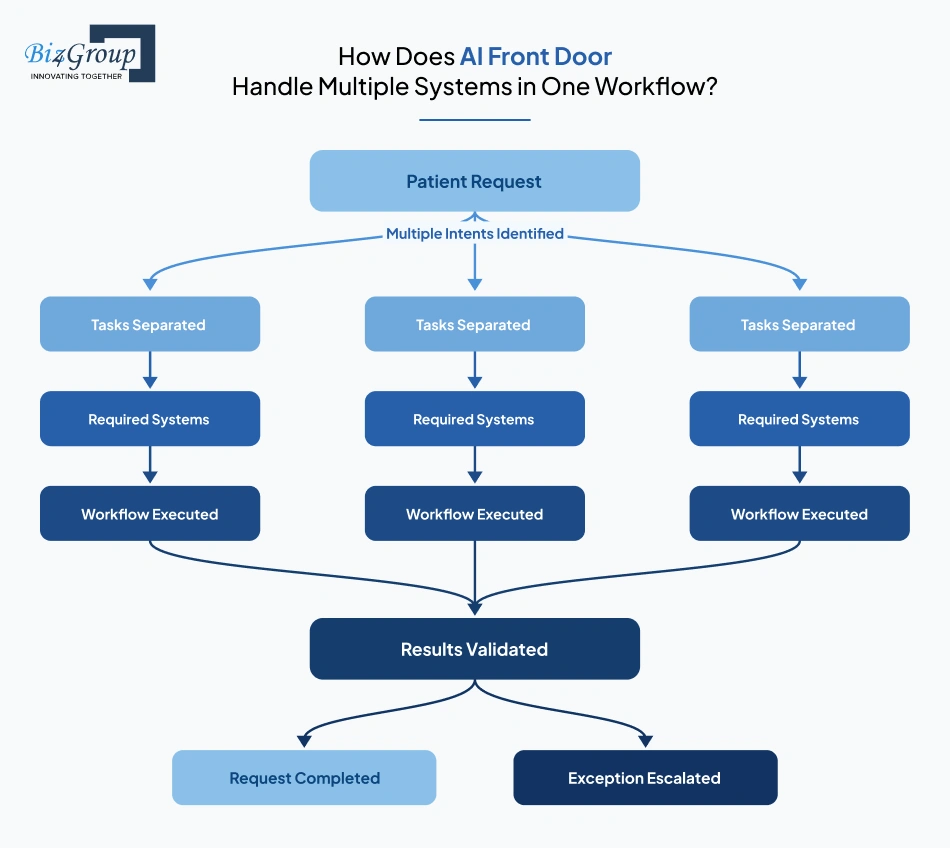
Patient request → Multiple intents identified → Tasks separated → Required systems identified → Workflows executed → Results validated → Request completed or exception escalated
6. What Happens When an Integration Cannot Complete the Request?
An AI front door should not improvise when an integration fails; information is missing, or an action falls outside its permissions. The system should identify the exception, retain relevant context, and route the request to the appropriate staff workflow.
Actual flow:
Request initiated → Integration attempted → Error/restriction detected → Recovery path checked → Human escalation triggered → Context transferred → Staff resolves request → Workflow logged
7. Actual AI Front Door Integration Flow
Across these systems, the complete process can be represented as:
Patient request → Authentication → Intent detection → Information collection → Workflow selection → API/integration call → EHR/scheduling/eligibility/portal system → Result validation → Patient response → Audit logging or human escalation
The key implementation principle is that the AI front door orchestrates approved workflows rather than bypassing the systems that control them. Authentication, authorization, API permissions, data validation, audit trails, and human escalation remain core parts of the architecture.
Can an AI Front Door Safely Handle Patient Access Workflows?
An AI front door can safely handle patient access workflows when security, privacy, permissions, and human oversight are designed into the system from the start. For U.S. health systems, compliance depends on the data handled, system integrations, organizational role, and specific AI functionality. AI front door healthcare automation solutions therefore need both technical safeguards and governance controls.
1. HIPAA and PHI Protection
The HIPAA Privacy Rule, Security Rule, and Breach Notification Rule, together with applicable HITECH requirements, establish core federal protections for PHI and ePHI. An AI front door handling patient information must apply appropriate administrative, physical, and technical safeguards.
- Apply minimum necessary access to PHI based on the workflow.
- Use appropriate safeguards for ePHI throughout processing and transmission.
- Establish a Business Associate Agreement when an AI vendor qualifies as a business associate.
- Include breach detection, response, and notification procedures.
2. Authentication, Authorization, and API Security
Patient identity must be established before an AI front door exposes protected information or performs account-specific actions. Authorization should then determine exactly which data and workflows the AI can access through EHR, scheduling, eligibility, or other APIs.
- Use strong patient authentication and identity verification.
- Apply role-based and least-privilege access.
- Separate read, write, and transaction permissions.
- Restrict AI front door integration with EHR systems to approved APIs and workflows.
3. Data Encryption, Privacy, and Retention
Patient information should be protected while moving between the AI layer, EHR, scheduling platforms, portals, and other connected systems, as well as when stored. Privacy and retention policies should also define how conversation data, prompts, extracted information, and audit records are handled.
- Encrypt sensitive data in transit and at rest where appropriate.
- Define retention periods for conversations, logs, and patient information.
- Control access to stored AI interaction data.
- Apply applicable federal and state privacy requirements.
4. AI Guardrails and Human Oversight
An AI front door should operate within clearly defined boundaries rather than making unrestricted decisions or taking unsupported actions. Guardrails can limit sensitive workflows, require confirmation, validate outputs, and escalate requests that require human judgment.
- Define which AI front door patient access workflows can be automated.
- Require human review for restricted or high-risk actions.
- Validate AI outputs before consequential transactions.
- Use the NIST AI Risk Management Framework as a voluntary governance framework for identifying and managing AI risks.
5. Audit Trails and Third-Party Risk
Healthcare organizations need visibility into who accessed information, what the AI attempted to do, which systems it interacted with, and when a request was escalated. Third-party AI, cloud, integration, and infrastructure providers also need to be assessed according to their role and access to healthcare data.
- Maintain access and activity logs.
- Monitor failed transactions, unusual access, and escalation patterns.
- Assess vendors that process PHI or connect to healthcare systems.
- Use SOC 2 as a service-provider control assessment where relevant, without treating it as a substitute for HIPAA compliance.
Regulatory Scope for AI Front Door Applications
Not every AI front door function falls under the same regulatory requirements. Scheduling, registration, eligibility, and patient communication generally raise different considerations from AI functionality that may fall within FDA-regulated medical-device software or certified health IT.
Key requirements and frameworks to assess include:
- HIPAA, HITECH, and applicable federal privacy requirements
- 21st Century Cures Act and Information Blocking requirements, where applicable
- ONC Health IT Certification Program and HTI-1, where applicable
- HL7 FHIR and other applicable interoperability standards
- NIST AI Risk Management Framework and NIST Cybersecurity Framework
- Applicable state privacy and health-data laws
- FTC privacy and security requirements, where applicable
- FDA requirements, only when the specific AI functionality falls within FDA-regulated medical-device scope
For a health system implementing an AI front door healthcare platform, compliance should therefore be assessed workflow by workflow. The organization needs to map the data involved, systems accessed, permissions granted, vendor responsibilities, and applicable regulations rather than treating "HIPAA compliant" as the complete security assessment.
What Would You Automate First?
Identify the patient access workflows worth automating before investing in another layer of healthcare technology.
Talk to an AI Healthcare ExpertWhat Does AI Front Door Implementation Actually Look Like for a Health System?
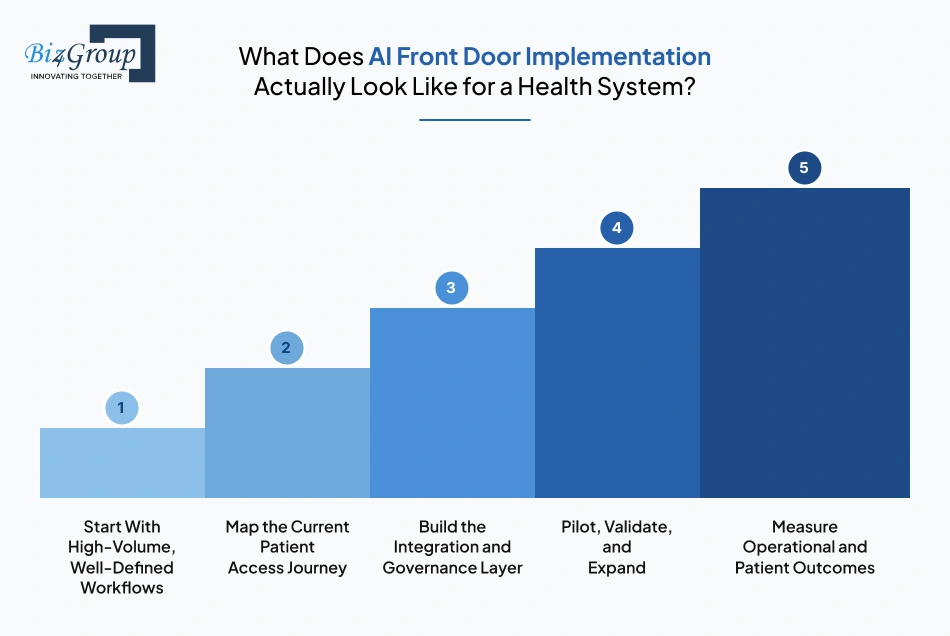
Implementing an AI front door patient access automation platform is less about deploying a chatbot and more about deciding which workflows should be automated, how they connect with existing systems, and where staff should remain involved. A health system needs to assess workflow readiness, integration dependencies, governance, and measurable outcomes before expanding automation.
Step 1: Start With High-Volume, Well-Defined Workflows
The first step is identifying patient access workflows that are frequent, structured, and supported by reliable data. Starting with clearly defined use cases gives organizations a controlled way to validate AI-powered patient access automation before expanding into more complex workflows.
- Prioritize scheduling, registration, appointment changes, eligibility checks, and routine inquiries.
- Identify workflows with high transaction volume and repeatable decision rules.
- Separate routine requests from workflows requiring staff judgment.
- Establish baseline performance before automation begins.
Step 2: Map the Current Patient Access Journey
Before introducing an intelligent healthcare front door platform, teams should document how patients currently move through each access workflow. This helps identify manual handoffs, duplicate data entry, disconnected systems, and escalation points that may be suitable for automation.
- Map interactions across phone, web, SMS, and patient portals.
- Document every system involved in each workflow.
- Identify repeated questions, manual handoffs, and transfer points.
- Define where human staff must remain in control.
Step 3: Build the Integration and Governance Layer
An AI front door healthcare platform implementation requires more than an AI model. The implementation layer should connect approved workflows with EHR, scheduling, registration, eligibility, communication, and identity systems while enforcing permissions, business rules, and escalation policies.
- Define which systems the AI can read from or write to.
- Establish API permissions and transaction-level controls.
- Configure workflow rules, escalation thresholds, and human handoffs.
- Assign ownership across IT, patient access, security, compliance, and operations.
Step 4: Pilot, Validate, and Expand
A controlled pilot allows the health system to evaluate an AI front door patient access system development approach against real workflows before expanding across departments or channels. Testing should include successful interactions as well as incomplete information, ambiguous requests, integration failures, and situations requiring staff intervention.
- Test accuracy and workflow completion before broader deployment.
- Compare AI-assisted performance with existing processes.
- Monitor escalation and exception-handling behavior.
- Define performance and safety criteria for expansion.
Step 5: Measure Operational and Patient Outcomes
Implementation should be measured against both operational performance and patient experience. AI front door patient access workflow automation should improve measurable outcomes without simply shifting unresolved work to staff or creating new access barriers.
- Track scheduling and registration completion rates.
- Monitor eligibility accuracy, exceptions, transfers, and escalations.
- Measure response time and patient resolution rates.
- Evaluate patient satisfaction alongside staff workload.
- Use AI healthcare analytics to identify performance trends and workflows that need adjustment.
A successful implementation therefore depends on starting with the right workflows, connecting the right systems, and expanding only after the AI demonstrates reliable performance under defined controls. Once the implementation scope is clear, the next consideration is the total cost of building, integrating, deploying, and maintaining an AI front door.
How Much Does It Cost to Implement an AI Front Door in Healthcare?
The cost to implement an AI front door in healthcare can range from approximately $25,000 to $120,000, depending on the scope and complexity of the implementation. A smaller deployment with limited workflows and standard integrations will generally require less investment, while a more advanced AI front door healthcare platform with multiple channels, EHR and scheduling integrations, custom workflow orchestration, security controls, and extensive testing will require a larger budget.
The main cost drivers include AI and application development, system integrations, security and compliance, infrastructure, testing, deployment, and ongoing maintenance. Organizations estimating AI front door development cost should also account for long-term operating expenses and support. These factors align with the broader cost considerations involved in implementing AI in healthcare, where project complexity, integration requirements, infrastructure, and ongoing development can significantly affect the overall investment.
Why Healthcare Leaders Choose Biz4Group for AI Front Door Development
Healthcare leaders evaluating an AI front door development company need more than AI expertise. They need a partner that can connect patient-facing experiences with healthcare workflows, EHRs, scheduling systems, security controls, and ongoing support. Biz4Group has 20+ years of AI healthcare experience, 1,000+ projects delivered, and 300+ consultants, architects, and AI specialists, with capabilities spanning healthcare software consulting, AI development, integration, implementation, and maintenance.
That combination is particularly relevant to an AI front door because the work sits at the intersection of patient access automation, healthcare integration, and AI workflow orchestration. Biz4Group's healthcare portfolio includes MBI Marketing, a healthcare services and access platform with patient portal functionality, appointment scheduling, program enrollment, and HIPAA-focused data handling.

For healthcare organizations evaluating AI healthcare platform development companies in the USA, these capabilities provide a useful benchmark for assessing experience across patient-facing applications, integrations, and AI-enabled healthcare workflows. Biz4Group also works across healthcare automation and implementation, which are important considerations when moving an AI front door from development into production.
Ready to Give Your Patient Access a Smarter Front Door?
From workflow automation to healthcare integrations, Biz4Group can help turn your AI front door concept into an implementation-ready solution.
Talk to Biz4GroupWrapping This Up!
An AI front door can create meaningful value when a health system has clearly defined patient access workflows, reliable underlying systems, and governance processes for controlling AI-driven actions. The implementation can begin with practical use cases such as scheduling, registration, eligibility, and patient communication, then expand as performance and oversight requirements are validated. Biz4Group's healthcare work includes platforms such as MBI Marketing, which combines patient portals, appointment scheduling, healthcare service access, and program enrollment, providing relevant experience across several workflows that an AI front door patient access system may need to connect.
For organizations moving from evaluation to execution, the key is choosing a development partner that understands both AI and the healthcare systems around it. Biz4Group works across AI automation, healthcare software, system integration, and implementation, with its healthcare portfolio covering patient journey automation, EHR-connected solutions, conversational AI, and other operational use cases. This makes AI healthcare implementation companies in the USA a useful reference point when evaluating the capabilities required to take an AI front door healthcare platform from development through deployment and ongoing improvement.
An AI front door patient access automation platform should not be treated as another patient-facing tool layered onto an already fragmented access environment. Its value comes from connecting patient intent with the right workflows, systems, and human support while maintaining appropriate security, permissions, and oversight. For health systems considering AI front door implementation services, the focus should remain on measurable patient access improvements, integration readiness, and sustainable workflow automation.
FAQ
1. What is the difference between an AI front door and traditional patient access?
An AI front door vs. traditional patient access comparison primarily comes down to how patient requests are understood, routed, and completed. Traditional patient access often relies on separate channels, staff teams, portals, and rule-based workflows, while an AI front door can interpret conversational intent and coordinate approved workflows across those systems.
2. Can an AI front door complete scheduling and registration tasks inside an EHR?
Yes, an AI front door patient access automation platform can support scheduling, registration, appointment changes, and other administrative workflows when it has the appropriate EHR integrations, permissions, APIs, and workflow controls. The AI does not independently alter the EHR. Its actions are limited by the integration architecture and permissions defined by the health system.
3. How can an AI front door integrate with Epic, Oracle Health, or athenahealth?
An AI front door integration with EHR systems can use supported APIs, FHIR-based interoperability, and other approved integration methods to exchange information with systems such as Epic, Oracle Health, and athenahealth. The exact implementation depends on the EHR, workflow, data being accessed, whether information must be written back, and the health system's technical and governance requirements. Current integration guidance also emphasizes that FHIR does not make every EHR implementation operationally identical.
4. What happens when an AI front door cannot resolve a patient request?
When an AI cannot safely or reliably complete a request, the workflow should trigger a defined escalation rather than forcing an automated answer. AI front door patient access workflows can use confidence thresholds, business rules, exception handling, and human handoffs to route unresolved scheduling, eligibility, referral, or other requests to the appropriate staff member while preserving the conversation context.
5. How does an AI front door protect PHI and maintain HIPAA compliance?
An AI front door healthcare platform should incorporate safeguards for PHI across authentication, authorization, encryption, access controls, audit logging, data retention, and third-party integrations. HIPAA applicability depends on the organizations and vendors involved, so implementation should assess the specific data flows, roles, systems, and services rather than treating "HIPAA compliant" as a standalone product feature.
6. How much does it cost to implement an AI front door in healthcare?
The AI front door development cost can range from approximately $25,000 to $120,000, depending on the number of workflows, communication channels, integrations, security requirements, customization, testing, and ongoing support. A limited implementation with a few well-defined workflows will have a different cost profile from a multi-channel AI front door healthcare automation solution connected to multiple enterprise systems.
7. How should healthcare organizations evaluate an AI front door development partner?
Healthcare organizations should evaluate an AI front door development company based on healthcare integration experience, workflow orchestration capabilities, security and compliance expertise, interoperability knowledge, implementation support, and the ability to maintain the platform after deployment. The right evaluation should focus on whether the partner can connect AI capabilities with real patient access workflows, rather than evaluating the AI model in isolation.