 Location :
Orlando, FL, USA
Location :
Orlando, FL, USA +1 (407) 714-1616
 info@biz4group.com

- The top AI healthcare implementation companies in USA focus on integrating AI into existing systems, ensuring real-world usability across clinical and operational workflows.
- Most AI healthcare implementation companies in USA follow a structured approach that includes data preparation, pilot testing, system integration, and continuous optimization.
- Implementation costs typically range from USD 50,000 to USD 300,000+, depending on system complexity, data readiness, and scale of deployment.
- Companies like Biz4Group LLC focus on end-to-end implementation, helping healthcare organizations connect AI systems with existing infrastructure and workflows.
- Organizations often choose between modular and full-stack approaches, with end-to-end AI implementation companies for healthcare offering simpler management.
Healthcare organizations are now focusing on using AI in real environments, not just testing it. This has increased the need for the top AI healthcare implementation companies in USA, which help turn AI ideas into systems that actually work in hospitals and healthcare operations.
AI is being used for tasks like diagnosis support, workflow automation, patient monitoring, and data analysis. But building a model is only one part of the process. The bigger challenge is making it work with existing systems, data, and daily workflows. This is where AI healthcare solutions need to be properly integrated into real environments.
At this stage, most decision-makers start asking practical questions like:
- Who can implement AI in my hospital in the USA?
- Who provides AI rollout and integration in healthcare?
- What companies specialize in implementing AI into existing healthcare IT infrastructure?
- Which companies provide AI implementation services for remote patient monitoring systems?
These are not early-stage questions. They come up when you are actively evaluating implementation, not just exploring possibilities.
To handle this, many providers work with AI healthcare implementation companies in USA that focus on connecting AI with existing healthcare systems. Their work includes integrating with electronic health records, managing data flow, and making sure the system works smoothly in real use.
An AI healthcare software development company may build the technology, but implementation requires additional steps like system integration, compliance, and workflow alignment. Without this, AI systems often fail to deliver real value.
There is also growing demand for companies that implement AI solutions in hospitals of USA, especially among organizations that want to improve efficiency and reduce manual work. These implementations often need to work with older systems and must be done without disrupting ongoing operations.
This blog lists companies that focus on implementing AI in healthcare systems. It is designed to help you understand which companies can take AI beyond development and make it work in real-world healthcare settings.
Understanding AI Healthcare Implementation Companies USA and Their Role
In healthcare, AI implementation means taking an AI model and making it work inside real systems. This includes connecting it to data, linking it with existing software, and making sure it fits into daily workflows used by doctors and staff.
Implementation is not just about deployment. It also includes integration, testing in real conditions, and ongoing support. Many healthcare providers work with AI healthcare implementation companies in USA to manage this process, especially when systems are complex and involve multiple tools.
Difference Between AI Development and AI Integration
AI development and AI integration are two different steps in using AI in healthcare.
- AI development is about building and training models.
- AI integration is about making those models work inside real systems and workflows.
AI Development vs AI Integration
|
Aspect |
AI Development |
AI Integration |
|---|---|---|
|
Focus |
Building and training models |
Connecting models to real systems |
|
Environment |
Test or controlled settings |
Live healthcare systems |
|
Output |
A working model |
A usable system |
|
Dependencies |
Data and algorithms |
Systems, workflows, compliance |
|
Goal |
Accuracy |
Usability and reliability |
A custom software development company may build the model, but integration requires making sure it works with existing systems, data, and workflows without disruption.
Why Implementation Determines Real World Outcomes
The success of AI in healthcare depends on how well it is implemented. A model may perform well in testing, but it will not deliver value unless it works properly in real systems.
Some key factors that affect outcomes are:
- How well the AI system connects with existing healthcare software
- Whether staff can easily use the outputs in their daily work
- How the system performs with real-time data
- Whether it meets compliance and data requirements
- How well it is maintained after deployment
In many cases, organizations also rely on AI integration services to ensure that AI systems are properly connected with existing infrastructure and workflows.
Healthcare providers often work with companies that implement AI solutions in hospitals of USA to ensure these factors are handled properly and the system delivers real results.
This is why choosing the top AI healthcare implementation companies in USA is important. The focus should not only be on building AI, but on making sure it works reliably in real healthcare environments.
Core Components Used by AI Healthcare Implementation Companies in USA
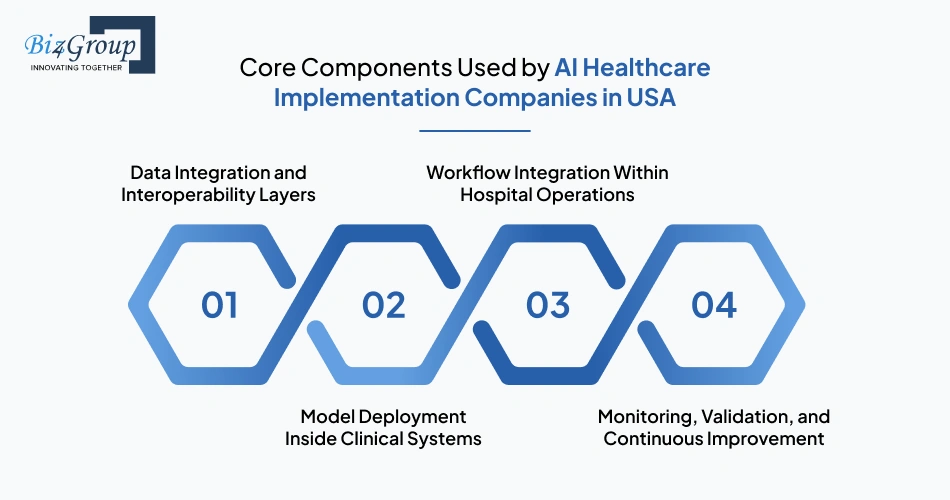
The top AI healthcare implementation companies in USA focus on making AI systems work inside real healthcare environments. This requires more than building models. It involves connecting data, deploying systems, and making sure everything works smoothly in daily operations.
1. Data Integration and Interoperability Layers
AI systems need access to clean and connected data. This step involves linking different sources such as electronic health records, lab systems, and monitoring devices. Interoperability ensures these systems can share data without errors, so AI models can work with complete and accurate information.
2. Model Deployment Inside Clinical Systems
After a model is built, it must be placed inside clinical systems where it can be used. This means embedding it into existing software so that doctors and staff can access results during their work. In many cases, this step requires adjustments in AI model development to match real-time system needs.
3. Workflow Integration Within Hospital Operations
AI systems must fit into how hospitals already function. This includes making sure outputs are easy to use within existing workflows. Many AI healthcare implementation companies USA focus on this step to support tasks like scheduling, diagnosis support, and daily operations without disrupting current processes.
4. Monitoring, Validation, and Continuous Improvement
AI systems need regular checks after deployment. This includes monitoring performance, validating outputs, and updating models when needed. In many cases, AI automation services are used to handle these updates and ensure the system continues to perform well over time.
These components help ensure that AI systems are not only built but also usable in real environments. Healthcare organizations often work with top firms for healthcare AI workflow automation implementation in USA to manage these steps and maintain system performance over time.
Difference Between AI Healthcare Implementation Companies in USA and AI Vendors
The difference between AI vendors and AI healthcare implementation companies in USA comes down to what they deliver. Vendors provide tools or platforms, while implementation companies focus on making those tools work inside real healthcare systems.
AI vendors build and supply AI products, while implementation companies integrate those products into healthcare systems, workflows, and infrastructure so they can be used in real environments.
Product Companies vs Implementation Partners
AI vendors and implementation partners serve different roles in healthcare AI projects. Vendors focus on building AI tools, while implementation companies focus on applying those tools in real-world settings.
AI Vendors vs Implementation Companies
|
Aspect |
AI Vendors |
Implementation Companies |
|---|---|---|
|
Primary Role |
Build AI products or platforms |
Deploy AI in real systems |
|
What You Get |
Software, models, or tools |
Working systems integrated into workflows |
|
Environment |
Product or platform-based |
Live healthcare environments |
|
Responsibility |
Provide functionality |
Ensure usability and integration |
|
Key Dependency |
Product features |
System compatibility and workflows |
AI vendors often build tools using enterprise AI solutions, but these tools do not automatically work within hospital systems. Implementation partners ensure these tools connect with existing infrastructure and function correctly in real use.
Decision Signal: If you need a ready-made AI tool, a vendor is enough. If you need that tool to work inside your systems, you need an implementation partner.
When You Need One vs Both
Whether you need a vendor, an implementation partner, or both depends on your starting point and system complexity.
You may need one or both in the following situations:
1. When building a new AI solution
You may need a vendor to create the system and a partner to deploy it in real environments.
2. When using existing AI tools
If you already have a solution, an implementation partner can help integrate it into your infrastructure.
3. When scaling across systems
Larger healthcare setups often require both roles working together to manage complexity.
4. When using internal teams
Some organizations prefer to hire AI developers internally and rely on partners only for deployment and integration.
Decision Signal: Use a vendor for building AI capabilities, and use an implementation partner when those capabilities need to work inside real systems.
In most healthcare AI projects, vendors provide the tools, but implementation companies ensure those tools work in real environments. Organizations often need both roles to move from development to full deployment, especially when working with the best companies for healthcare AI implementation services.
How Hybrid Models Work in Real Deployments
Hybrid models are used when organizations need both AI products and system-level integration at the same time. This approach combines vendor tools with implementation expertise to move from development to real deployment.
Product Selection and Customization: Organizations select an AI product or model and adapt it to their healthcare use case, such as clinical workflows or operational needs.
- System Integration: The AI system is connected with existing infrastructure like EHRs and data systems. This is where healthcare AI vendors specializing in system integration or implementation partners are involved.
- Workflow Alignment: The system is adjusted to match how doctors and staff work, ensuring it fits into daily operations.
- Testing in Real Environments: The system is tested with real data to confirm it works correctly before full deployment.
- Continuous Support and Updates: After deployment, the system is monitored and updated to maintain performance over time.
- Decision Signal: Hybrid models are useful when you need both a ready-made solution and the ability to adapt it to complex healthcare systems.
In most healthcare AI projects, vendors provide the tools, but implementation companies ensure those tools work in real environments. Organizations often need both roles to move from development to full deployment, especially when working with the best companies for healthcare AI implementation services.
Make AI Work Inside Your Healthcare Systems
Partner with the top AI healthcare implementation companies in USA to integrate AI into real clinical workflows.
Start Your AI ImplementationWho Needs AI Healthcare Implementation Companies in USA and When
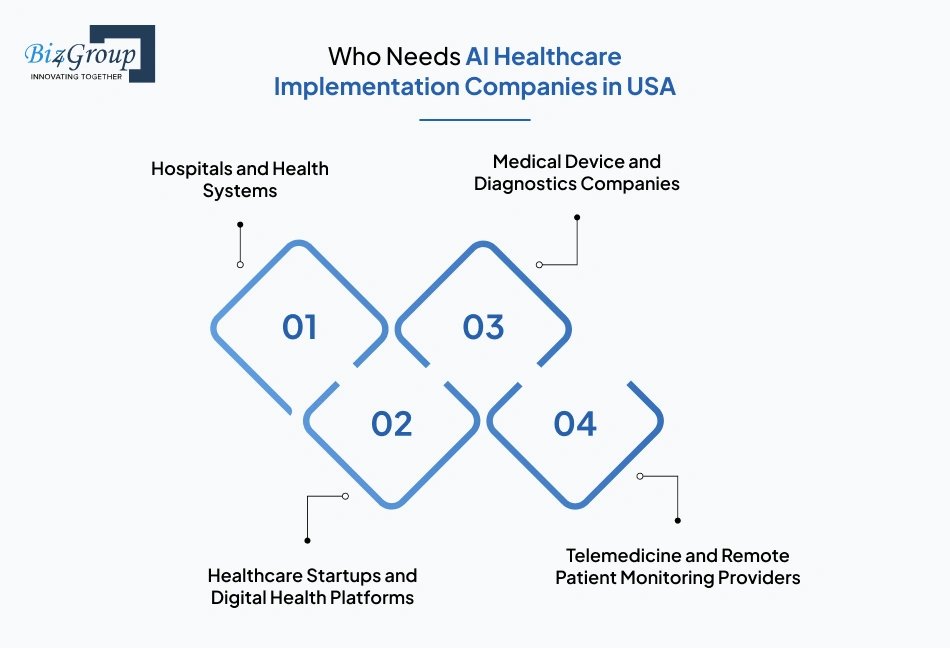
Hospitals, startups, device companies, and telemedicine providers need the top AI healthcare implementation companies in USA at different stages, especially when moving from development to real-world deployment or when existing systems cannot support AI directly.
1. Hospitals and Health Systems
Hospitals and health systems work with multiple systems, data sources, and workflows, which makes AI deployment complex. They usually need implementation support when introducing AI into existing systems or scaling it across departments.
In many cases, they rely on AI consulting services to plan integration and ensure that AI fits into clinical workflows without disrupting operations. This is most relevant for organizations with large and interconnected IT environments.
2. Healthcare Startups and Digital Health Platforms
Healthcare startups and digital platforms often build AI-driven products but need support when moving those products into real healthcare environments. This usually happens when they start onboarding users, integrating with external systems, or scaling their product.
Many of these teams work on business app development using AI, where implementation ensures the system performs reliably across different users and platforms. This is most relevant for teams transitioning from product development to deployment.
3. Medical Device and Diagnostics Companies
Medical device and diagnostics companies use AI to improve analysis and decision-making, but their systems must work across hardware, software, and regulatory layers. They typically need implementation support when embedding AI into devices or preparing for real-world clinical use.
These organizations often work with end-to-end AI implementation companies for healthcare to ensure systems function correctly in controlled and live environments. This is most relevant for companies dealing with regulated and high-precision systems.
4. Telemedicine and Remote Patient Monitoring Providers
Telemedicine and remote patient monitoring providers rely on AI for real-time insights and continuous data processing. They need implementation support when integrating AI into live applications or handling increasing data volumes from patients.
Implementation partners help ensure system stability, data flow, and real-time performance. This is most relevant for organizations operating in distributed environments with continuous data input.
Majority of organizations need implementation support when they move from testing to real deployment, or when their existing systems cannot support AI integration directly. That is why it’s recommended to evaluate the best AI healthcare implementation companies in USA 2026 based on how well they handle system complexity, workflow integration, and long-term performance in real healthcare environments.
How to Evaluate and Select AI Healthcare Implementation Companies in USA for Healthcare Systems
To evaluate and select AI healthcare implementation companies in USA, focus on capabilities, system integration, compliance readiness, and how well the company can deploy AI in real healthcare environments. The goal is to choose a partner that can move AI from development into reliable, real-world use.
Capabilities That Matter During Selection
Use the following checklist when evaluating companies:
- Experience working with healthcare systems and workflows
- Ability to handle data integration across multiple sources
- Proven track record of deploying AI in production environments
- Support for scaling AI across departments or use cases
- Ability to build AI software that fits into existing systems
If your systems are complex, prioritize integration experience. If your goal is faster deployment, prioritize execution speed and delivery capability.
Capabilities should be evaluated based on how well they support real deployment, not just technical claims.
Integration With Existing Healthcare IT Infrastructure
Integration is one of the most critical parts of AI implementation, especially in environments with legacy systems.
1. Compatibility With Existing Systems
The company should connect AI with systems like EHRs and data platforms without requiring major changes.
2. Data Flow and Interoperability
They should ensure smooth data exchange so AI models receive accurate and complete data.
3. Minimal Disruption to Workflows
Integration should not interrupt daily operations or require major workflow changes.
4. Scalability Across Systems
The solution should expand across departments or locations without major redesign.
5. Application-Level Integration
Some use cases require teams to integrate AI into an app, especially for operational or patient-facing tools.
Strong integration capability ensures AI systems work within your infrastructure instead of forcing system changes.
Regulatory and Compliance Readiness
Healthcare AI systems must meet strict regulatory and data requirements.
- Understanding of healthcare regulations such as HIPAA
- Ability to manage sensitive patient data securely
- Experience with compliance during deployment
- Proper validation and testing before real-world use
- Support for audit and reporting requirements
Compliance readiness is essential for using AI safely in real healthcare environments.
Key Trade Offs in Healthcare AI Implementation Services
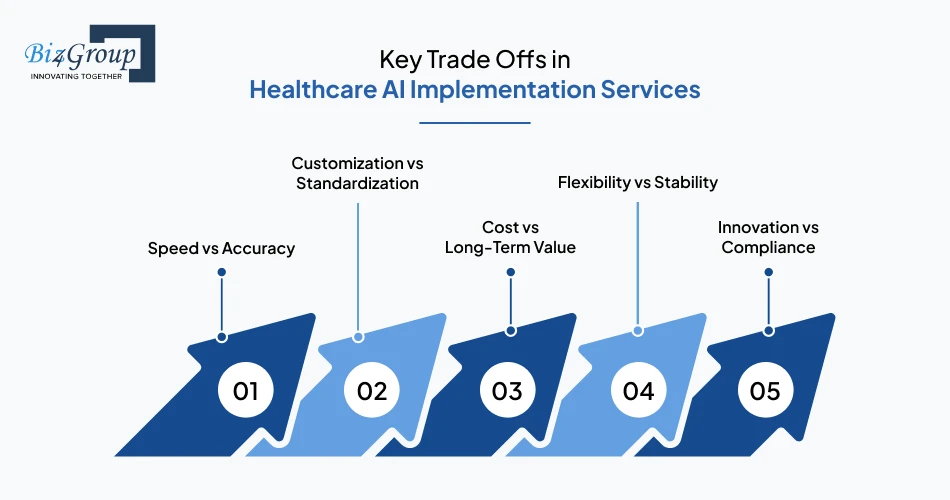
Choosing an implementation partner involves balancing key trade-offs.
1. Speed vs Accuracy
Faster deployment reduces time to launch, but accuracy and validation are critical in healthcare.
2. Customization vs Standardization
Custom solutions fit specific needs, while standardized systems are easier to scale.
3. Cost vs Long-Term Value
Lower upfront cost may lead to higher maintenance or performance issues later.
4. Flexibility vs Stability
Flexible systems adapt quickly, but stable systems are easier to manage in regulated environments.
5. Innovation vs Compliance
Advanced features like generative AI can add value but must meet strict compliance standards.
The right balance depends on your risk tolerance, regulatory requirements, and how critical the AI system is to your operations.
Decision Framework Based on Organization Type
Different organizations require different implementation approaches. Here’s all you need to know:
|
Organization Type |
Primary Selection Factor |
Impact on Implementation |
|---|---|---|
|
Hospitals and Health Systems |
Integration and scalability |
Supports complex, multi-system environments |
|
Startups and Digital Platforms |
Speed and flexibility |
Enables faster product rollout |
|
Device and Diagnostics Companies |
Accuracy and compliance |
Ensures safe and precise outputs |
|
Telemedicine Providers |
Real-time performance |
Supports continuous data processing |
Your organization type determines the level of integration, speed, and compliance required.
Decision Framework Based on Use Case
The use case directly affects how AI should be implemented.
|
Use Case |
Primary Selection Factor |
Impact on Implementation |
|
Clinical Decision Support |
Accuracy and validation |
Direct impact on patient care |
|
Workflow Automation |
Integration and usability |
Must fit into daily operations |
|
Remote Monitoring |
Real-time processing |
Requires continuous data handling |
|
Administrative Automation |
Efficiency and scalability |
Handles high-volume tasks |
Selecting based on use case ensures the implementation approach matches the actual problem being solved.
Decision Framework Based on Internal Capabilities
Internal team strength affects how much support is needed from external partners.
|
Internal Capability Level |
Primary Selection Factor |
Impact on Implementation |
|---|---|---|
|
Strong Technical Team |
Integration support |
Internal teams handle development |
|
Limited Technical Team |
End-to-end support |
External partner handles full implementation |
|
No AI Experience |
Guided implementation |
Requires structured planning and execution |
|
Mixed Capabilities |
Flexible engagement |
Balances internal and external roles |
Internal capabilities determine whether you need partial support or full implementation services.
To choose the right partner, focus on how well a company can integrate AI into your systems, handle compliance, and support long-term performance. Many organizations compare US based AI healthcare implementation companies, review a list of top AI healthcare implementation companies in USA, or evaluate top AI healthcare implementation vendors in USA, but the final decision should be based on real deployment capability, not just features.
Also Read: AI in Healthcare Explained: 130+ Questions Answered for Healthcare Providers and Innovators
List of Top AI Healthcare Implementation Companies in USA (2026)
Below is a curated list of the top AI healthcare implementation companies in USA. Each company listed here has a verified presence on Clutch, is headquartered in the United States, and focuses on implementing AI within real healthcare systems.
These companies were selected based on their experience in deploying AI within healthcare environments, ability to integrate with existing infrastructure, and consistency in delivering production-ready systems. The list includes firms that work across clinical workflows, data systems, and large-scale healthcare platforms.
|
Company |
Hourly Rate |
Clutch Rating |
Best Suited For |
|---|---|---|---|
|
Biz4Group LLC |
$25–49/hr |
4.9/5 |
End-to-end AI implementation with strong system integration |
|
LeewayHertz |
$50–99/hr |
4.7/5 |
Scalable AI product development and deployment |
|
Turing |
$50–99/hr |
5.0/5 |
AI deployment and scaling with engineering support |
|
Simform |
$25–49/hr |
4.8/5 |
Cloud-based and enterprise AI implementation |
|
BairesDev |
$50–99/hr |
4.9/5 |
Large-scale AI deployment across complex systems |
|
Intellectsoft |
$50–99/hr |
4.9/5 |
Compliance-driven AI implementation in regulated environments |
|
Itransition |
$25–49/hr |
4.9/5 |
Multi-system AI integration across legacy and modern infrastructure |
|
ScienceSoft |
$50–99/hr |
4.8/5 |
Workflow automation and clinical AI integration |
|
HatchWorks AI |
$50–99/hr |
4.9/5 |
System integration and AI adoption across teams |
|
Azumo |
$25–49/hr |
4.9/5 |
Real-time AI deployment in healthcare applications |
|
Oxagile |
Undisclosed |
5.0/5 |
AI implementation in data-heavy systems like imaging |
|
Trigent Software |
$25–49/hr |
4.8/5 |
AI integration into legacy healthcare systems |
1. Biz4Group LLC
- Website: https://www.biz4group.com/
- Headquarters: Orlando, Florida, USA
- Hourly Rate: USD 25–49/hr
- Minimum Project Size: USD 10,000+
- Clutch Rating:9/5
Biz4Group LLC works with healthcare organizations to implement AI solutions that fit into real systems and workflows. Their projects focus on connecting AI models with existing infrastructure, ensuring outputs are usable in clinical and operational settings, and supporting full deployment from setup through rollout.
Implementation Focus Areas:
- Integration with existing healthcare IT systems
- Predictive analytics for patient and operational insights
- Workflow automation across clinical and admin processes
- End-to-end implementation support
- Data flow and interoperability alignment
Case Studies:
Truman- AI-Powered Wellness & Preventive Care App
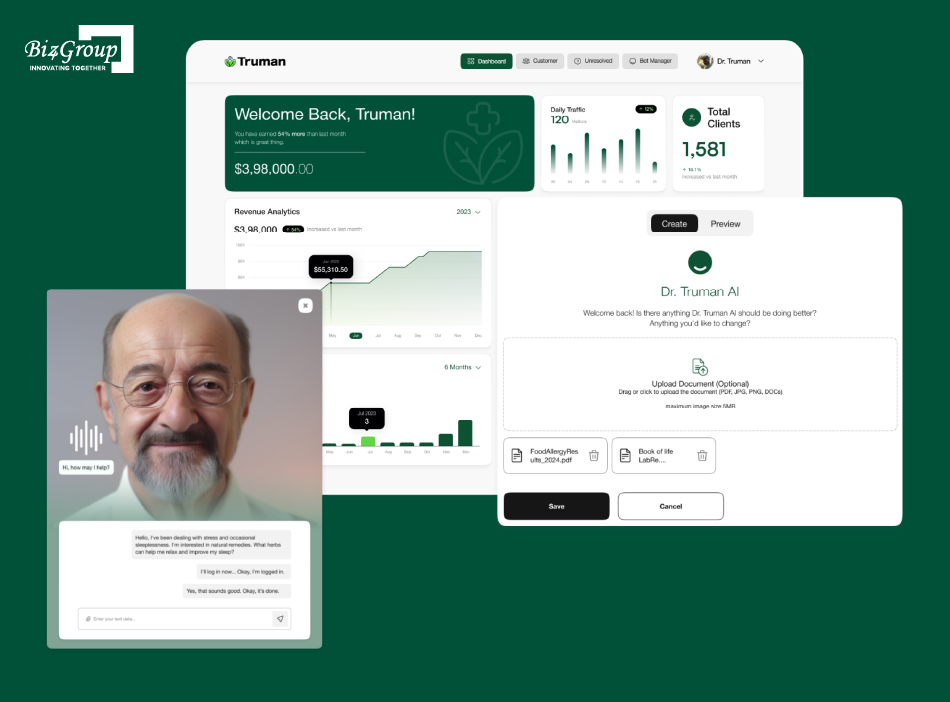
An AI-driven wellness platform designed to deliver personalized health insights, supplement recommendations, and continuous progress tracking for users. By combining behavioral data with intelligent recommendations, Biz4Group enabled a proactive approach to health management rather than reactive care.
Dr. Ara- AI-Based Athletic Health & Injury Prevention Solution
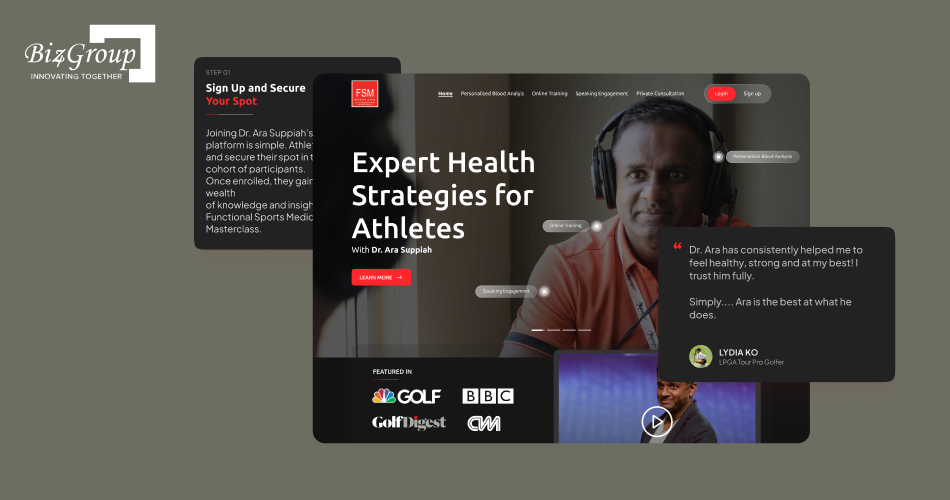
A specialized healthcare solution tailored for athletes and sports enthusiasts, leveraging AI to assess health conditions, prevent injuries, and optimize performance. Biz4Group successfully integrated intelligent diagnostics with real-time user data to create a more responsive and personalized care experience.
CogniHelp- AI-Driven Cognitive Support for Dementia Patients
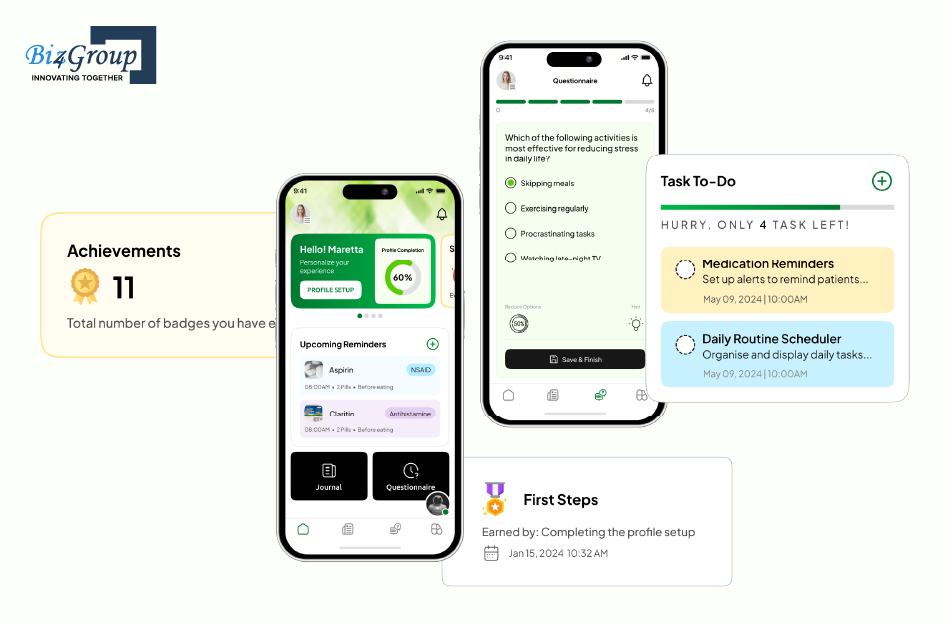
A mobile application built to assist early- to mid-stage dementia patients through cognitive exercises and daily support tools. Biz4Group implemented AI capabilities to enhance memory retention, improve engagement, and provide caregivers with meaningful insights into patient progress.
Best Suited For: Healthcare teams looking for end-to-end AI implementation with strong integration into existing systems.
2. LeewayHertz
- Headquarters: San Francisco, California, USA
- Hourly Rate: $50–99/hr
- Minimum Project Size: $10,000+
- Clutch Rating:7/5
LeewayHertz helps healthcare teams move AI systems into production by integrating them with existing applications and data pipelines. As one of the AI healthcare implementation companies in USA, their work focuses on making AI usable in real environments where reliability and scalability matter.
Implementation Focus Areas:
- AI integration into healthcare applications
- Deployment of NLP and computer vision solutions
- Cloud-based infrastructure setup
- Workflow automation
- System integration across environments
Best Suited For: Organizations building AI-powered healthcare products that need scalable and production-ready systems.
3. Turing
- Headquarters: Palo Alto, California, USA
- Hourly Rate: $50–99/hr
- Minimum Project Size: $50,000+
- Clutch Rating:0/5
Turing supports healthcare organizations by helping deploy AI within systems they already use. Their role is often to bridge engineering gaps, making sure AI solutions work in production and scale across environments without requiring a full rebuild of existing platforms.
Implementation Focus Areas:
- AI deployment support within healthcare systems
- Integration with existing platforms
- Scaling AI across environments
- Backend support for AI tools
- Infrastructure setup for rollout
Best Suited For: Teams that already have internal development capabilities but need support with deployment and scaling.
Choose the Right AI Implementation Path
Work with AI healthcare implementation companies in USA that align with your systems, data, and long-term goals.
Explore Your Options4. Simform
- Headquarters: San Francisco, California, USA
- Hourly Rate: $25–49/hr
- Minimum Project Size: $25,000+
- Clutch Rating:8/5
Simform works with healthcare organizations that need AI systems to run reliably at scale. Their projects typically involve integrating AI into cloud environments and aligning solutions with existing platforms, making them one of the best AI healthcare implementation companies in USA 2026 for scalable deployments.
Implementation Focus Areas:
- Integration into enterprise healthcare systems
- Cloud-based deployment
- Data engineering for AI systems
- Workflow automation
- Scalable system architecture
Best Suited For: Healthcare organizations looking to deploy AI within cloud-based or enterprise-scale systems.
5. BairesDev
- Headquarters: San Francisco, California, USA
- Hourly Rate: $50–99/hr
- Minimum Project Size: $50,000+
- Clutch Rating:9/5
BairesDev helps healthcare companies implement AI solutions across large systems. Their work focuses on embedding AI into production environments and improving long-term performance, especially for organizations looking for companies that implement AI solutions in hospitals USA.
Implementation Focus Areas:
- Large-scale AI deployment
- Integration with enterprise platforms
- Performance optimization
- Backend infrastructure support
- Ongoing monitoring
Best Suited For: Large healthcare organizations managing complex systems and requiring stable, long-term AI deployment.
6. Intellectsoft
- Headquarters: New York, USA
- Hourly Rate: $50–99/hr
- Minimum Project Size: $50,000+
- Clutch Rating:9/5
Intellectsoft works with healthcare organizations that require structured AI implementation within regulated environments. Their projects involve integrating AI into enterprise systems while ensuring compliance and workflow alignment across clinical and operational teams.
Implementation Focus Areas:
- Enterprise system integration
- Compliance-aligned deployment
- Workflow optimization
- Integration with IT systems
- Data-driven solutions
Best Suited For: Organizations operating in regulated environments that require structured and compliant AI deployment.
7. Itransition
- Headquarters: Denver, Colorado, USA
- Hourly Rate: $25–49/hr
- Minimum Project Size: $25,000+
- Clutch Rating:9/5
Itransition supports healthcare organizations that need AI to function across multiple systems. Their work involves connecting platforms and ensuring smooth operation across environments, which aligns with what many expect from AI healthcare implementation companies USA.
Implementation Focus Areas:
- Multi-system integration
- Deployment across legacy and modern systems
- Data pipeline setup
- Workflow automation
- System scalability
Best Suited For: Organizations with complex IT ecosystems that need AI integrated across multiple systems.
Improve Workflow Efficiency by Up to 30%
Collaborate with top firms for healthcare AI workflow automation implementation in USA to streamline operations and reduce delays.
Optimize My Healthcare Workflows8. ScienceSoft
- Headquarters: McKinney, Texas, USA
- Hourly Rate: $50–99/hr
- Minimum Project Size: $5,000+
- Clutch Rating:8/5
ScienceSoft works with healthcare providers to implement AI within clinical and operational workflows. Their focus is on making outputs usable in real scenarios, especially for organizations searching for top firms for healthcare AI workflow automation implementation in USA.
Implementation Focus Areas:
- Clinical decision support integration
- EHR and data system integration
- Administrative automation
- Data analytics implementation
- System monitoring
Best Suited For: Healthcare providers focused on improving operational efficiency and workflow automation.
9. HatchWorks AI
- Headquarters: Atlanta, Georgia, USA
- Hourly Rate: $50–99/hr
- Minimum Project Size: $25,000+
- Clutch Rating:9/5
HatchWorks AI helps healthcare organizations implement AI across data systems and workflows. Their work focuses on enabling practical usage, particularly for teams evaluating healthcare AI vendors specializing in system integration across multiple platforms.
Implementation Focus Areas:
- AI integration into data systems
- Workflow deployment
- Data pipeline setup
- Cross-system alignment
- Internal enablement
Best Suited For: Teams that need both technical implementation and internal adoption of AI systems.
10. Azumo
- Headquarters: San Francisco, California, USA
- Hourly Rate: $25–49/hr
- Minimum Project Size: $10,000+
- Clutch Rating:9/5
Azumo works with healthcare platforms that require real-time AI performance. Their projects involve embedding AI into applications and ensuring stable performance, making them a practical choice among AI healthcare implementation companies in USA for real-time systems.
Implementation Focus Areas:
- Application-level AI integration
- Real-time deployment
- Backend system support
- Workflow automation
- Performance optimization
Best Suited For: Healthcare platforms that require real-time AI processing and fast system response.
11. Oxagile
- Headquarters: New York, USA
- Hourly Rate: Undisclosed
- Minimum Project Size: Undisclosed
- Clutch Rating:0/5
Oxagile works with healthcare organizations that manage large volumes of data, including imaging systems. Their focus is on integrating AI into existing platforms and ensuring compatibility and performance in production environments.
Implementation Focus Areas:
- Integration into imaging and data systems
- Deployment within existing platforms
- Data pipeline setup
- Workflow alignment
- System-level integration
Best Suited For: Organizations dealing with data-heavy systems such as imaging or video-based healthcare platforms.
12. Trigent Software
- Headquarters: Southborough, Massachusetts, USA
- Hourly Rate: $25–49/hr
- Minimum Project Size: $10,000+
- Clutch Rating:8/5
Trigent Software helps healthcare organizations implement AI within systems they already use. Their projects focus on integrating capabilities into legacy environments while ensuring compatibility with workflows and enabling gradual adoption across teams.
Implementation Focus Areas:
- Legacy system integration
- Workflow-based deployment
- Clinical and admin automation
- Data engineering
- IT system alignment
Best Suited For: Healthcare organizations working with legacy systems that need gradual and low-disruption AI adoption.
Choosing between AI healthcare implementation companies in USA depends on how your systems are structured and what kind of integration you need. Some companies focus more on workflow automation, while others specialize in system-level integration or large-scale deployments. The best choice is the one that fits your infrastructure and can deliver reliable outcomes in real healthcare environments.
Simplify AI Deployment Across Systems
Work with end-to-end AI implementation companies for healthcare to manage everything from setup to scaling.
Plan My AI RolloutWhat End to End AI Healthcare Implementation Looks Like in Practice in USA
End-to-end AI healthcare implementation in USA means managing the full process from planning to deployment and ongoing support within real healthcare systems. The top AI healthcare implementation companies in USA handle this process to make sure AI systems work properly in real environments.
What End to End Implementation Includes
End-to-end implementation usually includes these steps:
- Defining the problem and checking feasibility
- Preparing data and systems
- Building or adjusting the AI model
- Integrating it with existing healthcare systems
- Deploying it within workflows
- Monitoring and improving performance over time
This approach ensures that all parts of the system are handled together instead of being managed separately. Many US based AI healthcare implementation companies follow this method to avoid gaps between development and deployment.
End-to-end implementation covers everything needed to make AI work from start to finish.
Step by Step Workflow From Pilot to Scale
This workflow is used when organizations move from testing AI to using it in real healthcare systems.
1. Problem Definition and Feasibility
Identify the use case and check if AI can solve it.
2. Data Preparation and System Readiness
Prepare data and systems for integration.
3. Pilot Deployment
Test the system in a limited environment.
4. System Integration
Connect the AI system with existing tools and workflows.
5. Scaling Across Systems
Expand the system across teams or locations.
6. Monitoring and Optimization
Track performance and update the system when needed.
Some implementations may also include features like AI chatbot integration, especially for communication or patient interaction.
A clear workflow helps move AI from testing to full use without major issues.
When Full Stack Implementation Is Necessary
Full stack implementation is needed when:
- There is no internal team to manage deployment
- Multiple systems need to be connected
- Compliance requirements are complex
- AI needs to work across different workflows
- The system supports areas like AI in healthcare administration automation
In these cases, organizations often work with top AI healthcare implementation vendors in USA to handle the full process.
Full stack implementation is useful when the setup is complex and needs a single team to manage everything.
Trade Offs of End to End vs Modular Approaches
Organizations can choose between end-to-end and modular approaches based on their needs.
- End-to-End Approach → Easier to manage, one partner, fewer integration issues
- Modular Approach → More flexible, multiple vendors, but harder to manage
- End-to-End → Faster setup across systems, less flexibility
- Modular → More control, but more coordination required
Decision Signal: Choose end-to-end if you want simplicity. Choose modular if you want flexibility.
The right choice depends on how much control you need and how much complexity you can handle.
End-to-end AI implementation is useful when you need one partner to manage the full process from setup to scaling. The right approach depends on system complexity, internal resources, and how tightly AI needs to fit into daily operations, especially when evaluating top-rated companies in USA who can implement AI in healthcare system.
How AI Healthcare Implementation Companies in USA Handle Existing Healthcare IT Infrastructure?
AI healthcare implementation companies in USA handle existing IT infrastructure by integrating AI systems with legacy platforms, connecting data sources, and ensuring compatibility with clinical workflows. The top AI healthcare implementation companies in USA focus on making AI work within current systems instead of replacing them.
This typically involves handling legacy systems, integrating with core healthcare tools, and ensuring smooth data exchange across platforms.
Challenges With Legacy Systems
Legacy systems are one of the main challenges in healthcare AI implementation. These systems are often outdated and not built to support modern AI requirements. Common challenges include:
- Outdated system architecture
- Limited access to usable data
- Poor data quality and inconsistencies
- Lack of interoperability between systems
Many AI healthcare implementation companies in USA solve these issues by adding integration layers or adapting AI systems to work with existing setups. In some cases, this also supports efforts to build an AI app that runs alongside legacy systems.
Integration With EHR, PACS, and Clinical Workflows
AI systems must connect with core healthcare tools such as EHR, PACS, and clinical workflows. This means linking AI outputs with patient records, imaging data, and decision-making processes used by healthcare staff.
The goal is to make AI outputs available at the right time and in the right place, without changing how teams work. In some cases, this may include elements like AI assistant app design to support interaction within workflows.
If this step is not handled properly, it can lead to delays, incorrect outputs, or low adoption by staff.
Role of Interoperability in Vendor Selection
Interoperability is the ability of systems to share and use data across platforms. It is a key factor when choosing an implementation partner. A strong partner should be able to:
- Connect multiple healthcare systems
- Handle different data formats
- Enable smooth data exchange across tools
Organizations often evaluate companies that implement AI solutions in hospitals of USA based on how well they handle interoperability, especially in complex environments.
Decision Signal: If systems cannot exchange data properly, AI will not work reliably across departments.
Interoperability ensures that AI systems work across systems instead of creating silos.
Handling existing healthcare IT infrastructure is a critical part of AI implementation. The focus should be on integrating AI with current systems, improving data flow, and ensuring compatibility without disruption.
When evaluating partners, prioritize experience with legacy systems, strong integration capability, and reliable interoperability support.
Turn AI Plans Into Real Deployments
Connect with top AI healthcare implementation companies in USA to move from concept to production-ready systems.
Talk to Our AI ExpertsHow AI Healthcare Implementation Companies in USA Support Remote Patient Monitoring Systems?
AI healthcare implementation companies in USA support remote patient monitoring systems by integrating AI with patient data streams, enabling real-time analysis, and ensuring system scalability. The top AI healthcare implementation companies in USA focus on making these systems reliable and usable in real-world healthcare environments.
Remote Patient Monitoring (RPM) refers to tracking patient health data outside clinical settings using connected devices and digital systems.
What Makes RPM Implementation Different
RPM implementation is different because it works with continuous, real-time data instead of one-time inputs. Unlike traditional healthcare AI systems that operate on stored data, RPM systems must process data as it is generated.
This requires handling multiple data sources such as wearable devices, mobile apps, and connected systems. Many AI healthcare implementation companies USA focus on ensuring that these systems remain stable and responsive under constant data flow.
In some cases, RPM platforms also include features like chatbot development for healthcare industry, especially when patient communication is part of the system.
RPM systems require continuous operation, making real-time performance and system stability critical.
Data Streaming and Real Time Analytics Requirements
RPM systems depend on continuous data streaming and fast analytics to detect changes in patient conditions. Key requirements include:
- Continuous data ingestion from devices and applications
- Real-time processing of incoming data
- Immediate alerts for critical conditions
- Low latency in system response
Implementation partners ensure that AI models can process this data quickly and deliver outputs that healthcare providers can act on immediately.
If real-time processing fails, it can delay alerts and reduce the effectiveness of patient monitoring.
Real-time analytics is essential for turning patient data into timely and actionable insights.
Scalability Considerations
Scalability becomes critical when the number of monitored patients or connected devices increases. RPM systems must handle growing data volumes without affecting performance.
This includes expanding infrastructure, managing higher data loads, and maintaining system stability across distributed environments. In some cases, organizations rely on expertise in AI medical web development to ensure that platforms can support both performance and user access as they grow.
Organizations should prioritize scalability when monitoring needs are continuous and expected to expand over time.
Decision Signal: If your system is expected to grow quickly, scalability should be a key factor in implementation.
Supporting remote patient monitoring requires systems that can handle continuous data, deliver real-time insights, and scale as usage grows. The right implementation partner ensures that these systems remain reliable and responsive in real-world conditions, especially when working with top firms for healthcare AI workflow automation implementation in USA.
Costs and Timelines With AI Healthcare Implementation Companies in USA
AI healthcare implementation in USA typically costs between USD 50,000 and USD 300,000+, depending on system complexity, integration needs, and scale. The top AI healthcare implementation companies in USA usually price projects based on how much integration, customization, and compliance work is required.
Smaller pilot projects are usually at the lower end of the range, while large-scale deployments with multiple integrations and workflows fall at the higher end.
Key Cost Drivers in Implementation of AI in Healthcare
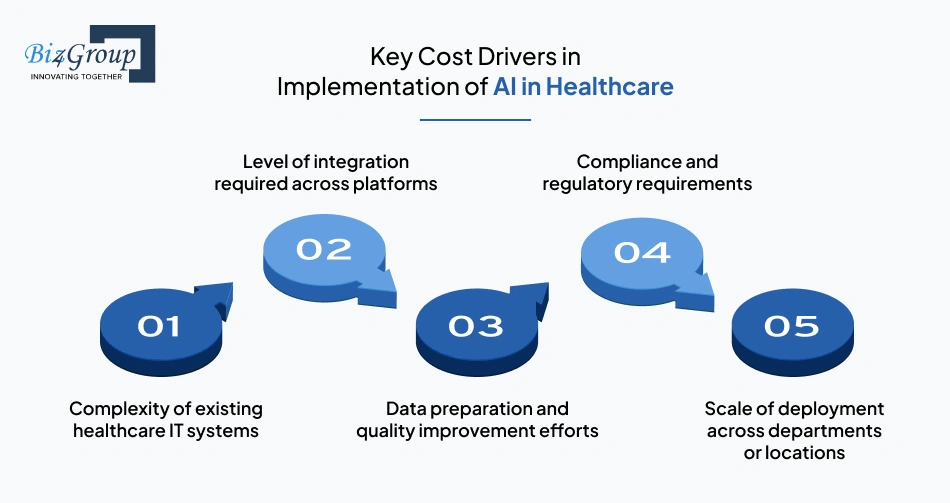
The cost of AI implementation in healthcare depends on several key factors. Some of the main cost drivers include:
- Complexity of existing healthcare IT systems
- Level of integration required across platforms
- Data preparation and quality improvement efforts
- Compliance and regulatory requirements
- Scale of deployment across departments or locations
Projects that involve deeper system integration or multiple data sources tend to cost more. In some cases, costs also increase when features such as AI chatbot development for medical diagnosis are included as part of the solution.
Organizations often evaluate providers based on their ability to manage these factors, especially when working with healthcare AI vendors specializing in system integration.
Typical Timelines from Pilot to Scale
Timelines vary depending on project scope, system readiness, and data availability. A typical timeline includes:
- Initial planning and setup: 2–4 weeks
- Pilot deployment: 4–5 weeks
- System integration: 3–4 weeks
- Scaling and optimization: ongoing basis
In total, most projects take 2 to 9 months from MVP to full deployment.
Timelines increase when data is unstructured, systems require complex integration, or compliance validation takes longer. Faster timelines are possible when systems are already prepared and integration needs are minimal.
Internal Resource Requirements
AI implementation requires involvement from internal teams along with external partners. Key internal roles include:
- Technical teams for system access and coordination
- Data teams for preparation and validation
- Clinical or operational staff for workflow alignment
- Compliance teams for regulatory checks
Some organizations also support features like AI conversation app functionality internally, especially when user interaction is part of the system.
Organizations with limited internal teams often rely more on external partners, which can increase cost but reduce internal workload.
Decision Signal: Stronger internal teams can reduce external costs, while limited teams may require full-service implementation support.
AI implementation cost and timelines depend mainly on system complexity, integration effort, and internal readiness. Faster deployment usually increases cost, while more complex systems increase both cost and time. Many organizations compare the best companies for healthcare AI implementation services based on how well they balance these factors and deliver reliable outcomes.
Workflow Used by AI Healthcare Implementation Companies in USA
AI healthcare implementation companies in USA follow a step-by-step workflow that includes problem definition, data preparation, pilot testing, system integration, and ongoing optimization. The top AI healthcare implementation companies in USA use this structured process to ensure AI systems work reliably in real healthcare environments.
This workflow is used when organizations move from planning or pilot stages to full-scale deployment.
|
Step |
Stage |
Key Activities |
Impact on Implementation |
|---|---|---|---|
|
Step 1 |
Problem Definition and Feasibility |
Define the use case, set goals, and assess whether AI can solve the problem within system constraints |
Ensures the project is aligned with real needs and is technically feasible |
|
Step 2 |
Data Readiness and Infrastructure Setup |
Prepare, clean, and organize data while setting up systems for integration |
Ensures accurate data input and smooth system compatibility |
|
Step 3 |
Pilot Deployment |
Test the AI system in a limited environment to validate performance and identify issues |
Reduces risk before full-scale rollout |
|
Step 4 |
System Integration and Rollout |
Integrate AI with existing systems and workflows, then deploy across teams or departments |
Makes AI usable in daily operations |
|
Step 5 |
Monitoring and Optimization |
Track system performance, update models, and improve outputs over time |
Maintains long-term reliability and accuracy |
This workflow provides a clear path from planning to full deployment. Organizations that follow these steps are more likely to achieve stable, scalable, and reliable AI systems in real healthcare environments. Many teams evaluate the best AI healthcare implementation companies in USA 2026 based on how well they follow and adapt this process.
Skipping or rushing any of these steps can lead to integration issues, poor performance, or delays in deployment.
Some implementations also include communication features such as chat-based systems, where teams may work with an AI chatbot development company. In other cases, frameworks similar to a healthcare conversational AI guide are used to align AI systems with user interaction needs.
Build AI Systems That Scale With You
Partner with healthcare AI vendors specializing in system integration to ensure long-term performance and stability.
Scale My AI SystemsMistakes to Avoid When Hiring AI Healthcare Implementation Companies in USA
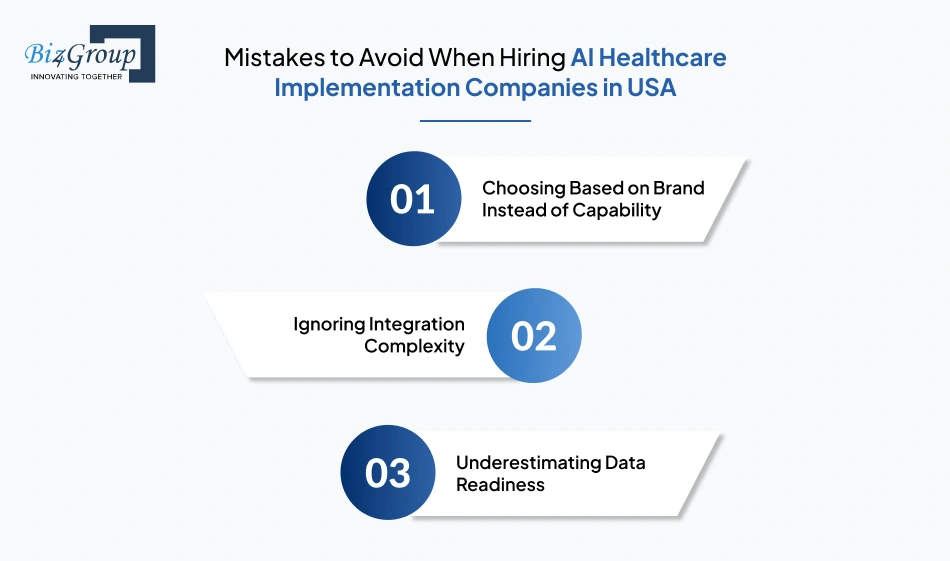
Common mistakes when hiring AI healthcare implementation companies in USA include choosing vendors based on brand, ignoring integration complexity, and underestimating data readiness. The top AI healthcare implementation companies in USA are usually selected based on proven capability, not just reputation.
These mistakes can lead to delays, increased costs, or systems that fail in real healthcare environments.
1. Choosing Based on Brand Instead of Capability
Some organizations select vendors based on brand recognition rather than actual implementation ability. A well-known name does not guarantee experience with healthcare systems or complex integrations.
This can result in poor system fit, delays in deployment, or solutions that do not work effectively in real environments. Even when reviewing top-rated companies in USA who can implement AI in healthcare system, it is important to assess real project experience and outcomes.
2. Ignoring Integration Complexity
Healthcare systems are often complex, with multiple platforms that need to work together. Ignoring this complexity during vendor selection can lead to integration failures or incomplete implementations.
This can cause delays, increased costs, and reduced system performance. Working with a vendor that understands system integration, including the top software development companies in Florida, can help manage these challenges more effectively.
3. Underestimating Data Readiness
AI systems depend on clean, structured, and accessible data. Many organizations underestimate the effort required to prepare data for implementation.
This can lead to delays, inaccurate outputs, and reduced system effectiveness. Teams working with end-to-end AI implementation companies for healthcare often need to prioritize data readiness early in the process to avoid these issues.
What to Do Instead
- To avoid these mistakes, focus on:
- Proven implementation experience in healthcare environments
- Strong system integration capability
- Clear data readiness and preparation processes
Decision Signal: If a vendor cannot demonstrate real-world deployment experience, they are unlikely to deliver reliable results.
Avoiding these mistakes helps ensure that AI systems are deployed correctly and perform reliably in real healthcare environments. The right partner should be evaluated based on capability, integration strength, and data readiness, rather than surface-level factors.
Final Words on AI Healthcare Implementation Companies in USA
AI in healthcare sounds powerful, but its value depends on how well it works inside real systems and workflows. That is where implementation makes the difference between an idea and something that actually delivers results.
Choosing from the top AI healthcare implementation companies in USA is less about who builds the most advanced models and more about who can make them work in your environment. Details like integration, data readiness, and system performance decide whether AI succeeds or fails. Working with the right AI product development company can help ensure those pieces come together properly.
The takeaway is simple: AI in healthcare works when it is implemented carefully, with the right decisions at each step.
Talk to our team to see how AI can fit into your current healthcare systems.
FAQs
1. How do I know if my healthcare system is ready for AI implementation?
A healthcare system is ready for AI implementation if it has accessible and structured data, stable IT infrastructure, and defined use cases. If data is fragmented or systems are not connected, preparation work is usually needed before implementation can begin.
2. What types of healthcare use cases benefit most from AI implementation?
AI is most effective in use cases that involve large volumes of data, repetitive processes, or the need for real-time insights. Common areas include clinical decision support, patient monitoring, workflow automation, and administrative task optimization.
3. How long does it take to see results after implementing AI in healthcare systems?
Initial results can be seen during the pilot phase, often within a few weeks. However, measurable impact at scale typically takes a few months, depending on how quickly the system is integrated and adopted within workflows.
4. What are the common risks in AI healthcare implementation?
Common risks include poor data quality, integration challenges, lack of user adoption, and compliance issues. These risks can lead to delays, inaccurate outputs, or systems that are not used effectively in real environments.
5. How much does AI healthcare implementation typically cost in the USA?
AI healthcare implementation in the USA typically costs between USD 50,000 and USD 300,000+, depending on system complexity, data requirements, integration needs, and scale of deployment. Smaller pilot projects are usually at the lower end, while large-scale implementations fall at the higher end.
6. Can AI be implemented in healthcare systems without replacing existing software?
Yes, AI can be integrated into existing healthcare systems without replacing them. Most implementations focus on connecting AI with current infrastructure, allowing organizations to improve capabilities without rebuilding their entire system.
