Location :
Orlando, FL, USA
Location :
Orlando, FL, USA +1 (407) 714-1616
 info@biz4group.com

 AI Powered Summary by Biz4AI
- Most denials start at registration, not in the billing office. AI catches eligibility, authorization, and coding errors before the claim is submitted.
- The seven main use cases are coverage verification, charge capture, claims scrubbing, denial scoring, authorization gap checks, payment reconciliation, and patient collections.
- The main gains show up in days in A/R, clean claim rate, net collection rate, cost to collect, and denial volume. Baseline each one before go-live so you can prove the change.
- The biggest risks are messy data, weak EHR integration, compliance exposure from automated coding, and automating too much too soon.
- No single platform is best for everyone. Test any vendor's model on your own historical claims, and get data ownership and exit terms in writing.
- Start with a contained pilot, keep humans reviewing low-confidence results, and set pass or fail thresholds before expanding.
What can make a market jump from $17.87 billion to $21.49 billion in one year?
For AI in healthcare revenue cycle management, the answer is not hype. RCM teams are finding more work for AI to handle. The market stood at $17.87 billion in 2025 and is projected to reach $21.49 billion in 2026. By 2031, it is expected to reach $71.27 billion, reflecting a 27.10% CAGR from 2026 to 2031.
That is a striking climb. But the bigger story sits inside the revenue cycle.
A claim can be clean when submitted and still lose money later. A coding gap can leave revenue unbilled. A payer can underpay against a contract. A denial can send staff back through the same claim twice. Multiply those issues across thousands of claims, and manual work becomes expensive.
AI can examine claims, documents, remittance data, and billing information at scale. It can spot patterns, flag exceptions, and prioritize work before small errors become larger revenue problems. That is driving demand for AI-powered healthcare revenue cycle management solutions and AI automation across more RCM workflows.
Biz4Group brings hands-on product experience to this space. We have spent 20+ years delivering about 1,000+ projects in the evolving world. That work includes HIPAA-compliant AI healthcare solutions, such as RevIntegrity for AI-driven underpayment detection and revenue recovery along with our recently launched in-house product, Bill Matters for denial management.
The rest of this guide focuses on where AI can add value in RCM, what providers should consider before adopting it, and what implementation actually involves.
What Is AI in Healthcare Revenue Cycle Management?
AI in healthcare revenue cycle management refers to using artificial intelligence to interpret RCM data and support decisions across financial workflows. It can work with both structured data and documents that traditional software may struggle to interpret.
In AI in medical billing and revenue cycle management, the key difference is how information is handled. Traditional systems generally execute predefined instructions. AI can interpret information, recognize relationships, and provide context for decisions. So,
How Does AI Work Within the Healthcare Revenue Cycle?
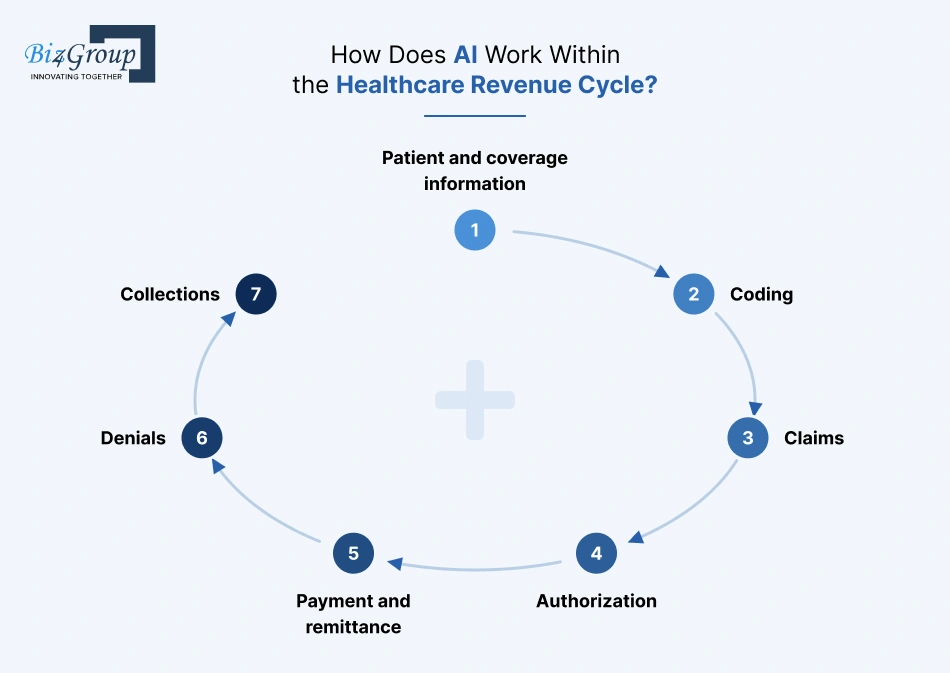
AI can be positioned across the RCM lifecycle rather than limited to one department or transaction.
The lifecycle typically connects:
Patient and coverage information → Coding → Claims → Authorization → Payment and remittance → Denials → Collections
Each stage produces information that can become relevant to another stage.
For example, coverage information originates before billing but can affect later claim activity. Coding creates information that becomes part of the claim. Payer responses add information about how that claim was processed. Remittance data shows what was actually paid. Denial records then add another layer of financial and operational information.
AI can work across these connected data points, giving RCM teams a broader view of the revenue cycle.
This is also why AI-driven revenue cycle automation should not be viewed as a single tool or isolated feature. AI can sit alongside existing billing, EHR, practice management, claims, and payment systems.
The goal is to connect relevant information across the cycle so decisions are based on more than one isolated transaction.
How Is AI Different from Traditional RCM Automation?
Traditional automation follows predefined instructions. AI can interpret information and respond to patterns.
Consider a basic example. A rules-based system can flag a claim when a required field is missing. The rule is explicit and predictable.
AI can work with less structured information and assess multiple signals together. Its output may be a classification, risk assessment, recommendation, or generated response.
The main approaches differ as follows:
|
Technology |
Primary role in RCM |
|---|---|
|
Rules-based automation |
Executes predefined conditions and actions. |
|
Workflow automation |
Routes tasks, records, alerts, or approvals through fixed workflows. |
|
Predictive AI |
Identifies patterns in data to estimate risk, priority, or likely outcomes. |
|
NLP and document intelligence |
Interprets text and information contained in documents. |
|
Generative AI |
Produces summaries, recommendations, explanations, or draft content from available information. |
These technologies can also work together. A system might use AI to interpret information and workflow automation to route the resulting task to the right team.
That distinction matters for buyers evaluating RCM technology. An automated system may complete a task exactly as programmed. An AI-enabled system can add an interpretation layer before the next action occurs.
The difference is not automation versus AI. It is fixed instructions versus systems that can interpret information and adapt their output to the signals they find.
What Are the Key Use Cases of AI in Healthcare Revenue Cycle Management?
AI can intervene at specific points across the revenue cycle where information must be interpreted, compared, or prioritized. These applications range from front-end eligibility to back-end payment reconciliation and collections.
1. Real-Time Coverage and Benefits Verification
Eligibility data can be difficult to interpret when payer responses contain different benefit details. AI can bring relevant coverage information together and flag discrepancies before the account moves forward.
It can assist with:
- Coverage and eligibility retrieval
- Benefit interpretation
- Patient-to-payer data matching
- Exception routing
2. Undercoding Detection and Charge Capture
A gap between documented services and captured charges can leave coding teams with incomplete information. AI can compare documentation with billing data and surface records that deserve closer coding review.
It can flag:
- Potentially missed charges
- Undercoding indicators
- Documentation gaps
- Coding review candidates
3. Pre-Submission Claims Scrubbing
Claim errors are not always visible through basic field validation. AI can examine relationships among claim elements and identify combinations that appear inconsistent before the claim reaches the payer.
Review can cover:
- Missing claim information
- Conflicting data elements
- Potential submission errors
- Claims needing manual validation
4. Denial Risk Scoring and Underpayment Recovery
Denial queues often contain more cases than staff can review with equal depth. AI can analyze claim and payment signals to separate recurring patterns and cases needing attention. Bill Matters uses AI to connect denial reasons with claim details and supporting evidence during denial review.
It can support:
- Denial-risk scoring
- Pattern identification
- Underpayment detection
- Recovery prioritization
5. Prior Authorization Gap Management
Authorization information can sit across payer responses, patient records, and internal workflows. AI can bring those signals together and identify cases where authorization status or required information needs attention.
Relevant checks include:
- Authorization status
- Missing information
- Service-to-authorization mismatches
- Follow-up triggers
Also Read: How to Develop AI Prior Authorization Platform for Mid-Size Clinics
6. Remittance-Triggered Payment Reconciliation
Remittance files explain how payers processed submitted claims. AI can interpret those records and connect payment details with the underlying claim, making exceptions easier to isolate.
It can handle:
- ERA and EOB interpretation
- Claim-to-payment matching
- Variance identification
- Unmatched transaction review
7. Guided Patient Billing and Collections
Patient accounts differ in balance, payment history, responsibility, and communication needs. AI can use those account signals to organize billing and collection activity around the appropriate next interaction.
Applications include:
- Personalized billing messages
- Payment guidance
- Account segmentation
- Collection queue prioritization
What are The Benefits of AI-Powered Revenue Cycle Management in Healthcare?
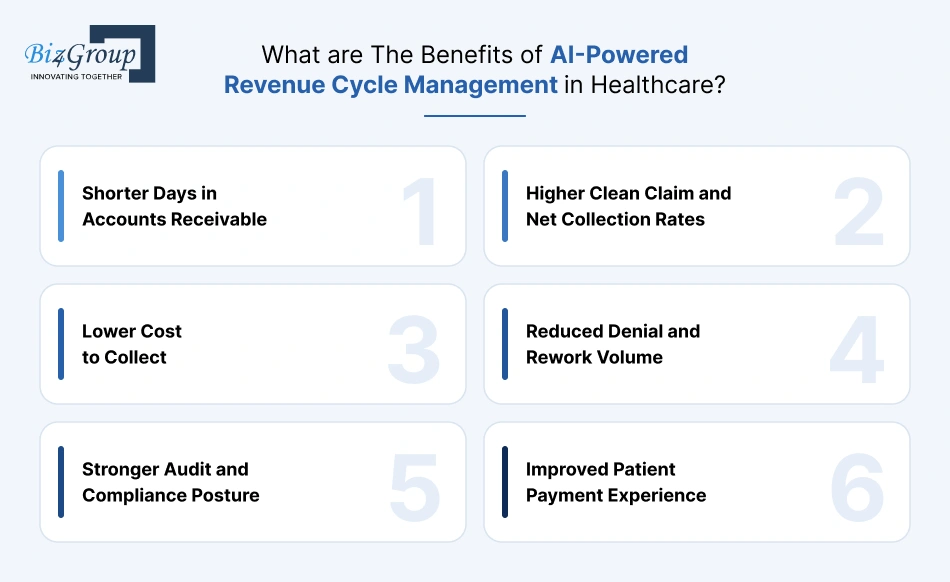
The benefits of AI in healthcare revenue cycle management show up in a handful of metrics your team already tracks. Each one below moves for a different reason. Results vary by starting point, so treat any vendor's headline percentage as a hypothesis to test on your own data. Well-implemented AI-powered healthcare revenue cycle management solutions tend to help most where a provider's current process has the biggest leaks.
1. Shorter Days in Accounts Receivable
Days in A/R drop when errors are caught before submission and follow-up starts sooner. Prioritized work queues also stop aged claims from sitting untouched while staff work the easiest accounts first. Watch the share of claims older than 90 days, since that bucket is where recovery odds fall quickly.
2. Higher Clean Claim and Net Collection Rates
A higher first-pass clean claim rate means fewer resubmissions. Net collection rate improves separately, as underpayments get recovered and avoidable write-offs shrink. Together they form the core of healthcare revenue optimization with AI. Clean claim rate tells you how well the front end works, while net collection rate tells you how much of what you were owed actually arrived.
3. Lower Cost to Collect
Fewer touches per claim means lower cost per dollar collected. Staff time shifts from routine checks to exceptions that need judgment, such as complex appeals and payer disputes. Most organizations redeploy that capacity to denials and underpayment work rather than reduce headcount.
4. Reduced Denial and Rework Volume
Denial volume falls when upstream causes are fixed, and rework falls with it. Track denials by root cause, such as registration, authorization, coding, or payer policy. A single overall denial rate hides which fix is actually working.
5. Stronger Audit and Compliance Posture
Consistent code checks and system logs create a record of what was reviewed and changed. That helps during payer audits and internal compliance reviews. The benefit exists only if the platform keeps a clear audit trail and your team documents its oversight.
6. Improved Patient Payment Experience
Accurate estimates before the visit, readable statements, and flexible payment options reduce billing surprises. Patients who understand what they owe pay sooner and call the billing office less.
Your Revenue Should Not Need Chasing
Turn recurring RCM bottlenecks into measurable gains with smarter AI-powered revenue cycle workflows
Talk to Our AI ExpertsTurn recurring RCM bottlenecks into measurable gains with smarter AI-powered revenue cycle workflows
Talk to Our AI Experts
What Challenges and Risks Should Providers Consider Before Adopting AI for RCM?
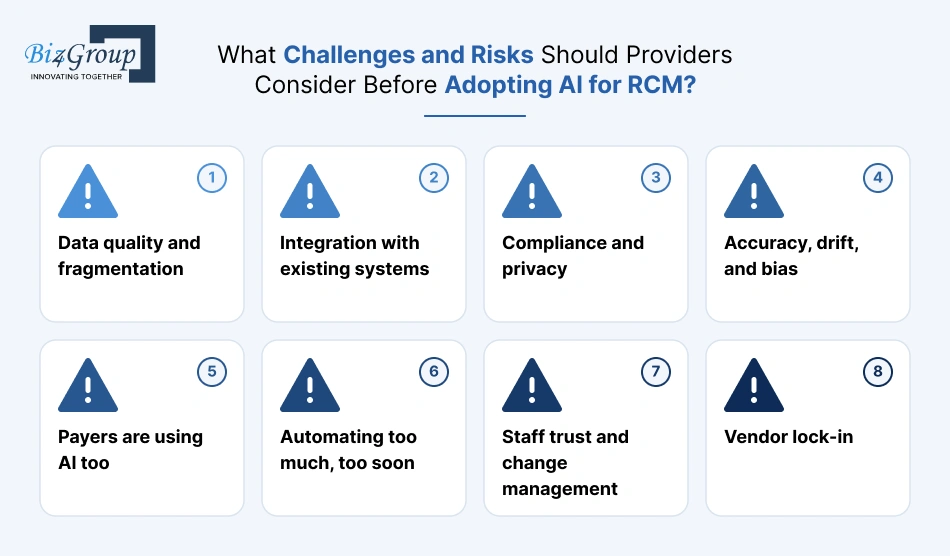
AI in healthcare revenue cycle management fails most often for practical reasons, not technical ones. These are the risks worth testing before you sign anything.
1. Data quality and fragmentation
Models learn from your history. If denial reasons are coded inconsistently, payer names are entered five different ways, or notes live in scanned files, the model learns noise. Clean and standardize a sample of claims first, and expect the vendor to tell you honestly what they find.
2. Integration with existing systems
AI revenue cycle management integration with EHR systems is the most common source of delay. The tool needs to read scheduling, documentation, and charge data, and often write corrections back. Access usually runs through HL7 feeds, FHIR APIs, or vendor-controlled interfaces, and some EHR vendors charge for that access.
The practice management system, clearinghouse, and payer portals add further connection points. Map each one before selecting a platform, because a tool that cannot write back creates a second screen for staff to check.
3. Compliance and privacy
- Sign a business associate agreement and confirm exactly how protected health information is stored and used.
- Ask whether your data trains models shared with other customers.
- Keep a human accountable for coding decisions. Automated upcoding can create false claims exposure.
- Check state rules on AI use in billing and patient communication, which continue to change.
4. Accuracy, drift, and bias
Payer rules shift, and a model trained last year may score this year's claims poorly. Ask how often models are retrained and how performance is monitored. Patient propensity models need extra scrutiny, since a biased score can lead to unequal collection treatment.
5. Payers are using AI too
Many payers now apply automated review to claims and medical necessity. That raises the bar on documentation, since a thin note that once passed human review may now be auto-denied. Your own tools should help you meet that standard, and your appeal process should be ready for higher volume.
6. Automating too much, too soon
Letting a new model submit claims or post payments without review is a common early mistake. Errors repeat at scale before anyone notices. Expand automation only after the model's accuracy is proven on your data.
7. Staff trust and change management
Coders and billers who believe the tool exists to replace them will work around it. Explain which tasks are changing and how roles will grow toward exception handling and analysis.
8. Vendor lock-in
Some vendors will not explain how a score was produced, or will claim ownership of models built on your data. Put data ownership, export rights, and exit terms in the contract.
How to Choose the Right AI RCM Platform: Market Landscape, Features, and Evaluation Criteria
There is no single ranking of the best AI revenue cycle management platforms. The right fit depends on your EHR, specialty mix, payer mix, and internal technical capacity. It helps to start with the categories, since what you are really choosing is where AI in healthcare revenue cycle management will sit in your existing technology stack.
1. Market landscape
|
Category |
Typical strengths |
What to watch for |
|---|---|---|
|
EHR-native modules |
Tight data access, one vendor, simple write-back |
Limited payer-specific learning; tied to that EHR's roadmap |
|
Enterprise RCM suites and clearinghouse platforms |
Broad claim and payer connectivity, mature workflows |
Can be heavy to configure; AI may be add-on modules |
|
AI-first point solutions |
Deep capability in one area such as coding or denials |
Integration effort; managing several vendors |
|
Outsourced RCM with AI |
Staff and technology together |
Less direct control over workflows and data |
|
Custom-built platform |
Fits unusual workflows; you own the models |
Higher upfront cost; needs data science and support capacity |
Examples are illustrative, not a ranking or endorsement. Offerings change quickly, so verify current capabilities directly.
2. Features to require
Any AI healthcare revenue cycle management platform worth shortlisting should do the following:
- Explain why a claim was flagged or scored, in terms a biller can act on.
- Learn payer-specific patterns from your claims, not only generic edits.
- Write corrections back to the EHR or practice management system.
- Let you set confidence thresholds for what runs automatically and what gets reviewed.
- Report denials by root cause, payer, and department.
- Keep full audit logs and hold security certifications such as SOC 2 or HITRUST.
3. Build or buy
Buying suits most AI RCM solutions for healthcare providers, since vendors already hold payer data and tested models. Custom AI revenue cycle management system development makes sense when your workflows are unusual, you run many entities on different systems, or your claim data is itself a competitive asset. A custom build also demands ongoing model maintenance, so be realistic about the team you can sustain. A purpose-built AI healthcare RCM automation platform of your own can also start small, with one module such as denial prediction, and grow from there.
4. How to test a platform before you commit?
Ask the vendor to run its model against your historical claims, where you already know what happened. Then compare its predictions with reality.
- Hit rate: of the claims it flagged, how many were actually denied or rejected?
- Miss rate: of the claims that were actually denied, how many did it catch?
- Dollar impact: what would the flagged claims have been worth?
- Usability: can a biller fix a flagged claim in a minute or two, or does each flag need research?
A model that flags everything will catch most denials and bury your team. A model that flags almost nothing looks accurate and saves nothing. You want both measures to be reasonable.
5. Questions to ask every vendor
- Can you show results from an organization with our specialty, EHR, and payer mix?
- Will you run a pilot on our historical data before we commit?
- Who owns models trained on our data, and what happens if we leave?
- How often are models retrained, and how do you detect drift?
- How is pricing structured, and what costs sit outside the quote?
How Can Healthcare Organizations Implement AI in Revenue Cycle Management?
A sound AI revenue cycle management implementation starts narrow and expands once results are proven. If you are working out how to implement AI in healthcare revenue cycle management without disrupting daily operations, this sequence works well.
1. Baseline your metrics
Record at least 90 days of clean claim rate, denial rate by cause, days in A/R, and cost to collect. Without a baseline, you cannot prove anything later. Choose the single bottleneck costing you the most.
2. Prepare the data
Pull 12 to 24 months of claims, remittances, and denial codes. Standardize payer names and reason codes, and resolve gaps.
3. Start with a contained pilot
Pick one specialty or location and one use case. Eligibility checks and claim scrubbing are common starting points because the data is structured and results appear quickly.
4. Connect the systems
Begin with read-only access to confirm the tool sees what you expect. Add write-back once staff trust its output.
5. Keep humans in the loop
Set confidence thresholds, route low-confidence items to reviewers, and track how often staff override the tool. A high override rate means something needs tuning.
6. Train staff and adjust roles
Show teams how their daily work changes and who owns exceptions. Name one operational lead who can make decisions quickly.
7. Measure, tune, and expand
Compare results with your baseline at 60 to 90 days. Retrain where needed, then add the next use case.
Agree on pass or fail thresholds before the pilot starts, such as a target clean claim rate or a limit on override rate. Writing these down in the contract keeps the decision to expand or stop objective.
A focused pilot commonly takes two to three months. Reaching organization-wide automated healthcare financial operations typically takes six to twelve months, depending on the number of sites and systems involved. A small governance group from finance, compliance, IT, and revenue cycle should review performance monthly.
AI in healthcare revenue cycle management works best when it is pointed at the causes of lost revenue rather than the symptoms. Fixing eligibility, authorization, coding, and claim errors before submission removes work that no amount of follow-up staff can fully recover.
The winning approach is unglamorous. Baseline your numbers, clean your data, pilot one use case, and keep humans accountable for decisions. Organizations that do this build a foundation for intelligent healthcare billing management that grows one proven step at a time. Those that buy a platform first and sort out data and workflows later tend to end up with expensive dashboards.
FAQ's
1. Does AI in revenue cycle work differently for hospitals, physician groups, and specialty practices?
Yes. Hospitals deal with facility claims, inpatient case groupings, large charge masters, and complex authorizations. Physician groups focus more on visit-level coding and front-end accuracy. Specialties such as anesthesia, radiology, and behavioral health carry their own billing rules, including time-based units and visit-length codes. A model trained on the wrong claim type performs poorly, so ask vendors for results in your specialty.
2. Is it safe to use generative AI to write appeal letters?
It can save real time by drafting a letter from the denial reason, the payer policy, and the chart. The risk is invented facts or policy citations. Require that every clinical statement trace back to a chart entry, check each policy reference, and have a person approve the letter before it goes out.
3. How does AI handle Medicare Advantage and Medicaid claims?
These payers follow different rules from commercial plans, and the rules vary by plan and by state. Medicare Advantage plans often add their own authorization and audit requirements. Medicaid eligibility can change month to month, so checks need to run more often. Ask whether the vendor's models were trained on these payer types and whether you can tune them by plan.
4. Which roles should we hire or train for after adopting AI?
Four roles tend to matter most: a denial analyst who studies root causes, a data analyst who validates model output, a named owner for AI oversight, and an integration lead in IT. Experienced coders often move into audit and quality review, where their judgment catches what the model misses.
5. What happens to the AI if we change EHRs or acquire another practice?
Models depend on your data structure, so a migration means remapping fields, codes, and payer names. Expect a short dip in accuracy while the model recalibrates. For an acquired group on a different system, onboard it separately and run the tool in review-only mode first. Ask vendors in writing what migration support is included.