 Location :
Orlando, FL, USA
 +1 (407) 714-1616
 info@biz4group.com


 Key Insights
- AI prior authorization platform development builds software that checks eligibility, matches payer rules, assembles chart evidence, and tracks requests, so mid-size clinics cut processing delays and claim denials.
- A HIPAA compliant AI prior authorization automation system needs BAAs, encryption, multi-factor authentication, and audit logs. CMS-0057-F regulates payers, not clinics, but its FHIR APIs due January 1, 2027 shape what your platform connects to.
- Core features include real-time eligibility verification, payer requirement matching, documentation assembly, denial-risk scoring, and worklists, all connected to your EHR.
- Start with a baseline, then build a narrow MVP, pilot, and expand. At Biz4Group, an MVP typically takes 2 to 4 weeks and an enterprise build 6 to 8 weeks, with costs typically running $30,000 to $250,000 depending on scope.
- Buy software for standard payers and modest volume, and build custom or hybrid for unusual payers or deep EHR integration. Plan for payer rule changes, AI errors, and staff adoption. Biz4Group, a HIPAA compliant AI healthcare software development company, supports mid-size clinics.
Ask any prior authorization coordinator how their week went. You'll hear about hold music, faxes, and payer portals that time out halfway through a submission.
Sound familiar?
We've spent 20+ years building platform and have delivered 1,000+ projects. That work includes HIPAA compliant AI healthcare solutions and Bill Matters, our own denial management product for rejected bills. So, we see prior authorization from both ends: the request that goes out and the denial that comes back.
Here's where 2026 stands. AHIP and the Blue Cross Blue Shield Association report that health plans have cut 11% of prior authorization requirements. That's progress, but physicians aren't convinced. In the AMA's survey of 1,000 physicians, taken in December 2025, only 33% believed the insurer reform pledge would make a meaningful difference. And 95% said prior authorization still delays necessary care.
So, what do you do while payers catch up? You fix your own side of the process.
That's where AI prior authorization platform development helps. A well-built platform checks eligibility before anyone builds a request. It matches each request to the payer's actual rules. It flags weak submissions before they go out.
No software can change a payer's rules. What it can do is help your team meet them the first time. Your clinicians and staff still make calls that matter.
The payoff shows up in your medical billing denials. Most start upstream, with a missing note or the wrong plan type. Catch those early and your team stops doing the same work twice.
So how do you build a platform that eliminates processing delays and reduces claim denials at a mid-size clinic? This guide covers it step by step. You'll learn:
- How to plan for HIPAA and the CMS-0057-F timeline
- Which features cut delays and denials
- What it costs and how long it takes
What is AI Prior Authorization Platform Development, and Why Is Manual Authorization Still Costing Your Clinic Time and Revenue?
AI prior authorization platform development is the work of building custom software that handles the steps between a clinician's order and a payer's decision. It checks eligibility, finds out whether authorization is required, matches the payer's criteria to the patient's chart, gathers the evidence, submits the request, and tracks it to a decision. Your team reviews the exceptions instead of touching every case.
Your team may use different words for the same things, so here are three terms we'll use throughout:
- Prior authorization: the payer's approval, required before certain services, imaging, or drugs are covered
- Eligibility verification: confirming the patient's coverage is active and which plan applies
- First-pass approval rate: the share of requests approved without a resubmission or a request for more information
Sounds simple. So why do so many clinics still do this by hand?
Part of the answer is that the whole industry is still catching up. The 2025 CAQH Index, released in February 2026, collected data from 600 provider organizations and health plans. It found that only 40% of medical prior authorizations run through fully electronic processes. The rest still involve manual steps.
What an Intelligent Prior Authorization Platform Actually Does
Older electronic tools digitize paperwork. You get a cleaner form and a status screen. Your coordinator still hunts through the chart for evidence.
Intelligent prior authorization platform development goes a step further and reads the chart. Document AI pulls diagnoses, prior therapies, imaging dates, and lab values out of notes, referral letters, and scanned faxes. A rules layer compares that evidence with the payer's criteria. A scoring layer flags requests likely to bounce for missing information.
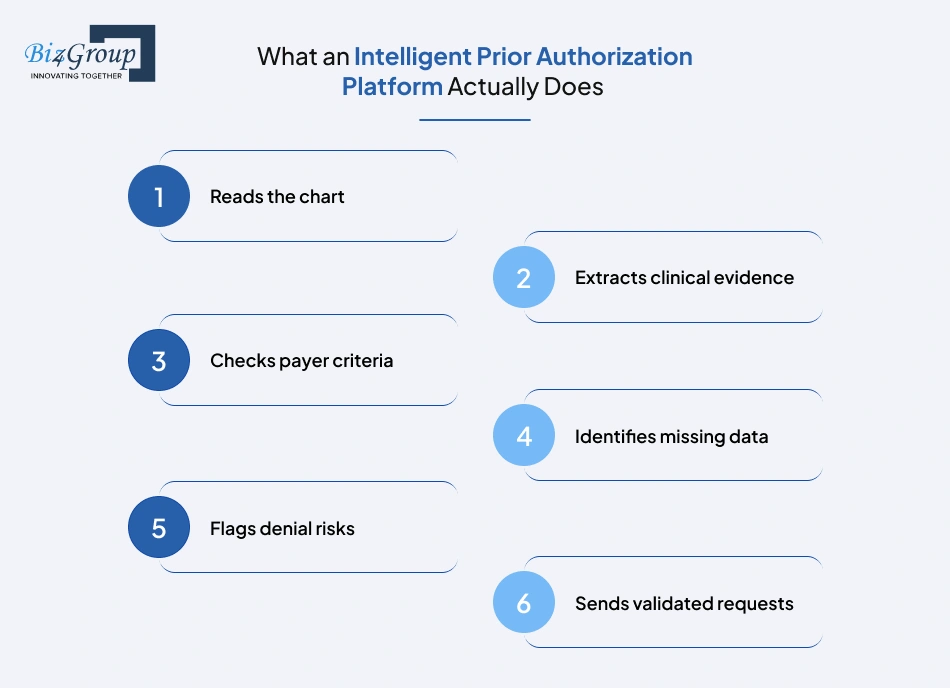
Under the hood, eligibility checks typically run on X12 270/271 transactions. Requests go out through X12 278 or, as payers adopt them, FHIR-based APIs. You don't need to memorize these. You do want your build partner to name them. If a vendor can't say how a request actually reaches the payer, keep asking.
That's what sets healthcare prior authorization AI platform development apart from generic workflow tools. The aim isn't to push a weak request through faster. It's to get it right the first time.
Where Delays and Denials Actually Start
You're not imagining that the workload keeps growing. In MGMA's 2026 burden report, 90% of practices said prior authorization requirements increased over the past year.
Ask your team where requests stall, and the answers tend to repeat:
- Coverage or plan-type errors found after scheduling, not before
- No clear answer on whether a service needs authorization under that plan
- Notes that don't match the payer's criteria, like missing therapy history or imaging dates
- Coding that doesn't line up between the order and the request
- Pended requests that sit for days because nobody sees them
- Approval numbers that never reach the claim
Every one of these is preventable early in the workflow.
Once a denial does land, an AI denial management system for healthcare providers can take on much of the appeal work. Stopping the denial before submission is cheaper still.
What Manual Authorization Costs a Mid-Size Clinic
- Let's run the numbers for a 20-physician clinic. This is an illustrative model, so swap in your own headcount and wages.
- The AMA's 2025 physician survey, published in May 2026, found that practices complete an average of 40 prior authorizations per physician each week. Physicians and staff spend about 13 hours a week on them.
- For 20 physicians, that's roughly 800 requests and 260 hours every week. Assume a fully loaded labor cost of $30 an hour. That comes to about $7,800 a week, or more than $400,000 a year, on work that adds nothing clinically.
- Labor is the smaller part of the bill. Nearly one in three physicians (32%) said requests are often or always denied. Every one of those denials means rework or a delayed procedure.
- Burnout adds to the cost. In the same survey, 94% of physicians said prior authorization contributes to burnout, and replacing experienced staff is expensive.
Why Your EHR and Billing System Don't Close the Gap
Your EHR holds the clinical record. Your billing system handles claims after care is delivered. Prior authorization sits between them, spread across payer rules, portals, faxes, and phone calls. So, your coordinators end up as the connection, retyping data and chasing status by hand.
What are the Core Functions of an AI Prior Authorization Platform?
AI prior authorization platform handles the operational tasks involved in preparing, reviewing, submitting, and monitoring insurance authorization requests across clinical and administrative workflows. The system manages multiple process-level responsibilities that clinics traditionally handle manually during prior authorization processing.
1. Eligibility Verification
- Patient insurance details are reviewed before authorization workflows begin
- Coverage validation is performed against active payer plans and policy conditions
- Authorization requirements are checked for procedures, imaging requests, treatments, and medications
- Payer-specific approval conditions are reviewed during the verification stage
- Inactive coverage, missing policy details, and authorization requirement conflicts are identified early in the workflow
2. Clinical Document Extraction
- Relevant clinical information is extracted from physician notes, AI EHR platform, referral documents, and uploaded medical files
- Diagnosis codes, treatment history, medication records, symptoms, and procedure-related information are identified during document review
- Authorization-related clinical data is organized into structured review workflows
- Missing or incomplete clinical records required for authorization processing are flagged during documentation review
- Extracted information is prepared for downstream authorization submission workflows
3. Payer Rule Mapping
- Payer-specific authorization rules are reviewed against submitted clinical information
- Approval conditions are mapped according to insurance provider requirements
- Authorization workflows are aligned with payer documentation criteria and medical necessity conditions
- Rule variations across commercial insurance plans, Medicare Advantage programs, and specialty-specific payers are processed within the workflow
- Updates to changing payer authorization requirements are incorporated into rule-processing workflows
4. Authorization Form Population
- Authorization request forms are populated using patient, provider, clinical, and payer-related data
- Required submission fields are prepared before payer submission workflows begin
- Supporting documentation is attached to authorization requests during form preparation
- Clinical and authorization data fields are aligned before submission review
- Authorization records are structured according to payer submission requirements
5. API-Based Submission Workflows
- Authorization requests are submitted through payer-connected API development and electronic communication channels
- Submission workflows are routed according to payer-specific processing requirements
- Electronic authorization transactions are formatted based on payer submission protocols
- Submission confirmations, returned requests, and pending authorization cases are recorded during workflow processing
- External payer portal workflows are supported when direct API connectivity is unavailable
6. Authorization Status Tracking
- Submitted authorization requests are monitored throughout the payer review cycle
- Approval updates, pending reviews, returned cases, and additional documentation requests are tracked within the workflow
- Authorization activity is recorded across multiple payer environments
- Delayed, inactive, or unresolved authorization requests are identified during status monitoring
- Workflow history is maintained for authorization actions and status-related changes
7. Denial Risk Scoring
- Authorization requests are evaluated for documentation and approval-related risks before submission
- Clinical records, coding alignment, payer requirements, and authorization completeness are reviewed during risk analysis
- Requests containing missing information or unsupported documentation are flagged during workflow review
- Authorization cases requiring manual validation are identified before payer submission
- Risk analysis workflows review potential authorization gaps connected to payer-specific approval conditions
These core functions allow AI prior authorization platform to manage critical authorization responsibilities across payer workflows, clinical documentation review, and authorization monitoring inside mid-size clinic operations.
How Do You Build a HIPAA-Compliant AI Prior Authorization Automation System That Also Meets CMS-0057-F?
Good AI prior authorization platform development treats both rules as design requirements, not afterthoughts. HIPAA applies directly to your platform because it handles patient data. CMS-0057-F applies mainly to payers, but it shapes what your platform connects to.
What CMS-0057-F Means for Your Clinic (and What It Doesn't)
CMS-0057-F covers Medicare Advantage, Medicaid and CHIP managed care, and federal exchange plans. Your clinic isn't directly regulated.
Payers had to meet 72-hour urgent and seven-day standard decision times and give specific denial reasons from January 1, 2026. They also had to begin public reporting of prior authorization metrics in March 2026.
The four FHIR-based APIs, including the Prior Authorization API, are due January 1, 2027, so build on FHIR R4 and Da Vinci standards and keep X12 278 as a fallback.
HIPAA Compliant AI Prior Authorization Automation System for High-Volume Practices
Your clinic is the covered entity, and any vendor that touches patient data is a business associate. Sign a business associate agreement (BAA) with each one, including your cloud, OCR, and language model providers.
Confirm that no patient data is kept or used to train models and send each model only the fields the task needs.
A HIPAA compliant AI prior authorization automation system also needs encryption, multi-factor authentication, role-based access, tamper-proof audit logs, and a documented risk analysis.
HIPAA Security Rule Update
- The proposed update would make encryption and multi-factor authentication mandatory, but it isn't final. Today's rule is still what regulators enforce.
- Building the proposal now costs far less than retrofitting later, and many cyber insurers already ask for both controls.
- Some clinics also add AI compliance software to track rule changes and flag audit gaps.
State AI Laws and Clinician Review
- California (SB 1120) and Texas (SB 815) limit insurers from using AI as the sole basis for a medical necessity denial, and more states are following.
- These laws target payers, but they show where oversight is heading. Design your platform to assist and never decide.
- Require clinician sign-off, link each extracted fact to its source in the chart, and keep an audit trail of every AI suggestion and edit.
Still Chasing Authorizations Across Systems?
Disconnected workflows quietly drain approvals, staff hours, and reimbursement momentum every single day.
Fix The Workflow BottleneckYour Staff Shouldn't Review Everything
Let intelligent authorization workflows handle repetitive review cycles before teams get overloaded.
See Smart Authorization In ActionWhat Key Business Problems Does AI Prior Authorization Platform for Mid-Size Clinics Solve?
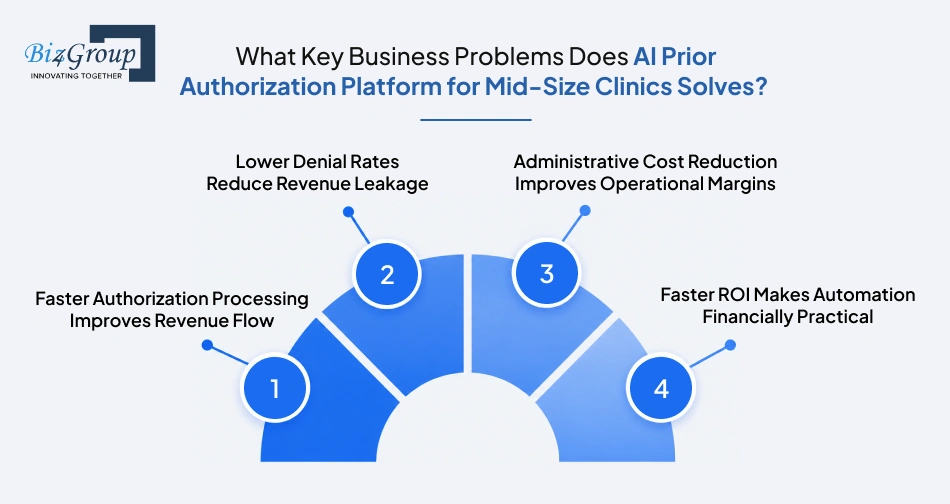
Prior authorization problems eventually turn into financial problems for mid-size clinics. For clinics processing large authorization volumes every week, even small workflow inefficiencies can create significant revenue leakage over time.
As clinics evaluate a prior authorization AI automation system development for clinic operations, the discussion usually shifts from administrative workload toward measurable business impact. Here's how it creates a measurable business impact:
1. Faster Authorization Processing Improves Revenue Flow
Long authorization cycles often delay procedures, imaging approvals, specialty treatments, and claim submissions. When approvals move faster, clinics can stabilize scheduling workflows and reduce reimbursement delays tied to pending authorizations.
Many healthcare organizations using automated authorization workflows report nearly 60% reduction in prior authorization processing time. AI-powered systems also reduce approval turnaround from multiple days to only minutes in certain authorization workflows.
For mid-size clinics, this directly impacts:
- reimbursement timelines
- appointment scheduling efficiency
- treatment throughput
- and monthly cash flow predictability
2. Lower Denial Rates Reduce Revenue Leakage
When approval risks are identified earlier in the authorization cycle, clinics avoid a large portion of the financial waste tied to preventable denials. Fewer rejected requests mean fewer delayed reimbursements, lower claim recovery costs, and reduced revenue leakage caused by unresolved authorization issues.
For mid-size clinics processing high authorization volumes every month, stronger approval accuracy directly improves:
- monthly reimbursement predictability
- claim recovery rates
- administrative cost control
- and overall revenue retention across payer workflows
3. Administrative Cost Reduction Improves Operational Margins
Automation changes the financial equation by reducing the amount of manual coordination required during authorization handling. Healthcare providers adopting automated authorization systems see nearly 35% reduction in administrative costs tied to prior authorization management.
This creates measurable financial impact through:
- lower overtime dependency
- reduced claim rework costs
- fewer payer follow-up hours
- and better administrative resource allocation
4. Faster ROI Makes Automation Financially Practical
Healthcare organizations implementing AI automation tools for prior authorization workflows frequently report positive ROI within 3-6 months after deployment, particularly in high-volume specialty environments.
Clinics experience measurable financial improvements through:
- Faster reimbursement cycles tied to quicker authorization approvals
- Lower claim recovery costs caused by fewer authorization-related denials
- Reduced overtime and administrative payroll pressure
- Better revenue retention from fewer unresolved authorization cases
- Improved financial predictability across high-volume payer workflows
For mid-size clinics dealing with rising authorization burdens, AI prior authorization platform development for mid-size clinics is increasingly becoming a revenue protection and operational sustainability investment rather than only an administrative upgrade.
Revenue Delays Are Operational Warnings
Authorization inefficiencies usually surface financially long before clinics notice operational damage.
Reduce Revenue Leakage FasterHow Do AI Prior Authorization Platforms Integrate with EHRs and Healthcare Systems?
Prior authorization platforms must exchange information continuously across EHR systems, payer environments, billing platforms, scheduling systems, and clinical record repositories. Integration architecture determines how accurately authorization data moves between these systems during approval processing and status management.
1. EHR Systems Provide Clinical and Patient Data
AI prior authorization platforms connect with EHR systems to access patient demographics, diagnosis records, physician notes, medication history, procedure details, and treatment documentation required during authorization submission workflows.
Most integrations support healthcare standards such as:
- FHIR
- HL7
- REST-based APIs
These connections allow authorization systems to synchronize patient-related information directly from clinical records without separate manual data transfer processes.
Also Read: How to Integrate AI with EHR/EMR Systems to Transform Healthcare Operations?
2. Payer Systems Handle Authorization Submission and Status Exchange
Prior authorization platform also connects with payer communication environments to manage authorization submission activity, response updates, and approval tracking processes.
Depending on payer infrastructure, integrations usually support:
- API-based authorization submission
- Clearinghouse connectivity
- Electronic authorization gateways
- External payer portal workflows
These integrations maintain authorization of data exchange between clinic systems and insurance providers throughout active review cycles.
3. Document Management Systems Support Record Synchronization
Authorization processing often involves referrals, prescriptions, physician notes, imaging reports, and scanned medical documentation stored across multiple systems. Integration of workflows synchronize these records during authorization review and submission handling.
Many clinics also connect document repositories and OCR systems to process:
- faxed records
- uploaded PDFs
- scanned referral documents
- and external clinical files
This keeps authorization-related documentation aligned across connected systems.
4. Scheduling and Billing Platforms Receive Authorization Updates
Scheduling systems and billing platforms also connect with authorization workflows to maintain synchronized approval status information during treatment coordination and reimbursement preparation.
These integrations help systems exchange:
- authorization approval status
- pending review updates
- procedure clearance information
- and payer response activity
Connected workflows reduce disconnected data handling across administrative systems.
Also Read: AI Medical Scheduling Platform Development Cost
Strong integration architecture allows prior authorization platforms to exchange information consistently across healthcare systems, payer environments, and clinical record workflows. AI prior authorization platform fits more effectively into clinic operations when authorization data remains synchronized across connected platforms and approval channels.
Which Features Does a Prior Authorization Automation Platform Need for Real-Time Eligibility Checks and Payer Matching?
Prior authorization workflows involve multiple operational layers across payer verification, documentation review, approval coordination, and authorization tracking. AI prior authorization platform development for mid-size clinics require feature planning that supports both administrative efficiency and workflow reliability across daily clinic operations.
1. AI Automation Features
|
Feature |
Purpose |
|---|---|
|
Clinical document extraction |
Pulls relevant patient and treatment information from uploaded records and physician notes |
|
Payer rule matching |
Reviews authorization requests against payer-specific approval conditions before submission |
|
Denial risk identification |
Flags authorization requests that may contain missing documentation or workflow gaps |
|
Automated authorization routing |
Sends requests through the correct payer workflow based on insurance requirements |
|
Smart workflow prioritization |
Helps teams identify urgent or time-sensitive authorization cases faster |
2. Authorization Workflow Management Features
|
Feature |
Purpose |
|---|---|
|
Centralized authorization dashboard |
Gives teams one place to monitor active requests and pending approvals |
|
Authorization queue management |
Organizes requests based on status, urgency, payer type, or department workflows |
|
Escalation workflow handling |
Routes delayed or exception-based cases for manual review when needed |
|
Approval status monitoring |
Tracks authorization progress across payer review cycles |
|
Task assignment controls |
Helps managers distribute authorization workloads across staff members |
3. Clinical Documentation Features
|
Feature |
Purpose |
|---|---|
|
Supporting document validation |
Reviews whether required records are attached before submission |
|
Physician note synchronization |
Pulls clinical notes into authorization workflows automatically |
|
ICD and CPT code verification |
Checks whether diagnosis and procedure codes align correctly during submission preparation |
|
Missing information alerts |
Identifies incomplete authorization requests before payer review begins |
|
Multi-document management |
Organizes referrals, imaging records, prescriptions, and supporting files together |
4. Payer Connectivity Features
|
Feature |
Purpose |
|---|---|
|
Multi-payer workflow support |
Handles authorization requirements across different insurance providers |
|
API-based authorization submission |
Sends authorization requests electronically through connected payer systems |
|
Real-time eligibility verification |
Checks active patient coverage and authorization requirements instantly |
|
Payer response synchronization |
Updates authorization status automatically after payer review activity |
|
Portal workflow support |
Supports payer workflows that still require external portal processing |
5. Security and Compliance Features
|
Feature |
Purpose |
|---|---|
|
Role-based access management |
Restricts authorization data access based on staff responsibilities |
|
Audit trail logging |
Records workflow activity and authorization-related actions for compliance review |
|
Encrypted data handling |
Protects patient records during storage and workflow transmission |
|
Multi-factor authentication |
Adds additional login protection for sensitive healthcare workflows |
|
Session monitoring controls |
Tracks user activity during authorization handling workflows |
The right feature structure helps clinics manage authorization operations more consistently as payer complexity and approval volumes continue increasing. Teams planning to build AI prior authorization platform for clinics usually achieve better long-term workflow stability when operational, payer, and compliance requirements are addressed together during feature planning.
How to Develop an AI Prior Authorization Platform for Mid-Size Medical Clinics, Step by Step
Prior authorization workflows vary significantly across specialties, payer environments, and clinic operations. That is why clinics planning to develop AI prior authorization platform for medical clinics need a structured development roadmap that aligns technical execution with real approval dependencies, and reimbursement requirements.
Step 1: Analyze Existing Authorization Workflows
The development process starts with operational workflow discovery. Development teams work with billing managers, authorization coordinators, physicians, and administrators to understand how prior authorization currently moves through the clinic.
This stage usually includes:
- Identifying authorization bottlenecks
- Reviewing denial-prone workflows
- Mapping payer-specific approval paths
- Auditing existing administrative processes
- Defining workflow automation priorities
Clear workflow mapping helps prevent unnecessary system complexity during development.
Step 2: Define MVP Scope for Initial Deployment
Most mid-size clinics begin with a focused rollout instead of building a large-scale system immediately. Teams often work with providers offering MVP development services to define the minimum operational workflows required for launch.
The initial MVP generally focuses on:
- High-volume authorization workflows
- Frequently denied procedures
- Limited payer environments
- One specialty or department
- Core approval tracking workflows
This approach helps clinics validate operational performance before expanding system scope.
Also Read: Top MVP Development Companies in USA
Step 3: Plan User Workflow Experience
Prior authorization systems are used daily by coordinators, billing staff, schedulers, and physicians. Workflow usability directly affects adoption inside clinics. During this phase, teams often collaborate with a UI/UX design company to structure practical workflow experiences around real authorization operations.
The design process usually includes:
- Authorization dashboard planning
- Queue visibility structure
- Approval status workflows
- Staff action routing
- Physician review interfaces
Operational simplicity becomes critical during high-volume authorization handling.
Also Read: Top UI/UX Design Companies in USA
Step 4: Build EHR and Payer Connectivity
Once workflow planning is complete, development teams begin connecting the system with EHR platforms, payer communication channels, and authorization data workflows.
This stage generally includes:
- EHR data connectivity setup
- Patient record synchronization
- Authorization data mapping
- Payer communication workflow configuration
- API and portal connectivity preparation
Reliable data movement becomes essential before automation workflows are activated.
Step 5: Develop Authorization Intelligence Workflows
After connectivity is established, teams begin configuring operational logic that supports authorization handling across payer workflows. This is where AI automation tools are integrated into authorization processing activities.
The development phase commonly includes:
- Documentation review workflows
- Payer requirement logic setup
- Authorization routing configuration
- Risk review workflows
- Approval monitoring logic
Operational workflows are usually refined continuously during this phase.
Step 6: Conduct End-to-End Platform Testing
Prior authorization workflows involve sensitive patient, payer, and reimbursement data. Before launch, clinics typically work alongside internal QA teams or external platform testing companies to validate workflow accuracy across different authorization scenarios.
Testing workflows generally focus on:
- Authorization submission accuracy
- Workflow interruption handling
- Payer response validation
- Data synchronization stability
- User access control review
Testing helps reduce operational disruption after deployment.
Also Read: Top AI Platform Development Companies in USA
Step 7: Launch Pilot Deployment in Selected Departments
Instead of releasing the platform clinic-wide immediately, most organizations begin with a controlled rollout inside one specialty or operational department.
Pilot deployment usually helps clinics:
- Validate workflow performance
- Monitor authorization turnaround behavior
- Identify operational adjustments
- Review staff adoption patterns
- Resolve workflow exceptions early
Pilot environments provide operational feedback before broader expansion.
Step 8: Expand Deployment Across Clinic Operations
After pilot validation, clinics gradually extend the platform into additional specialties, payer environments, and administrative teams. Operational workflows continue evolving as authorization volumes increase, and payer requirements change over time.
Expansion stages commonly include:
- Multi-specialty rollout planning
- Additional payer workflow support
- Workflow optimization updates
- Staff onboarding processes
- Long-term operational monitoring
A structured rollout strategy helps clinics maintain workflow stability while scaling authorization operations across departments.
Developing a successful authorization platform requires more than workflow automation alone. AI prior authorization platform development for mid-size clinics depends heavily on operational alignment, realistic rollout planning, workflow usability, and long-term adaptability across changing payer environments.
Complex Workflows Need Structured Rollouts
Strong authorization systems succeed when operational planning happens before development begins.
Plan Your Automation RoadmapWhat Is the Recommended Technology Stack for AI Prior Authorization Platform Development?
For custom prior authorization platform development for mid clinics, the tech stack needs to support secure data flow, fast document handling, and reliable workflow logic. That is where the right mix of web development and mobile development tools starts shaping the system.
|
Architecture Layer |
Recommended Tool |
Purpose |
|---|---|---|
|
Presentation Layer |
React with Next.js |
Presents the authorization dashboard to clinic staff and gives them a clear interface for reviewing cases, managing queues, and handling daily workflows. |
|
Workflow Orchestration Layer |
Temporal or Camunda |
Controls how authorization tasks move from one step to another, so approvals, reviews, and escalations follow a consistent process. |
|
Backend API Layer |
Python development with FastAPI |
Processes application requests, applies business logic, and connects the front end with the rest of the system. |
|
Rules Engine Layer |
Drools or a custom Python rules service |
Evaluates payer-specific approval logic and determines whether a request meets the required authorization conditions. |
|
Document Ingestion Layer |
Tesseract OCR with Python |
Reads scanned documents, faxed records, and PDFs so the system can extract usable information from unstructured files. |
|
AI Processing Layer |
PyTorch or TensorFlow |
Supports document classification, information extraction, and approval risk scoring using machine learning models. |
|
Integration Layer |
Mirth Connect with FHIR APIs |
Transfers data between the platform, EHR systems, and payer-connected services in a structured healthcare format. |
|
Database Layer |
PostgreSQL |
Stores patient data, authorization history, payer rules, workflow records, and other structured information safely. |
|
Cache and Queue Layer |
Redis with RabbitMQ |
Manages background tasks, keeps status updates moving, and helps the system handle high request volumes efficiently. |
|
Security Layer |
Keycloak with encryption services |
Controls user access and protects patient information through authentication, encryption, and permission management. |
|
Audit Logging Layer |
Elasticsearch or PostgreSQL audit tables |
Records user actions and workflow events so the clinic can maintain traceability and compliance visibility. |
|
Analytics Layer |
Metabase or Grafana |
Displays operational metrics so teams can monitor performance, delays, approval trends, and workload patterns. |
|
Monitoring Layer |
Prometheus with Grafana |
Tracks system health, performance issues, and technical errors so problems can be identified early. |
|
Deployment Layer |
Docker with Kubernetes on AWS |
Manages application deployment, scaling, and release stability across clinic operations. |
This stack gives AI prior authorization platform development a clean base for speed, security, and scale. With full stack development handled well, clinics get a system that stays stable, readable, and ready for future workflow growth.
Also Read: Why to Choose the Full Stack Development for Modern Business
How Much Does AI Prior Authorization Platform Development Cost for a Medical Clinic?
Most AI prior authorization platform development projects for mid-size clinics cost between $30,000 and $250,000. Your number will differ. Scope, payer count, and EHR connections move the budget more than anything else.
That range assumes a clinic with one to a few specialties and a defined set of payers. Larger, multi-location builds cost more.
A fair quote follows discovery, not a phone call. Ask any partner what they assumed about your payers, EHR, and request volume.
AI Prior Authorization System Development Cost by Feature
Here's how the budget breaks down in AI prior authorization system development. Ranges overlap, and few clinics need every feature at full depth. An MVP usually sits at the low end of a handful of rows.
|
Feature |
What it covers |
Estimated cost |
|---|---|---|
|
Clinical document extraction |
Reads notes, referrals, and scanned faxes |
$3,500-$25,000 |
|
Real-time eligibility verification |
Coverage and plan checks before requests start |
$2,000-$12,000 |
|
Payer rule matching |
Maps chart evidence to each payer's criteria |
$4,000-$30,000 |
|
Denial-risk scoring |
Flags weak requests before submission |
$3,000-$20,000 |
|
Code and document validation |
ICD/CPT checks and missing-information alerts |
$1,500-$10,000 |
|
Submission and routing |
API, X12 278, and portal workflows |
$4,000-$25,000 |
|
Status tracking |
Payer responses, approvals, and pending cases |
$1,500-$12,000 |
|
Dashboard and worklists |
Queues, escalations, and task assignment |
$3,000-$20,000 |
|
EHR integration |
FHIR or HL7 data exchange |
$4,000-$30,000 |
|
Security and compliance |
Access control, MFA, encryption, and audit logs |
$2,500-$25,000 |
|
Design, testing, and project management |
UI/UX, QA, and delivery |
$2,000-$25,000 |
Factors That Affect Prior Authorization Automation Platform Development Cost
Six things decide where your project lands in prior authorization automation platform development:
- EHR integration depth: a one-way data pull costs far less than two-way sync
- Payer count and type: commercial, Medicare Advantage, and Medicaid plans each add rules and testing
- Automation depth: routing and checklists cost less than extraction, scoring, and appeal drafting
- Compliance scope: audit logging, access controls, and security testing add effort
- Workflow customization: specialty-specific rules and exceptions need more design work
- Scale: more locations, users, and requests need stronger infrastructure
Hidden Costs in Medical Clinic Prior Authorization AI Development
The build price isn't the whole bill. In medical clinic prior authorization AI development, plan for these:
- Payer rule updates when criteria change
- Model monitoring and tuning after launch
- Staff training and change management
- Security testing and risk analysis updates
- EHR vendor fees for API access or sandbox environments
- Clearinghouse transaction fees
- Cloud and language model usage that grows with volume
Cost Optimization Tips for AI Prior Authorization Platform Development
When you build an AI prior authorization platform for clinics, phase the work:
- Start with an MVP for one department
- Automate your highest-volume services and top payers first
- Fix scope before development begins, because changes mid-build cost the most
- Use standard FHIR connections where your EHR supports them
- Reuse infrastructure you already trust, such as your clearinghouse
- Run the platform alongside your manual process before full rollout, so you catch issues while they're cheap to fix
Build vs. Buy for Prior Authorization Management Platform Development
Should you build or buy? It depends on your payers, volume, and how much control you want. Here's how the two paths compare in prior authorization management platform development:
|
Factor |
Build custom |
Buy off-the-shelf |
|---|---|---|
|
Upfront cost |
Higher, one-time build |
Lower, with subscription or per-request fees |
|
Ongoing cost |
Maintenance and hosting |
Recurring fees that grow with volume |
|
Time to launch |
Longer |
Shorter |
|
Workflow fit |
Built around your payers and specialties |
Standard workflows, limited changes |
|
EHR and payer depth |
Designed for your systems |
Depends on the vendor's supported list |
|
Data and IP |
You own the logic and data pipelines |
The vendor controls the product |
|
Best for |
Unusual payer mix, deep integration, or a product you plan to sell |
Standard payers and modest volume |
Many clinics land in the middle. They buy commodity pieces, like eligibility checks through a clearinghouse, and build only what sets their workflow apart. Custom AI prior authorization platform development for mid-size clinics tends to work best this way.
Overspending Usually Starts with Unclear Scope
Authorization platforms cost less when rollout priorities and workflow boundaries stay clearly defined.
Estimate Your Real Project CostWhat Challenges Come Up in Prior Authorization Automation System Development, and How Do You Solve Them?
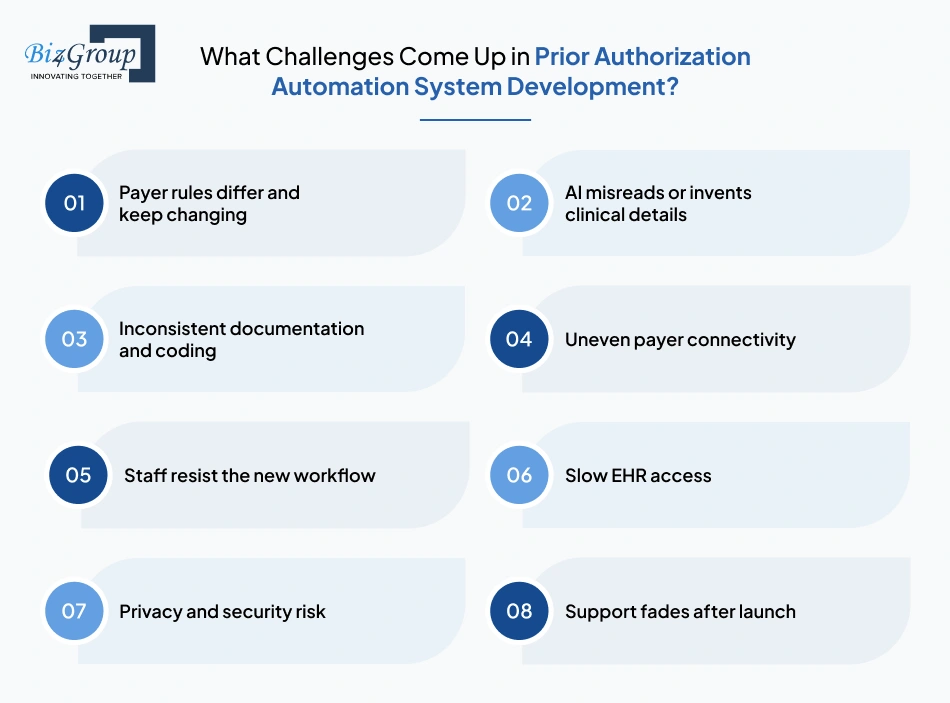
Across 1,000+ projects, we've seen the same pattern. Most builds in prior authorization automation system development for clinics don't stall because of the AI. They stall on payer variation, messy records, and staff adoption.
Here's what to plan for, and how we'd handle each one. This list isn't exhaustive, so a discovery phase with your team should surface the ones specific to your clinic.
|
Challenge |
Why it happens |
How to solve it |
|---|---|---|
|
Payer rules differ and keep changing |
Each payer sets its own criteria. Among the large insurers in KFF's August 2026 analysis, standard denial rates in Medicare Advantage ranged from 5% to 17% |
Keep payer policies in a versioned rules library, assign an owner, alert the team on changes, and rerun open cases against the new version |
|
AI misreads or invents clinical details |
Chart notes are messy, and language models can produce confident errors |
Extract only what's in the chart, link each fact to its source page, mark gaps as "missing," require clinician sign-off, and test on de-identified historical cases before go-live |
|
Inconsistent documentation and coding |
Providers document differently, and codes on the order don't always match the request |
Standardize templates and structured order fields, then pair validation with an {A(U+'/blog/ai-claim-scrubber-system-development','AI claim scrubber')} that catches coding and documentation errors before claims go out |
|
Uneven payer connectivity |
Payers adopt electronic standards at different speeds |
Use FHIR where payers support it, X12 278 for standard electronic exchange, and portal automation for the rest, prioritized by your own volume |
|
Staff resist the new workflow |
Coordinators distrust tools they didn't help design |
Involve coordinators in design, run the platform beside your manual process, and roll out one department at a time |
|
Slow EHR access |
EHR vendors control API access, sandboxes, and sometimes fees |
Request access and confirm costs at kickoff. We connect through APIs and standard formats so your current operations keep running |
|
Privacy and security risk |
More patient data moves through more components |
Sign BAAs with every vendor, use encryption, multi-factor authentication, role-based access, and audit logs, and run code reviews and security testing before launch |
|
Support fades after launch |
Rules, models, and integrations drift over time |
Plan post-launch monitoring and maintenance, assign an owner on your side, and review your KPIs every month |
We follow a structured process: requirement analysis, data preparation, model selection, development, testing, and deployment. Agile check-ins keep you informed along the way. That's how we plan AI prior auth platform development for healthcare clinics, so the hard problems surface in week two, not month six.
KPIs Mid-Size Clinics Should Track After Deployment of AI Prior Authorization Platform
Once prior authorization workflows move into daily operations, clinics need clear performance visibility across approvals, payer response cycles, administrative workload, and workflow accuracy.
That is why AI prior authorization platform development for mid-size clinics should include structured KPI monitoring from the beginning instead of relying only on operational assumptions.
- Track how many authorization requests get approved during the first submission cycle without additional documentation requests or resubmissions. This helps clinics monitor workflow accuracy across payer environments.
- Monitor how frequently authorization requests are denied because rising denial patterns often indicate documentation gaps, payer rule mismatches, or workflow inconsistencies.
- Measure the average time required to move authorization requests from intake to final payer decision. This helps clinics identify workflow slowdowns and delayed approval cycles.
- Review how much staff time is being spent on each authorization request after deployment. Clinics can use this KPI to monitor administrative workload changes across departments.
- Monitor the number of authorization requests remaining unresolved inside active queues. Large pending volumes usually indicate payer bottlenecks or workflow handling issues.
- Track how often denied authorization cases are successfully overturned through appeals. This helps clinics evaluate the quality of supporting documentation and payer response handling.
- Measure how frequently authorization requests enter workflows with incomplete records or missing information. This KPI helps identify documentation quality problems early.
- Monitor how many cases require manual escalation outside automated workflows. Higher escalation volume often signals workflow exceptions or payer-specific approval complications.
Consistent KPI monitoring gives clinics a clearer operational view of how authorization workflows perform after deployment. AI prior authorization management platform development becomes easier to manage when teams continuously track approval patterns, workflow delays, and operational exceptions across departments.
Why Choose Biz4Group for Custom AI Prior Authorization Platform Development?
Biz4Group is an Orlando, Florida AI software company founded in 2003, with 1,000+ delivered projects and a focus on HIPAA-compliant healthcare software. For clinics, we bring healthcare data standards expertise, our own denial management product.
|
Fact |
Detail |
|---|---|
|
Founded and headquartered |
2003, Orlando, FL (additional office in the Bay Area, CA) |
|
Track record |
1,000+ projects, 750+ clients, 85% client retention |
|
Independent reviews |
4.9/5 on Clutch (28 reviews), 4.8/5 on Upwork (120+ reviews) |
|
Healthcare standards |
HIPAA, HL7, FHIR, SMART on FHIR, X12/EDI |
|
Our own healthcare product |
Bill Matters, AI denial management and appeals |
Custom AI Prior Authorization Platform Development for Mid-Size Clinics
- We start with your baseline, your payers, and your EHR. Then we scope a narrow MVP you can measure.
- Our process covers requirements, security setup, integration, testing with healthcare scenarios, team training, and post-launch support.
- We connect through FHIR, HL7, and X12, so your current systems keep running. That's how we approach AI prior authorization system development.
The Denial Experience Behind the Platform
- Bill Matters is our AI denial management and appeals platform for US providers and billing companies. It reads denials, checks them against payer rules and prior authorization guidelines, and drafts evidence-backed appeals.
- A person reviews and signs off on every appeal before it reaches a payer. Patient data is encrypted, access is role-based, every action is logged, and your data never trains shared models. We hold clinic builds to the same standards.
- We also build on the insurance side, including AI insurance automation platform work for claims processing and policy support.
Four Questions to Ask Any Development Partner
- Will you sign a BAA?
- Who are the named architects, and what healthcare experience do they have?
- How do you test AI outputs before go-live?
- What support do you provide after launch?
Ask us the same questions on your first call. If you're weighing a build, we'll start with your numbers and give you a clear view of scope, cost, and timeline.
Wrapping Up!
Payers will keep changing their rules, and your clinic can't control what they decide. What you can control is how prepared your workflow is when a request goes out. Clinics that make progress usually start with their own baseline, pick a narrow scope, and measure results before expanding.
AI prior authorization platform development works best when it fits how your coordinators, billing team, and clinicians already work. Eligibility checks, payer matching, clear evidence, and human sign-off work together to reduce avoidable denials. HIPAA and CMS-0057-F planning also belong in the design from the start.
That is where Biz4Group supports mid-size clinics. As a HIPAA compliant AI healthcare software development company, we bring AI consulting, product development, and healthcare integration experience into practical workflow planning.
Ready to talk through your clinic's authorization workflow? Book an appointment with our team.
FAQs
1. How much does AI prior authorization platform development cost for a medical clinic?
Most projects for mid-size clinics cost between $30,000 and $250,000, and your number will differ. AI prior authorization platform development costs depend on payer count, EHR integration depth, automation scope, and compliance requirements. Budget for ongoing costs too. That includes payer rule updates, model monitoring, security reviews, and cloud usage.
2. How long does AI prior authorization system development take?
At Biz4Group, AI prior authorization system development typically takes 2 to 4 weeks for an MVP and 6 to 8 weeks for an enterprise-scale build, depending on payer count, EHR connections, and automation depth.
3. Can AI approve or deny prior authorization requests on its own?
On the clinic side, no. A prior authorization automation platform prepares and submits requests, and the payer makes the decision. Several states now limit payers from using AI as the sole basis for a denial. Even so, design your platform with clinician sign-off, evidence links to the chart, and an audit trail of every AI suggestion.
4. Is an AI prior authorization platform HIPAA compliant?
No AI model is HIPAA compliant by itself. Compliance depends on how the system is deployed. A HIPAA compliant AI prior authorization automation system needs business associate agreements with every vendor, minimum necessary data use, encryption, multi-factor authentication, role-based access, audit logs, and a documented risk analysis. Confirm that no patient data trains shared models.
5. Will the platform work with our existing EHR?
Yes. Healthcare prior authorization AI platform development typically connects to your current EHR through FHIR, HL7, or the vendor's API, so you don't replace it. The depth of integration depends on the API access and any fees your EHR vendor sets. Confirm access early, before scoping.
6. Should we build a custom platform or buy software?
Buy when your payers and workflows are standard and your volume is modest. Choose custom AI prior authorization platform development for mid-size clinics when you have an unusual payer mix, need deep EHR integration, or want to own your rules and data. Many clinics combine both. Also check whether a tool covers procedures and imaging or only prescriptions, since those run on different networks.
7. Does CMS-0057-F require our clinic to build or buy a prior authorization platform?
No. The rule applies to payers: Medicare Advantage, Medicaid and CHIP managed care, and federal exchange plans. Your clinic isn't directly regulated. The payer APIs due January 1, 2027 do affect what a platform can connect to, so build on FHIR R4 and Da Vinci standards. A partner experienced in prior authorization management platform development can help you plan for both.
