 Location :
Orlando, FL, USA
Location :
Orlando, FL, USA +1 (407) 714-1616
 info@biz4group.com

 AI-Powered Summary
- AI insurance claims automation uses specialized AI agents across FNOL, document processing, triage, evidence analysis, fraud investigation, settlement, and communication.
- An AI orchestrator connects agents and existing claims, policy, CRM, payment, and document systems while managing claim state, permissions, and escalations.
- Human oversight remains essential for complex, disputed, high-value, or consequential claims.
- Implementation should start with one measurable workflow and track accuracy, cycle time, exceptions, overrides, and cost per claim.
- Planning estimates range from $30K-$75K for a focused pilot to $75K-$200K for a production workflow, depending on scope and integrations.
- If you're looking to build AI insurance claims automation, Biz4Group can help you design and deploy an AI solution around your existing workflows, systems, integrations, and approval processes.
What if the biggest bottleneck in a claim isn't the adjuster, the policy, or even the damage itself, but the dozens of small decisions happening between them?
A claim can start with an FNOL (First Notice of Loss), move through coverage checks, document review, damage assessment, fraud screening, approvals, and payment, with different people and systems touching the same case along the way. AI insurance claims automation is changing how insurers handle that coordination. Instead of asking one AI system to do everything, multi-agent agentic AI can give different agents specific jobs, pass structured findings between them, and bring a human into the loop when judgment is required.
The timing matters. Deloitte's 2026 analysis of nearly 4,000 P&C customer responses across 12 insurers found that the claims process has an above-average influence on future purchase decisions, yet ranked lowest among the factors driving positive customer sentiment.
One lesson from building AI for insurance teams, we have learned that people trust a system that shows its sources and hands off cleanly far more than one that sounds confident. That shapes how we approach claims. Agents should prepare and route information, and people should decide.
So, how are AI agents for claims processing being used in 2026? We break down the architecture, automation, integrations, governance, and where humans still call the shots.
What Is Multi-Agent Agentic AI in Insurance Claims, and When Is It Better Than a Single AI Agent?
Multi-agent agentic AI in insurance claims uses multiple specialized AI agents to handle different parts of a claim while coordinating through a shared workflow. It is more useful than a single AI agent when claims involve several dependent tasks, systems, evidence types, and approval points.
A single agent can handle focused work such as extracting policy details or summarizing a claim. A multi-agent system becomes relevant when a workflow spans multiple stages. These may include coverage verification, document analysis, damage assessment, fraud investigation, decision support, settlement, and communication.
The goal is not to add more AI agents. It is to give each agent a controlled responsibility and coordinate their work through an orchestrator.
1. AI Automation, AI Agents, And Multi-agent Systems: The Differences
The difference comes down to how much decision-making the system can perform.
|
Approach |
What it does |
Claims use case |
|---|---|---|
|
Executes predefined rules and workflows |
Routing, notifications, status updates |
|
|
Interprets context, selects actions, and completes a task |
FNOL intake, claim summarization, document review |
|
|
Multi-agent system |
Coordinates specialized agents across a workflow |
Complex claims involving coverage, evidence, assessment, fraud, and settlement |
Traditional AI Insurance automation works well when the input and outcome are predictable. AI agents are useful when the system needs to interpret information and decide what to do next. Multi-agent AI adds specialization when one claim requires several types of analysis.
For example, one agent can verify coverage, another can extract evidence from documents, another can assess damage, and another can identify potential fraud indicators. The results can then feed into a decision-support agent or human adjuster.
Also Read: How InsurTech Companies Are Automating Workers Compensation Claims Using Generative AI
2. The Orchestrator, Specialized Agents, And Human Teams
The orchestrator manages the workflow. It determines which agent should act, passes the required context, tracks claim state, and triggers escalation when predefined conditions are met.
Specialized agents should have narrow responsibilities and controlled permissions. A typical setup might include:
- FNOL agent: Captures and structures initial claim information.
- Coverage agent: Checks policy terms, limits, exclusions, and eligibility.
- Document agent: Extracts information from statements, invoices, estimates, and other evidence.
- Assessment agent: Analyzes images, video, or repair estimates where applicable.
- Fraud agent: Flags inconsistencies and investigation signals.
- Decision-support agent: Combines findings into an adjuster-ready recommendation.
- Communication agent: Prepares claimant updates based on claim status.
Human teams remain responsible for decisions that require professional judgment. An adjuster may approve a recommendation, an SIU investigator may handle a flagged claim, and a supervisor may approve a high-value settlement.
This separation also supports AI claims governance. An agent may be allowed to recommend a reserve change without being authorized to make that change itself. The same principle applies to payments, coverage decisions, and claimant communications.
3. Complex Claims and Interdependent Tasks That Need Several Specialized Agents
Multi-agent AI for claims processing is most valuable when one task depends on the outcome of another. A coverage finding can determine what evidence is required. New evidence can change a damage assessment. A fraud signal can stop an otherwise routine settlement path.
A complex claim may therefore follow:
FNOL → Coverage → Evidence → Assessment → Investigation → Decision support → Approval
Each stage can have its own agent while the orchestrator controls the sequence and dependencies.
This architecture fits claims with multiple documents, conflicting evidence, complex coverage conditions, external data sources, fraud indicators, or several approval levels. For straightforward claims, a rules engine or single AI agent may be easier to operate and audit.
4. High Claim Volumes and Exception-heavy Workflows That Fixed Rules Cannot Handle
High volume alone does not justify multi-agent claims automation. The stronger use case is high volume combined with exceptions, unstructured information, or decisions that fixed rules cannot handle reliably.
- Rules work well for: Policy status checks, required fields, claim routing, notifications, and other predictable tasks.
- Agents add value when: The system must interpret documents, compare evidence, identify missing information, or determine the next workflow.
- Selective automation works best: Agents handle repeatable, information-heavy work while ambiguous, high-value, or sensitive claims go to people.
- Start with the workflow: If one agent can reliably complete a task, adding multiple agents only adds complexity. Multi-agent architecture makes more sense when several specialized tasks need to interact.
How Do AI Agents Automate Claims Processing from FNOL to Settlement?
AI agents for claims processing can automate the claim journey by assigning specialized tasks to different agents, from first notice of loss (FNOL) through settlement and closure. Each agent works on a defined part of the workflow, while the broader system maintains claim context and routes exceptions to the appropriate human team.
1. FNOL Agents Capture, Validate, And Structure Claim Information
FNOL AI agents turn initial claimant information into structured claim data. They can capture details from forms, calls, emails, images, or other intake channels, then check for missing or inconsistent information before creating or updating the claim.
The agent can also identify the likely claim type, collect required evidence, and trigger the next workflow instead of making an adjuster manually organize the initial submission.
2. Coverage And Triage Agents Assess Severity and Route Claims
Claims triage AI evaluates the initial claim against policy information and available loss details to determine the appropriate workflow. It can identify potential coverage issues, estimate severity categories, and route claims based on predefined business rules and AI-derived findings.
Low-complexity claims can move toward automated processing, while claims involving coverage uncertainty, high exposure, or sensitive circumstances can be escalated.
3. Document Agents Extract and Organize Evidence
AI document processing for insurance claims extracts relevant information from estimates, invoices, medical records, police reports, statements, policy documents, and other claim evidence.
Instead of simply producing text summaries, the agent can structure key fields, associate documents with the claim, identify missing records, and pass relevant information to downstream agents.
4. Assessment Agents Analyze Images, Video, And Estimates
AI claims assessment can analyze submitted images or video for visible damage and compare repair estimates against the available evidence. Depending on the line of business, the agent may identify damage categories, estimate severity, or flag discrepancies for human review.
The output should support an adjuster's decision rather than be treated as an unquestioned assessment.
5. Investigation And Fraud Agents Connect Evidence and Flag Inconsistencies
AI fraud detection in insurance claims can compare information across statements, documents, prior claims, policy data, and other authorized sources to identify inconsistencies or unusual patterns.
The agent should generate investigation signals rather than automatically label a claimant as fraudulent. Cases that meet defined thresholds can be routed to SIU or another investigation team.
6. Decision-support Agents Prepare Summaries and Recommendations
Decision-support agents bring findings from the earlier stages into one claims view. They can prepare an adjuster-ready summary covering coverage findings, evidence, damage assessment, investigation signals, and unresolved issues.
This is where AI claims decision support can reduce review time without transferring final authority to the model.
7. Settlement Agents Coordinate Approvals and Payments
AI settlement automation can prepare settlement packages, verify required approvals, check payment information, and coordinate the next steps with payment systems.
For higher-value or sensitive claims, the agent can stop at recommendation or approval preparation rather than initiating payment autonomously.
8. Closure Agents Complete Post-Settlement Requirements
Once the settlement is approved, closure agents can verify that required documents, payment confirmations, reserves, notifications, and other closure tasks are complete.
They can also identify outstanding items and prevent a claim from being marked closed while required work remains.
9. Communication Agents Keep Claimants Informed at Every Stage
AI claims communication agents can generate status updates based on the actual claim state, explain requested documentation, and notify claimants when a workflow milestone changes.
The important control is context. Communications should be generated from verified claim data and approved templates or policies, rather than allowing an agent to improvise coverage or settlement statements.
How Do Multiple AI Agents Work Together on a Single Claim?
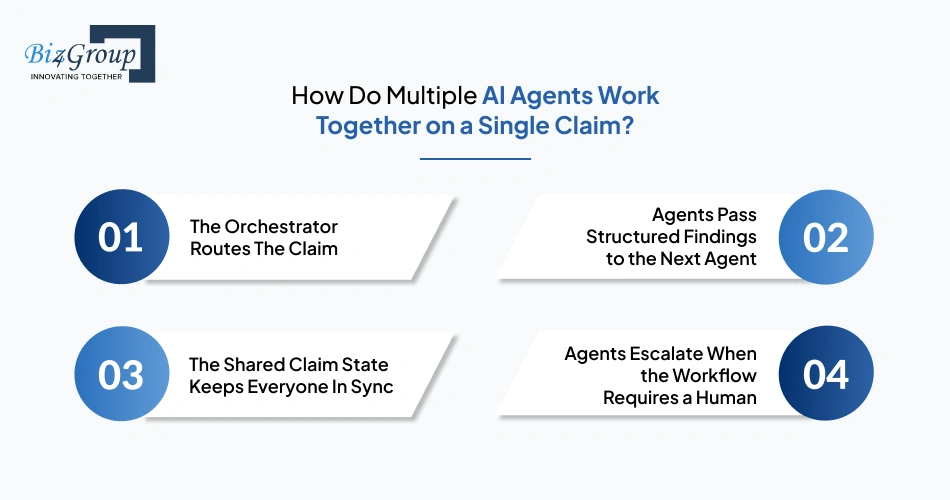
Multiple AI agents work together on a claim by taking specialized tasks, passing structured findings to the next agent, and updating a shared claim state throughout the workflow. An orchestrator manages the sequence so each agent receives the right context and performs only the actions it is permitted to take.
1. The Orchestrator Routes The Claim
The AI claims orchestrator determines what should happen next based on the claim's current state and completed tasks.
For example:
FNOL Agent → Coverage Agent → Document Agent → Assessment Agent → Decision Agent
The sequence can change based on the claim. If coverage information is incomplete, the workflow can pause for additional information instead of sending the claim to the next agent prematurely.
A simplified flow is:
Claim State → Orchestrator → Agent Task → Structured Result → Updated Claim State → Next Task
2. Agents Pass Structured Findings to the Next Agent
Agents should exchange structured findings rather than long conversational messages. This gives the next agent the specific context it needs without exposing the entire claim file.
For example, a Coverage Agent might return:
- Coverage status
- Applicable limits and deductibles
- Relevant policy references
- Missing conditions
- Confidence level
The Document or Assessment Agent can then use those findings as part of its own task.
3. The Shared Claim State Keeps Everyone In Sync
The shared claim state acts as the common record of what has happened, what is pending, and what information agents can use.
It can maintain:
- Claim ID and current status
- Policy and coverage information
- Evidence and document references
- Agent findings and confidence
- Completed and pending tasks
- Human decisions and overrides
- Escalation status
This prevents agents from starting each task from scratch and makes the workflow easier to trace and audit.
4. Agents Escalate When the Workflow Requires a Human
Agents can move a claim forward, but predefined conditions determine when a human needs to take over.
Common triggers include:
- Conflicting evidence
- Missing or ambiguous coverage information
- Low-confidence findings
- High-value claims
- Potential fraud indicators
- Actions outside an agent's permissions
When escalation occurs, the claim record should show what the agents found, which evidence they used, and what remains unresolved.
The result is a coordinated workflow rather than a collection of independent AI tools. Each agent handles its defined task, the orchestrator manages the handoffs, and the shared claim state keeps the entire process connected.
Claims Have Enough Plot Twists. Your Workflow Doesn't Need More.
Let's build AI that handles the busywork while your team stays in control.
Build Smarter ClaimsWhat Does AI Insurance Claims Automation Change for Claims Teams?
AI insurance claims automation changes the day-to-day claims experience by taking information-heavy work off people's plates and giving each team better context when they need to act.
|
Team |
What changes |
|---|---|
|
Claims intake teams |
Less manual entry and faster handling of incoming claim information |
|
Adjusters |
More structured evidence and claim summaries before review |
|
SIU investigators |
Connected claim information and clearer investigation signals |
|
Claims managers |
Better visibility into workflow status, exceptions, and bottlenecks |
|
Customers |
Faster updates, fewer repetitive information requests, and more consistent communication |
|
IT teams |
An AI layer that can work with existing claims and enterprise systems |
The bigger benefit is coordination. Instead of each team chasing information across systems, specialized AI agents can prepare, connect, and route that information so people can focus on the decisions that actually need them.
What Data, Systems, and Integrations Does a Multi-Agent Claims System Need?
A multi-agent claims system needs reliable insurance data, access to existing business systems, and an integration layer that lets specialized agents exchange information and trigger approved actions.
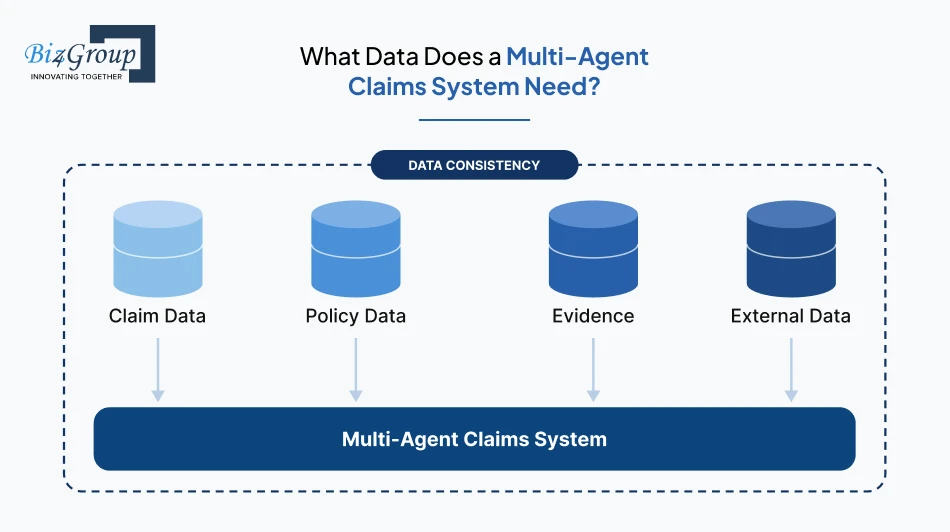
1. What Data Does a Multi-Agent Claims System Need?
The data layer gives agents the claim context they need to analyze information, make recommendations, and move workflows forward.
- Claim data: FNOL details, claim status, loss type, reserves, adjuster notes, and claim history.
- Policy data: Coverage, limits, deductibles, exclusions, effective dates, and endorsements.
- Evidence: Photos, videos, estimates, invoices, statements, inspection reports, and correspondence.
- External data: Weather, property, vehicle, repair-cost, identity, medical, or authorized fraud-related data, depending on the claim.
- Data consistency: Every document, policy, party, and event should map reliably to the correct claim.
2. What External Data Sources Can AI Claims Agents Use?
External data sources provide information that is not available in the insurer's internal systems but may help agents assess a claim.
Depending on the line of business, these can include:
- Weather and property data
- Vehicle and repair-cost information
- Identity and verification services
- Medical information
- Authorized fraud-related databases
Each source should carry its origin, timestamp, permissions, and reliability context so agents can assess the information appropriately.
3. Which Agents Typically Make Up a Multi-Agent Claims System?
An agent roster defines the specialized AI responsibilities within the claims workflow. Each agent handles a focused task rather than having one AI system do everything.
|
Agent |
Primary responsibility |
Typical inputs |
|---|---|---|
|
FNOL Agent |
Intake and validation |
Forms, calls, emails |
|
Coverage Agent |
Policy and coverage analysis |
Policy + claim data |
|
Document Agent |
Information extraction |
PDFs, invoices, statements |
|
Assessment Agent |
Evidence and damage analysis |
Images, video, estimates |
|
Fraud Agent |
Inconsistency detection |
Claim + historical data |
|
Decision Support Agent |
Findings and recommendations |
Agent outputs |
|
Communication Agent |
Claimant updates |
Claim status |
The orchestrator controls which agent runs, what context it receives, and what happens after the task is completed.
4. How Do AI Agents Connect to Existing Insurance Systems?
The AI layer connects to existing insurance systems through multiple APIs and integration services, allowing agents to retrieve approved information and perform authorized actions without replacing the core claims platform.
Common connections include:
- Claims management systems
- Policy administration platforms
- CRM systems
- Payment systems
- Document repositories
- Communication platforms
A typical architecture is:
AI Agents → Orchestrator → Integration Layer → Core Insurance Systems
The integration layer handles authentication, permissions, data transformation, logging, retries, and error handling. For legacy platforms, middleware, adapters, message queues, or controlled data pipelines can provide the required connectivity.
This lets insurers add AI around their existing claims ecosystem while keeping core systems as the source of truth.
5. How Does the Data Flow Through a Multi-Agent Claims System?
Data flows through a multi-agent claims system as structured records that are retrieved, updated, and passed between controlled workflow steps. The system keeps the claim context consistent while limiting each agent to the information and actions required for its task.
A typical data flow includes:
- Input: FNOL details, policy information, documents, images, estimates, and other claim evidence enter the workflow.
- Context building: Relevant data is validated, linked to the correct claim, and organized into a shared claim state.
- Agent processing: Each agent receives only the data required for its assigned task and returns a structured result.
- State updates: Findings, confidence levels, completed tasks, and outstanding information are added to the claim record.
- Next-step routing: The orchestrator uses the updated state to determine the next approved action or workflow.
- Human handoff: If a decision requires human review, the relevant findings and supporting evidence are presented together.
This approach keeps claim context, data access, and workflow actions connected, without giving every agent unrestricted access to the entire claim file.
Can AI Agents Make Claims Decisions? Where Humans Stay in Control
AI agents can support and, in narrowly defined workflows, execute claims decisions, but insurers should set explicit boundaries around what an agent can recommend, approve, or execute. Coverage disputes, fraud determinations, high-value settlements, and other consequential decisions generally require defined human oversight and documented approval controls.
1. Automate, Assist, Or Escalate: A Decision Model
A practical AI claims decision-making model separates actions into three levels:
|
Level |
AI role |
Typical claims tasks |
|---|---|---|
|
Automate |
Agent executes within defined rules and permissions |
Data validation, routing, document classification, routine notifications |
|
Assist |
Agent analyzes information and recommends an action |
Coverage analysis, damage assessment, reserve recommendations |
|
Escalate |
Agent stops and sends the case to a human |
Coverage ambiguity, conflicting evidence, fraud concerns, high-value claims |
The boundary should depend on risk, financial exposure, regulatory requirements, and confidence, not simply whether an AI model can technically perform the task.
For example, an agent may automatically classify a claim as low complexity, but a coverage dispute can require adjuster review even when the model has high confidence.
2. Adjuster, SIU, And Settlement Approval Points
Human control should be built into specific workflow decisions, not added as a fallback after deployment.
- Adjusters: Review coverage findings, damage assessments, and settlement recommendations.
- SIU teams: Take over when agents flag potential fraud indicators, conflicting evidence, or unusual claim patterns.
- Settlement teams: Approve payments that exceed defined thresholds or require additional authorization.
- Audit trail: Record the agent recommendation, supporting evidence, human decision, and any override.
- Continuous improvement: Use these records to identify where agents perform reliably and where tighter controls or additional review are needed.
The practical model is just to automate low-risk work, assist with information-heavy decisions, and escalate consequential cases to people.
What Are the Risks of AI in Claims, and How Should Insurers Govern Multi-Agent Systems?
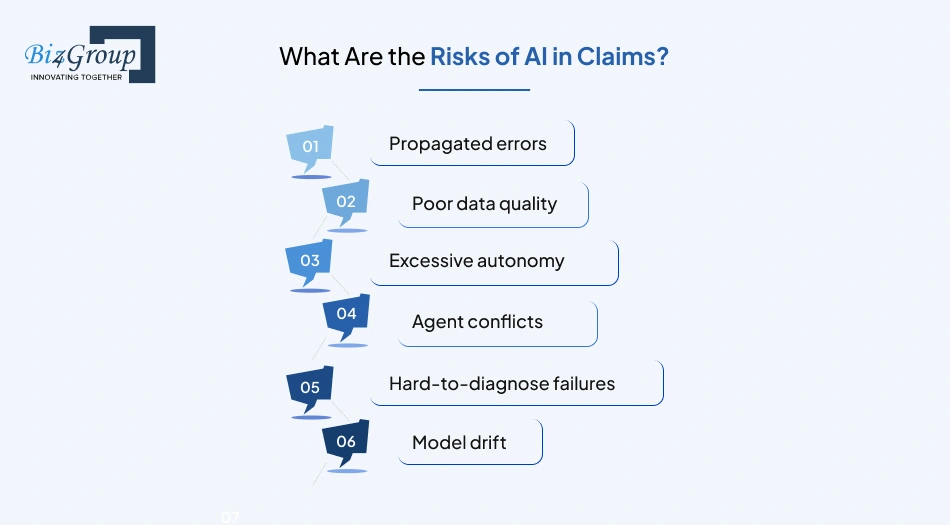
The biggest risks in multi-agent AI for claims come from how agents interact, not just from individual model errors. A wrong output can move downstream, poor data can affect multiple decisions, and excessive permissions can turn an AI mistake into a consequential action.
Biz4Group's Bill Matters platform illustrates why these controls matter in claims-related workflows. The platform reads denial codes, payer responses, and claim details, checks supporting evidence, and prepares an appeal for review. A person then reviews and signs off before the appeal is submitted.
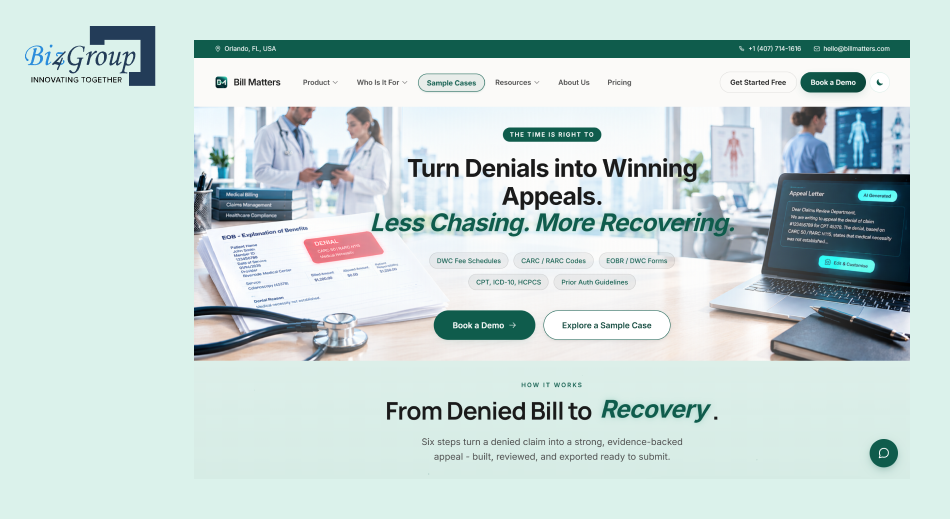
For AI insurance claims automation, agents can analyze evidence and prepare the next action while defined permissions, traceable inputs, and human approval control what ultimately changes the claim.
1. What Are the Main Risks in Multi-Agent Claims AI?
|
Risk |
What can happen |
Control |
|---|---|---|
|
Propagated errors |
One incorrect finding affects downstream agents |
Validate outputs before downstream actions |
|
Poor data quality |
Missing or outdated data produces unreliable results |
Source checks and data validation |
|
Excessive autonomy |
An agent performs an action beyond its authority |
Role-based permissions and approval gates |
|
Agent conflicts |
Agents produce contradictory findings |
Orchestrator rules and conflict handling |
|
Hard-to-diagnose failures |
Teams cannot identify where an error occurred |
Centralized logs and agent-level tracing |
|
Model drift |
Performance changes as models, policies, or data change |
Continuous evaluation and controlled updates |
The goal is not to eliminate every AI error. It is to prevent an incorrect output from automatically becoming an incorrect claim action.
2. What Should AI Claims Governance Cover?
A production AI claims governance framework should define:
- Permissions: What each agent can access, recommend, and execute.
- Audit trails: Agent inputs, outputs, versions, actions, approvals, and overrides.
- Accuracy testing: Performance against representative claims before and after deployment.
- Fairness testing: Checks for potentially unfair or discriminatory outcomes.
- Privacy: Controls for sensitive claimant and policyholder information.
- Change control: Versioning for models, prompts, tools, policies, and agent workflows.
- Human oversight: Clear escalation points for consequential decisions.
The NAIC's AI guidance states that AI-supported insurer decisions must comply with applicable insurance laws and sets expectations around AI governance and risk management.
3. What Are the Regulatory Limits on Autonomous Claims Decisions?
AI does not remove an insurer's existing regulatory responsibilities. In the U.S., insurers remain subject to applicable state insurance laws when AI makes or supports decisions affecting consumers.
The regulatory landscape is also developing:
- The NAIC adopted its Model Bulletin on the Use of Artificial Intelligence Systems by Insurers on December 4, 2023.
- As of April 1, 2026, 25 jurisdictions had adopted actions addressing the Model Bulletin topic, while four had insurance-specific AI regulation or guidance.
- The NAIC is developing and piloting an AI Systems Evaluation Tool to help regulators assess insurers' AI use, governance, risk mitigation, data inputs, and potentially high-risk AI models.
For insurers, the practical approach is to define agent permissions, human approval points, escalation rules, auditability, and regulatory requirements before deployment, rather than treating compliance as a final review step.
How Should Insurers Implement Multi-Agent AI Around Their Existing Claims Platform?
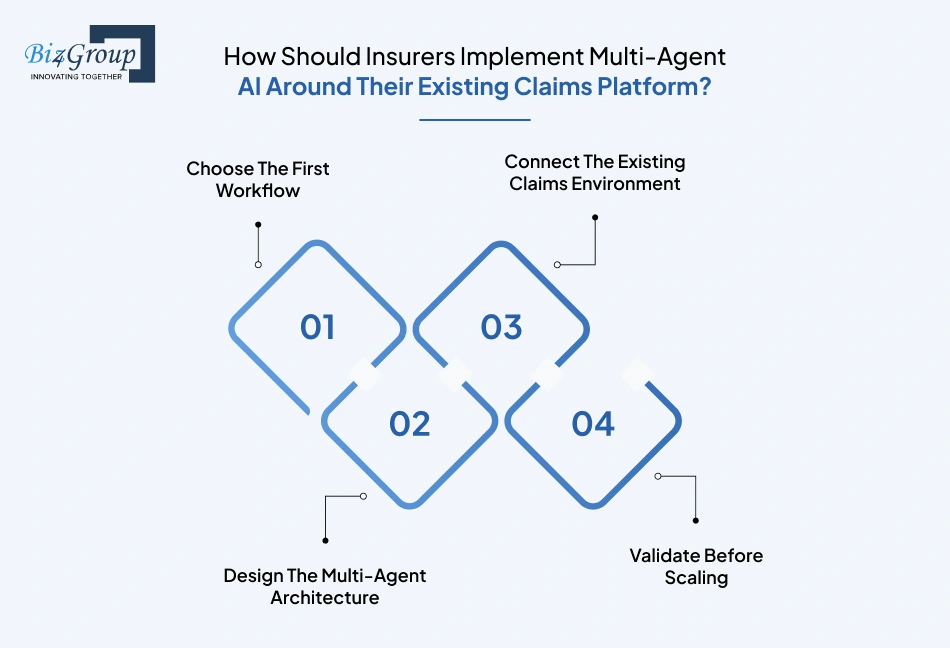
Insurers can introduce multi-agent AI as an intelligence and orchestration layer around their existing claims platform. The practical path is to start with one workflow, design the required architecture, connect it to existing systems, and expand after proving the results.
1. Choose The First Workflow
Start with a workflow that combines high volume, repetitive information work, measurable KPIs, and clear decision boundaries.
Good starting points include:
- FNOL intake
- Document processing
- Claims triage
- Adjuster decision support
Define the workflow first:
Input → AI tasks → System actions → Human approval → Outcome
This creates a clear scope for the pilot and gives the team a baseline for measuring results.
2. Design The Multi-Agent Architecture
Define the agents, orchestrator, data flow, permissions, and human decision points required for that workflow.
The architecture should establish:
- Which tasks each agent owns?
- What information each agent can access?
- How findings move between agents?
- Which actions require approval?
- What happens when information is missing or conflicting?
- How the workflow records agent activity?
Use the simplest architecture that reliably handles the workflow. If one agent can complete a task effectively, adding more agents only creates unnecessary complexity.
3. Connect The Existing Claims Environment
APIs, middleware, event-driven architecture, and controlled data pipelines can connect the AI layer with existing claims, policy, CRM, payment, and document systems.
A common pattern is:
Claims Platform → Integration Layer → Orchestrator → AI Agents → Integration Layer → Claims Platform
For legacy environments, controlled adapters, database views, message queues, or middleware can provide connectivity.
The integration layer should handle authentication, permissions, data transformation, logging, retries, and error handling, while the existing claims platform remains the system of record.
4. Validate Before Scaling
Start with a controlled pilot using representative claims and compare performance with the existing workflow.
Measure:
- Accuracy
- Cycle time
- Exception rate
- Human override rate
- Cost per claim
- Integration reliability
If the workflow meets its targets, expand gradually by claim type, geography, or business unit. Reuse the underlying orchestration, integration, evaluation, and governance infrastructure as new workflows are added.
Should Insurers Build, Buy, Or Partner For AI Claims Automation?
The right approach depends on how much of the existing claims stack already works.
|
Approach |
Best fit |
Trade-off |
|---|---|---|
|
Build |
Unique workflows, proprietary data, or strict control requirements |
Higher engineering and maintenance effort |
|
Buy |
Standardized capabilities with mature integrations |
Less architectural control and customization |
|
Partner |
Insurers that need specialized AI expertise without building the entire capability internally |
Requires careful vendor selection and coordination |
When the core claims platform works but the internal team needs expertise in agent architecture, AI integration, and production deployment, partnering with an AI development company can provide a practical path.
Evaluate potential partners based on:
- Insurance and enterprise workflow experience
- Integration capabilities
- Security and data residency
- Model and architecture control
- Explainability and governance
- Total cost of ownership
- Ability to support future workflows
How Can Insurers Build Multi-Agent Claims Automation With Biz4Group?
Biz4Group builds multi-agent claims automation around the claims platform you already use. The approach starts with one workflow, measures it against your current baseline, and expands only when the results support the next stage. Adjusters, SIU teams, and designated approvers remain responsible for consequential claims decisions.
What Does Working With Biz4Group Look Like?
|
Phase |
Timeline |
What We Do |
What You Get |
What We Need From You |
|---|---|---|---|---|
|
Discovery |
1-2 weeks |
Map one workflow, systems, pain points, and current KPIs |
Workflow map, baseline, recommended use case |
Workflow owner and process documentation |
|
Proof Of Concept |
2-4 weeks |
Test agents using representative claims and defined permissions |
Initial accuracy results, escalation rules, integration approach |
Anonymized claims and API or sandbox access |
|
Controlled Pilot |
4-6 weeks |
Run the workflow with human review around consequential actions |
Results against baseline, including overrides and exceptions |
Adjuster or SIU reviewer feedback |
|
Production Rollout |
6-8 weeks |
Add monitoring, audit trails, support, and expand the workflow |
Production-ready workflow and rollout plan |
Go-live approver and support contact |
Each phase ends with a go/no-go decision, giving the insurer control over whether and when to move forward.
Common Questions Before A Claims Automation Project
- Will it work with our legacy claims system? Usually, yes. The approach depends on the interfaces available, using APIs, middleware, or controlled adapters while keeping the claims platform as the system of record.
- Who makes the final claims decision? Your team. Before development, we define what agents can automate, recommend, or escalate. Consequential decisions can remain with adjusters, investigators, or designated approvers.
- How will we measure the results? We establish a baseline first, then compare the same claim types using cycle time, override rate, exception rate, and cost per claim.
- How is claimant data handled? Access is restricted by agent role, actions are logged, and data-hosting, model-provider, retention, and access requirements are defined before the proof of concept.
What Insurance AI Experience Does Biz4Group Bring?
Biz4Group's published Insurance AI work focuses on helping insurance professionals access policy and training information through an evolving knowledge platform.
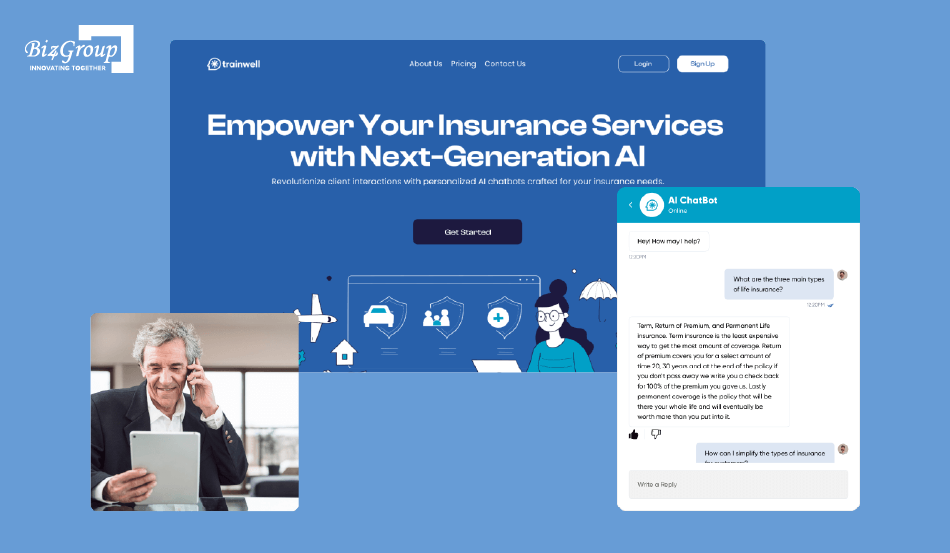
That experience provides a foundation for working with insurance data, knowledge workflows, AI integration, and professional decision support. For claims automation, the discovery and proof-of-concept stages allow the proposed architecture to be tested against the insurer's own workflow before a broader production rollout.
Your Claims Stack Already Works. Let's Make It Work Smarter.
Explore a multi-agent AI solution designed around your workflows, systems, and business goals.
Talk to Biz4GroupHow Should Insurers Measure Results and Estimate Cost?
Insurers should measure AI claims automation against operational and financial baselines, not AI activity metrics. The useful question is whether the system reduces claim cycle time, manual effort, leakage, and unnecessary escalations without increasing overrides, errors, or compliance risk.
1. Claims KPIs: Cycle Time, Override Rate, Leakage, And Straight-through Processing
The right KPI set should cover both automation efficiency and decision quality.
|
KPI |
What it measures |
What to watch |
|---|---|---|
|
Cycle time |
Time from FNOL to claim resolution |
Compare automated and non-automated claims |
|
Override rate |
How often humans reject or change AI recommendations |
High rates may indicate poor agent performance or unsuitable automation boundaries |
|
Claims leakage |
Unnecessary claim costs caused by errors, missed controls, or inconsistent handling |
Measure against a consistent baseline |
|
Straight-through processing (STP) |
Share of eligible claims completed without manual intervention |
Track only for workflows where autonomous processing is permitted |
|
Exception rate |
Claims requiring human intervention |
Separate legitimate escalations from AI failures |
|
Cost per claim |
Operational cost required to process a claim |
Include AI, infrastructure, integration, and human review costs |
Do not optimize STP in isolation. A higher automation rate is not a success if it increases incorrect settlements or forces adjusters to spend more time correcting AI outputs.
For AI claims processing, establish the baseline before deployment, then measure the same claim types under comparable conditions. This makes it easier to determine whether an improvement came from the AI system rather than changes in claim mix, staffing, or workflow.
2. Cost Drivers By Scope
The cost of a multi-agent claims system depends less on the number of agents than on the complexity of the workflow, integrations, data, and controls required.
|
Implementation Level |
Typical Cost Range |
What It Covers |
|---|---|---|
|
Small Pilot |
$30K-$75K |
One focused workflow, such as FNOL intake, document processing, or claim triage |
|
Production Workflow |
$75K-$200K |
One production-ready workflow with system integration, testing, security, and human review |
|
Multiple Workflows |
$200K-$500K+ |
Several claims workflows with shared AI infrastructure and multiple integrations |
|
Enterprise Program |
$500K+ |
Large-scale claims automation across multiple lines, systems, teams, and business units |
These are planning ranges, not fixed prices. Actual cost depends on workflow complexity, integrations, data readiness, security requirements, and the level of AI autonomy required.
The major cost drivers are:
|
Cost driver |
Typical cost contribution |
What increases the cost |
|---|---|---|
|
AI architecture |
15%-25% |
Multiple specialized agents, orchestration, evaluation, observability |
|
Data |
10%-20% |
Unstructured documents, historical claims, data cleaning, labeling |
|
Integrations |
20%-30% |
Legacy claims platforms, policy systems, payment systems, CRM, external APIs |
|
AI models |
10%-20% |
Model usage, specialized vision or document models, model hosting |
|
Security and governance |
10%-15% |
Access controls, audit trails, privacy controls, testing |
|
Human oversight |
5%-15% |
Adjuster review, exception handling, quality assurance |
|
Production operations |
5%-10% |
Monitoring, model evaluation, maintenance, incident handling |
These percentages are budgeting guidance rather than fixed vendor pricing. Costs can overlap during implementation, particularly where engineering work covers both architecture and integrations.
For example, on a $500,000 production implementation, the planning ranges would put roughly $75K-$125K into AI architecture, $100K-$150K into integrations, and $50K-$100K into AI models, with the remaining budget distributed across data, governance, human oversight, and production operations.
A focused FNOL or document-processing workflow can require far less investment than an enterprise platform spanning multiple lines of business, external data providers, payment systems, and autonomous decision paths.
For budgeting, insurers should estimate total cost of ownership, not just model or vendor fees. The business case should compare implementation and operating costs against measurable changes in processing time, staffing effort, leakage, claim capacity, and customer experience.
Final Thoughts
Multi-agent AI can take a lot of the busywork out of insurance claims, especially when claims involve multiple systems, piles of documents, specialized tasks, and decisions that still need a human in the loop.
The trick isn't having more agents. It's having the right agents doing the right jobs, keeping everyone synced through a reliable claim workflow, and knowing when it's time to hand things back to a human.
For insurers, the best way to get started is simple: pick one workflow, like FNOL, document processing, triage, or adjuster support. Connect it to the systems you already use, put the right permissions and audit controls in place, measure the results, and scale once it works in the real world.
And no, AI doesn't mean taking people out of the picture. Agents can handle repetitive tasks, spot patterns, prepare recommendations, and move information between systems. Adjusters, investigators, and settlement teams can stay focused on the decisions that require context, accountability, and good judgment.
At Biz4Group LLC, our Insurance AI project shows how AI can support insurance professionals with policy and training information. For insurers exploring multi-agent AI, we apply the same practical approach to existing workflows and tech stacks, starting with one question: Which workflow can we improve, and how will we measure it?
Ready to see what multi-agent AI could look like in your claims workflow? Let's talk architecture, integrations, and a practical path to production.
FAQs
1. How is a multi-agent claims system different from a claims chatbot?
A multi-agent claims system operates inside the claims workflow, while a claims chatbot primarily handles conversations. A chatbot may collect information or answer status questions, whereas AI agents for claims processing can perform tasks such as document analysis, claims triage, evidence processing, and workflow coordination.
2. How Much Does AI Insurance Claims Automation Cost?
A focused pilot typically costs $30K-$75K and can take 2-4 weeks. A production workflow may cost $75K-$200K and take 6-8 weeks, depending on integrations, data readiness, security, and workflow complexity.
3. How do insurers evaluate AI claims automation before going live?
Test accuracy, processing time, exception rates, human overrides, integration reliability, auditability, and cost per claim using representative claims data. Evaluate the complete workflow, not just the AI model.
4. What should insurers look for in an AI claims automation partner?
Look for experience with insurance workflows, enterprise integrations, AI governance, security, human oversight, and production deployment. The partner should also be able to work with your existing claims infrastructure.
5. What types of insurance claims are best suited for AI automation?
Claims with high volumes, repeatable workflows, structured decision criteria, and significant documentation are generally suitable for AI claims automation. Auto, property, travel, and selected health insurance workflows can contain strong use cases, although suitability depends on the insurer's data, systems, and regulatory requirements.
6. How accurate are AI claims processing agents compared to human insurance adjusters?
There is no single accuracy figure for AI claims processing because performance varies by task. AI can perform strongly on activities such as document extraction, classification, and data validation, while ambiguous coverage, conflicting evidence, liability, and unusual claims require greater human oversight. Insurers should evaluate accuracy at the individual task level rather than treat the entire claims system as one AI capability.
7. Can AI agents process insurance claims in real time?
AI agents can process many claims tasks in near real time when the required data and system integrations are available. End-to-end processing speed still depends on document availability, external data, human approvals, investigations, payment systems, and claim complexity.
8. How do you scale AI insurance claims automation beyond a pilot?
Start with a measurable workflow, validate performance in production, then expand by claim type, workflow, or business unit. Reuse the core orchestration, integration, governance, and monitoring layers as adoption grows.
9. Looking for a partner to build an AI insurance claims system?
If you are evaluating AI insurance claims automation, Biz4Group can help design and develop the AI layer around your existing claims workflows, integrations, and systems, with experience building AI solutions for insurance workflows and knowledge management.
10. How do I start an AI insurance claims automation project?
Start with one workflow where the business outcome can be measured clearly. Define the current process and baseline, identify tasks suitable for AI agents for claims processing, map integrations and human approval points, and validate the workflow through a controlled pilot before expanding to additional claim types.
