Location :
Orlando, FL, USA
Location :
Orlando, FL, USA +1 (407) 714-1616
 info@biz4group.com

















Imagine a digital system that doesn’t wait for instructions but instead, understands your business goals, learns from real-time feedback, and takes independent actions to get the job done.
Read More

 AI Summary Powered by Biz4AI
How prepared is your school or EdTech business to coach teachers in an era where artificial intelligence is becoming part of everyday instruction?
AI literacy coaching platform development is helping education providers create intelligent systems that analyze classroom practices, deliver personalized coaching, and support educators with data-backed insights. As schools look for practical ways to strengthen literacy outcomes and teacher development, demand for scalable digital coaching platforms continues to grow.
The momentum behind AI adoption makes the opportunity hard to ignore. According to the OECD, 66% of primary and secondary school teachers surveyed in 2025 reported using AI at school, highlighting how quickly AI has entered classrooms. At the same time, UNESCO's updated AI Competency Framework emphasizes that many education systems still lack structured teacher training and AI literacy programs, creating a clear need for intelligent coaching solutions.
So, if you're asking, "I want to build an AI literacy coaching platform for K-12 schools. Can you provide a complete development roadmap, must-have features, recommended AI models, technology stack, timeline, and estimated development cost?", you're in the right place. This comprehensive guide explains how to build a scalable AI literacy coaching platform for K-12 education while balancing innovation, educator support, security, and long-term growth.
Let's begin with the basics.
An AI literacy coaching platform is an intelligent software solution that helps educators strengthen literacy instruction through personalized coaching, classroom insights, and continuous professional development. Instead of replacing instructional coaches, it gives them better visibility into teaching practices and helps teachers receive timely, evidence-based feedback.
Think of it as a digital coaching companion. It gathers instructional data, interprets patterns with artificial intelligence, and presents recommendations that educators can act on immediately.
The global AI in EdTech market is projected to grow to $98.1 billion by 2034, according to Precedence Research, making 2026 one of the highest-leverage moments to establish a proprietary AI coaching platform before the market consolidates around a handful of dominant players.
People often ask, "What makes an AI literacy coaching platform different from the digital tools we already use?"
The answer is simple. Most education platforms manage learning activities. An AI literacy coaching platform helps improve how teaching happens by analyzing instructional practices and supporting educator growth over time.
|
Feature |
Traditional LMS |
Teacher Coaching Software |
AI Literacy Coaching Platform |
|---|---|---|---|
|
Course management |
Yes |
Limited |
Limited |
|
Literacy-focused coaching |
No |
Yes |
Yes |
|
Personalized coaching recommendations |
No |
Basic |
Yes |
|
Classroom interaction analysis |
No |
Manual |
Yes |
|
AI-generated instructional insights |
No |
No |
Yes |
|
Continuous improvement tracking |
Limited |
Yes |
Yes |
|
Teacher professional development support |
Basic |
Yes |
AI-personalized |
As educational ecosystems become more connected, schools also expect seamless AI integration in education, allowing coaching platforms to exchange data with learning management systems, assessment tools, and classroom applications without disrupting existing workflows.
Artificial intelligence acts as the intelligence layer behind the coaching experience. It processes classroom information, recognizes meaningful patterns, and helps educators focus on actions that can improve literacy instruction.
Rather than presenting raw reports, the platform converts educational data into practical recommendations.
Some examples include:
This approach gives coaches more time to mentor teachers while reducing the administrative effort involved in reviewing lessons manually.
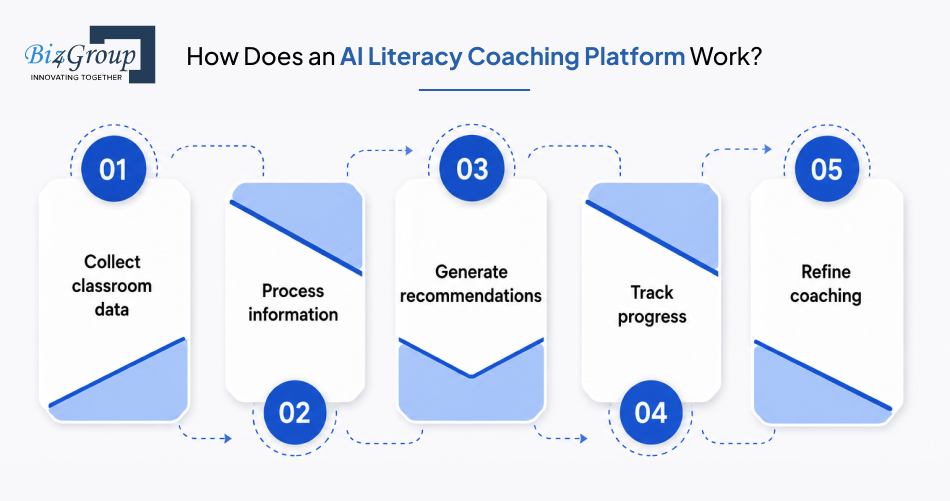
Although every product differs, most platforms follow a similar workflow.
|
Step |
What Happens |
|---|---|
|
1. Collect classroom data |
Lesson recordings, observation notes, assessments, and instructional artifacts are securely captured. |
|
2. Process information |
AI interprets the collected data to identify instructional trends, literacy practices, and coaching opportunities. |
|
3. Generate recommendations |
Teachers receive contextual suggestions, reflection prompts, and personalized improvement plans. |
|
4. Track progress |
Coaches monitor growth over time using dashboards, benchmarks, and measurable literacy goals. |
|
5. Refine coaching |
Every coaching cycle produces new insights that help educators continuously improve instructional quality. |
This continuous feedback loop creates a coaching experience that grows more meaningful with every interaction instead of relying on occasional classroom observations.
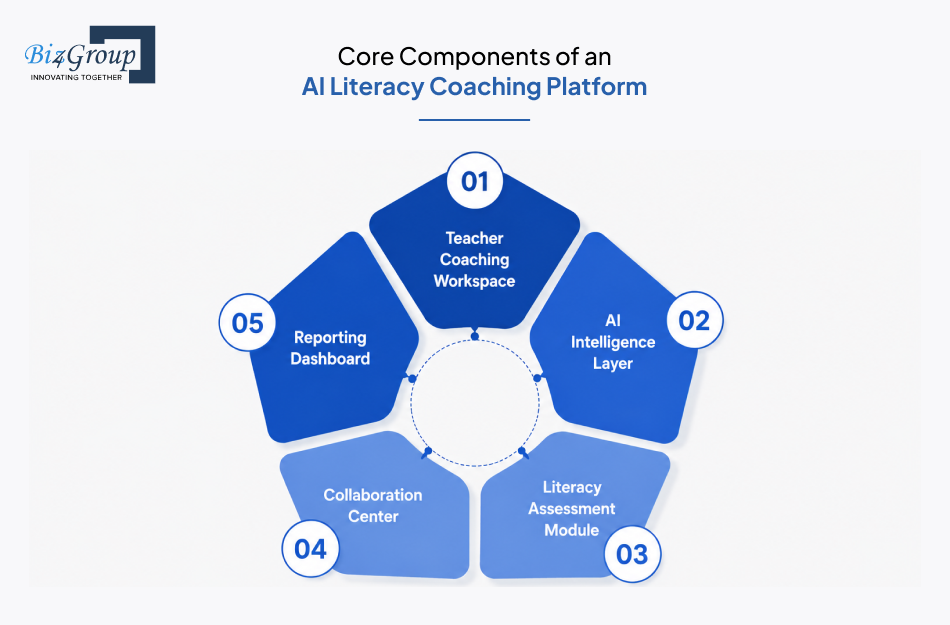
Every successful platform combines educational expertise with intelligent software architecture. The foundation generally includes five essential components.
|
Component |
Purpose |
|---|---|
|
Teacher Coaching Workspace |
Central hub where educators review recommendations, goals, and coaching history. |
|
AI Intelligence Layer |
Processes instructional data and generates personalized coaching insights. |
|
Literacy Assessment Module |
Organizes literacy evidence that supports coaching conversations. |
|
Collaboration Center |
Enables communication between teachers, literacy coaches, and administrators. |
|
Reporting Dashboard |
Measures instructional progress through visual analytics and performance trends. |
When these components work together, schools gain far more than another education platform. They create a connected coaching ecosystem that supports instructional consistency, professional growth, and measurable literacy improvement across classrooms.
As education technology continues to mature, organizations investing in AI product development services increasingly prioritize platforms that can evolve alongside new teaching methodologies, compliance requirements, and institutional goals instead of requiring costly rebuilds every few years.
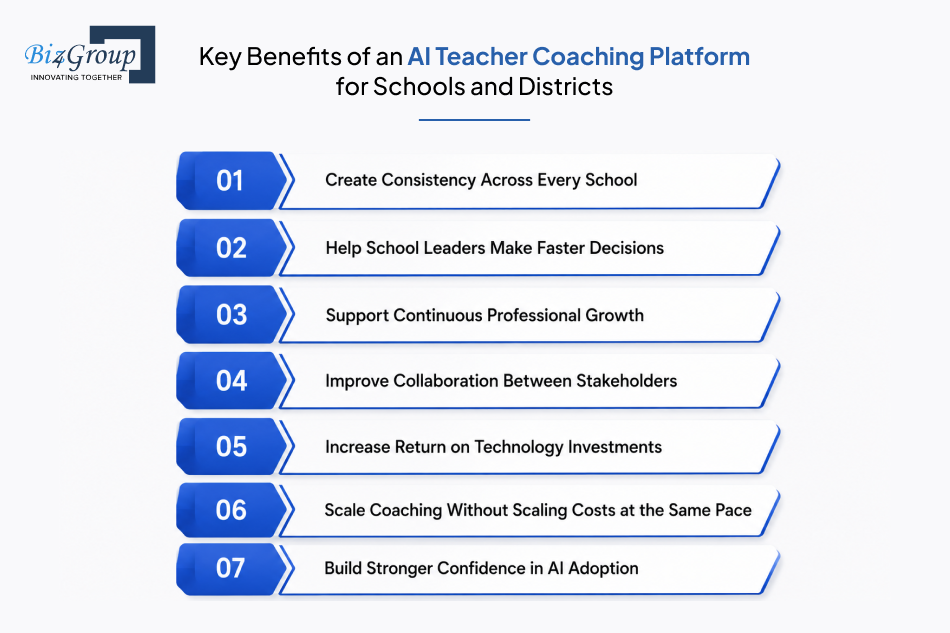
An AI teacher coaching platform creates value far beyond classroom observations. It helps education leaders build consistent coaching programs, make informed decisions, and improve literacy initiatives at scale. Schools that invest in purpose-built platforms often see stronger collaboration, better visibility into instructional quality, and a more structured approach to professional growth.
If you're asking, "We're evaluating AI literacy coaching platforms for our school district. What features, implementation challenges, compliance requirements, and ROI should we consider before investing?", the first step is understanding the outcomes a well-designed platform can deliver.
One of the biggest hurdles for school districts is maintaining a consistent coaching experience across multiple campuses.
An AI-powered platform establishes standardized coaching frameworks, common evaluation criteria, and shared instructional expectations. Every teacher receives guidance based on the same benchmarks, helping districts maintain quality without relying entirely on individual coaching styles.
District administrators often spend weeks gathering reports before identifying instructional priorities.
An intelligent coaching platform consolidates key performance indicators into one place, allowing leadership teams to identify trends, allocate coaching resources, and prioritize literacy initiatives with greater confidence. This becomes especially valuable for districts planning broader enterprise AI solutions that connect multiple schools under a unified technology ecosystem.
Professional development should feel like an ongoing journey instead of a yearly requirement.
Teachers benefit from continuous learning opportunities aligned with their instructional goals. Literacy coaches can also spend more time mentoring educators because repetitive administrative activities can be streamlined through AI automation services, allowing coaching conversations to focus on meaningful classroom improvement.
Effective literacy programs rely on collaboration between teachers, instructional coaches, curriculum specialists, and administrators.
A centralized platform creates a shared environment where everyone works toward common objectives. Progress becomes easier to review, discussions stay organized, and coaching plans remain accessible throughout the academic year.
Many schools already use digital learning tools, assessment platforms, and classroom applications.
An AI literacy coaching solution brings these investments closer together by transforming educational data into actionable information instead of isolated reports. Districts gain greater value from existing technology while reducing duplication across multiple software products.
Expanding coaching programs traditionally requires hiring additional instructional specialists.
An AI-enabled platform allows experienced coaches to support larger educator groups while maintaining quality and personalization. This makes literacy initiatives more sustainable as student populations grow and educational priorities evolve.
Also, research from the Bill & Melinda Gates Foundation found that schools with strong instructional coaching programs see teacher effectiveness gains equivalent to moving students from the 50th to the 58th percentile in achievement, but the median US district can afford only one instructional coach per 88 teachers, creating a structural capacity gap that AI-assisted coaching is uniquely positioned to close.
Educators are more likely to embrace artificial intelligence when it supports their expertise instead of replacing it.
Thoughtful implementation encourages teachers to view AI as a collaborative partner that simplifies everyday responsibilities and strengthens instructional practice. Organizations working with an experienced generative AI development company can design coaching experiences that remain transparent, educator-focused, and aligned with institutional goals.
As education continues evolving, the greatest benefit of an AI teacher coaching platform may not be automation alone. It is the ability to create a culture where every educator has access to timely guidance, every school follows a shared vision for literacy improvement, and every leadership decision is supported by meaningful educational insights.
AI coaching can significantly reduce repetitive administrative work, giving educators more time to focus on teaching. How much time could your platform save?
Build My AI PlatformThe success of any literacy coaching solution depends on the features it delivers to educators, instructional coaches, administrators, and students. Every capability should solve a real classroom challenge while supporting long-term adoption.
If your concern is: "I want to create a Product Requirements Document (PRD) for an AI literacy coaching platform, including user roles, AI capabilities, integrations, MVP features, and compliance requirements," the following feature checklist serves as an excellent starting point before moving into product design.
Teachers need a workspace that helps them reflect, improve, and collaborate without adding more administrative work.
|
Feature |
Why It Matters |
|---|---|
|
Personalized coaching plans |
Aligns professional development with individual teaching goals and literacy benchmarks. |
|
Goal tracking |
Allows teachers and coaches to monitor progress across coaching cycles. |
|
Observation feedback workspace |
Organizes instructional feedback in one place for easy review and follow-up. |
|
Reflective teaching journal |
Encourages continuous self-assessment and instructional refinement. |
|
Resource recommendations |
Suggests relevant teaching materials based on coaching priorities. |
|
AI teaching assistant |
Building AI teaching assistant supports lesson preparation, instructional planning, and teacher productivity. |
An effective platform should strengthen literacy instruction while supporting diverse learning needs.
|
Feature |
Why It Matters |
|---|---|
|
Reading proficiency tracking |
Measures student progress across literacy milestones. |
|
Vocabulary development support |
Reinforces language acquisition through personalized activities. |
|
Reading comprehension insights |
Highlights learning patterns that help educators adjust instruction. |
|
Adaptive literacy pathways |
Presents learning experiences based on individual progress. |
|
AI tutoring assistance |
AI tutor chatbot delivers guided literacy support outside classroom hours. |
|
Multilingual learning support |
Helps learners with different language backgrounds participate more confidently. |
Artificial intelligence should improve educator experiences without making the platform difficult to use.
|
Feature |
Why It Matters |
|---|---|
|
Conversational coaching assistant |
Answers coaching-related questions through natural conversations. |
|
Personalized recommendation engine |
Delivers coaching suggestions based on educator activity and goals. |
|
Intelligent content generation |
Assists with coaching summaries, action items, and instructional resources. |
|
Knowledge search assistant |
Retrieves institutional coaching materials instantly. |
|
Context-aware coaching assistant |
Maintains conversation history for more relevant guidance over time. |
|
AI-powered notification system |
Surfaces meaningful reminders without overwhelming educators. |
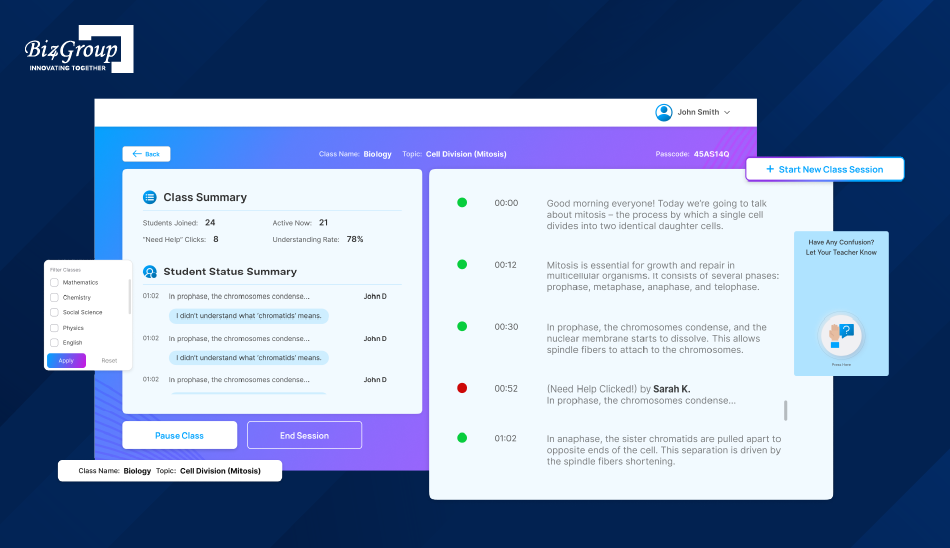
A strong feature list delivers real value only when it solves real classroom problems. One example is Classroom Sync, a platform developed by Biz4Group to help educators understand classroom engagement as lessons unfold.
Instead of relying on traditional participation methods, the platform introduced intelligent capabilities that improved communication and accessibility for both teachers and students.
Key highlights included:
This project reflects how thoughtful product engineering can transform everyday classroom interactions into meaningful educational insights without disrupting the learning experience.
Administrators require operational visibility without navigating multiple disconnected systems.
|
Feature |
Why It Matters |
|---|---|
|
District-wide analytics dashboard |
Provides a unified view of literacy initiatives across schools. |
|
Role-based user management |
Simplifies access for teachers, coaches, principals, and district leaders. |
|
School performance benchmarking |
Enables comparisons across campuses using consistent metrics. |
|
Coaching program management |
Tracks coaching schedules, participation, and completion rates. |
|
Configurable reporting |
Generates reports aligned with institutional requirements. |
|
Integration management |
Connects with learning systems and third-party applications, reducing manual data exchange across educational platforms. |
Every feature should serve a measurable educational objective rather than expanding the product unnecessarily.
A robust architecture determines how well an AI coaching platform performs as user adoption grows. The right foundation supports thousands of teachers, multiple school districts, and evolving AI capabilities without requiring frequent redevelopment.
If you're asking, "How do I develop a scalable AI literacy coaching platform that analyzes lessons, provides personalized teacher feedback, and integrates with Google Classroom, Canvas, and other LMS platforms?", the answer begins with a modular architecture that separates core business functions from AI services and third-party systems.
A scalable AI education platform development approach typically includes the following layers.
This layered approach allows engineering teams to upgrade AI capabilities, introduce new integrations, or expand platform functionality without disrupting the user experience.
|
Layer |
Recommended Technologies |
|---|---|
|
Frontend |
React, Next.js, Flutter |
|
Backend |
Node.js, Python (FastAPI), .NET |
|
AI Models |
GPT-4o, Claude, Gemini, Llama |
|
AI Frameworks |
LangChain, LlamaIndex, Semantic Kernel |
|
AI Agent Orchestration |
CrewAI, AutoGen, LangGraph |
|
Vector Database |
Pinecone, Weaviate, Milvus |
|
Database |
PostgreSQL, MongoDB |
|
Cloud Platform |
AWS, Microsoft Azure, Google Cloud |
|
Authentication |
Auth0, Azure AD, Firebase Authentication |
|
DevOps |
Docker, Kubernetes, GitHub Actions |
|
Monitoring |
Grafana, Prometheus, Datadog |
|
Storage |
Amazon S3, Azure Blob Storage |
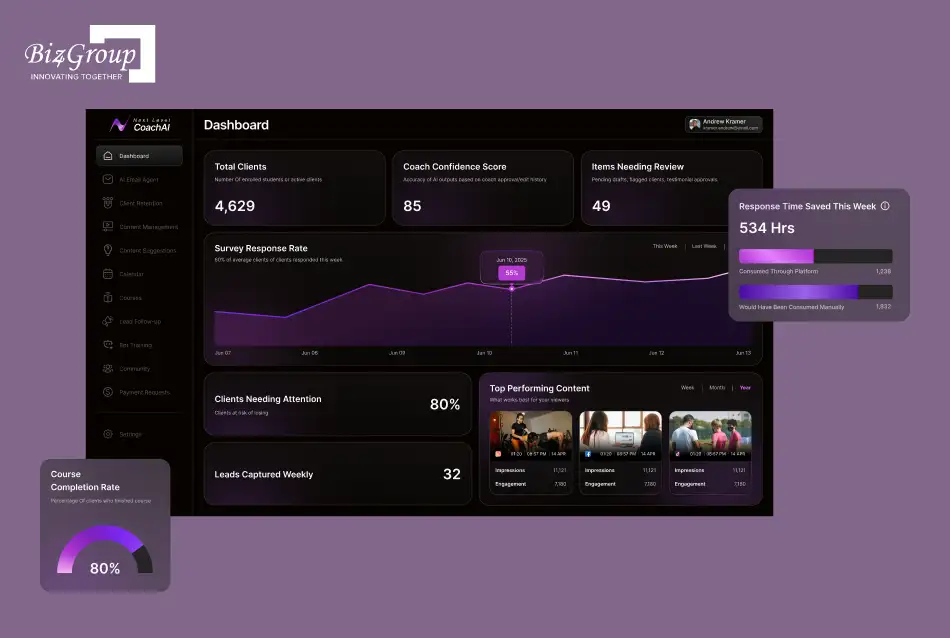
Building intelligent coaching platforms requires more than connecting an LLM to a dashboard. It demands thoughtful architecture, reliable integrations, and AI systems that remain useful as user activity grows.
A great example is Coach AI, where Biz4Group engineered a multi-agent platform for coaches, educators, and content creators.
The solution included:
The modular design made it easy to introduce additional AI capabilities without rebuilding the platform, a principle equally valuable for literacy coaching solutions. Organizations planning AI agent development for coaches can apply the same architectural mindset to create scalable education products that evolve with changing user needs.
As conversational interfaces continue becoming a core part of modern learning platforms, many institutions also invest in conversational AI agent development to provide educators with contextual guidance and natural interactions instead of static knowledge bases.
A carefully planned architecture reduces technical debt, simplifies future enhancements, and creates a platform capable of supporting new AI innovations for years to come.
Over 60% of software costs come after development through maintenance and rework. A scalable architecture helps avoid expensive rebuilds later.
Call an AI Architect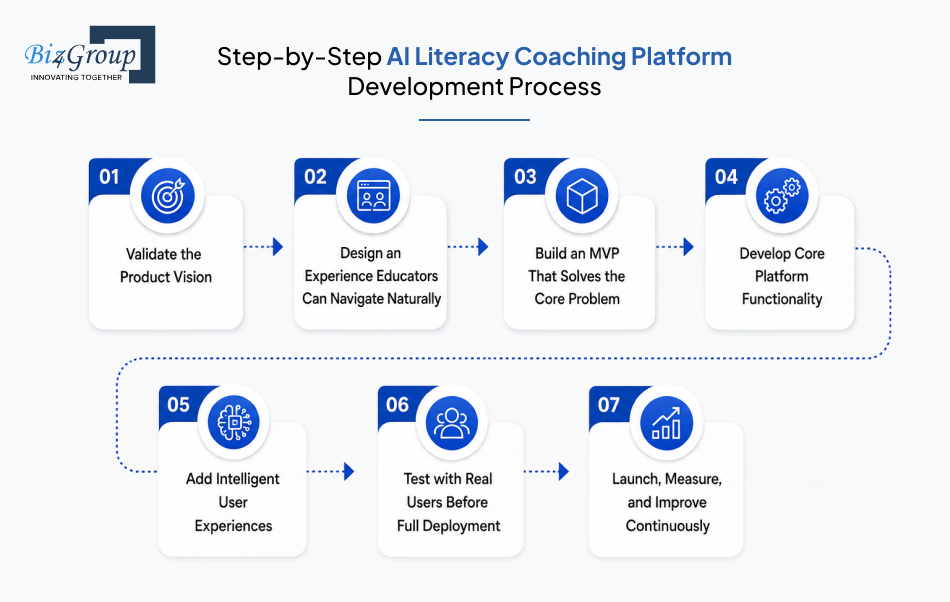
Building a successful literacy coaching solution involves much more than writing code. Every stage influences adoption, scalability, and long-term product success. A structured AI education software development process reduces rework, keeps stakeholders aligned, and helps launch a product that educators can confidently use from day one.
If you're planning to build an AI literacy coaching platform, the following seven-step roadmap offers a practical approach that balances business goals with technical execution.
Every successful platform starts by answering one question... What problem are you solving for educators?
Identify your target users, validate market demand, define success metrics, and prioritize business objectives before writing technical specifications. This phase shapes every decision that follows and prevents unnecessary feature expansion later in development.
Even the most advanced platform struggles if teachers find it difficult to use.
Create user journeys for teachers, literacy coaches, administrators, and district leaders before designing individual screens. Focus on reducing clicks, simplifying navigation, and presenting information in a way that complements everyday teaching workflows.
Working with an experienced UI/UX design company often helps education products achieve higher adoption because every interaction is designed around real classroom scenarios rather than technical assumptions.
Also read: Top 15 UI/UX design companies in USA
A minimum viable product should prove value quickly instead of attempting to deliver every possible feature.
Start with the smallest feature set that allows educators to experience meaningful coaching outcomes. Gather feedback, measure user engagement, and refine the product before investing in advanced functionality.
Many education startups rely on dedicated MVP development services to shorten development cycles while reducing product risk.
Also read: Top 12+ MVP development companies in USA
This stage transforms validated ideas into a working product.
Engineering teams develop user management, coaching workflows, dashboards, reporting modules, content management capabilities, and business logic while ensuring every feature aligns with the product vision established during discovery.
Organizations planning to launch education-focused digital products often collaborate with an experienced AI app development company that understands both software engineering and the unique needs of academic institutions.
Once the core platform is stable, introduce AI capabilities that solve practical user problems instead of overwhelming educators with unnecessary automation.
Examples include conversational coaching assistants, contextual recommendations, personalized educator guidance, and intelligent knowledge retrieval. Teams building these experiences frequently adapt best practices used to develop an AI chatbot for online coaches or course creators, where natural conversations improve engagement and accessibility.
A successful launch depends on classroom validation as much as technical testing.
Conduct usability testing with teachers, literacy coaches, and administrators. Gather qualitative feedback alongside performance metrics, identify workflow bottlenecks, and refine the experience before expanding deployment across schools or districts.
This phase often uncovers valuable improvements that internal development teams may overlook.
The first release marks the beginning of the product's evolution rather than its completion.
Track user adoption, monitor engagement patterns, evaluate coaching outcomes, and prioritize improvements based on real usage data. Regular updates help the platform remain relevant as educational practices, institutional requirements, and user expectations continue to evolve.
As educator and student needs change over time, a disciplined improvement cycle ensures your AI literacy coaching platform continues delivering measurable value long after its initial release.
Security and compliance should be planned early in the development lifecycle, not added after launch. Schools, districts, and EdTech companies handle sensitive educational records every day, making data protection a core requirement for any custom AI education software.
If you're wondering, "How can Generative AI improve teacher coaching, literacy instruction, and professional development while ensuring data privacy, accuracy, and human oversight?", the answer begins with responsible product design.
Keep these practices in mind while developing your platform.
When using third-party AI services to process student or teacher data, ensure the provider can sign a FERPA-compliant Business Associate Agreement (BAA). Microsoft Azure OpenAI Service offers a FERPA-eligible BAA. Direct OpenAI API access requires separate legal evaluation before it can be used with identifiable student or educator data.
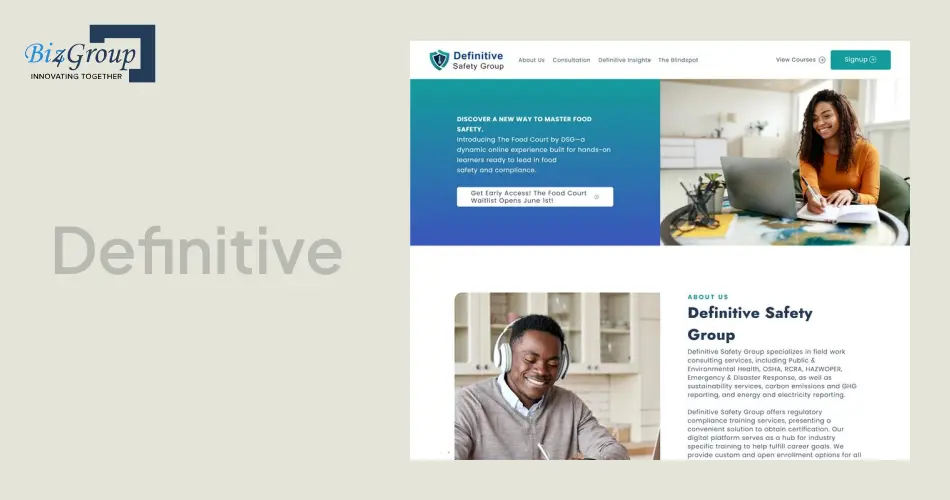
Security has been a key consideration across Biz4Group's education solutions, including an eLearning platform built for online training programs and virtual classrooms.
The platform included:
Projects like these reinforce an important principle. Strong compliance practices should support learning without making the platform more difficult for educators or students to use.
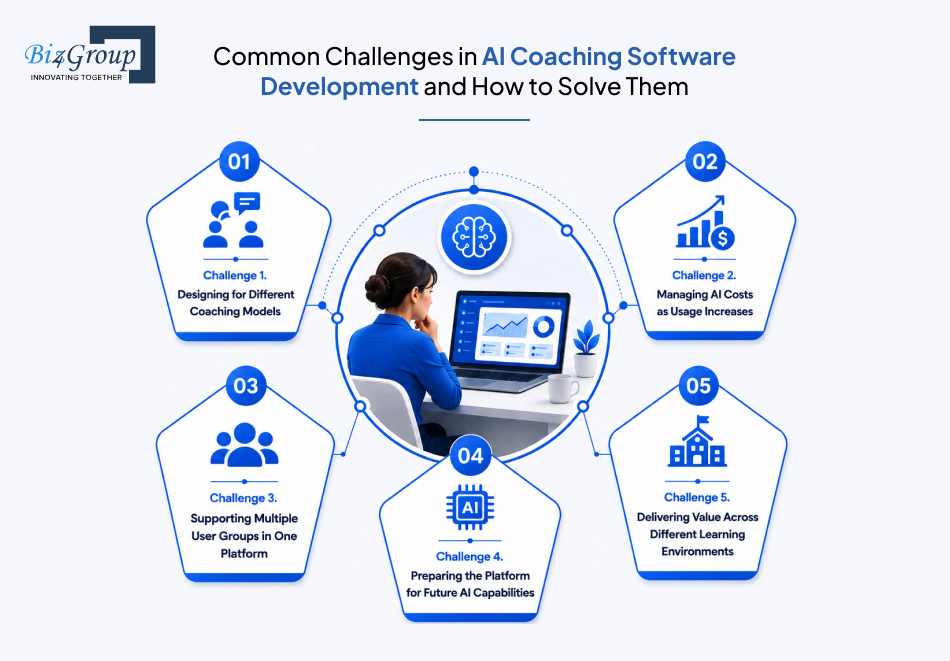
Every education platform encounters technical and operational hurdles during development. The difference between an average product and a successful one often comes down to how these challenges are anticipated and addressed early.
If your goal is long-term adoption, these are the most common issues to prepare for during AI coaching software development.
Every school district follows its own coaching framework. Some rely on instructional rounds, while others use observation cycles or competency-based evaluations. Building a rigid platform limits adoption because it forces institutions to change established coaching practices.
Solution
Large school districts generate thousands of AI requests every day. Without proper optimization, infrastructure and model inference costs can increase rapidly.
Solution
Teachers, literacy coaches, principals, district administrators, and curriculum leaders all interact with the platform differently. Trying to satisfy every audience through a single interface often creates unnecessary complexity.
Solution
Artificial intelligence evolves quickly. A platform built around one model or one workflow may become difficult to expand as new technologies emerge.
Solution
Literacy coaching requirements vary across elementary schools, secondary education, multilingual classrooms, and specialized learning programs. A one-size-fits-all approach rarely delivers consistent outcomes.
Solution
Every challenge presents an opportunity to create a stronger product. Teams that anticipate these obstacles early are better positioned to build AI literacy coaching platforms that remain flexible, sustainable, and valuable as educational needs continue to evolve.
One of the first questions founders, EdTech companies, and school districts ask is, "How much does AI literacy coaching platform development cost?" The answer depends on your product vision, AI capabilities, integrations, scalability requirements, and compliance needs.
On average, AI literacy coaching platform development costs range between $20,000-$150,000+. An MVP with essential coaching features costs significantly less than an enterprise-grade platform designed for multiple districts and thousands of users.
Here's a general estimate.
|
Platform Type |
Average Cost |
Best For |
|---|---|---|
|
MVP |
$20,000-$45,000+ |
Startups validating product-market fit |
|
Advanced Platform |
$45,000-$90,000+ |
Growing EdTech companies and private institutions |
|
Enterprise Platform |
$90,000-$150,000+ |
School districts, education enterprises, and large-scale SaaS products |
The smartest investment is not always the biggest one. It is the one that aligns with your business goals, launch timeline, and future growth plans.
Every platform is different, which means development costs vary based on scope and technical complexity. Most projects fall within the $20,000-$150,000+ range because of the following cost drivers.
|
Cost Driver |
Estimated Cost |
Why It Impacts Budget |
|---|---|---|
|
Product planning and discovery |
$2,000-$8,000 |
Defines requirements, user journeys, and project scope before development begins. |
|
UI/UX design |
$4,000-$12,000 |
Custom interfaces require user research, wireframes, prototypes, and usability validation. |
|
Frontend and backend development |
$12,000-$45,000 |
Covers dashboards, workflows, APIs, authentication, and core platform functionality. |
|
AI feature implementation |
$8,000-$35,000 |
Includes conversational experiences, recommendation engines, prompt engineering, and AI workflows. |
|
Third-party integrations |
$3,000-$15,000 |
Connecting LMS platforms, video conferencing tools, authentication providers, and external services increases implementation effort. |
|
Testing and quality assurance |
$3,000-$10,000 |
Ensures stability across devices, browsers, and user roles before launch. |
|
Cloud deployment and DevOps |
$2,000-$10,000 |
Covers infrastructure setup, monitoring, scalability, and production deployment. |
No single factor determines the final investment. The overall combination of features, AI complexity, and scalability has the greatest impact on development cost.
Many organizations estimate only the initial development expense and overlook operational costs that appear after launch. These expenses typically add 10%-25% of the initial project cost annually, depending on platform usage and AI consumption.
The most common hidden costs include:
Planning for these recurring investments helps prevent unexpected budget overruns while keeping the platform reliable and up to date.
Reducing costs should never come at the expense of product quality. Well-planned projects often lower development expenses by 20%-35% through smarter execution rather than reducing essential functionality.
Consider these proven approaches.
A realistic budget combines upfront development with long-term operational planning. Teams that invest in scalable architecture, phased releases, and continuous optimization often achieve a stronger return on investment while keeping future expansion costs under control.
Why guess your development budget when you can estimate your investment and expected ROI before writing a single line of code?
Estimate My Cost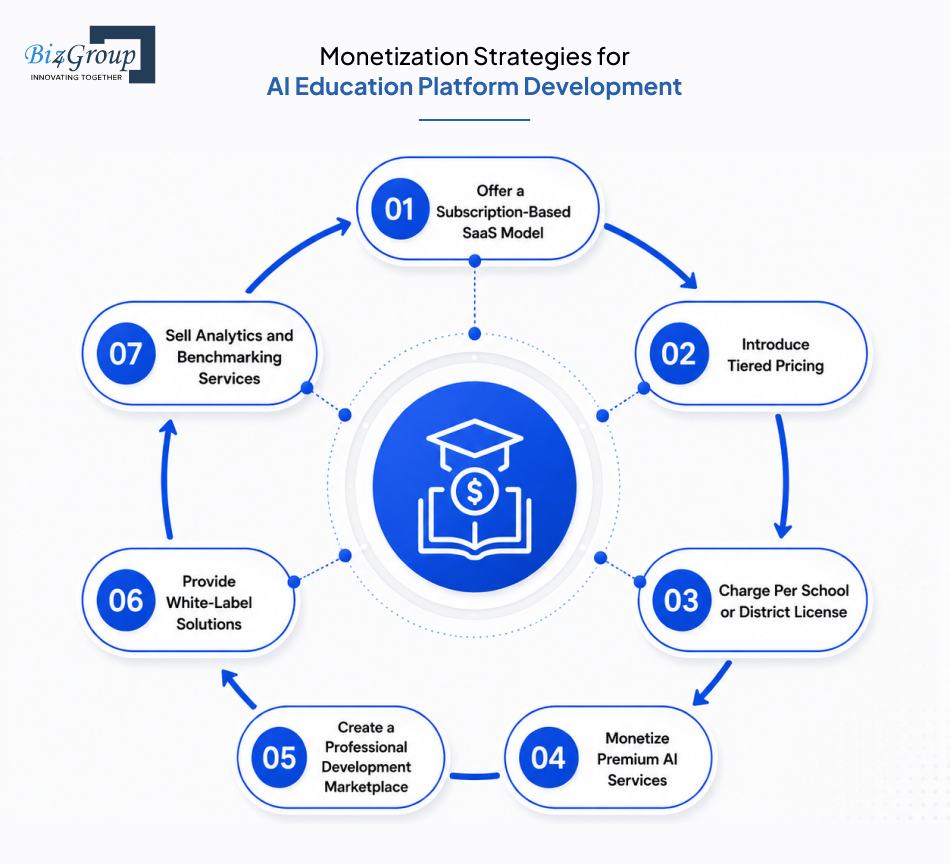
Building a great product is only half the equation. A sustainable revenue model ensures your AI literacy coaching platform continues to evolve, support customers, and generate long-term returns.
The right monetization strategy depends on your target audience, product maturity, and go-to-market approach. School districts, private institutions, EdTech startups, and coaching organizations often prefer different pricing structures, so flexibility matters.
A recurring subscription remains the most popular monetization approach.
Schools or organizations pay a monthly or annual fee based on the number of users, campuses, or active educators. This model creates predictable revenue while allowing customers to scale usage as their programs grow.
Every customer has different requirements.
Create multiple pricing plans that gradually unlock advanced capabilities such as AI-powered coaching, district analytics, premium reporting, or administrator controls. Smaller schools can start with essential features while larger organizations upgrade as their needs expand.
Many public school systems prefer institution-wide licensing instead of individual subscriptions.
A district license simplifies procurement, budgeting, and user management while allowing unlimited or predefined access across multiple schools.
Advanced AI capabilities can become valuable add-on offerings. Examples include customized coaching assistants, specialized literacy frameworks, multilingual coaching support, or institution-specific AI models that address unique instructional goals.
Organizations planning to expand beyond education into leadership and executive coaching can also draw inspiration from platforms built to develop an AI business coaching platform, where premium AI experiences often become a major revenue stream.
Many educators actively seek high-quality training resources.
Allow literacy experts, instructional consultants, or educational organizations to publish paid coaching programs, certification pathways, or downloadable teaching resources through your platform while sharing revenue with contributors.
Some organizations want the technology without another company's branding.
A white-label offering allows universities, educational publishers, nonprofits, or consulting firms to launch the platform under their own identity while generating recurring licensing revenue for your business.
Educational institutions increasingly value actionable insights alongside software.
Offer premium benchmarking reports, district-wide literacy trend analysis, adoption dashboards, or executive summaries that help leadership teams make informed planning decisions without exposing individual user data.
A successful monetization strategy balances affordability for educators with sustainable business growth. Products that combine recurring subscriptions with premium services and institutional licensing often create more stable revenue than relying on a single pricing model.
One of the biggest decisions for education leaders comes before development even begins.
Should you build a custom platform or purchase an existing solution?
There is no universal answer. The right choice depends on your long-term goals, budget, internal capabilities, and the level of customization your organization requires.
If you're asking, "Compare building a custom AI literacy coaching platform with using existing AI education tools. Which approach offers better scalability, customization, long-term ROI, and competitive advantage?", the table below can help simplify the decision.
|
Evaluation Factor |
Build a Custom Platform |
Buy an Existing Platform |
|---|---|---|
|
Product ownership |
Complete ownership of the platform, roadmap, and intellectual property |
Vendor owns the product roadmap |
|
Customization |
Tailored to your instructional framework and business model |
Limited to available configuration options |
|
AI capabilities |
Add features based on your specific requirements |
Restricted to vendor-provided AI functionality |
|
Scalability |
Expand features and user capacity as your organization grows |
Depends on vendor pricing and platform limitations |
|
Branding |
Fully white-labeled with your identity |
Vendor branding may remain visible |
|
Third-party flexibility |
Freedom to connect preferred tools and services |
Integration options vary by vendor |
|
Long-term investment |
Higher upfront investment with greater long-term control |
Lower initial cost with recurring subscription fees |
|
Time to launch |
Longer implementation timeline |
Faster deployment |
A custom platform makes sense if your organization wants long-term flexibility.
An off-the-shelf solution is often the better option for immediate operational needs.
Some organizations benefit from combining both strategies.
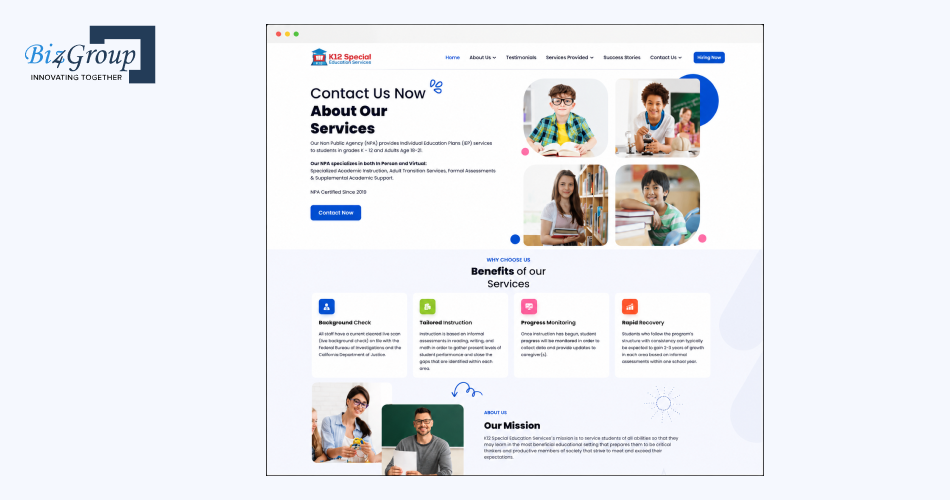
Many educational organizations discover that generic software cannot support their operational requirements as they grow. Biz4Group addressed a similar challenge while developing a school management system for K-12 Special Education Services, where flexibility was essential from the beginning.
The solution included:
Instead of forcing the client to adapt to existing software limitations, the platform was built around their operational processes. The same product-first approach is equally valuable for organizations planning an AI literacy coaching platform with specialized instructional requirements.
If your vision extends beyond standard education software, it is often worthwhile to hire AI developers who can translate your instructional goals into a scalable product rather than adapting your workflows to fit a prebuilt solution.
Ultimately, the decision comes down to one question. Do you want software that fits your organization today, or a platform that grows with your organization for years to come?
A great idea deserves a technology partner that understands education, artificial intelligence, scalable software architecture, and the realities of launching successful digital products.
If you're thinking, "I'm looking for an AI development company to build a custom literacy coaching platform. What questions should I ask, what expertise should I look for, and what budget should I expect?", start by evaluating the partner, not the proposal.
Here is what separates Biz4Group LLC from a typical software development company.
Many development teams focus on delivering requested functionality.
Our team starts by understanding your users, business model, monetization strategy, and long-term product vision. Every technical decision is aligned with measurable business outcomes, helping you launch a platform that is built to evolve instead of becoming obsolete after the first release.
AI literacy coaching platforms require expertise in education workflows, intelligent automation, conversational AI, cloud architecture, analytics, and scalable SaaS engineering.
Over the years, Biz4Group has delivered AI-powered education platforms, coaching solutions, classroom technologies, and enterprise applications that solve practical business challenges while delivering intuitive user experiences.
As a full-service AI education software development company, we bring together product strategists, UI/UX designers, AI engineers, software architects, QA specialists, and cloud experts under one roof.
Artificial intelligence changes quickly.
Our engineering approach keeps your platform ready for what comes next by designing flexible architectures that can adopt newer models, AI agents, and emerging capabilities without requiring a complete rebuild.
As an experienced AI development company, we help organizations select the right technologies based on business goals rather than industry trends.
Successful software projects rely on visibility and communication.
You receive clear project milestones, regular sprint demonstrations, technical consultations, and collaborative planning sessions throughout the engagement. This keeps product decisions aligned with your expectations while reducing development risk.
Launching your platform is only the beginning.
We continue supporting product evolution through feature enhancements, AI optimization, performance improvements, scalability planning, and ongoing technical guidance as your user base grows.
That long-term mindset helps many of our clients transform an initial MVP into a mature commercial product.
Building an AI literacy coaching platform is a significant investment. The right technology partner can help you reduce product risk, accelerate time to market, and create a solution that educators genuinely want to use.
So, if you are ready to turn your vision into a market-ready AI literacy coaching platform, connect with Biz4Group LLC today to build an intelligent education product that delivers measurable impact for teachers, schools, and learners.
Let's talk.
Building an AI literacy coaching platform is about creating a system that empowers educators, improves literacy outcomes, and scales coaching across schools and districts. Success depends on making the right decisions at every stage, including product planning, feature prioritization, architecture, compliance, monetization, and long-term scalability. When these elements come together, your platform becomes a valuable resource for teachers, instructional coaches, and education leaders alike.
If you're still asking, "I want to build an AI literacy coaching platform for K-12 schools. Where do I begin?" the answer starts with a clear product vision and an experienced technology partner who understands both AI and education. Investing in thoughtful AI literacy coaching platform development today can position your organization to meet the evolving needs of modern classrooms while creating lasting value for educators and learners.
At Biz4Group LLC, we've helped businesses transform ambitious ideas into intelligent digital products across education, AI, SaaS, and enterprise technology. As a trusted USA-based software development company, we combine product strategy, AI expertise, and scalable engineering to build solutions that solve real-world challenges and support long-term growth.
Have an idea for an AI literacy coaching platform? Let's turn it into the next success story. Connect with Biz4Group today and build a future-ready education solution that educators will love and institutions will trust.
Your AI-powered education platform starts with the right partner. Let's build it together. Get in touch.
An AI literacy coaching platform is ideal for K-12 school districts, charter schools, higher education institutions, EdTech startups, literacy nonprofits, educational publishers, and teacher training organizations. It is especially valuable for organizations looking to standardize instructional coaching, expand professional learning programs, or launch AI-powered education products.
Yes. Modern platforms can be designed to support multiple languages through AI-powered translation, multilingual content delivery, and language-aware coaching experiences. This helps educators provide more inclusive instruction while ensuring students with diverse language backgrounds receive the support they need.
Most platforms take 2-8 months to design, develop, and launch, depending on feature complexity and customization requirements. Biz4Group, however, can deliver a functional MVP in as little as 2-4 weeks by leveraging reusable components, proven development frameworks, and pre-built AI modules that significantly reduce both development time and overall project costs.
Absolutely. Many successful EdTech products begin with a pilot deployment at a single school or district. This allows organizations to collect user feedback, validate adoption, measure outcomes, and refine the platform before expanding to additional campuses or larger customer segments.
Yes. A well-designed AI literacy coaching platform can offer a consistent experience across web browsers, smartphones, and tablets. This allows teachers, coaches, and administrators to access coaching resources, review progress, and collaborate from virtually any device.
Teachers are more likely to stay engaged when they receive timely support, personalized professional learning, and constructive feedback throughout the school year. An AI-powered coaching platform helps create a more supportive teaching environment, reducing frustration and encouraging continuous professional growth.
Yes. Custom development allows organizations to align the platform with specific literacy models, instructional standards, coaching frameworks, grading systems, and organizational workflows instead of adapting existing processes to generic software.
Look for a partner with proven experience in AI, education technology, cloud architecture, and scalable SaaS development. Beyond technical expertise, evaluate their product strategy capabilities, communication process, post-launch support, and ability to build secure, future-ready solutions that align with your long-term business goals.

Our website require some cookies to function properly. Read our privacy policy to know more.