 Location :
Orlando, FL, USA
Location :
Orlando, FL, USA +1 (407) 714-1616
 info@biz4group.com

 AI Summary Powered by Biz4AI
- AI property tax appeal automation helps CRE teams review assessments across large portfolios and identify properties that may be over-assessed.
- It can automate repetitive tasks such as notice extraction, valuation comparisons, evidence preparation, deadline tracking, and appeal status updates.
- Reliable results depend on accurate property records, relevant comparable sales, jurisdiction-specific rules, and traceable evidence.
- Human review still matters: tax professionals need to verify valuations, check appeal arguments, and approve filings.
- Teams can build a custom platform, buy existing software, or use a hybrid approach combining automation with consultant expertise.
- Development costs may range from $40,000 to $300,000, depending on scope. A focused MVP can take days, while a broader enterprise platform may take months.
Building an AI property tax appeal automation platform can make assessment reviews much easier to manage across a commercial real estate portfolio. AI property tax appeal automation platform development can help teams pull information from tax notices and property records, compare assessments with market data, flag properties that may need a closer look, and keep appeal documents and deadlines organized.
If you manage hundreds or thousands of parcels, how much time does your team spend just figuring out which assessments deserve a review? A platform can help surface potential opportunities, but finding a difference between an assessed value and a market estimate doesn't automatically mean a property has a strong appeal. Reliable data, checkable valuation analysis, and accurate filing rules still matter. Tax professionals also need to review the evidence and decide what happens next.
That's an important consideration when choosing or building property tax assessment software. The system has to fit the way real estate teams actually work, including the records they already use and the people responsible for reviewing and filing appeals. And when an assessment looks questionable, can your team quickly trace the recommendation back to the underlying records?
Biz4Group LLC's experience developing AI products for the U.S. real estate market is relevant to a challenge that can easily get overlooked in property tax automation: a valuation model may flag a parcel, but that alone doesn't make the case ready to file. The platform also needs to connect the assessment to the right property records, account for local appeal requirements, and give tax professionals a clear trail of evidence to review before deciding whether to proceed.
Why Do Over-Assessed Properties Go Unappealed?
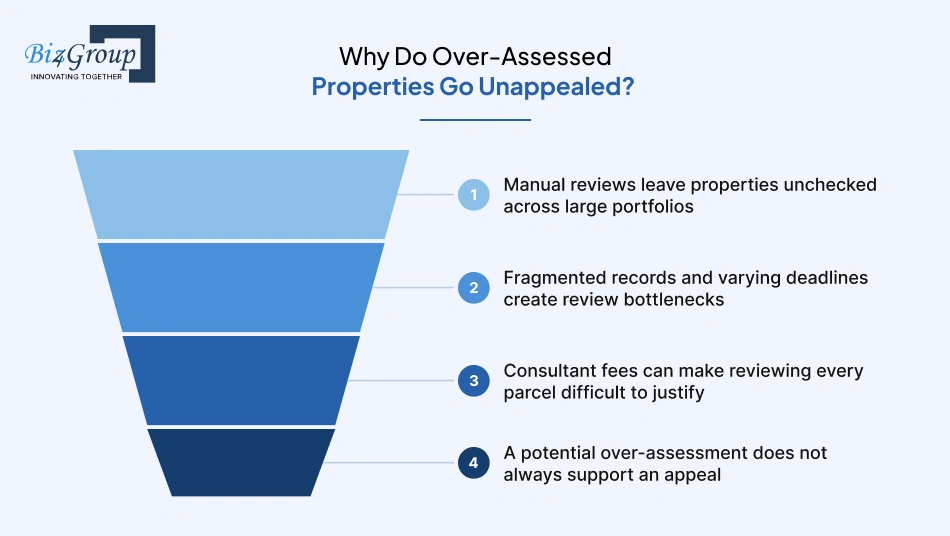
Even when a property looks over-assessed, it can be hard to find the time, evidence, and budget to challenge it. Across a large portfolio, some assessments simply never get a proper look.
Manual reviews leave properties unchecked across large portfolios
Reviewing every parcel by hand takes time, especially when your team is already juggling other tax work. So, are you checking every property or just the ones with the biggest tax bills? AI can help flag other assessments that might be worth a second look.
Fragmented records and varying deadlines create review bottlenecks
Assessment notices in one system, property records in another, and different filing deadlines for each jurisdiction. Sound familiar? Pulling all that together can slow reviews down before anyone even gets to the valuation.
Consultant fees can make reviewing every parcel difficult to justify
Bringing in a consultant for every possible appeal can get expensive, particularly when the potential savings are small. Property tax assessment software can help your team screen properties first, so you have a clearer idea of which cases may deserve expert attention.
A potential over-assessment does not always support an appeal
A high assessment doesn't automatically make a strong case. Before moving forward, you still need evidence that supports the challenge and enough potential savings to make the effort worthwhile. That's where a closer review matters.
Which Parts of the Property Tax Appeal Process Can AI Automate?
AI can handle much of the repetitive work in a property tax appeal, from reading assessment notices to organizing evidence and tracking cases. Your tax team still checks the findings, decides whether an appeal makes sense, and approves the filing.
Generative AI can help summarize records, draft appeal narratives, and organize supporting documents, but reviewers still need to check the facts and approve the final materials.
Document extraction, assessment comparisons, and candidate prioritization
Think about the time your team spends opening tax notices, entering figures, and matching them to the right properties. How much of that work could be handled before a reviewer even looks at the assessment?
AI can help by:
- Assessment notice / tax bill extraction: Pulling parcel IDs, assessed values, tax amounts, and dates from documents.
- Assessment comparisons: Matching those figures with property records and available market data.
- Candidate prioritization: Flagging properties with valuation differences, potential tax impact, and evidence worth investigating.
For larger portfolios, AI-powered property tax appeal software for portfolios can help teams screen more properties without starting every review from scratch. A flagged assessment still needs a closer look before anyone decides to appeal.
Appeal narratives, evidence packets, and filing document preparation
When a property looks questionable, the next job is pulling together the records that support a challenge. Can your team quickly find the relevant assessment, property details, and comparable sales without chasing documents across different systems?
AI can organize those materials, summarize valuation differences, and prepare draft narratives and appeal packet / evidence generation documents. Reviewers must still confirm that the records match the property, the comparisons are relevant, and the draft meets the jurisdiction's filing requirements.
Human judgment for valuation disputes and filing decisions
AI can point out a possible issue, but it shouldn't make the final call on a disputed valuation. A comparable property may look similar in a database while differing in condition, location, use, or other details that matter.
That's where human-in-the-loop review comes in:
- AI identifies potential concerns and gathers supporting information.
- A tax professional checks the valuation assumptions and evidence.
- The responsible reviewer decides whether to proceed and approves the filing.
Submission tracking, hearings, decisions, and outcome reporting
Once an appeal is underway, AI can help your team keep track of deadlines, hearing dates, assigned tasks, and case outcomes. If you're managing properties across several jurisdictions, having that information in one place can make it easier to see what needs attention.
|
What the platform tracks |
How it helps |
|---|---|
|
Filing deadlines and hearing dates |
Keeps upcoming tasks visible, using verified jurisdictional rules. |
|
Case status and assigned reviewers |
Shows who is handling each appeal and what remains to be done. |
|
Decisions and follow-up actions |
Keeps outcomes and next steps connected to the case. |
|
Estimated and confirmed savings |
Separates potential tax benefits from reductions actually achieved. |
Multi-jurisdiction deadline tracking can make coordination easier, but the underlying dates and rules still need to be verified. That way, reminders are based on reliable information rather than assumptions.
What Features Should an AI Property Tax Appeal Automation Platform Include?
A useful AI property tax appeal automation platform helps teams review assessments, organize evidence, manage deadlines, and track appeals in one place. The right features depend on your portfolio size, jurisdictions, and existing workflows.
For larger portfolios, enterprise AI solutions should support multi-jurisdiction workflows, detailed access controls, audit trails, and integrations with existing business systems.
Centralized property and parcel data
Keep parcel IDs, ownership details, assessment history, tax bills, and supporting documents together. This helps prevent mismatches between assessor records and internal systems.
Automated assessment notice and tax bill extraction
Use assessment notice / tax bill extraction to capture values, parcel numbers, and dates from documents. Flag uncertain fields for review instead of treating every extracted value as correct.
Valuation analysis and over-assessment detection
Compare assessments with market data and relevant properties through an Automated Valuation Model (AVM) and Comparable property analysis (comps). The platform should explain why a property was flagged, not simply label it over-assessed.
Appeal prioritization
Help reviewers consider potential tax impact, evidence quality, and confidence in the analysis. When assessing the best AI tools for detecting over-assessed commercial properties, check whether their findings can be traced to source data.
Deadline tracking and alerts
Support multi-jurisdiction deadline tracking with filing dates, reminders, assigned owners, and checklists. Deadlines and local requirements should be verified against authoritative sources.
Evidence and document generation
Organize relevant records and prepare draft narratives and appeal packet / evidence generation materials. Reviewers should be able to check each claim against its supporting evidence.
Workflow and approval controls
Assign cases, track their status, and route documents for approval. Keep tax professionals involved in valuation decisions and final filing authorization through human-in-the-loop review.
Case tracking and reporting
Track submissions, hearings, decisions, and confirmed tax reductions. Dashboards can show outstanding cases, upcoming deadlines, review coverage, and estimated versus realized savings.
Integrations and security
Connect with ERP, property management, and accounting systems through APIs, imports, or custom connectors. Include role-based access, audit trails, and appropriate data-retention controls.
|
Feature |
What it helps your team do |
|---|---|
|
Centralized property data |
Keep parcel records, assessments, and documents together |
|
AI document extraction |
Capture key values and dates from notices and tax bills |
|
Valuation and comps analysis |
Compare assessments with relevant market evidence |
|
Appeal prioritization |
Identify cases for review based on tax impact and evidence |
|
Deadline tracking |
Manage jurisdiction-specific dates, alerts, and filing tasks |
|
Evidence generation |
Organize supporting records and prepare draft appeal documents |
|
Workflow and approvals |
Assign cases, review findings, and authorize submissions |
|
Reporting and integrations |
Track outcomes and connect with existing business systems |
What should teams check before choosing a platform? Make sure it can explain its valuation flags, preserve evidence sources, handle jurisdiction-specific workflows, and fit the systems your team already uses.
How to Build an AI Property Tax Appeal Automation Platform
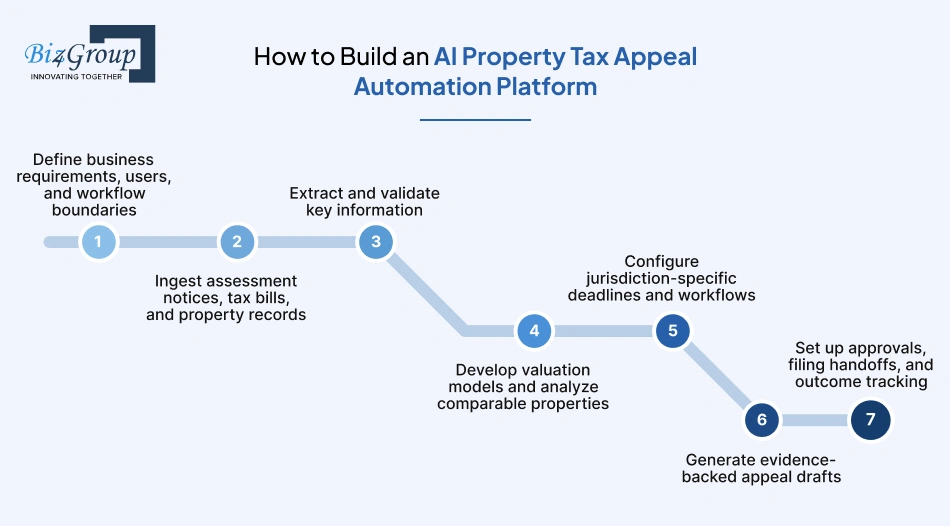
If you're planning to build this platform, start with the assessment review process your team already follows. Get the core workflow working first, then add valuation analysis, document generation, and integrations as you validate what users actually need.
If your team doesn't have the technical resources in-house, you can hire AI developers to build the document processing, valuation analysis, and workflow features around your requirements.
To implement generative AI in real estate tax workflows, use it for tasks such as summarizing verified records and drafting appeal materials, with qualified reviewers checking the output before it's used.
1. Define business requirements, users, and workflow boundaries
Talk to the people who review assessments and manage appeals. Where do they lose time? Which decisions need a tax professional? These answers shape the first release. MVP development services can help you focus on essential features before investing in a larger platform.
2. Ingest assessment notices, tax bills, and property records
Bring assessment notices, tax bills, parcel records, and appraisals into one place. Make it easy to upload documents in bulk or connect existing property systems, so users aren't constantly switching between files and applications.
3. Extract and validate key information
Use assessment notice / tax bill extraction to capture parcel IDs, assessed values, tax rates, and deadlines. Check extracted details against property records and flag anything uncertain. A small data mismatch can send an appeal down the wrong path.
4. Develop valuation models and analyze comparable properties
Use an Automated Valuation Model (AVM) and Comparable property analysis (comps) to identify assessments that may need a closer look. AI model training can help tailor extraction or valuation models using verified records and expert-reviewed cases. Keep the results explainable, so reviewers can see what supports a flagged assessment.
5. Configure jurisdiction-specific deadlines and workflows
Set up filing rules, reminders, required documents, and case assignments for each jurisdiction. Have someone verify the rules against authoritative sources, especially when deadlines or exceptions are unclear.
6. Generate evidence-backed appeal drafts
Let the platform gather relevant records, summarize valuation findings, and prepare draft appeal documents. Keep each claim linked to its supporting evidence, so a reviewer can check the facts before anything is filed.
7. Set up approvals, filing handoffs, and outcome tracking
Decide who reviews the evidence, approves the appeal, and handles submission. Use UI/UX design to make those steps easy to follow, with clear case statuses, visible deadlines, and accessible source documents. Track decisions and confirmed tax reductions separately from estimated savings.
Start with a limited pilot, learn where the workflow breaks down, and make improvements before rolling the platform out across more properties and jurisdictions.
What Tech Stack Is Used to Build an AI Property Tax Appeal Automation Platform?
A platform like this needs more than a frontend, backend, and AI model. It also needs document processing, property and market data, workflow automation, integrations, and security. The exact choices depend on your portfolio and deployment requirements.
|
Layer |
Technologies and purpose |
|---|---|
|
Frontend |
ReactJS development for dashboards and review screens; NextJS development for application structure and routing. |
|
Backend |
NodeJS development for APIs, permissions, notifications, and integrations. |
|
AI and data science |
Python development for document extraction, valuation models, comparable analysis, and prioritization. |
|
Document processing |
OCR and document AI to read notices, tax bills, appraisals, and scanned records. |
|
AI knowledge and retrieval |
LLMs and retrieval-augmented generation (RAG) to draft summaries and evidence-backed narratives from approved source material. |
|
Database and file storage |
PostgreSQL or a similar database for parcel and case records, plus secure object storage for documents. |
|
Data and market integrations |
APIs and data connectors for assessor records, comparable sales, property systems, and accounting platforms. |
|
Workflow and background jobs |
A rules engine, queues, and scheduled jobs for deadline alerts, case assignments, and document-processing tasks. |
|
Cloud and deployment |
AWS, Azure, or Google Cloud for hosting, scaling, backups, and monitoring. |
|
Security and governance |
Encryption, role-based access, single sign-on, audit logs, and controlled data retention. |
The stack should also support human-in-the-loop review. AI can extract, compare, and draft, but tax professionals need to verify evidence, confirm jurisdictional requirements, and authorize filings.
How AI Detects Over-Assessed Properties Across a Portfolio
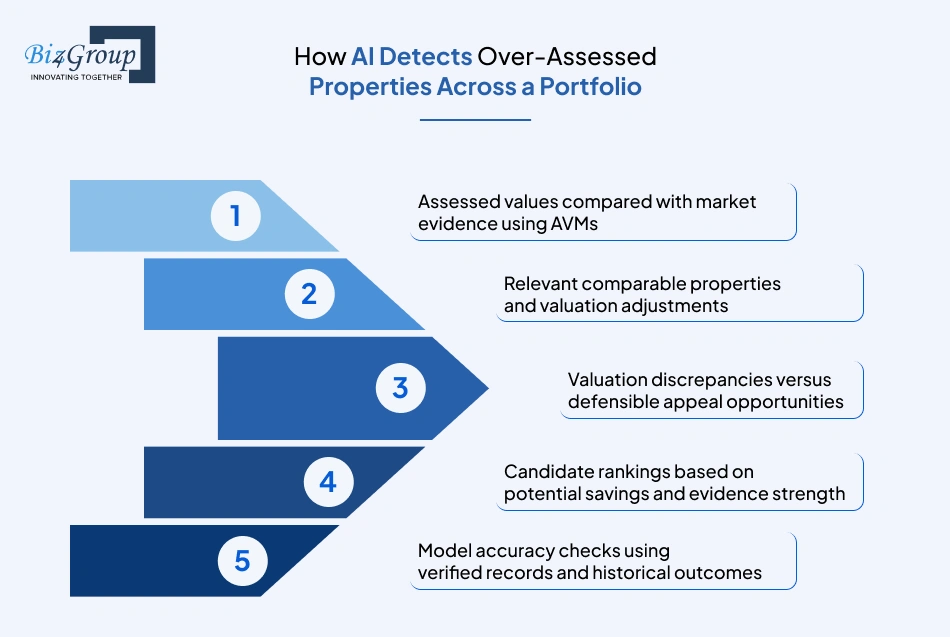
AI helps you spot properties that may be over-assessed by comparing their assessed values with market estimates and relevant comparable properties. It can flag potential issues, help your team decide what to review first, and bring the supporting data together. That doesn't mean every flagged property is worth appealing.
AI model development should start with verified property records and expert-reviewed cases, so the model's estimates and flags can be tested against evidence rather than treated as unquestionable answers.
Assessed values compared with market evidence using AVMs
An Automated Valuation Model (AVM) estimates what a property may be worth using available data. The platform compares that estimate with the assessed value and flags gaps that may deserve a closer look.
Relevant comparable properties and valuation adjustments
A nearby sale isn't automatically a good comparison. The system needs to account for differences in property type, size, condition, location, and sale date. Otherwise, the comparison could point your team in the wrong direction.
Valuation discrepancies versus defensible appeal opportunities
A lower estimated value might catch your attention, but is there enough evidence to support an appeal? Your team still needs to check the records, valuation date, and local rules before deciding whether to move forward.
Candidate rankings based on potential savings and evidence strength
The platform can help sort potential cases using a few practical factors:
|
Factor |
Why it matters |
|---|---|
|
Potential tax impact |
Helps show whether a review could be financially worthwhile |
|
Evidence strength |
Indicates how well the available information supports a challenge |
|
Model confidence |
Helps reviewers understand how much uncertainty remains |
|
Data completeness |
Shows whether key records are missing or inconsistent |
Model accuracy checks using verified records and historical outcomes
Don't just assume the model is right. Compare its results with verified records and cases reviewed by tax professionals. When the estimates repeatedly miss the mark, investigate why and improve the model before relying on it more widely.
The bottom line: AI can help your team find potential issues across a portfolio without manually reviewing every property first. The evidence still needs to hold up before you decide to appeal.
What Data Sources Feed an AI Property Tax Appeal Platform?
An AI property tax appeal platform brings together the records your team already uses to review assessments, along with market evidence that helps explain what a property may be worth. Having that information in one place makes it easier to spot gaps, check the numbers, and prepare a case.
|
Data source |
What your team uses it for |
|---|---|
|
Assessor records, tax bills, and public property data |
Check parcel IDs, assessed values, tax rates, ownership, and assessment history. |
|
Comparable sales, lease information, and market evidence |
Compare similar properties and understand local market conditions. |
|
Property financials, appraisals, and internal records |
Review income, expenses, appraised values, property details, and previous assessments. |
|
Data quality and provenance checks |
Find missing information, mismatched parcel details, and conflicting records, while keeping track of where data came from. |
The tricky part is getting everything to match the right property and valuation date. If a tax notice and an internal record disagree, the platform should flag the mismatch for someone to check rather than simply picking one value and carrying on.
How Does AI Track Appeal and Payment Deadlines Across Multiple Jurisdictions?
AI tracks deadlines by connecting each property to the relevant jurisdiction's rules, recording key dates, and helping teams act before those dates pass. For a portfolio spread across several locations, that means fewer scattered calendars and a clearer view of what needs attention.
A common question is:
"I keep missing appeal deadlines because they vary by jurisdiction and I am tracking them manually across a spreadsheet, so I need an AI platform that can monitor every deadline automatically."
An AI platform can track jurisdiction-specific dates, send reminders, assign tasks, and flag uncertain deadlines for verification. Teams should still confirm dates against authoritative sources.
Jurisdiction-specific filing rules and requirements
A filing process in one county may not match the process in another. The platform needs to store requirements by jurisdiction and associate them with the right properties, rather than applying one set of rules across the portfolio.
Notice-based, fixed-date, and payment-related deadlines
The system should distinguish between deadlines triggered by a notice, dates set on the calendar, and tax payment due dates. These aren't interchangeable, and confusing them can create costly problems.
Automated alerts, assignments, and filing checklists
When a deadline gets close, the platform can notify the assigned person and show what still needs to be done.
A reviewer's checklist might include:
- Confirm the assessment notice and filing date.
- Gather valuation records and supporting evidence.
- Review and approve the appeal documents.
- Confirm the filing has been submitted.
Rule updates based on authoritative sources and human verification
Rules change, and an outdated deadline can be just as problematic as a missed reminder. Use official assessor or tax authority information to check requirements, and have a qualified person verify updates before they're applied to cases.
Exceptions, extensions, and uncertain deadlines requiring escalation
Suppose a notice has an unclear date or a property may qualify for an extension. The platform should flag the issue for review instead of filling in a deadline based on an assumption.
That way, reviewers can resolve the uncertainty and document the confirmed date before proceeding.
How Can an AI Tax Appeal Platform Integrate With ERP and Property Management Systems?
Connecting the platform to your existing systems lets teams use property and accounting records without repeatedly entering the same information. Use AI integration services to connect the appeal platform with your ERP, property management, and accounting systems, so teams can work with consistent records and share case updates without repeated data entry.
|
Integration area |
What needs to happen |
|---|---|
|
Property and parcel records |
Match parcel IDs, ownership, and property codes across systems. |
|
Data exchange |
Use APIs, scheduled imports, or custom connectors based on the systems involved. |
|
Appeal and accounting updates |
Share case status, tax liabilities, documents, and savings figures with the relevant teams. |
|
Record conflicts |
Flag duplicates or mismatched information for verification instead of overwriting records automatically. |
|
Security and auditability |
Apply role-based access, retention rules, and audit logs. |
What does this look like in practice?
Say your team files an appeal for a commercial property. The platform updates the case status, makes the supporting documents available, and passes relevant tax information to accounting. If the parcel ID doesn't match the ERP record, the discrepancy is flagged for review.
Which system should be treated as the source of truth? That needs to be decided for each type of record before integration begins. And should estimated savings flow into financial reporting as confirmed reductions? No. Keep projections separate from actual outcomes.
Turn Property Tax Guesswork Into a Smarter Review
AI can help your team compare assessments, analyze supporting data, and focus expert attention where it matters.
Explore AI Property Tax AutomationWhat Are the Risks and Limitations of AI Property Tax Appeal Automation?
AI property tax appeal automation can speed up assessment reviews, but its outputs still need to be checked. Errors in extracted records, valuation estimates, filing rules, or generated documents can lead to wasted effort or a weak appeal.
Inaccurate document extraction and valuation outputs
Document AI can misread figures, dates, or parcel identifiers, while valuation models can produce estimates that don't reflect a property's actual circumstances. Treat uncertain results as items to verify, not facts to file.
- Example: A scanned notice is read as showing an assessed value of $8.2 million instead of $8.7 million. A reviewer catches the error before the team calculates a potential appeal.
Weak comparables, missing data, and uncertain model results
An Automated Valuation Model (AVM) is only as useful as its data and assumptions. Poorly matched comparable properties, outdated sales, or missing details can distort the estimate.
- Example: A model compares a renovated office building with older, partially vacant properties nearby. The apparent valuation gap looks compelling until a reviewer checks the differences.
Missed deadlines and unsupported appeal claims
Automated reminders can help teams stay organized, but incorrect dates or unverified arguments can still put a case at risk. Filing deadlines and supporting claims should be checked against the applicable requirements.
- Example: The platform calculates a deadline from the wrong notice date. A tax professional spots the mismatch during review and confirms the actual filing date before submitting.
Jurisdictional restrictions and professional responsibilities
Appeal procedures, representation rules, and filing requirements vary by jurisdiction. Software should identify the relevant rules, while qualified people confirm what applies and who is authorized to act.
- Example: A portfolio team uses the same workflow for properties in two counties, but one county requires a specific form and authorized representative. The platform flags the difference for review.
Accountability for AI-generated recommendations and documents
AI can recommend properties for review and prepare draft materials, but responsibility for decisions and submissions should remain clear. Keep source records, reviewer approvals, and changes traceable.
- Example: The platform drafts an appeal statement using an outdated appraisal. The reviewer replaces it with current evidence, approves the final version, and records the change before filing.
Why Human-in-the-Loop Review Still Matters in AI Tax Appeals
AI can help your team spot potential assessment issues, organize evidence, and prepare appeal drafts. But someone still needs to check whether the numbers make sense, the evidence supports the case, and the filing is ready to go.
Where does human judgment still matter?
- Valuation assumptions and comparable adjustments: Are the selected properties actually similar in size, condition, use, and location? A tax professional can catch differences that a model may overlook.
- Evidence quality and appeal arguments: Does the evidence support the reason for challenging the assessment? Reviewers need to check the records and make sure the argument fits the jurisdiction's requirements.
- Filing authority and final submissions: Who is authorized to represent the owner and approve the appeal? The platform can prepare documents, but the right person must verify and authorize the submission.
- Low-confidence results and unusual cases: What happens when records conflict, information is missing, or a property doesn't fit the model's assumptions? Those cases should go to a qualified reviewer rather than move through automatically.
What might this look like in practice?
Imagine the platform flags an office property because its assessed value is higher than the model's estimate. A reviewer notices that the comparable properties are in better condition and that the building records are outdated. The team corrects the information and reassesses whether there's enough evidence to proceed.
That's the value of human review: AI helps bring cases to the team's attention, while people check the reasoning and make the decisions.
AI Property Tax Appeals vs. Traditional Consultants: Cost and Process Compared
AI property tax appeal automation platform development can cost around $40,000-$300,000, depending on whether you build an MVP, mid-level solution, or enterprise platform. Traditional consultants generally charge based on the services and properties involved, while a hybrid approach combines software automation with professional support.
Consultant fees can take a substantial share of appeal savings, so real estate teams may wonder whether automation could make the process more cost-effective. Here's a question they might ask:
"We pay contingency fees of 25 to 35 percent to tax consultants for every successful appeal, and I want to know if building or using an AI platform could reduce that cost while still winning appeals."
An AI platform may reduce manual review and document preparation costs, but it cannot guarantee successful appeals. Compare total platform and expert-support costs with consultant fees and actual appeal outcomes.
|
Cost or process |
AI platform |
Traditional consultants |
|---|---|---|
|
MVP |
$40,000-$80,000 for core features and a focused pilot |
Usually a fixed fee, retainer, or contingency arrangement |
|
Mid-Level |
$80,000-$180,000 for expanded analysis, evidence generation, workflows, and integrations |
Fees depend on portfolio size, services, and case complexity |
|
Enterprise |
$180,000-$300,000 for broader jurisdiction coverage, complex integrations, and enterprise controls |
Costs depend on the number and complexity of properties and the engagement terms |
|
Ongoing expenses |
Hosting, maintenance, data licensing, and support |
Continuing professional fees, if services remain active |
|
Assessment review |
Screens portfolios and flags potential issues |
Reviews assessments and identifies possible challenges |
|
Evidence and filing |
Organizes records and drafts documents for human review |
May analyze evidence, prepare arguments, and manage filings |
|
Scale |
Supports repeatable processing across many parcels |
Capacity depends on consultant staffing and workload |
Development figures are indicative estimates within the overall $40,000-$300,000 range. Actual costs depend on features, data access, jurisdiction coverage, integrations, and validation needs. Ongoing operating expenses may be additional.
A hybrid model may suit teams that want software to screen a portfolio while consultants handle complex valuations and appeal arguments. Compare the full cost with your team's workload, internal expertise, and required level of support.
Build, Buy, or Hybrid: How to Evaluate Your Options
Should you build your own platform, buy one off the shelf, or combine software with consultant support? It comes down to how your team works, what your portfolio needs, and how much flexibility you want.
|
Factor |
Build custom |
Buy software |
Hybrid approach |
|---|---|---|---|
|
Cost |
Higher upfront investment. Development may range from $40,000-$300,000. |
Subscription or licensing fees, depending on the vendor. |
Software costs plus consultant fees. |
|
Flexibility |
Tailor features and workflows to your portfolio. |
Work within the vendor's available features and configuration options. |
If existing products don't match your workflows, you can build AI software that fits your specific needs. |
|
Getting started |
Takes time to develop, test, and launch. |
Can be quicker if the product fits your needs. |
Depends on software setup and how responsibilities are divided. |
|
Best fit |
Teams with specific workflows, complex integrations, or unusual requirements. |
Teams whose needs are already covered by an existing product. |
Teams that want automation but still need hands-on tax expertise. |
|
What your team needs |
Technical resources and property tax knowledge. |
People to configure, use, and oversee the software. |
Someone to coordinate the software, internal team, and consultants. |
|
Ongoing work |
Your team or development partner handles maintenance and updates. |
The vendor maintains the product, according to its support terms. |
The vendor maintains the software, while your team and consultants handle their parts of the process. |
The practical question is: what does your team actually need help with? If existing software covers your workflow, buying may be enough. If your processes are highly specific, custom development may be worth exploring. And if you want automation without giving up expert support, a hybrid setup is another option.
How Long Does It Take to Build an AI Property Tax Appeal Platform?
With AI-assisted development, you can get a simple prototype running in 1-3 days and a focused MVP in 3-10 days if the scope is tight and your data is ready. More involved platforms take longer, especially when you're connecting business systems or supporting multiple jurisdictions.
A focused pilot across selected properties and jurisdictions
You don't have to build the whole thing upfront. Start with a small group of properties and a few jurisdictions. Get the essentials working, such as reading assessment notices, flagging possible issues, and tracking cases.
A basic demo can come together in days. A usable MVP may take longer if you need to connect real records or refine the workflow with tax professionals.
What can slow things down?
AI can help developers move quickly, but the work doesn't end when the screens and buttons function. Are your property records clean? Do your systems connect easily? Have the local filing rules been checked?
|
Factor |
Why it matters |
|---|---|
|
Data readiness |
Missing records and mismatched parcel IDs need attention. |
|
Integrations |
ERP, accounting, and property systems need to exchange data reliably. |
|
Workflow complexity |
More jurisdictions and approval steps mean more work to configure. |
|
Validation |
Valuations, extracted details, deadlines, and documents need to be checked. |
From pilot to production
Before using the platform for live appeals, test it against verified records and have qualified reviewers check the results. A demo that works with sample data isn't necessarily ready for real filings.
Rolling it out more widely
|
Stage |
Illustrative timeline |
|---|---|
|
Prototype |
1-3 days |
|
Focused MVP |
3-10 days |
|
Mid-level platform |
2-6 weeks |
|
Enterprise rollout |
1-3+ months |
These are rough planning estimates, not promises. The more ready your data and requirements are, the faster development can move. Live integrations, broader jurisdiction coverage, and review requirements can add time.
How Should an AI Property Tax Appeal Platform Be Tested Before Production?
Before putting an AI property tax appeal platform into production, test it against verified property records and real workflow scenarios. The system should extract information correctly, produce reviewable valuation results, handle deadlines reliably, and generate documents that meet filing requirements.
Test the parts that can create costly mistakes
|
What to test |
What your team should check |
|---|---|
|
Document extraction |
Do parcel IDs, assessed values, tax amounts, and dates match the original notices? |
|
Valuations and rankings |
Do estimates and appeal priorities hold up against expert-reviewed cases and supporting market evidence? |
|
Deadlines and workflows |
Are dates, alerts, permissions, and exception handling working as expected? |
|
Generated documents |
Are the facts accurate, the evidence traceable, and the documents aligned with applicable filing requirements? |
Try real-world scenarios, not just clean sample data
What happens when a notice is blurry, a parcel ID conflicts with another record, or a filing deadline is unclear? Include these messy cases in testing and confirm the platform flags them for review instead of confidently producing a questionable result.
Set acceptance criteria before expanding
Agree on measurable requirements with your tax and technology teams before the wider rollout. For example:
- Required extraction fields meet an agreed accuracy threshold.
- Valuation flags and rankings are reviewed against expert-assessed cases.
- Deadline calculations and alerts pass jurisdiction-specific test cases.
- Documents receive approval before filing.
- Low-confidence results and exceptions reach the right reviewer.
The important question is: can your team explain and verify why the platform flagged a property and what evidence supports the next step? If not, keep refining the workflow before expanding to more properties.
How to Measure ROI for an AI Property Tax Appeal Platform
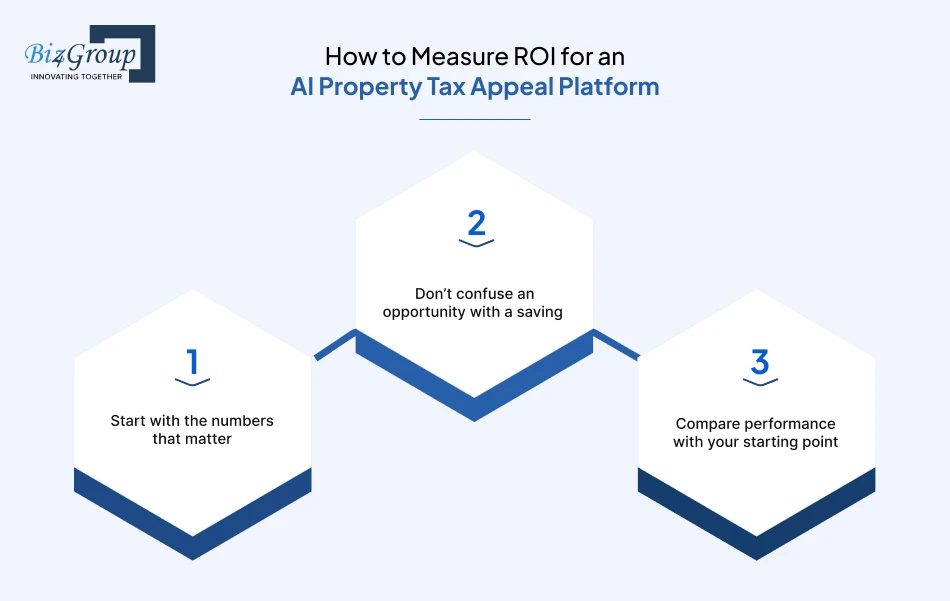
Measure ROI by looking at confirmed tax savings, lower review costs, and the extra assessment coverage your team can handle. Compare those benefits with the full cost of building and running the platform.
Start with the numbers that matter
Your team doesn't need dozens of metrics to understand whether the platform is helping. Start with these:
- Realized tax savings: Tax reductions actually confirmed, not just predicted by the model.
- Review efficiency: Parcels reviewed, staff hours spent, and average cost per parcel.
- Process performance: On-time filings, appeal outcomes, and time taken to resolve cases.
Don't confuse an opportunity with a saving
Suppose the platform flags 100 properties with possible over-assessments. That's a set of cases to investigate, not 100 successful appeals. Track estimated opportunities, filed appeals, and confirmed reductions separately.
Compare performance with your starting point
Before rollout, record how many parcels your team reviews, how long the work takes, and what it costs. Compare those figures after implementation to see whether coverage improved and effort decreased.
A simple ROI formula is:
ROI = (Benefits - Total Costs) / Total Costs x 100. Include development, data, licensing, maintenance, and relevant staffing costs. That way, you're measuring the platform's actual contribution, not just its most promising estimates.
What Should a Practical Implementation and Governance Plan Include?
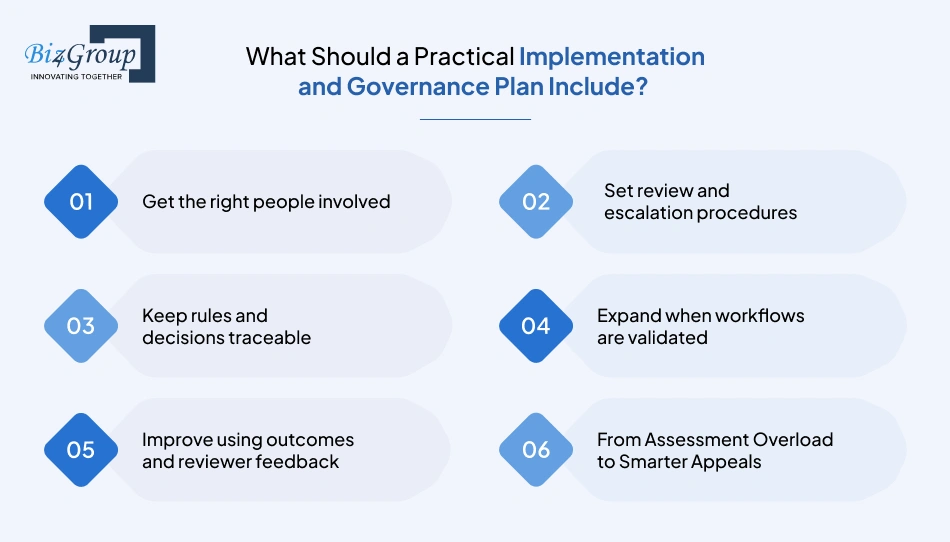
A practical plan should define who makes decisions, how AI outputs are checked, and when the platform is ready to expand. That keeps the system accountable while helping your team use it in day-to-day appeal work.
Get the right people involved
Who verifies valuations? Who checks jurisdiction rules? Who maintains the platform? Assign clear responsibilities across business, tax, and technology teams so everyone knows what they own.
Set review and escalation procedures
Decide which tasks can run automatically and which need approval. Routine document extraction might proceed automatically, while uncertain valuations, conflicting records, or unusual cases should go to qualified reviewers.
Keep rules and decisions traceable
How will your team know which filing requirements were applied to a case? Maintain verified jurisdiction rules, filing controls, approval records, and audit trails so changes and decisions can be traced.
Expand when workflows are validated
Start with a limited group of properties and jurisdictions. Once the team has tested the results and controls, expand in stages rather than rolling out everywhere at once.
Improve using outcomes and reviewer feedback
What are reviewers correcting most often? Which cases are taking longer than expected? Use appeal outcomes and team feedback to improve data quality, model behavior, alerts, and workflows over time.
Ready to Make Appeal Season Less Painful?
The right AI workflow can bring the pieces together while keeping your tax experts in control.
Build a Smarter Property Tax Appeal WorkflowFrom Assessment Overload to Smarter Appeals
Building an AI property tax appeal automation platform isn't about letting a bot argue with the tax assessor while your team grabs coffee. It's about spotting questionable assessments, organizing evidence, tracking deadlines, and giving people the information they need to make sound decisions. So, should you build, buy, or go hybrid? That depends on your portfolio, workflows, budget, and how much expert oversight you need. The smartest starting point is a focused solution you can test, learn from, and expand with confidence.
For Biz4Group LLC, experience in AI product development and real estate technology connects to a key challenge here: making property data, valuation insights, and workflows work together reliably. With the right AI consulting services, teams can shape a platform around their actual needs, keep humans in control of critical decisions, and turn assessment review from a spreadsheet marathon into a more manageable process.
Frequently Asked Questions
What should a CRE team look for in AI property tax appeal software?
Look for reliable assessment extraction, valuation and comps analysis, jurisdiction-specific deadline tracking, evidence management, integrations, and human review controls.
Can AI identify over-assessed commercial properties without filing an appeal automatically?
Yes. AI can flag properties for review and estimate potential opportunities. A qualified reviewer should check the evidence and decide whether to proceed.
How much does it cost to develop a custom AI property tax appeal platform?
An indicative development budget is $40,000-$300,000, depending on features, integrations, data access, and jurisdiction coverage. Hosting, licensing, and maintenance may cost extra.
How quickly can an AI property tax appeal MVP be built?
A focused MVP may take 3-10 days with AI-assisted development when requirements and data are ready. Production use requires additional testing and validation.
Should we build a custom platform or buy existing software?
Buy if an existing product fits your workflows. Build if you need specialized features or integrations. Choose a hybrid approach if you want automation alongside consultant expertise.
Can AI generate appeal evidence packets and filing documents?
Yes. It can organize records and draft documents, but reviewers should verify the facts, evidence, and jurisdiction-specific requirements before submission.
How does AI manage property tax deadlines across jurisdictions?
It can record jurisdiction-specific dates, send reminders, and assign tasks. Teams should verify deadlines against authoritative sources and escalate uncertain cases.
How do we measure whether the platform is paying off?
Compare confirmed tax reductions and operational savings with total costs. Track review coverage, staff hours, cost per parcel, filing compliance, and appeal outcomes. Keep projected savings separate from realized reductions.
