 Location :
Orlando, FL, USA
Location :
Orlando, FL, USA +1 (407) 714-1616
 info@biz4group.com

 AI Summary Powered by Biz4AI
- AI real estate platform development cost ranges from $30,000 to $300,000+, based on scope and complexity.
- MVPs typically cost $30,000 to $60,000, while enterprise platforms require more.
- Integrations, data, security, and infrastructure can significantly affect AI real estate platform development pricing.
- Plan for ongoing maintenance, AI model, hosting, security, and scaling costs after launch.
- Biz4Group's real estate AI projects show how AI, property data, integrations, and workflows collectively shape development costs.
Building an AI-powered real estate platform in 2026 can cost anywhere from $30,000 to $300,000+, but the estimate of AI real estate platform development cost depends on what sits behind the interface.
The market is moving in the same direction. JLL's Global Real Estate Technology Survey found that 87% of companies are increasing their real estate technology budgets to adopt AI, signaling stronger investment in AI-enabled platforms.
So if you're also thinking along the lines:
- I want to build an AI real estate platform, but I do not know how much to budget for the MVP, core features, integrations, and future scaling.
- We are planning an AI real estate platform for our business, but we need a clear cost breakdown before presenting the investment to stakeholders.
- I am concerned that enterprise AI real estate development costs may exceed our budget, and I want to understand which features can be included in the first release.
Then you're in the right place. This structured approach helps in setting the foundation for detailed cost analysis, benchmarks, and decision logic covered in this guide.
At Biz4Group LLC, a U.S.-based AI development company, we have found through real-world real estate projects that data readiness, workflow complexity, MLS and CRM integrations, and production infrastructure can influence budgets as much as the AI capability itself.
Stop Guessing Your AI Budget
Understand the real AI real estate platform development cost before scope decisions lock in. Get a realistic view of what your product will actually take to build.
Estimate My AI Real Estate Platform CostWhat is the Practical Formula to Calculate AI Real Estate Platform Development Cost?
Total Development Cost = (Development Hours × Hourly Rate) + Additional Expenses
Estimating cost to build an AI real estate platform is a planning exercise. Teams that start with a clear formula can match product scope to budget early and avoid rework later.
- Development hours include product design, backend and frontend work, testing, and AI model development for features like predictions or recommendations.
- Hourly rates change based on team experience and whether work is done in house or externally.
- Additional expenses cover elements like infrastructure, data preparation, cloud usage, and security.
These items often define AI real estate platform development pricing, especially when systems must scale or run continuously.
How to Apply Cost Formulas to AI Real Estate Platform Development?
To apply the formula, teams first need to estimate the effort. This includes planning, building data pipelines, validating outputs, and tuning performance. These steps are essential when the goal is to build real estate AI platform that works reliably with real data.
Next, teams account for expenses like hosting, integrations, monitoring, and long-term support. A focused MVP usually sits near the lower end of the range, while advanced platforms push higher.
For example:
- A real estate startup estimating cost to build AI real estate platform MVP in 2026 may budget $30,000 to $60,000, focusing on core features and limited data sources.
- A mid-sized platform with automation, analytics, and basic intelligence often falls between $80,000 and $150,000+.
- An advanced, enterprise grade system with scalable architecture and continuous learning models can reach $200,000 to $300,000+.
Overall, using this formula to estimate AI real estate platform development pricing helps link each cost item to a real requirement, making budgets easier to defend and adjust.
What is the Cost Breakdown for Building an AI-Powered Real Estate Platform?
The AI real estate platform development cost usually falls between $30,000 and $300,000+. The final number depends on how advanced the platform is and how much AI capability it includes. The cost to build AI real estate platform MVP with limited automation is much less than a large-scale system built for high traffic and complex data.
Here is a quick view of how cost changes by development stage:
|
Development Stage |
Scope |
Estimated Cost Range |
|---|---|---|
|
MVP-level AI Real Estate Platform |
Core features, basic AI logic, limited integrations |
$30,000 – $60,000 |
|
Advanced AI Real Estate Platform |
Automation, analytics dashboards, broader integrations |
$80,000 – $150,000+ |
|
Enterprise-grade AI Real Estate Platform |
High scalability, strong security, complex AI systems |
$200,000 – $300,000+ |
As platforms become more complex, AI real estate platform development cost shot up. This happens because advanced systems require more data processing, stronger infrastructure, and more testing.
Below is a detailed look at where the money typically goes while estimating custom AI real estate platform development cost:
|
Category |
Typical Range |
Notes |
|---|---|---|
|
Discovery and Planning |
$2,000 – $8,000 |
Defining features, scope, and data sources |
|
UI and UX Design |
$3,000 – $12,000 |
Designing dashboards and user flows |
|
AI Model Development |
$10,000 – $50,000 |
Building and refining machine learning models |
|
Integrations and APIs |
$5,000 – $30,000 |
Connecting MLS systems and third-party tools |
|
Backend and Database |
$5,000 – $25,000 |
Core system logic and data storage |
|
Security and Compliance |
$4,000 – $20,000 |
Access control and data protection measures |
|
Infrastructure and Cloud |
$2,000 – $10,000 |
Hosting and scaling setup |
|
Testing and Quality Assurance |
$3,000 – $10,000 |
Performance and accuracy testing |
|
Post Launch Maintenance |
15% – 25%/ year |
Updates, monitoring, and improvements |
Costs increase further when teams choose to integrate AI into an app for handling real time analytics or large volumes of data.
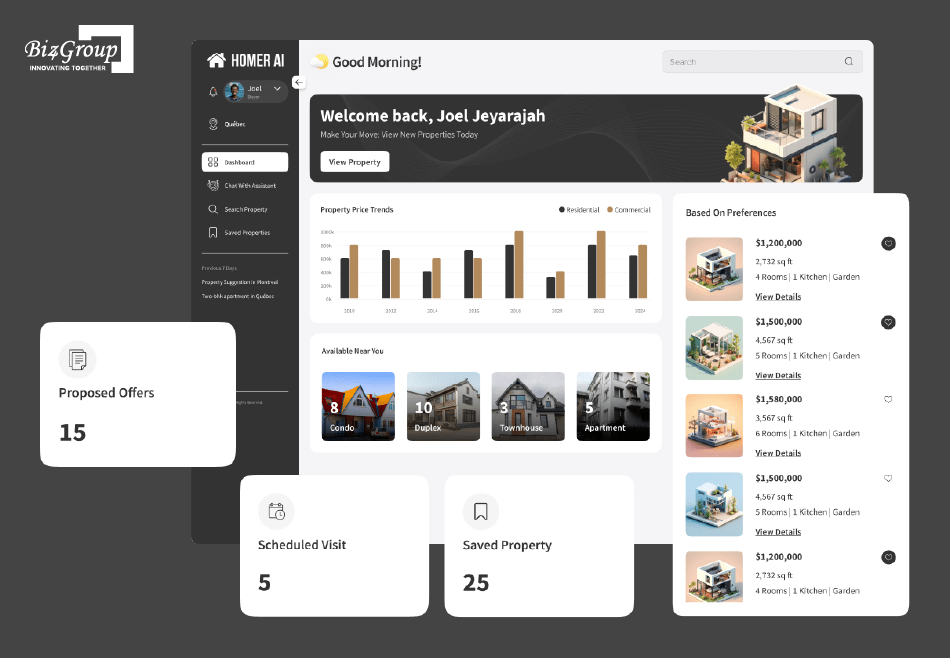
Homer AI is one example from Biz4Group's real estate development work where conversational AI was connected to actual property workflows. The platform used buyer preferences such as budget and location to support property recommendations, while also connecting those interactions with listings, dashboards, property details, and visit scheduling.
What Factors Affect AI Real Estate Platform Development Cost?
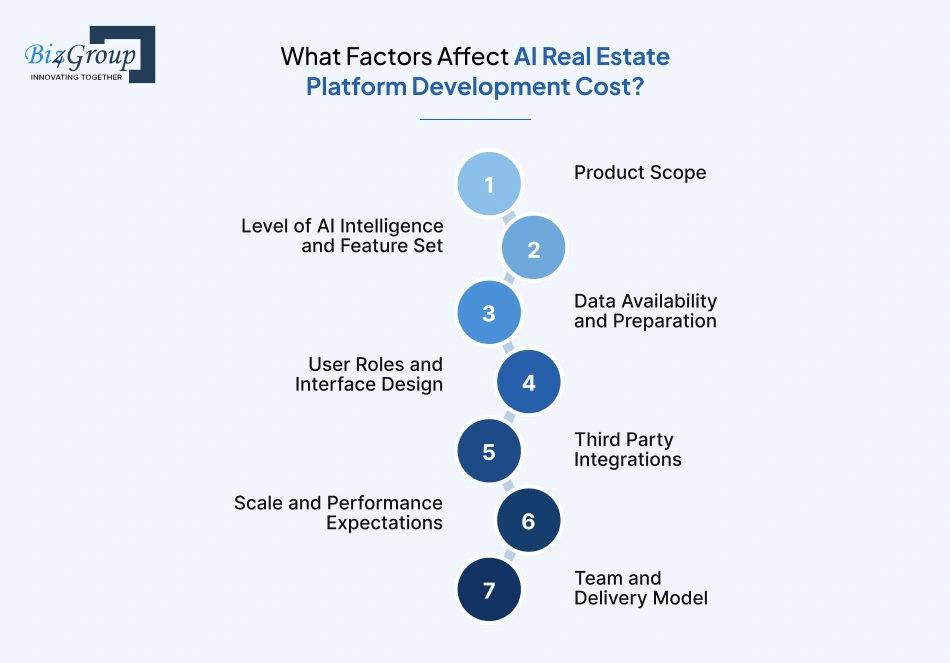
The AI real estate platform development cost changes based on real, measurable choices. What you build, how smart it needs to be, and how many people will use it all directly affect the final budget.
Below are the factors that usually move up the cost to build a custom AI real estate platform with realistic numbers for a better understanding:
1. Product Scope
A focused product that solves one or two problems costs far less than a platform covering multiple workflows.
- Example: A small product with search, filters, and basic insights may cost $30,000 to $50,000, while a broader system with automation and analytics can move past $80,000+. This difference often defines the cost to develop MVP for AI real estate platform.
2. Level of AI Intelligence and Feature Set
AI real estate platform development cost by features varies based on the sophistication of the AI capabilities you choose to implement.
What features influence the cost of an AI real estate platform?
Rule-based automation and basic AI features are relatively affordable, while machine learning models that analyze data, adapt over time, and improve prediction accuracy require significantly higher development effort
- Example: Basic AI features may add $5,000 to $10,000, while advanced learning models can increase costs by $25,000 to $50,000+, depending on complexity.
3. Data Availability and Preparation
AI needs data. If your data is already clean and structured, costs stay lower. If data needs cleaning or merging from multiple tools, budgets rise.
- Example: Minimal data prep may cost $3,000 to $8,000, while building full data pipelines can add $15,000 to $30,000, often requiring AI integration services.
4. User Roles and Interface Design
More users and roles mean more screens, permissions, and testing adding a significant amount to ai-driven real estate platform cost.
- Example: A simple internal dashboard may cost $5,000 to $8,000 in design and UI work, while a multi role system for agents, admins, and managers can reach $15,000 to $25,000.
5. Third Party Integrations
This is a common concern for real estate businesses that already rely on multiple systems. The audience often asks:
"We need to integrate AI with our existing property management, CRM, MLS, and accounting systems, but we are unsure how these integrations will affect the total development cost.?"
These integrations can add $5,000 to $20,000+ to development costs, depending on API availability, data complexity, and the number of systems involved. Custom or poorly documented integrations generally require more development and testing.
- Example: One basic integration may cost $4,000 to $7,000, while multiple integrations can push this to $20,000+.
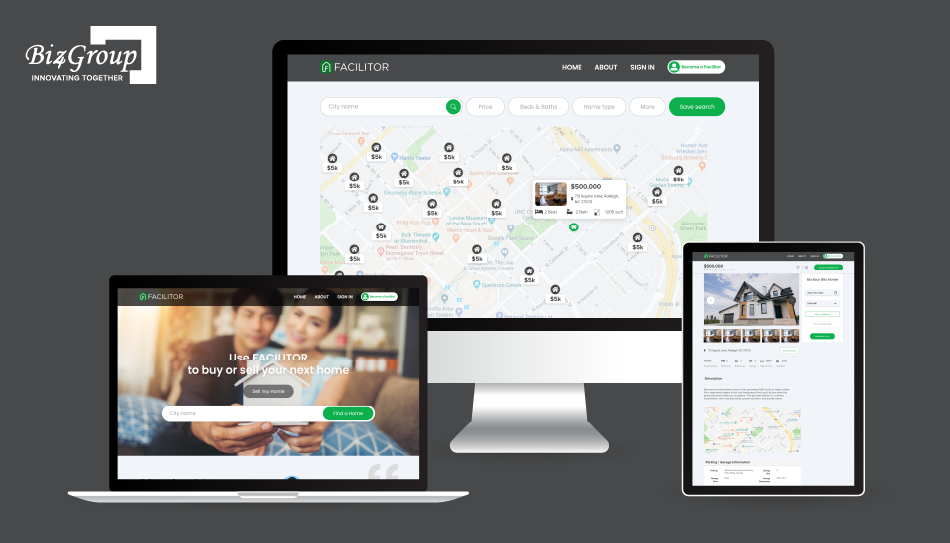
Biz4Group's experience with Facilitor shows why integrations can become a meaningful part of an AI real estate platform's development scope. The platform combined AI-powered property recommendations with MLS and GPS integration, buyer verification, real-time chat, and video-based property visits.
6. Scale and Performance Expectations
Platforms built for a small team costs less than a system expected to handle high traffic and real time data.
- Example: Light usage systems may stay under $10,000 in infrastructure setup, while platforms built for scale often require $25,000+, placing them closer to the levels of an enterprise AI real estate platform development cost.
7. Team and Delivery Model
Development costs are heavily influenced by who builds your system. The dedicated real estate app developer cost can vary significantly based on technical expertise, geographic location, and the hiring model, which ultimately impacts both project timelines and total investment.
- Example: Smaller teams may deliver MVPs in the $30,000 to $60,000 range, while larger, experienced teams handling complex systems can push total budgets past $150,000+.
These factors determine whether your project stays near the lower end of the AI real estate MVP development cost range or grows into a full-scale platform with enterprise level investment.
Why Should You Keep an Eye on Overlooked Costs in AI Real Estate Platform Development?
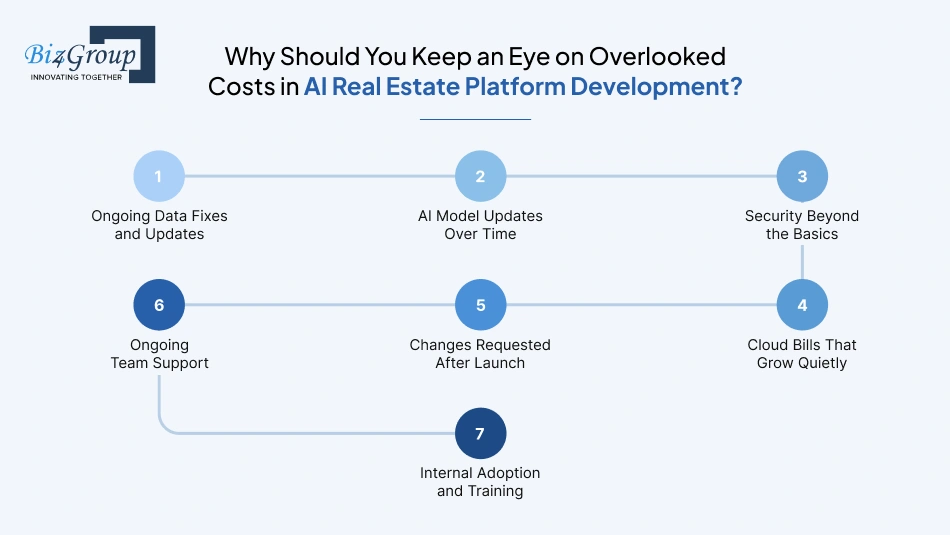
When planning the real estate AI development budgeting, what usually gets missed are the costs that show up once real users, real data, and real usage patterns come into play. These costs are common, predictable, and often underestimated.
Long-term costs are a common concern for businesses planning an AI real estate platform. Many teams want to know what expenses they should account for after the initial development is complete.
"We are worried about unexpected maintenance, security, hosting, and AI model costs after launch, and we want to estimate the total long-term investment."
Plan for ongoing costs of roughly 15% to 25% of the initial development cost per year for maintenance and improvements, plus hosting, AI model usage, security, and third-party services. Actual costs will increase as users, data, and platform usage grow.
Below are the overlooked areas that tend to affect budgets after planning begins.
1. Ongoing Data Fixes and Updates
Real estate data changes constantly. Listings expire, prices change, and records get outdated. Keeping data usable takes continuous effort.
- Example: Initial data setup may cost $3,000 to $7,000, but ongoing updates and cleanup often add $5,000 to $15,000 per year.
- Why it matters: If data quality drops, AI outputs become unreliable.
2. AI Model Updates Over Time
Building the AI model is only the beginning. As property markets evolve, AI models need regular updates to maintain accuracy and deliver reliable insights. Hence AI real estate platform pricing for small companies in 2026 should account for ongoing AI maintenance, not just the initial development cost.
- Example: Yearly retraining and validation usually costs $5,000 to $20,000, depending on how complex the logic is.
- Why it matters: Skipping updates reduces trust in predictions and recommendations.
Also Read: How to Train AI Models?
3. Security Beyond the Basics
Real estate platform handles personal and financial data. Basic security is not enough once users scale.
- Example: Initial security setup can cost $8,000 to $20,000, with $3,000 to $8,000 per year for monitoring and improvements.
- Why it matters: Security gaps create risks long after launch.
4. Cloud Bills That Grow Quietly
As usage increases, infrastructure costs rise. Many teams notice this only after launch.
- Example: Early usage may cost $500 to $1,000 per month, but steady growth can push this to $4,000 to $6,000 per month.
- Why it matters: Infrastructure becomes a recurring cost, not a one time expense.
5. Changes Requested After Launch
Once users start using the AI platform, change requests follow. These are rarely included in the original estimate.
- Example: Feature improvements and refinements often add $10,000 to $30,000 in the first year.
- Why it matters: This is where products mature, but costs rise.
6. Ongoing Team Support
After launch, someone still needs to monitor systems, fix issues, and respond to users.
- Example: Support and maintenance usually cost 15 to 25 percent of the original build cost per year, especially when teams hire AI developers to maintain and improve the system.
- Why it matters: Maintenance is predictable, but often ignored early.
7. Internal Adoption and Training
If your team uses the platform daily, they need time to learn it properly.
- Example: Training and onboarding typically cost $2,000 to $6,000, depending on team size.
- Why it matters: Poor adoption delays value, even if the platform works well.
|
Area |
Typical Cost |
|---|---|
|
Data updates |
$5K – $15K annually |
|
Model retraining |
$5K – $20K annually |
|
Security |
$8K – $20K + yearly costs |
|
Cloud usage |
$500 – $6K per month |
|
Feature changes |
$10K – $30K |
|
Maintenance |
15–25% annually |
Planning these items early helps teams avoid budget surprises. Looking beyond launch ensures the AI powered real estate platform building cost reflects how the product will actually be used.
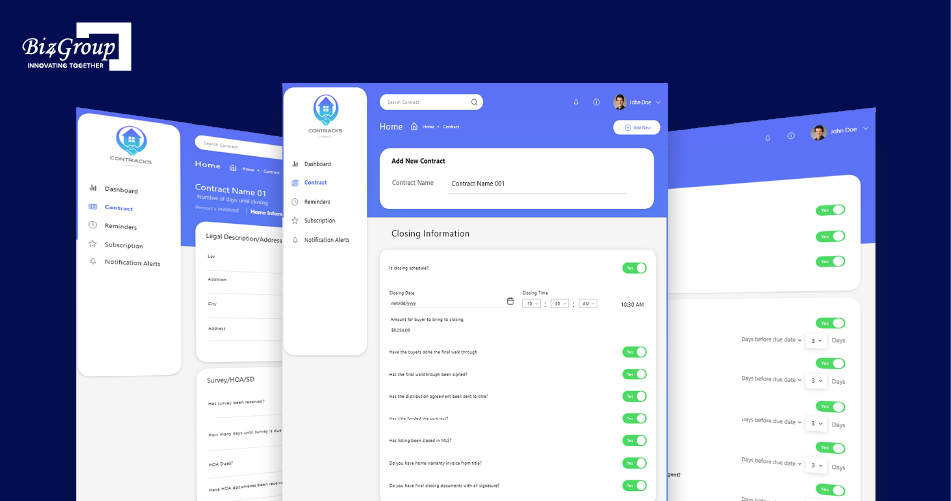
Projects like Contrack's built by Biz4Group show why long-term budgeting needs to account for more than model usage. As workflows, documents, integrations, and users grow, the platform also needs ongoing maintenance, security, infrastructure, and feature updates.
Also Read: How to Develop an AI Real Estate Website with Smart Search & Chat?
Which Cost Optimization Strategies for AI Real Estate Platform Development are the Best?
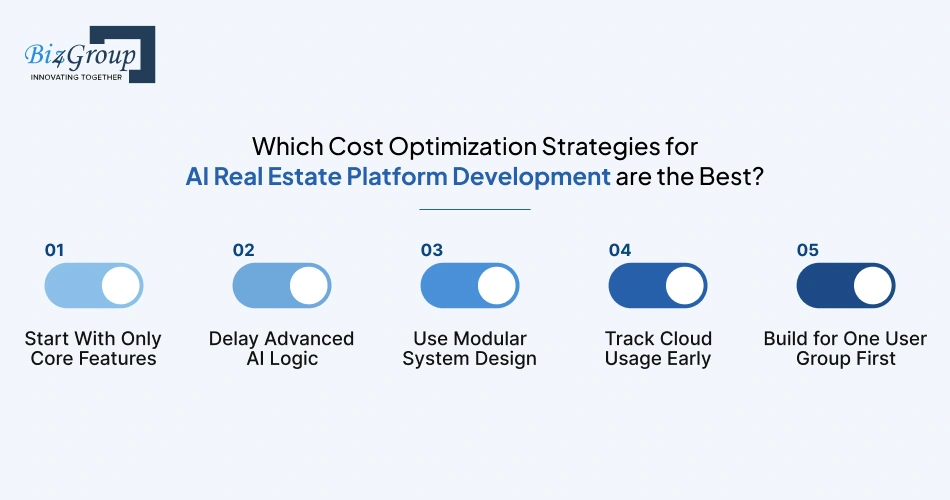
The best strategy to control real estate technology development expenses cost is mostly about timing and focus. If you plan what to build first and what can wait, costs stay predictable and easier to manage.
Below are practical ways founders and CTOs reduce spend without slowing progress.
|
Strategy |
How It Helps Control Cost |
Real Estate Example |
|---|---|---|
|
Start With Only Core Features |
Limits early development effort |
A startup launches with property search and basic insights instead of full automation, cutting early costs by 30–40% |
|
Delay Advanced AI Logic |
Avoids complex work before validation |
Basic rules are used first, with advanced AI added later |
|
Use Modular System Design |
Prevents expensive rework |
Search, pricing, and analytics are built as separate modules |
|
Track Cloud Usage Early |
Stops monthly bills from growing quietly |
Usage limits and alerts are set from day one |
|
Build for One User Group First |
Reduces design and testing effort |
Platform is built for internal teams before expanding to agents or customers |
Another way to control spending is to avoid overengineering early. Vendor pricing also varies widely.
What is the AI Real Estate Platform Development Cost Across Building Phases?
The AI real estate platform development cost grows step by step as your idea turns into a usable product. Below is how costs usually unfold in real projects:
1. Discovery and Planning
This phase is about slowing down before building. Teams define what problem the platform should solve, what data is available, and what success actually looks like.
Typical cost: $2,000 to $6,000
For early teams, this phase often answers practical questions around how to build AI real estate app MVP without committing to features that are not yet proven.
2. UI and UX Design
Design costs depend on who will use the product and how often. Internal tools are simpler. Products meant for daily use by agents or clients require more thought.
Typical cost: $3,000 to $10,000
When platform is built for AI for real estate agents, extra time usually goes into dashboards, filters, and usability testing.
Also Read: Top 15 UI/UX Design Companies in USA
3. Backend and Core System Setup
This is where the system starts to take shape. Databases, user access, and core logic are built here.
Typical cost: $5,000 to $20,000
Decisions made at this stage affect how easily the product can scale later.
4. AI Model Development and Integration
This phase adds intelligence to the system. It might involve scoring leads, estimating prices, or automating decisions.
Typical cost: $10,000 to $50,000
Costs tend to rise when teams move beyond simple logic and rely on AI automation services to handle complex workflows.
5. Data Integration and Testing
This phase connects MLS systems, internal databases, and third party tools, then tests everything under real conditions.
Typical cost: $5,000 to $25,000
This is often where hidden complexity shows up, especially if data quality varies.
Also Read: 15+ Platform Testing Companies in USA in 2026
6. Deployment and Go Live
Here, the product is prepared for real users. Monitoring, hosting, and backups are set up.
Typical cost: $2,000 to $6,000
Costs depend mostly on expected usage, not features.
7. Maintenance and Ongoing Improvements
Once the product is live, work does not stop. Models need tuning, bugs need fixes, and users request changes.
What is the ongoing maintenance cost of an AI real estate platform?
Typical ongoing cost: 15 to 25 percent of the original build cost per year
This phase is not optional. Skipping it usually leads to performance issues later.
|
Phase |
Typical Cost |
|---|---|
|
Discovery and Planning |
$2K – $6K |
|
UI and UX Design |
$3K – $10K |
|
Backend Setup |
$5K – $20K |
|
AI Development |
$10K – $50K |
|
Data Integration and Testing |
$5K – $25K |
|
Deployment |
$2K – $6K |
|
Maintenance |
15–25% annually |
In real projects, the biggest cost difference comes down to the cost to build AI real estate MVP vs enterprise solution. MVPs move faster, while enterprise builds invest more heavily in scaling, security, and long-term support.
This phase-based view is especially helpful when thinking about AI real estate platform development cost for startups, where timing matters as much as total budget and every decision needs time to evolve.
Also Read: AI Real Estate Website Development Cost
Which Common Mistakes Increase the AI Real Estate Platform Development Cost?
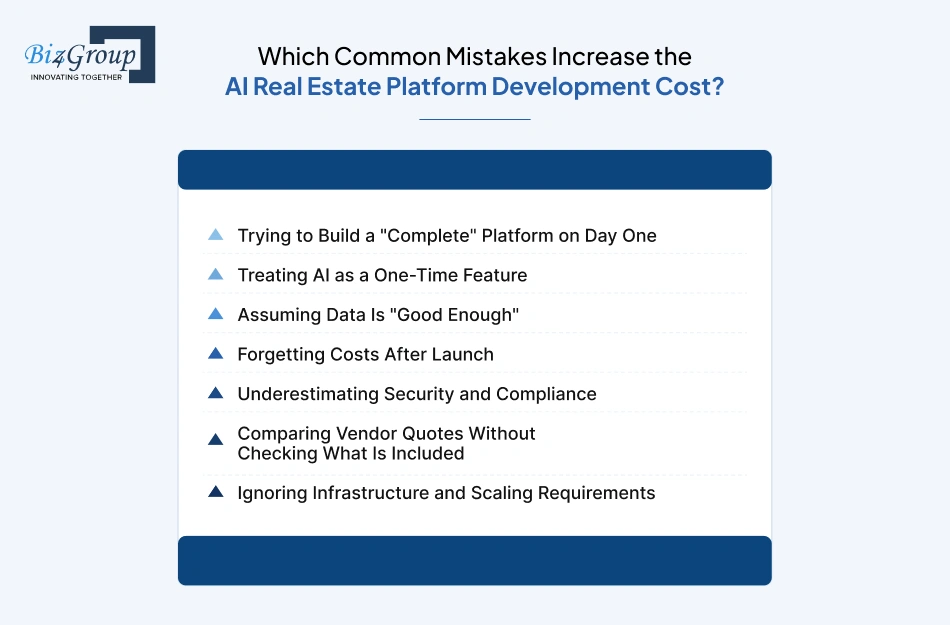
Most teams get the AI real estate platform development cost based on what they hope to build, not how AI products actually evolve once real data and users are involved. These mistakes are common, avoidable, and usually show up early if you know what to look for.
|
Common Mistake |
How It Affects the Budget |
Typical Cost Impact |
|---|---|---|
|
Trying to Build a "Complete" Platform on Day One |
Too many features, user roles, workflows, and AI capabilities expand development time before the core use case is validated. |
$30K–$60K for an MVP; broader platforms can reach $80K–$150K+ |
|
Treating AI as a One-Time Feature |
Initial development is budgeted, but testing, tuning, monitoring, and retraining are overlooked. |
$5K–$20K annually for model retraining and validation |
|
Assuming Data Is "Good Enough" |
Existing property, CRM, MLS, or operational data may require cleaning, restructuring, merging, and pipeline development. |
$3K–$8K for minimal preparation; $15K–$30K for full data pipelines |
|
Forgetting Costs After Launch |
Teams overlook ongoing fixes, feature improvements, model updates, and optimization after deployment. |
15%–25% of original build cost annually |
|
Underestimating Security and Compliance |
Adding security controls late can require additional development, testing, and infrastructure work. |
$8K–$20K initially, plus $3K–$8K annually |
|
Comparing Vendor Quotes Without Checking What Is Included |
A lower quote may exclude testing, deployment, integrations, support, or maintenance, making AI real estate platform development pricing difficult to compare. |
Can materially increase the total project investment |
|
Ignoring Infrastructure and Scaling Requirements |
Higher users, data volumes, and AI workloads can increase hosting, monitoring, and infrastructure expenses after launch. |
$500–$1K/month initially; potentially $4K–$6K/month as usage grows |
A realistic AI real estate platform development cost estimate should therefore cover more than the initial build. Data preparation, integrations, security, infrastructure, AI maintenance, and future scaling all need to be considered before comparing development proposals.
What are the Monetization Models That Influence the Cost to Build AI Real Estate Platform?
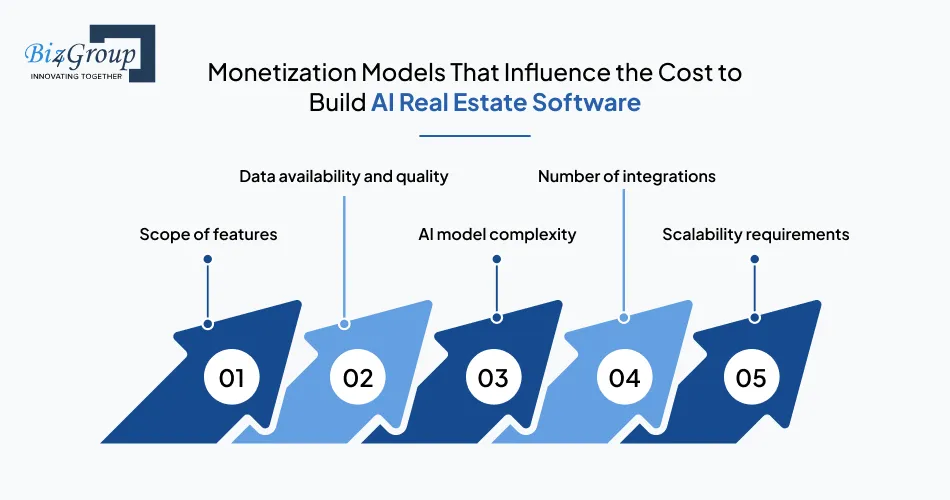
Put simply, different ways of earning require different things to be built.
Below are common monetization models and how they affect development effort and budget:
|
Monetization Model |
How It Works |
Best Fit For |
Cost Impact |
|---|---|---|---|
|
Subscription Based |
Users pay monthly or yearly for access |
Broker tools, investor dashboards, SaaS platforms |
Adds $8K–$20K for billing, user tiers, and access control |
|
Freemium With Paid Features |
Core features are free, advanced AI is paid |
Early stage products testing demand |
Adds $5K–$15K for feature limits and upgrade logic |
|
Usage Based Pricing |
Users pay per report, search, or AI action |
Data and analytics driven platforms |
Adds $4K–$10K for usage tracking and controls |
|
Licensing or B2B Access |
AI models or insights sold to other companies |
Data providers and partners |
Adds $15K–$40K for APIs, security, and documentation |
|
Lead or Referral Based |
Revenue earned per qualified lead |
Platforms focused on demand generation |
Adds $5K–$12K for tracking and attribution |
Products that spend time explaining how to use AI for real estate often invest more in dashboards, reports, and transparency. This raises early development cost, but it also improves trust and retention at the same time.
Is AI Real Estate Platform Worth the Investment in 2026?
In 2026, AI is about saving time, reducing manual work, and running leaner teams. The value comes from what the platform replaces and improves, not from AI itself.
Below is a simple way to judge whether the investment makes sense for your business.
1. Saving Time on Everyday Work
AI is most useful when it takes over routine tasks. These often include sorting leads, analyzing listings, updating reports, or spotting trends.
- Why this matters: When AI handles repeat work, your team spends more time on decisions and deals.
- Tip: List the tasks your team repeats daily and estimate how many hours AI could remove each week. This often justifies a large part of the startup cost to build AI real estate platform.
2. Making Fewer Costly Decisions
AI helps standardize decisions like pricing, lead scoring, or recommendations. This reduces errors that happen when decisions depend on individuals.
- Why this matters: More consistent decisions mean fewer missed opportunities and fewer mistakes.
- Tip: Compare outcomes before and after AI adoption, such as lead response time or pricing accuracy.
3. Building With a Business Goal in Mind
AI projects work best when they are built around a clear business outcome. This is where business app development using AI makes a difference, because features are tied directly to how the business operates.
- Why this matters: When AI is added without a goal, costs rise but value stays unclear.
- Tip: Define one core outcome the AI must improve before expanding scope.
4. Growing Without Growing Costs at the Same Rate
Once AI systems are running, they can support more users and data with limited extra effort.
- Why this matters: Growth does not require hiring at the same pace as revenue.
- Tip: Track cost per user as adoption grows to see the real scaling benefit.
5. Understanding Startup-Level Investment Reality
For early teams, the question is not just value, but timing.
- Why this matters: The investment needed to launch AI real estate startup platforms pays off only when scope is controlled, and growth is planned in steps.
- Tip: Start small, validate value, then expand once the return is visible.
So, AI is worth the investment when it clearly reduces effort, improves decisions, and supports growth.
Turn Budget Planning Into an Advantage
Smart budget planning to build AI real estate platform solutions starts with the right questions. Let's align scope, cost, and outcomes from day one.
Start My AI Cost StrategyAlso Read: 90+ AI Business Ideas In 2026: Investment Opportunities In USA
What Can Real Estate Businesses Learn from Building AI Platforms at Enterprise Scale?
At Biz4Group LLC, one thing we've seen while building AI-powered real estate products is that the AI itself is not always the biggest cost. Getting MLS, CRM, property, and operational data to work together can take just as much, or sometimes more, effort.
That's why an experienced custom AI platform development company will usually look at the data and workflow before deciding which AI capabilities to build. It's easy to add advanced AI to a roadmap, but if the underlying data is messy or the workflow is not clearly defined, that investment may need to be reworked later.
For enterprise platforms, it also helps to budget integrations, security, infrastructure, and ongoing AI maintenance separately. This gives you a much clearer picture of what the platform will actually cost beyond the first release.
If you're exploring AI agents for real estate workflows, you can reach out to AI Agent development experts at Biz4Group to discuss the use case and technical requirements before development begins.
Wrapping Up!
AI real estate projects rarely go off track because AI is too expensive. They go off track because the scope keeps moving. Define the right features, check your data early, and scale in stages, and the AI real estate platform development cost becomes much easier to control.
The goal isn't to build everything on day one. It's to build what matters, prove the value, and expand from there.
That's where experienced AI consulting services can help, especially when you're deciding what to build, what to postpone, and where AI actually belongs. Have an AI real estate idea you want to pressure-test? Let's talk.
FAQs on AI Real Estate Platform Development Cost
Frequently Asked Questions
1. What is the average cost of developing an AI real estate platform?
The average cost depends on the platform's scope, AI capabilities, integrations, and scalability requirements. A practical range is $30,000 to $60,000 for an MVP, $80,000 to $150,000+ for an advanced platform, and $200,000 to $300,000+ for an enterprise-grade solution.
2. How much does it cost to integrate AI into a real estate platform?
AI integration can range from $10,000 to $50,000+, depending on whether you are adding an existing AI model, building custom AI capabilities, preparing property data, or connecting AI with existing workflows. Integrating AI into an established platform can also require additional backend, API, and data engineering work.
3. How does the technology stack affect AI real estate development pricing?
The technology stack affects development pricing through infrastructure, AI frameworks, databases, APIs, cloud services, scalability, and security requirements. A straightforward cloud-based stack can keep the initial cost lower, while enterprise infrastructure, complex data processing, custom AI models, and high-volume workloads can increase both development and operating costs.
4. What development team and timeline are required for an AI real estate platform?
A typical project may require a product manager, UI/UX designer, frontend developer, backend developer, AI/ML engineer, and QA engineer, depending on the scope. An MVP can take roughly 3 to 6 months, while advanced and enterprise platforms may require 6 to 12+ months because of deeper integrations, testing, security, and scalability requirements.
5. How do data security and compliance requirements affect AI real estate platform costs?
Security and compliance add costs through secure data storage, access controls, encryption, authentication, audit logging, testing, and ongoing monitoring. The impact is usually higher when a platform handles sensitive customer, financial, tenant, or property information or needs to meet specific regulatory requirements.
6. What are the biggest hidden costs when building an AI real estate platform?
Beyond development, teams should budget for data preparation, third-party API fees, cloud infrastructure, AI model usage, security updates, monitoring, maintenance, and future feature changes. These expenses can become significant after launch, especially as usage and data volumes grow.
7. How much does it cost to scale an AI real estate platform after launch?
Scaling costs vary with user growth, property data volume, AI usage, infrastructure requirements, and new integrations. Early infrastructure may cost around $500 to $1,000 per month, while growing platforms can reach $4,000 to $6,000+ per month. Additional engineering work may also be needed as the platform expands.
8. Should I build a custom AI real estate platform or use an existing platform?
A custom platform offers greater control over workflows, integrations, AI capabilities, and future scalability, while an existing platform can reduce upfront development time and cost. The better choice depends on how closely existing solutions match your business processes and how much customization you need.
