 Location :
Orlando, FL, USA
Location :
Orlando, FL, USA +1 (407) 714-1616
 info@biz4group.com

 AI Summary Powered by Biz4AI
- Bring utility bills, meters, building systems, and property records into one platform.
- Use AI to track energy use, emissions, and water consumption across buildings.
- Adjust sustainability scores for property type, size, occupancy, and climate.
- Detect unusual energy use and flag potential equipment inefficiencies for investigation.
- Compare retrofit costs, expected savings, emissions reductions, and payback periods to prioritize projects.
- Validate data and AI outputs, maintain proper oversight, and track whether improvements deliver measurable results.
An AI sustainability scoring platform for real estate portfolios helps property owners and asset managers understand how their buildings are performing on energy use, emissions, and sustainability. It brings together information from utility bills, building systems, property records, and benchmarks, helping teams compare assets, spot unusual energy use, and identify opportunities to improve efficiency.
- Are you finding it difficult to compare buildings with different sizes, ages, and energy needs?
- Does your team spend hours collecting data for sustainability reports?
- When a building uses more energy than expected, can you tell what's causing it and where to focus your efforts?
A scoring platform needs to account for differences in property type, occupancy, and climate. It also needs to show how scores are calculated and flag gaps in the underlying data, so teams can understand what the results actually mean.
Biz4Group LLC, a U.S.-based AI product development company, recognizes a key challenge in this area: a score that works for a new office tower may not fairly represent an older residential building. Accounting for building type, occupancy, climate, and missing utility data helps make portfolio comparisons more meaningful and improvement priorities more practical.
What Makes AI Sustainability Scoring Different From Manual ESG Reporting?
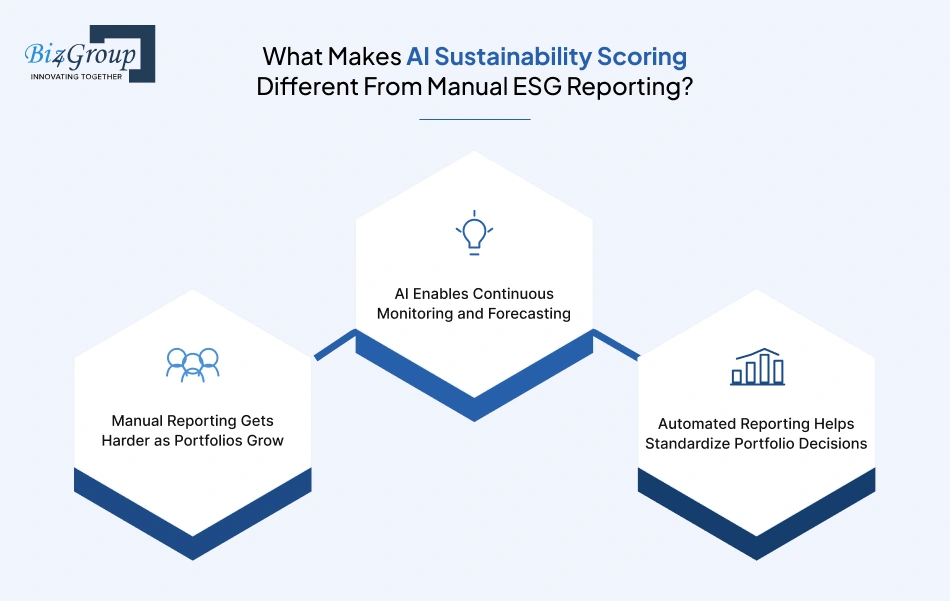
Managing sustainability across a real estate portfolio can mean chasing utility bills, cleaning spreadsheets, and gathering updates from property teams. As portfolios grow, keeping data consistent gets harder. An AI sustainability scoring platform brings information together and helps teams spot patterns and performance issues.
Manual Reporting Gets Harder as Portfolios Grow
Different formats, reporting periods, and missing readings make properties harder to compare. Landlord and tenant energy use can also be recorded separately. Ever tried comparing two buildings only to find their data doesn't line up?
AI Enables Continuous Monitoring and Forecasting
AI can analyze meter and building-system data as it arrives, flag unusual energy use, and forecast demand. That helps teams investigate changes sooner, though insights still depend on data quality and model assumptions.
Automated Reporting Helps Standardize Portfolio Decisions
Automation applies consistent metrics, prepares portfolio summaries, and tracks performance against benchmarks. Teams can compare assets and prioritize improvements, while checking source data and estimates before acting.
For teams that need help connecting data sources and reducing repetitive reporting work, AI automation services may support workflows such as data consolidation, validation, and report preparation.
|
Area |
Manual ESG Reporting |
AI Sustainability Scoring |
|---|---|---|
|
Data collection |
Manual gathering and follow-ups |
Combines data from multiple sources |
|
Monitoring |
Reviews at set reporting intervals |
Flags changes as data arrives |
|
Analysis |
Manual comparisons and trend checks |
Helps identify anomalies and forecast demand |
|
Comparisons |
Data gaps and inconsistent formats complicate reviews |
Uses shared metrics and highlights gaps |
|
Reporting |
Reports take time to compile |
Automates summaries and benchmark tracking |
|
Decisions |
Based on available reports |
Helps teams investigate issues and prioritize work |
What does this mean for your portfolio? A clearer, more timely view of building performance, with less time spent assembling reports. Human review and reliable data still matter when it's time to make decisions.
What Data Sources Feed an AI Sustainability Scoring Platform?

An AI sustainability scoring platform combines building consumption data with operational and property information to help asset managers understand energy use, emissions, and performance across their portfolios.
Utility Bills and Meters Track Energy and Water Use
Utility bills provide consumption and cost history, while smart meters and submeters offer more frequent readings.
- Useful data: Electricity, gas, water, heat, consumption, and cost.
Building Systems and IoT Sensors Reveal Operational Performance
Building Management Systems (BMS), HVAC controls, and IoT sensors show how equipment and spaces are operating. AI can use these signals to flag unusual patterns and potential inefficiencies. Connecting building management systems, meters, and sensors may require AI integration services that bring data from different sources into one usable view.
- Useful data: Equipment runtime, temperatures, occupancy, and system status.
Tenant, Property, and Weather Data Add Useful Context
Energy use depends on how a property is built and occupied, as well as local weather. Including this context helps make comparisons between buildings more meaningful.
- Useful data: Property type, floor area, operating hours, occupancy, and weather conditions.
Shared Meters and Missing Records Require Careful Handling
Shared meters, incomplete bills, and gaps in readings can affect the accuracy of a building's score. The platform should clearly distinguish measured consumption from estimates and flag missing information.
- Key checks: Meter coverage, landlord and tenant usage, missing periods, and estimated values.
Data Validation Establishes Reliable Performance Baselines
Before scoring, the platform should check incoming data for errors and inconsistencies. Keeping a record of sources and corrections helps teams trace results and compare performance with greater confidence.
- Key checks: Duplicate readings, inconsistent units, unusual values, timestamps, and data gaps.
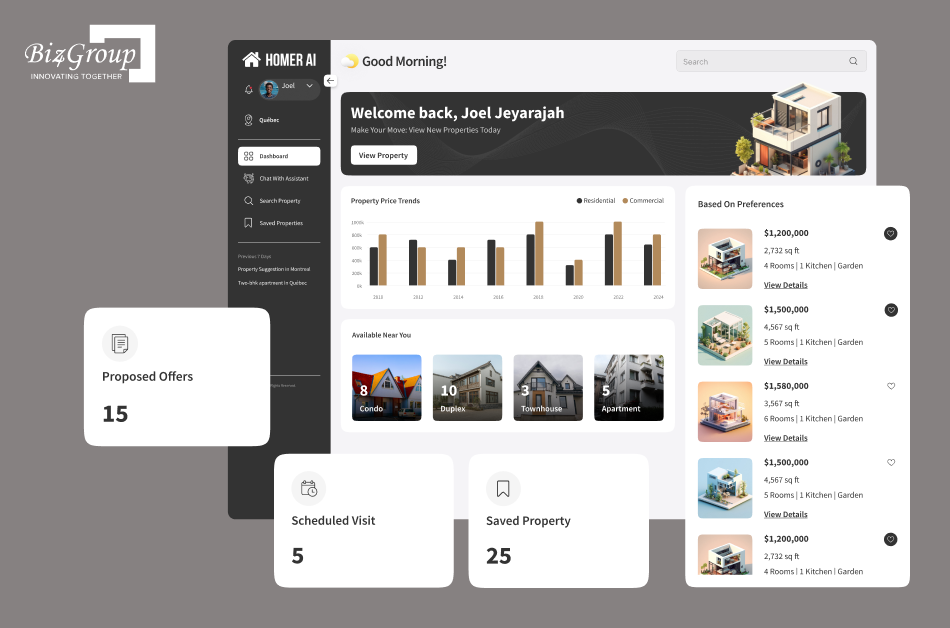
Biz4Group LLC's work on Homer AI provides a real estate software example of bringing property information into an AI-enabled application. The project included property details, buyer and seller dashboards, and API development to retrieve property plans. That experience is relevant to a sustainability platform's integration work, where data from different property systems needs to be organized and made accessible to users.
How Does AI Calculate a Sustainability Score Across a Real Estate Portfolio?
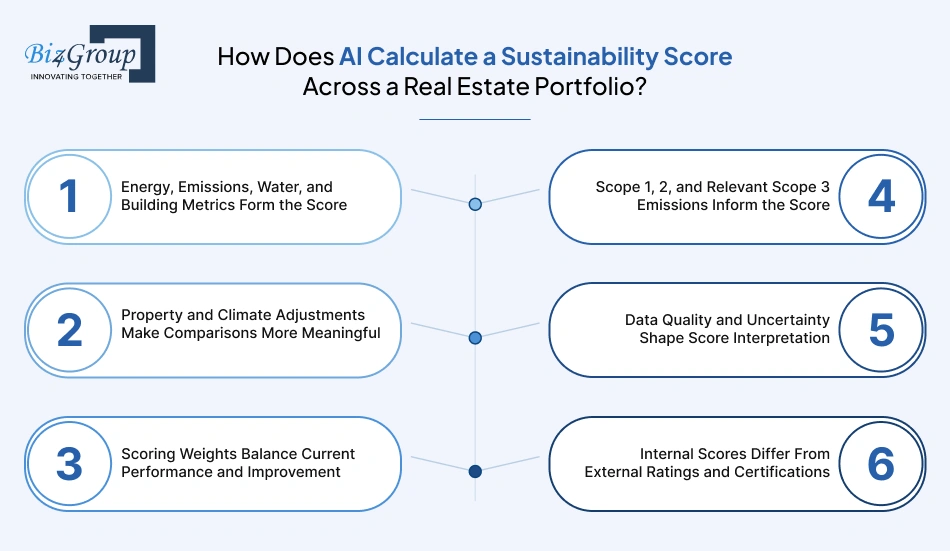
An AI platform calculates a sustainability score by combining building data, applying defined scoring rules, and accounting for factors such as property type and climate. It then shows how each asset performs against the portfolio's chosen metrics, while making assumptions and data gaps visible.
Energy, Emissions, Water, and Building Metrics Form the Score
The platform combines indicators such as energy intensity, carbon emissions, water consumption, and relevant building-performance measures to create a score aligned with the portfolio's sustainability goals.
Property and Climate Adjustments Make Comparisons More Meaningful
A hospital and an office tower have different operating needs. Adjusting for property type, floor area, occupancy, and climate helps make comparisons more meaningful. Would you compare those buildings using raw energy consumption alone? That could give you a misleading picture.
Scoring Weights Balance Current Performance and Improvement
Each metric receives a weight based on the scoring objectives. A carbon-focused portfolio may give emissions more weight, while another may emphasize energy and water efficiency. The methodology should explain whether the score reflects current performance, progress over time, or both.
Scope 1, 2, and Relevant Scope 3 Emissions Inform the Score
The emissions calculation may include direct fuel use (Scope 1), purchased energy (Scope 2), and relevant value-chain emissions (Scope 3). The categories included depend on the organization's reporting boundary and property activities.
Data Quality and Uncertainty Shape Score Interpretation
Missing readings, estimates, and inconsistent records can affect the result. The platform should show data coverage and uncertainty so users can judge how much confidence to place in each score. How reliable is a score if a large share of its inputs are estimated?
Internal Scores Differ From External Ratings and Certifications
An internal score uses the organization's own metrics and methodology. External systems such as GRESB, ENERGY STAR, and LEED have separate assessment criteria, so an AI-generated score should not be treated as a replacement for those ratings or certifications.
|
Scoring factor |
What the platform evaluates |
Why it matters |
|---|---|---|
|
Energy, emissions, and water |
Consumption, carbon output, and building metrics |
Establishes a sustainability performance score |
|
Property and climate |
Building type, size, occupancy, and local conditions |
Makes asset comparisons more meaningful |
|
Scoring weights |
Importance assigned to each metric and improvement over time |
Aligns the score with portfolio goals |
|
Emissions scopes |
Relevant Scope 1, 2, and Scope 3 emissions |
Clarifies which emissions are included |
|
Data quality |
Coverage, estimates, missing records, and uncertainty |
Helps users interpret the score reliably |
|
External frameworks |
Differences from ratings and certifications such as GRESB, ENERGY STAR, and LEED |
Prevents confusion between internal scores and external assessments |
How Does AI Detect Energy Waste Across a Real Estate Portfolio?
AI detects potential energy waste by comparing actual building consumption with expected usage, then flagging unusual patterns, possible equipment problems, and changes in future demand. Here's how that works in practice.
Meter and BMS Data Reveal Abnormal Energy Use
- What AI looks for: Unexpected energy spikes, overnight consumption, and usage that stays unusually high.
- How it helps: Meter readings and building management system (BMS) data help narrow down when and where an issue may be happening.
Operating Patterns Help Identify Equipment Inefficiencies
- What AI looks for: Equipment running beyond scheduled hours, heating and cooling operating together, or systems behaving differently from their usual patterns.
- How it helps: Teams can investigate likely causes instead of searching through every building system manually. Could a building be consuming energy when its spaces are empty?
Asset managers often want to know whether AI can help identify where energy is being wasted and ask:
"I keep hearing about energy waste in our older buildings, but I have no way to pinpoint exactly where the inefficiencies are, so I want to understand how AI can detect and flag these issues across a large portfolio."
AI can analyze meter readings, building management system data, and operating patterns to flag unusual consumption or equipment behavior. These alerts help teams decide which buildings or systems to investigate, while on-site checks are still needed to confirm the cause.
Forecasts Estimate Future Energy Demand and Carbon Risk
- What AI uses: Historical energy consumption, weather, occupancy, and operating schedules.
- How it helps: Forecasts estimate future demand. When combined with emissions factors and relevant transition pathways, they can also help assess real estate carbon risk. These estimates depend on the quality of the data and the assumptions behind the model.
Alerts Help Teams Investigate and Address Energy Waste
A typical response workflow:
- Detect: The platform flags an unusual pattern.
- Investigate: Property teams check the equipment, schedules, and conditions involved.
- Act: Staff address the issue where appropriate and record what they changed.
- Verify: Teams review later consumption to see whether the problem has improved.
This feedback helps teams assess alert accuracy and track progress toward energy efficiency goals across the portfolio.
Where it adds value, generative AI can help turn technical alerts into plain-language summaries, explain which readings triggered them, and suggest questions for a building team to investigate. Those explanations should remain grounded in the underlying data.
Which Sustainability Benchmarks and Compliance Frameworks Should the Platform Support?
For U.S. real estate portfolios, the platform should support energy benchmarks, green-building certifications, investor reporting frameworks, and local building-emissions rules. The right mix depends on where your properties are and what your company needs to report. Some tools are voluntary, while certain laws apply to specific buildings.
GRESB, ENERGY STAR, and LEED Serve Different Purposes
These three names often come up in real estate sustainability, but each does a different job:
- GRESB helps investors assess the ESG performance of real estate companies and funds.
- ENERGY STAR helps property teams measure and compare building energy performance.
- LEED certifies buildings that meet defined green-building standards.
The platform should keep these results separate because they measure different things. A strong ENERGY STAR score, for example, does not automatically mean a property has earned LEED certification.
CRREM Pathways Help Assess Carbon Transition Risk
CRREM helps owners compare a building's emissions with pathways designed to align with climate targets. This can show where a property may face growing pressure from changing regulations, technology, or market expectations.
For U.S. assets, teams should choose the relevant pathway and document the assumptions. Could a building that performs well today fall behind as emissions limits become stricter? CRREM analysis can help explore that risk.
CSRD, ESRS, SASB, and TCFD Inform Sustainability Disclosures
These frameworks and standards can matter to U.S. real estate companies with European operations, international investors, or specific reporting needs.
- CSRD and ESRS relate to sustainability reporting requirements in the European Union and may apply to certain companies with EU connections.
- SASB Standards provide industry-specific guidance on sustainability information that may matter to investors.
- TCFD recommendations help structure climate-related disclosures and continue to inform reporting practices.
The platform should support the frameworks relevant to the company rather than assume every portfolio needs all of them.
Building Emissions Laws Add Local Compliance Requirements
Building rules can vary by city and state, so a U.S. portfolio may need to track different requirements for different properties. For example, New York City Local Law 97 sets emissions limits for covered buildings, while Boston BERDO includes reporting and emissions requirements for covered properties.
Do you know which buildings in your portfolio are covered, and when their next reporting deadlines fall? The platform should help track applicable thresholds, deadlines, and rule changes.
Framework Mapping Connects Portfolio Data to Reporting Needs
Framework mapping connects property data to the definitions and calculations each benchmark or regulation requires. This lets teams reuse validated information while keeping each framework's rules and reporting boundaries clear.
It should also make it easy to see which data is missing and where estimates are being used. That way, an internal AI score supports reporting and planning without being mistaken for proof of compliance or certification.
A common question from asset managers is how AI can make that reporting process more manageable:
"We are under pressure from investors to report GRESB and ENERGY STAR scores every year, but pulling utility data from dozens of properties takes weeks, so I need an AI platform that can automate this process."
An AI platform can consolidate utility and building data, validate records, and organize relevant metrics for reporting. It can help prepare information for GRESB and ENERGY STAR workflows, while teams still need to check data quality and meet each framework's specific requirements.
|
Framework or tool |
Main purpose |
What the platform should support |
|---|---|---|
|
GRESB |
Real estate ESG assessment |
Collect and organize relevant ESG data |
|
ENERGY STAR |
Building energy benchmarking |
Track energy performance and benchmark results |
|
LEED |
Green-building certification |
Record certification status and related building data |
|
CRREM |
Carbon transition risk analysis |
Compare emissions with relevant decarbonization pathways |
|
CSRD / ESRS |
EU sustainability reporting |
Support applicable disclosure data and requirements |
|
SASB / TCFD |
Sustainability and climate-related disclosures |
Organize relevant investor and climate reporting information |
|
Local building laws |
Jurisdiction-specific compliance |
Track covered properties, emissions limits, and deadlines |
|
Framework mapping |
Connect data to reporting needs |
Reuse validated data while preserving each framework's rules |
How Does AI Prioritize Decarbonization Projects by ROI?
AI helps asset managers compare real estate decarbonization projects by estimating their costs, energy savings, emissions reductions, and payback periods. It can then help identify which improvements deserve a closer look, based on each building's needs and available budget.
Cost, Savings, and Payback Help Compare Retrofit Options
AI can compare options such as LED lighting, HVAC upgrades, and improved building controls using installation costs, expected utility savings, and payback periods.
Would you spend on a quick-payback upgrade first, or choose a larger project with greater long-term savings? Comparing both helps make the trade-offs clearer.
Emissions Reductions Must Be Weighed Against Capital Needs
A retrofit may cut substantial emissions but also require a large upfront investment. AI can help weigh expected carbon emissions reductions against capital costs, energy savings, and portfolio targets.
Engineering Evidence Helps Validate Proposed Improvements
AI recommendations need to be checked against energy audits, equipment condition, and how the building actually operates. If the model suggests replacing an HVAC system, does the equipment need replacing, or could a controls adjustment solve the problem? Engineering review helps confirm what's practical.
Transparent Assumptions Clarify Expected Savings and Confidence
Savings estimates depend on energy prices, occupancy, installation costs, and equipment performance. Showing these assumptions, along with data gaps and confidence levels, helps managers understand how much trust to place in projected retrofit ROI.
Capital Constraints Shape Priorities for Affordable Housing
Affordable housing providers may need to balance energy upgrades with limited budgets, essential repairs, and resident comfort. AI can help compare projects by cost, savings, emissions impact, and feasibility, keeping affordability in the decision-making process.
Build vs. Buy: Should You Choose a Custom Platform or Existing ESG Software?
It comes down to how closely your needs match what existing real estate ESG software already offers. Buying can get you started with established workflows, while custom development gives you more control over integrations and scoring. The right fit depends on your portfolio, data, reporting needs, budget, and flexibility requirements.
For larger portfolios, enterprise AI solutions may need to support multiple property types, complex integrations, portfolio-wide reporting, and clear access controls.
|
Consideration |
Buy Existing ESG Software |
Build a Custom Platform |
|---|---|---|
|
Time to launch |
Often faster with ready-made features |
Longer setup, development, and testing |
|
Cost |
Subscription, setup, and integration fees |
Upfront development and ongoing maintenance |
|
Scoring and analytics |
Uses the vendor's methods and available settings |
If existing tools can't handle your data sources or scoring requirements, build AI software around the way your portfolio actually operates. |
|
Integrations |
Limited to supported connectors and capabilities |
Designed around your data sources and systems |
|
Control and flexibility |
Changes depend partly on the vendor |
More control over features and future changes |
|
Maintenance |
Vendor handles much of the product upkeep |
Your team or development partner manages it |
A quick rule of thumb: Don't build a whole platform just to solve one awkward workflow. And don't buy software that forces your portfolio into a scoring method that doesn't fit. Find the balance that works for your buildings, your team, and your budget.
A common question for real estate funds evaluating their options is:
"I am evaluating whether to build a custom AI sustainability scoring platform in-house or use existing ESG software, so I need to understand the cost, data requirements, and long-term value for our real estate fund."
Existing ESG software may suit portfolios whose reporting and data needs match its capabilities. A custom platform can offer more control over integrations and scoring, but typically requires greater development and maintenance effort. Compare both options against your data sources, required features, budget, and expected long-term use before deciding.
How Do You Build an AI Sustainability Scoring Platform for Real Estate Portfolios?
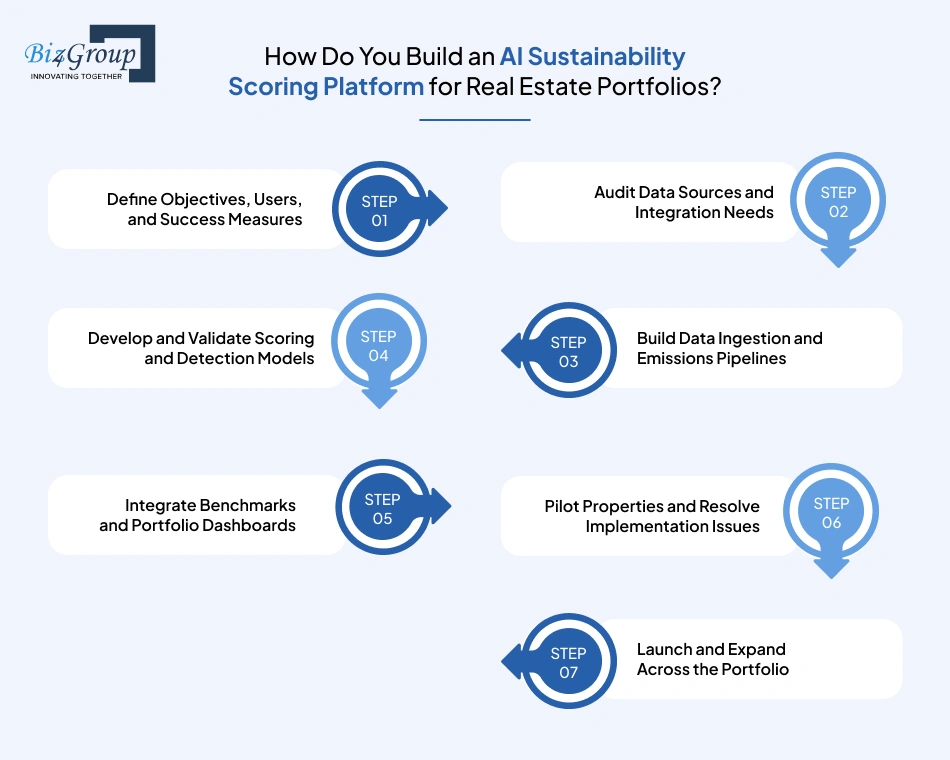
Build the platform in stages: define what your team needs, plan the user experience, connect property data, develop and validate the AI models, and expand after a pilot. Starting with a focused MVP helps you test the core idea before investing in a full-scale system.
Step 1: Define Objectives, Users, and Success Measures
Decide what the platform should help your team achieve, such as reducing emissions, finding energy waste, simplifying ESG reporting, or prioritizing retrofits. Identify who'll use it and set measurable goals, such as better data coverage or lower energy use.
This is also the time to plan MVP development services around the features you need first, alongside UI/UX development that makes the platform clear and practical for asset managers and sustainability teams.
Step 2: Audit Data Sources and Integration Needs
List your existing utility bills, meters, BMS platforms, property records, and ESG tools. Check how reliable each source is, how often it updates, and whether you can access it. This gives your development team a clearer picture of the integration work ahead.
Step 3: Build Data Ingestion and Emissions Pipelines
Create the process that brings property data together, standardizes units, and prepares it for analysis. Add emissions calculations using suitable emission factors, and retain source records so measured values aren't confused with estimates.
Step 4: Develop and Validate Scoring and Detection Models
This is where training AI models becomes important. Use relevant building data to develop scoring and anomaly-detection models, then test whether their outputs make sense under different operating conditions. Your property and engineering teams should review the findings, too. Are the models flagging genuine issues, or creating noise?
AI model development should include selecting suitable methods, training and validating them with relevant building data, and checking whether their outputs are useful to the teams investigating energy performance.
If your team lacks the required machine-learning experience, you may need to hire AI developers to build and validate models using relevant building data.
Step 5: Integrate Benchmarks and Portfolio Dashboards
Connect the benchmarks and reporting frameworks your organization needs, then build dashboards that make the results easy to understand. A thoughtful user experience helps asset managers compare buildings, follow energy and emissions trends, and find important information without digging through complicated screens.
Step 6: Pilot Properties and Resolve Implementation Issues
Start with a small group of buildings that reflects your portfolio's variety. Use testing services to check integrations, scoring accuracy, alerts, usability, and security. Gather feedback from actual users, address problems, and confirm that the platform meets the goals you set before expanding.
Step 7: Launch and Expand Across the Portfolio
Once the pilot meets your targets, roll out the platform in manageable stages. Train users, assign responsibility for data quality, and keep monitoring model performance as more buildings and data sources are added.
Before you scale, ask: Can your team explain why a building received its score and what action to take next? If they can, you'll have a clearer foundation for expanding the platform across your portfolio.
What Does It Cost to Develop an AI Sustainability Scoring Platform?
Developing an AI sustainability scoring platform for real estate portfolios can cost around $45,000 to $300,000+, depending on portfolio size, data readiness, integrations, scoring complexity, and reporting needs. A focused MVP covers the essentials, while larger platforms may require more advanced analytics, custom integrations, and enterprise-level controls.
|
Platform level |
Estimated cost |
What it typically includes |
|---|---|---|
|
MVP |
$45,000-$80,000 |
Core data ingestion, basic sustainability scoring, limited integrations, an essential dashboard, and initial testing. |
|
Mid-Level |
$80,000-$180,000 |
More data sources, portfolio comparisons, emissions tracking, anomaly detection, benchmark mapping, and configurable reports. |
|
Enterprise |
$180,000-$300,000+ |
Complex integrations, advanced AI analytics, multi-portfolio support, custom scoring, stronger governance and security, and enterprise reporting. |
Think of it like a building: start with the essentials, add the upgrades that earn their keep, and save the penthouse features for when you really need them.
Does Sustainability Performance Affect Property Valuation, Rent, and Investor Demand?
In the U.S., a building's sustainability performance can matter when you're setting rents, managing expenses, or discussing investments. The impact depends on the property and its market, so it helps to look at what's happening at the asset level. Where could better sustainability data make a difference for your portfolio?
Green-Building Rent Premiums Vary by Market and Property Type
Green certifications and energy-efficient features may influence what tenants are willing to pay, but the effect can differ between office, residential, and industrial properties. A premium reported for one market won't necessarily apply to yours.
When you look at your buildings, are tenants asking about energy performance or sustainability credentials? Local leasing data can help you understand whether those features are affecting demand and rental discussions.
Energy Efficiency Can Lower Operating Costs and Support Net Operating Income
Using less energy can mean lower utility bills. If other income and expenses stay the same, those savings can support net operating income (NOI). The size of the benefit depends on energy prices, occupancy, building condition, and what the upgrades cost.
For your team, the useful question is: Which improvements could cut energy costs, and how long might it take for the savings to cover the investment?
Sustainability Features May Influence Leasing Demand and Transition Risk
Tenants may pay attention to efficient systems, building comfort, and sustainability credentials when choosing space. Meanwhile, properties that need expensive upgrades to address changing energy or emissions requirements may face carbon transition risk.
Do you know which buildings in your portfolio may need upgrades, and what those improvements could involve? Reviewing each property's condition and applicable local requirements can help your team plan ahead.
Investors Use Sustainability Data in Portfolio Decisions
A January 2026 GRESB and MIPIM survey of nearly 200 respondents globally found that 66% considered sustainability central to their investment or operational strategy. It also found that 49% cited investor or lender requirements as a leading driver of sustainability strategy. These are global survey results, rather than figures specific to U.S. investors.
Clear real estate ESG data can help your team explain how buildings are performing, where risks may exist, and why certain improvements are being considered. Can you show investors the evidence behind a proposed project and how you'll measure its results?
Market Evidence Does Not Automatically Prove Platform Impact
A sustainability score can help your team spot issues and compare properties, but the score alone doesn't prove that the platform improved rent, value, or operating performance. To understand its impact, track what decisions were made and compare results against a baseline, taking account of factors such as weather, occupancy, and energy prices.
In short, follow the insight all the way to the outcome. That's how you find out whether the platform is helping your team make practical, measurable improvements.
What Metrics Should Asset Managers Track to Measure Platform Impact?
Asset managers should track metrics that show whether the platform is improving building performance, helping teams act on problems, and delivering measurable results. Looking at portfolio-wide trends alongside individual property data makes it easier to see what's working and where attention is needed.
|
Metric area |
What to track |
What it helps you understand |
|---|---|---|
|
Portfolio energy, emissions, costs, and benchmarks |
Energy use and intensity, carbon emissions, water consumption, utility costs, and performance against selected benchmarks. |
Are portfolio-wide results improving, and which buildings are falling behind? |
|
Asset performance and improvement opportunities |
Energy use by property, unusual consumption patterns, equipment performance, and identified upgrade opportunities. |
Which buildings need a closer look, and where could improvements make a difference? |
|
Reporting time and data coverage |
Time spent preparing reports, percentage of properties with usable data, missing records, and frequency of data updates. |
Is the platform reducing manual work and giving your team a more complete picture? |
|
Detection accuracy and alert resolution |
Accuracy of flagged issues, false alarms, time to investigate, and percentage of alerts resolved. |
Are alerts helping staff find and fix real problems, or just adding to their workload? |
|
Verified project savings |
Actual energy and cost savings, emissions reductions, and results compared with the project's baseline and estimates. |
Did completed upgrades deliver the benefits the team expected? |
Think of these metrics as your portfolio's report card, minus the red pen. Keep tracking them, follow up on the findings, and give improvements time to show results. Because a dashboard full of green arrows is nice, but buildings that actually perform better are the real win.
How Should an AI Sustainability Scoring Platform Be Deployed and Governed?
Deploy an AI sustainability scoring platform in stages, with clear rules for data access, model oversight, and decision-making. Good data governance helps protect property information and makes it easier for asset managers to understand, trust, and act on sustainability insights across a portfolio.
Data Governance and Access Controls Protect Portfolio Information
Set rules for who can view, edit, export, and approve information. Utility bills, tenant records, building systems data, and financial details may require different permissions. Role-based access, secure storage, and audit logs help protect real estate sustainability data and keep a record of important changes.
Can each person access the information they need without exposing data they shouldn't see? Make access reviews part of routine platform management.
Model Monitoring and Human Oversight Support Accountable Decisions
Keep an eye on AI model monitoring measures such as scoring consistency, detection accuracy, and unexpected outputs. Building conditions and operating patterns change, so review model performance regularly and investigate unusual results.
If a property's score changes sharply, can your team trace the change back to its source? Make sure staff can review the inputs and reasoning, correct data issues, and apply professional judgment before acting.
If you implement generative AI in real estate workflows, monitor whether its summaries and explanations stay consistent with the source data, and keep human review in place for important decisions.
Deployment Standards Address Differences Between Properties
Use shared data definitions and scoring rules across the portfolio, while accounting for differences in property type, age, climate, occupancy, and operating hours. Document any property-specific adjustments so comparisons remain meaningful.
An office tower and a residential building won't have the same energy-use patterns. Does your deployment approach account for those differences instead of treating every building alike?
High-Impact Recommendations Require Review Before Implementation
Use AI recommendations to inform decisions involving major capital spending, building systems, or tenant comfort, and have qualified staff review them before implementation. Asset managers and engineering teams can check feasibility, costs, safety, and expected benefits.
Would you approve a major equipment replacement based on a model output alone? Keep human review in the process, especially when a recommendation carries significant financial or operational consequences.
Integrations and Framework Mappings Need Ongoing Maintenance
Assign owners to maintain data connections, check for missing or inconsistent records, and update emissions factors and reporting mappings when requirements change. Regular maintenance helps prevent outdated inputs from undermining AI sustainability scoring or real estate ESG reporting.
Responsibility and Escalation Rules Keep Teams Aligned
Define who is responsible for data quality, model monitoring, alert investigation, project approval, and reporting. Set clear escalation paths across sustainability, engineering, IT, and asset management teams.
When the platform flags a problem, does everyone know who takes the next step? Clear ownership helps turn insights into action instead of letting alerts collect dust in a dashboard.
Beyond the Dashboard: Putting AI Sustainability Insights to Work
An AI sustainability scoring platform for real estate portfolios can bring building data, energy patterns, and emissions measures into one place, helping teams compare properties and plan improvements. The score is a starting point, though. Are the underlying data reliable, and can your team connect each recommendation to a measurable result? That's what makes the insights useful beyond the dashboard.
For businesses exploring this kind of platform, Biz4Group LLC's role can be framed around its AI product development perspective, including the technical work involved in data integration, scoring workflows, and user-focused design. Its AI consulting services may help teams assess how these capabilities fit their requirements. Start with a real portfolio challenge, validate the approach, and let the results speak for themselves.
FAQs
How can AI sustainability scoring handle missing utility data across a property portfolio?
The platform should flag missing readings, identify where estimates are used, and show how data gaps affect each score. Asset managers can then prioritize data collection instead of treating incomplete records as verified measurements.
Can an AI sustainability platform connect with existing BMS, utility, and property management systems?
Yes, if the required integrations are available or can be developed. The platform can connect to building management systems, meter feeds, utility records, and property software through APIs, data exports, or other supported methods.
How does an AI platform make sustainability scores comparable between different building types?
It can account for factors such as property type, floor area, occupancy, operating hours, and climate. The scoring method should document its adjustments so managers can understand why buildings receive different scores.
Does an internal AI sustainability score replace ENERGY STAR, LEED, or GRESB ratings?
No. An internal score helps track performance using your chosen methodology. ENERGY STAR, LEED, and GRESB have their own purposes and requirements, so the platform should keep those assessments distinct and map data to them where appropriate.
Can AI identify which building retrofits are worth investing in?
AI can compare potential upgrades using estimated costs, energy savings, emissions reductions, and payback periods. Treat the results as decision support: review assumptions and have qualified teams validate feasibility before approving projects.
How much does it cost to develop a real estate sustainability scoring platform?
A typical planning range is $45,000 to $300,000+. An MVP may cover core data ingestion, scoring, and dashboards, while enterprise development can involve complex integrations, customized models, and stronger governance. Actual costs depend on project scope.
How long does it take to build and roll out the platform?
It depends on portfolio size, data quality, integration complexity, and the amount of customization required. A limited pilot can help validate the approach before a wider rollout, but timelines should be estimated after reviewing the requirements.
How can asset managers tell whether the platform is actually improving performance?
Track changes in energy use, emissions, utility costs, reporting effort, alert resolution, and verified project savings against a baseline. Account for factors such as occupancy, weather, and energy prices when interpreting results.
