 Location :
Orlando, FL, USA
Location :
Orlando, FL, USA +1 (407) 714-1616
 info@biz4group.com

 AI Summary Powered by Biz4AI
- The best AI tools for real estate agents help automate lead tracking, listing marketing, client communication, and market analysis.
- AI tools for real estate agents can handle repetitive tasks such as writing listing descriptions, managing inquiries, organizing lead data, and automating follow-ups.
- AI tools for property valuation and market analysis help agents review pricing trends, comparable properties, and housing market signals before listing a property.
- Most real estate agencies use a focused stack of AI real estate tools for lead generation, CRM workflows, marketing, and client communication.
- Pricing varies from basic monthly plans to custom enterprise pricing for larger brokerages and high-volume workflows.
- When comparing the top AI tools for real estate agents, focus on real workflow needs, integrations, automation capabilities, and overall cost rather than adding multiple tools with overlapping features.
How much time is your team losing to lead follow-ups, listing work, property research, and routine client communication?
For many real estate professionals, the issue is not just whether AI can help, but which AI tools for real estate agents can actually improve the workflow.
AI adoption is already mainstream. A 2026 Realtors Property Resource survey of 225 real estate agents found that 92% use AI or plan to use it, while 71% cite time savings as its top benefit. Accuracy remains a concern, with 63% identifying it as their biggest challenge.
The shift is now from isolated AI features to connected workflows. McKinsey estimates AI could create $430 billion to $550 billion in value across the real estate value chain, with the larger opportunity coming from redesigning workflows rather than simply adding individual AI tools.
Biz4Group is already putting these ideas to work in real estate technology. Take Homer AI, for example. It uses conversational AI to understand buyer preferences, recommend relevant properties, filter listings, and even schedule visits. While it isn't built specifically for agents, it shows how AI can bring conversations, property data, recommendations, and actions together in one seamless workflow.
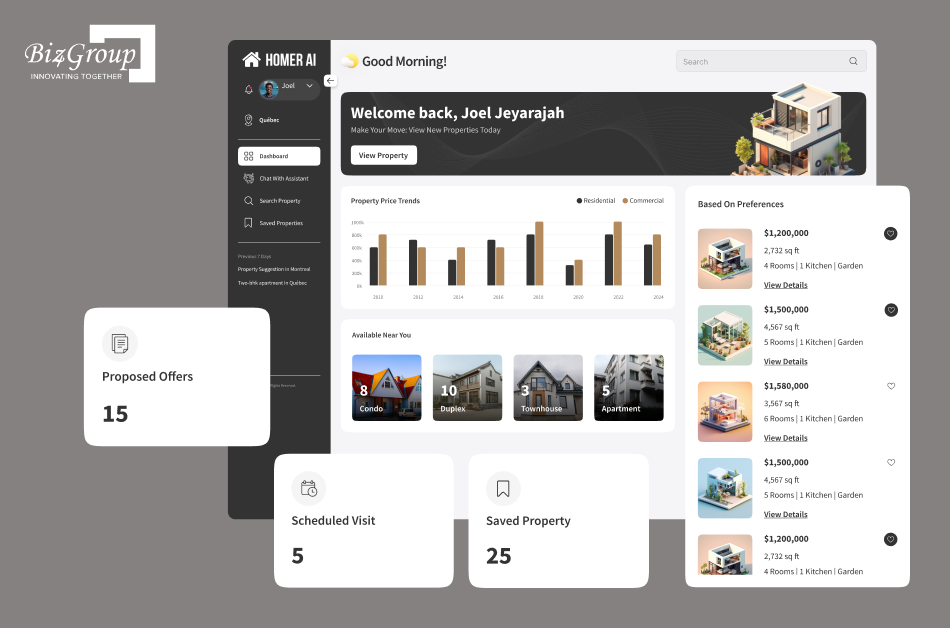
Wondering which AI tools can actually make a real estate agent's day easier? Let's explore.
What Are AI Tools for Real Estate Agents and Why They Matter in 2026?
Artificial intelligence is becoming part of everyday real estate operations. The best AI tools for real estate agents help with tasks such as identifying leads, preparing listings, analyzing property data, and managing communication with buyers and sellers. These AI real estate tools process large volumes of market information and support agents in completing routine work more efficiently.
Definition of AI Tools for Real Estate Agents
AI tools for real estate agents are digital platforms that analyze property data, buyer activity, and market signals to automate tasks such as lead identification, listing preparation, communication management, and pricing analysis within real estate workflows.
Why AI Adoption is Increasing in Real Estate?
The real estate industry generates large amounts of data from listings, transactions, and online property searches. AI tools help agents review this information faster and identify useful patterns. Many AI real estate agent tools are designed to process these datasets and highlight signals that may indicate buyer interest, market shifts, or property demand.
Another reason adoption is growing is the need for faster response times and organized client management. Some organizations explore AI automation services to connect lead management systems, marketing tools, and communication platforms. This helps agents handle inquiries and manage multiple listings more efficiently.
Where AI Tools for Real Estate Agents Fit in the Real Estate Workflow?
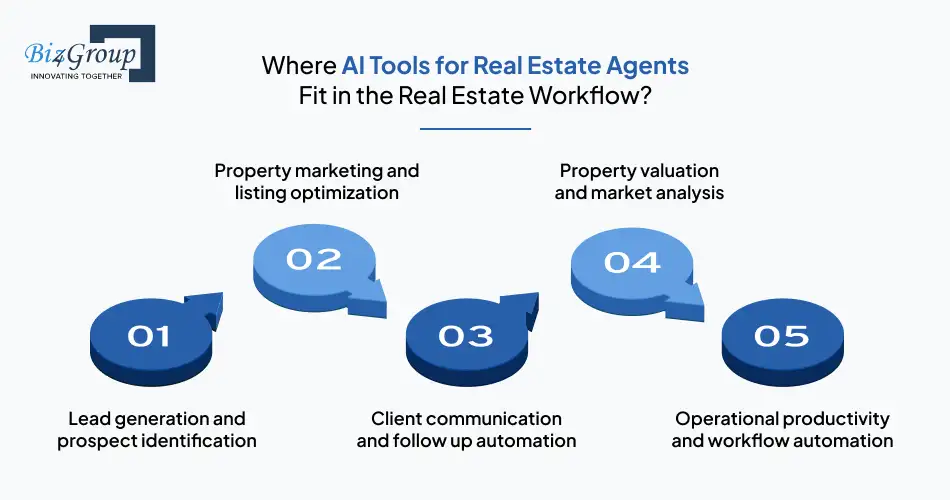
Real estate transactions involve several steps, from finding potential buyers to closing a deal. The best AI tools for real estate agents support many of these steps by helping agents process data, manage leads, and automate routine tasks. These tools assist with daily work so agents can focus more on client interactions and property negotiations.
1. Lead Generation and Prospect Identification
AI tools for real estate lead generation review data such as property searches, online activity, and listing interactions to identify potential buyers and sellers. These insights help agents recognize prospects who may be planning to buy or sell. Many AI prospecting tools for real estate agents include lead scoring features that organize contacts based on their activity.
2. Property Marketing and Listing Optimization
AI tools assist agents in preparing and improving property listings. They can generate listing descriptions, summarize property features, and organize listing content for different platforms. Many AI tools for real estate marketing also help agents distribute listings across websites and marketing channels.
3. Client Communication and Follow-Up Automation
AI systems can help manage client communication by organizing inquiries and sending follow-up messages. Some platforms use generative AI to draft responses based on property details or listing information. These tools help agents keep communication consistent while handling multiple client conversations.
4. Property Valuation and Market Analysis
AI tools review property records, past sales, and location data to identify market trends. This information helps agents understand price ranges and comparable properties in the area. These insights support pricing decisions but do not replace the agent's professional judgment.
5. Operational Productivity and Workflow Automation
AI platforms also help organize daily tasks such as tracking leads, managing listings, and scheduling follow-ups. Some AI real estate workflow automation tools bring these activities together in a single dashboard so agents can monitor their work more easily. In some cases, companies explore AI in real estate development to build tools that connect marketing, communication, and property data systems.
AI tools now support several stages of the real estate workflow, from identifying prospects to managing listings and communication. Understanding where these tools fit helps agents evaluate AI tools for real estate professionals that align with their business needs.
Turn Property Data into Smarter Decisions
Build platforms inspired by the top AI tools for real estate agents to automate lead tracking, listing insights, and property analytics.
Develop an AI Real Estate PlatformWhat Are the Top 11 AI Tools for Real Estate Agents in 2026?
AI is becoming a regular part of how real estate agents handle daily work. The top AI tools for real estate agents support tasks such as finding leads, preparing listings, managing client activity, analyzing property data, and automating follow-up. These real estate AI tools help agents manage information more efficiently and reduce repetitive work.
The list below is organized by a primary use case rather than a strict ranking.
|
AI Tool |
Primary Use |
Key Capability |
Current Pricing |
|---|---|---|---|
|
Property valuation and market analytics |
AI-powered property valuations, market insights, forecasts, CMAs, and CanaryAI |
Basic $19/month; Pro $79/month; Enterprise custom |
|
|
Lead generation and marketing automation |
AI lead generation, AI text and voice follow-up, seller intelligence, remarketing, and CRM integration |
Custom pricing based on market, team size, lead type, and database |
|
|
Predictive seller lead generation |
Predictive seller identification, geographic targeting, automated marketing, and follow-up |
Quote-based; public fixed pricing not listed |
|
|
CINC |
Lead generation, CRM, and follow-up |
Lead capture, automated nurturing, CRM workflows, lead routing, and CINC AI |
Custom pricing; CINC AI starts at $200/month |
|
CRM and agentic workflow automation |
AI-powered CRM, dynamic lead scoring, Smart Plans, AI assistants, and workflow automation |
Custom pricing based on package, seats, upgrades, and lead-generation programs |
|
|
Virtual staging and listing visuals |
AI virtual staging, interior redesign, landscaping, image enhancement, and batch listing processing |
Essential $19/month; Pro $36/month; Advanced $59/month; Agency $119/month |
|
|
Automated lead conversations |
Conversational AI for voice, SMS, and email, including qualification, follow-up, scheduling, and live transfers |
Platform fee custom + usage; voice from ~$0.07/min, SMS from ~$0.02/message, AI email from ~$0.02/email |
|
|
Property image intelligence |
Computer vision for property features, condition, quality, image tagging, captions, and comparable analysis |
Custom pricing based on property volume, products, API requests, and usage |
|
|
Buyer collaboration and property search |
Natural-language AI Search, listing alerts, client engagement scoring, contact enrichment, and automated nurture |
Core $179/month or $149/month on 12-month term; Build $299/month or $249/month annually; Enterprise custom |
|
|
3D property visualization |
3D digital twins, virtual walkthroughs, Property Intelligence, measurements, and AI defurnishing |
Free; Starter from $14/month; Professional from $69/month; Business from $355/month; Enterprise custom |
|
|
Predictive seller and mover identification |
AI lead scoring, likely-mover identification, database analysis, property data, and marketing automation |
Custom pricing based on contact volume and plan |
1. HouseCanary
HouseCanary is a property analytics platform that helps real estate agents understand home values and housing market trends. It analyzes property data, historical transactions, and market signals to support property valuations, comparable analysis, and market research. Its CanaryAI assistant also lets users query property and market data using natural language.
What it helps with:
- Property value estimates and automated valuation models (AVMs)
- Comparable property analysis for pricing strategy
- Market trends and housing forecasts
- Property research and investment analysis
- Propensity-to-list data for identifying potential seller opportunities
|
Plan |
Price |
Users Included |
Reports Included |
Key Features |
|---|---|---|---|---|
|
Basic |
$19/month or $190/year |
1 user |
2 CMA reports/month; additional reports $5 each |
Property search and valuations, CanaryAI, market insights, propensity-to-list data |
|
Pro |
$79/month or $790/year |
2 users |
Unlimited CMA reports* |
Everything in Basic, plus unlimited CMAs and priority support |
|
Enterprise |
Custom |
Custom |
Custom |
Custom products, scalable data, advanced APIs, dedicated customer success, SSO |
2. Ylopo
Ylopo is a digital marketing and lead-generation platform built for real estate professionals. It uses online property-search behavior and AI-powered follow-up to help agents generate, engage, qualify, and nurture buyer and seller leads. Its AI capabilities include automated text and voice conversations, behavioral lead engagement, remarketing, and lead routing.
What it helps with:
- Buyer and seller lead generation
- Behavioral tracking of property searches and listing activity
- AI-powered text and voice lead follow-up
- Automated lead qualification and appointment setting
- Dynamic remarketing and listing-based marketing
- CRM integration and lead routing
|
Plan / Package |
Price |
What's Included |
Notes |
|---|---|---|---|
|
Solo |
Custom pricing |
Branded home-search website, buyer and seller lead generation, AI text nurture, dynamic remarketing, Mission Control dashboard |
Pricing varies by market and business requirements |
|
Growing Team |
Custom pricing |
Everything in Solo, plus AI Text and Voice, seller intelligence, home-value leads, team routing, roles, reporting, and Identity Graph |
Designed for growing teams; pricing depends on market, team, and database |
|
Complete |
Custom pricing |
Everything in Growing Team, plus Radar buyer and seller leads, expanded Identity Graph, Google Local presence, managed LSA, advanced remarketing, and CRM integration |
Full AI workforce and higher-volume capabilities |
3. SmartZip
SmartZip is a predictive real estate marketing platform that helps agents identify homeowners who are more likely to sell. Its SmartTargeting platform uses predictive analytics, property data, and market signals to narrow a geographic farm to potential seller prospects, then supports targeted marketing and follow-up.
What it helps with:
- Predictive seller lead identification
- Targeted geographic prospecting
- Data-driven homeowner targeting
- Automated marketing campaigns
- Seller lead follow-up and daily lead prioritization
|
Product |
Price |
Pricing Model |
What It Does |
|---|---|---|---|
|
SmartTargeting |
Custom pricing |
Territory- and package-based |
Uses predictive analytics to identify homeowners most likely to sell and provides tools for targeted seller marketing, lead capture, and follow-up |
|
CheckIn |
Included with SmartTargeting |
Bundled |
Provides daily action plans, lead alerts, and prospect insights to help agents prioritize follow-up |
|
Enterprise / Large Teams |
Custom pricing |
Custom |
Built around larger territories, teams, data requirements, and marketing needs |
Predictive platforms like this are frequently mentioned among the best AI tools for real estate lead generation, especially for agents focused on seller listings.
4. CINC (Commissions Inc.)
CINC combines CRM, lead generation, website lead capture, and marketing automation for real estate agents and teams. It helps businesses capture buyer and seller leads, organize contacts, automate follow-up, and track lead activity in one platform. CINC also offers CINC AI, an optional conversational AI add-on that can engage new leads 24/7 and hand conversations to agents when human follow-up is needed. Many brokerages connect platforms like this with marketing systems through AI integration services, allowing lead data, campaigns, and communication tools to work together.
What it helps with:
- Lead capture from real estate websites and landing pages
- Automated email and text follow-up
- AI-powered lead conversations and nurturing
- Contact and pipeline management
- Lead routing and team management
- Marketing campaign tracking and remarketing
- CRM and third-party integrations
|
Plan / Add-On |
Price |
What's Included |
Notes |
|---|---|---|---|
|
Solo |
Custom pricing |
CINC CRM, AutoTracks, mobile apps, landing pages, consumer website, basic lead-generation and nurturing tools |
1 user |
|
Ramp |
Custom pricing |
Expanded CRM and lead-management capabilities, lead routing, integrations, and additional platform features |
Up to 4 users |
|
Pro |
Custom pricing |
Advanced CRM, lead routing, integrations, lead-generation products, and team features |
Up to 49 users |
|
Select |
Custom pricing |
Enterprise-level CINC capabilities, advanced lead management, integrations, and team support |
50+ users |
|
CINC AI |
Starting at $200/month |
24/7 conversational AI for engaging and nurturing new real estate leads |
Optional add-on for CINC plans |
|
Dialer |
$75/month |
Three-line dialing capability |
Optional add-on |
CINC does not currently publish fixed prices for its core platform packages. Final pricing depends on the selected solution, users, lead-generation products, advertising, and add-ons. Its current pricing page lists CINC AI starting at $200/month. Advertising costs and other applicable fees are separate.
5. REimagineHome AI
REimagineHome AI focuses on improving property listing visuals with AI-generated images. Agents can virtually stage empty rooms, redesign interiors, enhance listing photos, and experiment with different styles before using the images for property marketing. The platform also supports batch processing for real estate listings, making it useful for agents and teams working with multiple property photos.
This type of visual transformation is part of a broader shift where companies implement generative AI in real estate to improve how listings appear online.
What it helps with:
- Virtual staging for vacant properties
- Interior and exterior redesign previews
- Listing photo enhancement
- Style and room transformation
- Batch processing of listing images
- High-resolution, marketing-ready property visuals
|
Plan |
Monthly Price |
Credits / Month |
Best For |
|---|---|---|---|
|
Essential |
$19/month |
30 |
Basic virtual staging and light edits |
|
Pro |
$36/month |
200 |
Active agents needing full design and listing workflows |
|
Advanced |
$59/month |
400 |
Higher-volume staging and multi-listing work |
|
Agency |
$119/month |
900 |
Teams and agencies producing visuals at scale |
6. Structurely
Structurely is a conversational AI platform that helps real estate teams automate buyer and seller conversations across voice, SMS, and email. It can engage leads, qualify prospects, answer questions, schedule appointments, route high-intent conversations to agents, and update CRM records automatically.
What it helps with:
- Automated responses to buyer and seller inquiries
- Lead qualification through AI conversations
- Automated follow-up across voice, SMS, and email
- Appointment and callback scheduling
- Live transfers and lead routing
- Automatic CRM updates and conversation disposition
- CRM, API, and webhook integrations
|
Plan / Pricing Model |
Platform Price |
Usage Pricing |
What's Included |
|---|---|---|---|
|
Small Team |
Custom |
Usage-based |
AI agent builder, inbound and outbound voice, SMS and email workflows, call campaigns, live transfers, appointment scheduling, lead uploader, basic reporting |
|
Large Team |
Custom |
Usage-based, with volume discounts |
Everything in Small Team plus multi-team permissions, advanced routing, custom agents, advanced analytics, integrations, A/B testing, and dedicated customer success |
|
Enterprise / Build Your Own |
Custom |
Custom / volume pricing |
Advanced APIs, webhooks, MCP, custom tools and workflows, SSO/SAML, dedicated infrastructure, white-label or headless deployment, custom security and support |
7. Restb.ai
Restb.ai uses computer vision and AI to analyze property images and extract structured real estate data. It can identify rooms, property features, architectural styles, condition, and other visual details from listing photos.
What it helps with:
- Property image recognition and tagging
- Automatic extraction of property features
- Visual search and similar-property discovery
- Property condition and quality analysis
- Image captions and listing descriptions
- Photo compliance and duplicate detection
Price: Custom pricing model
These technologies are often used by companies that build real estate AI solution for listing platforms.
8. RealScout
RealScout helps agents collaborate with buyers, share listings, and track client engagement. Its 2026 updates add AI Search, which converts natural-language requests into MLS-aware searches, along with contact enrichment and engagement scoring.
What it helps with:
- Buyer collaboration and property search
- Natural-language AI property searches
- Personalized listing alerts
- Client engagement tracking
- CRM and website integrations
- Automated email nurturing
- Lead and contact prioritization
|
Plan |
Price |
Billing |
Best For |
Licenses |
Nurtured Contacts |
|---|---|---|---|---|---|
|
Core |
$179/month or $149/month |
Monthly or 12-month term |
Solo agents |
1 |
500 |
|
Build |
$299/month or $249/month |
12-month term |
Real estate teams |
2 |
2,500 pooled |
|
Enterprise |
Custom |
Custom |
Brokerages and brands |
Custom |
Custom |
8. Matterport
Matterport helps agents create 3D digital twins and virtual tours of properties. Its platform also includes AI features such as Property Intelligence and AI-powered defurnishing.
What it helps with:
- 3D property scans and digital twins
- Interactive virtual walkthroughs
- Property visualization and measurements
- AI-powered property insights
- AI defurnishing for property images
- Listing and website sharing
|
Plan |
Monthly Price |
Annual Billing |
Users |
Active Spaces |
|---|---|---|---|---|
|
Free |
$0 |
Free |
2 |
1 |
|
Starter |
From $14/month |
From $12/month |
3 |
5-20 |
|
Professional |
From $69/month |
From $58/month |
10 |
20-150 |
|
Business |
From $355/month |
From $296/month |
50 |
100-300 |
|
Enterprise |
Custom |
Custom |
Custom |
Custom |
Matterport can support AI real estate tools workflows where agents combine virtual tours, property visualization, and AI-assisted property insights.
9. Revaluate
Revaluate uses AI and predictive analytics to identify contacts in a real estate database who may be likely to move within the next 3-6 months. It scores contacts using behavioral, property, demographic, and life-event signals and can surface high-priority prospects for agents.
What it helps with:
- Predictive homeowner and mover identification
- AI-powered contact scoring
- Seller lead prioritization
- Property and contact data enrichment
- Automated marketing
- CRM and API integrations
|
Plan |
Price |
Contacts Monitored |
Seats |
Key Features |
|---|---|---|---|---|
|
Starter |
Custom |
1,000 |
1 |
AI lead score, lead and property data, marketing automation, address verification |
|
Growth |
Custom |
2,000 |
5 |
Everything in Starter, plus enhanced property data, address repair, email bounce check, custom domain |
|
Scaling |
Custom |
10,000 |
15 |
Everything in Growth, plus API access, custom marketing, webhooks, and team dashboard |
|
Enterprise |
Custom |
Custom |
Custom |
Custom data, integrations, and support |
Revaluate does not currently publish fixed monthly prices. Pricing is customized according to the number of contacts monitored and the selected plan.
10. Lofty (formerly Chime CRM)
Lofty combines CRM, lead management, marketing automation, and AI tools for real estate agents and teams. It helps users track leads, automate follow-up, prioritize contacts, and manage marketing and client workflows from one platform. Lofty now includes agentic AI features such as AI task prioritization, custom AI agents, scheduled AI tasks, and AI lead scoring.
What it helps with:
- Lead scoring and prioritization
- Automated email and text follow-up
- Contact and pipeline management
- Marketing automation with Smart Plans
- AI-powered task management
- Custom AI agents and workflows
- IDX and real estate website tools
- Transaction and reporting tools
|
Plan |
Price |
Best For |
Key Features |
|---|---|---|---|
|
Agent |
Custom |
Individual agents |
AI-powered CRM, lead scoring, Smart Plans, IDX website, email and text automation |
|
Team |
Custom |
Real estate teams |
Agent features plus team management, lead routing, reporting, and collaboration |
|
Broker |
Custom |
Brokerages |
Brokerage management, advanced routing, reporting, and organization controls |
|
Enterprise |
Custom |
Large organizations |
Custom configuration, SSO, white labeling, advanced integrations, and support |
Lofty does not currently publish fixed platform pricing. Costs vary by package, seat count, optional upgrades, and lead-generation services.
How Do AI Tools for Real Estate Agents' Pricing Models Work?
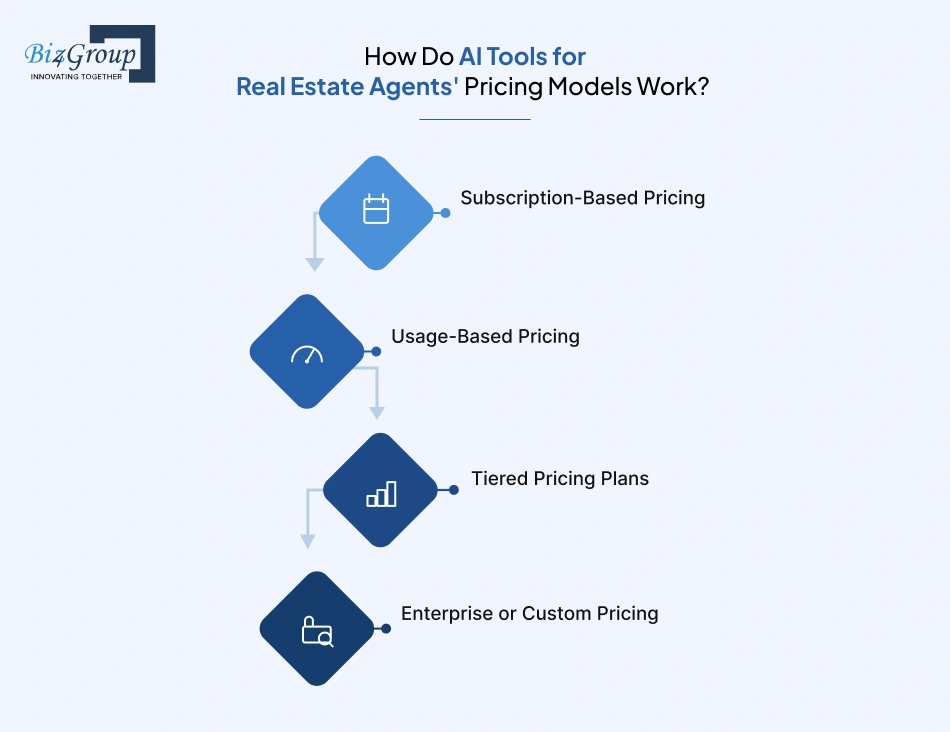
AI platforms used in real estate do not all follow the same pricing structure. Some charge a flat monthly fee, while others price their services based on usage or team size. When exploring the top AI tools for real estate agents, understanding how these pricing models work makes it easier to estimate costs and compare platforms.
Below are the pricing approaches most commonly used across real estate AI platforms.
1. Subscription-Based Pricing
Many AI platforms charge a fixed monthly or yearly fee to use their tools. The cost usually depends on the number of users, available features, and access to data or marketing tools. This model is common among CRM platforms and marketing automation systems.
- Example: If a lead generation platform charges about $345 per month for an agent website, marketing tools, and lead capture features.
2. Usage-Based Pricing
Some platforms charge based on how much the system is used. Instead of paying a fixed fee, the cost depends on activities such as generating reports, processing images, or running automated conversations. Platforms that rely on heavy AI model development often use this model because computing costs increase with usage.
- Example: A virtual staging tool may charge per image credit, meaning each staged listing photo reduces the available credit balance.
3. Tiered Pricing Plans
Many tools offer several pricing levels with different features. Entry plans include basic functionality, while higher plans add advanced tools, larger usage limits, or support for teams. This structure makes it easier to review AI tools for real estate agents with pricing comparison across different platforms.
- Example: A property analytics platform might offer $19/month for basic access, $79/month for advanced reports, and $199/month for team access.
4. Enterprise Or Custom Pricing
Large brokerages often require custom integrations, additional data access, or higher usage limits. In these cases, vendors usually provide enterprise plans tailored to the organization's needs. Some companies also choose to build AI app that connects their CRM, listing databases, and marketing systems.
- Example: A brokerage signs a custom contract for a platform that integrates lead data, marketing automation, and analytics across multiple offices.
Understanding these pricing structures helps agents estimate costs and identify affordable AI tools for real estate professionals that match their business needs.
How to Choose AI Tools for Real Estate Agents?
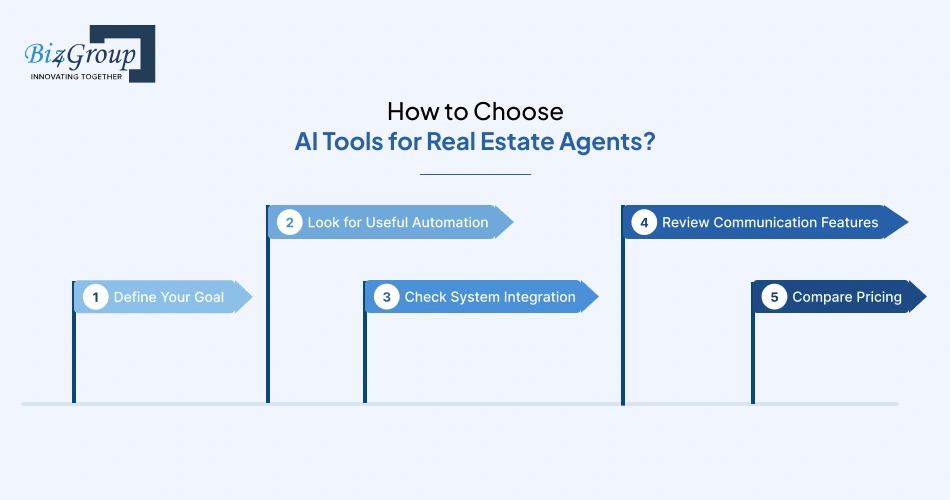
Not every AI tool solves the same problem. Some tools help with marketing, others help track leads, and some analyze property data. When exploring the top AI tools for real estate agents, focus on what you need the tool to do in your daily workflow.
|
Step |
What to Check |
Example |
|---|---|---|
|
Define Your Goal |
Identify the task you want to improve, such as marketing, lead tracking, or pricing insights. |
An agent looking to promote listings may choose AI real estate tools for marketing automation. |
|
Look for Useful Automation |
Choose tools that reduce repetitive work such as follow-ups, email campaigns, or listing updates. |
A platform that automatically sends follow-up messages to new leads. |
|
Check System Integration |
Make sure the tool works with your CRM, marketing tools, listing platforms, and other data sources. Some brokerages also integrate AI into an app to connect several workflows. |
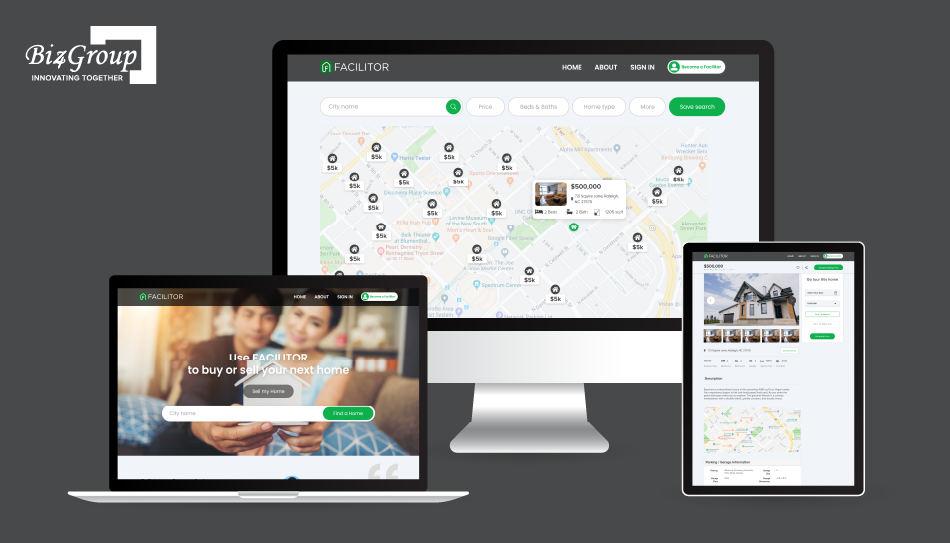
Facilitor, built by Biz4Group, combines AI property recommendations with MLS, GPS, financial verification, property visits, and real-time communication. |
|
Review Communication Features |
Check whether the tool can respond to inquiries, qualify leads, or schedule appointments. |
A system that works as an AI conversation app and replies to buyer questions. |
|
Compare Pricing |
Compare subscription, usage, user, and integration costs against your team size and expected usage. |
An individual agent may start with a basic plan before upgrading as usage grows. |
Facilitor, developed by Biz4group is also an example of when a standard AI tool may not cover the complete workflow. Its platform was built around connected property search, recommendations, financial verification, property visits, and communication rather than a single isolated task.
The right AI tools for real estate agents should fit the tasks, systems, and scale of the business rather than simply offering the largest number of AI features.
How Many AI Tools for Real Estate Agents Should an Agency Use?
Real estate agencies often use several tools to manage leads, listings, marketing, and client communication. The goal is not to use as many AI tools for real estate agents as possible, but to build a stack where each tool has a clear role and connects with the rest of the workflow. NAR's 2026 guidance similarly highlights the value of connected tools and warns against adding technology simply for the sake of adding it.
The Typical AI Stack for Real Estate Agencies
Most agencies can organize their AI stack around a few core functions rather than separate tools for every task. The exact number depends on team size, existing systems, lead volume, and how much automation the brokerage requires.
- Lead generation and marketing: Capture, qualify, and nurture potential buyers or sellers.
- CRM and workflow automation: Organize contacts, track conversations, manage pipelines, and automate follow-ups.
- Property data and market analysis: Support valuation, comparable research, pricing, and market insights.
- Client communication: Handle inquiries, responses, scheduling, and routine follow-ups.
- Analytics and reporting: Track lead activity, campaign performance, and business metrics.
Larger brokerages may connect these capabilities through enterprise AI solutions instead of adding separate tools for every workflow.
There is no fixed ideal number of AI tools for every agency. A smaller, well-integrated stack can be more practical than several overlapping platforms, particularly when each tool adds subscription, integration, training, and maintenance costs.
When Multiple AI Tools Create Workflow Complexity
While adding new technology can improve efficiency, too many tools can slow teams down. Each additional platform introduces new logins, integrations, and data management tasks.
- Duplicate features across tools, which can cause confusion about where certain tasks should be handled.
- Disconnected data, where lead information is stored in different platforms.
- Manual data transfer, when tools cannot automatically share information.
- Higher tool costs, especially when multiple tools provide similar functions.
Some organizations address these issues through business app development using AI, which allows them to connect systems and reduce fragmentation.
When too many tools are used without clear planning, productivity can decrease instead of improving.
How to Build an Efficient Stack using AI Apps for Real Estate Agents?
Building an effective AI stack usually begins with identifying the core activities that drive real estate operations. Agencies should focus on tools that support marketing, client communication, and market insights.
- Start with one CRM platform that manages leads, contacts, and communication history.
- Add marketing automation tools that support campaigns and lead nurturing.
- Use analytics platforms to monitor listing performance and buyer activity.
- Choose tools that integrate easily with existing systems.
- Avoid overlapping platforms that perform the same function.
Some teams exploring new technology even begin by researching real estate AI apps ideas before adopting full platforms.
By focusing on workflow needs rather than tool quantity, agencies can determine how to choose AI tools for real estate agents that support efficiency and help teams adopt AI tools for real estate agents to improve productivity.
What Are the Risks and Limitations of AI Tools for Real Estate Agents?
AI tools can make many parts of real estate work faster, from analyzing market data to writing listing descriptions. But they are not perfect. When evaluating the top AI tools for real estate agents, agents should consider factors such as data accuracy, integration limits, privacy, compliance, and the need for human review. These systems are designed to assist agents, not replace their judgment or experience.
Our experience building Groundhogs, a custom platform for construction site management, also showed how quickly fragmented tools can become a limitation. The project required a centralized system for activity logging, documentation, compliance, scheduling, and real-time visibility because existing tools did not provide the required workflow in one place.
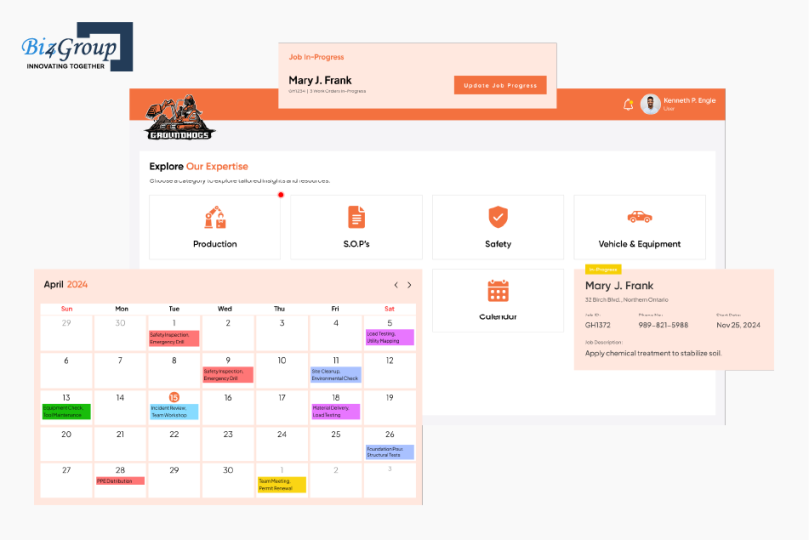
A similar issue can arise in real estate. Here are some limitations.
1. Accuracy Limits in AI Tools For Property Valuation and Market Analysis
AI tools estimate property values using past sales data, neighborhood trends, and listing information. While these insights can be helpful, they may miss details like property condition, renovations, or local market changes. That is why many enterprise AI tools for large real estate agencies are used as guidance rather than the final decision on pricing.
2. Risks Related to AI Generated Property Marketing Content
AI can quickly create listing descriptions, social posts, or marketing emails. However, the content may sometimes include incorrect or exaggerated details if the information provided is incomplete. Agents should always review AI-generated content before publishing it to make sure the listing accurately represents the property.
3. Compliance And Disclosure Considerations for AI Tools For Real Estate Agents
Real estate marketing and communication must follow local laws and disclosure rules. AI systems may not automatically include required disclosures or regulatory language. As more agents learn how to use AI for real estate, it becomes important to check that all marketing materials follow the correct guidelines.
4. Human Oversight Requirements When Using Real Estate AI Technology Tools
AI tools work best when they support, not replace, the agent's role. Pricing suggestions, marketing copy, and automated messages should still be reviewed before being shared with clients. Even when using the best AI tools for real estate agents, human oversight helps ensure that decisions remain accurate and professional.
In the end, AI tools are most useful when they are treated as assistants rather than decision-makers. When agents combine technology with their own market knowledge and client experience, they can use AI more effectively without relying on it blindly.
What's Next for AI-Powered Tools for Real Estate Business?
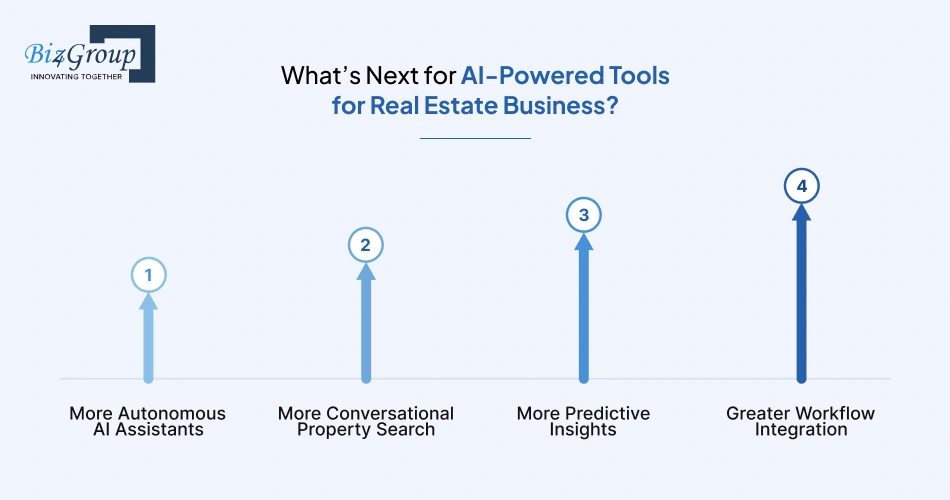
AI is already being used across lead management, property search, listing workflows, communication, and market analysis. The next phase is not about these capabilities appearing for the first time, but about expanding their autonomy, accuracy, and integration across real estate workflows.
1. More Autonomous AI Assistants
AI assistants already handle tasks such as lead qualification, follow-up, CRM updates, and appointment scheduling. The next development is greater autonomy, where AI can coordinate multiple steps in a workflow while keeping human approval for higher-risk decisions.
2. More Conversational Property Search
Natural-language property search is already available. RealScout, for example, lets users describe what they are looking for and converts those requests into MLS-aware searches. The trend is toward search systems that better understand preferences, context, and intent.
3. More Predictive Insights
AI is already being used to analyze property data, market trends, and lead signals. Future improvements are likely to focus on more localized predictions, better data quality, and insights that can be incorporated directly into agent workflows.
4. Greater Workflow Integration
Many real estate businesses still use separate systems for CRM, marketing, property data, and communication. The emerging shift is toward AI connecting these systems and executing workflows across them, rather than operating as isolated tools.
The direction is clear: AI in real estate is moving from individual task assistance toward connected, semi-autonomous workflows. The technology is already here; the next stage is improving how reliably it can work across an entire business process.
Build Smarter Platforms for Modern Brokerages
Combine analytics, marketing, and CRM features using technology similar to the top AI tools for real estate agents.
Explore AI DevelopmentFinal Thoughts on Best AI Tools for Real Estate Agents
AI is becoming a practical part of real estate operations, supporting lead generation, property research, listing marketing, client communication, and workflow automation. The best AI tools for real estate agents are not necessarily the ones with the most features, but the ones that fit existing processes, integrate with other systems, and solve specific business problems.
The tools covered in this guide serve different purposes. Some focus on lead generation and follow-up, while others support property analytics, buyer engagement, visual marketing, or workflow automation. The right combination depends on the agency's size, data, existing technology stack, and day-to-day requirements.
Our work at Biz4Group LLC includes projects such as Homer AI, Facilitor, and Groundhogs, giving us hands-on experience in building AI-powered platforms, integrating multiple workflows, and addressing real-world business requirements.
When existing tools do not provide the required features or integrations, product development services can support a custom solution. AI consulting services can help businesses identify suitable use cases and implementation priorities.
Start with the workflow problem, evaluate the available tools, and consider custom AI when more control or integration is required.
Have an idea for an AI-powered real estate platform? Connect with our experts.
FAQs About AI Tools for Real Estate Agents
1. What are the best AI tools for real estate agents in 2026?
The best tool depends on the workflow you want to improve. Agents commonly look for AI tools for lead generation, follow-up, property research, listing marketing, client communication, and workflow automation. A focused tool that integrates with your existing systems is often more useful than one with a large number of unrelated features.
2. Which AI tools can help real estate agents generate and manage leads?
AI lead generation tools can help capture prospects, score contacts, identify potential sellers, automate follow-up, and route high-intent leads to agents. Platforms such as Ylopo, CINC, Structurely, SmartZip, and Revaluate address different parts of this process.
3. I spend too much time following up with property leads. Which AI tool can automate this?
Conversational AI platforms can automate initial responses, lead qualification, reminders, and appointment scheduling. Tools such as Structurely, CINC, and Ylopo are designed for these types of lead-engagement workflows.
4. How can real estate agents use AI tools to improve client follow-up?
AI can help maintain consistent follow-up by triggering messages based on lead activity, scheduling reminders, summarizing conversations, and prioritizing contacts that need attention. The most useful setup depends on how well the AI tool connects with the agency's CRM and communication channels.
5. Which AI tools are best for real estate agents looking to automate marketing?
Marketing-focused AI tools can assist with lead nurturing, remarketing, listing content, email campaigns, and visual property promotion. Ylopo focuses on digital marketing and lead engagement, while REimagineHome supports AI-generated listing visuals.
6. How do AI tools fit into a real estate agent's existing CRM and workflow?
AI tools can connect with CRMs, listing platforms, websites, communication systems, and property data sources through built-in integrations or APIs. Before adopting a tool, check whether it can exchange the data and trigger the actions your existing workflow requires.
7. Our team uses several tools for CRM, marketing, and lead management. Can AI bring these workflows together?
It can, provided the systems expose the required integrations or APIs. When separate platforms create duplicated data or manual handoffs, a connected AI workflow or custom platform can bring lead management, communication, property data, and reporting into one system.
8. How Do I Choose an AI Development Company for My Real Estate Business?
Look for experience in real estate AI development, workflow automation, integrations, security, and scalable systems. Review the company's portfolio, technical expertise, development process, and support. Biz4Group LLC is one example of a company with experience building AI-powered business platforms.
9. Are AI tools for real estate agents worth paying for?
The value depends on whether the tool reduces meaningful manual work or improves lead response and workflow efficiency. Compare the subscription cost with factors such as lead volume, time saved, required integrations, usage limits, and the amount of human work that still needs to be completed.
10. Can AI tools help real estate agents respond to inquiries outside business hours?
Yes. Conversational AI can respond to inquiries, answer routine questions, qualify prospects, and schedule follow-ups when agents are unavailable. For higher-value or complex conversations, the workflow can hand the interaction to a human agent.
