 Location :
Orlando, FL, USA
 +1 (407) 714-1616
 info@biz4group.com


 AI Summary Powered by Biz4AI
- A custom AI HOA platform runs from about $15,000 to $250,000+, based on 2026 AI development guides.
- Scope, data, integrations, AI freedom, and compliance set where a project lands.
- Upkeep adds roughly 15–25% of the build cost each year, plus usage and hosting.
- Payback depends on repeat work: about one year with heavy volume, nearly five with light volume (illustrative figures).
- A scope sheet and a five-question scorecard help pick the first workflow worth building.
- Biz4Group builds AI platforms for real estate workflows, and its advice is to price one workflow first, not the whole platform.
Based on 2026 AI development pricing guides, a custom AI HOA platform runs from roughly $15,000 for a simple single-task agent to $250,000 or more for a multi-system build, with upkeep adding about 15–25% of the build cost each year. A first build for one workflow, such as an invoice agent or a resident assistant, maps to the lower and middle part of that range.
Four things decide where a project lands: how many modules it covers, how messy the data is and how many systems must connect, how much freedom the AI gets, and which compliance rules apply. Each one can be sized before anything is built.
The price only means something next to what it earns back. A build pays off on repeat work, so the practical test is payback: build cost plus a buffer, divided by annual savings minus running costs. On the illustrative figures further down, a workflow with heavy repeat work pays back in about a year, and a lighter one in nearly five.
Biz4Group’s view is that an HOA build should be priced by the workflow it replaces, not by the word “platform.” The rest of this page shows how to do that: a range to start from, a scope sheet, a scorecard for picking the first workflow, and a payback calculator that runs on your own numbers.
What Makes a Custom AI HOA Platform Cost More or Less?
Scope, data and integrations, how much freedom the AI gets, and compliance are the four main drivers of what AI HOA management software costs.
Scope: How Many Modules Does It Cover?
Every module added brings its own rules, screens, and testing. An invoice agent touches vendors, approvals, and accounting. Adding resident messaging, violations, and document search turns one project into a program.
A useful way to size it: list every workflow the platform should handle, then mark each as must-have for launch or later. If staff touch a workflow every day, it belongs in the first build. If it matters a few times a month, it can wait.
Data and Integrations: What Does the AI Have to Read and Connect To?
Messy records and many connected systems both raise the price. Scanned PDFs, a separate accounting system, and resident requests in email each mean cleanup or a connection that has to be built.
One 2026 agency guide puts data engineering at 20–40% of total cost on first-time builds, and another says each integration adds roughly $5,000–$15,000 (the guides are listed below). Those are generic AI figures, but the pattern holds for HOA work.
Before asking for quotes, note where the records live and in what format. Each location is a line on the quote.
How Much Freedom Does the AI Get?
The more the AI is trusted to do, the more it costs to build and test. It comes at three levels:
- Rules. Fixed if-then steps, like a payment reminder on day five. The cheapest level.
- Assistants. Generative AI drafts replies and summarizes documents, with a person reviewing.
- Agents. Multi-step work, like reading an invoice, coding it, and routing it for approval.
An agent that codes invoices has to be checked against real invoices, including the odd ones. Tuning a model to HOA language is another step up. AI model development is a separate line item, and most first builds can skip it by working from approved documents instead.
Which Compliance Rules Apply?
Compliance adds cost because it adds access controls, audit trails, and testing. Resident data, bank details, and board records all need protecting, and rules vary by state. Florida, for example, requires larger HOAs to run an official website or portal as of January 1, 2026.
Agency guides put the compliance uplift at 20–40% in regulated settings, and as high as 30–100% with healthcare at the top. HOAs sit well short of healthcare in regulation, so the lower end is a fair starting guess. An attorney can say what actually applies, especially for a multi-state company.
What Do Published Sources Say a Custom AI Build Costs?
Generic 2026 agency guides put a simple AI agent at about $15,000–$40,000 and complex or multi-system builds at $250,000 or more. The guides cover AI builds in general and come from agencies that sell the work, so they work as a planning bracket rather than a quote.
All three were published or updated in 2026.
|
Source and date |
What it prices |
Range |
|---|---|---|
|
AI feature (chatbot, automation) |
$60,000–$180,000 |
|
|
Azilen |
Generative AI application |
$150,000–$500,000 |
|
Azilen |
AI agent system |
$50,000–$400,000 |
|
Simple AI agent |
$15,000–$40,000 |
|
|
Acropolium |
LLM-powered chatbot |
$50,000–$150,000 |
|
Acropolium |
Generative AI product |
$75,000–$300,000 |
|
Moderate project (custom RAG system, multi-model app) |
$40,000–$120,000 |
|
|
SFAI Labs |
Complex project (agent system, fine-tuned models) |
$120,000–$250,000 |
A single-workflow HOA build sits closest to the “agent,” “chatbot,” and “moderate” rows. A full multi-module platform lands in the higher ones. One of the guides notes its ranges exclude ongoing AI costs, which are covered below.
Why Are the Ranges So Wide?
Each guide is pricing a different project under the same label. Look at the “AI agent” rows: $15,000–$40,000 in one guide, $50,000–$400,000 in another.
A “simple agent” might do one task against one system. A full agent system handles several tasks, several systems, and the exceptions. Each source also counts different things, such as design, testing, and project management, so lines don’t compare cleanly.
That makes a one-page scope sheet worth more than any range, and one is included further down.
What Does the Subscription Alternative Cost at Scale?
Per-unit subscription pricing climbs with portfolio size, while a build is priced by scope. At published list rates of $1.49–$5.00 per unit per month, 500 units cost about $8,940–$30,000 a year and 5,000 units about $89,400–$300,000.
Those rates come from one rental property management platform’s pricing page, checked in October 2026, and a 50-unit minimum applies to its lowest plan. Several association-focused platforms list no prices at all and ask for a demo, so HOA numbers have to come from a quote. The table is a scale illustration, not an HOA quote.
|
Units managed |
Lowest plan ($1.49) per year |
Top plan ($5.00) per year |
|---|---|---|
|
500 |
$8,940 |
$30,000 |
|
2,000 |
$35,760 |
$120,000 |
|
5,000 |
$89,400 |
$300,000 |
Two things follow. A subscription grows with every unit added, while a build’s cost is set by scope. And AI HOA management software usually sits on top of a core platform rather than replacing it, so the real comparison is the AI build against the platform’s own AI add-ons, not against the whole subscription.
Which Modules Cost the Most to Build?
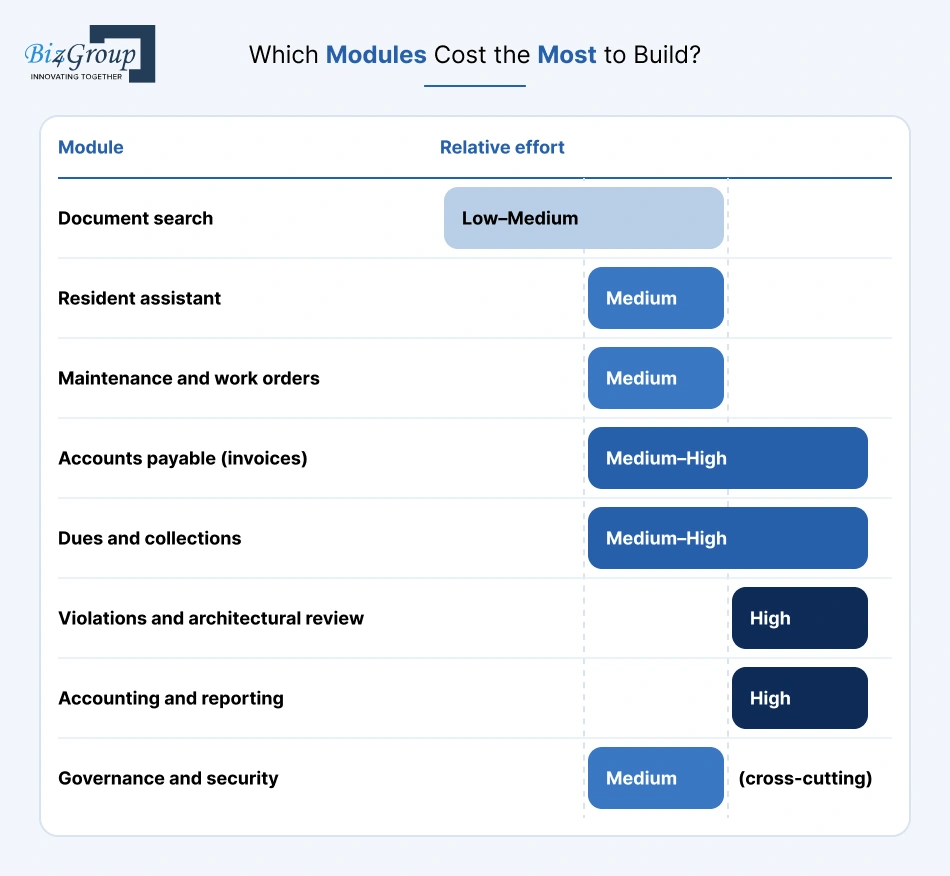
Violations and architectural review, and accounting and reporting, are the heaviest. Document search and a resident assistant are the lightest. The ranking below is an editorial judgment, based on what each module has to read, connect to, and get right. It’s not a quote.
|
Module |
Relative effort |
What drives it |
|---|---|---|
|
Document search |
Low–Medium |
Document quality; citing the right page |
|
Resident assistant |
Medium |
Approved-answer sources; handing off to a person |
|
Maintenance and work orders |
Medium |
Vendor lists; escalation rules |
|
Accounts payable (invoices) |
Medium–High |
Accounting connection; approval rules |
|
Dues and collections |
Medium–High |
Payment connections; legal limits on notices |
|
Violations and architectural review |
High |
Guideline rules; consistent treatment; attorney review |
|
Accounting and reporting |
High |
Ledger accuracy; reserves; reconciliation |
|
Governance and security |
Medium (cross-cutting) |
Access roles; action logs |
Two modules in the same AI HOA management platform can differ several times over in effort. That’s why a “per platform” price never means much, and why starting with a lighter module is a smart way in.
How Is an AI HOA Build Scoped Before It’s Priced?
By writing down one workflow in enough detail that two builders would quote the same thing. A one-page scope sheet does that, and it’s the most useful document to have before asking anyone for a number.
|
Scope sheet field |
What to write |
|---|---|
|
Workflow name |
One sentence, for example “Code and route vendor invoices” |
|
Steps today |
Each step, in order, and who does it |
|
Volume |
How many times per week or month it happens |
|
Systems touched |
Accounting, email, portal, document storage, and so on |
|
Data format |
Digital and structured, scanned, or on paper |
|
Exceptions |
The cases that don’t follow the rules, and how often they occur |
|
AI can do |
The steps it may handle alone |
|
A person must decide |
Anything with money, enforcement, or legal weight |
|
Launch must-haves |
What the first version can’t ship without |
|
Later |
Wanted, but not needed at launch |
|
How success is measured |
Hours saved, errors avoided, response time |
|
Who owns it after launch |
A named person or team |
Quotes built on the same sheet can be compared line by line, and the sheet also exposes the vague parts of a workflow before they turn into change orders.
Which Workflow Should Be Built First?
The one that scores highest on five questions: how often it happens, how clear the rules are, how ready the data is, how costly a mistake would be, and how many hours it eats. Score each from 1 to 3, then add them up. This is a working scorecard, not a validated model.
|
Question |
1 point |
2 points |
3 points |
|---|---|---|---|
|
How often does it happen? |
A few times a month |
A few times a week |
Daily |
|
How clear are the rules? |
Mostly judgment calls |
Mixed |
Written down |
|
How ready is the data? |
Paper or scattered |
Mixed |
Digital, in one place |
|
What does a mistake cost? |
Legal or financial harm |
Real but fixable |
Minutes to correct |
|
How many hours a week does it take? |
Under 5 |
5–15 |
15 or more |
A score of 12–15 marks a strong first build, such as invoice coding or routine resident questions. A score of 8–11 means preparing first: cleaning records or writing down the rules. Below 8, a custom build is rarely the right first move, and a process fix or a subscription feature comes first.
Scored 12 or higher? Scope that workflow with Biz4Group.
Bring the filled-in scope sheet and the scorecard result. The Biz4Group team can talk through what a first build for that workflow would involve.
Book a Scoping CallHow Do You Estimate the Payback on a Custom AI HOA Platform?
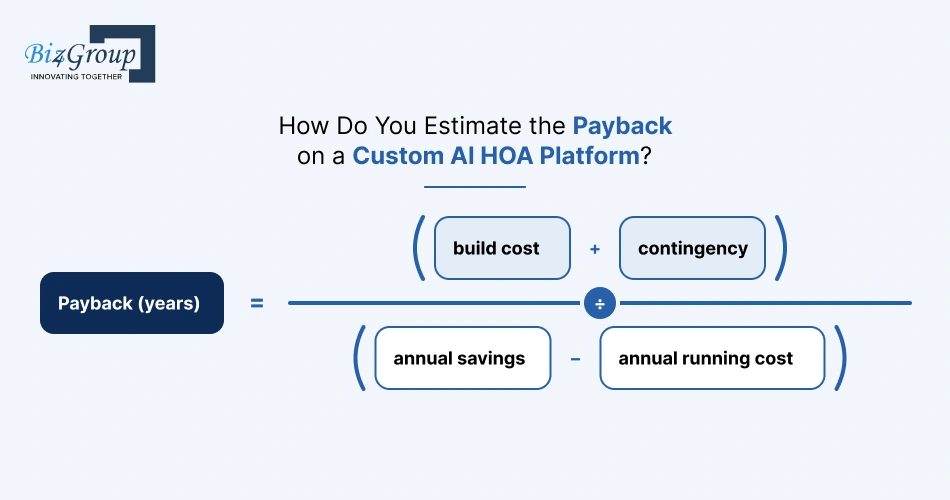
Divide the build cost plus a buffer by the yearly savings minus the yearly running cost. The result is the number of years the build takes to pay for itself.
Payback (years) = (build cost + contingency) ÷ (annual savings − annual running cost)
The formula needs four inputs:
- Annual manual cost of the workflow. Timing the work for two weeks gives the real hours, and the cost of manual HOA management vs AI automation model turns them into dollars. Use that number here and don’t re-estimate it.
- Share the AI can realistically take. Not 100%. Plan for exceptions that still need a person.
- Build cost. A figure from the bracket above that matches the scope, or a quote.
- Annual running cost. Covered next.
What Does It Cost to Run an AI HOA Platform After Launch?
Upkeep alone runs roughly 15–25% of the build cost per year, with usage fees and hosting on top. Four costs keep arriving:
- Upkeep. A common rule of thumb puts annual maintenance at 15–25% of the original build cost, according to a Swiss digital agency’s January 2026 guide. On a $100,000 build, that’s $15,000–$25,000 a year.
- AI usage fees. Models charge for what they process. Agency guides put LLM API fees at $200–$5,000 a month for typical projects, and $5,000–$50,000 a month for heavy use at scale.
- Hosting. The same guides list cloud infrastructure at $500–$5,000 a month.
- Monitoring. Someone has to check that answers stay accurate and that the AI isn’t drifting.
The guides also advise budgeting 20–30% for scope changes, which is where the contingency line in the formula comes from.
What Does a Worked Payback Example Look Like?
With the same build and running cost, payback swings from about one year to nearly five, depending only on how much repeat work the AI removes. These figures are made up to show the arithmetic. Swap in real ones.
|
|
Example 1: heavy repeat work |
Example 2: lighter repeat work |
|---|---|---|
|
Annual manual cost of the workflow |
$240,000 |
$96,000 |
|
Share the AI takes over |
60% |
60% |
|
Annual savings |
$144,000 |
$57,600 |
|
Build cost |
$100,000 |
$100,000 |
|
Contingency (20%) |
$20,000 |
$20,000 |
|
Upkeep (20% of build) |
$20,000 |
$20,000 |
|
AI usage and hosting ($1,000 a month) |
$12,000 |
$12,000 |
|
Annual running cost |
$32,000 |
$32,000 |
|
Savings minus running cost |
$112,000 |
$25,600 |
|
Payback |
about 1.1 years |
about 4.7 years |
The more repeat work in one workflow, the faster a build pays back. Example 2 isn’t a dead end. It’s a signal to pick a workflow with more volume, or to start with a smaller build. The examples also leave out savings from fewer errors and faster resident replies, which are upside on top of the numbers.
[EMBED: payback calculator] Enter the workflow’s annual manual cost, the share the AI takes over, the build cost, and the running costs. The calculator returns payback in years and shows the same breakdown as the table above.
What Causes Budget Overruns, and How Can They Be Avoided?
Scope creep is the most-reported cause, and each major cause has a simple guard. Overruns of 60–150% are reported as common on generative AI projects without hard scope gates. The figures below come from the agency guides listed above, and they describe generic AI projects, not HOA ones.
|
What goes wrong |
Figure reported |
The guard |
|---|---|---|
|
Scope creep |
Overruns of 60–150% are common without hard scope gates |
Fix the scope in writing, and park new ideas for the next phase |
|
Prototype rewrites |
Moving a proof of concept to production can consume 60–80% of the production budget |
Build the first version to production standards |
|
Rushed timelines |
Compressing a schedule typically adds 30–50% |
Set the timeline from the scope, not from a deadline |
|
Vague requirements |
Well-defined requirements cost 30–50% less than vague ones |
Complete the scope sheet before quoting |
|
Ignored running costs |
Plan for year-one total cost 30–40% above the quoted development cost |
Use the contingency and running-cost lines above |
What Should a Quote for an AI HOA Platform Include?
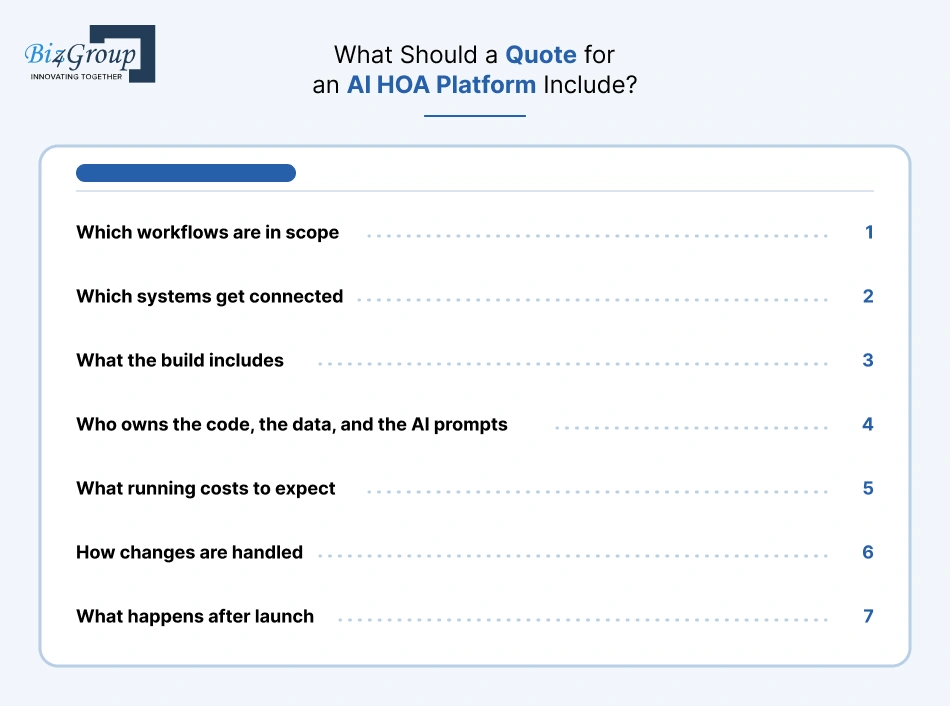
A good quote spells out seven things: scope, connections, inclusions, ownership, running costs, change handling, and post-launch support. Two quotes that answer all seven can be compared line by line. Quotes that skip them can’t.
- Which workflows are in scope, and which are explicitly left out.
- Which systems get connected, and whether each connection is priced separately.
- What the build includes. Design, testing, security review, and handover are often separate lines.
- Who owns the code, the data, and the AI prompts at the end.
- What running costs to expect, including usage fees and who pays them.
- How changes are handled. A change process with a price attached beats an open-ended hourly rate.
- What happens after launch. Support terms, response times, and who fixes it when an answer is wrong.
How Can the First Build Stay Small?
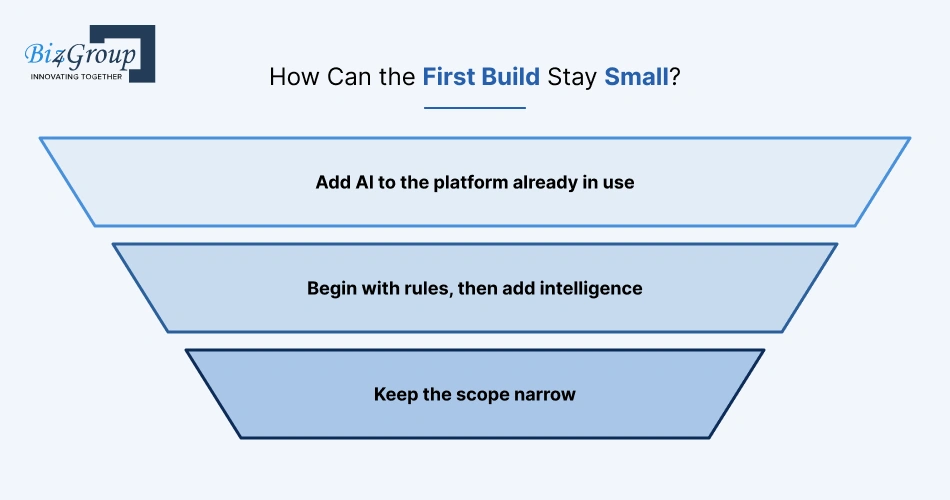
Start with one workflow, ideally on top of the platform already in use. A narrow first project is the cheapest way to learn what AI does for a portfolio, and it gives real numbers for the next module’s budget.
- Add AI to the platform already in use. If the current system has an API, an AI integration can sit on top, which is usually far cheaper than a rebuild. Learning to integrate AI into an app is mostly an API job.
- Begin with rules, then add intelligence. AI automation services often start with fixed rules and add AI only where rules run out.
- Keep the scope narrow. Homer AI, a conversational assistant that Biz4Group built, asks buyers about budget and location, filters listings, and schedules visits. It does a few jobs well, which is the pattern worth borrowing. For HOAs, an AI conversation app answering routine questions from approved documents is a comparable first step.
Who builds it is a cost lever too. For in-house work, the median pay for developers was $135,980 a year in May 2025, per the U.S. Bureau of Labor Statistics, before benefits, recruiting, and tools. A team can also hire AI developers for a single workflow instead of staffing a full team.
When Is a Custom Build Not the Right First Move?
When the repeat work is small, the platform in use already handles it, or the records are too messy to use and nobody will clean them. A build pays off on repeat work, so a workflow that takes only a few hours a week rarely justifies one. A scorecard result under 8 is the same signal.
In those cases the first step is cleaning up the process or testing a subscription. Cost is only one input into the bigger decision of custom AI HOA platform development vs. off-the-shelf solutions.
Got your numbers? Pressure-test the payback.
Share the workflow’s manual cost, the build assumption, and the running costs. A second pair of eyes can check whether the assumptions hold before any money is committed.
Talk Through Your NumbersConclusion: Price One Workflow and Test It
A custom AI HOA platform is priced by what it’s asked to do, and the same method sizes any project. Fill in the scope sheet, score the workflow, pick a range that fits its scope, add running costs and a buffer, and compare the total with the savings.
Where the payback is short, that workflow is the place to start. Build it narrow, measure the result, and let the numbers decide what comes next.
FAQs
1. How much does a custom AI HOA platform cost?
Based on 2026 agency pricing guides, single-workflow AI projects run in the tens of thousands of dollars, and larger multi-system builds start around $250,000. Scope decides where a project falls.
2. How long does it take to pay back?
It depends on how much repeat work the AI removes. In the illustrative examples above, heavy repeat work pays back in about a year and lighter work in nearly five. Run the formula with your own numbers.
3. What does it cost to run after launch?
A common rule of thumb is 15–25% of the build cost per year for upkeep, plus AI usage and hosting fees. Monthly AI and cloud fees often run from hundreds to a few thousand dollars.
4. Is custom cheaper than a subscription?
It depends on portfolio size and how long the platform is used. Subscription costs grow with every unit managed, while a build’s cost is set by scope. Compare total cost over three to five years.
5. What should be prepared before asking for a quote?
A completed scope sheet: the workflow’s steps, volume, systems touched, data format, exceptions, and what a person must still decide. It lets every vendor quote the same thing.
6. Can we start small?
Yes. Start with one workflow, such as invoices or resident questions, and prove the savings before adding modules.
7. What makes the price jump the most?
Scope. Each extra module, connected system, or level of AI freedom adds work. Unclear requirements and rushed timelines add more.
8. Does a first build need a custom AI model?
Usually not. Most first builds work from approved documents and existing models. Fine-tuning adds cost and rarely changes results at the start.
