 Location :
Orlando, FL, USA
Location :
Orlando, FL, USA +1 (407) 714-1616
 info@biz4group.com

- The cost of manual HOA management vs AI automation savings can exceed $90K to $150K+ annually for HOA companies managing 25 to 30 communities with manual operational workflows.
- Manual HOA operations often consume $180K to $300K+ yearly across communication handling, maintenance coordination, billing support, administrative processing, and overtime costs.
- Modern AI solutions for HOA communication and operations can lower resident communication workload by 45% to 55% while improving response turnaround times by up to 50%.
- The cost savings of AI automation in HOA community management operations become even more noticeable at scale, with portfolios managing 50+ communities potentially saving $180K to $320K annually.
- Biz4Group LLC helps HOA and property management companies across the USA build scalable AI automation ecosystems that reduce operational overhead, improve workflow efficiency, and support profitable long-term portfolio growth.
How many hours does your team spend every week chasing maintenance updates, answering homeowner emails, processing violations, and reconciling dues across communities?
More importantly, how much profit disappears because of it?
According to the Foundation for Community Association Research, the U.S. now has nearly 373,000 community associations housing more than 78 million residents, and that number continues to grow rapidly in 2026. Yet many HOA management companies still rely on spreadsheets, inboxes, phone calls, and disconnected workflows to manage daily operations.
That growing operational pressure has made the cost of manual HOA management vs AI automation savings one of the biggest financial conversations in the property management industry today.
The problem becomes obvious when portfolios scale. Revenue increases, but operational overhead rises even faster. Staff burnout grows. Response times slow down. Margins quietly shrink. Many firms begin exploring HOA management cost reduction using AI automation after realizing that adding five more communities often requires hiring two more employees.
At that point, growth starts feeling expensive instead of profitable.
If this sounds familiar, you are not alone. Operators often say, “we are managing an HOA community and want to understand how much manual operations are costing us and how AI automation solutions can reduce expenses.”
That question is becoming increasingly urgent as resident expectations continue rising and operational workloads become harder to manage manually.
This shift is also why more companies are evaluating AI for HOA community management efficiency and searching for practical ways to reduce administrative strain without sacrificing service quality.
The goal is not replacing people. The goal is identifying where repetitive operational work is draining time and money.
Why HOA Management Companies Lose Margin as They Scale
Most HOA management companies expect profitability to improve as they add more communities. In reality, the opposite often happens.
Revenue grows steadily, yet margins slowly tighten year after year. More coordinators are hired. More support staff are added. More time gets consumed handling operational work that repeats daily across every community.
That is usually when leadership starts asking questions like, “We are running a property management company and facing high operational costs in HOA management, what AI solutions can help reduce this?”
The concern is valid because manual operations do not scale efficiently.
The Core Problem Behind Margin Compression
Every new HOA community increases operational volume across multiple areas:
|
Operational Area |
What Increases as Communities Grow |
|---|---|
|
Resident Communication |
Emails, calls, status updates |
|
Billing Operations |
Invoices, reconciliations, reminders |
|
Maintenance Coordination |
Vendor follow-ups, scheduling |
|
Compliance Handling |
Violation notices and tracking |
|
Administrative Work |
Documents, approvals, reporting |
The challenge is not growth itself. The challenge is that manual workflows require more people to support that growth.
For many firms, adding 5 to 7 communities often means hiring:
- Another community coordinator
- Additional administrative support
- Extra accounting or maintenance staff
That creates a scaling model where labor costs rise almost as quickly as revenue.
What Margin Compression Looks Like Operationally
The pattern becomes easier to spot once portfolios expand beyond 20 communities.
|
Portfolio Size |
Estimated Staff Count |
Approximate Annual Labor Cost |
|---|---|---|
|
10 Communities |
5 to 7 Employees |
$320K to $480K |
|
25 Communities |
11 to 15 Employees |
$720K to $1.1M |
|
50 Communities |
22 to 30 Employees |
$1.5M to $2.4M |
Notice what changes here... Community count grows significantly, but operational efficiency barely improves.
That is because repetitive administrative work continues increasing at nearly the same pace as portfolio growth.
This is one reason many operators eventually begin evaluating solutions like AI HOA management software after realizing their existing workflows cannot support long-term scalability efficiently.
Why Manual Operations Become Harder to Sustain
Most HOA firms do not suddenly become inefficient overnight. The operational strain builds gradually.
At first, teams absorb the workload by working longer hours. Then response times slow down. Communication gaps increase. Managers spend more time coordinating tasks than actually managing communities.
Over time, three things begin happening simultaneously:
- Administrative workload grows faster than operational capacity
- Service quality becomes harder to maintain consistently
- Profitability per community starts declining
That creates a difficult position for growing firms. Especially in competitive HOA markets where operational responsiveness strongly influences renewals and referrals.
The Warning Signs Most HOA Companies Already Recognize
Before firms calculate the actual financial impact, they usually experience operational symptoms first.
Common warning signs include:
- Every new community creates immediate staffing pressure
- Managers spend most of the day handling repetitive coordination
- Internal response delays become more frequent
- Teams rely heavily on spreadsheets and inboxes
- Operational visibility decreases as portfolios expand
The important thing to understand here is that margin compression in HOA management is rarely caused by weak demand. It is usually caused by operational models that were never designed to scale efficiently across larger community portfolios.
And that makes understanding the true cost of manual operations the next critical step.
Your Portfolio Is Growing. Is Your Profit Margin Shrinking Too?
HOA firms lose 18% to 32% operational efficiency as manual workload scales across communities.
Find Your Margin LeaksWhat Manual HOA Management Actually Costs Per Community
Most HOA management companies know operations feel expensive. Very few know the exact number. That is the real problem.
The daily workload becomes so normalized that teams rarely stop to calculate how much time and money repetitive operational work consumes every month across multiple communities.
And once companies finally run the numbers, the results are usually far higher than expected.
A common concern sounds like, “We are struggling with inefficient HOA workflows and want to calculate the cost savings of implementing AI automation system.” That calculation starts by understanding what manual operations are already costing today.
For this example, let’s use a mid-sized HOA management company operating:
- 30 communities
- 9,000 homeowner units
- 14 staff members
- Dallas-Fort Worth market
We will use an average blended labor rate of $22 per hour, which aligns closely with HOA administrative and operational staffing averages across major U.S. Sun Belt markets in 2026.
The Five Operational Areas Consuming the Most Money
Manual HOA operations usually drain resources in five major categories.
|
Operational Function |
Typical Manual Activity |
|---|---|
|
Billing & Accounts Receivable |
Invoicing, reconciliation, reminders |
|
Violation Processing |
Documentation, notices, tracking |
|
Maintenance Coordination |
Vendor outreach, scheduling, updates |
|
Resident Communication |
Emails, calls, support requests |
|
Administrative Records |
Document handling and approvals |
Individually, these tasks may seem manageable. Collectively, they create a major operational expense layer across every community being managed.
Billing and Accounts Receivable Costs Add Up Quickly
Manual billing requires staff involvement almost every step of the way.
Teams spend time:
- Generating invoices
- Tracking payments
- Following up on delinquencies
- Reconciling records
- Responding to homeowner billing questions
For many HOA firms, monthly billing cycles consume between 2.5 to 4 hours per community.
Now multiply that across 30 communities.
|
Billing Activity |
Monthly Hours Across Portfolio |
Estimated Annual Cost |
|---|---|---|
|
Invoice Processing & Reconciliation |
95 to 120 Hours |
$25,000 to $31,000 |
And that only reflects direct labor.
Delayed payment follow-ups and inconsistent collection cycles often create additional financial pressure that does not immediately appear in operational reporting.
Maintenance Coordination Quietly Becomes One of the Largest Operational Expenses
Maintenance workflows create constant operational movement throughout the day.
Requests arrive through:
- emails
- phone calls
- resident portals
- vendor updates
- board escalations
Each request typically requires:
- intake
- vendor assignment
- scheduling
- follow-up communication
- status tracking
That process often takes 20 to 35 minutes per request.
For a portfolio managing hundreds of monthly maintenance requests, the labor cost becomes substantial very quickly.
|
Monthly Maintenance Requests |
Avg. Staff Time Per Request |
Estimated Annual Labor Cost |
|---|---|---|
|
750 to 1,100 Requests |
20 to 35 Minutes |
$58,000 to $92,000 |
Resident Communication Creates Constant Administrative Pressure
Homeowner communication rarely stops during business hours.
Managers and coordinators handle:
- account questions
- maintenance updates
- document requests
- rule clarification
- payment inquiries
- board communication
Even a short 5-minute interaction becomes expensive when repeated dozens of times daily.
For a 30-community portfolio, inbound communication volume can easily reach 60 to 90 inquiries per day. That creates a surprisingly large annual labor burden.
|
Communication Volume |
Estimated Daily Staff Hours |
Annual Labor Cost |
|---|---|---|
|
60 to 90 Daily Inquiries |
6 to 10 Hours |
$40,000 to $68,000 |
This is one of the biggest reasons operators begin researching how much does manual HOA management cost compared to AI automation systems. Because communication workload often scales faster than almost any other operational category.
The Numbers Become Harder to Ignore at Scale
When these operational costs are combined, the annual financial impact becomes much clearer.
|
Manual HOA Function |
Estimated Annual Cost Range |
|---|---|
|
Billing & Collections |
$25K to $31K |
|
Maintenance Coordination |
$58K to $92K |
|
Resident Communication |
$40K to $68K |
|
Violation Processing & Administration |
$22K to $38K |
|
Document Handling & Records |
$12K to $20K |
Estimated Total Annual Operational Cost
$157,000 to $249,000+
And this still reflects direct labor costs only. It does not include:
- benefits
- overtime
- employee turnover
- management oversight
- operational delays
- service quality impact
That is why many growing firms eventually realize the issue is not isolated inefficiency. The issue is that manual operations become increasingly expensive with every additional community added to the portfolio.
The Operational Expenses Most HOA Companies Never Calculate
Most HOA management companies calculate visible operational expenses.
Payroll gets tracked carefully. Vendor invoices are reviewed monthly. Software subscriptions are monitored closely. But the largest operational leaks often sit outside standard reporting.
These hidden costs quietly reduce profitability across growing community portfolios and usually become noticeable only after margins begin tightening.
That is why many operators now ask, “We are looking to reduce manual workload in HOA operations and want to compare costs with AI-based automation systems.”
The answer often starts with identifying the costs traditional reporting never captures properly.
Hidden Operational Costs Most HOA Firms Overlook
|
Hidden Operational Cost |
How It Impacts HOA Companies |
Estimated Annual Cost Impact |
|---|---|---|
|
Staff Overtime |
Extended work hours during billing cycles, board meetings, and maintenance surges |
$18K to $45K |
|
Employee Turnover |
Recruiting, onboarding, and productivity loss from coordinator burnout |
$8K to $14K per replacement |
|
Error Correction & Rework |
Fixing billing mistakes, notice errors, duplicate communication, and record inconsistencies |
$12K to $28K |
|
Delayed Revenue Collection |
Slower payment follow-ups affecting cash flow and delinquency recovery |
$15K to $40K |
|
Vendor Coordination Delays |
Repeated follow-ups and scheduling inefficiencies increasing staff dependency |
$10K to $26K |
|
Resident Escalations |
Additional management time spent handling complaints and board escalations |
$9K to $22K |
|
Administrative Printing & Mailing |
Violation notices, compliance documents, statements, and manual record distribution |
$6K to $18K |
|
Lost Growth Capacity |
Inability to onboard additional communities without immediate hiring |
Revenue opportunity loss varies significantly |
For many firms, these hidden expenses quietly add another 20% to 35% in operational overhead annually.
This is also where conversations around AI-based solutions for improving HOA operational efficiency and cost control start becoming financially important rather than operationally optional. Because the longer repetitive manual work continues growing, the harder it becomes to protect profitability at scale.
What If Your HOA Operations Are Costing 30% More Than You Think?
Hidden overtime, rework, and delayed collections can drain $50K to $120K+ yearly.
Build Smart with Biz4GroupThe Operational Bottlenecks Slowing Down HOA Management Teams
Most HOA management companies assume their teams spend the majority of their time managing communities strategically.
In reality, most staff hours disappear into coordination work.
Not decision-making. Not relationship-building.
Coordination.
A common operational concern today sounds like “We are managing multiple HOA communities and want to know how AI can reduce administrative and support costs.” The reason this question keeps surfacing is simple. Most teams are overloaded with repetitive operational tasks that consume hours every single day.
The Average HOA Team’s Weekly Time Allocation
For mid-sized HOA firms managing 20 to 50 communities, staff workload distribution typically looks like this:
|
Operational Activity |
Average Weekly Time Allocation |
|---|---|
|
Resident Communication & Follow-Ups |
24% |
|
Maintenance Coordination |
21% |
|
Administrative Documentation |
14% |
|
Billing & Account Handling |
13% |
|
Vendor Coordination |
11% |
|
Internal Reporting & Updates |
9% |
|
Strategic Community Management |
8% |
That means nearly 60% to 70% of operational hours go toward repetitive administrative coordination.
This is one of the biggest reasons firms begin exploring how property managers use AI to reduce administrative expenses in HOA communities. Because operational inefficiency is often a workload allocation problem before it becomes a staffing problem.
Maintenance Coordination Creates the Largest Operational Bottleneck
Among all operational areas, maintenance coordination usually consumes the highest amount of fragmented staff time.
Why? Because every request creates multiple operational touchpoints:
- Resident submits issue
- Staff reviews request
- Vendor gets contacted
- Scheduling gets coordinated
- Status updates are shared
- Completion gets verified
- Records are updated
Now multiply that process across hundreds of monthly requests. The operational strain escalates quickly.
|
Portfolio Size |
Average Monthly Maintenance Requests |
Estimated Staff Hours Consumed |
|---|---|---|
|
15 Communities |
220 to 350 |
95 to 140 Hours |
|
30 Communities |
500 to 850 |
210 to 340 Hours |
|
50 Communities |
1,000+ |
420+ Hours |
For many firms, maintenance coordination alone starts consuming the equivalent of 1 to 3 full-time employees. That creates a major operational cost center hiding inside daily workflows.
What Happens When Coordination Stays Manual
The issue is rarely one large failure. It is constant small delays happening across dozens of workflows simultaneously.
Manual maintenance processes often lead to:
- slower vendor response cycles
- duplicate communication
- missed scheduling updates
- inconsistent tracking
- higher homeowner frustration
- increased administrative dependency
This is where many HOA firms begin evaluating centralized workflow systems and broader property management automation for HOA companies to reduce operational friction across maintenance-heavy portfolios.
Portfolio Spotlight: Web Application for Automated Maintenance of Rented Homes
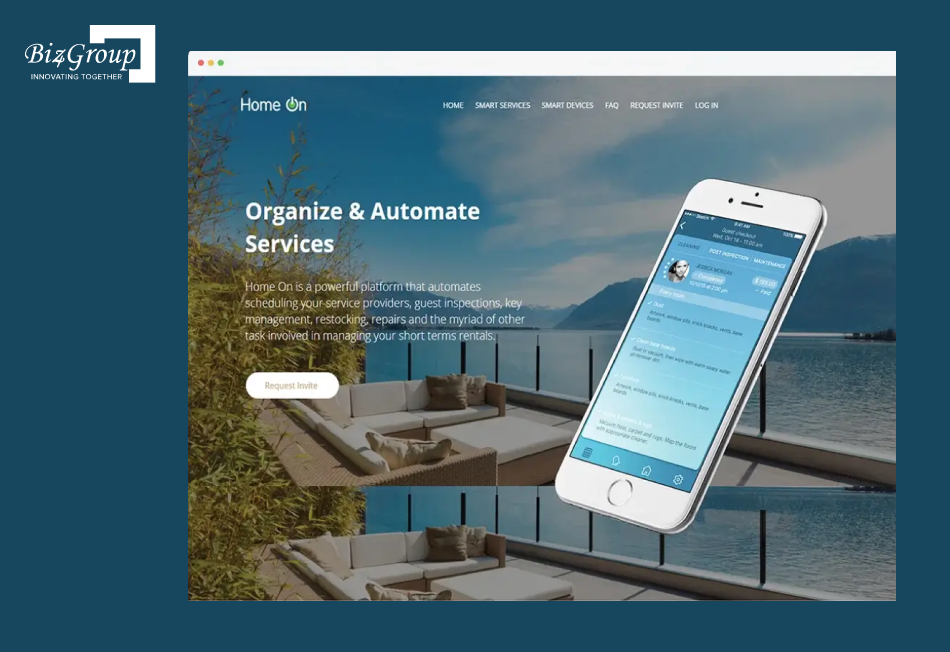
A strong example comes from Biz4Group’s advanced web app developed to automate operational workflows for rental property and home management environments.
The platform streamlined:
- task scheduling
- maintenance tracking
- repair coordination
- inspections
- key management
- real-time activity monitoring
Instead of managing updates across disconnected communication channels, teams could monitor operational activity through a centralized dashboard with synchronized updates.
The operational impact becomes significant at scale.
Even reducing 8 to 10 minutes per maintenance workflow across 800 monthly requests can recover 130+ staff hours every month.
That equals:
- lower overtime costs
- faster response handling
- improved operational visibility
- reduced staffing pressure
This is also why many growing firms eventually realize operational efficiency is not only about hiring more people. It is about reducing how much repetitive coordination work requires human involvement in the first place.
What AI Automation Actually Replaces in HOA Operations
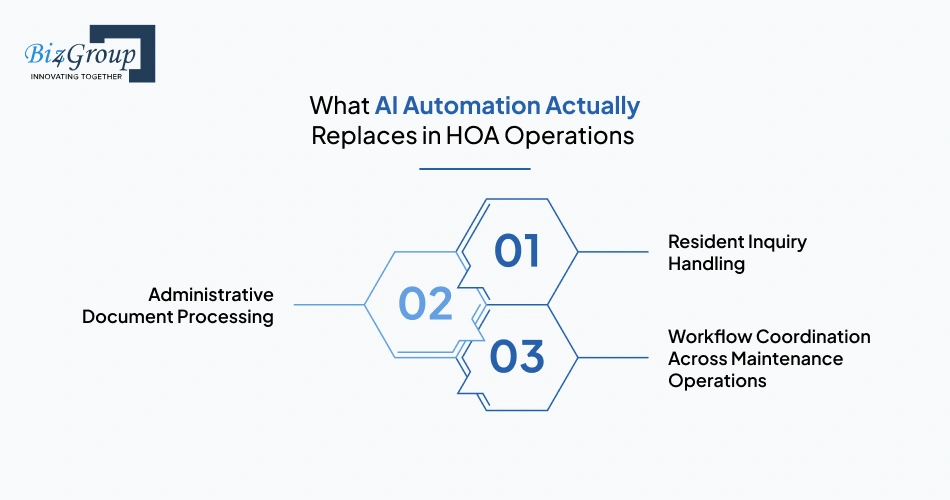
The biggest misconception around automation is that it replaces people.
In HOA management, automation primarily replaces repetitive operational workload that consumes staff capacity every single day.
That is why more operators are now asking, “I am running a property management firm and want to know how AI can replace manual HOA processes and reduce expenses.” The answer becomes clearer once companies identify how much operational work follows predictable patterns.
For example, a mid-sized HOA management company handling 25 to 40 communities may process:
- Thousands of homeowner inquiries annually
- Hundreds of recurring maintenance workflows monthly
- Large volumes of account reminders and notices
- Constant scheduling and coordination updates
- Ongoing document-sharing requests across communities
Most of these activities require administrative effort, not strategic decision-making. That is the operational gap automation systems target first.
Resident Inquiry Handling
One of the largest replacements happens inside communication workflows. In many HOA portfolios, resident support teams spend several hours daily responding to repetitive questions related to:
- payment status
- maintenance updates
- amenity rules
- account access
- HOA documents
When these requests are handled manually, response queues grow quickly as communities scale.
AI-powered communication systems replace:
- repetitive inquiry routing
- manual response dependency
- status-update handling
- scheduling coordination workflows
Operationally, companies managing larger portfolios often reduce repetitive communication handling volume by 35% to 55%. That directly lowers administrative workload across support teams.
Organizations evaluating scalable communication infrastructure frequently compare workflows with systems like AI HOA self service resident portal while assessing long-term operational scalability.
Administrative Document Processing
Another major replacement area involves records and document management. Manual workflows often require staff to:
- search records manually
- verify document versions
- share files repeatedly through email
- coordinate approvals
- track compliance-related requests
At scale, these small administrative tasks consume a substantial amount of operational time.
Automation systems replace:
- repetitive retrieval workflows
- manual file distribution
- document coordination dependency
- repetitive approval handling
For portfolios managing dozens of communities, automated systems can reduce document-related administrative handling time by 50% to 70%.
This is why many firms investing in broader AI automation initiatives prioritize operational areas with high repetitive workload first.
Also read: How to develop automated HOA document retrieval system?
Workflow Coordination Across Maintenance Operations
Maintenance operations create constant movement between residents, vendors, coordinators, and managers. Without automation, teams manually manage:
- work order routing
- vendor assignment
- scheduling updates
- status tracking
- completion verification
As request volume increases, these coordination layers become harder to manage consistently. Workflow automation replaces much of the repetitive operational routing involved in maintenance administration.
For companies handling hundreds of monthly requests, this can recover 120 to 250 operational staff hours annually. That workload recovery becomes financially important once portfolios begin scaling aggressively.
Portfolio Spotlight: AI-based Modern Property Management Application
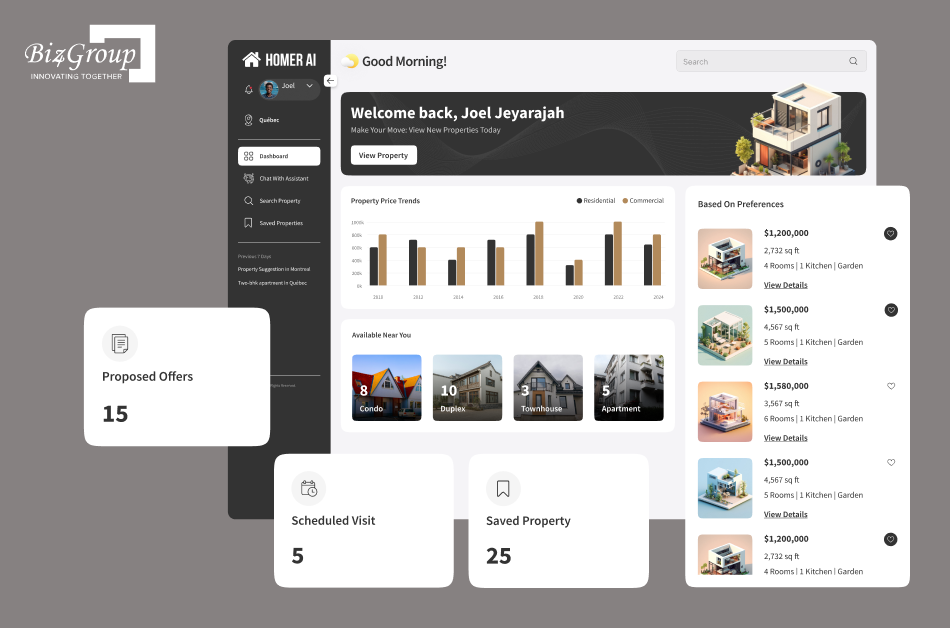
Biz4Group developed a conversational property management platform focused on automating interaction-heavy operational workflows.
The platform included:
- Conversational AI chatbot interaction
- Automated scheduling workflows
- User dashboard management
- Personalized property filtering
- Buyer and seller onboarding flows
- Centralized communication handling
Operationally, the platform helped reduce:
- repetitive inquiry handling
- manual scheduling dependency
- fragmented communication coordination
- administrative interaction workload
The project demonstrated how conversational operational systems can handle growing communication volume without requiring proportional increases in administrative staffing.
For companies evaluating scalable rollout strategies, operational systems are often first validated through MVP development before expanding into larger workflow ecosystems.
Also read: Top 12+ MVP development companies in USA
Still Paying Skilled Teams to Repeat the Same Tasks Daily?
AI automation can reduce repetitive HOA workload by 35% to 55% across operations.
Talk to Biz4Group’s ExpertsCost of Manual HOA Management vs AI Automation Savings
Most HOA management companies do not realize how much operational cost gets reduced once repetitive workflows stop depending entirely on manual coordination. That is why more firms are now asking, “We are looking for vendors for HOA automation and want to understand ROI before investing.”
The table below compares a mid-sized HOA management company operating:
- 30 communities
- approximately 9,000 homeowner units
- traditional manual workflows
versus:
- AI-supported operational workflows
The estimates below reflect typical operational cost ranges observed across growing HOA portfolios in 2026.
|
Operational Area |
Manual HOA Operations |
AI-Supported HOA Operations |
Estimated Reduction |
|---|---|---|---|
|
Resident Communication Handling |
$40K to $68K annually |
$18K to $32K annually |
45% to 60% |
|
Maintenance Coordination |
$58K to $92K annually |
$28K to $52K annually |
35% to 50% |
|
Document Retrieval & Processing |
$12K to $20K annually |
$4K to $9K annually |
50% to 70% |
|
Billing & Account Follow-Ups |
$25K to $31K annually |
$11K to $18K annually |
35% to 55% |
|
Administrative Workflow Handling |
$30K to $48K annually |
$14K to $24K annually |
40% to 55% |
|
Overtime & Operational Spillover |
$18K to $45K annually |
$6K to $18K annually |
50% to 65% |
Estimated Annual Operational Cost
|
Operational Model |
Estimated Annual Cost |
|---|---|
|
Primarily Manual Operations |
$183K to $304K |
|
AI-Supported Operational Workflows |
$81K to $153K |
Estimated Annual Savings: $90K to $150K+
For many growing HOA firms, that difference directly impacts:
- staffing pressure
- operational scalability
- profitability per community
- long-term portfolio growth capacity
This is also why many operators researching cost savings of AI automation in HOA community management operations eventually begin comparing workflow modernization approaches and evaluating whether custom AI HOA software development vs. off-the-shelf solutions aligns better with their operational structure.
Another major factor influencing savings is workflow integration quality.
Disconnected systems often create duplicated operational handling across departments. Centralized workflows built through structured AI integration reduce that fragmentation by connecting communication, maintenance, billing, and records management into synchronized operational environments.
The financial impact becomes even more visible as portfolios expand.
For example:
|
Portfolio Size |
Estimated Annual Savings Potential |
|---|---|
|
10 Communities |
$35K to $60K |
|
25 Communities |
$75K to $125K |
|
50 Communities |
$180K to $320K |
This explains why firms managing larger portfolios increasingly evaluate scalable enterprise AI solutions to reduce operational dependency before administrative overhead begins affecting profitability.
Companies planning long-term operational modernization also frequently evaluate:
- implementation complexity
- staffing impact
- workflow migration costs
- platform scalability
- deployment timelines
That is one reason searches around how much does it cost to develop AI HOA management software continue increasing among property management operators trying to compare operational savings against long-term automation investment.
As HOA portfolios continue growing across the U.S., the gap between manual operational costs and automation-enabled operational efficiency is becoming harder to ignore financially.
How HOA Companies Save Money Using AI-Powered Automation Software Solutions
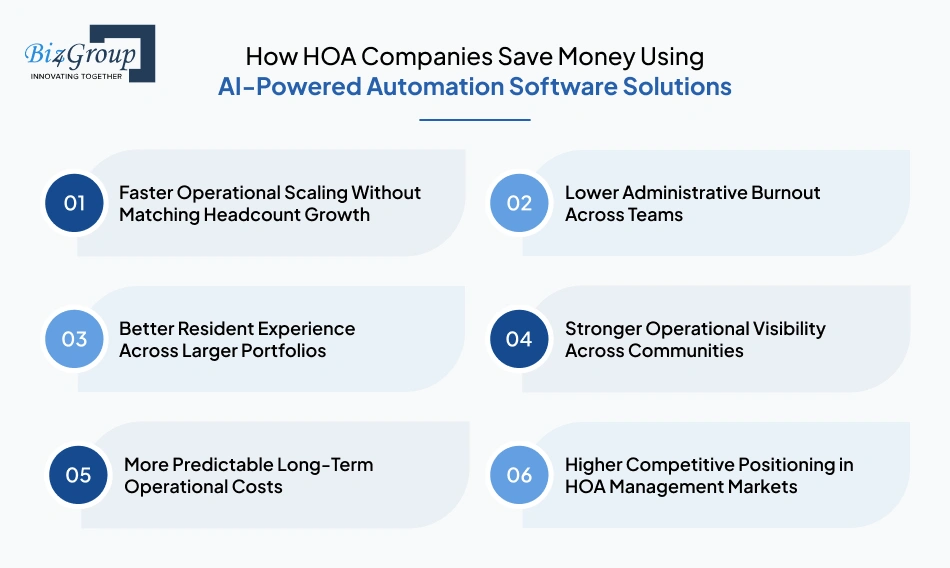
As HOA portfolios grow larger, operational efficiency becomes a profitability issue.
That is why more operators are now asking, “I am running a property management business and want to reduce HOA management workload using automation, so can you suggest US-based companies that can provide AI workflow automation solutions for homeowner support and maintenance handling?”
We'll get to that, but for now, here are the benefits of AI solutions for HOA communication and operations.
1. Faster Operational Scaling Without Matching Headcount Growth
One of the biggest advantages of automation is the ability to grow portfolios without increasing staffing at the same pace.
In manual operational environments, adding 10 to 15 communities often requires:
- additional coordinators
- more administrative support
- expanded communication handling teams
AI-supported operational systems reduce that dependency significantly.
Many firms implementing automation workflows report 25% to 40% improvement in operational scalability. This allows managers to oversee larger portfolios while maintaining service responsiveness more efficiently.
Companies evaluating long-term operational growth often begin assessing scalable AI HOA management software platforms designed for multi-community management environments.
2. Lower Administrative Burnout Across Teams
Administrative fatigue remains one of the largest operational challenges in HOA management.
Repetitive coordination work creates:
- slower response handling
- operational inconsistency
- employee frustration
- higher turnover pressure
Automation helps reduce repetitive workload concentration across support teams by streamlining operational workflows that traditionally consume large portions of the workday.
Many firms implementing structured workflow automation report 20% to 35% reduction in repetitive administrative handling time. This creates healthier operational capacity distribution across teams instead of forcing coordinators into constant reactive task management.
3. Better Resident Experience Across Larger Portfolios
Resident expectations have changed significantly in recent years.
Homeowners now expect:
- faster responses
- self-service access
- real-time communication
- easier information retrieval
Manual operational systems struggle to maintain consistency as inquiry volume increases.
AI-supported communication systems help standardize operational responsiveness across growing portfolios. This improves overall service consistency while reducing operational bottlenecks caused by fragmented communication handling.
That is one reason searches related to how to cut HOA management costs using AI automation software solutions continue increasing among larger property management firms in 2026.
Operationally, firms often report 30% to 50% faster response turnaround times after implementing centralized automation workflows.
4. Stronger Operational Visibility Across Communities
One major issue with fragmented manual operations is limited visibility.
Managers often struggle to track:
- pending requests
- workflow delays
- communication gaps
- unresolved operational tasks
Automation systems centralize workflow activity into structured operational environments where updates, approvals, and task movement remain visible across departments.
This creates:
- better operational tracking
- fewer workflow bottlenecks
- stronger accountability
- improved reporting consistency
For firms managing multiple communities simultaneously, this visibility becomes increasingly valuable as operational complexity grows.
5. More Predictable Long-Term Operational Costs
Manual operational models become harder to forecast financially because staffing requirements increase continuously with portfolio growth.
Automation changes that equation.
Instead of scaling operational costs linearly with workload volume, firms can standardize large portions of recurring workflows through centralized systems. Many HOA operators implementing structured automation frameworks report 18% to 32% improvement in long-term operational cost predictability.
That matters significantly for firms planning:
- regional expansion
- multi-community growth
- larger homeowner portfolios
This is also why many companies researching how property managers use AI to reduce administrative expenses in HOA communities begin evaluating broader operational modernization strategies before scaling further.
6. Higher Competitive Positioning in HOA Management Markets
Operational efficiency increasingly influences:
- board retention
- service perception
- management contract renewals
- referral growth
Firms operating with slower response cycles and fragmented workflows often struggle to compete against companies offering more streamlined operational experiences.
That is why many operators now ask, “We are managing multiple HOA communities and facing high operational costs, so can you suggest US-based AI automation companies that can build automated homeowner support systems and reduce manual communication workload?”
Let's talk about that next.
Also read: Top 10 AI HOA management software development companies in USA
The Fastest Growing HOA Companies Are Not Hiring Faster. They’re Automating Smarter.
Top-performing HOA firms improve scalability by up to 40% with automation-first operations.
Call Biz4Group NowHow Biz4Group LLC Helps HOA Companies in the USA Reduce Operational Costs With AI
Most technology companies can build software. Very few understand operational pressure inside HOA management. That difference matters.
At Biz4Group LLC, we help HOA management companies solve the real business problem behind operational inefficiency... Rising administrative overhead, overloaded support teams, fragmented communication, slower workflows, and shrinking margins across growing portfolios.
We are a USA-based real estate AI software development company focused on building intelligent operational systems for modern businesses. Our expertise combines AI, workflow automation, scalable software architecture, and deep real estate technology experience to help property management companies operate more efficiently at scale.
Over the years, we have worked with startups, enterprises, and operationally complex businesses looking to modernize high-volume workflows through automation. From conversational AI systems to centralized maintenance coordination platforms, our focus has always remained practical. We build systems that solve operational bottlenecks, reduce manual dependency, and create measurable business impact.
That is why more operators searching, “I am planning to upgrade our HOA management system with AI automation and chatbot features, so can you suggest reliable US-based companies that specialize in building AI homeowner support system and property management automation platforms?” are increasingly evaluating Biz4Group LLC as a long-term technology partner.
As an experienced AI development company, our capabilities extend across:
- AI-powered workflow automation
- homeowner communication systems
- maintenance coordination platforms
- operational dashboards
- centralized workflow ecosystems
- intelligent document management
- scalable real estate platforms
Our portfolio reflects this operational-first mindset. Instead of building feature-heavy systems that create additional complexity, we focus on usability, scalability, and operational clarity for teams handling large portfolios and communication-heavy environments.
Why Businesses Choose Biz4Group LLC
- Proven experience across real estate and property operations
- Deep understanding of HOA workflow challenges
- Strong focus on automation-driven operational efficiency
- Scalable architecture built for long-term portfolio growth
- Expertise in conversational AI and communication systems
- Custom workflow development tailored to operational needs
- End-to-end development from strategy to deployment
- Dedicated support and long-term technology partnership approach
What truly separates Biz4Group LLC is our ability to think beyond software delivery.
We understand that HOA companies are not looking for another disconnected tool. They are looking for operational leverage. They want systems that help teams manage more communities without creating staffing chaos every time the portfolio expands.
That is exactly where our approach creates value.
We help businesses transition from reactive operational environments into scalable automation ecosystems designed for long-term growth, stronger resident experience, and healthier operational economics.
If your HOA operations are growing faster than your workflows can support, now is the right time to rethink how your systems scale. Talk to Biz4Group LLC and discover how AI automation can help your HOA business reduce operational costs, improve efficiency, and grow without operational bottlenecks.
Final Thoughts
The operational cost of managing HOA communities manually becomes harder to sustain as portfolios grow. What starts as manageable coordination slowly turns into rising administrative overhead, slower workflows, staffing pressure, and shrinking profitability. That is exactly why the conversation around the cost of manual HOA management vs AI automation savings has become increasingly important for property management companies across the USA.
From resident communication and maintenance coordination to billing workflows and document handling, repetitive operational tasks consume a significant portion of staff capacity every year. Companies evaluating how to cut HOA management costs using AI automation software solutions are no longer looking at automation as a future upgrade. They are looking at it as a necessary operational strategy for long-term scalability, efficiency, and cost control.
This is where Biz4Group LLC helps businesses move forward with clarity and confidence. As a USA-based software development company with deep expertise in AI and real estate operations, we build scalable automation systems tailored specifically for HOA and property management workflows. Our focus stays on helping businesses reduce operational friction, improve responsiveness, and create sustainable growth models through intelligent automation.
So, without any further ado, connect with Biz4Group LLC and explore how AI automation can help your business level up.
FAQs
1. How do HOA management companies know when manual operations are becoming too expensive?
The biggest warning signs usually appear operationally before they appear financially. Slower response times, growing administrative backlog, higher employee turnover, delayed maintenance coordination, and increased staffing dependency often indicate that manual workflows are no longer scaling efficiently.
2. Can small and mid-sized HOA companies benefit from AI automation?
Yes. Smaller HOA firms often benefit quickly because automation helps lean teams handle growing workloads without expanding staff aggressively. Many companies begin with communication workflows or maintenance coordination before expanding automation into other operational areas.
3. What HOA processes are usually automated first?
Most HOA companies start with high-volume operational workflows such as resident communication, maintenance request handling, billing reminders, document management, and task routing. These areas typically consume the most repetitive administrative time.
4. Does AI automation work with existing HOA management systems?
In many cases, yes. Modern automation systems can often integrate with existing HOA software, accounting tools, communication systems, and operational platforms. The compatibility level depends on the current software infrastructure and integration requirements.
5. What is the biggest operational advantage of AI in HOA management?
One of the biggest advantages is workflow consistency. AI automation helps standardize communication, operational tracking, request handling, and administrative coordination across multiple communities, which becomes increasingly important as portfolios scale.
6. What should HOA companies look for before choosing an AI automation partner?
HOA companies should evaluate industry experience, workflow automation expertise, scalability capabilities, integration flexibility, long-term support, and understanding of property management operations. Choosing a partner that understands operational challenges is often more valuable than choosing a company focused only on software development.
