Location :
Orlando, FL, USA
 +1 (407) 714-1616
 info@biz4group.com


 AI Summary Powered by Biz4AI
- Healthcare AI avatar development means building a digital human that talks with patients by voice, text, or video, answers only from clinician-approved content, and hands off to staff when a person is needed, so an AI healthcare avatar supports your team instead of replacing it.
- AI avatars for healthcare in the USA work best on routine, high-volume, after-hours tasks such as prep questions, scheduling, reminders, and multilingual help, which makes AI avatar development for patient engagement the right starting point for healthcare AI avatar solutions for clinics and hospitals.
- How to build an AI avatar for healthcare starts with one low-risk workflow, core safety features such as AI disclosure, approved content, and human handoff, then phased development, testing, and a pilot, while how to integrate AI avatars with healthcare systems depends on FHIR-based EHR access and vendor approvals.
- Compliance shapes every build, because HIPAA requires BAAs, risk analysis, and PHI controls, FDA treatment depends on intended use, and state laws such as California AB 3030 and Texas TRAIGA require AI disclosure, so every AI-powered healthcare avatar needs a written plan for wrong answers.
- Healthcare digital avatar development typically costs $35,000 to $300,000+ depending on avatar realism, integrations, languages, and compliance scope, so measure results against a baseline of call volume, wait times, and no-shows and work with a healthcare AI avatar development company such as Biz4Group, a U.S.-based team in Orlando with 20+ years of experience, 100+ healthcare AI projects, and HIPAA-compliant platform development with FHIR-based EHR integration.
It is 10:40 p.m., the night before a patient’s knee replacement.
She is 68. She has the prep sheet in one hand and a worry in her head. Can she take her morning blood pressure pill, or does “nothing by mouth” cover that too?
Your office closed at 5. The nurse line has a 40-minute wait. Her daughter lives two states away.
She needs a person. Someone calm, who can explain it slowly, in her language, and say it again if she asks twice.
Now picture a different ending.
She opens your patient app, and a friendly digital guide greets her by name. It tells her up front that it is an AI assistant. It walks her through the prep instructions your surgical team already approved, in Spanish, as many times as she needs.
When she asks about the pill, it does not guess. It sends the question to the on-call nurse and tells her exactly when she will hear back.
The avatar does not replace your nurse. It covers the hours when your nurse cannot be reached.
That is the kind of moment healthcare AI avatar development is built for.
So what is it?
Healthcare AI avatar development is the process of designing, building, and deploying a digital human, powered by conversational AI, that talks with patients by voice, text, or video and connects to your scheduling, records, and care workflows. An AI healthcare avatar answers from content your clinical team has approved, and it hands the conversation to a person when a person should take over.
Is this still an experiment? Not anymore.
The American Medical Association’s 2026 survey of 1,692 physicians found that 81% now use AI in their practice, up from 38% in 2023. On the operations side, 75% of US health systems use at least one AI application, up from 59% a year earlier, according to Eliciting Insights’ survey of 120 health systems.
Interest in AI avatars for healthcare in the USA is rising fast. Do patients respond to a face on the screen? Early evidence says yes.
At ESTRO 2026, an oncology team at Christiana Care reported that patients who watched personalized videos from an AI avatar of a doctor before their consult understood their radiation treatment better and felt less stressed than patients who watched a standard video. The study followed 1,464 patients.
It used pre-recorded avatar videos, not live conversation. So we treat it as a strong signal, not a guarantee.
Here is the catch. AI avatar development for healthcare carries higher stakes than a retail chatbot. A wrong answer, exposed patient data, or a patient who cannot reach a human can undo months of goodwill.
Dave Caplis, Technical Director at Biz4Group, described the pattern we see most often: “Healthcare organizations come to us after spending months trying to make generic AI tools fit clinical environments they were never designed for.”
We built our approach around that problem. As an AI avatar development company in USA with 20+ years of experience and 100+ healthcare AI projects delivered, we created Dr. Truman, an AI-powered healthcare avatar for personalized wellness guidance report a 40% increase in user engagement, 30% increase in supplement sales. 85% positive feedback from customers, 20% reduced operational costs and 25% improved marketing conversion.
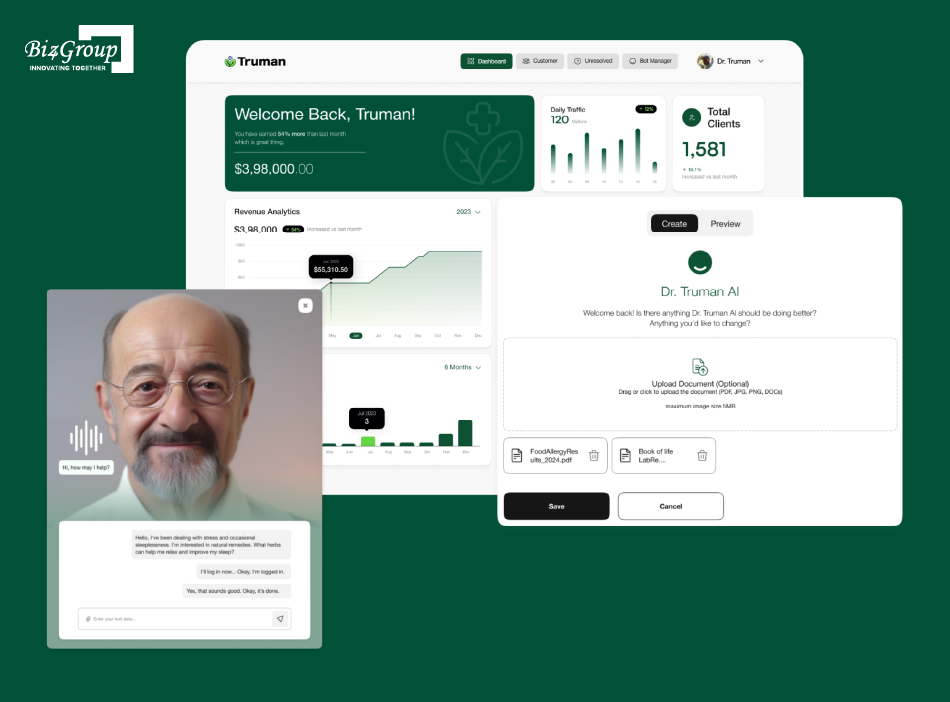
In this guide, we answer the questions teams ask us before they start:
- What does healthcare digital avatar development involve, and how to develop digital human technology for healthcare step by step?
- How to build an AI avatar for healthcare without putting patient data at risk?
- How to integrate AI avatars with healthcare systems such as your EHR and scheduling tools?
- Which US rules apply, what does it cost, and how do you prove it pays off?
If your goal is AI avatar development for patient engagement, you will see where it delivers results first. If you run a single practice or a hospital network, you will leave with a plan for healthcare AI avatar solutions for clinics and hospitals and the right questions to ask any healthcare AI avatar development company before you sign.
What Is Healthcare AI Avatar Development and How Does It Work?
Before talking about benefits, costs, or ROI, one question needs a clear answer. What exactly is a healthcare AI avatar, and why are so many organizations investing in it now?
Let’s break it down in plain terms.
What Is Healthcare AI Avatar?
A healthcare AI avatar is a digital, human-like interface that communicates with patients using voice, text, or visuals. It understands questions, responds naturally, and guides users through healthcare-related interactions.
Think of it as a front-line digital representative that works around the clock.
But here’s the important part. This is not a basic chatbot with scripted replies. Healthcare AI avatar development focuses on building intelligent systems that can:
- Understand patient intent
- Respond with context-aware guidance
- Personalize conversations over time
- Operate securely within healthcare regulations
So, what does that mean for your business? It means fewer repetitive tasks for staff and better engagement for patients.
How Does Healthcare AI Avatar Development Work?
At a high level, these systems follow a simple flow. Input. Understanding. Response. Learning.
Here’s how it comes together behind the scenes.
|
Component |
What It Does |
Why It Matters |
|---|---|---|
|
Conversational AI |
Interprets patient questions and intent |
Enables natural, human-like dialogue |
|
Speech Recognition & Text Processing |
Converts voice or text into actionable data |
Supports voice-first and chat-based care |
|
Decision Logic |
Determines the best response or next step |
Keeps interactions accurate and relevant |
|
Visual or Voice Avatar Layer |
Presents responses through a digital persona |
Builds trust and familiarity |
|
System Integrations |
Connects with EHRs, CRMs, or care platforms |
Ensures real-time, personalized responses |
|
Learning Engine |
Improves answers based on interactions |
Makes the avatar smarter over time |
Each component plays a role, but together they create something powerful. A patient-facing experience that feels responsive, reliable, and scalable.
How Is This Different from Traditional Automation?
Let’s address a common question... is this replacing staff? No. It’s reshaping how staff time is used.
Healthcare AI avatar development allows organizations to:
- Automate high-volume interactions
- Maintain consistency in patient communication
- Offer 24/7 availability without burnout
- Extend care access beyond clinic hours
In short, the avatar handles the routine. Your team focuses on care that requires human judgment.
Healthcare AI avatar development is about redesigning how patients interact with your brand, your services, and your care teams.
Is a Healthcare AI Avatar Better Than Human Staff, or Do They Work Best Together?
A healthcare AI avatar is better at high-volume, repeatable, after-hours tasks such as prep questions, scheduling, and reminders. Human staff are better at clinical judgment, comfort in hard moments, and any decision that carries risk. In our experience, the strongest setup is hybrid: the avatar handles routine conversations and routes anything uncertain to a person.
That answers a question many leaders ask first: can an AI avatar replace a nurse or front desk staff? No. Here is how the work splits.
|
Task |
Healthcare AI avatar |
Human staff |
Who should lead |
|---|---|---|---|
|
After-hours questions (prep steps, directions, forms) |
Answers at any hour, with the same approved wording every time |
Limited by shifts and call volume |
Avatar |
|
Scheduling, rescheduling, and reminders |
Handles high volume at once |
Handles exceptions and tricky cases |
Avatar |
|
Language support |
Speaks the languages you configure |
Needs bilingual staff on every shift |
Avatar, with quality checks |
|
Symptom questions and triage |
Collects details and flags urgency using rules your clinicians set |
Judges real risk |
Human |
|
Medication changes, test results, bad news |
Should not decide or deliver |
Explains, answers follow-ups, reads the room |
Human |
|
Upset or anxious patients |
Recognizes the signs and hands off quickly |
Listens and reassures |
Human |
|
Billing and insurance disputes |
Gathers account details first |
Negotiates and resolves |
Shared |
Clinicians draw the same line. In the AMA’s 2026 survey, about 70% of physicians said AI can help automate tasks that contribute to burnout. Yet nearly half strongly opposed patients using AI to interpret radiology or pathology results.
Automate the busywork. Keep interpretation with a clinician.
Some states now write that line into law. California’s AB 3030 requires an AI disclaimer, plus instructions for reaching a human, on generative AI messages that carry clinical information, unless a licensed provider reviews the message first. Administrative matters such as appointments fall outside it. We cover the full rules in the compliance section.
“Healthcare teams are stretched thin, and adding more staff is not always the answer,” said Dave Caplis. We build AI-powered healthcare avatars to match: each one handles defined tasks within set limits and escalates to staff when needed.
Not sure where a task belongs? Ask three questions:
- Is the correct answer the same every time?
- Could a wrong answer harm the patient?
- Does the patient need to feel heard, not just informed?
If you answer yes, no, no, give the task to the avatar. Any other combination goes to a person, or needs a built-in handoff.
Good AI avatar development for patient engagement gives your staff their time back for judgment and empathy. It also makes sure no patient waits for a first answer.
Now comes the bigger question. Why are so many healthcare organizations choosing to build these solutions today instead of waiting? Let’s explore that next.
Also read: AI Avatars vs Traditional Chatbots
Why Are More Providers Turning to AI Avatars for Healthcare in the USA Today?
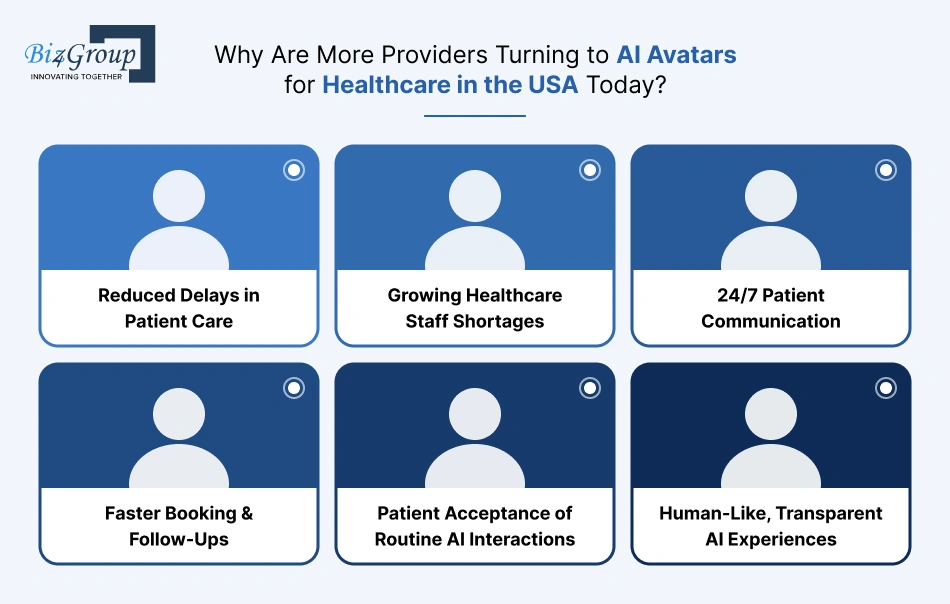
Providers are turning to AI avatars for healthcare in the USA for three reasons:
- Patients delay care when booking and follow-up are hard.
- Staff are stretched too thin to answer every call and message.
- Patients now accept AI for routine tasks, as long as it feels human and says what it is.
You might be asking: why are AI avatars getting attention now, when chatbots have been around for years? The patient data answers it.
The 2026 State of Patient Communications report from Hyro and Pixel Health surveyed 800 US patients and 200 digital and IT executives at hospitals and health systems. Wakefield Research ran the surveys in November 2025, and the report came out in March 2026. Here is what stands out:
|
Area |
What the report found |
What it means for an AI avatar |
|---|---|---|
|
Access |
72% of patients have put off seeing a provider. 51% said it was too difficult to make an appointment. |
Booking friction can cost you patients you never see. |
|
Effort gap |
All 200 executives call helping patients overcome barriers to care a priority. Only 48% of patients say a provider helped them proactively in the past 12 months. |
Intent is not enough. Help has to actually reach patients. |
|
Openness |
69% of patients are comfortable with AI agents handling tasks like scheduling. |
Routine tasks are the right place to start. |
|
Trust |
69% worry AI could erode the human element of care. 82% trust humans more than AI to protect their health data. |
Disclosure and a human handoff must be built in. |
|
Channel |
33% prefer a phone call. Only 5% prefer a chatbot or virtual assistant. |
A plain chatbot is not what patients ask for. |
|
Provider view |
56% of providers name patient skepticism as the biggest obstacle to AI adoption. |
Trust design will decide adoption. |
Read down the table and the pattern is clear. Patients want easier access. They will let AI handle routine work. They will not tolerate a cold bot.
Think about what that means for your practice. A patient who gives up on booking never appears in your no-show report. They simply never arrive.
Do patients trust AI avatars in healthcare? Not automatically. The survey did not test avatars, so we will not claim it settles the question. It does show the bar a tool has to clear. Patients push back on:
- Cold bots with no personality
- AI that does not say it is AI
- Dead ends with no person at the end
That bar is where healthcare AI avatar development has an opening. A face and a voice can make routine help feel less like filling in a form. Clear disclosure and an easy handoff keep trust intact. For providers weighing AI avatar development for patient engagement, that is the right place to start.
We build every AI-powered healthcare avatar to that standard:
- It tells patients it is AI.
- It answers from content your clinical team has approved.
- It hands off to staff when a person is needed.
So where do these pressures land on your team first? We look at that next.
What Healthcare Organizations Are Struggling With
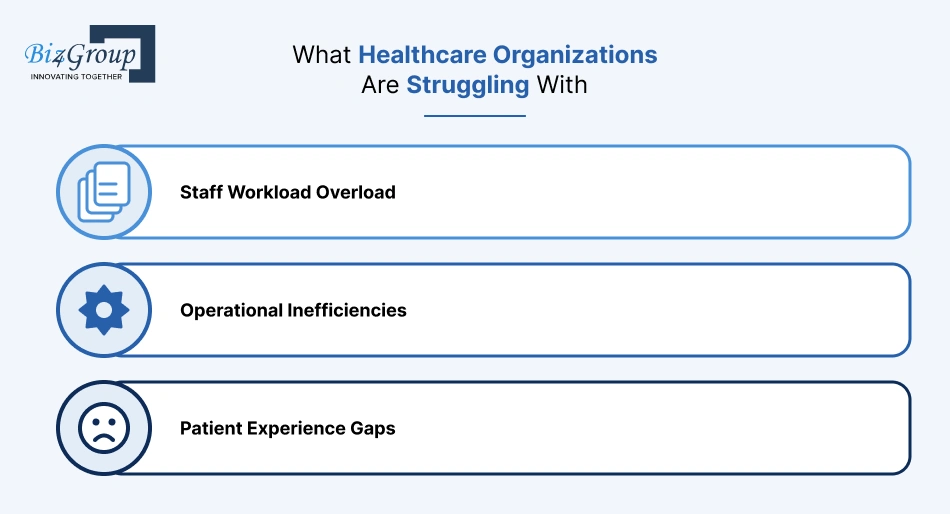
Despite interest in digital transformation, healthcare systems are still facing heavy pressure in daily operations.
Here are the persistent pain points:
Staff Workload Overload
- Patient inquiries that flood call centers
- Scheduling bottlenecks
- Repetitive information requests
Operational Inefficiencies
- Manual follow-ups
- Lack of 24/7 engagement
- Disjointed patient communication channels
Patient Experience Gaps
- Patients expect modern digital experiences
- Tech fatigue when systems offer portals but no real engagement
These issues are not small. They hit the bottom line and patient satisfaction directly.
So here’s the real question... what if your organization could automate routine conversations, support patients nonstop, and free up your teams for value-driven care?
That is the promise of building healthcare AI avatars.
The Real Pressure Points AI Avatars Relieve
AI avatars are not magic. They are leverage points. They address specific problems that traditional solutions struggle with. Here’s how they help:
1. Constant Availability Patients want help now, not when your office opens. AI avatars answer questions, schedule visits, share information, or triage basics around the clock.
2. Reduced Staff Burnout Front desk teams are often overwhelmed with repetitive queries. AI avatars remove thousands of routine touchpoints from their plate.
3. Consistent Communication Humans vary in tone, memory, and availability. AI avatars deliver consistent guidance every time.
4. Better Patient Engagement Metrics Studies on conversational agents show high engagement rates when patients receive instant, personalized answers rather than delayed callbacks.
These systems allow healthcare providers to scale without proportionally increasing staff. They reduce friction at every interaction point.
Healthcare has always been about trust, access, and quality. Today, your patients judge quality by digital experience, not just clinical outcomes. The question is not only “Can we build this?” It’s “Can we afford not to build this?”
In the next section, we will look at the business benefits of healthcare AI avatar development and how these systems can move the needle in measurable ways.
Healthcare Is Moving Fast. Are You?
AI adoption in healthcare has already crossed 20%. Early adopters are already locking in efficiency and patient loyalty. Waiting has a cost!
Contact Biz4Group TodayWhat Business Results Can AI Avatar Development for Healthcare Deliver?
You’ve seen the market shift. You understand the pressure points. Now let’s talk business.
What does healthcare AI avatar development services actually do for your revenue, operations, and long-term growth?
Below is a focused breakdown of measurable business outcomes that healthcare organizations experience when they implement healthcare AI avatar solutions for clinics and hospitals.
|
Business Area |
Challenge Faced by Providers |
How Healthcare AI Avatar Development Services Create Impact |
Business Outcome |
|---|---|---|---|
|
Patient Acquisition |
Low digital engagement and weak conversion from website visitors |
Interactive avatars guide users through services, insurance info, and next steps in real time |
Higher appointment bookings and stronger digital conversion rates |
|
Revenue Expansion |
Missed upsell opportunities for services, preventive programs, or wellness offerings |
Personalized recommendations based on patient data and interaction history |
Increased average patient lifetime value |
|
Appointment Retention |
No-shows and poor follow-up adherence |
Automated reminders, conversational rescheduling, and personalized nudges |
Improved show-up rates and reduced revenue leakage |
|
Call Center Costs |
High volume of repetitive inbound calls |
AI avatars handle FAQs, insurance queries, and scheduling tasks |
Lower staffing pressure and reduced call handling costs |
|
Brand Positioning |
Outdated perception in competitive healthcare markets |
Modern, interactive, patient-friendly digital presence |
Stronger brand differentiation in local and national markets |
|
Scalability |
Expansion to new locations increases staffing costs proportionally |
One AI avatar infrastructure serves multiple clinics and geographies |
Growth without equal headcount expansion |
|
Data Insights |
Limited visibility into patient intent and interaction patterns |
Real-time analytics on patient conversations and service interests |
Smarter strategic planning and service optimization |
|
Multilingual Access |
Difficulty serving diverse patient populations efficiently |
AI avatars communicate in multiple languages without hiring separate staff |
Expanded market reach and improved accessibility |
Healthcare executives are measured on efficiency, growth, and patient satisfaction. Healthcare AI avatar development services support all three without requiring a full operational overhaul.
Instead of adding layers of complexity, these systems simplify patient touchpoints while strengthening internal control.
In the next section, we’ll move from business value to practical application.
Where Do Healthcare AI Avatar Solutions for Clinics and Hospitals Work Best?
Once the business case is clear, the next logical question follows. Where exactly do healthcare AI avatars fit into day-to-day operations?
This is where theory turns into execution.
Below are the most impactful, real-world use cases where healthcare AI avatar solutions for clinics and hospitals are delivering value today. Each use case addresses a specific operational or patient experience gap.
1. Patient Onboarding and First-Time Engagement
First impressions matter in healthcare more than most industries. AI avatars greet new patients, explain services, guide them through registration, and answer common questions without delays.
What changes for your organization?
- Patients feel supported from the first interaction.
- Front-desk teams avoid repetitive explanations.
- Digital drop-offs reduce significantly.
This use case is especially valuable for clinics with high patient churn or strong online discovery channels.
Also read: How to create an AI medical agent for patient interaction & triage?
2. Appointment Scheduling and Intelligent Triage
Scheduling sounds simple. In reality, it drains staff time. Healthcare AI avatar development allows organizations to automate:
- Medical scheduling and rescheduling requests
- Basic patient triage
- Department routing
Instead of phone queues, patients interact instantly. Instead of staff juggling calendars, the system handles availability logic. The result is smoother scheduling workflows and faster patient access to care.
3. Preventive Care and Wellness Engagement
Care does not begin at diagnosis. AI avatars support preventive health by delivering medication reminders, lifestyle guidance, and educational content based on patient profiles.
For clinics and wellness-focused providers, this creates:
- Stronger ongoing engagement
- Better adherence to care plans
- Higher participation in wellness programs
It also positions your organization as proactive rather than reactive.
4. Post-Visit Follow-Ups and Care Continuity
Aftercare often gets overlooked due to time constraints. Healthcare AI avatars step in to:
- Share post-visit instructions
- Check symptom progression
- Answer recovery-related questions
- Escalate concerns when needed
Patients feel monitored. Providers gain peace of mind. Care continuity improves without increasing workload.
This use case is critical for chronic care, recovery programs, and outpatient services.
5. Multilingual Patient Support and Accessibility
Language barriers create friction and risk. AI avatars can communicate in multiple languages while maintaining consistency and accuracy. This expands access without requiring multilingual staffing across every shift.
For clinics serving diverse communities, this use case directly improves equity and patient satisfaction.
6. Internal Support for Clinical and Administrative Teams
Not all avatars face patients. Healthcare AI avatars also assist internal teams by answering policy questions, surfacing procedural information, and guiding staff through workflows.
This reduces training time and improves operational consistency across departments.
Also read: How to develop an AI avatar for clinical management?
Healthcare AI avatar solutions for clinics and hospitals are not tied to a single workflow. They adapt wherever interaction volume, response time, or consistency becomes a challenge.
The next step is deciding what features your avatar must include to support these use cases effectively.
Can Your Front Desk Handle 10,000 Conversations a Day?
AI avatars can. From onboarding to follow-ups, smart systems scale instantly while human teams stay focused on care.
Book a Strategy Call NowWhich Features Make an AI-Powered Healthcare Avatar Safe and Useful for Patients?
By now, one thing should be clear. A healthcare AI avatar is only as effective as the features behind it.
This section focuses on practical, execution-level features that directly influence usability, trust, and scalability. These are the functional capabilities that healthcare leaders should insist on before moving forward.
Below is a clean, feature-first breakdown designed for quick evaluation.
|
Feature |
What It Is |
What It Does |
|---|---|---|
|
Patient Identity Verification |
Secure patient validation through OTPs or secure login |
Prevents unauthorized access and protects sensitive health interactions |
|
Context Retention |
Ability to remember prior interactions within a session or over time |
Enables personalized and continuous conversations |
|
Consent Capture and Management |
Digital consent workflows embedded into conversations |
Ensures patients agree to data use and interaction scope |
|
Custom Conversation Flows |
Configurable dialogue paths based on services or specialties |
Aligns patient interactions with your care offerings |
|
Role-Based Response Control |
Differentiated responses for patients, caregivers, or staff |
Maintains relevance and prevents information overload |
|
Escalation to Human Staff |
Smart handoff logic when cases exceed automation limits |
Avoids frustration and ensures timely human intervention |
|
Analytics and Interaction Reporting |
Real-time insights into conversation trends and drop-offs |
Helps optimize engagement strategies and workflows |
|
Deployment Flexibility |
Ability to deploy across web, mobile apps, or kiosks |
Supports omnichannel patient engagement |
|
Branding and Persona Customization |
Visual, tone, and language customization |
Strengthens brand identity and patient trust |
|
Accessibility Support |
Voice navigation, text resizing, and assistive compatibility |
Improves usability for elderly and disabled patients |
Each feature above serves one purpose. To make your healthcare AI avatar usable, trustworthy, and scalable. Missing even a few of these can lead to low adoption, compliance risks, or poor patient experiences.
In the upcoming section, we will explore advanced capabilities in custom healthcare AI avatar development that help organizations stand out and future-proof their investment.
What Advanced Capabilities Set AI Medical Avatar Development Apart?
This is where healthcare AI avatar development shifts from operational efficiency to strategic differentiation. Advanced capabilities determine whether your avatar feels basic or transformative.
Let’s explore the features that elevate custom healthcare AI avatar development from functional to exceptional.
1. Emotion Recognition and Sentiment Awareness
Healthcare conversations are rarely neutral. Advanced avatars can analyze sentiment, frustration, urgency, or track mood through voice modulation or language patterns.
What does that change? The system adapts responses in real time. A stressed patient receives reassurance. A confused patient gets simplified guidance.
That subtle shift dramatically improves trust and satisfaction.
2. Predictive Patient Engagement Modeling
Instead of reacting to questions, advanced systems anticipate them. By analyzing interaction patterns, appointment histories, or behavioral signals, avatars can suggest preventive screenings, recommend follow-ups, and prompt medication reminders.
This moves your organization from reactive care to proactive engagement.
3. Dynamic Personalization Across Specialties
A dermatology clinic and a cardiology practice do not communicate the same way. Custom healthcare AI avatar development allows the avatar to dynamically adjust medical terminology depth, tone and language complexity, and service-specific workflows.
The experience feels tailored, not generic. Patients notice the difference.
4. Real-Time Clinical Data Synchronization
Advanced systems connect directly with live scheduling tools, patient records, or care management systems. This enables the avatar to confirm real-time availability, surface recent visit summaries, and personalize recommendations based on medical history.
Accuracy builds credibility. Credibility builds long-term adoption.
5. Intelligent Revenue Support Integration
Healthcare organizations are also businesses. Advanced avatars can support revenue by presenting membership plans, offering bundled wellness programs, explaining insurance coverage clearly, and guiding payment plan discussions.
These interactions feel helpful rather than transactional when executed properly.
6. Adaptive Learning for Workflow Optimization
Over time, interaction data reveals patterns. Advanced healthcare AI avatar development systems analyze drop-off points, common confusion areas, and high-frequency requests.
The avatar continuously refines its responses and routing logic. That means fewer bottlenecks and better efficiency without rebuilding the system.
7. Multi-Modal Interaction Experiences
Patients engage differently. Some prefer text, others prefer voice. Some respond better to visual guidance. Advanced avatars support seamless transitions between chat, voice interaction, visual avatars, and embedded educational content.
The flexibility expands accessibility and engagement simultaneously.
Advanced capabilities are not about showing off technology. They are about building resilience into your digital care ecosystem. The more intelligent and adaptive your avatar becomes, the more value it generates over time.
Now that we’ve covered capabilities, it’s time to ground this discussion in reality.
Also read: A comprehensive guide to mental health AI avatar development for clinics, and remote therapy
Basic Automation or Intelligent Advantage?
Emotion-aware, predictive, and personalized AI avatars are separating leaders from laggards. Which side of the line are you on?
Build Smart with Biz4GroupHow to Develop Healthcare AI Avatars from Idea to Deployment in 8 Steps?
Building a healthcare AI avatar requires structure, clarity, and disciplined execution. Without a defined process, projects drift, budgets expand, and outcomes suffer.
Below is an 8-step development process for healthcare AI avatar that experienced teams follow to move with confidence.
Step 1. Define the Business Objective and Use Case
Every successful avatar starts with a sharp purpose. Clear objectives guide every design and technical decision that follows.
Is the goal to:
- reduce call volume?
- improve onboarding?
- support wellness programs?
- assist internal teams?
When the goal is vague, the avatar becomes confusing. When the goal is focused, adoption improves naturally.
Step 2. Map User Journeys and Interaction Scenarios
Next comes understanding how users will actually interact with the avatar. This step involves:
- Identifying user types
- Listing common questions and tasks
- Mapping conversation paths
This clarity prevents feature overload and keeps interactions purposeful.
Step 3. UI and UX Design for Patient-Centered Interaction
Design shapes trust. In healthcare AI avatar development, UI and UX design determines whether patients feel supported or overwhelmed.
Key design priorities include:
- Clean, distraction-free interfaces
- Simple conversation prompts
- Clear visual cues and feedback
- Accessibility-friendly layouts
Strong design reduces learning curves and encourages repeat usage.
Also read: Top 15 UI/UX design companies in USA
Step 4. Build an MVP to Validate Core Functionality
This step separates strategic builders from risky spenders. An MVP focuses on 2 to 4 high-impact features rather than full-scale ambition.
Typical AI healthcare MVP goals include:
- Validating patient engagement
- Testing conversation accuracy
- Measuring response time and usability
Developing an MVP allows teams to gather feedback early and refine direction before scaling.
Also read: Top 12+ MVP development companies in USA
Step 5. Select the Technology Stack
Technology choices determine scalability, performance, and future flexibility.
Below is a simplified view of commonly used layers in healthcare AI avatar development and why they matter.
|
Layer |
Tools and Frameworks |
Why It Matters |
|---|---|---|
|
Frontend Interface |
React.js, Angular, Vue.js |
Enables responsive and interactive user experiences |
|
Backend Services |
Node.js, Python, Java |
Handles logic, workflows, and system integrations |
|
AI and NLP |
TensorFlow, PyTorch, spaCy |
Powers conversation understanding and responses |
|
Avatar Rendering |
WebGL, Three.js, Unity |
Creates realistic visual and interactive avatars |
|
Data Management |
PostgreSQL, MongoDB |
Stores interaction data and user context |
|
Cloud Infrastructure |
AWS, Google Cloud, Azure |
Supports scalability and availability |
The right stack supports growth without rebuilding from scratch.
Step 6. Conversation Design and Logic Implementation
This phase brings the avatar to life. Teams define:
- Response patterns
- Escalation triggers
- Context handling rules
Well-designed logic prevents robotic conversations and improves clarity.
Step 7. Testing, Feedback, and Iteration
Testing goes beyond functionality. It includes:
- Conversation accuracy
- Response timing
- User experience feedback
Iteration ensures the avatar evolves with real user behavior rather than assumptions.
Step 8. Deployment and Performance Optimization
Deployment is not the finish line. Post-launch optimization focuses on:
- Monitoring engagement trends
- Refining workflows
- Improving response relevance
This step ensures long-term success rather than short-term novelty.
Also read: Top 10 AI avatar development companies for healthcare industry in USA
What Compliance Rules Shape Healthcare AI Avatar Development in the USA?
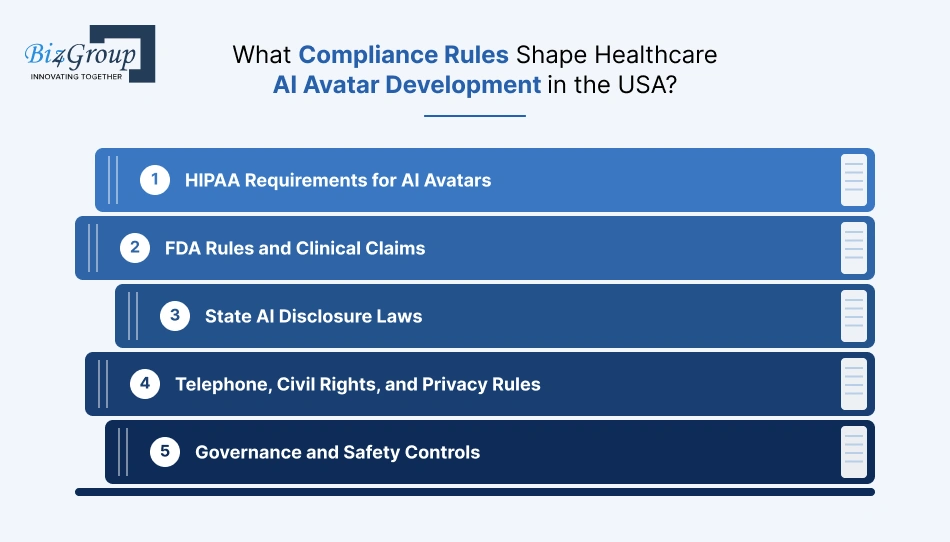
Five areas of rules shape healthcare AI avatar development in the USA: HIPAA for patient data, FDA rules for clinical claims, state AI disclosure laws, telephone and civil rights rules, and your own AI governance. Which ones apply depends on what your avatar does, not how it looks.
We are a development team, not a law firm. This section reflects the rules as of October 2026, and your counsel should confirm each point before launch.
Is an AI healthcare avatar HIPAA compliant by default? No. No government body certifies software as HIPAA compliant. Compliance comes from how the avatar is built, which vendors touch patient data, and how your organization runs it.
Here is the quick reference:
|
Rule area |
Applies when |
Your main duty |
Avatar watch-out |
|---|---|---|---|
|
HIPAA |
The avatar handles protected health information (PHI) |
Sign BAAs, assess risk, control access, log activity |
PHI in prompts, transcripts, and call recordings |
|
FDA |
The avatar’s intended use is to diagnose, treat, or drive clinical decisions |
Classify each feature before design |
Symptom interpretation and triage |
|
State AI laws |
Your patients live in states such as California or Texas |
Disclose AI and offer a route to a person |
Video, voice, and chat each have a different disclosure format |
|
TCPA and Section 1557 |
The avatar places calls in an AI voice, or supports clinical decisions |
Get consent and check tools for bias |
Reminder calls and triage inputs such as age or disability |
|
Privacy and biometric laws |
Data falls outside HIPAA, or you use face or voice prints |
Get consent and publish notices |
Wellness avatars and voice identification |
1. HIPAA Requirements for AI Avatars
Any vendor that touches PHI for you is a business associate. You need a signed business associate agreement (BAA) before patient data flows. That covers the whole chain behind your avatar: the language model, speech services, avatar rendering, and hosting.
A BAA with one vendor does not cover its subcontractors. Ask for the full chain in writing.
Four duties matter most for an AI healthcare avatar:
- Limit PHI: Send the model only what the task needs and redact the rest.
- Control logs: Transcripts, voice recordings, and video logs can all be PHI. Set retention limits.
- Assess risk: Run a risk analysis before launch and after major changes.
- Plan for breaches: Notify affected patients without unreasonable delay, and no later than 60 days after discovery.
The risk analysis is where regulators are looking. In April 2026, OCR announced four ransomware settlements, and each cited a failure to conduct a thorough risk analysis. They brought completed Risk Analysis Initiative investigations to 13.
The cost of getting it wrong also rose this year. In its January 28, 2026 inflation adjustment, HHS set HIPAA maximums at $73,011 per violation in the lower tiers and $2,190,294 for willful neglect that is not corrected.
A proposed overhaul of the HIPAA Security Rule is delayed. HHS has pushed final action to July 2027. The current rule stays fully enforceable, so build to the stricter direction now: encryption, multi-factor authentication, and documented risk management.
2. FDA Rules and Clinical Claims
FDA revised its clinical decision support guidance on January 6, 2026, and re-issued it on January 29. The update covers software for healthcare professionals. It did not announce new policy for patient-facing tools such as chatbots or symptom checkers.
So, for a patient-facing AI-powered healthcare avatar, intended use drives the answer:
|
Lower-risk lane |
Higher-risk lane |
|---|---|
|
Prep instructions, scheduling, reminders, directions, and education from approved content |
Interpreting symptoms, suggesting diagnoses, recommending treatment, and triage that sets care urgency |
Teams doing AI medical avatar development should classify each feature before design starts. We do this on every build. Each feature is sorted into wellness support or regulated functionality up front, so a first product avoids a rebuild later.
3. State AI Disclosure Laws
State rules differ and keep changing. A December 11, 2025 executive order directs the Justice Department to challenge state AI laws, but it does not cancel them. State laws stay enforceable unless they are changed, repealed, or struck down.
|
State law |
What it requires |
What it means for an avatar |
|---|---|---|
|
California AB 3030 (in effect since January 1, 2025) |
An AI disclaimer and a way to reach a human on generative AI communications about clinical information. Exempt if a licensed provider reviews the message first. Does not cover administrative matters such as appointments. |
Video: disclaimer displayed throughout. Audio: spoken at the start and end. Chat: shown throughout. |
|
Texas TRAIGA (effective January 1, 2026) |
Providers give conspicuous written disclosure when AI is used in diagnosis or treatment, before or at the interaction. Narrow emergency exception. |
Put the notice in intake and on the avatar’s opening screen. |
|
Utah HB 452 |
Mental health chatbots must disclose that they are AI. |
Disclose on the first screen. |
|
Illinois and Nevada |
Restrict AI from providing independent therapy. |
Never position an avatar as a therapist there. |
These duties sit with your organization, not your developer. So your avatar has to make compliance easy.
Build to the strictest rule once, and use it everywhere:
- Say it is AI in the first message and on the first screen.
- Keep the label visible during video and say it at the start and end of any voice call.
- Show a one-tap route to a person on every screen.
4. Telephone, Civil Rights, and Privacy Rules
Four more rules can apply:
- Calls in an AI voice: The FCC ruled in February 2024 that AI-generated voices count as artificial voices under the TCPA. If your avatar makes outbound calls, get consent first. Ask counsel how your appointment-reminder exemptions apply.
- Clinical decision tools: Section 1557’s rule on patient care decision support tools took effect in May 2025. If your triage logic uses inputs such as age or disability, document how you check for bias. The 2024 rule has faced court challenges, so confirm what is enforced today.
- Data outside HIPAA: Wellness avatars can collect consumer health data that HIPAA does not cover. State laws such as Washington’s My Health My Data Act can apply.
- Face and voice prints: If the avatar identifies patients by voice or face, biometric laws such as Illinois BIPA can apply.
5. Governance and Safety Controls
How to build an AI avatar for healthcare that passes a compliance review? Start with these controls:
|
Control |
What it prevents |
|---|---|
|
Answers only from a clinician-reviewed content library |
Invented medical advice |
|
Plain AI disclosure and a one-tap human handoff |
Legal exposure and lost trust |
|
Red-flag escalation (chest pain, thoughts of self-harm) |
Missed emergencies |
|
Audit logs for every response |
Disputes you cannot reconstruct |
|
Re-testing after every model update |
Quiet drops in accuracy |
|
Bias review with a named sign-off owner |
Unequal answers by language or age |
|
Written consent for any clinician’s face or voice |
Likeness disputes |
|
Captions, screen reader support, and multiple languages |
Excluding the patients who need help most |
Vendor Questions Before You Sign
When you assess any healthcare AI avatar development company, ask for written answers to these:
- Will you sign a BAA before any PHI is shared?
- Which subprocessors and model providers touch PHI, and does each have a BAA?
- Where do prompts, transcripts, and recordings live, and for how long?
- Does patient data ever train a model?
- How do you classify each feature for FDA purposes?
- How do you re-test after each model update?
Treat “HIPAA compliant” on a website as a marketing claim, not a certificate.
How We Build for Compliance
As a HIPAA-compliant AI healthcare platform development company, we treat compliance as architecture, not a final review. On every build:
- We sign a BAA before any PHI is shared, and we require BAAs from the cloud and AI providers that touch that data.
- We limit the PHI that reaches a model, use de-identified data where the task allows, and log every request for audit.
- We connect to your EHR through standard FHIR interfaces.
- We document model validation, bias review, and human sign-off rules for every AI output.
Your team still owns the parts only you can do: risk analysis, policies, and staff training. We work with your compliance team on each.
Compliance shapes the budget more than most teams expect, so cost is next.
Confident About Compliance or Hoping for the Best?
Healthcare regulations are strict, and digital systems must keep up. The right development partner builds innovation without risk.
Talk to Biz4Group’s ExpertsHow Much Does It Cost to Build AI Avatars for Healthcare Organizations?
Healthcare digital avatar development typically costs $35,000 to $300,000+. A focused pilot sits near the low end. A multi-department rollout with deep EHR integration sits at the top. Your final figure will differ based on avatar realism, the number of use cases, integrations, languages, and compliance scope.
How much does it cost to build an AI avatar for healthcare? The honest answer is a range, because no two organizations buy the same thing. A clinic that wants a pre-visit guide for one service line has a different budget than a hospital network that wants healthcare AI avatar solutions for clinics and hospitals across departments.
Cost of AI Avatar Development for Healthcare by Project Level
- Starter pilot ($35,000 to $75,000): one use case, a stylized avatar, and one integration. This is a good way to test AI avatar development for patient engagement on a single service line.
- Mid-level build ($75,000 to $150,000): several use cases, multilingual voice, EHR write-back, and analytics.
- Enterprise rollout ($150,000 to $300,000+): multiple departments or sites, a photorealistic avatar, deep integrations, and formal AI governance.
Independent analyses of HIPAA-compliant voice agents show a similar ladder. They list pilots at $40,000 to $60,000 and a full clinical documentation assistant at $120,000 to $150,000+.
Healthcare AI Avatar Development Cost by Feature
Here is where the money goes in a custom build. You will rarely pay the top of every row.
|
Feature |
What it covers |
Estimated cost |
|---|---|---|
|
Discovery and conversation design |
Use case selection, patient journeys, dialogue flows, escalation rules |
$2,000 to $10,000 |
|
Avatar design and rendering |
Stylized 2D to photorealistic 3D, lip sync, gestures, brand persona |
$2,000 to $30,000 |
|
Conversational AI and approved knowledge base |
Language model with retrieval over clinician-reviewed content, guardrails, intent handling |
$5,000 to $40,000 |
|
Voice and multilingual support |
Speech recognition, text to speech, language packs, latency tuning |
$2,000 to $20,000 |
|
Identity verification and consent capture |
Secure login or OTP, consent workflows, role-based responses |
$2,000 to $10,000 |
|
EHR, scheduling, and CRM integration |
FHIR and HL7 connections, priced per system |
$4,000 to $50,000 |
|
Security, HIPAA safeguards, and data retention |
Encryption, access control, audit logs, PHI redaction, retention rules |
$12,000 to $80,000 |
|
Human handoff and escalation |
Routing to staff, urgent-keyword triggers, handoff summaries |
$2,000 to $10,000 |
|
Analytics and admin panel |
Usage and drop-off reports, content management, role controls |
$2,000 to $20,000 |
|
Testing, clinical validation, and launch |
Accuracy testing, bias review, pilot, go-live support |
$2,000 to $30,000 |
|
Total build |
All low ends added together, and all high ends added together |
$35,000 to $300,000 |
The low ends add up to $35,000. The high ends add up to $300,000. Projects with more sites, more systems, or deeper customization go past that, which is why we write the range as $35,000 to $300,000+.
Security and compliance is the largest single line at every level. It takes about a third of a starter budget and about a quarter of a full rollout, because the other lines grow faster as scope expands. Independent analyses of HIPAA-compliant voice agents put compliance infrastructure alone at 30% to 40% of build cost.
Integration has the widest range after security. How to integrate AI avatars with healthcare systems is priced per system, and access depends on each vendor’s approval process. Cost grows with every EHR, scheduling tool, or CRM you connect.
Clinical content validation is also a real line item in AI medical avatar development. Clinicians have to approve what the avatar says before it says it.
Factors That Affect AI Healthcare Avatar Development Cost
Eight factors move the price of AI avatar development for healthcare up or down:
- Avatar realism: a stylized 2D guide costs far less than a photorealistic 3D digital human. If you want a clinician’s own face and voice, add capture, consent, and quality review.
- Live or pre-rendered: real-time conversation is billed per streamed minute. Pre-rendered avatar videos for fixed content, such as prep instructions, cost less to run.
- Use cases and departments: each workflow needs its own dialogue design, approved content, and testing.
- Languages: every added language needs voice quality checks and clinical review of translated content.
- Integrations: each EHR, scheduling tool, or CRM adds build time and approval steps.
- Compliance scope: an avatar that discusses clinical information carries more disclosure, logging, and review duties than one that only books appointments.
- Channels: web, mobile app, kiosk, and phone each need their own testing.
- Clinician review time: your team’s hours are part of the real project cost.
Hidden Costs in AI Avatar Development for Healthcare
These costs rarely appear in a first quote for healthcare AI avatar development:
- Monthly operations: independent analyses put running costs for HIPAA-compliant voice agents at $2,000 to $15,000 a month, rising with volume. An avatar adds streaming on top.
- Streaming minutes: one real-time avatar platform publishes 2026 rates from about $0.04 a minute at enterprise volume to $0.16 a minute on its starter plan. At 10,000 streamed minutes a month, that is roughly $400 to $1,600. An avatar left idle on screen still bills.
- What the price includes: some platforms bundle speech, the language model, and voice into the per-minute rate. Others render only the face, and you pay for the rest separately.
- Model and infrastructure spend: about 5,000 guarded AI runs a month commonly cost $2,500 to $6,000 in model spend. Storage, logging, and knowledge-base infrastructure can add 30% to 80% more.
- Re-testing: every model update needs testing before and after release.
- Content upkeep: approved content needs clinician review whenever protocols change.
- Security and legal work: yearly risk analysis, security testing, and counsel review of disclosures and consents.
- Integration upkeep: EHR API changes and vendor access fees can appear after launch.
- Staff training: your team needs to know when the avatar hands a patient to them.
Ways to Optimize Healthcare AI Avatar Development Cost
How to build an AI avatar for healthcare without overspending comes down to sequencing:
- Start with one high-volume, low-risk workflow, such as prep questions or scheduling.
- Begin with a stylized avatar, and upgrade realism once usage data shows it pays off.
- Pre-render content that never changes, and stream only live conversations.
- Buy the face and build the clinical layer. A hybrid keeps rendering costs low while you control content, logging, and handoff.
- Phase integrations: read-only first, write-back after the pilot proves value.
- Set session limits and close idle sessions to control per-minute spend.
- Reuse what you already have: approved patient instructions, FAQs, and consent forms.
- Negotiate volume rates after you know your real minutes.
- Protect the compliance layer. Cutting it to save budget only moves the cost to the risk side.
Buy vs Build for AI-Powered Healthcare Avatar Development
Buy means licensing a platform that renders and streams an avatar. Build means a custom AI-powered healthcare avatar system around your workflows, data, and rules.
|
Factor |
Buy (platform or vendor) |
Build (custom) |
|---|---|---|
|
Upfront cost |
Low. Subscription or per-minute pricing, with small plans starting near $12 a month |
$35,000 to $300,000+ |
|
Time to launch |
Weeks |
About 2 to 7+ months in independent 2026 benchmarks, longer with deep EHR work |
|
Customization |
Limited to the vendor’s templates and personas |
Full control of persona, workflows, and clinical rules |
|
EHR integration |
Standard connectors only. Custom logic is often unsupported |
Built around your EHR, scheduling, and exception rules |
|
Compliance control |
Depends on the vendor’s BAA, retention defaults, and plan tier |
You set retention, logging, and governance |
|
Running cost |
Per-minute and per-seat fees that grow with usage |
Infrastructure, model, and maintenance costs |
|
Lock-in |
Higher. Your content and persona live on the vendor’s platform |
Lower. You own the code and data |
|
Best for |
Standard FAQ, scheduling, or education at low volume |
Complex workflows, multiple systems, strict governance |
Before you buy, confirm the BAA. HIPAA availability can depend on the plan tier, and no PHI should flow until the agreement is signed.
For many providers, the right answer is hybrid. License the streaming and rendering layer, and build the clinical logic, content controls, integrations, and logging yourself. As a healthcare AI avatar development company, we scope that split during discovery, so you pay for custom work only where it matters.
We also plan in stages with defined deliverables, reviews, and checkpoints. That surfaces scope and integration issues while changes are still inexpensive.
Cost is only half the picture. Next, we look at how to measure what you get back.
Speaking of returns...
How Do You Measure ROI From AI Avatar Development for Patient Engagement?
Cost answers the “how much.” ROI answers the question that actually matters. Was it worth it?
Healthcare leaders investing in healthcare AI avatar development want clarity, not assumptions. ROI comes from a combination of cost savings, productivity gains, and revenue impact over time.
Let’s break this down in a way that makes sense for decision-makers.
Where ROI Comes from in Healthcare AI Avatar Development
ROI does not appear from one source. It compounds across operations. Here are the primary contributors.
1. Administrative Cost Reduction
AI avatars absorb a large volume of repetitive interactions. Common areas of savings include appointment scheduling, FAQs and basic patient guidance, and follow-up reminders.
For many clinics, this translates into:
- Lower call center load
- Reduced overtime
- Better staff utilization
Even a modest reduction in manual handling can free thousands of dollars annually.
2. Productivity Gains for Clinical and Non-Clinical Teams
Time saved is value created. When teams spend less time on routine questions, they can focus on:
- Patient care
- Case resolution
- High-touch interactions
Healthcare AI avatar development services often deliver productivity gains in the range of 20%-40% across front-office and support functions, depending on usage volume and workflow coverage.
3. Revenue Enablement Opportunities
AI avatars do more than save money. They help generate it. Revenue impact often comes from:
- Higher appointment booking rates
- Reduced no-shows
- Better follow-up adherence
- Promotion of wellness programs or memberships
For organizations offering paid services, these gains directly increase patient lifetime value.
Key Metrics to Track ROI
Measuring ROI requires tracking the right indicators. Below are metrics healthcare organizations commonly monitor after implementing healthcare AI avatar solutions for clinics and hospitals.
|
Metric |
What It Measures |
Why It Matters |
|---|---|---|
|
Cost Per Interaction |
Expense per patient interaction |
Shows efficiency gains |
|
Staff Hours Saved |
Time shifted from manual tasks |
Indicates productivity impact |
|
Appointment Conversion Rate |
Visits booked per interaction |
Reflects revenue influence |
|
No-Show Reduction |
Missed visits avoided |
Prevents revenue loss |
|
Patient Engagement Rate |
Interaction completion and return usage |
Signals adoption success |
|
Average Response Time |
Speed of patient assistance |
Impacts satisfaction |
Tracking these monthly provides a clear performance picture.
A Simple ROI Calculation Framework
Here is a straightforward way to estimate ROI.
- Calculate annual savings from reduced staff workload
- Add incremental revenue from improved bookings or services
- Subtract total development and maintenance costs
ROI Formula:
ROI (%) = [(Annual Financial Gains - Total Investment) / Total Investment] x 100
Many healthcare organizations begin seeing positive ROI within 6-12 months when deployment is aligned with high-volume workflows.
ROI from healthcare AI avatar development is measurable, repeatable, and scalable. When implemented with clear objectives and tracked against the right metrics, these systems move beyond efficiency gains and become growth enablers.
If It Pays for Itself in 6–12 Months, Why Wait?
Reduced workload, higher conversions, better engagement. The numbers make sense. The only question is timing.
Let’s Talk NumbersHow Do You Measure ROI From AI Avatar Development for Patient Engagement and How to Solve them?
Healthcare AI avatar development delivers strong upside, but only when executed thoughtfully. Many projects struggle not because the idea is flawed, but because common risks are underestimated early.
Below are the most frequent challenges organizations face, along with practical ways to mitigate them before they escalate.
Challenge 1: Overestimating What the Avatar Should Handle
One of the earliest mistakes is expecting the avatar to solve everything.
Healthcare interactions vary widely in complexity, and forcing automation where human judgment is required leads to frustration.
How to mitigate
- Clearly define boundaries for automated interactions
- Build escalation paths to human staff
- Start with high-volume, low-risk workflows
Challenge 2: Low Patient Adoption and Trust Issues
Patients may hesitate to engage if the avatar feels confusing or impersonal. Trust is earned through clarity and consistency.
How to mitigate
- Use simple, transparent language
- Clearly disclose AI involvement
- Offer easy access to human assistance
Challenge 3: Poor Conversation Design
Even powerful AI fails when conversations are poorly structured. Long, rigid flows discourage engagement.
How to mitigate
- Design short, guided interaction paths
- Test conversations with real users
- Continuously refine based on feedback
Challenge 4: Data Quality and Context Gaps
AI systems rely on accurate, relevant data. Incomplete or outdated information leads to unreliable responses.
How to mitigate
- Audit data sources before launch
- Limit early interactions to validated data sets
- Monitor response accuracy continuously
Challenge 5: Scaling Too Quickly
Rushing to expand features can backfire. Unstable performance damages credibility.
How to mitigate
- Validate performance at smaller scale first
- Monitor usage patterns closely
- Expand features incrementally
Most challenges in healthcare AI avatar development are preventable. The difference between success and frustration lies in preparation, clarity, and iteration.
Why Choose Biz4Group as Your Healthcare AI Avatar Development Company?
Choosing a healthcare AI avatar development company is a trust decision before it is a technical one. You are handing a patient-facing system to a team, so you should see their track record, their people, and their safeguards before you sign.
Here is what you can check for yourself:
|
What to look for |
What you get with Biz4Group |
|---|---|
|
Healthcare AI depth |
20+ years in software, 100+ healthcare AI projects, and 300+ consultants, architects, and AI specialists |
|
Avatar track record |
Dr. Truman, a lifelike health companion avatar, and NextLPC, avatar-based AI therapy tutors for psychotherapy students |
|
Senior accountability |
Dave Caplis, Technical Director, leads architecture and delivery of our HIPAA-compliant AI platforms |
|
Compliance by design |
A signed BAA before any PHI is shared, FHIR-based EHR integration, and human sign-off rules for AI output |
|
Independent reviews |
4.9 out of 5 on Clutch, 4.8 out of 5 from 120+ Upwork reviews, and an 85% client retention rate |
|
Delivery model |
U.S. headquarters in Orlando, a dedicated project manager, and staged delivery with a review at every checkpoint |
Behind those numbers are people. Dave Caplis has 20+ years in technology. He specializes in EHR and EMR integration, clinical decision support, patient triage, and remote patient monitoring. Our founder and CEO, Sanjeev Verma, has been a featured author on Entrepreneur, IBM, and TechTarget.
Our avatar work shows up in real projects. For AI avatar development for patient engagement, we built Dr. Truman with natural expressions, gestures, lip sync, and secure health record uploads. For education, we built avatar-based therapy tutors that walk students through case studies.
Dr. Tiffinee Yancey, CEO of NextLPC, said: “Their excellent communication, timely delivery, innovative solutions, and genuine commitment to our project have made a significant impact.”
Whether you need healthcare digital avatar development or AI medical avatar development for clinical education, our services cover digital human design, 3D character modeling, and avatar personality and behavior engineering. That is how we answer how to develop digital human technology for healthcare: as a repeatable process, not a one-off experiment. How to integrate AI avatars with healthcare systems is part of every engagement, through FHIR-based connections to your EHR and scheduling tools.
We also start with consulting that reviews your workflows, data, and regulatory needs, then advises whether to build, buy, or extend. That is the same split we covered in the cost section.
Dave sums up what we aim to be: “Not a vendor with a polished demo. A team that has built this before and can build it again.”
If you are weighing AI avatars for healthcare in the USA, book a strategy session with our healthcare AI team. Bring your use case, and we will help you size it, scope it, and plan it.
Wrapping Up!
You must be asking, "is healthcare AI avatar development the right next move for your organization?”
It is, when you want faster, clearer help for patients on routine questions and you are ready to own the oversight that comes with it. Healthcare AI avatar development pays off for teams that treat it as a care-access project, not a technology purchase.
Is AI avatar development for healthcare right for you? Run this readiness check before you talk to anyone:
|
Readiness check |
Ready to start |
Not yet |
|---|---|---|
|
Approved content |
Clinician-reviewed answers exist for your top patient questions |
Answers live in scattered documents or old handouts |
|
System access |
You know which EHR, scheduling, and CRM data the avatar needs, and who approves access |
No one has asked your vendors about API access |
|
Ownership |
A clinical owner, a compliance owner, and an operations owner are named |
Nobody owns the outcome after launch |
|
Baseline |
You track call volume, wait times, and no-shows today |
You have no numbers to compare against |
If most of your answers sit in the middle column, you are ready to turn healthcare AI avatar solutions for clinics and hospitals from an idea into a scoped plan. If they sit on the right, close those gaps first. They are cheaper to fix before development than after launch, and they decide whether an AI healthcare avatar helps patients or just adds another screen.
The same check applies if you are weighing how to build an AI avatar for healthcare, comparing an AI-powered healthcare avatar with a plain chatbot, or planning AI avatar development for patient engagement across several departments. It also shapes how to integrate AI avatars with healthcare systems. The clearer your data access, the faster that work moves.
We built this guide from 2026 regulator guidance, current survey data, and our own delivery work, so you can plan with realistic expectations. Still unsure where you land? Tell our healthcare AI team about your use case, and we will give you a straight answer on fit, even if the answer is “not yet.”
As a healthcare AI avatar development company, we would rather scope the right project than the biggest one. Whether you need healthcare digital avatar development, AI medical avatar development for clinical education, or guidance on how to develop digital human technology for healthcare, the best AI avatars for healthcare in the USA start with an honest first conversation.
FAQ
1. How is an AI healthcare avatar different from a chatbot or voice agent?
A chatbot answers in text. A voice agent answers by voice, usually on the phone. An AI healthcare avatar adds a face, a voice, and expressions, so it suits moments where tone matters, such as pre-procedure education or a nervous first visit. A “digital human” is simply a highly realistic avatar.
|
Tool |
How patients reach it |
Best fit |
|---|---|---|
|
Chatbot |
Text on a website or app |
Quick FAQs and form help |
|
Voice agent |
Phone call, no face |
High call volume and after-hours calls |
|
AI avatar |
Face and voice on web, app, or kiosk |
Education, guidance, and anxiety-heavy moments |
Choose by channel and need, not novelty.
2. Are AI avatars for healthcare in the USA HIPAA compliant?
They can be, but none is compliant by default. The test is whether the avatar touches protected health information (PHI). If it only shares public details such as office hours, fewer HIPAA duties generally apply. Once it verifies a patient, reads a record, or stores a transcript, you need a BAA, access controls, and audit logs. Ask any healthcare AI avatar development company to show these in writing.
3. What happens if an AI-powered healthcare avatar gives a patient the wrong answer?
Plan for it before launch. Good AI avatar development for healthcare includes a written incident plan:
- Flag and log the response.
- Have a clinician review it.
- Contact the patient with the correct information.
- Fix the source content or guardrail, then re-test.
- Document what happened and what changed.
Legal responsibility for AI errors is still unsettled. Health law partner Meghan O’Connor told MedCity News in 2026 that disclaimers may not protect you if a tool is presented as giving diagnostic guidance.
4. How do you integrate AI avatars with healthcare systems like Epic?
Most integrations run through FHIR APIs, sometimes with HL7 messages for real-time schedule updates. Two details decide success. First, the avatar must confirm a slot is open before it books, which Epic requires. Second, changes must sync both ways, so avatar bookings appear on the clinic schedule and clinic-side changes reach the avatar.
Access also depends on each EHR vendor’s approval process and your own IT review. How to integrate AI avatars with healthcare systems is the work that can set your launch date, so start the access request during discovery.
5. How long does healthcare AI avatar development take?
A focused pilot can go live in about 2 to 10 weeks. A production rollout with deep EHR integration, security review, and several departments takes longer, so plan in months.
How to build an AI avatar for healthcare usually follows five phases:
- Discovery and scope
- Persona and conversation design
- Build and integration
- Testing with clinician review
- Pilot launch
The usual delays in healthcare digital avatar development are BAA signing, EHR access approvals, and clinician review of content.
6. Can we create an AI avatar that looks and sounds like one of our doctors?
Yes, technically. Consent is the hard part. The AMA’s 2026 policy recommendations say a physician’s name, image, voice, or digital replica should not be used in AI content without explicit, informed, opt-in consent. That consent should be:
- Separate from employment agreements
- Specific to AI use, including where and for how long
- Revocable if the doctor’s role changes
Also decide what happens when the doctor leaves, have the doctor review the scripts, and label the avatar as AI. This is a core question in AI medical avatar development and in how to develop digital human technology for healthcare.
7. Can an AI avatar support patients who speak other languages?
Yes, and it is one of the strongest cases for healthcare AI avatar solutions for clinics and hospitals. Quality still varies by language and dialect, so test before you promise coverage.
- Start with the two or three languages most common in your patient base.
- Have bilingual clinicians review medication and consent wording.
- Keep a path to a qualified interpreter.
Done this way, AI avatar development for patient engagement widens access instead of hiding gaps.
8. How much does healthcare digital avatar development cost, and why do quotes differ?
Most projects land between $35,000 and $300,000+. Quotes differ because vendors price different scopes under the same label. Before you compare two numbers, ask each vendor to confirm what is included:
- Compliance work, including BAAs, audit logging, and PHI controls
- The number of EHR and scheduling systems connected
- The languages supported and who reviews them
- Streaming minutes, speech, and language model fees
- Clinician content review hours
- Post-launch support and re-testing
An itemized quote that mirrors the feature table above makes two offers comparable. A low price that leaves these out usually returns as change requests later.